Sdim: A Qudit Stabilizer Simulator
Pith reviewed 2026-05-17 21:33 UTC · model grok-4.3
The pith
Sdim provides the first open-source stabilizer simulator that works for qudits in any dimension.
A machine-rendered reading of the paper's core claim, the machinery that carries it, and where it could break.
Core claim
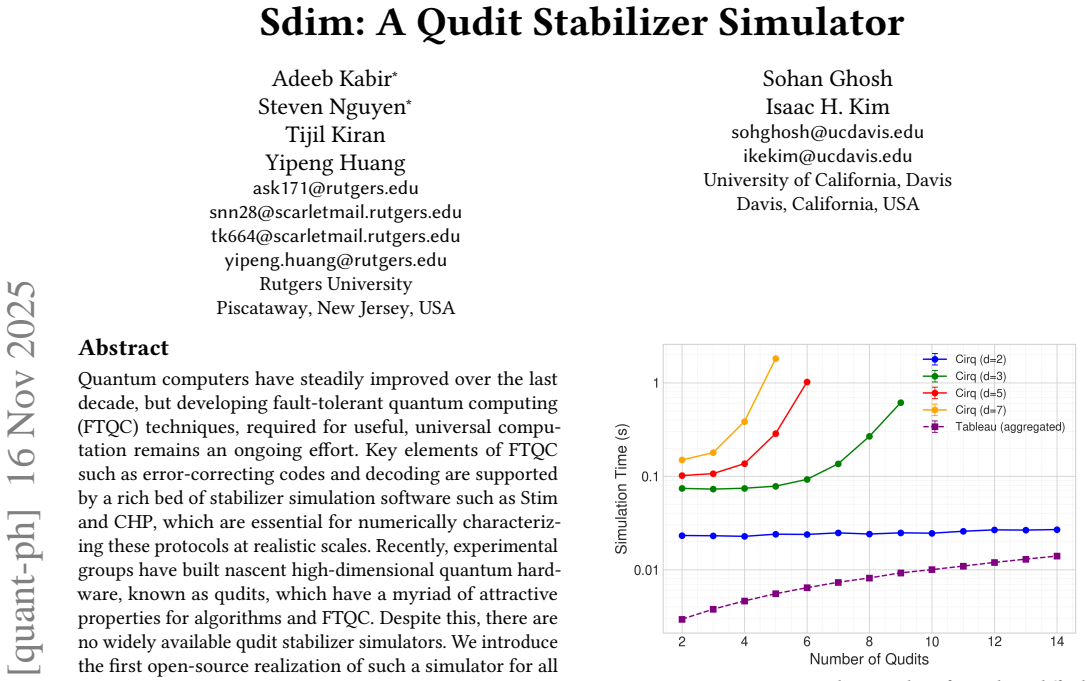
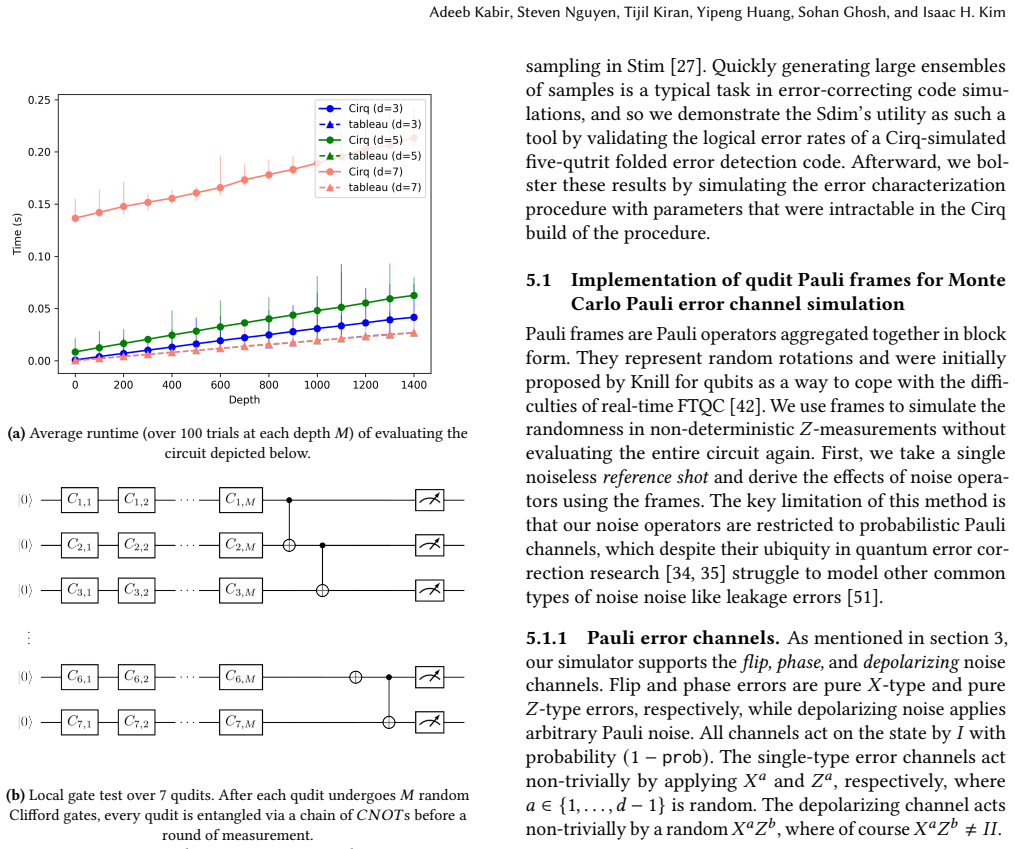
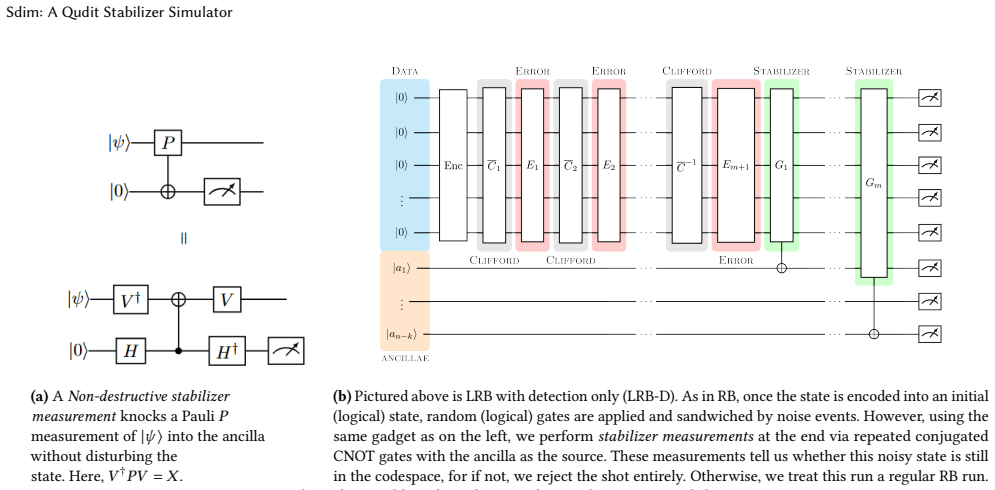
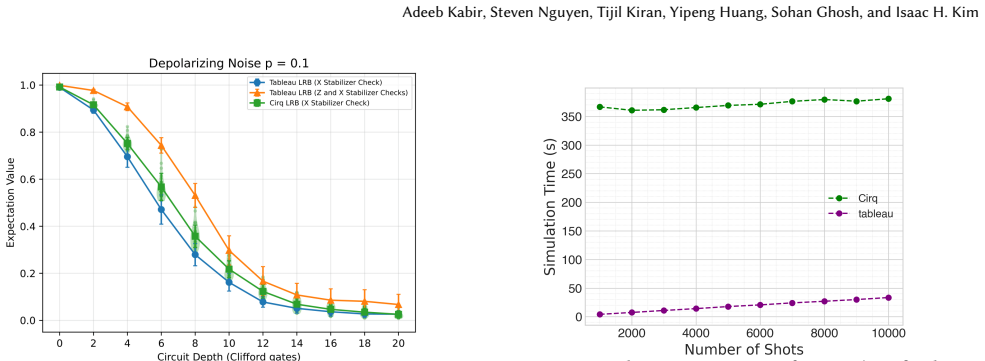
We introduce the first open-source realization of a qudit stabilizer simulator for all dimensions. We demonstrate its correctness against existing state vector simulations and benchmark its performance in evaluating and sampling quantum circuits. This simulator is the essential computational infrastructure to explore novel qudit error correction as earlier stabilizer simulators have been for qubits.
What carries the argument
Sdim, the open-source implementation of an efficient algorithm for tracking qudit stabilizer states across arbitrary dimensions.
If this is right
- Numerical studies of qudit error-correcting codes can now be performed at realistic scales.
- Sampling and evaluation of qudit stabilizer circuits becomes feasible without exponential cost in state space.
- Development of qudit-specific fault-tolerant protocols gains the same simulation support that qubits have had for years.
Where Pith is reading between the lines
- The same code base could be extended to simulate certain non-stabilizer operations on qudits if the underlying representation is kept.
- Direct performance comparisons between qubit and qudit stabilizer circuits on identical hardware models are now possible for the first time.
Load-bearing premise
The qudit stabilizer formalism admits an efficient simulation algorithm whose implementation matches the underlying physics for all tested dimensions and circuit sizes.
What would settle it
A systematic mismatch between Sdim outputs and independent state-vector results on any qudit circuit in dimension three or higher of moderate size would falsify the correctness claim.
Figures




read the original abstract
Quantum computers have steadily improved over the last decade, but developing fault-tolerant quantum computing (FTQC) techniques, required for useful, universal computation remains an ongoing effort. Key elements of FTQC such as error-correcting codes and decoding are supported by a rich bed of stabilizer simulation software such as Stim and CHP, which are essential for numerically characterizing these protocols at realistic scales. Recently, experimental groups have built nascent high-dimensional quantum hardware, known as qudits, which have a myriad of attractive properties for algorithms and FTQC. Despite this, there are no widely available qudit stabilizer simulators. We introduce the first open-source realization of such a simulator for all dimensions. We demonstrate its correctness against existing state vector simulations and benchmark its performance in evaluating and sampling quantum circuits. This simulator is the essential computational infrastructure to explore novel qudit error correction as earlier stabilizer simulators have been for qubits.
Editorial analysis
A structured set of objections, weighed in public.
Referee Report
Summary. The paper introduces Sdim, the first open-source qudit stabilizer simulator that operates for arbitrary dimensions. It asserts that correctness was established via direct comparison to state-vector evolution and reports performance benchmarks on sampling and circuit-evaluation tasks, framing the tool as essential infrastructure for exploring qudit error correction and fault-tolerant protocols.
Significance. If the claimed correctness and efficiency hold, the release supplies a missing computational resource that parallels the role of Stim and CHP for qubits, enabling scalable numerical studies of high-dimensional stabilizer codes and Clifford circuits. The open-source implementation together with the stated validation against state-vector methods constitutes a concrete, reproducible contribution that lowers the barrier for qudit FTQC research.
major comments (1)
- §4 (Verification): the manuscript states that correctness was checked by direct comparison to state-vector simulation, yet reports no quantitative agreement metrics (e.g., maximum absolute deviation in outcome probabilities, state fidelity, or tolerance threshold) nor the precise range of dimensions and circuit depths over which the comparison was performed. Because this comparison is the sole empirical support for the central claim that the implementation matches the underlying physics, the absence of these figures leaves the scope of validation unclear.
minor comments (2)
- Abstract: the claim of being the “first open-source realization” would be strengthened by a brief parenthetical note on the dimensions and circuit sizes actually tested, rather than leaving the scope entirely implicit.
- Performance section: the benchmark results are described qualitatively; inclusion of a table or log-log plot with explicit wall-clock times versus number of qudits and dimension would make the scaling claims easier to assess.
Simulated Author's Rebuttal
We thank the referee for their careful reading and for recommending minor revision. The single major comment concerns the level of detail in our verification section, which we address below.
read point-by-point responses
-
Referee: §4 (Verification): the manuscript states that correctness was checked by direct comparison to state-vector simulation, yet reports no quantitative agreement metrics (e.g., maximum absolute deviation in outcome probabilities, state fidelity, or tolerance threshold) nor the precise range of dimensions and circuit depths over which the comparison was performed. Because this comparison is the sole empirical support for the central claim that the implementation matches the underlying physics, the absence of these figures leaves the scope of validation unclear.
Authors: We agree that the verification section would benefit from explicit quantitative metrics and a clearer statement of the tested parameter ranges. In the revised manuscript we will expand §4 to report the following: maximum absolute deviation in outcome probabilities below 10^{-12}, average state fidelity exceeding 0.999999, and a numerical tolerance threshold of 10^{-10}. We will also state that comparisons were performed for dimensions d = 2 to d = 16 and for circuits containing up to several hundred Clifford gates. These figures were obtained during internal validation against a reference state-vector implementation and confirm agreement to within floating-point precision across the reported range. revision: yes
Circularity Check
No significant circularity identified
full rationale
The manuscript introduces an open-source software implementation of a qudit stabilizer simulator and validates it by direct comparison to independent state-vector simulations. No derivation chain, equations, or performance claims reduce by construction to internally fitted parameters or self-referential definitions. The central contribution is the release of the tool plus external benchmarking, which supplies independent verification rather than a closed loop. This is the expected non-finding for an engineering/software paper whose correctness rests on reproducible external checks.
Axiom & Free-Parameter Ledger
axioms (1)
- domain assumption Stabilizer formalism and its efficient simulation extend to prime-power and composite dimensions without loss of correctness
Forward citations
Cited by 1 Pith paper
-
Analytical and Compressed Simulation of Noisy Stabilizer Circuits
Closed-form expressions and circuit compression enable efficient strong and weak simulation of noisy stabilizer circuits with non-deterministic measurements.
Reference graph
Works this paper leans on
-
[1]
Scott Aaronson and Daniel Gottesman. 2004. Improved simulation of stabilizer circuits.Physical Review A70, 5 (Nov. 2004). doi:10.1103/ physreva.70.052328
work page 2004
-
[2]
Rajeev Acharya, Laleh Aghababaie-Beni, Igor Aleiner, Trond I. An- dersen, Markus Ansmann, Frank Arute, Kunal Arya, Abraham As- faw, Nikita Astrakhantsev, Juan Atalaya, Ryan Babbush, Dave Bacon, Brian Ballard, Joseph C. Bardin, Johannes Bausch, Andreas Bengtsson, Alexander Bilmes, Sam Blackwell, Sergio Boixo, Gina Bortoli, Alexan- dre Bourassa, Jenna Bovai...
-
[3]
Frank Arute, Kunal Arya, Ryan Babbush, Dave Bacon, Joseph C. Bardin, Rami Barends, Rupak Biswas, Sergio Boixo, Fernando G. S. L. Bran- dao, David A. Buell, Brian Burkett, Yu Chen, Zijun Chen, Ben Chiaro, Roberto Collins, William Courtney, Andrew Dunsworth, Edward Farhi, Brooks Foxen, Austin Fowler, Craig Gidney, Marissa Giustina, Rob Graff, Keith Guerin, ...
-
[4]
Baker, Casey Duckering, and Frederic T
Jonathan M. Baker, Casey Duckering, and Frederic T. Chong. 2020. Efficient Quantum Circuit Decompositions via Intermediate Qudits. In2020 IEEE 50th International Symposium on Multiple-Valued Logic (ISMVL). 303–308. doi:10.1109/ISMVL49045.2020.9345604
-
[5]
Baker, Casey Duckering, Pranav Gokhale, Natalie C
Jonathan M. Baker, Casey Duckering, Pranav Gokhale, Natalie C. Brown, Kenneth R. Brown, and Frederic T. Chong. 2020. Improved Quantum Circuits via Intermediate Qutrits.ACM Transactions on Quantum Computing1, 1, Article 2 (oct 2020), 25 pages. doi:10.1145/ 3406309
work page 2020
-
[6]
Ethan Bernstein and Umesh Vazirani. 1997. Quantum Complexity Theory.SIAM J. Comput.26, 5 (1997), 1411–
work page 1997
-
[7]
arXiv:https://doi.org/10.1137/S0097539796300921 doi:10.1137/S0097539796300921
-
[8]
M. S. Blok, V. V. Ramasesh, T. Schuster, K. OâĂŹBrien, J. M. Kreike- baum, D. Dahlen, A. Morvan, B. Yoshida, N. Y. Yao, and I. Siddiqi
-
[9]
Quantum Information Scrambling on a Superconducting Qutrit Processor.Physical Review X11, 2 (April 2021). doi:10.1103/physrevx. 11.021010
-
[10]
Earl T. Campbell. 2014. Enhanced Fault-Tolerant Quantum Computing in 𝑑-Level Systems.Phys. Rev. Lett.113 (Dec 2014), 230501. Issue 23. doi:10.1103/PhysRevLett.113.230501
-
[11]
Roads towards fault- tolerant universal quantum computation
Earl T. Campbell, Barbara M. Terhal, and Christophe Vuillot. 2017. Roads towards fault-tolerant universal quantum computation.Nature 549, 7671 (2017), 172–179. doi:10.1038/nature23460
-
[12]
Shuxiang Cao, Mustafa Bakr, Giulio Campanaro, Simone D Fasciati, James Wills, Deep Lall, Boris Shteynas, Vivek Chidambaram, Ivan Rungger, and Peter Leek. 2024. Emulating two qubits with a four-level transmon qudit for variational quantum algorithms.Quantum Science and Technology9, 3 (apr 2024), 035003. doi:10.1088/2058-9565/ad37d4
-
[13]
Turbasu Chatterjee, Arnav Das, Subhayu Kumar Bala, Amit Saha, Anupam Chattopadhyay, and Amlan Chakrabarti. 2023. QuDiet: A classical simulation platform for qubitâĂŘqudit hybrid quantum sys- tems.IET Quantum Communication4, 4 (March 2023), 167âĂŞ180. doi:10.1049/qtc2.12058 13 Adeeb Kabir, Steven Nguyen, Tijil Kiran, Yipeng Huang, Sohan Ghosh, and Isaac H. Kim
-
[14]
Yulin Chi, Jieshan Huang, Zhanchuan Zhang, Jun Mao, Zinan Zhou, Xi- aojiong Chen, Chonghao Zhai, Jueming Bao, Tianxiang Dai, Huihong Yuan, Ming Zhang, Daoxin Dai, Bo Tang, Yan Yang, Zhihua Li, Yun- hong Ding, Leif K. Oxenløwe, Mark G. Thompson, Jeremy L. O’Brien, Yan Li, Qihuang Gong, and Jianwei Wang. 2022. A programmable qudit-based quantum processor.Na...
work page 2022
-
[15]
doi:10.1038/s41467-022-28767-x
-
[16]
Joshua Combes, Christopher Granade, Christopher Ferrie, and Steven T. Flammia. 2017. Logical Randomized Benchmarking. arXiv:1702.03688 [quant-ph]https://arxiv.org/abs/1702.03688
work page internal anchor Pith review Pith/arXiv arXiv 2017
-
[17]
Christoph Dankert, Richard Cleve, Joseph Emerson, and Etera Livine
-
[18]
doi:10.1103/ physreva.80.012304
Exact and approximate unitary 2-designs and their application to fidelity estimation.Physical Review A80, 1 (July 2009). doi:10.1103/ physreva.80.012304
work page 2009
-
[19]
Niel de Beaudrap. 2013. A linearized stabilizer formalism for systems of finite dimension.Quantum Information and Computation13, 1,2 (Jan. 2013), 73âĂŞ115. doi:10.26421/qic13.1-2-6
- [20]
- [21]
-
[22]
Yannick Deller, Sebastian Schmitt, Maciej Lewenstein, Steve Lenk, Marika Federer, Fred Jendrzejewski, Philipp Hauke, and Valentin Kasper. 2023. Quantum approximate optimization algorithm for qudit systems.Phys. Rev. A107 (Jun 2023), 062410. Issue 6. doi:10.1103/ PhysRevA.107.062410
work page 2023
-
[23]
Eric Dennis, Alexei Kitaev, Andrew Landahl, and John Preskill
-
[24]
Topological quantum memory.J. Math. Phys.43, 9 (09 2002), 4452–4505. arXiv:https://pubs.aip.org/aip/jmp/article- pdf/43/9/4452/19183135/4452_1_online.pdf doi:10.1063/1.1499754
-
[25]
Advait Deshpande. 2022. Assessing the quantum-computing landscape. Commun. ACM65, 10 (Sept. 2022), 57âĂŞ65. doi:10.1145/3524109
-
[26]
Simon J Devitt, William J Munro, and Kae Nemoto. 2013. Quantum error correction for beginners.Reports on Progress in Physics76, 7 (jun 2013), 076001. doi:10.1088/0034-4885/76/7/076001
-
[27]
Yongshan Ding, Adam Holmes, Ali Javadi-Abhari, Diana Franklin, Mar- garet Martonosi, and Frederic T. Chong. 2018. Magic-state functional units: mapping and scheduling multi-level distillation circuits for fault-tolerant quantum architectures. InProceedings of the 51st Annual IEEE/ACM International Symposium on Microarchitecture(Fukuoka, Japan)(MICRO-51). ...
-
[28]
Cerf, Nicolas Gisin, and Marek Żukowski
Thomas Durt, Nicolas J. Cerf, Nicolas Gisin, and Marek Żukowski. 2003. Security of quantum key distribution with entangled qutrits.Phys. Rev. A67 (Jan 2003), 012311. Issue 1. doi:10.1103/PhysRevA.67.012311
-
[29]
Chris Edwards. 2022. Error Control Begins to Shape Quantum Ar- chitectures.Commun. ACM66, 1 (Dec. 2022), 13âĂŞ15. doi:10.1145/ 3570518
work page 2022
-
[30]
Yale Fan. 2007. A Generalization of the Deutsch-Jozsa Algorithm to Multi-Valued Quantum Logic . In37th International Symposium on Multiple-Valued Logic (ISMVL’07). IEEE Computer Society, Los Alami- tos, CA, USA, 12. doi:10.1109/ISMVL.2007.3
-
[31]
A. Fedorov, L. Steffen, M. Baur, M. P. da Silva, and A. Wallraff. 2012. Implementation of a Toffoli gate with superconducting circuits.Nature 481, 7380 (2012), 170–172. doi:10.1038/nature10713
-
[32]
Craig Gidney. 2021. Stim: a fast stabilizer circuit simulator.Quantum 5 (July 2021), 497. doi:10.22331/q-2021-07-06-497
-
[33]
Baker, Casey Duckering, Natalie C
Pranav Gokhale, Jonathan M. Baker, Casey Duckering, Natalie C. Brown, Kenneth R. Brown, and Frederic T. Chong. 2019. Asymp- totic improvements to quantum circuits via qutrits. InProceedings of the 46th International Symposium on Computer Architecture(Phoenix, Arizona)(ISCA ’19). Association for Computing Machinery, New York, NY, USA, 554âĂŞ566. doi:10.114...
-
[34]
Noah Goss, Alexis Morvan, Brian Marinelli, Bradley K. Mitchell, Long B. Nguyen, Ravi K. Naik, Larry Chen, Christian Jünger, John Mark Kreikebaum, David I. Santiago, Joel J. Wallman, and Irfan Siddiqi. 2022. High-fidelity qutrit entangling gates for superconducting circuits.Na- ture Communications13, 1 (2022), 7481. doi:10.1038/s41467-022-34851- z
-
[35]
Daniel Gottesman. 1998. The Heisenberg Representation of Quantum Computers. arXiv:quant-ph/9807006 [quant-ph]https://arxiv.org/abs/ quant-ph/9807006
work page internal anchor Pith review Pith/arXiv arXiv 1998
-
[36]
Daniel Gottesman. 1998. Theory of fault-tolerant quantum compu- tation.Physical Review A57, 1 (Jan. 1998), 127âĂŞ137. doi:10.1103/ physreva.57.127
work page 1998
-
[37]
Daniel Gottesman. 1999. Fault-Tolerant Quantum Computation with Higher-Dimensional Systems. InQuantum Computing and Quantum Communications, Colin P. Williams (Ed.). Springer Berlin Heidelberg, Berlin, Heidelberg, 302–313
work page 1999
-
[38]
Daniel Gottesman. 2024. Surviving as a Quantum Computer in a Classical World. URL:https://www.cs.umd.edu/class/spring2024/ cmsc858G/. Last visited on 2024/10/28
work page 2024
-
[39]
Mauricio Gutiérrez and Kenneth R. Brown. 2015. Comparison of a quantum error-correction threshold for exact and approximate errors. Phys. Rev. A91 (Feb 2015), 022335. Issue 2. doi:10.1103/PhysRevA.91. 022335
-
[40]
Mauricio Gutiérrez, Lukas Svec, Alexander Vargo, and Kenneth R. Brown. 2013. Approximation of realistic errors by Clifford channels and Pauli measurements.Phys. Rev. A87 (Mar 2013), 030302. Issue 3. doi:10.1103/PhysRevA.87.030302
-
[41]
Charles R. Harris, K. Jarrod Millman, Stéfan J. van der Walt, Ralf Gommers, Pauli Virtanen, David Cournapeau, Eric Wieser, Julian Taylor, Sebastian Berg, Nathaniel J. Smith, Robert Kern, Matti Picus, Stephan Hoyer, Marten H. van Kerkwijk, Matthew Brett, Allan Hal- dane, Jaime Fernández del Río, Mark Wiebe, Pearu Peterson, Pierre Gérard-Marchant, Kevin She...
-
[42]
Torsten Hoefler, Thomas Häner, and Matthias Troyer. 2023. Disen- tangling Hype from Practicality: On Realistically Achieving Quantum Advantage.Commun. ACM66, 5 (April 2023), 82âĂŞ87. doi:10.1145/ 3571725
work page 2023
-
[43]
van Mourik, Marcus Huber, Rainer Blatt, Philipp Schindler, Thomas Monz, and Martin Ringbauer
Pavel Hrmo, Benjamin Wilhelm, Lukas Gerster, Martin W. van Mourik, Marcus Huber, Rainer Blatt, Philipp Schindler, Thomas Monz, and Martin Ringbauer. 2023. Native qudit entanglement in a trapped ion quantum processor.Nature Communications14, 1 (2023), 2242. doi:10.1038/s41467-023-37375-2
-
[44]
Fei Hua, Yanhao Chen, Yuwei Jin, Chi Zhang, Ari Hayes, Youtao Zhang, and Eddy Z. Zhang. 2021. AutoBraid: A Framework for En- abling Efficient Surface Code Communication in Quantum Comput- ing. InMICRO-54: 54th Annual IEEE/ACM International Symposium on Microarchitecture(Virtual Event, Greece)(MICRO ’21). Associ- ation for Computing Machinery, New York, NY...
-
[45]
Brown, Margaret Martonosi, and Frederic T
Ali Javadi-Abhari, Pranav Gokhale, Adam Holmes, Diana Franklin, Kenneth R. Brown, Margaret Martonosi, and Frederic T. Chong. 2017. Optimized surface code communication in superconducting quantum computers. InProceedings of the 50th Annual IEEE/ACM International Symposium on Microarchitecture(Cambridge, Massachusetts)(MICRO- 50 ’17). Association for Comput...
- [46]
-
[47]
E. Knill. 2005. Quantum computing with realistically noisy devices. Nature434, 7029 (March 2005), 39âĂŞ44. doi:10.1038/nature03350
-
[48]
Randomized benchmarking of quantum gates,
E. Knill, D. Leibfried, R. Reichle, J. Britton, R. B. Blakestad, J. D. Jost, C. Langer, R. Ozeri, S. Seidelin, and D. J. Wineland. 2008. Randomized benchmarking of quantum gates.Physical Review A77, 1 (Jan. 2008). doi:10.1103/physreva.77.012307
- [49]
-
[51]
Andrew Litteken, Jonathan M. Baker, and Frederic T. Chong. 2022. Communication Trade Offs in Intermediate Qudit Circuits. In2022 IEEE 52nd International Symposium on Multiple-Valued Logic (ISMVL). 43–49. doi:10.1109/ISMVL52857.2022.00014
-
[52]
Chadwick, Na- talia Nottingham, Tanay Roy, Ziqian Li, David Schuster, Frederic T
Andrew Litteken, Lennart Maximilian Seifert, Jason D. Chadwick, Na- talia Nottingham, Tanay Roy, Ziqian Li, David Schuster, Frederic T. Chong, and Jonathan M. Baker. 2023. Dancing the Quantum Waltz: Compiling Three-Qubit Gates on Four Level Architectures. InPro- ceedings of the 50th Annual International Symposium on Computer Architecture (ISCA âĂŹ23). ACM...
-
[53]
Kai Luo, Wenhui Huang, Ziyu Tao, Libo Zhang, Yuxuan Zhou, Ji Chu, Wuxin Liu, Biying Wang, Jiangyu Cui, Song Liu, Fei Yan, Man- Hong Yung, Yuanzhen Chen, Tongxing Yan, and Dapeng Yu. 2023. Experimental Realization of Two Qutrits Gate with Tunable Coupling in Superconducting Circuits.Phys. Rev. Lett.130 (Jan 2023), 030603. Issue 3. doi:10.1103/PhysRevLett.1...
-
[54]
Easwar Magesan, J. M. Gambetta, and Joseph Emerson. 2011. Scal- able and Robust Randomized Benchmarking of Quantum Processes. Physical Review Letters106, 18 (May 2011). doi:10.1103/physrevlett. 106.180504
-
[55]
Easwar Magesan, Jay M. Gambetta, and Joseph Emerson. 2012. Char- acterizing quantum gates via randomized benchmarking.Physical Review A85, 4 (April 2012). doi:10.1103/physreva.85.042311
- [56]
-
[57]
Kevin Mato, Martin Ringbauer, Lukas Burgholzer, and Robert Wille
-
[58]
arXiv:2410.02854 [quant-ph]https://arxiv.org/ abs/2410.02854
MQT Qudits: A Software Framework for Mixed-Dimensional Quantum Computing. arXiv:2410.02854 [quant-ph]https://arxiv.org/ abs/2410.02854
-
[59]
Kevin Mato, Martin Ringbauer, Stefan Hillmich, and Robert Wille
-
[60]
Quisp: a quantum internet simulation package,
Adaptive Compilation of Multi-Level Quantum Operations . In2022 IEEE International Conference on Quantum Computing and Engineering (QCE). IEEE Computer Society, Los Alamitos, CA, USA, 484–491. doi:10.1109/QCE53715.2022.00070
-
[61]
N.D. Mermin. 2007.Quantum Computer Science: An Introduction. Cambridge University Press.https://books.google.com/books?id= q2S9APxFdUQC
work page 2007
-
[62]
Don Monroe. 2024. More Efficient Fault-Tolerant Quantum Computing. Commun. ACM67, 5 (May 2024), 26âĂŞ28. doi:10.1145/3640350
-
[63]
Jonathan E. Moussa. 2016. Transversal Clifford gates on folded surface codes.Physical Review A94, 4 (Oct. 2016). doi:10.1103/physreva.94. 042316
-
[64]
Michael A. Nielsen and Isaac L. Chuang. 2010.Quantum Computa- tion and Quantum Information: 10th Anniversary Edition. Cambridge University Press
work page 2010
-
[65]
National Academies of Sciences Engineering and Medicine. 2019. Quantum Computing: Progress and Prospects. The National Acade- mies Press, Washington, DC. doi:10.17226/25196
-
[66]
John Preskill. 1998. Lecture notes for physics 229: Quantum informa- tion and computation. (1998)
work page 1998
-
[67]
John Preskill. 2018. Quantum Computing in the NISQ era and beyond. Quantum2 (Aug. 2018), 79. doi:10.22331/q-2018-08-06-79
work page internal anchor Pith review doi:10.22331/q-2018-08-06-79 2018
-
[68]
T. C. Ralph, K. J. Resch, and A. Gilchrist. 2007. Efficient Toffoli gates using qudits.Phys. Rev. A75 (Feb 2007), 022313. Issue 2. doi:10.1103/ PhysRevA.75.022313
work page 2007
-
[69]
Martin Ringbauer, Michael Meth, Lukas Postler, Roman Stricker, Rainer Blatt, Philipp Schindler, and Thomas Monz. 2022. A universal qudit quantum processor with trapped ions.Nature Physics18, 9 (2022), 1053–1057. doi:10.1038/s41567-022-01658-0
-
[70]
Quisp: a quantum internet simulation package,
Lennart Maximilian Seifert, Jason Chadwick, Andrew Litteken, Fred- eric T. Chong, and Jonathan M. Baker. 2022. Time-Efficient Qudit Gates through Incremental Pulse Re-seeding . In2022 IEEE Interna- tional Conference on Quantum Computing and Engineering (QCE). IEEE Computer Society, Los Alamitos, CA, USA, 304–313. doi:10.1109/ QCE53715.2022.00051
-
[71]
S. P. Walborn, D. S. Lemelle, M. P. Almeida, and P. H. Souto Ribeiro
-
[72]
Quantum Key Distribution with Higher-Order Alphabets Using Spatially Encoded Qudits.Phys. Rev. Lett.96 (Mar 2006), 090501. Issue
work page 2006
-
[73]
doi:10.1103/PhysRevLett.96.090501
-
[74]
Joel J. Wallman. 2018. Randomized benchmarking with gate- dependent noise.Quantum2 (Jan. 2018), 47. doi:10.22331/q-2018-01- 29-47
-
[75]
Qudits and High-Dimensional Quantum Computing,
Yuchen Wang, Zixuan Hu, Barry C. Sanders, and Sabre Kais. 2020. Qudits and High-Dimensional Quantum Computing.Frontiers in Physics8 (Nov. 2020). doi:10.3389/fphy.2020.589504
-
[76]
Jordi R. Weggemans, Alexander Urech, Alexander Rausch, Robert Spreeuw, Richard Boucherie, Florian Schreck, Kareljan Schoutens, Jiří Minář, and Florian Speelman. 2022. Solving correlation clustering with QAOA and a Rydberg qudit system: a full-stack approach.Quantum6 (April 2022), 687. doi:10.22331/q-2022-04-13-687
-
[77]
Anbang Wu, Gushu Li, Hezi Zhang, Gian Giacomo Guerreschi, Yufei Ding, and Yuan Xie. 2022. A synthesis framework for stitching surface code with superconducting quantum devices. InProceedings of the 49th Annual International Symposium on Computer Architecture(New York, New York)(ISCA ’22). Association for Computing Machinery, New York, NY, USA, 337âĂŞ350. ...
-
[78]
Pablo Bonilla Ataides, Christopher A
Qian Xu, J. Pablo Bonilla Ataides, Christopher A. Pattison, Nithin Raveendran, Dolev Bluvstein, Jonathan Wurtz, Bane Vasić, Mikhail D. Lukin, Liang Jiang, and Hengyun Zhou. 2024. Constant-overhead fault-tolerant quantum computation with reconfigurable atom arrays. Nature Physics20, 7 (2024), 1084–1090. doi:10.1038/s41567-024-02479- z
-
[79]
M. A. Yurtalan, J. Shi, M. Kononenko, A. Lupascu, and S. Ashhab. 2020. Implementation of a Walsh-Hadamard Gate in a Superconducting Qutrit.Phys. Rev. Lett.125 (Oct 2020), 180504. Issue 18. doi:10.1103/ PhysRevLett.125.180504 15 Adeeb Kabir, Steven Nguyen, Tijil Kiran, Yipeng Huang, Sohan Ghosh, and Isaac H. Kim Appendix A Step-by-step illustration of the ...
work page 2020
-
[80]
However, this technical detail does not appear for odd prime𝑑[32]
exactly tracks those contributions to the phase calcula- tion. However, this technical detail does not appear for odd prime𝑑[32]. Appendix C Non-prime stabilizer tableau simulation The tableau we introduced for prime qudit stabilizer compu- tation does not cleanly generalize for non-prime dimensions. For example, when 𝑑 is even, Pauli 𝑃=𝑋 −1𝑍 −1 has order...
discussion (0)
Sign in with ORCID, Apple, or X to comment. Anyone can read and Pith papers without signing in.