REVIEW 4 major objections 5 minor 45 references
A multi-stage graph neural network with hierarchical pooling and unpooling predicts natural convection in enclosed cavities with higher accuracy and far less long-term error accumulation than a standard mesh-graph baseline.
Reviewed by Pith at T0; open to challenge. T0 means a machine referee read the full paper against a public rubric. the ladder, T0–T4 →
A multi-stage GNN with hierarchical pooling and unpooling predicts natural-convection temperature fields more accurately and efficiently than a single-scale MeshGraphNets baseline on a new 2D cavity dataset.
T0 review reviewed 2026-08-05 challenge →
load-bearing objection A plausible multi-stage GNN and a new natural-convection dataset, but the core accuracy and speedup claims are unsubstantiated because the baseline runs on a downsampled mesh and a subset of aspect ratios. the 4 major comments →
Multi-Stage Graph Neural Networks for Data-Driven Prediction of Natural Convection in Enclosed Cavities
The pith
A machine-rendered reading of the paper's core claim, the machinery that carries it, and where it could break.
The reading
Core claim
The paper claims that a multi-stage graph neural network—built from parallel GNN branches operating on progressively pooled versions of the same mesh—can model buoyancy-driven heat transfer in enclosed cavities more accurately than a standard single-scale GNN. The key designs are a clique-based pooling step that merges pairs or triples of neighboring nodes into supernodes, and a matching unpooling step that broadcasts pooled features back to the original nodes; a final refinement block fuses the multi-resolution features to predict the next temperature field. The authors test this on their own CFD dataset of natural convection in rectangular cavities with hot bottom, cold top, adiabatic side
What carries the argument
The central mechanism is hierarchical graph pooling and unpooling. Pooling clusters the mesh nodes into cliques of size two or three, average-pools node features within each clique, and builds a new adjacency matrix in which two cliques are connected if any of their original nodes were connected. Unpooling broadcasts each pooled node's feature back to every node in its clique, then concatenates or sums it with the original-resolution features. Several parallel GNN branches run at different resolutions, so distant nodes can exchange information through a few message-passing steps at the coarse level, and the refinement block reconstructs the fine-scale prediction. The paper's optimized implem
Load-bearing premise
The load-bearing assumption is that the comparison setup is fair: the baseline is limited to a downsampled mesh with about 1,750 nodes and two aspect ratios, while the proposed model trains on full-resolution meshes and all four aspect ratios; if the baseline given the same data and resolution performed as well, the central claim would collapse.
What would settle it
Train MeshGraphNets on the same full-resolution meshes (up to about 6,650 nodes for the 1:4 cavity) and all four aspect ratios, giving it the same budget or a better convergence strategy, then compare rollout MSE and SSIM at time step 300. If its error drift is not worse than the multi-stage model's, the paper's central claim fails.
If this is right
- Thermal-design iteration on fine meshes could run in hours instead of days: the reported 5-6 hour training time makes retraining for new boundary conditions practical.
- Long autoregressive rollouts stay close to the CFD solution, so the model can serve as a surrogate for time-dependent heat transport rather than just single-frame reconstruction.
- Because the same trained model generalizes across aspect ratios 1:1 to 1:4, a single surrogate could cover a family of enclosure geometries instead of one geometry per model.
- The fast tensor-based pooling/unpooling should scale to larger meshes, since the coarse branches reduce per-step message-passing cost at high resolution.
- Better convergence stability means high-resolution meshes (around 6,650 nodes) become trainable, where the single-scale baseline fails to converge.
Where Pith is reading between the lines
- The multi-resolution message-passing mechanism is not tied to heat transfer, so the same pooling/unpooling hierarchy could plausibly be applied to other mesh-based PDE surrogates, such as velocity/pressure prediction or vortex-shedding flows.
- The clique size is fixed at 2-3 nodes with average pooling; an adaptive pooling that concentrates coarse nodes near thermal boundary layers might sharpen near-wall gradients even further.
- A decisive validation would re-run the baseline at full resolution and all aspect ratios with a stronger training recipe; the current comparison stacks the resolution and data coverage against the baseline.
- For 3D or turbulent cases, a deeper hierarchy than two pooling levels may be needed, and the current single-level pooling would need re-testing.
Editorial analysis
A structured set of objections, weighed in public.
Referee Report
Summary. The manuscript proposes a multi-stage graph neural network with hierarchical pooling/unpooling for data-driven prediction of natural convection temperature fields in rectangular cavities. It introduces a new CFD dataset with aspect ratios 1:1 through 1:4 and compares the proposed model against MeshGraphNets, reporting higher predictive accuracy, reduced long-term error accumulation, and roughly a 4x training speedup. The core concern is that the MeshGraphNets baseline is trained on a downsampled mesh (~1,750 nodes) and only two aspect ratios, while the proposed model uses the full mesh (~6,650 nodes) and all four aspect ratios; the comparison therefore does not isolate the architectural contribution.
Significance. If the empirical claims were established under a controlled comparison, the multi-stage pooling/unpooling architecture, the optimized fast pooling implementation, and the new natural-convection dataset would be useful contributions to learned mesh-based simulation. The paper also explicitly addresses long-range interaction and error-drift problems that are relevant to the GNN-for-CFD community. However, as presented, the central comparison is confounded by resolution and training-data differences, so the significance of the proposed architecture over existing baselines is not yet demonstrated.
major comments (4)
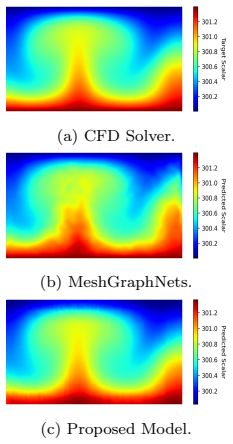
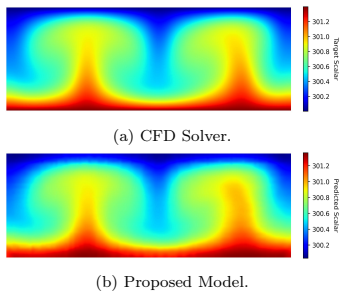
- [Section 3, Figs. 5-14] The baseline comparison is not apples-to-apples. The paper states that MeshGraphNets was trained on a downsampled mesh of ~1,750 nodes and only two aspect ratios, while the proposed model uses ~6,650 nodes and all four aspect ratios. Consequently, the accuracy, SSIM, error-map, and drift comparisons in Figs. 5-14 mix resolution and dataset differences with architectural differences. A coarse mesh yields smoother and less accurate predictions by construction, and a model trained on only two aspect ratios cannot be expected to generalize to the held-out aspect ratios. Notably, Figs. 7 and 8 show no MGN panel for aspect ratios 1 and 3. To support the central superiority claim, MGN must be trained on the same mesh resolution and the same aspect-ratio set with a documented hyperparameter search.
- [Section 3.0.1] The claimed ~4x training speedup is not a controlled measurement. It compares 24 hours 'to convergence' for MGN on a reduced-resolution, two-aspect-ratio dataset with 5-6 hours for the proposed model to reach 'comparable or better validation error' on the full dataset and full resolution. The two runs use different datasets, different stopping rules, and no reported epoch counts or learning-rate schedules. A fair efficiency comparison requires identical data, identical convergence criteria, and identical hardware; otherwise the speedup can be attributed to the smaller problem size rather than the architecture.
- [Section 3, MGN non-convergence] The paper reports that MeshGraphNets 'did not converge' when trained on the full dataset, which is a nonstandard claim given that MGN has been demonstrated in [33] on meshes considerably larger than ~6,650 nodes. No hyperparameter search, learning-rate schedule, normalization recipe, or seed count is reported for the baseline. Without a tuning record, the non-convergence is uninterpretable and the baseline is effectively handicapped. At minimum, the authors should report the exact MGN configuration used and provide evidence that standard MGN training practices were followed.
- [Section 4, Conclusion] The conclusion states that the proposed model 'outperforms MGN and other strong GNN baselines,' but only MGN is evaluated, and only on two aspect ratios at reduced resolution. No other strong GNN baselines are included. Furthermore, all experimental results appear to be single runs with no multiple seeds or variance reporting, despite the random seed used in the clustering algorithm. The empirical evidence is therefore overclaimed, and the statistical robustness of the accuracy and drift improvements is not established.
minor comments (5)
- [Section 2.5, Eq. (9)] There is a units inconsistency in the momentum equation: the left-hand side is ρ(∂u/∂t + u·∇u), which has units of force per volume, while the right-hand-side terms are accelerations. It should be ∂u/∂t + u·∇u = -(1/ρ0)∇p + ν∇²u + gβ(T-T0), or the pressure and viscous terms should be multiplied by ρ0. Please correct the governing equations.
- [Section 2.5, grid sizes] The text reports grid sizes of 1600, 3200, 5400, and 6400 cells for aspect ratios 1-4, but with a uniform grid size H/40 and H=1, the 1:3 cavity should give 120x40 = 4800 cells, not 5400. Also, the node count of ~6,650 for the 1:4 cavity should be reconciled with the 6400-cell count; clarify whether boundary nodes or cell vertices are counted.
- [Figures 11-12 captions] Figure 11 caption says 'bottom wall temperature of 300.7K' while the text and Fig. 12 context refer to 300.8K and 301.8K. These temperature values should be made consistent. Also, Fig. 14 caption uses 'GraphMeshNets' instead of 'MeshGraphNets'.
- [Section 2.2 and Appendix] There is an unresolved 'Fig.??' reference after the pooling description, and the text does not state the random seed used to make the clustering reproducible. Please provide the seed or explain the reproducibility mechanism.
- [Experimental setup] The main text does not report essential hyperparameters: number of GNN layers L, number of stages, hidden feature dimension, clique size, training epochs, learning rate, batch size, or validation split. An architecture table and full training details are needed for reproducibility. In addition, no code or dataset release is mentioned; providing these would substantially improve the paper.
Circularity Check
No circularity: predictions are empirical evaluations against CFD ground truth; no fitted parameter or self-citation chain forces the reported results.
full rationale
The paper is an empirical machine-learning study. It constructs a CFD dataset, trains a multi-stage GNN and a MeshGraphNets baseline, and compares predictions against held-out CFD outputs. No mathematical derivation or physical law is being "predicted" from a fitted input; the network is trained on simulation frames and evaluated on unseen frames. The pooling/unpooling operators are adopted from prior work (MAgNET) and are architectural components, not assumptions that encode the target results. There are no self-citations that carry a load-bearing uniqueness or derivation claim. The only substantive concern is that the baseline comparison is confounded: MeshGraphNets is trained on a downsampled mesh and only two aspect ratios, while the proposed model uses the full resolution and all aspect ratios. That is a fairness/validity issue regarding the reported accuracy, drift, and speedup claims, but it is not circularity under the defined patterns: the baseline's reduced setup does not make the proposed model's predictions equivalent to its training inputs by construction. No quoted equation reduces to another by definition, and no fitted parameter is renamed as a prediction. Therefore the appropriate circularity score is 0.
Axiom & Free-Parameter Ledger
free parameters (6)
- hidden feature dimension =
128
- number of GNN layers L =
not stated
- number of stages =
3 (default)
- clique size =
{2, 3}
- random seed for clustering =
not reported
- mesh resolution H/40 =
40 cells per unit height
axioms (4)
- domain assumption CFD solutions from OpenFOAM under the Boussinesq approximation are valid ground truth for natural convection in 2D cavities.
- domain assumption The multi-stage pooling and unpooling operators from MAgNET preserve the information needed to learn temperature dynamics.
- ad hoc to paper A downsampled mesh and two aspect ratios are sufficient to represent the capability of the MeshGraphNets baseline.
- domain assumption Message passing on the graph captures the relevant physics of buoyancy-driven flow.
Cite this review
Pith. "Pith review of Multi-Stage Graph Neural Networks for Data-Driven Prediction of Natural Convection in Enclosed Cavities." pith.science (2026). https://pith.science/paper/RGRKOTLF
@misc{pith2026250906041,
  author       = {Pith},
  title        = {Pith review of: Multi-Stage Graph Neural Networks for Data-Driven Prediction of Natural Convection in Enclosed Cavities},
  year         = {2026},
  howpublished = {\url{https://pith.science/paper/RGRKOTLF}},
  note         = {Machine review of arXiv:2509.06041}
}
read the original abstract
Buoyancy-driven heat transfer in closed cavities serves as a canonical testbed for thermal design High-fidelity CFD modelling yields accurate thermal field solutions, yet its reliance on expert-crafted physics models, fine meshes, and intensive computation limits rapid iteration. Recent developments in data-driven modeling, especially Graph Neural Networks (GNNs), offer new alternatives for learning thermal-fluid behavior directly from simulation data, particularly on irregular mesh structures. However, conventional GNNs often struggle to capture long-range dependencies in high-resolution graph structures. To overcome this limitation, we propose a novel multi-stage GNN architecture that leverages hierarchical pooling and unpooling operations to progressively model global-to-local interactions across multiple spatial scales. We evaluate the proposed model on our newly developed CFD dataset simulating natural convection within a rectangular cavities with varying aspect ratios where the bottom wall is isothermal hot, the top wall is isothermal cold, and the two vertical walls are adiabatic. Experimental results demonstrate that the proposed model achieves higher predictive accuracy, improved training efficiency, and reduced long-term error accumulation compared to state-of-the-art (SOTA) GNN baselines. These findings underscore the potential of the proposed multi-stage GNN approach for modeling complex heat transfer in mesh-based fluid dynamics simulations.
Figures






Reference graph
Works this paper leans on
-
[1]
A. Bounouar, K. Gueraoui, M. Taibi, A. Lahlou, M. Driouich, M. Sam- mouda, S. Men-La-Yakhaf, M. Belcadi, Numerical and mathematical modeling of unsteady heat transfer within a spherical cavity: Applica- tions laser in medicine, Contemporary Engineering Sciences 9 (2016) 1183–1199
work page 2016
- [2]
-
[3]
A. Andreozzi, L. Brunese, M. Iasiello, C. Tucci, G. P. Vanoli, Model- ing heat transfer in tumors: a review of thermal therapies, Annals of biomedical engineering 47 (3) (2019) 676–693
work page 2019
-
[4]
E. I. Basri, A. A. Basri, V. N. Riazuddin, S. Shahwir, Z. Mohammad, K. Ahmad, Computational fluid dynamics study in biomedical applica- tions: a review, International Journal of Fluids and Heat Transfer 1 (2) (2016) 2–14. 21
work page 2016
-
[5]
S. S. Murshed, C. N. De Castro, A critical review of traditional and emerging techniques and fluids for electronics cooling, Renewable and Sustainable Energy Reviews 78 (2017) 821–833
work page 2017
-
[6]
V. Nair, A. Baby, M. Murali, M. B. Nair, et al., A comprehensive review of air-cooled heat sinks for thermal management of electronic devices, International Communications in Heat and Mass Transfer 159 (2024) 108055
work page 2024
- [7]
- [8]
- [9]
-
[10]
M. Falcone, E. Palka Bayard De Volo, A. Hellany, C. Rossi, B. Pul- virenti, Lithium-ion battery thermal management systems: A survey and new cfd results, Batteries 7 (4) (2021) 86
work page 2021
-
[11]
X.Jiao, R.Yang, Cfdstudyoftheairflowandheattransferinalouvered finned heat exchanger for vehicles, Journal of Engineering Physics and Thermophysics 98 (2) (2025) 419–426
work page 2025
-
[12]
M. H. Bargal, A. N. Allam, A. M. Zaki, M. E. Zayed, L. M. Alhems, H. M. Ali, Thermohydraulic performance augmentation and heat trans- fer enhancement of automotive radiators using nano-coolants: a critical review, Journal of Thermal Analysis and Calorimetry (2025) 1–53
work page 2025
-
[13]
S. S. Pasunurthi, C. Srinivasan, N. Chaudhari, D. Maiti, Transient multi-dimensional conjugate heat transfer (cht) simulation of an oil- cooled automotive electric motor operated in a drive cycle, Tech. rep., SAE Technical Paper (2024). 22
work page 2024
-
[14]
T. M. Bandhauer, S. Garimella, T. F. Fuller, A critical review of thermal issues in lithium-ion batteries, Journal of the electrochemical society 158 (3) (2011) R1
work page 2011
- [15]
-
[16]
M. Alteneiji, M. I. H. Ali, K. A. Khan, R. K. A. Al-Rub, Heat trans- fer effectiveness characteristics maps for additively manufactured tpms compact heat exchangers, Energy Storage and Saving 1 (3) (2022) 153– 161
work page 2022
-
[17]
B. W. Reynolds, C. J. Fee, K. R. Morison, D. J. Holland, Characterisa- tion of heat transfer within 3d printed tpms heat exchangers, Interna- tional Journal of Heat and Mass Transfer 212 (2023) 124264
work page 2023
- [18]
-
[19]
S. Louhenkilpi, E. Laitinen, R. Nieminen, Real-time simulation of heat transfer in continuous casting, Metallurgical Transactions B 24 (4) (1993) 685–693
work page 1993
-
[20]
Q. Xia, T. Shi, L. Xia, Topology optimization for heat conduction by combining level set method and beso method, International Journal of Heat and Mass Transfer 127 (2018) 200–209
work page 2018
-
[21]
N. Deng, Q. Huang, Y. Li, P. Hou, L. Gu, G. Wang, F. Ma, J. Zhao, Topology optimization of cold plate for battery thermal management based on length scale control, International Journal of Heat and Mass Transfer 251 (2025) 127378
work page 2025
-
[22]
H. K. Versteeg, An introduction to computational fluid dynamics the finite volume method, 2/E, Pearson Education India, 2007
work page 2007
-
[23]
R. H. Pletcher, J. C. Tannehill, D. Anderson, Computational fluid me- chanics and heat transfer, CRC press, 2012. 23
work page 2012
-
[24]
R. Vinuesa, S. L. Brunton, Enhancing computational fluid dynamics with machine learning, Nature Computational Science 2 (6) (2022) 358– 366
work page 2022
-
[25]
D. Kochkov, J. A. Smith, A. Alieva, Q. Wang, M. P. Brenner, S. Hoyer, Machine learning–accelerated computational fluid dynamics, Proceed- ings of the National Academy of Sciences 118 (21) (2021) e2101784118
work page 2021
- [26]
-
[27]
K. O. Lye, S. Mishra, D. Ray, Deep learning observables in compu- tational fluid dynamics, Journal of Computational Physics 410 (2020) 109339
work page 2020
-
[28]
S. Lee, D. You, Data-driven prediction of unsteady flow over a circular cylinder using deep learning, Journal of Fluid Mechanics 879 (2019) 217–254
work page 2019
-
[29]
R. Wang, K. Kashinath, M. Mustafa, A. Albert, R. Yu, Towards physics- informed deep learning for turbulent flow prediction, in: Proceedings of the 26th ACM SIGKDD international conference on knowledge discov- ery & data mining, 2020, pp. 1457–1466
work page 2020
-
[30]
M. D. Ribeiro, A. Rehman, S. Ahmed, A. Dengel, Deepcfd: Efficient steady-state laminar flow approximation with deep convolutional neural networks, arXiv preprint arXiv:2004.08826 (2020)
Pith/arXiv arXiv 2004
-
[31]
F. Scarselli, M. Gori, A. C. Tsoi, M. Hagenbuchner, G. Monfardini, The graph neural network model, IEEE transactions on neural networks 20 (1) (2008) 61–80
work page 2008
-
[32]
N. A. Asif, Y. Sarker, R. K. Chakrabortty, M. J. Ryan, M. H. Ahamed, D. K. Saha, F. R. Badal, S. K. Das, M. F. Ali, S. I. Moyeen, et al., Graph neural network: A comprehensive review on non-euclidean space, Ieee Access 9 (2021) 60588–60606
work page 2021
- [33]
-
[34]
J. Zhou, G. Cui, S. Hu, Z. Zhang, C. Yang, Z. Liu, L. Wang, C. Li, M. Sun, Graph neural networks: A review of methods and applications, AI open 1 (2020) 57–81
2020
-
[35]
Z. Wu, S. Pan, F. Chen, G. Long, C. Zhang, P. S. Yu, A comprehensive survey on graph neural networks, IEEE transactions on neural networks and learning systems 32 (1) (2020) 4–24
2020
-
[37]
Sanchez-Gonzalez, J
A. Sanchez-Gonzalez, J. Godwin, T. Pfaff, R. Ying, J. Leskovec, P. Battaglia, Learning to simulate complex physics with graph net- works, in: International conference on machine learning, PMLR, 2020, pp. 8459–8468
2020
-
[38]
Q. Zhao, X. Han, R. Guo, C. Chen, A computationally efficient hybrid neural network architecture for porous media: Integrating cnns and gnns for improved permeability prediction, arXiv preprint arXiv:2311.06418 (2023)
work page internal anchor Pith review Pith/arXiv arXiv 2023
-
[39]
M. A. Mendez, J. Dominique, M. Fiore, F. Pino, P. Sperotto, J. Berghe, Challenges and opportunities for machine learning in fluid mechanics, arXiv preprint arXiv:2202.12577 (2022)
work page internal anchor Pith review Pith/arXiv arXiv 2022
-
[40]
H. Wang, Y. Cao, Z. Huang, Y. Liu, P. Hu, X. Luo, Z. Song, W. Zhao, J. Liu, J. Sun, et al., Recent advances on machine learning for computational fluid dynamics: A survey. arxiv 2024, arXiv preprint arXiv:2408.12171 (2024)
Pith/arXiv arXiv 2024
-
[41]
M. Lino, S. Fotiadis, A. A. Bharath, C. Cantwell, Towards fast simu- lation of environmental fluid mechanics with multi-scale graph neural networks, arXiv preprint arXiv:2205.02637 (2022)
work page internal anchor Pith review Pith/arXiv arXiv 2022
-
[42]
M. Fortunato, T. Pfaff, P. Wirnsberger, A. Pritzel, P. Battaglia, Multi- scale meshgraphnets, arXiv preprint arXiv:2210.00612 (2022). 25
Pith/arXiv arXiv 2022
-
[43]
Z. Li, N. Kovachki, K. Azizzadenesheli, B. Liu, A. Stuart, K. Bhat- tacharya, A. Anandkumar, Multipole graph neural operator for para- metric partial differential equations, Advances in Neural Information Processing Systems 33 (2020) 6755–6766
work page 2020
-
[44]
S. Deshpande, S. Bordas, J. Lengiewicz, Magnet: A graph u-net ar- chitecture for mesh-based simulations, arXiv preprint arXiv:2211.00713 (2022)
Pith/arXiv arXiv 2022
-
[45]
D. E. Rumelhart, G. E. Hinton, R. J. Williams, Learning representations by back-propagating errors, nature 323 (6088) (1986) 533–536
1986
-
[46]
Invalid input or missing ’ nodes ’
Z. Li, A. B. Farimani, Accelerating lagrangian fluid simulation with graph neural networks, in: ICLR 2021 SimDL Workshop, Vol. 20, 2020. 26 Appendix: Appendix .1. Fast pooling and un-pooling implementation: The original implementations of the pooling and unpooling operators are computationally expensive, which considerably slows down the training pro- ces...
work page 2021
This paper was first reviewed by deepseek-v4-flash on August 5, 2026.
discussion (0)
Sign in with ORCID, Apple, or X to comment. Anyone can read and Pith papers without signing in.