REVIEW 4 major objections 5 minor 1 cited by
An analytic theory of convolutional neural network inverse problems solvers
T0 review · 4 major / 5 minor · reviewed 2026-08-03 · deepseek-v4-flash
Pith's one-line read Trained CNNs for imaging inverse problems approximate a closed-form, patch-based MMSE estimator, not a black box.
desk verdict A genuinely new closed-form target function for CNN inverse solvers, with strong but over-claimed empirical support; the main soft spot is an unexamined assumption that trained networks actually lie in the constrained function class. read the letter →
The pith
A machine-rendered reading of the paper's core claim, the machinery that carries it, and where it could break.
The reading
What carries the argument
The Local-Equivariant MMSE (LE-MMSE) estimator: the minimum-mean-square-error estimator restricted to functions that are translation equivariant and local, meaning the output at a pixel depends only on the input patch of fixed size P around that pixel. Its closed form is a pixel-wise weighted average of training pixels with Gaussian patch-comparison weights; this single object carries the argument, because it is both exactly computable and claimed to be what trained CNNs approximate.
What would settle it
Train the same architectures on a single fixed noise level, say σ=0.05, without noise conditioning, and compare outputs to the LE-MMSE formula at that σ; if the agreement does not improve over a network trained on σ uniformly in [0,1], the assumed optimization and architectural containment are doubtful. As a second check, measure each trained network's translation-equivariance error and verify it correlates with the PSNR gap to the formula.
Extended reading notes
Core claim
The central discovery is the LE-MMSE estimator and its closed form. For each output pixel n', the estimator is a weighted average over all training pixels: the weight given to pixel n of training image x is proportional to the Gaussian density N(Q_{n'}y; Q_n A x, σ² Q_n Q_n^T), where Q_n extracts a size-P patch around pixel n and B is a pre-inverse. In words, the estimate at a pixel is built by matching the observed patch to every training patch in the domain of the forward operator, then averaging the training pixels weighted by those matching scores. The paper demonstrates empirically that trained networks approximate this estimator closely (PSNR ≳ 25 dB) across tasks, datasets, and archit
Load-bearing premise
The claim that trained networks match LE-MMSE rests on assuming the networks are, for practical purposes, unconstrained minimizers of the empirical MSE over the class of exactly local, translation-equivariant functions with patch size P; but the networks are trained with a range of noise levels and include downsampling/upsampling layers, so the match is only approximate and visibly degrades at low noise on test and out-of-distribution data.
Editorial extensions
If this is right
- Network outputs for these inverse problems become computable without the network: the closed-form formula can be evaluated directly, albeit at higher computational cost.
- The theory separates memorization from generalization: the unconstrained and translation-equivariant MMSE estimators stay inside the convex hull of the training set, while LE-MMSE recombines training patches and can produce reconstructions outside that set.
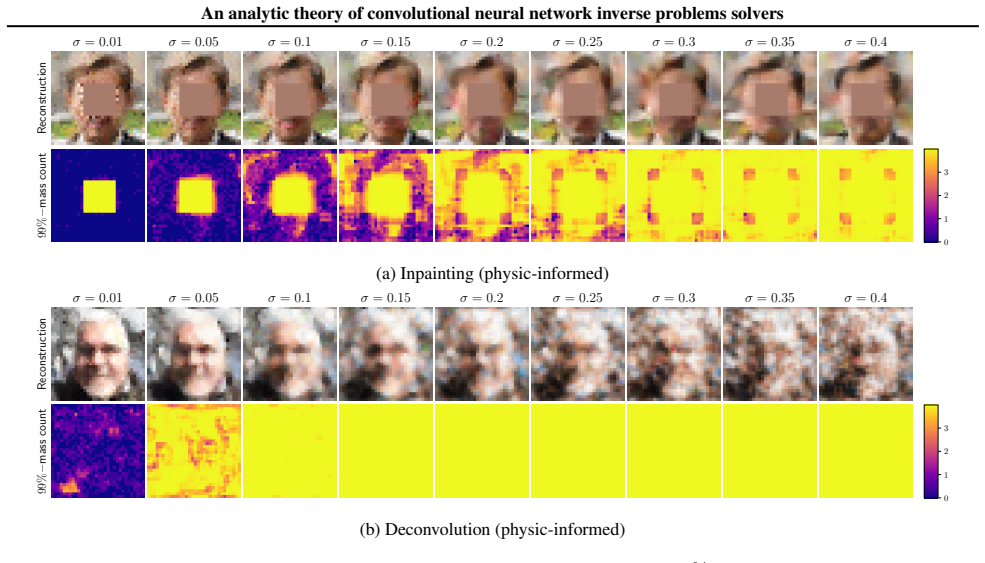
- The role of the pre-inverse B is made explicit: it trades off signal discrimination against noise amplification, which explains why physics-aware choices help inpainting but can hurt deconvolution.
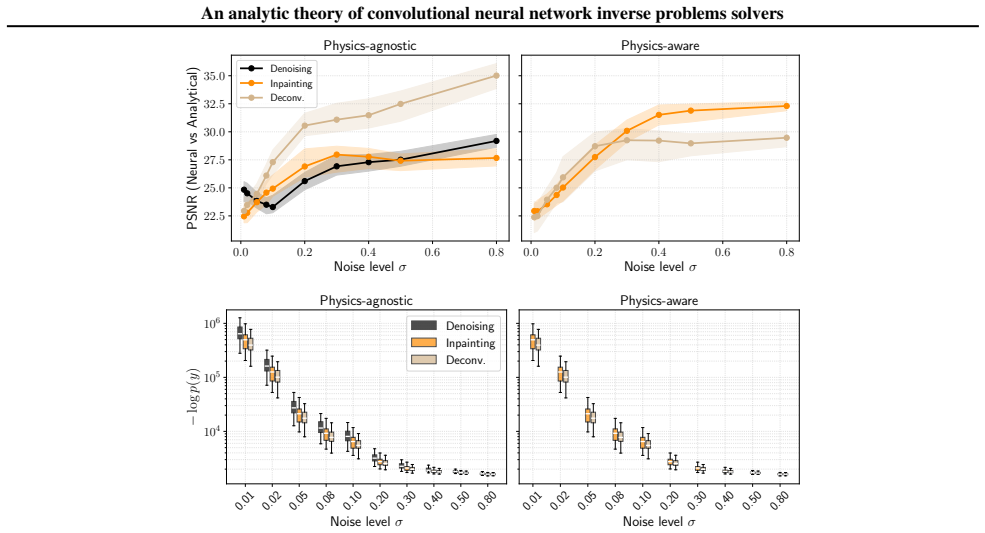
- The alignment between network and formula tracks the density of the measurement distribution, explaining why agreement is worse on test images and out-of-distribution inputs at low noise levels.
- Adding randomized smoothing to the LE-MMSE improves the match to networks and reconstruction quality, indicating that spectral bias can be modeled as smoothness of the estimator.
Reading between the lines
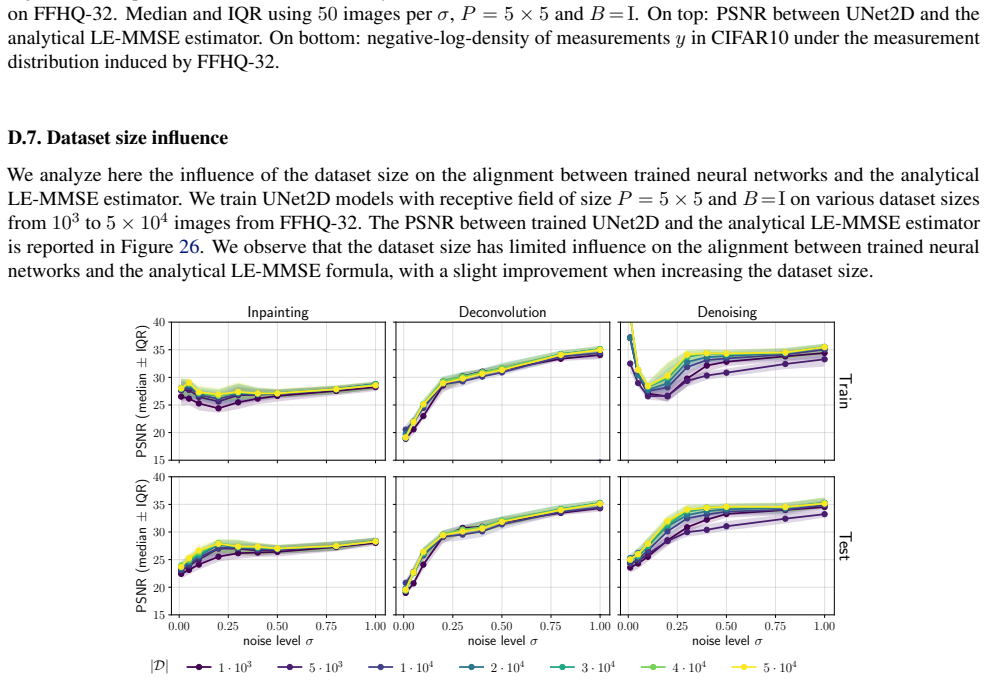
- The formula implies that the effective training resource is the collection of patches, not just whole images; one testable extension is whether augmenting a small dataset with rare patch configurations improves network–formula agreement in low-density regions.
- Training with a fixed noise level rather than a range would provide a cleaner test of the fixed-σ derivation; the paper's uniform σ∈[0,1] sampling likely contributes to the observed low-σ mismatch.
- Because the LE-MMSE weights are differentiable in both y and the training set, the closed form could serve as an analytic surrogate to study how small measurement perturbations or training-set edits propagate to reconstructions.
- The same derivation works for any finite group of orthogonal transformations, so rotation-equivariant networks could be tested against an analogous formula, extending the theory beyond translations.
Editorial analysis
A structured set of objections, weighed in public.
Referee Report
Summary. The paper develops an analytic theory for supervised CNN-based imaging inverse problem solvers. It defines the Local-Equivariant MMSE (LE-MMSE) estimator, obtained by constraining the empirical MMSE estimator to functions that are translation equivariant and have finite receptive field P. The main result (Theorem 3.8) gives a closed-form, pixel-wise expression for this estimator that is tractable for small datasets and images. The authors then compare the LE-MMSE formula against trained U-Net, ResNet, and PatchMLP networks on denoising, inpainting, and deconvolution tasks for FFHQ-32, CIFAR-10, FashionMNIST, and FFHQ-64, reporting PSNR values between the networks and formula that are typically high ("\gtrsim 25 dB") and concluding that trained CNNs closely approximate the LE-MMSE estimator. The paper also studies properties of the estimator: LE-MMSE is a patchwork of training patches, does not memorize in the same way as unconstrained MMSE, and can be augmented with randomized smoothing to better match network behavior. Theoretical derivations are provided in appendices, and code for reproducing the formula is made available.
Significance. If the central claim holds, this is a significant contribution: it provides an interpretable, closed-form estimator that captures the inductive biases of CNNs and claims to predict the outputs of trained networks across multiple architectures, tasks, and datasets. The derivation of the LE-MMSE formula is rigorous, with a clean optimality-condition argument (Appendix B.3) and a rank-stratified generalization (Theorem B.5). The paper also offers a useful conceptual separation between memorization (MMSE/E-MMSE) and patch-based generalization (LE-MMSE), and it explicitly ships code for the exact implementation of the formula, which is a strength. The paper is well written and the theoretical development is self-contained. However, the central empirical claim—that trained networks are unconstrained minimizers over the function class M_{T,loc}(P)—is not directly verified, and a few quantitative claims are inconsistent with the paper's own tables. These issues are fixable but currently limit the strength of the conclusions.
major comments (4)
- [Abstract and §4.2] The abstract and Section 4.2 state that the theory matches neural network outputs with PSNR ≳25 dB for all tasks. Table 2 contradicts this: for CIFAR10, UNet2D, inpainting at σ=0.05, the median PSNR is 22.5 dB; for FashionMNIST, ResNet, inpainting at σ=0.05, it is 21.7 dB. Several other entries in Figures 10–12 also fall below 25 dB at low noise. Please amend the claim to 'most settings' or specify the conditions under which the threshold holds, and show the full distribution rather than only the median.
- [§4.1 and Appendix C.3] The LE-MMSE formula is derived for a fixed noise level σ, but networks are trained with σ sampled uniformly in [0,1] with σ-conditioning. The paper does not justify that a network trained on this mixed-σ objective equals the fixed-σ LE-MMSE estimator. If the conditioning is imperfect, the comparison is between a fixed-σ formula and a mixed-σ network, and the reported agreement may be diluted. Provide either an explicit argument (e.g., that the conditional expectation factors correctly) or experiments with fixed-σ training, and quantify the effect of σ-mixing on the PSNR match.
- [§3.1 and Table 3] The claim that trained U-Net and ResNet networks lie in M_{T,loc}(P) is not established. These architectures use strided down/up-sampling and skip connections; even with circular padding, stride-2 operations break exact translation equivariance for odd shifts, and skip connections can enlarge the effective receptive field beyond the nominal P. The paper does not report empirical translation equivariance error or effective receptive field measurements. Without this, the LE-MMSE formula is not the network's constrained optimum, and the agreement could reflect both estimators being close to ground truth rather than the network implementing the formula. Please measure equivariance error and effective receptive field, or use architectures that exactly satisfy the constraints (e.g., PatchMLP without downsampling) for the core comparison.
- [§4.2 and Figure 6] The explanation that low PSNR in low-density regions of p(y) is due to low measurement density is post-hoc. The LE-MMSE formula itself behaves differently in low-density regimes (weights concentrate on a few patches), but the network's deviation in those regimes could also stem from its failure to be in M_{T,loc}(P) or from the mixed-σ training. To support the density-based explanation, the paper should show that the discrepancy between network and formula is specifically correlated with p(y) after controlling for equivariance/receptive-field mismatch, e.g., by evaluating on test points where the network is known to be approximately equivariant.
minor comments (5)
- [§D.1 and Figure 10 caption] Typo: 'accross' should be 'across'.
- [§D.4 and Figure 22 caption] Typo: 'physic-inform' should be 'physic-informed'.
- [Equation (8)] The notation η 2 is confusing; consider writing η^2 or ∥η∥^2.
- [§C.2] The reference to 'diffusers2' library is informal; please provide a proper citation or URL.
- [Table 3] The table formatting for receptive-field/hyper-parameters is hard to read; consider separating the architecture name from its hyper-parameters.
Circularity Check
No circularity: the LE-MMSE formula is derived from first principles and is not fitted to network outputs.
full rationale
The paper's central derivation (Theorem 3.8, Eq. 7) is self-contained: it derives the closed-form LE-MMSE estimator as the minimizer of the empirical MSE over the function class M_{T,loc} using the optimality condition (Prop. A.5). The formula depends only on the dataset D, the forward operator A, the pre-inverse B, the noise level σ, and the patch size P. No network parameters, learned features, or fitted constants appear in the formula, and no numerical result is used to define the estimator. The numerical section compares independently trained CNNs to this closed-form expression; the same dataset and forward operators are used, but the formula is not tuned to match network outputs. The main weakness—whether trained U-Net, ResNet, and PatchMLP networks are actually confined to M_{T,loc}(P)—is an unverified architectural assumption, not a circular step: if the assumption is false, the match would degrade, which is an empirical risk rather than a tautology. There are no load-bearing self-citations: the cited related works on diffusion models and equivariance are external, and no uniqueness result from the same authors is invoked to force the choice of LE-MMSE. Therefore the derivation chain does not reduce to its inputs by construction.
Assumptions & free parameters
free parameters (2)
- Patch size P =
5x5, 7x7, 9x9, 11x11
- Randomized smoothing parameter epsilon =
0.05
assumptions (7)
- domain assumption The empirical training distribution p_D replaces the true data distribution.
- domain assumption The forward model is y = Ax + e with additive white Gaussian noise e ~ N(0, sigma^2 I).
- domain assumption Translation equivariance with cyclic boundary conditions holds for the estimator class.
- domain assumption Each output pixel depends only on a finite local patch (locality).
- ad hoc to paper The matrices Q_n = Pi_n B have constant rank r > 0 (or the rank-stratified formula applies).
- domain assumption Trained neural networks converge to the global minimizer of the empirical MSE over their architecture class.
- ad hoc to paper Training with sigma sampled uniformly in [0,1] and sigma-conditioning yields the per-sigma LE-MMSE estimator.
Cite this review
Pith. "Pith review of An analytic theory of convolutional neural network inverse problems solvers." pith.science (2026). https://pith.science/paper/RGT4GJET
@misc{pith2026260110334,
  author       = {Pith},
  title        = {Pith review of: An analytic theory of convolutional neural network inverse problems solvers},
  year         = {2026},
  howpublished = {\url{https://pith.science/paper/RGT4GJET}},
  note         = {Machine review of arXiv:2601.10334}
}
abstract
Supervised convolutional neural networks (CNNs) are widely used to solve imaging inverse problems, achieving state-of-the-art performance in numerous applications. However, despite their empirical success, these methods are poorly understood from a theoretical perspective and often treated as black boxes. To bridge this gap, we analyze trained neural networks through the lens of the Minimum Mean Square Error (MMSE) estimator, incorporating functional constraints that capture two fundamental inductive biases of CNNs: translation equivariance and locality via finite receptive fields. Under the empirical training distribution, we derive an analytic, interpretable, and tractable formula for this constrained variant, termed Local-Equivariant MMSE (LE-MMSE). Through extensive numerical experiments across various inverse problems (denoising, inpainting, deconvolution), datasets (FFHQ, CIFAR-10, FashionMNIST), and architectures (U-Net, ResNet, PatchMLP), we demonstrate that our theory matches the neural networks outputs (PSNR $\gtrsim25$dB). Furthermore, we provide insights into the differences between \emph{physics-aware} and \emph{physics-agnostic} estimators, the impact of high-density regions in the training (patch) distribution, and the influence of other factors (dataset size, patch size, etc).
Figures


Figures from the paper (23 more)





Forward citations
Cited by 1 Pith paper
-
An exact information theory of generalization phase transitions in Bayesian diffusion models
Bayesian diffusion models memorize training data when mutual information between restricted observations and training data exceeds log dataset size, and generalize otherwise.
Reference graph
Works this paper leans on
-
[1]
Ifg 1, g2 ∈ Gtheng2 ·g 1 ∈ G
-
[2]
Ifg 1, g2, g3 ∈ Gthen(g1 ·g 2)·g 3 =g 1 ·(g 2 ·g 3)
-
[3]
There existsι∈ Gsuch thate·g=g·ι=gfor allg∈ G
-
[4]
Ifg∈ Gthere existsg −1 ∈ Gsuch thatg−1 ·g=g·g −1 =ι. Definition A.8(Group action).Given a group G and a set RN ⊂R N , we say that G acts on RN if there exists a function T:G ×R N →R N (we denote byT g(x)forg∈ Gandx∈R N ) that satisfies: Tg1 ◦T g2 =T g1·g2 andT ι = id Given a general group G. A function ϕ:R N →R N and group action T of G on RN . A function...
-
[6]
(And similarly for function defined inR M )
Invariance: for any function ϕ:R N →R , the function ¯ϕ= P g ϕ◦T g is invariant. (And similarly for function defined inR M )
-
[7]
patchwork effect
Equivariance: for any function ϕ:R N →R N , the function ¯ϕ= P g T −1 g ◦ϕ◦T g is equivariant. This is called Reynolds averaging. For image datax∈R N , letH, W∈Nbe the dimensions of a discrete gridΩ =Z H ×Z W withH×W=N. Definition A.10(Translation equivariant functions).Let T=Z H ×Z W be the group of 2D cyclic translations. For every group element g= (g h...
2025
-
[2025]
Karras, T., Laine, S., and Aila, T
URL https://openreview.net/forum? id=ilpL2qACla. Karras, T., Laine, S., and Aila, T. A style-based generator architecture for generative adversarial networks. InPro- ceedings of the IEEE/CVF conference on computer vision and pattern recognition, pp. 4401–4410, 2019. Kay, S. M.Fundamentals of statistical signal processing: estimation theory. Prentice-Hall,...
arXiv 2019
Reviewed August 3, 2026 · model on record in the stance chip above.
Discussion (0). Sign in to comment.