REVIEW 3 major objections 5 minor 38 references
Encapsulation-Induced Alignment in Endofullerenes
T0 review · 3 major / 5 minor · reviewed 2026-08-10 · deepseek-v4-flash
Pith's one-line read The carbon cage of C60 acts as an alignment field: trapped N2 and AlF become strongly aligned while their spectroscopic constants barely change.
desk verdict A testable and honest paper, but the headline alignment numbers rest on a phi-averaged m=0 treatment that is not yet robust. read the letter →
The pith
A machine-rendered reading of the paper's core claim, the machinery that carries it, and where it could break.
The reading
What carries the argument
The argument runs through a rigid-rotor Hamiltonian \(\hat H = \hat H_{\mathrm{rot}} + \hat H_c\), where \(\hat H_c\) is the molecule-cage interaction potential \(V(R,\$\theta$)\) expanded in spherical harmonics. The potential is obtained by interpolating a grid of B3LYP-D3 single-point DFT energies, with the azimuthal angle averaged out, so only \(m=0\) rotational states mix. Diagonalization gives the perturbed rotational ground state, whose population distribution yields alignment \(\langle\$cos^{2}$\$\theta$\rangle\) and orientation \(\langle\cos\$\theta$\rangle\). For the vibrational constants, the potential is averaged over a spherical harmonic, fitted to a Morse potential, and standard Morse formulas give \(\omega_e\), \(\omega_e\chi_e\), \(B_e\), and \(\alpha_e\).
What would settle it
Compute the full three-dimensional potential \(V(R,\$\theta$,\phi)\) and solve the rigid-rotor problem including phi-dependence, or replace the spherical-harmonic average in Eq. (4) with the aligned ground-state angular distribution; either calculation would show whether alignments of 0.82 and 0.98 and the unchanged constants survive. Experimentally, measuring the rotational revival times of N2@C60 and comparing them with free N2 would test whether the rotational constant is truly unshifted.
Extended reading notes
Core claim
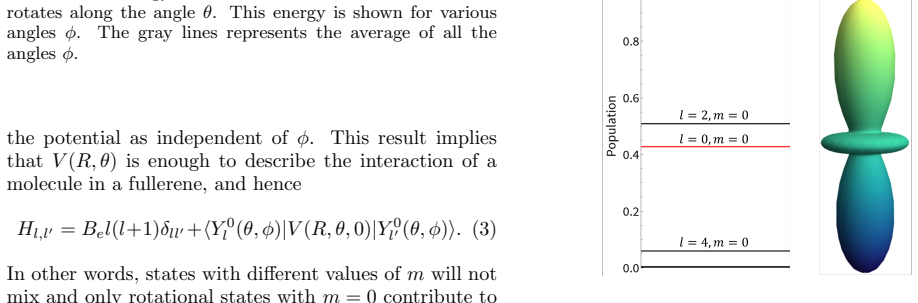
The central claim is that the molecule-cage interaction is highly anisotropic, inducing strong coupling between rotational states of the internal molecule, and that this coupling produces a high degree of alignment: the N2 ground rotational state has alignment \(\langle\$cos^{2}$\$\theta$\rangle = 0.82\), while AlF reaches alignment 0.98 and orientation 0.99. In the same calculation, the spectroscopic constants (\(R_e\), \(\omega_e\), \(\omega_e\chi_e\), \(B_e\), and \(\alpha_e\)) remain essentially unchanged from the free molecules, and the AlF dipole moment is slightly enhanced (1.63 D versus 1.53 D). The authors interpret the cage as creating a preferred axis analogous to an external electric field, but without significantly altering the molecule's internal properties.
Load-bearing premise
The calculation treats the interaction potential as independent of the azimuthal angle phi, even though the computed curves vary by up to 10.4% with phi, and it averages the vibrational potential over an unspecified single spherical harmonic instead of the actual aligned ground state; if those choices change the rotational wavefunction, the quoted alignments and near-unchanged constants could shift.
Editorial extensions
If this is right
- Encapsulation provides a built-in alignment mechanism: molecules inside C60 are held at a fixed orientation without any external electric or laser field.
- The near-unchanged spectroscopic constants imply that endofullerenes can serve as 'nearly free' molecules for precision spectroscopy or quantum applications.
- For heteronuclear molecules the cage provides both alignment and orientation, making AlF@C60 a candidate for orientation-dependent measurements.
- Laser-induced alignment revivals in an endofullerene should occur at times set by the nearly unchanged rotational constant, so any deviation would signal a cage-induced shift.
- The opposite dipole-moment trends of AlF@C60 and HF@C60 indicate that cage effects on the dipole moment depend strongly on the trapped molecule.
Reading between the lines
- Because the computed potential varies by up to 10.4% with the azimuthal angle, a full three-dimensional treatment that includes m-mixing could shift the quoted alignment values; this is a direct test the authors did not perform.
- The vibrational average in Eq. (4) uses a bare spherical harmonic instead of the aligned ground-state angular distribution; using the aligned distribution could alter the Morse fit and hence the predicted spectroscopic constants.
- The predicted dipole enhancement for AlF is testable by microwave or Stark spectroscopy on AlF@C60 and would distinguish cage enhancement from the suppression seen in HF@C60.
- The same rigid-rotor treatment could be extended to other diatomics, predicting that highly polar or elongated molecules will show even stronger orientation inside the cage.
Editorial analysis
A structured set of objections, weighed in public.
Referee Report
Summary. The paper reports DFT calculations of the interaction potential between N2 or AlF and the interior of C60, and uses these potentials to predict the rotational alignment/orientation and the spectroscopic constants of the encapsulated molecules. The central claims are that (i) the cage induces strong alignment, with <cos^2θ> = 0.82 for N2@C60 and <cos^2θ> = 0.98 with <cosθ> = 0.99 for AlF@C60, while (ii) the spectroscopic constants of the internal molecule are only weakly perturbed. The authors also report a slight enhancement of the AlF dipole moment inside C60 and propose a laser-alignment experiment based on rotational revival times. The calculations are based on B3LYP-D3 potentials with counterpoise corrections, a rigid-rotor treatment for rotational states, and a Morse-potential fit for vibrational constants.
Significance. If the quantitative predictions are robust, the paper would provide useful guidance for endofullerene spectroscopy and for experiments on laser-induced alignment of encapsulated molecules. The work has clear strengths: ab initio interaction potentials rather than fitted Lennard-Jones forms, a systematic functional comparison, explicit BSSE corrections, and transparent Morse fits with quoted fitting errors. The predicted alignment values and the revival-time proposal are concrete and falsifiable. However, the central quantitative claims depend on two approximations—neglect of the azimuthal dependence of the potential and a spherical-harmonic average for vibration—that are not quantitatively justified in the manuscript. The spectroscopic comparison also mixes levels of theory. These issues must be addressed before the conclusions can be accepted as stated.
major comments (3)
- [Sec. III, Eq. (3)] The replacement of the full potential by V(R,θ,0) and the restriction to m=0 states is not justified by the stated 10.4% maximum variation among φ curves. For N2, the rotational energy spacing between l=0 and l=2 is about 6Be ≈ 12 cm−1, while the θ-anisotropy of the potential is of order 10^2 cm−1; 10% of that anisotropy is therefore comparable to the rotational spacing. Moreover, the D5d symmetry of the optimized geometry implies that the full potential couples m with m±5, so restricting the basis to m=0 excludes couplings that could change the ground-state wavefunction and hence <cos^2θ>. The use of V(R,θ,0) rather than the azimuthal average (the gray curve in Fig. 4) also introduces an arbitrary choice of φ. The quoted alignments (0.82 for N2, 0.98/0.99 for AlF) should be verified by solving the 3D rigid-rotor problem with the full V(R,θ,φ), or by presenting a convergence study in the number of m components and φ grid points.
- [Sec. IV, Eq. (4)] The 'rotationally averaged potential' used for the vibrational analysis is defined as the expectation value of V(r,θ,φ) in a single spherical harmonic Y_l^m, but the manuscript does not specify which l and m are used. If l=0 is intended, the average is over all orientations, which is inconsistent with the strongly aligned ground state found in Sec. III; if a higher l is intended, the choice must be justified. The effective vibrational potential should be the expectation value in the actual ground rotational state (or include the rotational-vibrational coupling explicitly). Since the Morse parameters De and a, and hence all spectroscopic constants in Table II, are fit to this averaged potential, the unspecified spherical harmonic is load-bearing for the claim that the cage leaves the spectroscopic constants essentially unchanged.
- [Sec. IV, Table II and Sec. II] The comparison of encapsulated spectroscopic constants to 'known values' for free molecules is not like-for-like. For AlF, the text in Sec. II states that the same DFT method predicts a free-molecule bond length of 1.74 Å, whereas Table II lists the free AlF Re as 1.654369 Å (presumably experimental). The cage-induced change at the same level of theory (1.69 Å inside versus 1.74 Å free) is actually a compression, opposite in sign to the 'stretch' narrative, and the DFT error is larger than the reported cage effect. A reliable statement that the cage does not significantly alter the spectroscopic constants requires comparing encapsulated and free values computed at the same level of theory and with a quantified error budget, not comparing DFT-in-cage values to experimental free-molecule values.
minor comments (5)
- [Eq. (1)] The summation limits in Eq. (1) are written as 'lX m=−l ∞X l', which is malformed; they should read Σ_{l=0}^∞ Σ_{m=-l}^l.
- [Sec. IV, text before Eq. (4)] 'rationally averaged potential' appears to be a typo for 'rotationally averaged potential'.
- [Fig. 4 caption] The caption says 'The gray lines represents the average of all the angles φ' but the figure appears to show one gray curve; please clarify the wording.
- [Sec. II and Table I] The functional is referred to as 'wB97XV' in the text but as 'wB97XD' in Table I and reference [19]; please make the naming consistent.
- [Table II] The source of the free-molecule values in Table II should be stated explicitly: are they experimental values from ref. [28], and are the N2 and AlF free-molecule values computed at the same level of theory as the encapsulated ones? This is closely related to major comment 3, but a clarifying footnote would help.
Circularity Check
No significant circularity: the spectroscopic constants and alignment values are derived from ab initio potentials and compared against independent experimental benchmarks.
full rationale
The paper's derivation chain is self-contained rather than circular. The interaction potential V(R,theta,phi) is obtained from a grid of single-point DFT energy calculations (Section II), and the rotational Hamiltonian matrix elements in Eq. (2) are computed from that potential. Diagonalizing Eq. (3) then yields the rotational eigenstates from which the alignment <cos^2(theta)> and orientation <cos(theta)> values are obtained (Section III). The spectroscopic constants in Section IV are derived by fitting the rotationally averaged potential to a Morse potential, Eq. (5), and then applying the standard Morse formulas, Eqs. (6)-(9). No experimental spectroscopic constant of N2 or AlF is used as an input in the fit or in the diagonalization; the experimental values from ref. [28] appear only as a post-hoc comparison in Table II. Although ref. [28] is authored in part by one of the present authors, it is an independent database of measured spectroscopic constants, so it constitutes external evidence rather than a self-fulfilling input. The omission of phi-dependence and the restriction to m=0 states are accuracy approximations, not circular reductions: they may affect robustness of the numerical predictions, but they do not make the output equivalent to the input by construction.
Assumptions & free parameters
free parameters (4)
- De (Morse dissociation energy) for N2@C60 =
not reported explicitly
- a (Morse range parameter) for N2@C60 =
not reported explicitly
- De (Morse dissociation energy) for AlF@C60 =
not reported explicitly
- a (Morse range parameter) for AlF@C60 =
not reported explicitly
assumptions (5)
- domain assumption The B3LYP-D3/Def2QZV (N2) and Def2TZV (AlF) DFT methods with counterpoise correction accurately describe the molecule-cage interaction potential.
- ad hoc to paper The interaction potential's phi-dependence can be neglected because the maximum difference among phi curves is 10.4%.
- domain assumption Vibrational and rotational degrees of freedom can be treated separately, with the internal molecule as a rigid rotor during rotation.
- ad hoc to paper For vibration, the effective potential is the expectation value of V(r,theta,phi) in a single spherical harmonic Y_l^m (Eq. 4), rather than in the actual aligned ground rotational state.
- domain assumption The rotationally averaged potential is well described by a Morse potential (Eq. 5).
Cite this review
Pith. "Pith review of Encapsulation-Induced Alignment in Endofullerenes." pith.science (2026). https://pith.science/paper/RHBEQPSW
@misc{pith2026250112534,
  author       = {Pith},
  title        = {Pith review of: Encapsulation-Induced Alignment in Endofullerenes},
  year         = {2026},
  howpublished = {\url{https://pith.science/paper/RHBEQPSW}},
  note         = {Machine review of arXiv:2501.12534}
}
read the original abstract
Methods for creating endofullerenes have been steadily improving since their discovery, allowing for new types of endofullerenes to be created in larger numbers. When a molecule is trapped in a fullerene, the fullerene creates a harmonic trapping potential that leaves most of the fundamental properties of the internal molecule intact. The fullerene cage does create a preferred axis for the internal molecule, which we refer to as the encapsulation-induced alignment of the molecule. We explore the alignment of AlF and N2 inside of C60 by first computing the interaction between the internal molecule and the fullerene cage using ab initio electronic structure methods. Our results show that the internal molecules are found to be strongly aligned despite finding that all the calculated spectroscopic constants are relatively unaffected by the fullerene cage.
Figures


Figures from the paper (4 more)



Reference graph
Works this paper leans on
-
[1]
H. W. Kroto, C60: Buckminsterfullerene, the celestial sphere that fell to earth, Angewandte Chemie Interna- tional Edition in English 31, 111 (1992). 8
work page 1992
-
[2]
X. Lu, L. Feng, T. Akasaka, and S. Nagase, Current status and future developments of endohedral metallo- fullerenes, Chem. Soc. Rev. 41, 7723 (2012)
work page 2012
-
[3]
A. A. Popov, S. Yang, and L. Dunsch, Endohedral fullerenes, Chemical reviews 113, 5989 (2013)
work page 2013
-
[4]
Y. Chai, T. Guo, C. Jin, R. E. Haufler, L. P. F. Chibante, J. Fure, L. Wang, J. M. Alford, and R. E. Smalley, Fullerenes with metals inside, The Journal of Physical Chemistry 95, 7564 (1991)
work page 1991
-
[5]
M. H. Levitt, Spectroscopy of light-molecule endo- fullerenes, Philosophical Transactions of the Royal Soci- ety A: Mathematical, Physical and Engineering Sciences 371, 20120429 (2013)
work page 2013
-
[6]
W. Harneit, Spin quantum computing with endohedral fullerenes, in Endohedral Fullerenes: Electron Transfer and Spin, edited by A. A. Popov (Springer International Publishing, Cham, 2017) pp. 297–324
work page 2017
-
[7]
S. Bloodworth and R. J. Whitby, Synthesis of endohedral fullerenes by molecular surgery, Communications Chem- istry 5, 121 (2022)
work page 2022
-
[8]
C. Williams, M. Whitehead, and L. Pang, Interaction and dynamics of endohedral gas molecules in fullerene C60 isomers and C70, The Journal of Physical Chemistry 97, 11652 (1993)
work page 1993
Show all 38 references
-
[9]
Jafari, G
T. Jafari, G. Razvan Bacanu, A. Shugai, U. Nagel, M. Walkey, G. Hoffman, M. H. Levitt, R. J. Whitby, and T. R˜ o˜ om, Terahertz spectroscopy of the helium end- ofullerene He@C 60, Phys. Chem. Chem. Phys. 24, 9943 (2022)
2022
-
[10]
S. Ye, M. Xu, Z. Baˇ ci´ c, R. Lawler, and N. J. Turro, Quantum dynamics of a hydrogen molecule inside an anisotropic open-cage fullerene: Coupled translation- rotation eigenstates and comparison with inelastic neu- tron scattering spectroscopy, The Journal of Physical Chemist...
2010
-
[11]
M. Xu, F. Sebastianelli, B. R. Gibbons, Z. Baˇ ci´ c, R. Lawler, and N. J. Turro, Coupled translation-rotation eigenstates of H2 in C60 and C70 on the spectroscop- ically optimized interaction potential: Effects of cage anisotropy on the energy level structure and assignments,...
2009
-
[12]
P. M. Felker and Z. Baˇ ci´ c, Translation-rotation states of H2 in C60: New insights from a perturbation-theory treatment, The Journal of Chemical Physics 145, 084310 (2016)
2016
-
[13]
M. J. Frisch, G. W. Trucks, H. B. Schlegel, G. E. Scuseria, M. A. Robb, J. R. Cheeseman, G. Scal- mani, V. Barone, G. A. Petersson, H. Nakatsuji, X. Li, M. Caricato, A. V. Marenich, J. Bloino, B. G. Janesko, R. Gomperts, B. Mennucci, H. P. Hratchian, J. V. Or- tiz, A. F. Izmay...
2016
-
[14]
A. D. Becke, Density-functional thermochemistry. iii. the role of exact exchange, The Journal of Chemical Physics 98, 5648 (1993), https://pubs.aip.org/aip/jcp/article- pdf/98/7/5648/19277469/5648 1 online.pdf
1993
-
[15]
Ernzerhof and J
M. Ernzerhof and J. P. Perdew, Generalized gradi- ent approximation to the angle- and system-averaged exchange hole, The Journal of Chemical Physics 109, 3313 (1998), https://pubs.aip.org/aip/jcp/article- pdf/109/9/3313/19115007/3313 1 online.pdf
1998
-
[16]
H. S. Yu, X. He, S. L. Li, and D. G. Truhlar, Mn15: A kohn–sham global-hybrid exchange–correlation den- sity functional with broad accuracy for multi-reference and single-reference systems and noncovalent interac- tions, Chem. Sci. 7, 5032 (2016)
2016
-
[17]
Zhao and D
Y. Zhao and D. G. Truhlar, Design of density function- als that are broadly accurate for thermochemistry, ther- mochemical kinetics, and nonbonded interactions, The Journal of Physical Chemistry A 109, 5656 (2005)
2005
-
[18]
Austin, G
A. Austin, G. A. Petersson, M. J. Frisch, F. J. Dobek, G. Scalmani, and K. Throssell, A density functional with spherical atom dispersion terms, Journal of Chem- ical Theory and Computation 8, 4989 (2012), pMID: 26593191, https://doi.org/10.1021/ct300778e
2012 doi
-
[19]
Chai and M
J.-D. Chai and M. Head-Gordon, Long-range corrected hybrid density functionals with damped atom–atom dis- persion corrections, Phys. Chem. Chem. Phys. 10, 6615 (2008)
2008
-
[20]
Slanina, P
Z. Slanina, P. Pulay, and S. Nagase, H 2, Ne, and N2 energies of encapsulation into C 60 evaluated with the mpwb1k functional, Journal of Chemical Theory and Computation 2, 782 (2006), pMID: 26626683, https://doi.org/10.1021/ct0503320
2006 doi
-
[21]
Yanai, D
T. Yanai, D. P. Tew, and N. C. Handy, A new hy- brid exchange–correlation functional using the coulomb- attenuating method (cam-b3lyp), Chemical Physics Let- ters 393, 51 (2004)
2004
-
[22]
G. R. Bacanu, T. Jafari, M. Aouane, J. Ranta- harju, M. Walkey, G. Hoffman, A. Shugai, U. Nagel, M. Jim´ enez-Ruiz, A. J. Horsewill, S. Rols, T. R˜ o˜ om, R. J. Whitby, and M. H. Levitt, Experimental determination of the interaction potential between a helium atom and the inte...
2021
-
[23]
Boys and F
S. Boys and F. Bernardi, The calculation of small molecular interactions by the differences of sep- arate total energies. some procedures with re- duced errors, Molecular Physics 19, 553 (1970), https://doi.org/10.1080/00268977000101561
1970 doi
-
[24]
Simon, M
S. Simon, M. Duran, and J. J. Dannenberg, How does basis set superposition error change the potential surfaces for hydrogen-bonded dimers?, The Journal of Chemical Physics 105, 11024 (1996), https://pubs.aip.org/aip/jcp/article- pdf/105/24/11024/19073012/11024 1 online.pdf
1996
-
[25]
Slanina and S
Z. Slanina and S. Nagase, A computational characteri- zation of N 2@C60, Molecular Physics 104, 3167 (2006), https://doi.org/10.1080/00268970601041131
2006 doi
-
[26]
Akasaka and S
T. Akasaka and S. Nagase, Endofullerenes: a new family of carbon clusters, Vol. 3 (Springer Science & Business Media, 2002)
2002
-
[27]
M. D. Hanwell, D. E. Curtis, D. C. Lonie, T. Van- dermeersch, E. Zurek, and G. R. Hutchison, Avogadro: an advanced semantic chemical editor, visualization, 9 and analysis platform, Journal of Cheminformatics 4, 10.1186/1758-2946-4-17 (2012)
2012 doi
-
[28]
Y. Wang, D. Julian, M. A. Ibrahim, C. Chin, S. Bhat- tiprolu, E. Franco, and J. P´ erez-R ´ ıos, The database of spectroscopic constants of diatomic molecules (DSCDM): A dynamic and user-friendly interface for molecular physics and spectroscopy, Journal of Molecular Spec- tros...
2023
-
[29]
Gerhard Herzberg, Molecular Spectra and Molecular Structure (Springer, 1950)
F. Gerhard Herzberg, Molecular Spectra and Molecular Structure (Springer, 1950)
1950
-
[30]
Demtr¨ oder,Molecular physics: theoretical principles and experimental methods(John Wiley & Sons, 2008)
W. Demtr¨ oder,Molecular physics: theoretical principles and experimental methods(John Wiley & Sons, 2008)
2008
-
[31]
Herzberg, Molecular Spectra and Molecular Structure
G. Herzberg, Molecular Spectra and Molecular Structure. I. Spectra of Diatomic Molecules(Van Nostrand Rein- hold Company, 1950)
1950
-
[32]
Krachmalnicoff, R
A. Krachmalnicoff, R. Bounds, S. Mamone, S. Alom, M. Concistre, B. Meier, K. Kouˇ ril, M. E. Light, M. R. Johnson, S. Rols, et al. , The dipolar endofullerene HF@C60, Nature chemistry 8, 953 (2016)
2016
-
[33]
F. J. Lovas, E. Tiemann, J. S. Coursey, S. A. Ko- tochigova, K. O. J. Chang, and R. A. Dragoset,
-
[34]
D. S. Sabirov, Polarizability as a landmark property for fullerene chemistry and materials science, RSC Adv. 4, 44996 (2014)
2014
-
[35]
Seideman, Revival structure of aligned rotational wave packets, Phys
T. Seideman, Revival structure of aligned rotational wave packets, Phys. Rev. Lett. 83, 4971 (1999)
1999
-
[36]
Yu, T.-S
H. Yu, T.-S. Ho, and H. Rabitz, Optimal control of ori- entation and entanglement for two dipole–dipole coupled quantum planar rotors, Phys. Chem. Chem. Phys. 20, 13008 (2018)
2018
-
[37]
M. J. J. Vrakking, D. M. Villeneuve, and A. Stolow, Observation of fractional revivals of a molecular wave packet, Phys. Rev. A 54, R37 (1996)
1996
-
[38]
Stapelfeldt and T
H. Stapelfeldt and T. Seideman, Colloquium: Aligning molecules with strong laser pulses, Rev. Mod. Phys. 75, 543 (2003)
2003
Reviewed August 10, 2026 · model on record in the stance chip above.
Discussion (0). Continue with ORCID to comment.