Hybrid Electronic-Ionic Ferroelectricity in Superlubric van der Waals Heterostructures
Pith reviewed 2026-06-27 00:19 UTC · model grok-4.3
The pith
Polarization in superlubric sliding ferroelectrics arises from coupling between sliding and spacer buckling rather than sliding alone.
A machine-rendered reading of the paper's core claim, the machinery that carries it, and where it could break.
Core claim
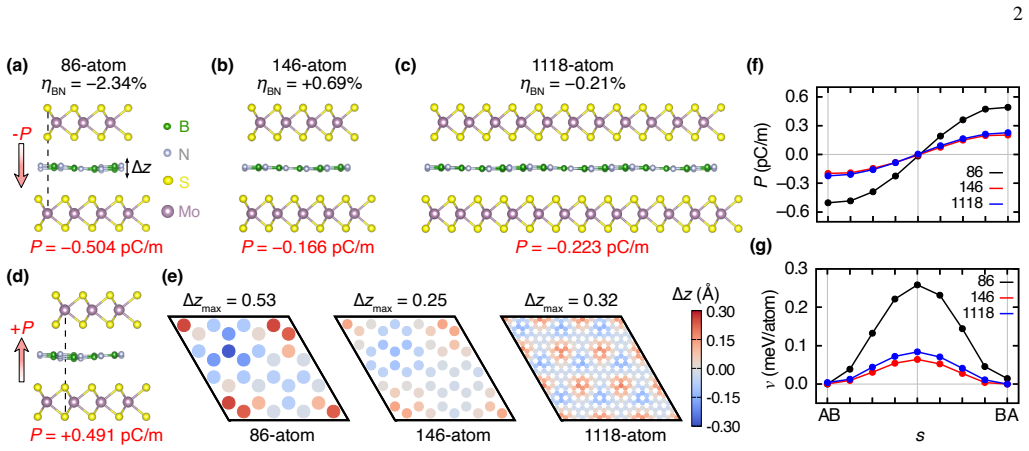
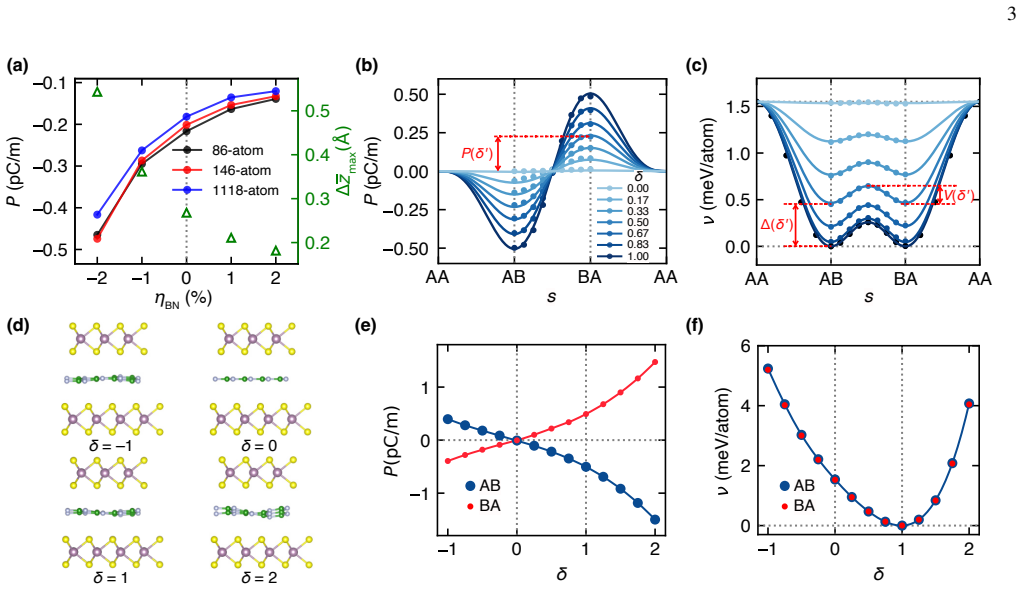
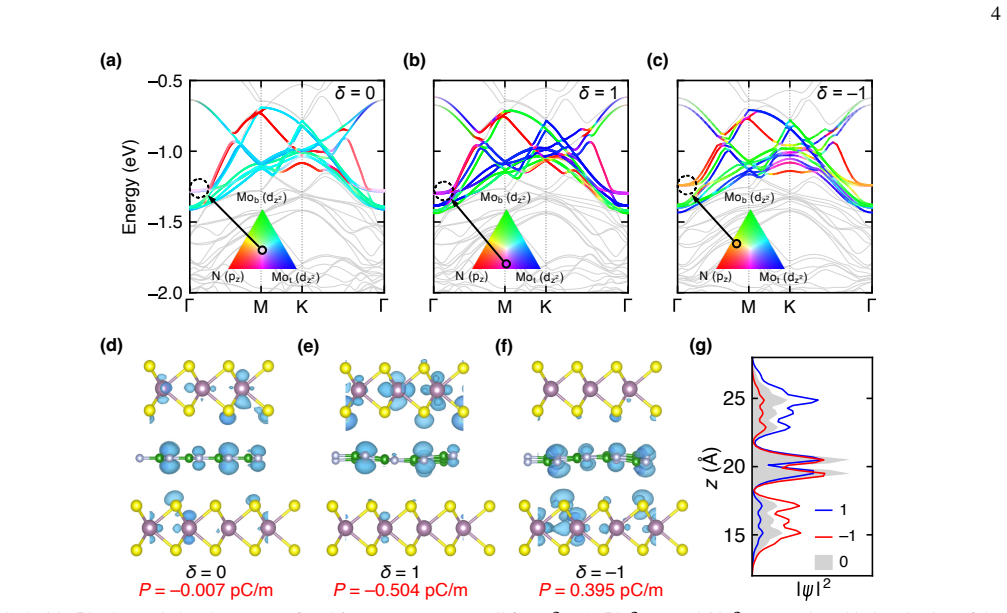
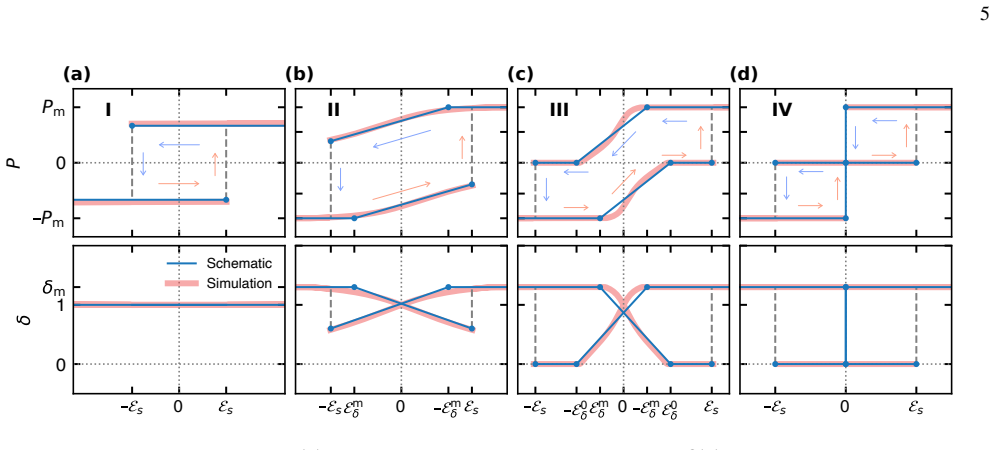
SL-sFEs are fundamentally different from conventional sFEs: polarization is not driven by sliding alone, but by an intricate coupling between interlayer sliding and the out-of-plane buckling of the spacer layer. This coupling results in a unique hybrid electronic-ionic polarization arising from asymmetric orbital hybridization. The interplay of these order parameters generates several distinct types of ferroelectric hysteresis, including mixed first- and second-order transitions, multi-step switching, and antiferroelectric-like behavior.
What carries the argument
Coupling between interlayer sliding and out-of-plane buckling of the incommensurate spacer layer that generates hybrid electronic-ionic polarization via asymmetric orbital hybridization.
If this is right
- SL-sFEs establish a distinct class of ferroelectrics.
- Multiple hysteresis types including mixed first- and second-order transitions become possible.
- Multi-step switching and antiferroelectric-like behavior can be realized.
- The polarization survives across decoupled outer layers due to the spacer's role.
Where Pith is reading between the lines
- Choosing different spacer materials could tune the buckling and thus the polarization strength.
- This hybrid mechanism might reduce switching barriers further in practical devices.
- Similar coupling effects could appear in other layered materials with incommensurate interfaces.
- Thermal stability of the buckling needs verification for room-temperature applications.
Load-bearing premise
An incommensurate spacer layer will buckle out-of-plane in a way that couples to sliding and creates net polarization from asymmetric orbital hybridization.
What would settle it
If experiments show no buckling in the spacer or no polarization when sliding occurs with an incommensurate spacer, the claim would be falsified.
Figures
read the original abstract
One strategy to lower the switching barrier in a sliding ferroelectric (sFE) is to insert an incommensurate spacer to reduce sliding friction, creating a superlubric sliding ferroelectric (SL-sFE). However, how polarization survives across the effectively decoupled outer layers remains an open question. We show that SL-sFEs are fundamentally different from conventional sFEs: polarization is not driven by sliding alone, but by an intricate coupling between interlayer sliding and the out-of-plane buckling of the spacer layer. This coupling results in a unique hybrid electronic-ionic polarization arising from asymmetric orbital hybridization. The interplay of these order parameters generates several distinct types of ferroelectric hysteresis, including mixed first- and second-order transitions, multi-step switching, and antiferroelectric-like behavior, establishing SL-sFEs as a distinct class of ferroelectrics.
Editorial analysis
A structured set of objections, weighed in public.
Referee Report
Summary. The manuscript proposes that inserting an incommensurate spacer into sliding ferroelectrics creates superlubric sliding ferroelectrics (SL-sFEs) in which polarization arises not from sliding alone but from coupling between interlayer sliding and out-of-plane buckling of the spacer. This coupling is said to produce a hybrid electronic-ionic polarization via asymmetric orbital hybridization, which in turn generates distinct hysteresis behaviors including mixed first- and second-order transitions, multi-step switching, and antiferroelectric-like response, thereby establishing SL-sFEs as a new class distinct from conventional sFEs.
Significance. If the mechanism can be placed on a quantitative footing with a concrete material system and verified stability against thermal fluctuations, the work would identify a route to low-friction ferroelectric switching with potentially novel order-parameter interplay. At present the significance remains prospective because the central structural assumption is stated without supporting calculations or examples.
major comments (2)
- [Abstract] Abstract: the claim that polarization 'is not driven by sliding alone, but by an intricate coupling between interlayer sliding and the out-of-plane buckling of the spacer layer' is load-bearing for the asserted distinction from conventional sFEs and for the predicted mixed-order hysteresis; however, no spacer material, interaction potential, buckling amplitude, or thermal-stability criterion is supplied, so the premise cannot be evaluated.
- [Abstract] Abstract: the statement that the coupling 'results in a unique hybrid electronic-ionic polarization arising from asymmetric orbital hybridization' is presented without any derivation, orbital-overlap calculation, or simulation protocol; without these the link between buckling and net polarization remains unverified and the classification of hysteresis types cannot be assessed.
minor comments (2)
- The abstract introduces the acronyms sFE and SL-sFE without spelling them out on first use.
- The abstract refers to 'several distinct types of ferroelectric hysteresis' but does not indicate whether these are illustrated by explicit energy landscapes or polarization loops in the manuscript.
Simulated Author's Rebuttal
We thank the referee for the careful reading of our manuscript and the constructive comments. Our work introduces SL-sFEs as a distinct class based on the coupling mechanism. We respond to each major comment below.
read point-by-point responses
-
Referee: [Abstract] Abstract: the claim that polarization 'is not driven by sliding alone, but by an intricate coupling between interlayer sliding and the out-of-plane buckling of the spacer layer' is load-bearing for the asserted distinction from conventional sFEs and for the predicted mixed-order hysteresis; however, no spacer material, interaction potential, buckling amplitude, or thermal-stability criterion is supplied, so the premise cannot be evaluated.
Authors: The manuscript presents a general theoretical model for the SL-sFE mechanism without tying it to a specific material system. The coupling between sliding and buckling is derived from the incommensurate nature of the spacer and the resulting structural relaxation, as described in the main text. The distinction and hysteresis behaviors follow from this model. We will revise the abstract to clarify that the supporting analysis is provided in the body of the paper. revision: partial
-
Referee: [Abstract] Abstract: the statement that the coupling 'results in a unique hybrid electronic-ionic polarization arising from asymmetric orbital hybridization' is presented without any derivation, orbital-overlap calculation, or simulation protocol; without these the link between buckling and net polarization remains unverified and the classification of hysteresis types cannot be assessed.
Authors: The derivation of the hybrid polarization from asymmetric orbital hybridization is detailed in the main text through model calculations that demonstrate the symmetry breaking and resulting polarization. The hysteresis classifications are obtained from the coupled order parameter dynamics. The abstract summarizes these results, and we will update it to reference the relevant sections for clarity. revision: partial
- Providing a concrete material system with quantitative calculations and verification of thermal stability, as the current work focuses on the general mechanism rather than specific implementations.
Circularity Check
No circularity detected; derivation rests on structural assumption about buckling rather than self-referential reduction.
full rationale
The provided abstract and context present a theoretical claim that SL-sFEs differ from conventional sFEs due to coupling between sliding and spacer buckling producing hybrid polarization via asymmetric orbital hybridization. No equations, parameter fits, self-citations, or uniqueness theorems are quoted that would make any prediction equivalent to its inputs by construction. The load-bearing premise is an unquantified assumption about buckling occurrence and stability, which concerns model validity and falsifiability rather than circular derivation. The paper's central classification is therefore self-contained as a proposed mechanism without reducing to fitted inputs or self-citation chains.
Axiom & Free-Parameter Ledger
Reference graph
Works this paper leans on
-
[1]
Li and M
L. Li and M. Wu, ACS Nano11, 6382 (2017)
2017
-
[2]
Yasuda, X
K. Yasuda, X. Wang, K. Watanabe, T. Taniguchi, and P. Jarillo- Herrero, Science372, 1458 (2021)
2021
-
[3]
M. V . Stern, Y . Waschitz, W. Cao, I. Nevo, K. Watanabe, T. Taniguchi, E. Sela, M. Urbakh, O. Hod, and M. B. Shalom, Science372, 1462 (2021)
2021
-
[4]
Yasuda, E
K. Yasuda, E. Zalys-Geller, X. Wang, D. Bennett, S. S. Cheema, K. Watanabe, T. Taniguchi, E. Kaxiras, P. Jarillo- Herrero, and R. Ashoori, Science385, 53 (2024)
2024
-
[5]
R. Bian, R. He, E. Pan, Z. Li, G. Cao, P. Meng, J. Chen, Q. Liu, Z. Zhong, W. Li, and F. Liu, Science385, 57 (2024)
2024
-
[8]
X. Wang, K. Yasuda, Y . Zhang, S. Liu, K. Watanabe, T. Taniguchi, J. Hone, L. Fu, and P. Jarillo-Herrero, Nat. Nan- otechnol.17, 367 (2022)
2022
-
[9]
Weston, E
A. Weston, E. G. Castanon, V . Enaldiev, F. Ferreira, S. Bhat- tacharjee, S. Xu, H. Corte-Le ´on, Z. Wu, N. Clark, A. Summer- field,et al., Nat. Nanotechnol.17, 390 (2022)
2022
-
[10]
Molino, L
L. Molino, L. Aggarwal, V . Enaldiev, R. Plumadore, V . I. Falko, and A. Luican-Mayer, Adv. Mater.35, 2207816 (2023)
2023
-
[11]
Van Winkle, N
M. Van Winkle, N. Dowlatshahi, N. Khaloo, M. Iyer, I. M. Craig, R. Dhall, T. Taniguchi, K. Watanabe, and D. K. Bediako, Nat. Nanotechnol. , 1 (2024)
2024
-
[12]
X. Wang, C. Xu, S. Aronson, D. Bennett, N. Paul, P. J. Crowley, C. Collignon, K. Watanabe, T. Taniguchi, R. Ashoori,et al., Nat. Commun.16, 178 (2025)
2025
-
[13]
K. Ko, A. Yuk, R. Engelke, S. Carr, J. Kim, D. Park, H. Heo, H.-M. Kim, S.-G. Kim, H. Kim,et al., Nat. Mater. , 1 (2023)
2023
-
[14]
Bennett and P
D. Bennett and P. Ghosez, Phys. Rev. B110, L041101 (2024)
2024
-
[16]
Bennett, G
D. Bennett, G. Chaudhary, R.-J. Slager, E. Bousquet, and P. Ghosez, Nat. Commun.14, 1629 (2023)
2023
-
[17]
Bennett, W
D. Bennett, W. J. Jankowski, G. Chaudhary, E. Kaxiras, and R.-J. Slager, Phys. Rev. Res.5, 033216 (2023)
2023
-
[18]
W. J. Jankowski, D. Bennett, A. Agarwal, G. Chaudhary, and R.-J. Slager, Phys. Rev. B110, 085429 (2024)
2024
-
[19]
T.-H.-Y . Vu, D. Bennett, G. N. Pallewella, M. H. Uddin, K. Xing, W. Zhao, S. H. Lee, Z. Mao, J. B. Muir, L. Jia, J. A. Davis, K. Watanabe, T. Taniguchi, S. Adam, P. Sharma, M. S. Fuhrer, and M. T. Edmonds, arxiv:2405.15126 (2024). 6
arXiv 2024
-
[20]
Sivadas, S
N. Sivadas, S. Okamoto, X. Xu, C. J. Fennie, and D. Xiao, Nano Lett.18, 7658 (2018)
2018
-
[21]
S. P. Poudel, J. M. Marmolejo-Tejada, J. E. Roll, M. A. Mos- quera, and S. Barraza-Lopez, Phys. Rev. B107, 195128 (2023)
2023
-
[22]
Bennett, G
D. Bennett, G. Mart´ınez-Carracedo, X. He, J. Ferrer, P. Ghosez, R. Comin, and E. Kaxiras, Phys. Rev. Lett.133, 246703 (2024)
2024
-
[23]
Wang and S
Z. Wang and S. Dong, Phys. Rev. B111, L201406 (2025)
2025
-
[24]
C. Ke, F. Liu, and S. Liu, Phys. Rev. Lett.135, 046201 (2025)
2025
-
[25]
Engelke, H
R. Engelke, H. Yoo, S. Carr, K. Xu, P. Cazeaux, R. Allen, A. M. Valdivia, M. Luskin, E. Kaxiras, M. Kim, J. H. Han, and P. Kim, Phys. Rev. B107, 125413 (2023)
2023
-
[26]
Yang and M
Z. Yang and M. Wu, Appl. Phys. Rev.12(2025)
2025
-
[27]
Henkelman, B
G. Henkelman, B. P. Uberuaga, and H. J´onsson, J. Chem. Phys. 113, 9901 (2000)
2000
-
[28]
Kaxiras and M
E. Kaxiras and M. S. Duesbery, Phys. Rev. Lett.70, 3752 (1993)
1993
-
[29]
S. Carr, D. Massatt, S. B. Torrisi, P. Cazeaux, M. Luskin, and E. Kaxiras, Phys. Rev. B98, 224102 (2018). Hybrid Electronic-Ionic Ferroelectricity in Superlubric van der Waals Heterostructures Jing Huang, 1,∗Jun Kang, 2, 3 and Daniel Bennett 1, † 1School of Electrical and Electronic Engineering, Nanyang Technological University Singapore, 50 Nanyang Avenu...
2018
-
[30]
The first term is the stacking energy, or cohesive energy between the layers, which depends primarily ons, but it also influenced by bucklingδ
and domain wall (DW, (s= 1 2)), and is sufficient to obtain a good description of the system for alls[7, 8]. The first term is the stacking energy, or cohesive energy between the layers, which depends primarily ons, but it also influenced by bucklingδ. Assuming a separation of variables, we write the stacking energy as Vstack(s,δ) =V(δ) ∑ n Φ e n(s).(2) Φ...
-
[31]
Calculations were performed between the AB and BA stackings, except forδ=1, where the entire unit cell diagonal was parametrized
The data shows results obtained from first-principles calculations, and the solid lines show the corresponding fit of the model. Calculations were performed between the AB and BA stackings, except forδ=1, where the entire unit cell diagonal was parametrized. The model yields a good fit to the first-principles calculations along the entire unit cell diagon...
-
[32]
Kresse and J
G. Kresse and J. Furthm ¨uller, Phys. Rev. B54, 11169 (1996)
1996
-
[33]
J. P. Perdew, K. Burke, and M. Ernzerhof, Phys. Rev. Lett.77, 3865 (1996)
1996
-
[34]
Grimme, J
S. Grimme, J. Chem. Phys.27, 1787 (2006)
2006
-
[35]
Neugebauer and M
J. Neugebauer and M. Scheffler, Phys. Rev. B46, 16067 (1992)
1992
-
[36]
Henkelman, B
G. Henkelman, B. P. Uberuaga, and H. J ´onsson, J. Chem. Phys.113, 9901 (2000)
2000
-
[37]
R. D. King-Smith and D. Vanderbilt, Phys. Rev. B47, 1651 (1993)
1993
-
[38]
Bennett and B
D. Bennett and B. Remez, npj 2D Mater. Appl.6, 1 (2022)
2022
-
[39]
Bennett, Phys
D. Bennett, Phys. Rev. B105, 235445 (2022)
2022
-
[40]
Ramos-Alonso, B
A. Ramos-Alonso, B. Remez, D. Bennett, R. M. Fernandes, and H. Ochoa, Phys. Rev. Lett.134, 026501 (2025)
2025
discussion (0)
Sign in with ORCID, Apple, or X to comment. Anyone can read and Pith papers without signing in.