Dual-Stream EEG Decoding for 3D Visual Perception
Pith reviewed 2026-06-26 12:07 UTC · model grok-4.3
The pith
A dual-stream EEG decoder extracts both object identity and continuous 3D orientation to support neural 3D reconstruction.
A machine-rendered reading of the paper's core claim, the machinery that carries it, and where it could break.
Core claim
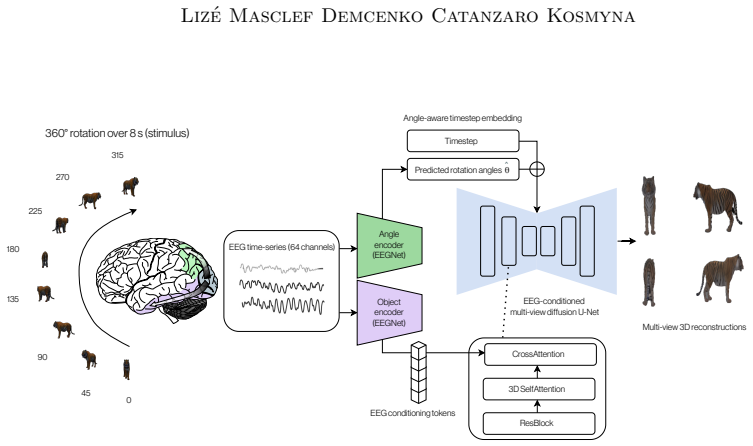
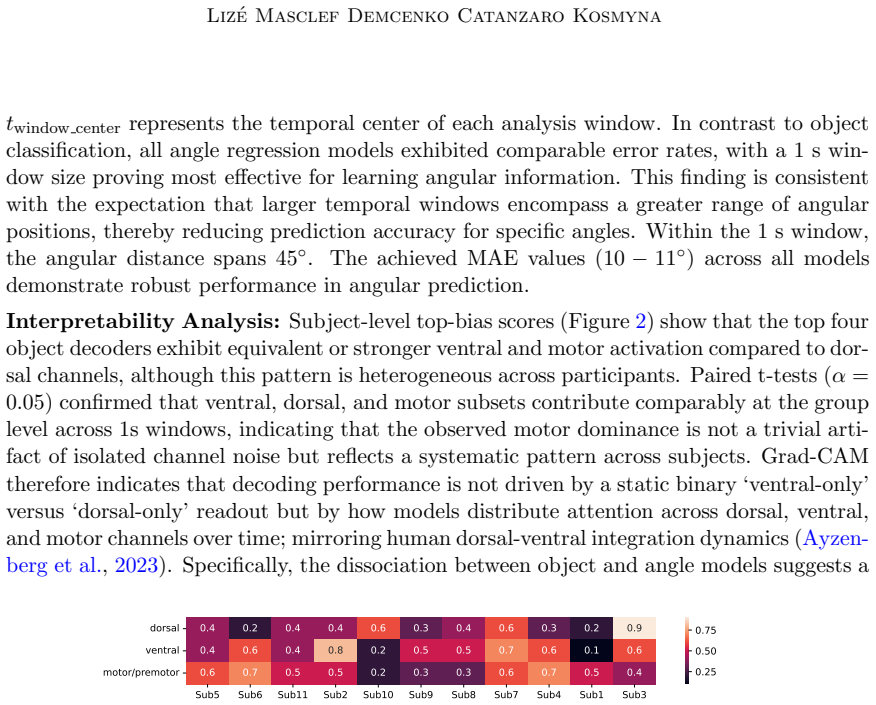
A dual-pathway architecture mirroring ventral and dorsal streams implements separate decoding modules for object identity and spatial orientation during continuous rotations; circular regression predicts angle while an EEG-conditioned multiview diffusion model produces 3D reconstructions, and channel analyses reveal temporally structured contributions from ventral, dorsal, and motor-related signals instead of static ventral dominance.
What carries the argument
Dual-stream decoder with one identity pathway and one circular-regression orientation pathway, followed by EEG-conditioned multiview diffusion for reconstruction.
If this is right
- EEG signals during object rotation contain separable information about both identity and continuous orientation.
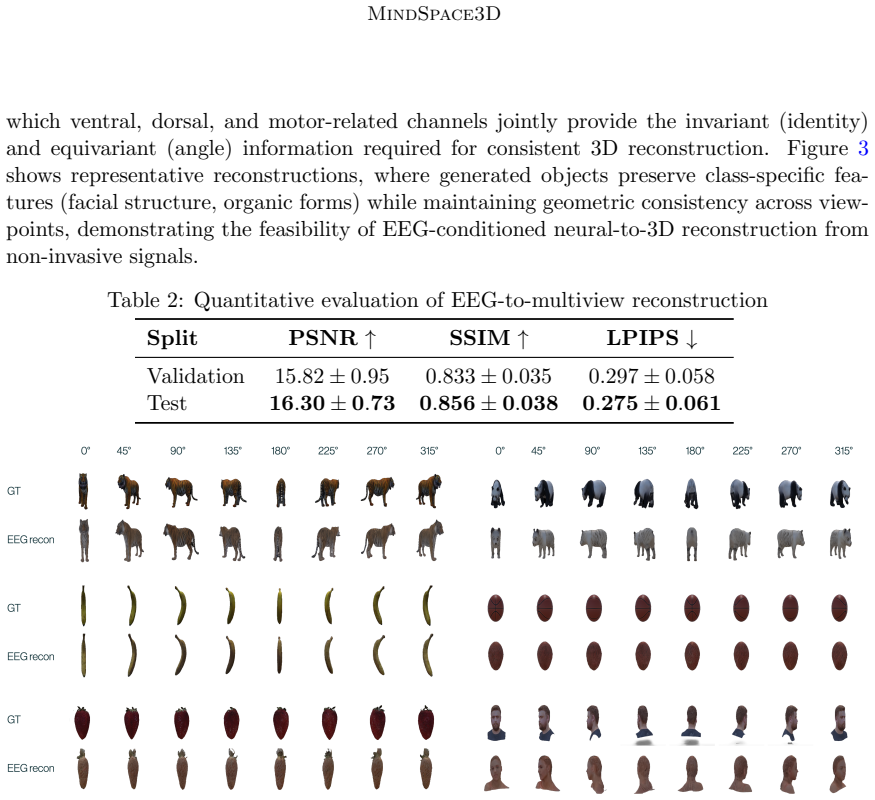
- Neural activity can condition a diffusion process to output 3D shape reconstructions without intermediate image generation.
- Channel contributions to decoding shift across time rather than remaining fixed to one visual stream.
- Motor-related channels participate alongside ventral and dorsal channels during the task.
Where Pith is reading between the lines
- The same dual-stream separation could be tested on EEG data from static viewing to check whether rotation is required for the temporal structure to appear.
- If the angle decoder generalizes across objects, it could support viewpoint-invariant 3D reconstruction pipelines.
- The observed timing differences suggest experiments that disrupt specific time windows to test causal roles of each channel group.
Load-bearing premise
Splitting the model into separate ventral-like and dorsal-like streams produces independent, usable signals for both identity and continuous angle from the same EEG recordings.
What would settle it
A controlled comparison in which a single shared decoder matches or exceeds the dual-stream model's accuracy on both identity classification and angle regression on the identical EEG dataset would falsify the need for the split.
Figures
read the original abstract
This paper explores a novel brain decoding model for 3D shape perception through a dual pathway architecture mirroring biological vision. Our bio-inspired approach implements separate decoding modules for object identity and spatial orientation, inspired by ventral and dorsal pathways, during continuous rotations. We employ circular regression for angle prediction and develop EEG-conditioned multiview diffusion for 3D reconstruction. Our approach successfully decodes both object identity and spatial orientation from EEG signals and enables 3D reconstruction from neural activity, with interpretability analyses revealing temporally structured involvement of ventral, dorsal, and motor-related channels rather than a static ventral dominance in supporting object and angle decoding.
Editorial analysis
A structured set of objections, weighed in public.
Referee Report
Summary. The paper proposes a dual-stream EEG decoding architecture inspired by ventral and dorsal visual pathways to separately decode object identity and spatial orientation from EEG signals recorded during continuous 3D object rotations. It employs circular regression for angle prediction and an EEG-conditioned multiview diffusion model for 3D reconstruction from neural activity. The central claims are successful decoding of both identity and orientation, enabling 3D reconstruction, and interpretability results showing temporally structured involvement of ventral, dorsal, and motor channels rather than static ventral dominance.
Significance. If the quantitative results and ablations support the claims, the work would advance EEG-based 3D perception decoding by providing a bio-inspired separable architecture and a new reconstruction pipeline, with potential implications for BCI and understanding stream-specific temporal dynamics in visual processing.
major comments (1)
- [Abstract] Abstract: The central claim of successful decoding and reconstruction is asserted without any reported metrics, baselines, error bars, participant numbers, or method implementation details, rendering the claim unevaluable from the supplied text and preventing assessment of whether the dual-stream design delivers separable signals.
Simulated Author's Rebuttal
We thank the referee for their comments. We address the concern about the abstract below and will revise accordingly to improve evaluability.
read point-by-point responses
-
Referee: [Abstract] Abstract: The central claim of successful decoding and reconstruction is asserted without any reported metrics, baselines, error bars, participant numbers, or method implementation details, rendering the claim unevaluable from the supplied text and preventing assessment of whether the dual-stream design delivers separable signals.
Authors: We agree that the provided abstract does not contain quantitative metrics, baselines, error bars, participant numbers or implementation details, which limits immediate evaluation of the claims from the abstract alone. The full manuscript reports these details in the results and methods sections, including identity decoding accuracy, circular regression angular errors, reconstruction metrics, participant count, and ablations demonstrating separable ventral/dorsal contributions. We will revise the abstract to incorporate the key quantitative results and participant information from the paper to make the central claims directly evaluable while preserving brevity. revision: yes
Circularity Check
No circularity in derivation chain
full rationale
The supplied abstract and description contain no equations, derivations, or analytical steps that could reduce to self-definition, fitted inputs renamed as predictions, or self-citation load-bearing claims. The work describes an empirical bio-inspired neural architecture for EEG decoding and 3D reconstruction; central claims rest on experimental results rather than any closed mathematical chain. No load-bearing premise is justified solely by prior self-citation or ansatz smuggling. This is the expected outcome for an applied ML paper lacking formal derivations.
Axiom & Free-Parameter Ledger
Reference graph
Works this paper leans on
-
[1]
Lizé Masclef, Ninon and Demcenko, Taisija and Catanzaro, Antonella and Kosmyna, Nataliya , year =. Dual-. Proceedings of
-
[2]
Onoo, Shunsuke and Nagano, Yoshihiro and Kamitani, Yukiyasu , year =. Readout. doi:10.48550/ARXIV.2510.12228 , abstract =
-
[3]
International Association for the Study of Dreams 40th Annual Dream Conference , author =
Reconstructing the. International Association for the Study of Dreams 40th Annual Dream Conference , author =
-
[4]
Brain-Computer Interfaces , author =
Riemannian geometry for. Brain-Computer Interfaces , author =. 2017 , pages =. doi:10.1080/2326263X.2017.1297192 , language =
-
[5]
Kneeland, Reese and Torrico, Cesar and Chen, Tong and Ojeda, Jordyn Antonio and Khanna, Shubh and Xu, Jonathan and Scotti, Paul Steven and Naselaris, Thomas , month = oct, year =
-
[6]
Journal of Cognitive Neuroscience , author =
Using. Journal of Cognitive Neuroscience , author =. 2022 , pages =. doi:10.1162/jocn_a_01845 , abstract =
-
[7]
The Journal of Neuroscience , author =
Dorsal–. The Journal of Neuroscience , author =. 2009 , pages =. doi:10.1523/JNEUROSCI.4978-08.2009 , abstract =
-
[8]
Cerebral Cortex Communications , author =
Temporal asymmetries and interactions between dorsal and ventral visual pathways during object recognition , volume =. Cerebral Cortex Communications , author =. 2023 , pages =. doi:10.1093/texcom/tgad003 , abstract =
-
[9]
Wang, Haibao and Ho, Jun Kai and Cheng, Fan L. and Aoki, Shuntaro C. and Muraki, Yusuke and Tanaka, Misato and Park, Jong-Yun and Kamitani, Yukiyasu , month = jul, year =. Inter-individual and inter-site neural code conversion without shared stimuli , volume =. Nature Computational Science , publisher =. doi:10.1038/s43588-025-00826-5 , abstract =
-
[10]
Inter-individual deep image reconstruction via hierarchical neural code conversion , volume =. NeuroImage , author =. 2023 , keywords =. doi:10.1016/j.neuroimage.2023.120007 , abstract =
-
[11]
Inter-subject neural code converter for visual image representation , volume =. NeuroImage , author =. 2015 , keywords =. doi:10.1016/j.neuroimage.2015.03.059 , abstract =
-
[12]
Constraints on an external reality under the simulation hypothesis , abstract =
-
[13]
Meaning is perspectival and associated with physical action , language =
-
[14]
Cognitive and Behavioral Neurology , author =
Consciousness as a. Cognitive and Behavioral Neurology , author =. 2022 , pages =. doi:10.1097/WNN.0000000000000319 , abstract =
-
[15]
Schreiner, Leonhard and Sieghartsleitner, Sebastian and La Rosa, Matteo and Tanackovic, Slobodan and Pretl, Harald and Colamarino, Emma and Guger, Christoph , month = oct, year =. Advancing. 2024. doi:10.1109/MetroXRAINE62247.2024.10796840 , abstract =
-
[16]
Epoché Magazine , author =
Gilbert. Epoché Magazine , author =
-
[17]
Journal of Mathematical Neuroscience , author =
Rendering neuronal state equations compatible with the principle of stationary action , volume =. Journal of Mathematical Neuroscience , author =. 2021 , pages =. doi:10.1186/s13408-021-00108-0 , abstract =
-
[18]
Theoretical Computer Science , author =
The principle of least cognitive action , volume =. Theoretical Computer Science , author =. 2016 , keywords =. doi:10.1016/j.tcs.2015.06.042 , abstract =
-
[19]
Khona, Mikail and Fiete, Ila R. , month = mar, year =. Attractor and integrator networks in the brain , url =. doi:10.48550/arXiv.2112.03978 , abstract =
-
[21]
Sieghartsleitner, Sebastian and Schreiner, Leonhard and Grünwald, Johannes and Jordan, Michael and Spataro, Rossella and Scharinger, Josef and Guger, Christoph , month = sep, year =. Decoding of image properties from single-trial visual evoked potentials recorded by ultra-high-density. Scientific Reports , publisher =. doi:10.1038/s41598-025-18275-5 , abstract =
-
[22]
Neuroscience & Biobehavioral Reviews , author =
Sleep and dreaming in the light of reactive and predictive homeostasis , volume =. Neuroscience & Biobehavioral Reviews , author =. 2023 , keywords =. doi:10.1016/j.neubiorev.2023.105104 , abstract =
-
[23]
Holmes, Jeremy and Nolte, Tobias , month = mar, year =. “. Frontiers in Psychology , publisher =. doi:10.3389/fpsyg.2019.00592 , abstract =
-
[24]
Psychoanalytic psychotherapies and the free energy principle , volume =
Rabeyron, Thomas , month = aug, year =. Psychoanalytic psychotherapies and the free energy principle , volume =. Frontiers in Human Neuroscience , publisher =. doi:10.3389/fnhum.2022.929940 , abstract =
-
[25]
Frontiers in Psychology , author =
Free. Frontiers in Psychology , author =. 2016 , pages =. doi:10.3389/fpsyg.2016.00922 , abstract =
-
[26]
Jha, Rishi and Zhang, Collin and Shmatikov, Vitaly and Morris, John X. , month = jun, year =. Harnessing the. doi:10.48550/arXiv.2505.12540 , abstract =
-
[27]
Huh, Minyoung and Cheung, Brian and Wang, Tongzhou and Isola, Phillip , month = jul, year =. The. doi:10.48550/arXiv.2405.07987 , abstract =
work page internal anchor Pith review Pith/arXiv arXiv doi:10.48550/arxiv.2405.07987
-
[28]
Pillai, Ajay S. and Jirsa, Viktor K. , month = jun, year =. Symmetry. Neuron , publisher =. doi:10.1016/j.neuron.2017.05.013 , language =
-
[29]
Annual review of neuroscience , author =
Computation. Annual review of neuroscience , author =. 2020 , pages =. doi:10.1146/annurev-neuro-092619-094115 , abstract =
-
[30]
Is perception discrete or continuous? , volume =
VanRullen, Rufin and Koch, Christof , month = may, year =. Is perception discrete or continuous? , volume =. Trends in Cognitive Sciences , publisher =. doi:10.1016/S1364-6613(03)00095-0 , language =
-
[31]
Thermodynamics of feedback controlled systems , volume =. Physical Review E , author =. 2009 , note =. doi:10.1103/PhysRevE.79.041118 , abstract =
-
[32]
Rovelli, Carlo , month = mar, year =. Memory and entropy , url =. doi:10.48550/arXiv.2003.06687 , abstract =
-
[33]
Optimal transport for machine learning -
-
[34]
Peyré, Gabriel and Cuturi, Marco , month = mar, year =. Computational. doi:10.48550/arXiv.1803.00567 , abstract =
-
[35]
Topics in optimal transportation , isbn =
Villani, Cédric , year =. Topics in optimal transportation , isbn =
-
[36]
An invitation to optimal transport,
Figalli, Alessio and Glaudo, Federico , year =. An invitation to optimal transport,
-
[37]
Recent. IEEE Trans. Pattern Anal. Mach. Intell. , author =. 2025 , pages =. doi:10.1109/TPAMI.2024.3489030 , abstract =
-
[38]
Advances in optimal transport and applications to neuroscience , abstract =
-
[39]
IEEE transactions on bio-medical engineering , author =
Transfer. IEEE transactions on bio-medical engineering , author =. 2022 , keywords =. doi:10.1109/TBME.2021.3105912 , abstract =
-
[40]
LoRA: Low-Rank Adaptation of Large Language Models
Hu, Edward J. and Shen, Yelong and Wallis, Phillip and Allen-Zhu, Zeyuan and Li, Yuanzhi and Wang, Shean and Wang, Lu and Chen, Weizhu , month = oct, year =. doi:10.48550/arXiv.2106.09685 , abstract =
work page internal anchor Pith review Pith/arXiv arXiv doi:10.48550/arxiv.2106.09685
-
[41]
MVDream: Multi-view Diffusion for 3D Generation
Shi, Yichun and Wang, Peng and Ye, Jianglong and Long, Mai and Li, Kejie and Yang, Xiao , month = apr, year =. doi:10.48550/arXiv.2308.16512 , abstract =
work page internal anchor Pith review Pith/arXiv arXiv doi:10.48550/arxiv.2308.16512
-
[42]
, month = may, year =
Luck, Steven J. , month = may, year =. An
-
[43]
Practical Bayesian Optimization of Machine Learning Algorithms
Snoek, Jasper and Larochelle, Hugo and Adams, Ryan P. , month = aug, year =. Practical. doi:10.48550/arXiv.1206.2944 , abstract =
work page internal anchor Pith review Pith/arXiv arXiv doi:10.48550/arxiv.1206.2944
-
[44]
Scientific Reports , publisher =
Zhao, Wei and Jiang, Xiaolu and Zhang, Baocan and Xiao, Shixiao and Weng, Sujun , month = aug, year =. Scientific Reports , publisher =. doi:10.1038/s41598-024-71118-7 , abstract =
-
[46]
Journal of Neurophysiology , author =
Integration of. Journal of Neurophysiology , author =. 2001 , pages =. doi:10.1152/jn.2001.86.6.2856 , abstract =
-
[47]
Evidence of a predictive coding hierarchy in the human brain listening to speech , volume =
Caucheteux, Charlotte and Gramfort, Alexandre and King, Jean-Rémi , month = mar, year =. Evidence of a predictive coding hierarchy in the human brain listening to speech , volume =. Nature Human Behaviour , publisher =. doi:10.1038/s41562-022-01516-2 , abstract =
-
[48]
DeepSDF: Learning Continuous Signed Distance Functions for Shape Representation
Park, Jeong Joon and Florence, Peter and Straub, Julian and Newcombe, Richard and Lovegrove, Steven , month = jan, year =. doi:10.48550/arXiv.1901.05103 , abstract =
work page internal anchor Pith review Pith/arXiv arXiv doi:10.48550/arxiv.1901.05103 1901
-
[49]
IEEE Transactions on Neural Networks and Learning Systems , author =
Spatio-. IEEE Transactions on Neural Networks and Learning Systems , author =. 2021 , keywords =. doi:10.1109/TNNLS.2020.3048385 , abstract =
-
[50]
ResearchGate , month = aug, year =
(. ResearchGate , month = aug, year =. doi:10.1016/j.cad.2011.04.008 , abstract =
-
[51]
Experimental Brain Research , author =
Source locations of pattern-specific components of human visual evoked potentials. Experimental Brain Research , author =. 1972 , keywords =. doi:10.1007/BF00233371 , language =
-
[52]
A new neural framework for visuospatial processing , volume =. Nature Reviews. Neuroscience , author =. 2011 , keywords =. doi:10.1038/nrn3008 , abstract =
-
[53]
Nature Neuroscience , author =
Patches of face-selective cortex in the macaque frontal lobe , volume =. Nature Neuroscience , author =. 2008 , keywords =. doi:10.1038/nn.2158 , abstract =
-
[54]
Weiler, Maurice and Cesa, Gabriele , month = apr, year =. General \. doi:10.48550/arXiv.1911.08251 , abstract =
-
[55]
Group Equivariant Convolutional Networks
Cohen, Taco S. and Welling, Max , month = jun, year =. Group. doi:10.48550/arXiv.1602.07576 , abstract =
work page internal anchor Pith review Pith/arXiv arXiv doi:10.48550/arxiv.1602.07576
-
[56]
Tensor field networks: Rotation- and translation-equivariant neural networks for 3D point clouds
Thomas, Nathaniel and Smidt, Tess and Kearnes, Steven and Yang, Lusann and Li, Li and Kohlhoff, Kai and Riley, Patrick , month = may, year =. Tensor field networks:. doi:10.48550/arXiv.1802.08219 , abstract =
work page internal anchor Pith review Pith/arXiv arXiv doi:10.48550/arxiv.1802.08219
-
[57]
and Tancik, Matthew and Barron, Jonathan T
Mildenhall, Ben and Srinivasan, Pratul P. and Tancik, Matthew and Barron, Jonathan T. and Ramamoorthi, Ravi and Ng, Ren , month = aug, year =. doi:10.48550/arXiv.2003.08934 , abstract =
-
[58]
Inductive Representation Learning on Large Graphs
Hamilton, William L. and Ying, Rex and Leskovec, Jure , month = sep, year =. Inductive. doi:10.48550/arXiv.1706.02216 , abstract =
work page internal anchor Pith review Pith/arXiv arXiv doi:10.48550/arxiv.1706.02216
-
[59]
Semi-Supervised Classification with Graph Convolutional Networks
Kipf, Thomas N. and Welling, Max , month = feb, year =. Semi-. doi:10.48550/arXiv.1609.02907 , abstract =
work page internal anchor Pith review Pith/arXiv arXiv doi:10.48550/arxiv.1609.02907
-
[60]
Zhao, Hengshuang and Jiang, Li and Jia, Jiaya and Torr, Philip and Koltun, Vladlen , month = sep, year =. Point. doi:10.48550/arXiv.2012.09164 , abstract =
-
[61]
Maturana, Daniel and Scherer, Sebastian , month = sep, year =. 2015. doi:10.1109/IROS.2015.7353481 , abstract =
-
[62]
Experimental Brain Research , author =
Flow of activation from. Experimental Brain Research , author =. 2002 , keywords =. doi:10.1007/s00221-001-0906-7 , abstract =
-
[64]
doi:10.48550/arXiv.2410.20981 , abstract =
Xiang, Xin and Zhou, Wenhui and Dai, Guojun , month = nov, year =. doi:10.48550/arXiv.2410.20981 , abstract =
-
[65]
Biological Cybernetics , author =
Neocognitron:. Biological Cybernetics , author =. 1980 , pages =. doi:10.1007/BF00344251 , abstract =
-
[66]
The Journal of Physiology , author =
Receptive fields, binocular interaction and functional architecture in the cat's visual cortex , volume =. The Journal of Physiology , author =. 1962 , keywords =. doi:10.1113/jphysiol.1962.sp006837 , language =
-
[67]
arXiv.org , author =
-
[68]
Cichy, Radoslaw Martin and Khosla, Aditya and Pantazis, Dimitrios and Torralba, Antonio and Oliva, Aude , month = jun, year =. Comparison of deep neural networks to spatio-temporal cortical dynamics of human visual object recognition reveals hierarchical correspondence , volume =. Scientific Reports , publisher =. doi:10.1038/srep27755 , abstract =
-
[69]
Hinton, Geoffrey and Sabour, Sara and Frosst, Nicholas , year =
-
[70]
IEEE Signal Processing Magazine , author =
Geometric deep learning: going beyond. IEEE Signal Processing Magazine , author =. 2017 , note =. doi:10.1109/MSP.2017.2693418 , abstract =
-
[71]
and Vasco, Miguel and Taleb, Farzaneh and Björkman, Mårten and Kragic, Danica , month = jun, year =
Rajabi, Nona and Ribeiro, Antônio H. and Vasco, Miguel and Taleb, Farzaneh and Björkman, Mårten and Kragic, Danica , month = jun, year =. Human-. doi:10.48550/arXiv.2502.03081 , abstract =
-
[73]
Proceedings of the National Academy of Sciences of the United States of America , author =
Performance-optimized hierarchical models predict neural responses in higher visual cortex , volume =. Proceedings of the National Academy of Sciences of the United States of America , author =. 2014 , keywords =. doi:10.1073/pnas.1403112111 , abstract =
-
[74]
PLoS computational biology , author =
Deep supervised, but not unsupervised, models may explain. PLoS computational biology , author =. 2014 , keywords =. doi:10.1371/journal.pcbi.1003915 , abstract =
-
[75]
Güçlü, Umut and Gerven, Marcel A. J. van , month = jul, year =. Deep. Journal of Neuroscience , publisher =. doi:10.1523/JNEUROSCI.5023-14.2015 , abstract =
-
[77]
ResearchGate , month = mar, year =
Evaluation of. ResearchGate , month = mar, year =. doi:10.2466/03.04.22.PMS.113.4.188-200 , abstract =
-
[78]
The Journal of Physiology , author =
Changes in pattern-evoked responses in man associated with the vertical and horizontal meridians of the visual field , volume =. The Journal of Physiology , author =. 1970 , pages =. doi:10.1113/jphysiol.1970.sp009134 , abstract =
-
[79]
Kasai, Tetsuko and Morotomi, Takashi , year =. Event-related brain potentials during selective attention to depth and form in global stereopsis , volume =. Vision Research , publisher =. doi:10.1016/S0042-6989(01)00067-0 , abstract =
-
[80]
and Rosch, E
Palmer, S. and Rosch, E. and Chase, P. , year =. Canonical
-
[81]
Canonical perspective and the perception of objects. , url =
-
[82]
Op de and Torfs, Katrien and Wagemans, Johan , month = oct, year =
Beeck, Hans P. Op de and Torfs, Katrien and Wagemans, Johan , month = oct, year =. Perceived. Journal of Neuroscience , publisher =. doi:10.1523/JNEUROSCI.2511-08.2008 , abstract =
-
[83]
, year =
Torralba, Antonio and Isola, Phillip and Freeman, William T. , year =. Foundations of computer vision , isbn =
-
[84]
Li, Dongyang and Wei, Chen and Li, Shiying and Zou, Jiachen and Qin, Haoyang and Liu, Quanying , month = oct, year =. Visual. doi:10.48550/arXiv.2403.07721 , abstract =
-
[85]
Trends in Neurosciences , author =
Separate visual pathways for perception and action , volume =. Trends in Neurosciences , author =. 1992 , keywords =. doi:10.1016/0166-2236(92)90344-8 , abstract =
discussion (0)
Sign in with ORCID, Apple, or X to comment. Anyone can read and Pith papers without signing in.