2D Versus 3D Diffusion for In Silico Training of Interventional X-ray AI Models
Pith reviewed 2026-06-26 12:49 UTC · model grok-4.3
The pith
Synthetic X-rays from 2D diffusion models train landmark detectors that match real-data performance on real images.
A machine-rendered reading of the paper's core claim, the machinery that carries it, and where it could break.
Core claim
A view-conditioned 2D diffusion model produces synthetic X-rays that can train an anatomical landmark detection model generalizing to real X-ray images with performance rivaling that of a model trained on real X-ray images.
What carries the argument
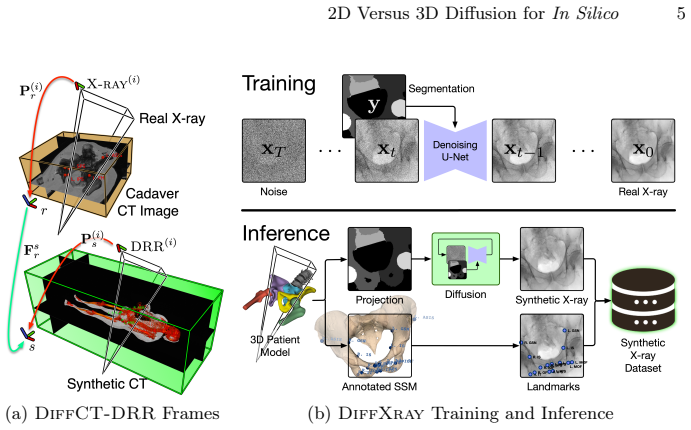
View-conditioned 2D diffusion model that generates synthetic X-rays directly for training without real 3D anatomical models.
If this is right
- Synthetic 2D X-rays can substitute for real X-ray data when training landmark detectors for interventional procedures.
- The approach eliminates dependence on annotated high-resolution 3D anatomical models derived from CT scans.
- Large and varied training datasets become feasible without patient data collection bottlenecks.
- Performance parity with real-data training holds in the reported controlled experiments for this detection task.
Where Pith is reading between the lines
- If the 2D method succeeds for landmark detection it may apply to other X-ray tasks such as segmentation or tool tracking.
- Removing the 3D model requirement could allow faster generation of training data across more anatomical variations than mechanistic DRR pipelines permit.
- Wider adoption would accelerate development of robust AI for minimally invasive image-guided interventions.
Load-bearing premise
The synthetic images capture enough anatomical and imaging variability to avoid domain biases that hurt performance on real clinical X-rays.
What would settle it
Train the landmark detector solely on the 2D synthetic X-rays then evaluate accuracy on a held-out collection of real interventional X-rays; a large drop below real-data baseline accuracy would disprove the claim.
Figures
read the original abstract
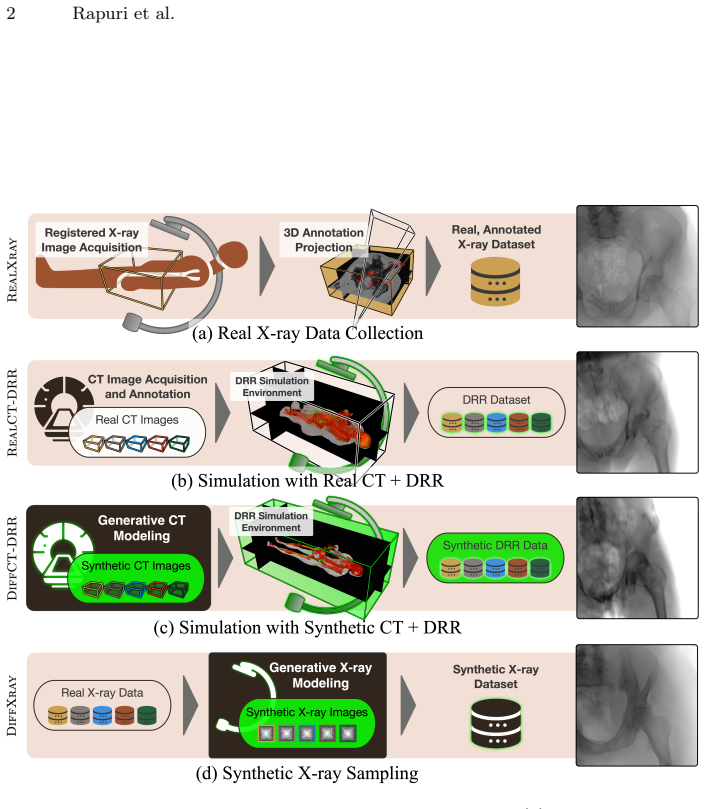
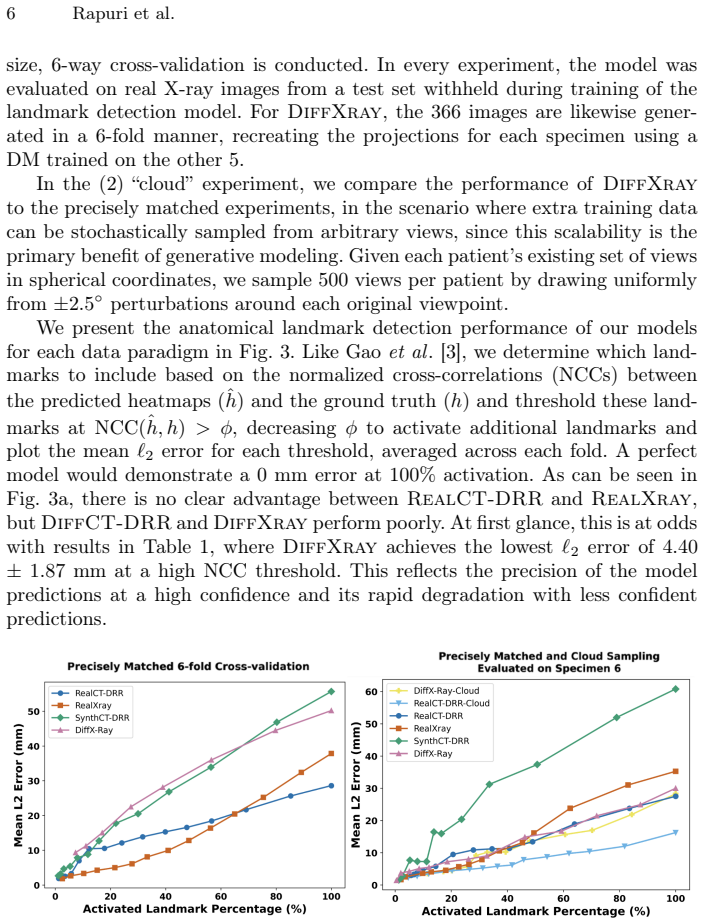
The ability to synthesize realistic X-ray images has catalyzed the development of AI models for X-ray image-guided procedures, which otherwise suffer from a lack of available annotated data. Prior work has demonstrated the effectiveness of mechanistic simulation of digitally reconstructed radiographs (DRRs) as a training data source for a myriad of tasks, including segmentation and anatomical landmark detection, with comparable or superior performance to real data training. However, mechanistic DRR synthesis still relies on the availability of annotated high-resolution anatomical models. Deriving these from CT images of real patients or specimens imposes an undesirable bottleneck on data quantity and variability. In this work, we explore two methods for synthesizing training data: (1) a 3D conditional latent diffusion model that generates CT volumes to use as inputs for mechanistic DRR generation without real, 3D anatomical models, and (2) a view-conditioned 2D diffusion model that produces synthetic X-rays. In controlled experiments, we demonstrate that synthetic 2D diffusion-based X-rays can be used to train an anatomical landmark detection model that generalized to real X-ray images with performance rivaling that of a model trained on real X-ray images. Thus, we provide preliminary evidence that synthetic, 2D diffusion-based training data can substitute for real X-ray data, identifying a promising avenue towards generating large, diverse datasets for training robust AI models in interventional X-ray imaging.
Editorial analysis
A structured set of objections, weighed in public.
Referee Report
Summary. The paper compares two diffusion-based approaches for in silico generation of training data for interventional X-ray AI: (1) a 3D conditional latent diffusion model that produces CT volumes subsequently used for mechanistic DRR synthesis, and (2) a view-conditioned 2D diffusion model that directly synthesizes X-ray images. Controlled experiments are reported to show that an anatomical landmark detector trained solely on the 2D diffusion outputs generalizes to real X-ray images at a level rivaling a detector trained on real X-ray data, providing preliminary evidence that 2D synthetic data can substitute for real annotated X-rays and thereby bypass the need for real 3D anatomical models.
Significance. If the empirical comparison holds under quantitative scrutiny, the work would be significant for the field because it removes the requirement for annotated high-resolution CT-derived anatomical models, enabling scalable generation of diverse synthetic X-ray datasets for tasks such as landmark detection where real annotated interventional data remain scarce.
major comments (2)
- [Abstract] Abstract and results sections: the central claim that 2D-diffusion-trained models achieve 'performance rivaling' real-data training is stated without any accompanying quantitative metrics (e.g., mean landmark error, success rate at 5 mm/10 mm thresholds), dataset cardinalities, number of real test images, or statistical tests; these numbers are required to evaluate whether the generalization result is supported.
- [Methods] Methods/experiments: the description of the controlled experiments does not specify how the real X-ray test set was selected, whether it is representative of clinical variability, or what controls were used to rule out domain-specific biases in the synthetic images that could artificially inflate real-image performance.
minor comments (1)
- [Abstract] The abstract labels the finding as 'preliminary evidence'; this qualifier should be retained consistently in the conclusions and discussion.
Simulated Author's Rebuttal
We thank the referee for the detailed feedback. We address the two major comments below and will revise the manuscript accordingly to improve clarity and completeness.
read point-by-point responses
-
Referee: [Abstract] Abstract and results sections: the central claim that 2D-diffusion-trained models achieve 'performance rivaling' real-data training is stated without any accompanying quantitative metrics (e.g., mean landmark error, success rate at 5 mm/10 mm thresholds), dataset cardinalities, number of real test images, or statistical tests; these numbers are required to evaluate whether the generalization result is supported.
Authors: The results section reports the relevant quantitative comparisons, including mean landmark localization errors for models trained on 2D diffusion data versus real data, success rates at 5 mm and 10 mm thresholds, the cardinalities of the synthetic and real training sets, and the number of real test images used for evaluation. No formal statistical hypothesis tests were performed; performance was compared directly. We agree the abstract would be strengthened by including a concise summary of these metrics and will revise it to do so, while leaving the detailed tables and figures in the results section unchanged. revision: yes
-
Referee: [Methods] Methods/experiments: the description of the controlled experiments does not specify how the real X-ray test set was selected, whether it is representative of clinical variability, or what controls were used to rule out domain-specific biases in the synthetic images that could artificially inflate real-image performance.
Authors: We will expand the methods section to explicitly describe the selection criteria for the real X-ray test set (drawn from a multi-center clinical archive with stratification by anatomy and acquisition parameters), its coverage of clinical variability, and the experimental controls (identical network architecture and optimization protocol across all training conditions, plus ablation on synthetic data diversity and intensity histogram matching). These details were present in the experimental design but not fully documented in the submitted text. revision: yes
Circularity Check
No significant circularity
full rationale
The paper is an empirical comparison of training an anatomical landmark detector on real X-ray images versus synthetic images generated by 2D and 3D diffusion models. No derivations, equations, or fitted parameters are presented whose outputs reduce by construction to the inputs. The central result is a performance comparison on held-out real test data, which is independent of any self-citation chain or ansatz. Prior work on DRR synthesis is cited only for context and is not load-bearing for the reported empirical finding.
Axiom & Free-Parameter Ledger
Reference graph
Works this paper leans on
-
[1]
In: Medical Image Computing and Computer Assisted Intervention – MICCAI 2018, pp
Bier, B., et al.: X-ray-transform Invariant Anatomical Landmark Detection for Pelvic Trauma Surgery. In: Medical Image Computing and Computer Assisted Intervention – MICCAI 2018, pp. 55–63. Springer, Cham, Switzer- land (Sep 2018). https://doi.org/10.1007/978-3-030-00937-3_7
-
[2]
Cao, H., et al.: Swin-unet: Unet-like pure transformer for medical image segmentation (2021), https://arxiv.org/abs/2105.05537
arXiv 2021
-
[3]
Gao, C., et al.: Synthetic data accelerates the development of generalizable learning-based algorithms for X-ray image analysis. Nat. Mach. Intell.5(3), 294–308 (Mar 2023). https://doi.org/10.1038/s42256-023-00629-1
-
[4]
Grupp, R.B., et al.: Automatic annotation of hip anatomy in fluoroscopy for robust and efficient 2D/3D registration. Int. J. CARS15(5), 759–769 (May 2020). https://doi.org/10.1007/s11548-020-02162-7
-
[5]
Guo, P., et al.: MAISI: Medical AI for Synthetic Imaging. arXiv (Sep 2024). https://doi.org/10.48550/arXiv.2409.11169
-
[6]
Ho, J., et al.: Denoising diffusion probabilistic models (Dec 2020). https: //doi.org/10.5555/3495724.3496298
-
[7]
In: 2024 IEEE International Symposium on Biomedical Imaging (ISBI), pp
Huang, P., et al.: Chest-Diffusion: A Light-Weight Text-to-Image Model for Report-to-CXR Generation. In: 2024 IEEE International Symposium on Biomedical Imaging (ISBI), pp. 27–30. IEEE (2024). https://doi.org/10. 1109/ISBI56570.2024.10635417
arXiv 2024
-
[8]
Kausch, L., et al.: Toward automatic C-arm positioning for standard pro- jections in orthopedic surgery. Int. J. CARS15(7), 1095–1105 (Jul 2020). https://doi.org/10.1007/s11548-020-02204-0
-
[9]
In: Medical Image Computing and Com- puter Assisted Intervention – MICCAI 2021, pp
Kausch, L., et al.: C-Arm Positioning for Spinal Standard Projections in Different Intra-operative Settings. In: Medical Image Computing and Com- puter Assisted Intervention – MICCAI 2021, pp. 352–362. Springer, Cham, Switzerland (Sep 2021). https://doi.org/10.1007/978-3-030-87202-1_34
-
[10]
Khader, F., et al.: Denoising diffusion probabilistic models for 3D medical image generation. Sci. Rep.13(7303), 1–12 (May 2023). https://doi.org/10. 1038/s41598-023-34341-2
2023
-
[11]
Killeen, B.D., et al.: An autonomous X-ray image acquisition and inter- pretation system for assisting percutaneous pelvic fracture fixation. Int. J. CARS pp. 1–8 (May 2023). https://doi.org/10.1007/s11548-023-02941-y
-
[12]
Killeen, B.D., et al.: In silico simulation: a key enabling technology for next- generation intelligent surgical systems. Prog. Biomed. Eng.5(3), 032001 (May 2023). https://doi.org/10.1088/2516-1091/acd28b
-
[13]
In: Medical Image Comput- ing and Computer Assisted Intervention – MICCAI 2023, pp
Killeen, B.D., et al.: Pelphix: Surgical Phase Recognition from X-Ray Images in Percutaneous Pelvic Fixation. In: Medical Image Comput- ing and Computer Assisted Intervention – MICCAI 2023, pp. 133–
2023
-
[14]
https://doi.org/10.1007/ 978-3-031-43996-4_13
Springer, Cham, Switzerland (Oct 2023). https://doi.org/10.1007/ 978-3-031-43996-4_13
2023
-
[15]
Killeen, B.D., et al.: Take a shot! Natural language control of intelligent robotic X-ray systems in surgery. Int. J. CARS19(6), 1165–1173 (Jun 2024). https://doi.org/10.1007/s11548-024-03120-3 10 Rapuri et al
-
[16]
In: Medical Image Com- puting and Computer Assisted Intervention – MICCAI 2025, pp
Killeen, B.D., et al.: FluoroSAM: A Language-Promptable Foundation Model for Flexible X-Ray Image Segmentation. In: Medical Image Com- puting and Computer Assisted Intervention – MICCAI 2025, pp. 248–
2025
-
[17]
https://doi.org/10.1007/ 978-3-032-04981-0_24
Springer, Cham, Switzerland (Sep 2025). https://doi.org/10.1007/ 978-3-032-04981-0_24
2025
-
[18]
Killeen, B.D., et al.: Intelligent control of robotic X-ray devices using a language-promptable digital twin. Int. J. CARS20(6), 1125–1134 (Jun 2025). https://doi.org/10.1007/s11548-025-03351-y
-
[19]
Killeen, B.D., et al.: Towards Virtual Clinical Trials of Radiology AI with Conditional Generative Modeling. arXiv (Feb 2025). https://doi.org/10. 48550/arXiv.2502.09688
arXiv 2025
-
[20]
Konz, N., et al.: Anatomically-controllable medical image generation with segmentation-guided diffusion models (2024), https://arxiv.org/abs/2402. 05210
2024
-
[21]
Ricci Lara, M.A., et al.: Addressing fairness in artificial intelligence for medical imaging. Nat. Commun.13(4581), 1–6 (Aug 2022). https://doi. org/10.1038/s41467-022-32186-3
-
[22]
Segars, W.P., et al.: Population of anatomically variable 4D XCAT adult phantoms for imaging research and optimization. Med. Phys.40(4), 043701. (Apr 2013). https://doi.org/10.1118/1.4794178
-
[23]
In: Medical Image Computing and Com- puter Assisted Intervention – MICCAI 2018, pp
Unberath, M., et al.: DeepDRR – A Catalyst for Machine Learning in Fluoroscopy-Guided Procedures. In: Medical Image Computing and Com- puter Assisted Intervention – MICCAI 2018, pp. 98–106. Springer, Cham, Switzerland (Sep 2018). https://doi.org/10.1007/978-3-030-00937-3_12
-
[24]
Radiology: Artificial Intelligence (Jul 2023), https://pubs.rsna.org/doi/10.1148/ryai.230024
Wasserthal, J., et al.: TotalSegmentator: Robust Segmentation of 104 Anatomic Structures in CT Images. Radiology: Artificial Intelligence (Jul 2023), https://pubs.rsna.org/doi/full/10.1148/ryai.230024
-
[25]
In: Advances in Knowledge Discovery and Data Mining, pp
Weber, T., et al.: Cascaded Latent Diffusion Models for High-Resolution Chest X-ray Synthesis. In: Advances in Knowledge Discovery and Data Mining, pp. 180–191. Springer, Cham, Switzerland (May 2023). https:// doi.org/10.1007/978-3-031-33380-4_14
-
[26]
IEEE Access8, 62011–62031 (2020) https://doi.org/10.1109/ACCESS.2020
Zhang, P., et al.: Drr4covid: Learning Automated COVID-19 Infec- tion Segmentation From Digitally Reconstructed Radiographs. IEEE Ac- cess8, 207736–207757 (Nov 2020). https://doi.org/10.1109/ACCESS.2020. 3038279
discussion (0)
Sign in with ORCID, Apple, or X to comment. Anyone can read and Pith papers without signing in.