REVIEW 2 major objections 5 minor 5 cited by
Strong Constraints on Dark Photon and Scalar Dark Matter Decay from INTEGRAL and AMS-02 data
T0 review · 2 major / 5 minor · reviewed 2026-08-12 · deepseek-v4-flash
Pith's one-line read The paper finds no evidence for dark photon or scalar dark matter decay and sets lower bounds on the decay lifetime of $10^{25}$ seconds at MeV masses and up to $10^{29}$ seconds near 10 GeV.
desk verdict Model-specific branching ratios and combined INTEGRAL/AMS-02 limits make this a useful paper, but the AMS-02 constraints hinge on a fixed pulsar/diffusion model; the scalar DM limits in particular are softer than the abstract suggests. read the letter →
The pith
A machine-rendered reading of the paper's core claim, the machinery that carries it, and where it could break.
The reading
What carries the argument
The load-bearing object is the complete decay table of the two portals as a function of dark matter mass: for the dark photon, kinetic mixing with the Standard Model neutral gauge bosons fixes partial widths to all fermion pairs and, above threshold, to $W$ pairs; for the scalar, Higgs mixing gives mass-proportional fermion couplings plus $W$ and $Z$ pair channels. These branching ratios determine the photon and positron spectra per decay, combined with final-state radiation for the low-energy x-ray search and electroweak- and QCD-corrected injection spectra for the high-energy positron search. The constraints come from template fits: a Monte Carlo fit of the dark matter spectrum on top of a modelled INTEGRAL/SPI x-ray background, and a refit of an AMS-02 positron background in which diffusion and pulsar parameters float while dark matter templates are added. A standard Galactic dark matter density profile provides the factor that converts a computed flux into a lifetime.
What would settle it
A concrete test would be to search the public AMS-02 positron spectrum for the sharp excess at $E = m_{A'}/2$ that dark photon decay into electron-positron pairs would imprint; seeing that feature with the predicted dark matter spatial morphology, or instead establishing from pulsar surveys that the assumed pulsar contribution is wrong by an order of magnitude, would settle the central claim.
Extended reading notes
Core claim
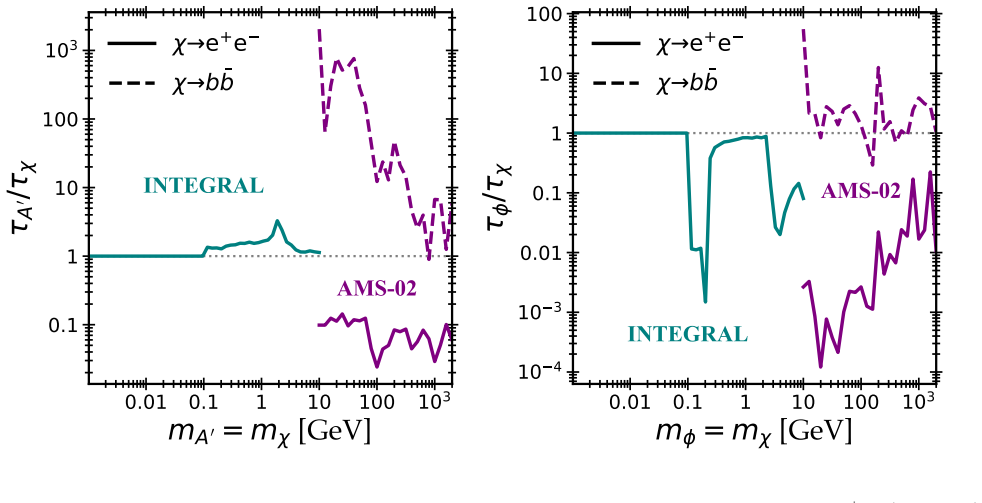
In its own terms, the paper's central claim is that dark photon and scalar dark matter, with the standard kinetic-mixing and Higgs-mixing couplings, are ruled out as decaying dark matter for lifetimes below the quoted bounds across 1 MeV to 2 TeV. Using a 16-year INTEGRAL/SPI x-ray analysis for masses below 10 GeV, the authors constrain the lifetime to $10^{22}$–$10^{25}$ s for the dark photon and $10^{21}$–$10^{25}$ s for the scalar; using AMS-02 positrons from 10 GeV to 2 TeV, they reach about $10^{29}$ s near 10 GeV for the dark photon and $10^{26}$–$10^{27}$ s for the scalar. These numbers translate into kinetic-mixing limits of $10^{-26}$–$10^{-27}$ and scalar mixing-angle limits of $10^{-24}$–$10^{-27}$ in the GeV-to-TeV range, several orders of magnitude below what the age of the Universe alone demands. The paper further claims that reducing either model to a single decay channel, such as electron-positron or bottom-antibottom pairs, changes the derived constraints by up to three or four orders of magnitude, so the multi-channel treatment is essential for translating data into model parameters.
Load-bearing premise
The load-bearing assumption is that the pulsar-plus-secondary positron background used in the AMS-02 fit is the true astrophysical flux; if the real pulsar population has a different spectrum or spatial distribution, the quoted lifetime limits could move by orders of magnitude.
Editorial extensions
If this is right
- If the dark photon is the dark matter, kinetic mixing above about $10^{-26}$–$10^{-27}$ in the 10 GeV to 2 TeV range is excluded, so surviving models must have still smaller mixing or masses above 2 TeV.
- For scalar dark matter, the opening of $W$ and $Z$ channels above 161 GeV produces a sudden jump in sensitivity, meaning high-mass scalar constraints are really probing the gauge-boson portal, not fermion final states.
- Single-channel approximations used in past decay searches can misestimate the true lifetime bound by up to three or four orders of magnitude, so future constraints should be quoted for complete, mass-dependent branching ratios.
- The data already require these dark matter candidates to be stable for 4–12 orders of magnitude longer than the age of the Universe, sharpening the target for future MeV-scale and cosmic-ray instruments.
- The strong x-ray constraints below 10 GeV rely on final-state radiation, so improved modelling of prompt photon production from hadronization would make the INTEGRAL limits stronger where they are currently conservative.
Reading between the lines
- The same template-fitting approach could be applied to other decaying dark matter candidates with vector or scalar portals simply by replacing the branching ratios, so the quoted limits serve as reusable benchmarks for dark sector model building.
- A future precise determination of the pulsar population from TeV halos or pulsar surveys would either tighten the AMS-02 limits or reveal systematic shifts of comparable size, because the pulsar background parameters are currently left free in the fit.
- Combining the positron channel with neutrino or antiproton searches in a single multi-messenger fit would break the degeneracy between pulsar and dark matter components more sharply than positrons alone.
- A future MeV-scale telescope covering the gap between roughly 10 MeV and 10 GeV could strengthen the x-ray limits by an order of magnitude or more once prompt hadronic photon production is computed, potentially closing the current sensitivity dip around the pion mass.
Signed reviews
Editorial analysis
A structured set of objections, weighed in public.
Referee Report
Summary. The paper studies the late-time decay of bosonic dark matter into Standard Model final states, focusing on two benchmark models: dark photons with kinetic mixing and scalars with Higgs-like Yukawa couplings. For dark matter masses between 1 MeV and 10 GeV, the authors use 16 years of INTEGRAL/SPI x-ray data; for masses between 10 GeV and 2 TeV, they use AMS-02 positron data. They compute model-dependent branching ratios from the Lagrangians in Section II, generate DM decay spectra with Hazma, FSR formulas, and CosmiXs, add DM templates to empirical astrophysical background models, and derive 95% CL upper limits on the decay rate, which translate to lower limits on the DM lifetime. The paper reports no evidence for a dark matter signal and quotes lifetime limits reaching about 10^25 s below 10 GeV and up to about 10^29 s for dark photons near 10 GeV, with corresponding constraints on the kinetic mixing and scalar mixing angle that improve on the age-of-Universe constraint by several orders of magnitude. It also compares the model-specific results with generic single-channel e+e- and bb decay analyses.
Significance. If the limits hold, they are competitive and in several mass ranges world-leading for these benchmark models, and the branching-ratio calculation is a useful public resource for other vector and scalar portal models. I credit the authors for the careful treatment of the full decay widths, for using a publicly available INTEGRAL template, for the explicitly conservative FSR-only treatment in the 1.5-10 GeV interval, and for the clear comparison to single-channel decay models. The analysis is not circular in the way that is sometimes found in dark matter fits: DM templates are added to an empirical astrophysical background rather than being derived from the parameters that the background fit determines. The main caveat is the completeness of the fixed AMS-02 background model from Ref. [116]; this is a systematic uncertainty rather than a flaw in the decay-width calculation, and it is quantified below.
major comments (2)
- [III B 2] The AMS-02 constraints are obtained by re-fitting only the diffusion coefficient, the diffusion spectral index, and three pulsar parameters (spectral index, cutoff energy, formation rate) on top of the fixed background model of Ref. [116]. The pulsar spatial distribution (Lorimer model), the injection spectral shape beyond a single power law with cutoff, the secondary positron calculation, and solar modulation are all held fixed. For scalar dark matter the injected positron spectrum is smooth (Fig. 6, right), and the paper itself notes that the scalar limits (about 10^26-10^27 s) are weakened by degeneracy with the pulsar component. An unmodeled pulsar spectral break or an alternative pulsar spatial distribution could therefore absorb part of a scalar DM template and shift the quoted 95% CL lifetime limits by orders of magnitude; the same concern applies to the sub-100 GeV dark photon limits, which are less peaked than the high-mass dark photon signal. I request a stability test that varies the fixed background components (for example, pulsar spectral break, spatial distribution, or an alternate pulsar population model) or otherwise quantifies the systematic uncertainty in the AMS-02 limits. Without such a test, the central claim of strong AMS-02 constraints is conditional on the completeness of Ref. [116].
- [Section IV / Fig. 7] The headline lifetime limits are presented as smooth curves spanning the full 1 MeV-2 TeV range, but the two experiments probe very different quantities: INTEGRAL uses the prompt x-ray flux from final-state radiation while AMS-02 uses propagated positrons. The paper should state more explicitly how the 10 GeV boundary is handled and whether the INTEGRAL and AMS-02 limits at that boundary are consistent, since the quoted 'up to 10^29 s' is driven by AMS-02 while the sub-10 GeV curves are driven by INTEGRAL. A reader could otherwise interpret the combined figure as a single continuous constraint from a single observable.
minor comments (5)
- [Abstract and throughout] Several exponents are typeset as inline digits rather than superscripts (for example, '10 25 s' in the abstract and '1029' in Section IV), which makes the numbers hard to read and could create ambiguity in the lifetime limits.
- [Fig. 7 caption and panel labels] The caption contains the typo 'T op', and the panel labels contain the corrupted glyph sequence 'I/glyph1197TEGRAL' in place of 'INTEGRAL'; these should be corrected in the final figure.
- [Fig. 9 and Section IV] The dwarf galaxy name is rendered as 'LeoT' both in the figure legend and in the text discussion; it should be 'Leo T'.
- [Acknowledgments] The sentence 'T.T.Q.N is also grateful for the supported by the COST Action COSMIC WISPers' is ungrammatical and should be rewritten.
- [Section IV] There is a typo 'suppressed compared to the the direct production of e+e-' that should read 'suppressed compared to the direct production'.
Circularity Check
No significant circularity: the derived constraints are obtained by adding independently computed dark-matter decay templates to empirical astrophysical background models, not by fitting a dark-matter parameter to the data and calling it a prediction.
full rationale
The paper's central claims are exclusion limits on dark-matter decay lifetimes for dark-photon and scalar models, derived by adding model-predicted photon/positron spectra to astrophysical backgrounds and performing a combined fit. The derivation chain is self-contained in the relevant sense: the dark-matter branching ratios are computed from the Lagrangians in Eqs. (1) and (9) via the width formulas in Eqs. (2)-(12); the photon and positron injection spectra are obtained with the external packages Hazma and CosmiXs; and the astrophysical backgrounds are empirical fits from prior work (Refs. [50], [95], [101] for INTEGRAL, and Ref. [116] for AMS-02). Some of these background references are authored or co-authored by members of the present team, notably Ref. [116], but these are empirical fits to INTEGRAL/AMS-02 data and do not contain the target dark-matter signal. The dark-matter templates are added on top of the fitted backgrounds, and the 95% CL upper limits are obtained by scanning the dark-matter flux and requiring Delta chi^2 = 3.84. No fitted parameter is renamed as a prediction, and no quantity used as an input is defined in terms of the output lifetime constraints. The acknowledged degeneracy of the smoother scalar dark-matter positron spectrum with the pulsar component is a physical/systematic model-dependence of the constraints, not a circularity: it does not make the lifetime bound mathematically equal to an input assumption. The paper also explicitly compares against single-channel decay results and external constraints, further confirming that the limits are not forced by construction.
Assumptions & free parameters
free parameters (2)
- INTEGRAL background normalizations and spectral indices =
Not specified in paper (fitted to INTEGRAL data in the MCMC)
- AMS-02 diffusion and pulsar parameters =
Not specified in paper (varied in fit)
assumptions (5)
- domain assumption NFW dark matter density profile with gamma=1, Rscale=20 kpc, R_sun=8.5 kpc, rho_sun=0.4 GeV/cm^3
- domain assumption Astrophysical background models from Refs [95] (INTEGRAL) and [116] (AMS-02) are accurate descriptions of non-DM emission
- domain assumption FSR dominates the low-energy x-ray flux for DM masses 1.5-10 GeV, and other radiative contributions are subdominant
- domain assumption The pulsar population is the source of the positron excess and is parameterized by the model of Ref [116]
- domain assumption Hazma and CosmiXs provide accurate spectra for the DM decay final states in their respective mass ranges
Cite this review
Pith. "Pith review of Strong Constraints on Dark Photon and Scalar Dark Matter Decay from INTEGRAL and AMS-02 data." pith.science (2026). https://pith.science/paper/RIR2GWTA
@misc{pith2026241200180,
  author       = {Pith},
  title        = {Pith review of: Strong Constraints on Dark Photon and Scalar Dark Matter Decay from INTEGRAL and AMS-02 data},
  year         = {2026},
  howpublished = {\url{https://pith.science/paper/RIR2GWTA}},
  note         = {Machine review of arXiv:2412.00180}
}
abstract
We investigate the decay of bosonic dark matter with masses between 1 MeV and 2 TeV into Standard Model final states. We specifically focus on dark photons that kinetically mix with the Standard Model, as well as scalar dark matter models that have Yukawa couplings with the Standard Model. Using INTEGRAL and AMS-02 data, we constrain the dark matter decay lifetime into final states that include photons or positrons, setting strong constraints on the dark matter lifetime that reach 10$^{25}$ s for dark matter below 10 GeV and up to 10$^{29}$ s for dark matter above 10 GeV.
Figures


Figures from the paper (4 more)



Forward citations
Cited by 5 Pith papers
-
Out of the darkness: probing the inflationary era with dark photon dark matter
A confirmed dark photon dark matter detection at 19.5 micro-electronvolts would, via the inflationary production formula, predict tensor modes just below current limits and within reach of next-generation experiments,...
-
In-flight positron annihilation as a probe of feebly interacting particles
In-flight annihilation of positrons produced by supernova feebly interacting particles gives the strongest astrophysical bounds on their electron couplings for masses of roughly 10-200 MeV, covering ALPs, sterile neut...
-
Constraints and Projections for Millicharged Dark Matter in the Sun with Water Cherenkov Neutrino Detectors
Super-Kamiokande constrains millicharged dark matter at 5-28 GeV for fractional abundance 10^{-4.5}; Hyper-Kamiokande reaches down to 5x10^{-6}.
-
Hunting for Dark Photon-Photon Tridents
Dark photon trident decay (A' to 3 gamma) is used with 16 years of INTEGRAL/SPI x-ray data to set 95% CL limits on kinetic mixing for masses of 61-1022 keV, improving earlier constraints by up to two orders of magnitude.
-
Searching for Dark Matter with MeVCube
Using Fisher forecasting, the author shows that a 2U to 12U MeVCube CubeSat could probe new dark matter parameter space for evaporating primordial black holes and MeV-scale decaying or annihilating dark matter.
Reference graph
Works this paper leans on
-
[116]
G. Vianello, R. J. Lauer, P. Younk, L. Tibaldo, J. M. Burgess, H. Ayala, P. Harding, M. Hui, N. Omodei, and H. Zhou (2015) arXiv:1507.08343 [astro-ph.HE]
arXiv 2015
-
[1]
Based on the frame- work in Refs
Astrophysical Background Model To constrain the dark matter flux, we must first model the astrophysical x-ray background. Based on the frame- work in Refs. [50, 95, 101], we use 16-years of INTEGRAL data to investigate dark matter decays. The observed photon flux from 30 keV to 8 MeV is divided into 24 en- ergy bins as shown in Figure 5. We note that some...
-
[2]
In this mass range, keV–MeV photons from dark matter decay are generated by several scenarios: • Charged lepton final states such as e±, µ±, and charged pions ( π±) radiate photons
Computing Dark Matter Constraints Using INTEGRAL/SPI data and this background model, we investigate the dark matter decay scenario for dark matter masses between 1 MeV and 10 GeV. In this mass range, keV–MeV photons from dark matter decay are generated by several scenarios: • Charged lepton final states such as e±, µ±, and charged pions ( π±) radiate phot...
-
[3]
Astrophysical Background Model We first compute an astrophysical background model of the cosmic-ray positron flux measured at Earth. Un- like photons that travel in straight lines, cosmic-ray positrons are dispersed during propagation, diffusing on magnetic fields due to their electric charge. Account- ing for this diffusion requires a more detailed model...
-
[4]
Computing Dark Matter Constraints To study dark matter contributions to the positron flux, we add the contributions from dark matter decay into the astrophysical model. We obtain the positron in- jection spectra for the various decay channels using the CosmiXs code [81, 141–143], and combine them at each dark matter mass according to Equations 2 to 8 for ...
2022
-
[5]
[7, 108] in order to model dark matter decay, instead of annihilation
Final State Radiation For ℓ± ≡ e±, µ± final states, the FSR spectrum from dark matter decay is given by: dN ℓ± γ dEγ FSR = 2α πβ(3 − β2)mDM × h A ×ln 1 + R(ν) 1 − R(ν) − 2B ×R(ν) i , (A1) where the variables and functions depend on the initial and final masses of the decay as: ν = 2Eγ/mDM, µ = mℓ/mDM, (A2) β2 = 1 − 4µ2, R (ν) = r 1 − 4µ2 1 − ν , (A3) A = ...
-
[6]
Following the notation from Refs
Radiative decay In addition to FSR, muons can decay into electrons and directly produce soft photons through the radiative decay channel µ− → e− ¯νeνµγ. Following the notation from Refs. [78, 79, 161, 162], the decay spectrum in the muon rest frame has the analytical form given by: dN µ γ dEγ Eµ=mµ Dec = α(1 − x) 36πEγ n 12[3 − 2x(1 − x)2] log 1 − x r +x(...
-
[7]
G. Bertone, D. Hooper, and J. Silk, Phys. Rept. 405, 279 (2005), arXiv:hep-ph/0404175
arXiv 2005
Show all 171 references
-
[8]
Bertone and D
G. Bertone and D. Hooper, Rev. Mod. Phys. 90, 045002 (2018), arXiv:1605.04909 [astro-ph.CO]
2018 arXiv
-
[9]
Bertone and T
G. Bertone and T. Tait, M. P., Nature 562, 51 (2018), arXiv:1810.01668 [astro-ph.CO]
2018 arXiv
-
[10]
T. R. Slatyer, in Theoretical Advanced Study Institute in Elementary Particle Physics: Anticipating the Next Discoveries in Particle Physics (2018) pp. 297–353, arXiv:1710.05137 [hep-ph]
2018 arXiv
-
[11]
B. R. Safdi, PoS T ASI2022, 009 (2024), arXiv:2303.02169 [hep-ph]
2024 arXiv
-
[12]
Cirelli, N
M. Cirelli, N. Fornengo, J. Koechler, E. Pinetti, and B. M. Roach, JCAP 07, 026 (2023), arXiv:2303.08854 [hep-ph]
2023 arXiv
-
[13]
Cirelli, N
M. Cirelli, N. Fornengo, B. J. Kavanagh, and E. Pinetti, Phys. Rev. D 103, 063022 (2021), arXiv:2007.11493 [hep-ph]
2021 arXiv
-
[14]
H. Liu, W. Qin, G. W. Ridgway, and T. R. Slatyer, Phys. Rev. D 104, 043514 (2021), arXiv:2008.01084 [astro-ph.CO]
2021 arXiv
-
[15]
W. Qin, J. B. Munoz, H. Liu, and T. R. Slatyer, Phys. 12 Rev. D 109, 103026 (2024), arXiv:2308.12992 [astro- ph.CO]
2024 arXiv
-
[16]
Jin, Y.-L
H.-B. Jin, Y.-L. Wu, and Y.-F. Zhou, JCAP 11, 026 (2013), arXiv:1304.1997 [hep-ph]
2013 arXiv
-
[17]
Blanco and D
C. Blanco and D. Hooper, JCAP 03, 019 (2019), arXiv:1811.05988 [astro-ph.HE]
2019 arXiv
-
[18]
S. Das, J. A. Carpio, and K. Murase, (2024), arXiv:2405.06382 [hep-ph]
2024 arXiv
- [19]
-
[20]
D. Song, N. Hiroshima, and K. Murase, JCAP 05, 087 (2024), arXiv:2401.15606 [astro-ph.HE]
2024 arXiv
-
[21]
D. Song, K. Murase, and A. Kheirandish, JCAP 03, 024 (2024), arXiv:2308.00589 [astro-ph.HE]
2024 arXiv
-
[22]
S. Das, K. Murase, and T. Fujii, Phys. Rev. D 107, 103013 (2023), arXiv:2302.02993 [astro-ph.HE]
2023 arXiv
-
[23]
Acharyya et al., Astrophys
A. Acharyya et al., Astrophys. J. 945, 101 (2023), arXiv:2302.08784 [astro-ph.HE]
2023 arXiv
-
[24]
C. W. Bauer, N. L. Rodd, and B. R. Webber, JHEP 06, 121 (2021), arXiv:2007.15001 [hep-ph]
2021 arXiv
-
[25]
Rinchiuso, N
L. Rinchiuso, N. L. Rodd, I. Moult, E. Moulin, M. Baumgart, T. Cohen, T. R. Slatyer, I. W. Stew- art, and V. Vaidya, Phys. Rev. D 98, 123014 (2018), arXiv:1808.04388 [astro-ph.HE]
2018 arXiv
-
[26]
Cohen, K
T. Cohen, K. Murase, N. L. Rodd, B. R. Safdi, and Y. Soreq, Phys. Rev. Lett. 119, 021102 (2017), arXiv:1612.05638 [hep-ph]
2017 arXiv
-
[27]
Baldes, F
I. Baldes, F. Calore, K. Petraki, V. Poireau, and N. L. Rodd, SciPost Phys. 9, 068 (2020), arXiv:2007.13787 [hep-ph]
2020 arXiv
-
[28]
Cirelli, P
M. Cirelli, P. Panci, K. Petraki, F. Sala, and M. Taoso, JCAP 05, 036 (2017), arXiv:1612.07295 [hep-ph]
2017 arXiv
- [29]
-
[30]
Pospelov and A
M. Pospelov and A. Ritz, Phys. Lett. B 671, 391 (2009), arXiv:0810.1502 [hep-ph]
2009 arXiv
-
[31]
Pospelov, A
M. Pospelov, A. Ritz, and M. B. Voloshin, Phys. Rev. D 78, 115012 (2008), arXiv:0807.3279 [hep-ph]
2008 arXiv
-
[32]
Fabbrichesi, E
M. Fabbrichesi, E. Gabrielli, and G. Lanfranchi, (2020), 10.1007/978-3-030-62519-1, arXiv:2005.01515 [hep-ph]
2020 arXiv
-
[33]
T. G. Rizzo, JHEP 10, 069 (2018), arXiv:1805.08150 [hep-ph]
2018 arXiv
-
[34]
T. G. Rizzo, JHEP 07, 118 (2018), arXiv:1801.08525 [hep-ph]
2018 arXiv
-
[35]
Hebecker, J
A. Hebecker, J. Jaeckel, and R. Kuespert, JHEP 04, 116 (2024), arXiv:2311.10817 [hep-th]
2024 arXiv
-
[36]
Fayet, Phys
P. Fayet, Phys. Lett. B 95, 285 (1980)
1980
-
[37]
Fayet, Nucl
P. Fayet, Nucl. Phys. B 347, 743 (1990)
1990
-
[38]
Servant and T
G. Servant and T. M. P. Tait, Nucl. Phys. B 650, 391 (2003), arXiv:hep-ph/0206071
2003 arXiv
-
[39]
Fradette, M
A. Fradette, M. Pospelov, J. Pradler, and A. Ritz, Phys. Rev. D 90, 035022 (2014), arXiv:1407.0993 [hep-ph]
2014 arXiv
-
[40]
Kitajima, S
N. Kitajima, S. Nakagawa, F. Takahashi, and W. Yin, (2024), arXiv:2410.17964 [hep-ph]
2024 arXiv
- [41]
-
[42]
Carena, A
M. Carena, A. Daleo, B. A. Dobrescu, and T. M. P. Tait, Phys. Rev. D 70, 093009 (2004), arXiv:hep- ph/0408098
2004
- [43]
-
[44]
Caputo, A
A. Caputo, A. J. Millar, C. A. J. O’Hare, and E. Vitagliano, Phys. Rev. D 104, 095029 (2021), arXiv:2105.04565 [hep-ph]
2021 arXiv
-
[45]
Jaeckel and A
J. Jaeckel and A. V. Phan, JHEP 08, 062 (2024), arXiv:2312.12522 [hep-ph]
2024
-
[46]
Fayet and M
P. Fayet and M. Mezard, Phys. Lett. B 104, 226 (1981)
1981
-
[47]
T. T. Q. Nguyen, in Windows on the Universe: 30th Anniversary of the Rencontres du Vietnam (2023) arXiv:2312.12292 [hep-ph]
2023 arXiv
-
[48]
V. Q. Tran, T. T. Q. Nguyen, and T.-C. Yuan, JCAP 05, 015 (2024), arXiv:2312.10785 [hep-ph]
2024 arXiv
-
[49]
Linden, T
T. Linden, T. T. Q. Nguyen, and T. M. P. Tait, (2024), arXiv:2402.01839 [hep-ph]
2024 arXiv
-
[50]
T. T. Q. Nguyen and T. M. P. Tait, Phys. Rev. D 107, 115016 (2023), arXiv:2212.12547 [hep-ph]
2023 arXiv
-
[51]
Krnjaic, D
G. Krnjaic, D. Rocha, and A. Sokolenko, Phys. Rev. D 108, 035047 (2023), arXiv:2210.06487 [hep-ph]
2023 arXiv
-
[52]
P. J. Fitzpatrick, H. Liu, T. R. Slatyer, and Y.-D. Tsai, Phys. Rev. D 106, 083507 (2022), arXiv:2105.05255 [hep-ph]
2022 arXiv
-
[53]
P. J. Fitzpatrick, H. Liu, T. R. Slatyer, and Y.-D. Tsai, Phys. Rev. D 106, 083517 (2022), arXiv:2011.01240 [hep-ph]
2022 arXiv
-
[54]
Giovanetti, M
C. Giovanetti, M. Lisanti, H. Liu, and J. T. Ruderman, Phys. Rev. Lett. 129, 021302 (2022), arXiv:2109.03246 [hep-ph]
2022 arXiv
- [55]
-
[56]
Linden, T
T. Linden, T. T. Q. Nguyen, and T. M. P. Tait, (2024), arXiv:2406.19445 [hep-ph]
2024 arXiv
-
[57]
Arias, D
P. Arias, D. Cadamuro, M. Goodsell, J. Jaeckel, J. Re- dondo, and A. Ringwald, JCAP 06, 013 (2012), arXiv:1201.5902 [hep-ph]
2012 arXiv
- [58]
- [59]
-
[60]
P. W. Graham, J. Mardon, and S. Rajendran, Phys. Rev. D 93, 103520 (2016), arXiv:1504.02102 [hep-ph]
2016 arXiv
-
[61]
De la Torre Luque, S
P. De la Torre Luque, S. Balaji, P. Carenza, and L. Mas- trototaro, (2024), arXiv:2405.08482 [hep-ph]
2024 arXiv
-
[62]
De la Torre Luque, S
P. De la Torre Luque, S. Balaji, and P. Carenza, Phys. Rev. D 109, 103028 (2024), arXiv:2307.13731 [hep-ph]
2024 arXiv
-
[63]
De la Torre Luque, S
P. De la Torre Luque, S. Balaji, and P. Carenza, Phys. Rev. D 109, L101305 (2024), arXiv:2307.13728 [hep-ph]
2024 arXiv
-
[64]
S. D. McDermott and S. J. Witte, Phys. Rev. D 101, 063030 (2020), arXiv:1911.05086 [hep-ph]
2020 arXiv
-
[65]
Catena, D
R. Catena, D. Cole, T. Emken, M. Matas, N. Spaldin, W. Tarantino, and E. Urdshals, JCAP 03, 052 (2023), arXiv:2210.07305 [hep-ph]
2023 arXiv
-
[66]
S. J. Witte, S. Rosauro-Alcaraz, S. D. McDermott, and V. Poulin, JHEP 06, 132 (2020), arXiv:2003.13698 [astro-ph.CO]
2020 arXiv
-
[67]
Caputo, H
A. Caputo, H. Liu, S. Mishra-Sharma, and J. T. Ruderman, Phys. Rev. Lett. 125, 221303 (2020), arXiv:2002.05165 [astro-ph.CO]
2020 arXiv
-
[68]
Krnjaic and T
G. Krnjaic and T. Trickle, Phys. Rev. D 108, 015024 (2023), arXiv:2303.11344 [hep-ph]
2023 arXiv
-
[69]
H. An, M. Pospelov, J. Pradler, and A. Ritz, Phys. Lett. B 747, 331 (2015), arXiv:1412.8378 [hep-ph]
2015 arXiv
-
[70]
Bruch, A
C. Bruch, A. Khodjamirian, and J. H. Kuhn, Eur. Phys. J. C 39, 41 (2005), arXiv:hep-ph/0409080
2005 arXiv
-
[71]
L. D. Landau, Dokl. Akad. Nauk SSSR 60, 207 (1948)
1948
-
[72]
Yang, Phys
C.-N. Yang, Phys. Rev. 77, 242 (1950)
1950
- [73]
-
[74]
Y. Bai, J. Berger, J. Osborne, and B. A. Stefanek, JHEP 11, 153 (2016), arXiv:1605.07183 [hep-ph]
2016 arXiv
-
[75]
Ekstedt, R
A. Ekstedt, R. Enberg, G. Ingelman, J. L¨ ofgren, and T. Mandal, JHEP 11, 071 (2016), arXiv:1605.04855 [hep-ph]
2016 arXiv
- [76]
-
[77]
Chatrchyan et al
S. Chatrchyan et al. (CMS), Phys. Lett. B 716, 30 (2012), arXiv:1207.7235 [hep-ex]
2012 arXiv
-
[78]
S. L. Glashow, Nucl. Phys. 22, 579 (1961)
1961
-
[79]
S. L. Glashow, J. Iliopoulos, and L. Maiani, Phys. Rev. D 2, 1285 (1970)
1970
-
[80]
Weinberg, Phys
S. Weinberg, Phys. Rev. Lett. 19, 1264 (1967)
1967
-
[81]
Navas et al
S. Navas et al. (Particle Data Group), Phys. Rev. D 110, 030001 (2024)
2024
-
[82]
J. F. Navarro, C. S. Frenk, and S. D. M. White, Astro- phys. J. 462, 563 (1996), arXiv:astro-ph/9508025
1996 arXiv
-
[83]
J. I. Read, J. Phys. G 41, 063101 (2014), arXiv:1404.1938 [astro-ph.GA]
2014 arXiv
- [84]
- [85]
-
[86]
Bierlich et al., SciPost Phys
C. Bierlich et al., SciPost Phys. Codeb. 2022, 8 (2022), arXiv:2203.11601 [hep-ph]
2022 arXiv
-
[87]
Arina, M
C. Arina, M. Di Mauro, N. Fornengo, J. Heisig, A. Jueid, and R. R. de Austri, JCAP 03, 035 (2024), arXiv:2312.01153 [astro-ph.HE]
2024 arXiv
-
[88]
Cirelli, G
M. Cirelli, G. Corcella, A. Hektor, G. Hutsi, M. Kadastik, P. Panci, M. Raidal, F. Sala, and A. Stru- mia, JCAP 03, 051 (2011), [Erratum: JCAP 10, E01 (2012)], arXiv:1012.4515 [hep-ph]
2011 arXiv
-
[89]
Ciafaloni, D
P. Ciafaloni, D. Comelli, A. Riotto, F. Sala, A. Strumia, and A. Urbano, JCAP 03, 019 (2011), arXiv:1009.0224 [hep-ph]
2011 arXiv
-
[90]
Baratella, M
P. Baratella, M. Cirelli, A. Hektor, J. Pata, M. Pi- ibeleht, and A. Strumia, JCAP 03, 053 (2014), arXiv:1312.6408 [hep-ph]
2014 arXiv
-
[91]
Boudaud, M
M. Boudaud, M. Cirelli, G. Giesen, and P. Salati, JCAP 05, 013 (2015), arXiv:1412.5696 [astro-ph.HE]
2015 arXiv
-
[92]
J. Buch, M. Cirelli, G. Giesen, and M. Taoso, JCAP 09, 037 (2015), arXiv:1505.01049 [hep-ph]
2015 arXiv
-
[93]
Bringmann, J
T. Bringmann, J. Edsj¨ o, P. Gondolo, P. Ullio, and L. Bergstr¨ om, JCAP07, 033 (2018), arXiv:1802.03399 [hep-ph]
2018 arXiv
-
[94]
Gondolo, J
P. Gondolo, J. Edsjo, P. Ullio, L. Bergstrom, M. Schelke, and E. A. Baltz, JCAP 07, 008 (2004), arXiv:astro- ph/0406204
2004
-
[95]
Siegert, R
T. Siegert, R. Diehl, M. G. H. Krause, and J. Greiner, Astron. Astrophys. 579, A124 (2015), arXiv:1505.05999 [astro-ph.HE]
2015 arXiv
-
[96]
Siegert, R
T. Siegert, R. Diehl, G. Khachatryan, M. G. H. Krause, F. Guglielmetti, J. Greiner, A. W. Strong, and X. Zhang, Astron. Astrophys. 586, A84 (2016), arXiv:1512.00325 [astro-ph.HE]
2016 arXiv
-
[97]
Siegert, R
T. Siegert, R. Diehl, J. Greiner, M. G. H. Krause, A. M. Beloborodov, M. Cadolle Bel, F. Guglielmetti, J. Ro- driguez, A. W. Strong, and X. Zhang, Nature 531, 341 (2016), arXiv:1603.01169 [astro-ph.HE]
2016 arXiv
-
[98]
Siegert, R
T. Siegert, R. Diehl, A. C. Vincent, F. Guglielmetti, M. G. H. Krause, and C. Boehm, Astron. Astrophys. 595, A25 (2016), arXiv:1608.00393 [astro-ph.HE]
2016 arXiv
-
[99]
Siegert, Astron
T. Siegert, Astron. Astrophys. 632, L1 (2019), arXiv:1910.09575 [astro-ph.HE]
2019 arXiv
-
[100]
Siegert, R
T. Siegert, R. M. Crocker, O. Macias, F. H. Panther, F. Calore, D. Song, and S. Horiuchi, Mon. Not. Roy. Astron. Soc. 509, L11 (2021), arXiv:2109.03691 [astro- ph.HE]
2021 arXiv
-
[101]
Calore, A
F. Calore, A. Dekker, P. D. Serpico, and T. Siegert, Mon. Not. Roy. Astron. Soc. 520, 4167 (2023), arXiv:2209.06299 [hep-ph]
2023
-
[102]
Langhoff, N
K. Langhoff, N. J. Outmezguine, and N. L. Rodd, Phys. Rev. Lett. 129, 241101 (2022), arXiv:2209.06216 [hep- ph]
2022 arXiv
-
[103]
Yuksel, J
H. Yuksel, J. F. Beacom, and C. R. Watson, Phys. Rev. Lett. 101, 121301 (2008), arXiv:0706.4084 [astro-ph]
2008 arXiv
-
[104]
Boyarsky, D
A. Boyarsky, D. Malyshev, A. Neronov, and O. Ruchayskiy, Mon. Not. Roy. Astron. Soc. 387, 1345 (2008), arXiv:0710.4922 [astro-ph]
2008 arXiv
-
[105]
Berteaud, F
J. Berteaud, F. Calore, J. Iguaz, P. D. Serpico, and T. Siegert, Phys. Rev. D 106, 023030 (2022), arXiv:2202.07483 [astro-ph.HE]
2022 arXiv
-
[106]
Iguaz, J
J. Iguaz, J. Iguaz, P. D. Serpico, P. D. Serpico, T. Siegert, and T. Siegert, Phys. Rev. D 103, 103025 (2021), [Erratum: Phys.Rev.D 107, 069902 (2023)], arXiv:2104.03145 [astro-ph.CO]
2021 arXiv
-
[107]
Siegert, C
T. Siegert, C. Boehm, F. Calore, R. Diehl, M. G. H. Krause, P. D. Serpico, and A. C. Vincent, Mon. Not. Roy. Astron. Soc. 511, 914 (2022), arXiv:2109.03791 [astro-ph.HE]
2022 arXiv
-
[108]
Krivonos, R., Revnivtsev, M., Churazov, E., Sazonov, S., Grebenev, S., and Sunyaev, R., A&A 463, 957 (2007)
2007
-
[109]
W. Wang, T. Siegert, Z. G. Dai, R. Diehl, J. Greiner, A. Heger, M. Krause, M. Lang, M. M. M. Pleintinger, and X. L. Zhang, The Astrophysical Journal 889, 169 (2020)
2020
-
[110]
John, How The Positron Became Cool : A Study of Cosmic-Ray Positrons from Pulsars and Dark Matter, Ph.D
I. John, How The Positron Became Cool : A Study of Cosmic-Ray Positrons from Pulsars and Dark Matter, Ph.D. thesis, Stockholm U. (2024)
2024
-
[111]
Siegert, S
T. Siegert, S. Ghosh, K. Mathur, E. Spraggon, and A. Yeddanapudi, Astron. Astrophys. 650, A187 (2021), arXiv:2104.00363 [astro-ph.HE]
2021 arXiv
-
[112]
Diehl et al., Nature 439, 45 (2006), arXiv:astro- ph/0601015
R. Diehl et al., Nature 439, 45 (2006), arXiv:astro- ph/0601015
2006
-
[113]
J. F. Beacom, N. F. Bell, and G. Bertone, Phys. Rev. Lett. 94, 171301 (2005), arXiv:astro-ph/0409403
2005 arXiv
-
[114]
Y. M. Bystritskiy, E. A. Kuraev, G. V. Fedotovich, and F. V. Ignatov, Phys. Rev. D 72, 114019 (2005), arXiv:hep-ph/0505236
2005 arXiv
-
[115]
Foreman-Mackey, D
D. Foreman-Mackey, D. W. Hogg, D. Lang, and J. Goodman, Publ. Astron. Soc. Pac. 125, 306 (2013), arXiv:1202.3665 [astro-ph.IM]
2013 arXiv
-
[117]
Kounine, Int
A. Kounine, Int. J. Mod. Phys. E 21, 1230005 (2012)
2012
-
[118]
Aguilar et al
M. Aguilar et al. (AMS), Phys. Rev. Lett. 122, 041102 (2019)
2019
-
[119]
M. S. Turner and F. Wilczek, Phys. Rev. D 42, 1001 (1990)
1990
-
[120]
Cirelli and A
M. Cirelli and A. Strumia, PoS IDM2008, 089 (2008), arXiv:0808.3867 [astro-ph]
2008 arXiv
-
[121]
Bergstrom, T
L. Bergstrom, T. Bringmann, I. Cholis, D. Hooper, and C. Weniger, Phys. Rev. Lett. 111, 171101 (2013), arXiv:1306.3983 [astro-ph.HE]
2013 arXiv
-
[122]
John and T
I. John and T. Linden, JCAP 12, 007 (2021), arXiv:2107.10261 [astro-ph.HE]. 14
2021 arXiv
-
[123]
A. W. Strong and I. V. Moskalenko, Astrophys. J. 509, 212 (1998), arXiv:astro-ph/9807150
1998 arXiv
-
[124]
A. W. Strong and I. V. Moskalenko, in 26th Interna- tional Cosmic Ray Conference, Vol. 4 (1999) p. 255, arXiv:astro-ph/9906228
1999 arXiv
-
[125]
A. W. Strong and I. V. Moskalenko, Adv. Space Res. 27, 717 (2001), arXiv:astro-ph/0101068
2001 arXiv
-
[126]
A. W. Strong, I. V. Moskalenko, T. A. Porter, G. Jo- hannesson, E. Orlando, and S. W. Digel, (2009), arXiv:0907.0559 [astro-ph.HE]
2009 arXiv
-
[127]
Aguilar et al
M. Aguilar et al. (AMS), Phys. Rev. Lett. 114, 171103 (2015)
2015
-
[128]
Aguilar et al
M. Aguilar et al. (AMS), Phys. Rev. Lett. 121, 051101 (2018)
2018
-
[129]
Aguilar et al
M. Aguilar et al. (AMS), Phys. Rev. Lett. 115, 211101 (2015)
2015
-
[130]
Bergstrom, T
L. Bergstrom, T. Bringmann, and J. Edsjo, Phys. Rev. D 78, 103520 (2008), arXiv:0808.3725 [astro-ph]
2008 arXiv
-
[131]
Cholis, L
I. Cholis, L. Goodenough, D. Hooper, M. Simet, and N. Weiner, Phys. Rev. D 80, 123511 (2009), arXiv:0809.1683 [hep-ph]
2009 arXiv
-
[132]
Cholis, D
I. Cholis, D. P. Finkbeiner, L. Goodenough, and N. Weiner, JCAP 12, 007 (2009), arXiv:0810.5344 [astro-ph]
2009 arXiv
-
[133]
Cholis, G
I. Cholis, G. Dobler, D. P. Finkbeiner, L. Goode- nough, and N. Weiner, Phys. Rev. D 80, 123518 (2009), arXiv:0811.3641 [astro-ph]
2009 arXiv
-
[134]
Hooper, P
D. Hooper, P. Blasi, and P. D. Serpico, JCAP 01, 025 (2009), arXiv:0810.1527 [astro-ph]
2009 arXiv
-
[135]
Profumo, Central Eur
S. Profumo, Central Eur. J. Phys. 10, 1 (2011), arXiv:0812.4457 [astro-ph]
2011 arXiv
-
[136]
Linden and S
T. Linden and S. Profumo, Astrophys. J.772, 18 (2013), arXiv:1304.1791 [astro-ph.HE]
2013 arXiv
-
[137]
Yuksel, M
H. Yuksel, M. D. Kistler, and T. Stanev, Phys. Rev. Lett. 103, 051101 (2009), arXiv:0810.2784 [astro-ph]
2009 arXiv
-
[138]
Malyshev, I
D. Malyshev, I. Cholis, and J. Gelfand, Phys. Rev. D 80, 063005 (2009), arXiv:0903.1310 [astro-ph.HE]
2009 arXiv
-
[139]
Blasi and E
P. Blasi and E. Amato, Astrophys. Space Sci. Proc. , 623 (2011), arXiv:1007.4745 [astro-ph.HE]
2011 arXiv
-
[140]
A. U. Abeysekara et al., Astrophys. J. 843, 40 (2017), arXiv:1702.02992 [astro-ph.HE]
2017 arXiv
-
[141]
A. U. Abeysekara et al. (HA WC), Science 358, 911 (2017), arXiv:1711.06223 [astro-ph.HE]
2017 arXiv
-
[142]
Linden, K
T. Linden, K. Auchettl, J. Bramante, I. Cholis, K. Fang, D. Hooper, T. Karwal, and S. W. Li, Phys. Rev. D 96, 103016 (2017), arXiv:1703.09704 [astro-ph.HE]
2017 arXiv
-
[143]
Hooper, I
D. Hooper, I. Cholis, T. Linden, and K. Fang, Phys. Rev. D 96, 103013 (2017), arXiv:1702.08436 [astro- ph.HE]
2017 arXiv
-
[144]
D. R. Lorimer, IAU Symp. 218, 105 (2004), arXiv:astro- ph/0308501
2004
-
[145]
Lorimer et al., Mon
D. Lorimer et al., Mon. Not. Roy. Astron. Soc. 372, 777 (2006), arXiv:astro-ph/0607640
2006 arXiv
-
[146]
Cholis, D
I. Cholis, D. Hooper, and T. Linden, JCAP 10, 051 (2022), arXiv:2007.00669 [astro-ph.HE]
2022 arXiv
-
[147]
Jueid, J
A. Jueid, J. Kip, R. R. de Austri, and P. Skands, JHEP 02, 119 (2024), arXiv:2303.11363 [hep-ph]
2024 arXiv
-
[148]
Jueid, J
A. Jueid, J. Kip, R. R. de Austri, and P. Skands, JCAP 04, 068 (2023), arXiv:2202.11546 [hep-ph]
2023 arXiv
-
[149]
Amoroso, S
S. Amoroso, S. Caron, A. Jueid, R. Ruiz de Austri, and P. Skands, JCAP05, 007 (2019), arXiv:1812.07424 [hep- ph]
2019 arXiv
- [150]
-
[151]
https://iminuit.readthedocs.io/en/stable/
Webpage. https://iminuit.readthedocs.io/en/stable/
-
[152]
Lopez-Honorez, O
L. Lopez-Honorez, O. Mena, S. Palomares-Ruiz, and A. C. Vincent, JCAP 07, 046 (2013), arXiv:1303.5094 [astro-ph.CO]
2013 arXiv
-
[153]
T. R. Slatyer, Phys. Rev. D 93, 023527 (2016), arXiv:1506.03811 [hep-ph]
2016 arXiv
-
[154]
Wadekar and Z
D. Wadekar and Z. Wang, Phys. Rev. D 106, 075007 (2022), arXiv:2111.08025 [hep-ph]
2022 arXiv
-
[155]
H. Liu, T. R. Slatyer, and J. Zavala, Phys. Rev. D 94, 063507 (2016), arXiv:1604.02457 [astro-ph.CO]
2016 arXiv
- [156]
-
[157]
K. E. O’Donnell and T. R. Slatyer, (2024), arXiv:2411.00087 [hep-ph]
2024 arXiv
-
[158]
C. R. Harris, K. J. Millman, S. J. van der Walt, R. Gom- mers, P. Virtanen, D. Cournapeau, E. Wieser, J. Tay- lor, S. Berg, N. J. Smith, R. Kern, M. Picus, S. Hoyer, M. H. van Kerkwijk, M. Brett, A. Haldane, J. F. del R ´ ıo, M. Wiebe, P. Peterson, P. G´ erard-Marchant, K. She...
2020
-
[159]
Virtanen et al
P. Virtanen et al. , Nature Meth. 17, 261 (2020), arXiv:1907.10121 [cs.MS]
2020 arXiv
-
[160]
T. P. Robitaille et al. (Astropy), Astron. Astrophys. 558, A33 (2013), arXiv:1307.6212 [astro-ph.IM]
2013 arXiv
-
[161]
J. D. Hunter, Computing in Science & Engineering 9, 90 (2007)
2007
-
[162]
Kluyver, B
T. Kluyver, B. Ragan-Kelley, F. P´ erez, B. Granger, M. Bussonnier, J. Frederic, K. Kelley, J. Hamrick, J. Grout, S. Corlay, P. Ivanov, D. Avila, S. Abdalla, C. Willing, and Jupyter Development Team, in IOS Press (2016) pp. 87–90
2016
-
[163]
Binosi, J
D. Binosi, J. Collins, C. Kaufhold, and L. Theussl, Comput. Phys. Commun. 180, 1709 (2009), arXiv:0811.4113 [hep-ph]
2009 arXiv
-
[164]
Mathematica, Version 14.1,
W. R. Inc., “Mathematica, Version 14.1,” Champaign, IL, 2024
2024
-
[165]
H. H. Patel, Comput. Phys. Commun. 197, 276 (2015), arXiv:1503.01469 [hep-ph]
2015 arXiv
-
[166]
Webplotdigitizer: Version 4.6,
A. Rohatgi, “Webplotdigitizer: Version 4.6,” (2022)
2022
- [167]
-
[168]
Essig, N
R. Essig, N. Sehgal, and L. E. Strigari, Phys. Rev. D 80, 023506 (2009), arXiv:0902.4750 [hep-ph]
2009 arXiv
-
[169]
D. A. Bryman, P. Depommier, and C. Leroy, Phys. Rept. 88, 151 (1982)
1982
-
[170]
Regis et al., JCAP 11, 046 (2021), arXiv:2106.08025 [astro-ph.HE]
M. Regis et al., JCAP 11, 046 (2021), arXiv:2106.08025 [astro-ph.HE]
2021 arXiv
-
[171]
Blanco, JCAP 01, 013 (2019), arXiv:1804.00005 [astro-ph.HE]
C. Blanco, JCAP 01, 013 (2019), arXiv:1804.00005 [astro-ph.HE]. 15
2019 arXiv
Reviewed August 12, 2026 · model on record in the stance chip above.
Discussion (0). Continue with ORCID to comment.