REVIEW 2 major objections 5 minor 18 references
VLM hallucinations can be detected as structured, per-head attention deviations called Role-Break, and a simple linear probe over them reaches an average AUROC of 93.23 across six vision-language models and four benchmarks.
Reviewed by Pith at T0; open to challenge. T0 means a machine referee read the full paper against a public rubric. the ladder, T0–T4 →
T0 review · deepseek-v4-flash
2026-08-03 07:27 UTC pith:RJNOJQKW
load-bearing objection A solid detector paper with a novel feature representation and unusually careful controls, but the headline 'faithful role' stability claim rests on a split-half statistic that doesn't test image-invariance. the 2 major comments →
Role-Break in Attention Heads: Understanding and Detecting Hallucinations in VLMs
The pith
A machine-rendered reading of the paper's core claim, the machinery that carries it, and where it could break.
Core claim
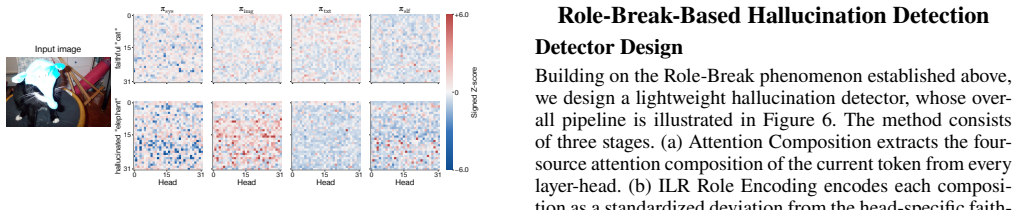
The central discovery is that a hallucinated token in a VLM is marked by reproducible, per-head deviations from that head's own faithful source-allocation baseline. Each attention head has a stable role: a mean and standard deviation of how it distributes attention across system, image, user-text, and self-generated tokens, estimated from faithful tokens. Hallucination breaks these roles in a way that is consistent across independent data splits, concentrated on a subset of heads, and linearly separable from faithful tokens. The deviations are not just larger; their pattern across heads and source channels is what carries the signal, and the pattern is destroyed when head identity or channel
What carries the argument
The load-bearing object is the per-head source-allocation vector — the fraction of attention a head places on each of four context groups: system prompt, image, user text, and self-generated output. Each head's faithful role is the empirical mean and standard deviation of these vectors over faithful tokens. Role-Break is the standardized deviation from that role after an isometric log-ratio (ILR) transform that maps the four-part composition to three Euclidean coordinates (capturing context-vs-self, image-vs-text, and system-vs-user balances). Flattening these residuals across all heads yields a vector below 5,000 dimensions that a single regularized logistic regression reads. The identity-p
Load-bearing premise
The per-head faithful role estimated from training-split faithful tokens is stable across images and generation positions, so a deviation seen on a test token is attributable to hallucination rather than to image-content variation or position effects.
What would settle it
Take a set of faithful tokens from images with unusual content (e.g., sparse or text-heavy images) or from a different prompt distribution, and check whether per-head source-allocation deviations from the training-split faithful role are as large as those of hallucinated tokens; if AUROC drops to near chance or role estimates shift beyond split-half noise, Role-Break is content noise, not a hallucination signature.
If this is right
- Hallucination can be detected from a single forward pass of the VLM, with no fine-tuning and negligible compute overhead, making real-time token-level monitors feasible.
- The Role-Break signal transfers across VLMs of different architectures and across both discriminative and generative tasks, so it is not bound to one model family or one failure pattern.
- Because the signal is linearly readable, it can be acted on directly: flipping a VLM's answer when the probe flags it as hallucinated improves answer accuracy across all tested VLMs.
- The faithful-role baseline gives an interpretable reference — a hallucinated token is one whose internal information-allocation pattern has departed from the model's own healthy behavior.
- A few hundred labeled faithful tokens per class suffice to estimate the role and train the probe, so the detector is practical to deploy in new settings.
Where Pith is reading between the lines
- Beyond the paper: Role-Break could serve as a generic monitoring signal for distribution shift, since the faithful-role baseline is a per-model fingerprint; sudden changes in the deviation pattern might flag out-of-distribution inputs even before tokens are labeled hallucinated.
- Beyond the paper: The head-identity-preserving representation may apply to other failure modes in multimodal models (e.g., sycophancy or instruction misalignment) if those also produce structured per-head departures; the paper's finding that scalar summaries lose information suggests such signals should be read with head coordinates intact.
- Beyond the paper: A testable extension is to use Role-Break as a reinforcement signal for decoding strategies in generative settings — e.g., suppressing tokens whose Role-Break magnitude is high — which the paper leaves for future work.
Editorial analysis
A structured set of objections, weighed in public.
Referee Report
Summary. The paper proposes a head-level characterization of VLM hallucination. It defines a per-head 'faithful role' as the mean source-allocation of each attention head over faithful tokens (Eq. 2), and 'Role-Break' as the studentized deviation from that role (Eq. 3; ILR version in Eq. 7). Findings 1–3 argue that single-channel attention indicators are not cross-setting stable, that hallucinated tokens exhibit reproducible, head-concentrated deviations from faithful roles, and that these deviations are linearly readable. The authors then build a linear detector over per-head ILR residuals, evaluate it on six VLMs and four benchmarks under image-disjoint 80/20 splits, and report an average AUROC of 93.23, together with ablations, controls, and a small answer-flipping intervention.
Significance. If the faithful-role construct is valid, this is a valuable contribution: it offers a unified head-level view of heterogeneous hallucination patterns, a lightweight and practical detector, and a rare degree of internal validation for an interpretability-driven claim. The paper includes strong controls: split-half stability analyses, caption-clustered sign-flip permutation nulls, amplitude-matched evaluation, answer-polarity controls, sample-efficiency curves, and Wilcoxon tests over paired observations. The ingredient-ladder and channel-choice ablations are particularly informative. The main weakness is that the faithfulness of the 'faithful role' baseline is not validated on image-disjoint splits, which is load-bearing for the central interpretation; a second, lesser issue is that the 'cross-setting' claim is supported only by in-distribution per-benchmark evaluations. With additional validation of the baseline's transfer, the paper would be a solid contribution.
major comments (2)
- [Finding 2 / Supp. Table 5; Eq. (2)] The faithful-role baseline (μ^F, σ^F; Eq. 2 and ILR analogue Eq. 7) is the reference against which Role-Break is defined. Its claimed stability rests on split-half Pearson correlations (Supp. Table 5, r≥0.9999), but the halves are described only as a random split of the faithful token pool. If tokens from the same images appear in both halves, the correlation measures within-image agreement and cannot detect an image-content-dependent component of the role. The detector itself uses image-disjoint 80/20 splits (§4.2), so μ^F is estimated on training images and applied to held-out images; any content-dependent shift in μ^F is exactly the confound the reported statistic would miss. Position trends are controlled for deviation reproducibility, not for the position-dependence of the baseline. Please add (i) image-disjoint split-half correlations (with caption-clustered intervals), (ii) a with
- [Abstract / §4.2, Table 1] The paper motivates Role-Break by contrasting it with signals that fail to remain stable 'across models and tasks,' but the detector is trained and evaluated in-distribution on each benchmark: every (VLM, benchmark) cell uses its own linear probe and its own faithful-role estimate on the same benchmark's training split. The 93.23 average AUROC is therefore an in-distribution number and does not by itself demonstrate cross-setting stability of the Role-Break representation. I recommend adding at least one transfer experiment (e.g., a POPE-trained probe evaluated on AMBER, or a CHAIR-labels-trained probe evaluated on M-HalDetect), or a within-model cross-benchmark role-transfer check. If transfer is not intended, the 'unified/cross-setting' language in the abstract and introduction should be softened.
minor comments (5)
- [Supp., Ingredient Ladder (Table 12)] The ingredient ladder shows that preserving head identity is the sole load-bearing predictive ingredient; subtracting μF, dividing by σF, and the ILR transform change AUC by <0.2 points. This is an honest and useful control, but it tempers the main-text phrasing that the detector is built on Role-Break in the sense of Eq. (3). Consider stating in the main text that the faithful-role baseline is primarily an interpretability anchor and that the predictive signal is the per-head source-allocation pattern itself.
- [Supp. Numerical Results, Finding 3] The reference to 'Figure 4 in the main paper' for the anatomy plot appears to point to Figure 5 (the ΔAUC disruption plot); please correct cross-references.
- [Section 4.2 / Experimental Setup] The sentence 'our setup follows prior work in teacher-forcing part of the answer tokens' is ambiguous for the generative benchmarks. Specify whether M-HalDetect and COCO-Caption tokens are generated free-running or teacher-forced, and how attention is extracted for them.
- [Eq. (1)–(3) / Notation] Consider a notation table for π_{k,l,h}, μ^F, σ^F, r^src, r^{ilr}; the paper uses many symbols and the reader must track them across sections.
- [Table 1 / caption] In the table header, 'LLaVA-1.5 †' and the footnote '†13B-scale variant' are clear, but the main text uses 'LLaVA-1.5-13B'; please unify naming.
Circularity Check
No significant circularity: Role-Break is an empirically estimated feature with external labels, and the detector is a standard supervised probe evaluated image-disjointly.
full rationale
The derivation chain is: Eq. (1) defines per-head source allocation π; Eq. (2) defines the faithful role as the mean of π over training-split faithful tokens; Eqs. (3)/(7) define Role-Break as the standardized deviation from that role; Eq. (8) trains an L2-regularized logistic probe on labeled tokens. Hallucination labels come from external sources (CHAIR-style noun matching against COCO ground truth, M-HalDetect expert span labels, POPE/AMBER answer ground truth), not from the Role-Break equations. The probe is evaluated on held-out tokens under 80/20 image-disjoint splits, and the faithful-role parameters are estimated from training tokens only. Thus the high AUROC is not forced by construction: a fitted linear probe can always achieve some separation, but 93.23 average AUROC across six VLMs and four benchmarks is an empirical outcome, not an identity. The split-half stability of μ^F is a quality check of an estimator, not a prediction; the concern that the split is not image-disjoint is a validity/confound issue, not circularity. The paper itself states in the Conclusion that 'our current evidence cannot distinguish whether Role-Break is a cause of hallucination, a downstream response to it, or a partial self-correction attempt' — an explicit limitation, not a circular derivation. The supplementary ingredient ladder even reports that faithful centering/z-scoring are 'primarily interpretability choices rather than predictive ones,' so the detector's performance does not secretly depend on the fitted baseline in a way that would make the central claim tautological. No equation defines the target in terms of the predictor, and no load-bearing self-citation is present. Score 0.
Axiom & Free-Parameter Ledger
free parameters (7)
- Faithful-role mean μ^F_{l,h} =
per-head 4-dim (or 3-dim ILR) vectors
- Faithful-role std σ^F_{l,h} =
per-head 4-dim (or 3-dim ILR) vectors
- Linear probe weights (w,b) =
3LH + 1 parameters
- L2 regularization constant =
not reported
- ε floor in Eq. 3 =
not reported
- ILR balance basis =
three fixed balances (Eqs. 4-6)
- Qwen3.5 full-attention layer subset =
8 of 32 layers
axioms (6)
- domain assumption The four context groups (system, image, user text, self-generated) form a disjoint, exhaustive partition of attention context.
- domain assumption External labels (CHAIR matching, expert annotations) correctly identify hallucinated tokens.
- domain assumption The per-head faithful role is stable across images and captions, so an image-disjoint training split yields valid baselines for test tokens.
- domain assumption Hallucination is reflected in attention source-allocation, not only in other internal states.
- domain assumption Pre-trained VLMs have functionally specialized attention heads.
- standard math Standard statistical machinery (logistic regression, permutation tests, split-half correlation) is valid for the inference.
invented entities (2)
-
Faithful role
no independent evidence
-
Role-Break
no independent evidence
read the original abstract
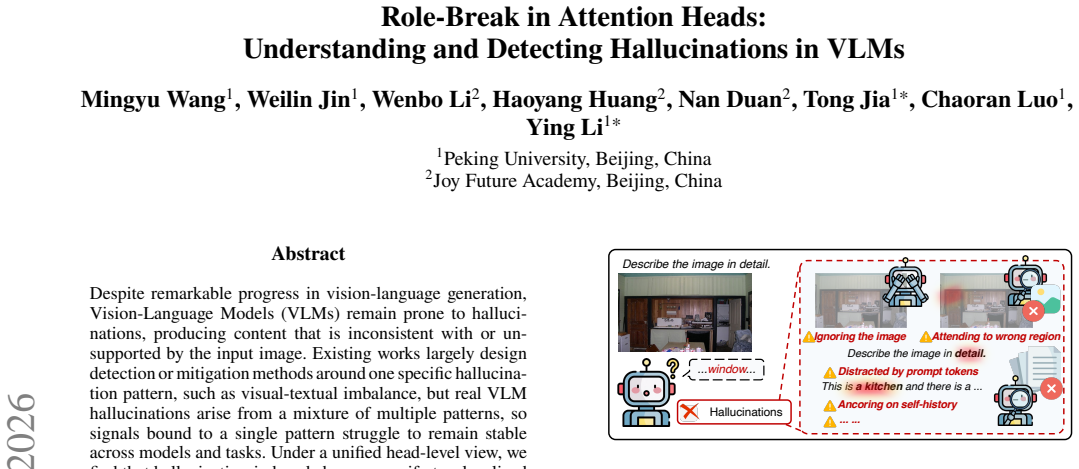
Despite remarkable progress in vision-language generation, Vision-Language Models (VLMs) remain prone to hallucinations, producing content that is inconsistent with or unsupported by the input image. Existing works largely design detection or mitigation methods around one specific hallucination pattern, such as visual-textual imbalance, but real VLM hallucinations arise from a mixture of multiple patterns, so signals bound to a single pattern struggle to remain stable across models and tasks. Under a unified head-level view, we find that hallucination-induced changes manifest as localized deviations from each head's faithful contextual behavior, a phenomenon we term Role-Break. Detailed analysis reveals that these deviations are systematically organized across attention heads, contextual sources, and deviation directions, and that the resulting signal is linearly readable once head identity is preserved. Based on these findings, we build a lightweight linear detector on top of Role-Break that requires no fine-tuning of the VLM, whose feature dimension stays below 5,000 and reaches an average AUROC of 93.23 across six VLMs and four benchmarks. A small-scale intervention experiment further shows that the detected tokens can be directly acted upon in the discriminative setting.
Figures




Reference graph
Works this paper leans on
-
[2]
Dai,W.;Li,J.;Li,D.;Tiong,A.;Zhao,J.;Wang,W.;Li,B.; Fung,P.N.;andHoi,S.2023
Attention hijackers: Detect and disentangle attention hijack- ing in lvlms for hallucination mitigation.arXiv preprint arXiv:2503.08216. Dai,W.;Li,J.;Li,D.;Tiong,A.;Zhao,J.;Wang,W.;Li,B.; Fung,P.N.;andHoi,S.2023. Instructblip:Towardsgeneral- purposevision-languagemodelswithinstructiontuning.Ad- vancesinneuralinformationprocessingsystems,36:49250– 49267. E...
Pith/arXiv arXiv 2023
-
[4]
Yes” and“No
instead usesrilr ∈R 3LH, which removes the sum- Setting KS SMD Amp Pattern L / C0.05 −0.10 +0.02−0.11 0.499 0.898 L / P0.02 −0.58 +0.01−1.56 0.501 0.916 Q / C0.08 −0.21 −0.01−0.56 0.502 0.876 Q / P0.02 −0.63 +0.01−1.74 0.502 0.942 Table 7: Amplitude-matched evaluation. KS and SMD columns are post-matching values with subscripts show- ingthereductionfrompr...
2000
-
[5]
InProceedingsof the IEEE/CVF Conference on Computer Vision and Pattern Recognition, 13418–13427
Opera: Alleviating hallucinationinmulti-modallargelanguagemodelsviaover- trustpenaltyandretrospection-allocation. InProceedingsof the IEEE/CVF Conference on Computer Vision and Pattern Recognition, 13418–13427. IbnArif,K.H.;AcharjeeDip,S.;Hussain,K.;Zhang,L.;and Thomas,C.2025.Fixingimbalancedattentiontomitigatein- context hallucination of large vision-lan...
2025
-
[6]
InFindings of the Association for Computational Linguistics: EMNLP 2024, 4542–4551
Reference-free hallucination detection for large vision-language models. InFindings of the Association for Computational Linguistics: EMNLP 2024, 4542–4551. Li, Y.; Du, Y.; Zhou, K.; Wang, J.; Zhao, X.; and Wen, J.-R
2024
-
[12]
Sarkar, S.; Che, Y.; Gavin, A.; Beerel, P
Mecha- nismsofPrompt-InducedHallucinationinVision-Language Models.arXiv preprint arXiv:2601.05201. Sarkar, S.; Che, Y.; Gavin, A.; Beerel, P. A.; and Kundu, S
-
[13]
Mitigating Hallucinations in Vision- LanguageModelsthroughImage-GuidedHeadSuppression. arXiv:2505.16411. Tu, C.; Ye, P.; Zhou, D.; Bai, L.; Yu, G.; Chen, T.; and Ouyang,W.2026. Attentionreallocation:Towardszero-cost and controllable hallucination mitigation of mllms.Interna- tional Journal of Computer Vision, 134(1):
arXiv 2026
-
[14]
Wang, K.; Variengien, A.; Conmy, A.; Shlegeris, B.; and Steinhardt, J
Amber: An llm- free multi-dimensional benchmark for mllms hallucination evaluation.arXiv preprint arXiv:2311.07397. Wang, K.; Variengien, A.; Conmy, A.; Shlegeris, B.; and Steinhardt, J
-
[15]
Xu, Y.; Gao, Q.; Fan, J.; Ding, G.; Yang, Z.; Lin, S.; and Xiao, Y
Interpretability in the wild: a circuit for indirect object identification in gpt-2 small.arXiv preprint arXiv:2211.00593. Xu, Y.; Gao, Q.; Fan, J.; Ding, G.; Yang, Z.; Lin, S.; and Xiao, Y
-
[16]
Zhang,F.;Wu,Y.;Wang,Z.;Wang,X.;Lv,C.;Huang,X.-J.; and Zheng, X
Mitigating Object Hallucinations in Vision- Language Models through Region-Aware Attention Recali- bration.arXiv preprint arXiv:2605.24957. Zhang,F.;Wu,Y.;Wang,Z.;Wang,X.;Lv,C.;Huang,X.-J.; and Zheng, X
-
[17]
larger deviations on hallucinated mentions,
Seeing clearly by layer two: Enhancing attention heads to alleviate hallucination in lvlms.arXiv preprint arXiv:2411.09968. Zhang,X.;Quan,Y.;Shen,C.;Gu,C.;Yuan,X.;Yan,S.;Cao, J.;Cheng,H.;Wu,K.;andYe,J.2025a.ShallowFocus,Deep Fixes: Enhancing Shallow Layers Vision Attention Sinks to Alleviate Hallucination in LVLMs. InProceedings of the 2025ConferenceonEmp...
Pith/arXiv arXiv 2024
-
[2003]
Fieback,L.;Spiegelberg,J.;andGottschalk,H.2024
Isometric logratio transforma- tionsforcompositionaldataanalysis.Mathematicalgeology, 35(3): 279–300. Fieback,L.;Spiegelberg,J.;andGottschalk,H.2024. Meta- token:Detectinghallucinationinimagedescriptionsbymeta classification.arXiv preprint arXiv:2405.19186. Gunjal,A.;Yin,J.;andBas,E.2024. Detectingandprevent- ing hallucinations in large vision language mo...
Pith/arXiv arXiv 2024
-
[2014]
InEuropean conference on computer vision, 740–755
Microsoft coco: Common objects in context. InEuropean conference on computer vision, 740–755. Springer. Liu,H.;Li,C.;Wu,Q.;andLee,Y.J.2023.Visualinstruction tuning.Advances in neural information processing systems, 36: 34892–34916. Liu,S.;Zheng,K.;andChen,W.2024.Payingmoreattention toimage:Atraining-freemethodforalleviatinghallucination inlvlms. InEuropea...
2023
-
[2018]
InProceedings of the 2018 Conference on Empirical Methods in Natural Language Processing, 4035–4045
Object hallucination in image caption- ing. InProceedings of the 2018 Conference on Empirical Methods in Natural Language Processing, 4035–4045. Rudman, W.; Golovanevsky, M.; Arad, D.; Belinkov, Y.; Singh, R.; Eickhoff, C.; and Mahowald, K
2018
-
[2022]
In-context learning and induction heads.arXiv preprint arXiv:2209.11895. Rohrbach, A.; Hendricks, L. A.; Burns, K.; Darrell, T.; and Saenko, K
-
[2023]
InProceedings of the 2023 conference on empiricalmethodsinnaturallanguageprocessing,292–305
Evaluating object hallucination in large vision- language models. InProceedings of the 2023 conference on empiricalmethodsinnaturallanguageprocessing,292–305. Li, Z.; Kong, C.; Bao, P.; Xia, S.; Tu, Y.; Yu, Y.; Jiang, X.; and Jiang, X
2023
-
[2024]
arXiv preprint arXiv:2412.13949
Cracking the code of hallucination in lvlms with vision-aware head divergence. arXiv preprint arXiv:2412.13949. Huang, Q.; Dong, X.; Zhang, P.; Wang, B.; He, C.; Wang, J.; Lin, D.; Zhang, W.; and Yu, N
-
[2025]
Chen, B.; Lyu, X.; Gao, L.; Song, J.; and Shen, H
Qwen3-vl technical report.arXiv preprint arXiv:2511.21631. Chen, B.; Lyu, X.; Gao, L.; Song, J.; and Shen, H. T
-
[2026]
Lin, T.-Y.; Maire, M.; Belongie, S.; Hays, J.; Perona, P.; Ramanan, D.; Dollár, P.; and Zitnick, C
SAKED: Mitigating Hallucination in Large Vision-Language Models via Stability-Aware Knowl- edgeEnhancedDecoding.arXivpreprintarXiv:2602.09825. Lin, T.-Y.; Maire, M.; Belongie, S.; Hays, J.; Perona, P.; Ramanan, D.; Dollár, P.; and Zitnick, C. L
discussion (0)
Sign in with ORCID, Apple, or X to comment. Anyone can read and Pith papers without signing in.