Measurement Geometry and Design for Trustworthy Generative Inverse Problems
Pith reviewed 2026-06-28 15:07 UTC · model grok-4.3
The pith
A local compatibility measure between measurements and generative priors controls the stable part of reconstruction error.
A machine-rendered reading of the paper's core claim, the machinery that carries it, and where it could break.
Core claim
Under local regularity assumptions, the local measurement-manifold compatibility measure controls the stable part of the reconstruction error in generative inverse problems, while the generative prior controls off-manifold drift. This worst-direction certificate leads to acquisition rules based on local volume preservation.
What carries the argument
The local measurement-manifold compatibility measure, which quantifies how well the measurement operator observes prior-relevant tangent directions on the generative manifold.
If this is right
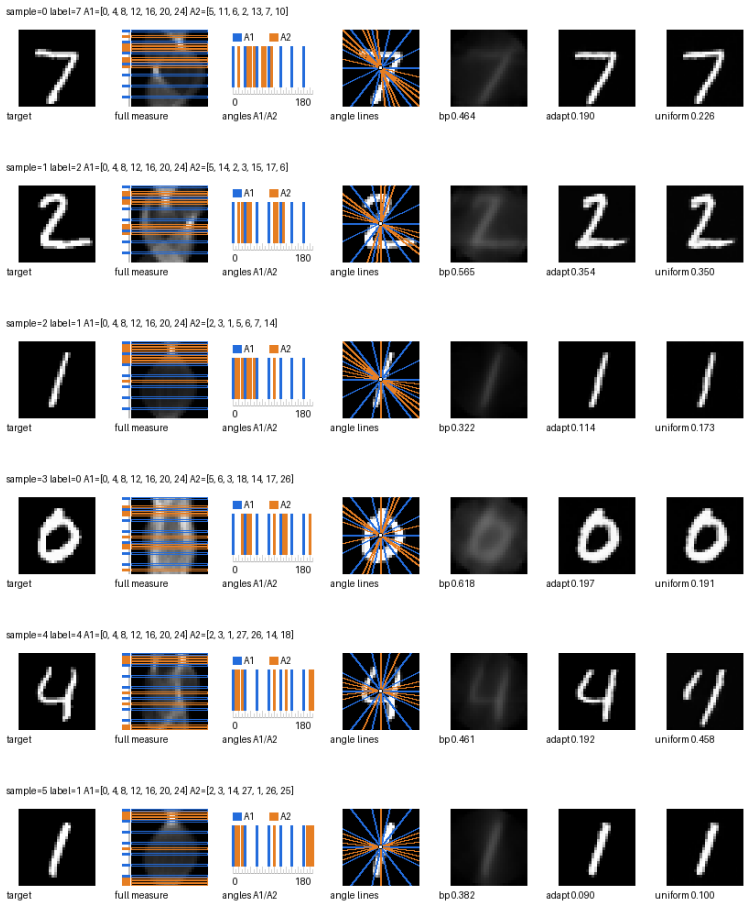
- The measure predicts failure modes across row-sampling, tomographic, and MR acquisition.
- It explains measurement-induced hallucinations in reconstructions.
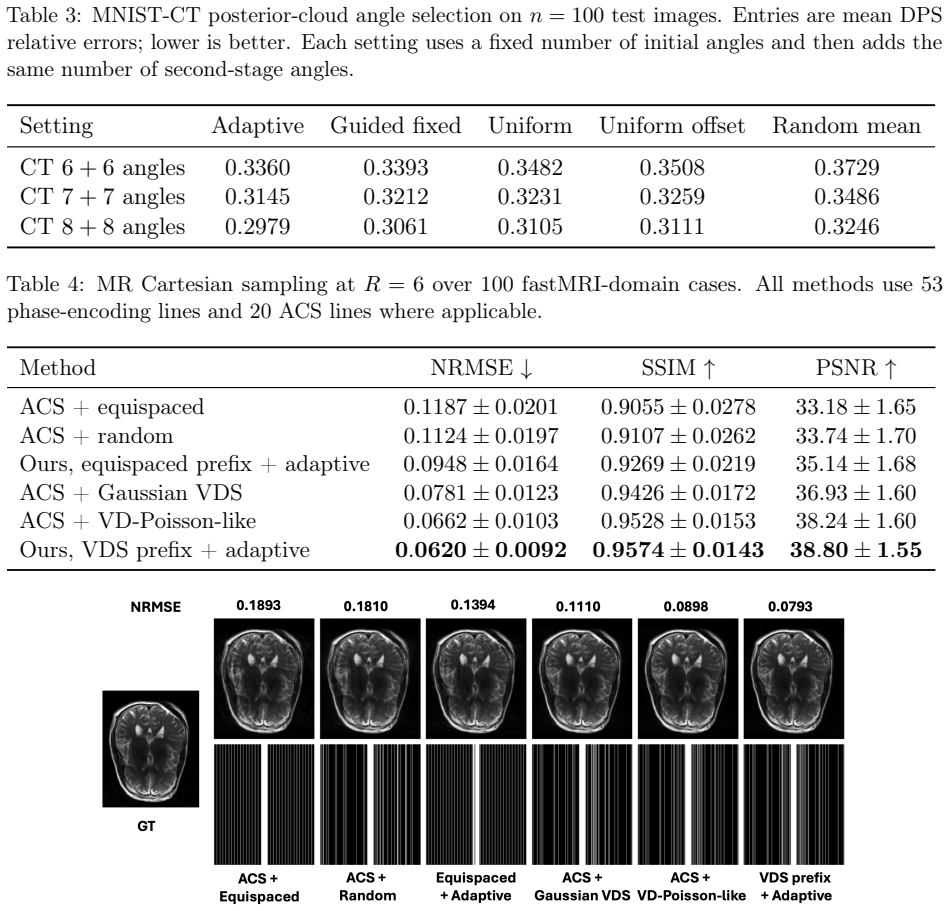
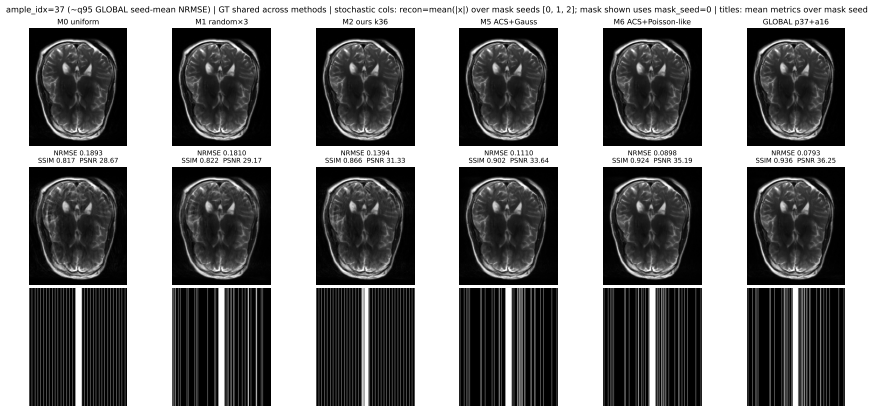
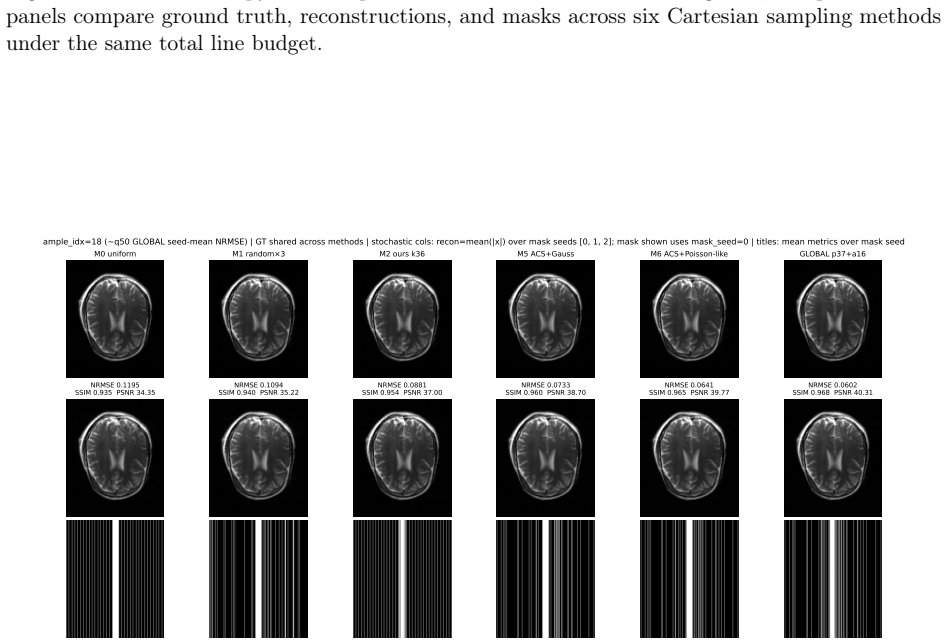
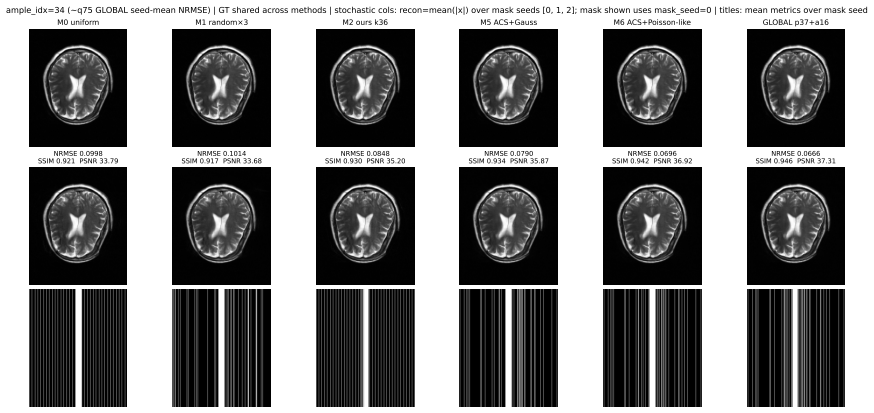
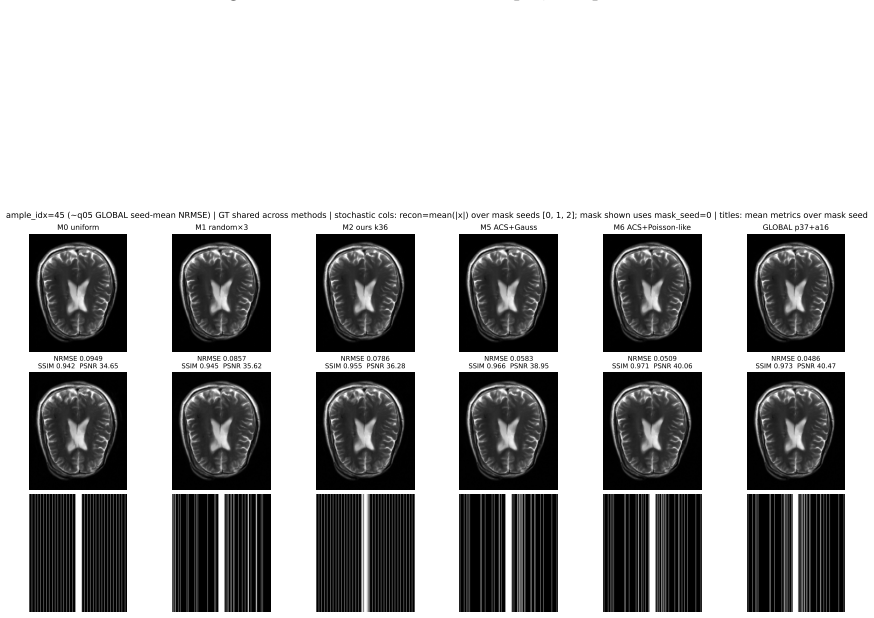
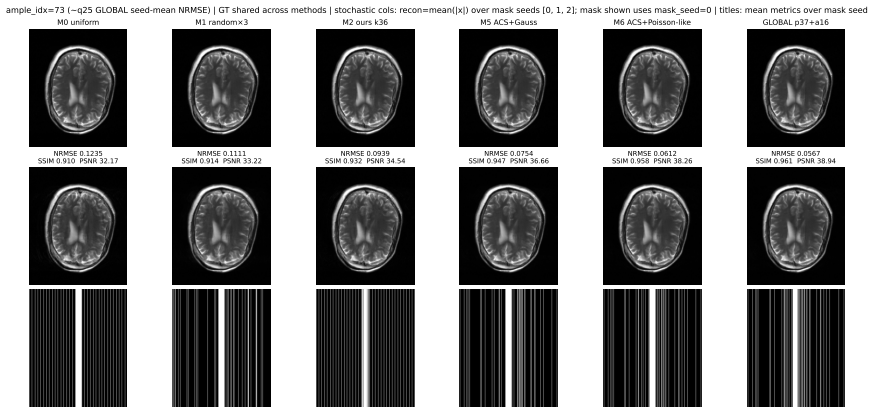
- Posterior-cloud design at test time improves over variable-density and Poisson-like masks in fastMRI.
- Fixed and sequential acquisition rules can be derived from overall local volume preservation.
Where Pith is reading between the lines
- The certificate may inform operator design in other inverse problems beyond imaging.
- Posterior-cloud adaptation provides a test-time way to handle uncertainty without learning a policy.
- The volume preservation idea could extend to sequential decisions in dynamic settings.
Load-bearing premise
Local regularity assumptions on the generative prior and measurement operator that relate the compatibility measure to stable error.
What would settle it
A counterexample where high compatibility measure coincides with large stable reconstruction error would falsify the main theorem.
Figures

read the original abstract
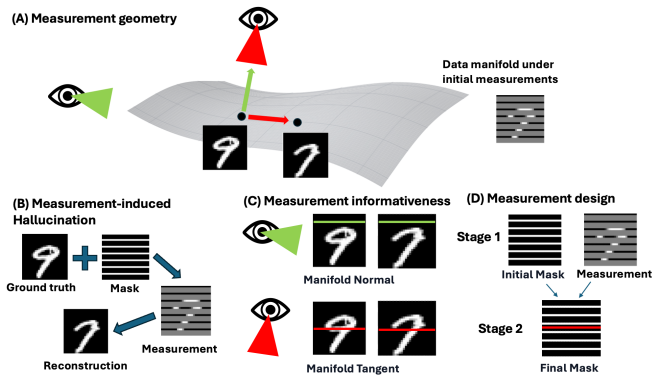
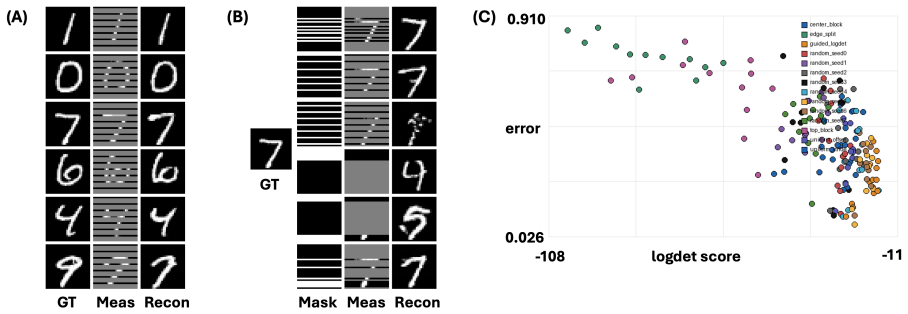
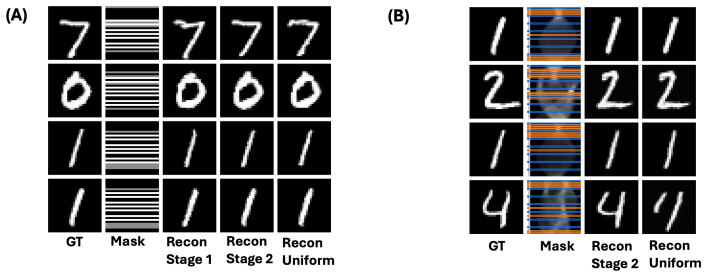
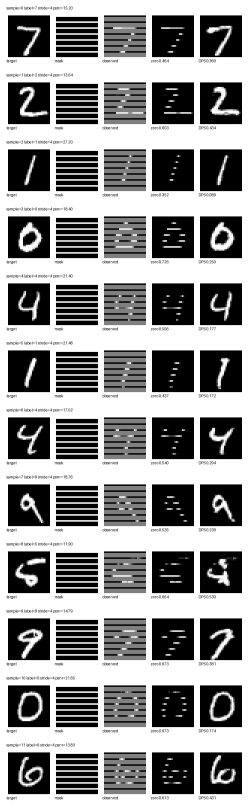
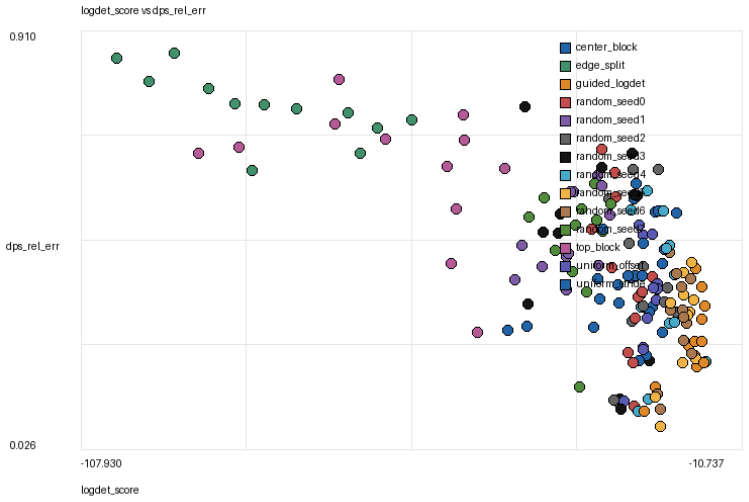
Generative models are increasingly used as priors for inverse problems, but their ability to produce realistic images creates a basic trust problem: a plausible reconstruction may be supported by the measurements, or it may be filled in by the prior along unobserved directions. This distinction is especially important in medical imaging, where acquisition operators are designed under scan-time, dose, and calibration constraints. We study generative inverse problems from a measurement-geometry perspective. The central question is whether a fixed measurement operator can distinguish nearby images that are plausible under the generative prior, and whether this relationship can guide better measurements. We introduce a local measurement-manifold compatibility measure that quantifies how well the operator observes prior-relevant tangent directions. Under local regularity assumptions, we prove that this quantity controls the stable part of the reconstruction error, while the generative prior controls off-manifold drift. This worst-direction certificate motivates practical fixed and sequential acquisition rules based on overall local volume preservation, including a posterior-cloud design that adapts measurements at test time without training a sampling policy. Across row-sampling, tomographic, and MR acquisition settings, the proposed scores predict failure modes, explain measurement-induced hallucinations, and guide better sampling. In fastMRI Cartesian sampling, posterior-cloud measurement design improves over strong non-learned ACS-preserving baselines, including variable-density and Poisson-like masks.
Editorial analysis
A structured set of objections, weighed in public.
Referee Report
Summary. The paper introduces a local measurement-manifold compatibility measure for generative inverse problems. Under local regularity assumptions on the generative prior and measurement operator, it proves that this measure controls the stable component of reconstruction error while the prior governs off-manifold drift. The measure motivates fixed and sequential acquisition designs, including a test-time posterior-cloud method. Experiments across row-sampling, tomography, MR, and fastMRI settings show that the scores predict failure modes and that the posterior-cloud design improves over non-learned baselines such as variable-density and Poisson-like masks in fastMRI Cartesian sampling.
Significance. If the central theorem holds with verified assumptions, the work supplies a geometric certificate linking measurement design to trustworthy reconstruction in generative inverse problems, with direct relevance to constrained medical imaging. The combination of a local volume-preservation design rule and empirical gains over strong baselines is a concrete contribution; the absence of parameter-free derivations or machine-checked proofs is offset by the falsifiable prediction that the compatibility score should correlate with stable error under the stated conditions.
major comments (2)
- [Abstract, §3] Abstract and §3 (theorem statement): the proof that the compatibility measure controls stable reconstruction error is conditioned on local regularity assumptions (manifold smoothness, bounded curvature, Lipschitz constants of the restricted operator in tangent neighborhoods). The experiments in §4–5 apply the method to standard generative models and operators (row-sampling, tomography, MR, fastMRI) yet report no verification or diagnostic that these local conditions hold at the operating points. If the assumptions are violated, the claimed certificate and derived design rules lack theoretical grounding for the concrete results.
- [§4] §4 (experimental setup): the manuscript provides no quantitative error analysis or ablation that isolates the contribution of the compatibility measure from the generative prior itself. Without such controls, it is difficult to assess whether observed improvements in fastMRI are attributable to the geometry-based design or to other factors such as mask density.
minor comments (2)
- [§2] Notation for the compatibility measure and tangent-space projections should be introduced with an explicit equation early in §2 to avoid ambiguity when the measure is later used in the theorem.
- [§5] Figure captions for the fastMRI results should include the exact number of test slices and the precise definition of the ACS-preserving baseline masks for reproducibility.
Simulated Author's Rebuttal
We thank the referee for the detailed and constructive report. We address each major comment below and will incorporate revisions to strengthen the connection between theory and experiments.
read point-by-point responses
-
Referee: [Abstract, §3] Abstract and §3 (theorem statement): the proof that the compatibility measure controls stable reconstruction error is conditioned on local regularity assumptions (manifold smoothness, bounded curvature, Lipschitz constants of the restricted operator in tangent neighborhoods). The experiments in §4–5 apply the method to standard generative models and operators (row-sampling, tomography, MR, fastMRI) yet report no verification or diagnostic that these local conditions hold at the operating points. If the assumptions are violated, the claimed certificate and derived design rules lack theoretical grounding for the concrete results.
Authors: We agree that explicit verification of the local regularity assumptions would strengthen the grounding of the theoretical claims in the concrete experiments. In the revised manuscript we will add a dedicated diagnostics subsection (new §4.1) that reports empirical estimates of local Lipschitz constants (via finite differences along estimated tangent spaces), curvature bounds (via second-order finite differences), and manifold smoothness indicators for the generative models at the operating points used in §4–5. These checks will either confirm the assumptions hold approximately or identify regimes where they are mildly violated, with discussion of the implications for the certificate. revision: yes
-
Referee: [§4] §4 (experimental setup): the manuscript provides no quantitative error analysis or ablation that isolates the contribution of the compatibility measure from the generative prior itself. Without such controls, it is difficult to assess whether observed improvements in fastMRI are attributable to the geometry-based design or to other factors such as mask density.
Authors: We acknowledge the absence of isolating ablations. In the revision we will add quantitative controls in §4 and the fastMRI experiments of §5: (i) fixed-prior comparisons of compatibility-guided masks versus density-matched random and variable-density masks, reporting both total and stable-component reconstruction error; (ii) an ablation that varies only the measurement design while holding the generative prior fixed; and (iii) a non-generative baseline (e.g., compressed-sensing reconstruction) to separate prior-driven from measurement-driven effects. These will clarify the incremental contribution of the compatibility measure. revision: yes
Circularity Check
No circularity; new measure defined and theorem proved independently under stated assumptions.
full rationale
The paper defines a local measurement-manifold compatibility measure and states a theorem that, under local regularity assumptions on the generative prior and measurement operator, this quantity controls the stable part of reconstruction error. No equations or steps reduce the claimed control to a fitted parameter, self-definition, or self-citation chain. The derivation introduces the quantity explicitly and derives its error-control property from the assumptions rather than by construction or renaming. Experiments apply the measure but do not alter the logical independence of the theorem. This is the normal case of a self-contained theoretical contribution.
Axiom & Free-Parameter Ledger
axioms (1)
- domain assumption local regularity assumptions
invented entities (1)
-
local measurement-manifold compatibility measure
no independent evidence
Reference graph
Works this paper leans on
-
[1]
Asad Aali, Giannis Daras, Brett Levac, Sidharth Kumar, Alexandros G. Dimakis, and Jonathan I. Tamir. Ambient diffusion posterior sampling: Solving inverse problems with diffusion models trained on corrupted data, 2024. URLhttps://arxiv.org/abs/2403.08728
arXiv 2024
-
[2]
Cagla Deniz Bahadir, Alan Q. Wang, Adrian V. Dalca, and Mert R. Sabuncu. Deep-learning- based optimization of the under-sampling pattern in mri.IEEE Transactions on Computational Imaging, 6:1139–1152, 2020. doi: 10.1109/TCI.2020.3006727. URLhttps://doi.org/10.1109/ TCI.2020.3006727. 11
-
[3]
Ashish Bora, Ajil Jalal, Eric Price, and Alexandros G. Dimakis. Compressed sensing using generative models. InProceedings of the 34th International Conference on Machine Learning, volume 70 ofProceedings of Machine Learning Research, pages 537–546. PMLR, 2017. URL https://proceedings.mlr.press/v70/bora17a.html
2017
-
[4]
Candès, Justin Romberg, and Terence Tao
Emmanuel J. Candès, Justin Romberg, and Terence Tao. Robust uncertainty principles: Exact signal reconstruction from highly incomplete frequency information.IEEE Transactions on Information Theory, 52(2):489–509, 2006. doi: 10.1109/TIT.2005.862083. URLhttps: //doi.org/10.1109/TIT.2005.862083
-
[5]
Cheng, Feiyu Chen, Christopher Sandino, Morteza Mardani, John M
Joseph Y. Cheng, Feiyu Chen, Christopher Sandino, Morteza Mardani, John M. Pauly, and Shreyas S. Vasanawala. Compressed sensing: From research to clinical practice with data-driven learning, 2019. URLhttps://arxiv.org/abs/1903.07824
Pith/arXiv arXiv 2019
-
[6]
Score-based diffusion models for accelerated mri.Medical Image Analysis, 80:102479, 2022
Hyungjin Chung and Jong Chul Ye. Score-based diffusion models for accelerated mri.Medical Image Analysis, 80:102479, 2022. doi: 10.1016/j.media.2022.102479. URLhttps://doi.org/ 10.1016/j.media.2022.102479
-
[7]
Improv- ing diffusion models for inverse problems using manifold constraints
Hyungjin Chung, Byeongsu Sim, Dohoon Ryu, and Jong Chul Ye. Improv- ing diffusion models for inverse problems using manifold constraints. InAd- vances in Neural Information Processing Systems, volume 35, pages 25683–25696,
-
[8]
URL https://proceedings.neurips.cc/paper_files/paper/2022/hash/ a48e5877c7bf86a513950ab23b360498-Abstract-Conference.html
2022
-
[9]
Klasky, and Jong Chul Ye
Hyungjin Chung, Jeongsol Kim, Michael Thompson McCann, Marc L. Klasky, and Jong Chul Ye. Diffusion posterior sampling for general noisy inverse problems. InThe Eleventh International Conference on Learning Representations, 2023. URLhttps://openreview.net/forum?id= OnD9zGAGT0k
2023
-
[10]
McCann, Marc L
Hyungjin Chung, Dohoon Ryu, Michael T. McCann, Marc L. Klasky, and Jong Chul Ye. Solving 3d inverse problems using pre-trained 2d diffusion models. InProceedings of the IEEE/CVF Conference on Computer Vision and Pattern Recognition, pages 22542–22551,
-
[11]
URL https://openaccess.thecvf.com/content/CVPR2023/html/Chung_Solving_3D_ Inverse_Problems_Using_Pre-Trained_2D_Diffusion_Models_CVPR_2023_paper.html
-
[12]
Dimakis, and Mauricio Delbracio
Giannis Daras, Hyungjin Chung, Chieh-Hsin Lai, Yuki Mitsufuji, Jong Chul Ye, Peyman Milanfar, Alexandros G. Dimakis, and Mauricio Delbracio. A survey on diffusion models for inverse problems, 2024. URLhttps://arxiv.org/abs/2410.00083
Pith/arXiv arXiv 2024
-
[13]
Constant-expansion suffices for compressed sensing with generative priors
Constantinos Daskalakis, Dhruv Rohatgi, and Emmanouil Zampetakis. Constant-expansion suffices for compressed sensing with generative priors. InAdvances in Neural Information Processing Systems, volume 33, 2020. URLhttps://proceedings.neurips.cc/paper/2020/ hash/9fa83fec3cf3810e5680ed45f7124dce-Abstract.html
2020
-
[14]
Diffusion models beat gans on image synthesis.Advances in Neural Information Processing Systems, 34: 8780–8794, 2021
Prafulla Dhariwal and Alexander Nichol. Diffusion models beat gans on image synthesis.Advances in Neural Information Processing Systems, 34: 8780–8794, 2021. URL https://proceedings.neurips.cc/paper/2021/hash/ 49ad23d1ec9fa4bd8d77d02681df5cfa-Abstract.html
2021
-
[15]
David L. Donoho. Compressed sensing.IEEE Transactions on Information Theory, 52(4): 1289–1306, 2006. doi: 10.1109/TIT.2006.871582. URLhttps://doi.org/10.1109/TIT.2006. 871582. 12
-
[16]
Diffusion posterior sampling for linear inverse problem solving: A filtering perspective
Zehao Dou and Yang Song. Diffusion posterior sampling for linear inverse problem solving: A filtering perspective. InThe Twelfth International Conference on Learning Representations,
-
[17]
URLhttps://openreview.net/forum?id=tplXNcHZs1
-
[18]
Nicholas Dwork, Corey A. Baron, Ethan M. I. Johnson, Daniel O’Connor, John M. Pauly, and Peder E. Z. Larson. Fast variable density poisson-disc sample generation with directional variation for compressed sensing in mri.Magnetic Resonance Imaging, 77:186–193, 2021. doi: 10.1016/j.mri.2020.11.012. URLhttps://doi.org/10.1016/j.mri.2020.11.012
-
[19]
Learning-based compressive mri.IEEE Transactions on Medical Imaging, 37(6):1394–1406, 2018
Baran Gözcü, Rabeeh Karimi Mahabadi, Yen-Huan Li, Efe Ilıcak, Tolga Çukur, Jonathan Scarlett, and Volkan Cevher. Learning-based compressive mri.IEEE Transactions on Medical Imaging, 37(6):1394–1406, 2018. doi: 10.1109/TMI.2018.2832540. URLhttps://doi.org/10. 1109/TMI.2018.2832540
-
[20]
Mark A. Griswold, Peter M. Jakob, Robin M. Heidemann, Mathias Nittka, Vladimir Jellus, Jianmin Wang, Berthold Kiefer, and Axel Haase. Generalized autocalibrating partially parallel acquisitions (grappa).Magnetic Resonance in Medicine, 47(6):1202–1210, 2002. doi: 10.1002/ mrm.10171. URLhttps://doi.org/10.1002/mrm.10171
-
[21]
Denoising diffusion probabilis- tic models
Jonathan Ho, Ajay Jain, and Pieter Abbeel. Denoising diffusion probabilis- tic models. InAdvances in Neural Information Processing Systems, volume 33, pages 6840–6851, 2020. URL https://proceedings.neurips.cc/paper/2020/hash/ 4c5bcfec8584af0d967f1ab10179ca4b-Abstract.html
2020
-
[22]
Chang Min Hyun, Seong Hyeon Baek, Mingyu Lee, Sung Min Lee, and Jin Keun Seo. Deep learning-based solvability of underdetermined inverse problems in medical imaging.Medical Image Analysis, 69:101967, 2021. doi: 10.1016/j.media.2021.101967. URLhttps://doi.org/ 10.1016/j.media.2021.101967
-
[23]
Dimakis, and Constantine Caramanis
Ajil Jalal, Liu Liu, Alexandros G. Dimakis, and Constantine Caramanis. Robust com- pressed sensing using generative models. InAdvances in Neural Information Process- ing Systems, volume 33, 2020. URLhttps://proceedings.neurips.cc/paper/2020/hash/ 07cb5f86508f146774a2fac4373a8e50-Abstract.html
2020
-
[24]
Dimakis, and Jonathan Tamir
Ajil Jalal, Marius Arvinte, Giannis Daras, Eric Price, Alexandros G. Dimakis, and Jonathan Tamir. Robust compressed sensing mri with deep generative priors. InAdvances in Neural Infor- mation Processing Systems, volume 34, pages 14938–14954, 2021. URLhttps://proceedings. neurips.cc/paper/2021/hash/7d6044e95a16761171b130dcb476a43e-Abstract.html
2021
-
[25]
Denoising diffu- sion restoration models
Bahjat Kawar, Michael Elad, Stefano Ermon, and Jiaming Song. Denoising diffu- sion restoration models. InAdvances in Neural Information Processing Systems, vol- ume 35, 2022. URL https://proceedings.neurips.cc/paper_files/paper/2022/hash/ 95504595b6169131b6ed6cd72eb05616-Abstract-Conference.html
2022
-
[26]
Tackling hallucination from conditional models for medical image reconstruction with dynamicdps
Seunghoi Kim, Henry FJ Tregidgo, Matteo Figini, Chen Jin, Sarang Joshi, and Daniel C Alexander. Tackling hallucination from conditional models for medical image reconstruction with dynamicdps. InInternational Conference on Medical Image Computing and Computer- Assisted Intervention, pages 593–603. Springer, 2025
2025
-
[27]
Michael Lustig, David Donoho, and John M. Pauly. Sparse mri: The application of compressed sensing for rapid mr imaging.Magnetic Resonance in Medicine, 58(6):1182–1195, 2007. doi: 10.1002/mrm.21391. URLhttps://doi.org/10.1002/mrm.21391. 13
-
[28]
A variational perspective on solving inverse problems with diffusion models
Morteza Mardani, Jiaming Song, Jan Kautz, and Arash Vahdat. A variational perspective on solving inverse problems with diffusion models. InThe Twelfth International Conference on Learning Representations, 2024. URLhttps://openreview.net/forum?id=1YO4EE3SPB
2024
-
[29]
Nguyen, Gauri Jagatap, and Chinmay Hegde
Thanh V. Nguyen, Gauri Jagatap, and Chinmay Hegde. Provable compressed sensing with generative priors via langevin dynamics.IEEE Transactions on Information Theory, 68(11): 7410–7422, 2022. doi: 10.1109/TIT.2022.3179643. URLhttps://doi.org/10.1109/TIT.2022. 3179643
-
[30]
Pruessmann, Markus Weiger, Markus B
Klaas P. Pruessmann, Markus Weiger, Markus B. Scheidegger, and Peter Boesiger. Sense: Sensitivity encoding for fast mri.Magnetic Resonance in Medicine, 42(5):952–962, 1999. doi: 10.1002/(SICI)1522-2594(199911)42:5<952::AID-MRM16>3.0.CO;2-S. URL https://doi. org/10.1002/(SICI)1522-2594(199911)42:5%3C952::AID-MRM16%3E3.0.CO;2-S
-
[31]
Adaptive sampling design for compressed sensing mri
Saiprasad Ravishankar and Yoram Bresler. Adaptive sampling design for compressed sensing mri. In2011 Annual International Conference of the IEEE Engineering in Medicine and Biology Society, pages 3751–3755. IEEE, 2011. doi: 10.1109/IEMBS.2011.6090639. URL https://doi.org/10.1109/IEMBS.2011.6090639
-
[32]
Pseudoinverse-guided diffusion models for inverse problems
Jiaming Song, Arash Vahdat, Morteza Mardani, and Jan Kautz. Pseudoinverse-guided diffusion models for inverse problems. InInternational Conference on Learning Representations, 2022. URLhttps://openreview.net/forum?id=9_gsMA8MRKQ
2022
-
[33]
Solving inverse problems in medical imaging with score-based generative models, 2021
Yang Song, Liyue Shen, Lei Xing, and Stefano Ermon. Solving inverse problems in medical imaging with score-based generative models, 2021. URLhttps://arxiv.org/abs/2111.08005
arXiv 2021
-
[34]
Kingma, Abhishek Kumar, Stefano Ermon, and Ben Poole
Yang Song, Jascha Sohl-Dickstein, Diederik P. Kingma, Abhishek Kumar, Stefano Ermon, and Ben Poole. Score-based generative modeling through stochastic differential equations. In International Conference on Learning Representations, 2021. URLhttps://openreview.net/ forum?id=PxTIG12RRHS
2021
-
[35]
Rods: Robust optimization inspired diffusion sampling for detecting and reducing hallucination in generative models
Yiqi Tian, Pengfei Jin, Mingze Yuan, Na Li, Bo Zeng, and Quanzheng Li. Rods: Robust optimization inspired diffusion sampling for detecting and reducing hallucination in generative models. InThe Thirty-ninth Annual Conference on Neural Information Processing Systems
-
[36]
Murphy, Patrick Virtue, Michael Elad, John M
Martin Uecker, Peng Lai, Mark J. Murphy, Patrick Virtue, Michael Elad, John M. Pauly, Shreyas S. Vasanawala, and Michael Lustig. Espirit–an eigenvalue approach to autocalibrating parallel mri: Where sense meets grappa.Magnetic Resonance in Medicine, 71(3):990–1001,
-
[37]
Murphy, Patrick Virtue, Michael Elad, John M
doi: 10.1002/mrm.24751. URLhttps://doi.org/10.1002/mrm.24751
-
[38]
Zero-shot image restoration using denoising diffusion null-space model, 2022
Yinhuai Wang, Jiwen Yu, and Jian Zhang. Zero-shot image restoration using denoising diffusion null-space model, 2022. URLhttps://arxiv.org/abs/2212.00490
arXiv 2022
-
[39]
Jong Chul Ye. Compressed sensing mri: A review from signal processing perspective.BMC Biomedical Engineering, 1(1):8, 2019. doi: 10.1186/s42490-019-0006-z. URLhttps://doi.org/ 10.1186/s42490-019-0006-z
-
[40]
Muckley, Aaron Defazio, Ruben Stern, Patricia Johnson, Mary Bruno, Marc Parente, Krzysztof J
Jure Zbontar, Florian Knoll, Anuroop Sriram, Tullie Murrell, Zhengnan Huang, Matthew J. Muckley, Aaron Defazio, Ruben Stern, Patricia Johnson, Mary Bruno, Marc Parente, Krzysztof J. Geras, Joe Katsnelson, Hersh Chandarana, Zizhao Zhang, Michal Drozdzal, Adriana Romero, Michael Rabbat, Pascal Vincent, Nafissa Yakubova, James Pinkerton, Duo Wang, Erich Owen...
2018
-
[41]
Denoising diffusion models for plug-and-play image restoration
Yuanzhi Zhu, Kai Zhang, Jingyun Liang, Jiezhang Cao, Bihan Wen, Radu Timofte, and Luc Van Gool. Denoising diffusion models for plug-and-play image restoration. InProceedings of the IEEE/CVF Conference on Computer Vision and Pattern Recognition, pages 1219–1229,
-
[42]
15 A Proof Details This appendix collects the proof details that are abbreviated in Section 4
URL https://openaccess.thecvf.com/content/CVPR2023/html/Zhu_Denoising_ Diffusion_Models_for_Plug-and-Play_Image_Restoration_CVPR_2023_paper.html. 15 A Proof Details This appendix collects the proof details that are abbreviated in Section 4. A.1 Regularizer Models For the generator-induced penalty, assume thatGθ is a local immersion atz∗ and that x∗ = Gθ(z...
arXiv 2000
discussion (0)
Sign in with ORCID, Apple, or X to comment. Anyone can read and Pith papers without signing in.