REVIEW 2 minor 1 cited by
JPPD: Joint Prediction_Planning Diffusion with Differentiable Safety Guidance for Dynamic Obstacle Avoidance in Intelligent Transportation Systems
T0 review · 0 major / 2 minor · reviewed 2026-06-27 · grok-4.3
Pith's one-line read A joint diffusion sampler generates robot plans and pedestrian futures together from one distribution, improving tail safety and speed over separate prediction-then-planning.
desk verdict Joint diffusion sampling with cross-trajectory attention and differentiable safety guidance is the main new element, and the shift to operational safety metrics is a clear improvement over standard baselines. read the letter →
The pith
A machine-rendered reading of the paper's core claim, the machinery that carries it, and where it could break.
The reading
What carries the argument
Causal Transformer with cross-trajectory attention that jointly samples robot and participant trajectories under differentiable safety potential guidance.
What would settle it
In the ROS/Orin deployment experiments, the joint method shows no measurable reduction in near-misses, hard-braking events, or blockage time compared with the separated prediction-then-planning baseline.
Extended reading notes
Core claim
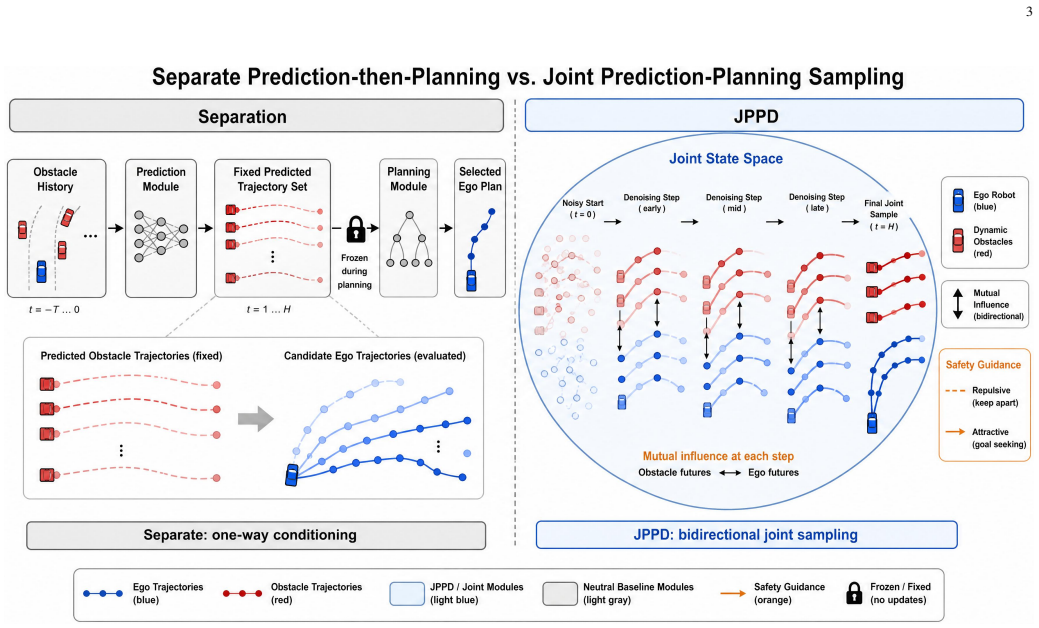
Joint prediction-planning diffusion treats participant prediction and robot planning as one conditional trajectory generation task that samples the robot trajectory together with all participant trajectories from a single coupled distribution; a causal Transformer with cross-trajectory attention models the joint evolution, differentiable safety potential guidance replaces heuristic post-processing, and conditional flow matching reduces the number of inference steps while preserving multimodal diversity, resulting in lower near-miss rates, reduced blockage time, fewer hard-braking events, and lower embedded latency than separated baselines.
Load-bearing premise
The causal Transformer successfully learns the true joint distribution of robot and participant trajectories so that the safety potential actually produces safer real-world behavior without creating new unmodeled risks.
Editorial extensions
If this is right
- Joint sampling improves tail safety metrics over separated baselines in scenario-grounded simulation and naturalistic pedestrian replay.
- The approach yields lower runtime latency on embedded hardware in ROS/Orin deployment.
- Induced participant deviation and hard-braking events decrease when the robot plan influences the joint forecast.
- Conditional flow matching maintains trajectory diversity while cutting inference steps.
- Isaac Sim validation and real-robot tests confirm the safety gains transfer beyond pure simulation.
Reading between the lines
- The same joint-sampling structure could be applied to mixed traffic with vehicles and cyclists where plans must influence forecasts.
- Testing whether the safety potential still works when participant behavior includes deliberate avoidance of the robot would check for hidden distribution shifts.
- Replacing the Transformer backbone with other sequence models might reveal whether cross-trajectory attention is the essential component.
- Deploying the method on fleets of service robots could show whether the efficiency gains compound across multiple interacting agents.
Editorial analysis
A structured set of objections, weighed in public.
Referee Report
Summary. The paper proposes JPPD, a joint prediction-planning diffusion framework for low-speed autonomous navigation in shared spaces with dynamic obstacles such as pedestrians. It models participant prediction and robot planning as sampling from a single coupled trajectory distribution via a causal Transformer with cross-trajectory attention, replaces heuristic safety post-processing with differentiable safety potential guidance (a time-varying occupancy-probability potential), and employs conditional flow matching to reduce inference steps while maintaining multimodal diversity. Evaluation focuses on shared-space operational metrics (near-misses, blockage time, induced deviation, hard-braking events, latency) rather than standard ADE/FDE, with experiments in scenario-grounded simulation, naturalistic pedestrian replay, Isaac Sim, and ROS/Orin hardware deployment claiming improvements in tail safety and runtime efficiency over separated prediction-then-planning baselines.
Significance. If the central claims hold, the work offers a principled way to close the one-way information loop between prediction and planning, which is a recognized limitation in multi-agent shared-space autonomy. The shift to tail-risk metrics and multi-environment validation (including hardware) aligns with operational safety needs. The differentiable safety guidance and joint diffusion sampling represent a technical contribution that could influence downstream work on safe trajectory generation; the absence of free parameters in the core modeling steps and the explicit multi-stage validation design are strengths.
minor comments (2)
- [Abstract] Abstract states that joint sampling 'improves tail safety and runtime efficiency' but supplies no numerical deltas, confidence intervals, or specific metric values; adding one or two headline quantitative results would improve immediate readability without altering the technical content.
- [Abstract] The description of 'differentiable safety potential guidance' as a 'time-varying occupancy-probability potential' is introduced without an explicit functional form or gradient derivation in the provided abstract; a short equation or pseudocode reference in the main text would clarify how the gradient is back-propagated through the sampler.
Simulated Author's Rebuttal
We thank the referee for the positive summary, significance assessment, and recommendation of minor revision. The recognition of the joint diffusion approach, differentiable safety guidance, and multi-environment validation as addressing a recognized limitation in shared-space autonomy is appreciated. No specific major comments were listed in the report.
Circularity Check
No significant circularity identified
full rationale
The paper presents a joint prediction-planning diffusion model with differentiable safety guidance, evaluated empirically against separated prediction-then-planning baselines across simulation, replay, Isaac Sim, and hardware. No equations, self-citations, or derivation steps are shown that reduce claims to fitted inputs, self-definitions, or author-prior ansatzes. The central claims rest on external validation metrics (near-misses, blockage time, etc.) rather than internal reductions, making the framework self-contained against the provided description.
Assumptions & free parameters
assumptions (2)
- domain assumption Diffusion models can generate diverse multimodal trajectory distributions conditioned on observations
- domain assumption Cross-trajectory attention in a causal Transformer can model inter-agent dependencies sufficiently for joint sampling
invented entities (1)
-
differentiable safety potential guidance
Cite this review
Pith. "Pith review of JPPD: Joint Prediction_Planning Diffusion with Differentiable Safety Guidance for Dynamic Obstacle Avoidance in Intelligent Transportation Systems." pith.science (2026). https://pith.science/paper/RL3CWR4F
@misc{pith2026260620686,
  author       = {Pith},
  title        = {Pith review of: JPPD: Joint Prediction_Planning Diffusion with Differentiable Safety Guidance for Dynamic Obstacle Avoidance in Intelligent Transportation Systems},
  year         = {2026},
  howpublished = {\url{https://pith.science/paper/RL3CWR4F}},
  note         = {Machine review of arXiv:2606.20686}
}
read the original abstract
Shared-space transportation operation requires low-speed autonomous platforms to navigate safely and efficiently among pedestrians, service robots, micromobility users, carts, and other road users. Most existing systems decompose this problem into trajectory prediction followed by motion planning, which creates one-way information flow: predicted participant futures influence the robot plan, but the selected robot plan cannot influence the predicted multi-agent evolution. This paper presents a joint prediction-planning diffusion framework that treats participant prediction and robot planning as a single conditional trajectory generation problem, where the model samples the future robot trajectory and all participant trajectories from one coupled distribution using a causal Transformer with cross-trajectory attention. To replace heuristic repulsive post-processing, the framework introduces differentiable safety potential guidance, a time-varying occupancy-probability potential whose gradient directly guides the joint sampler, and conditional flow matching is used to reduce inference steps while preserving multimodal trajectory diversity. The evaluation emphasizes shared-space operational effects, including near misses, blockage time, induced participant deviation, hard-braking events, and embedded latency, rather than treating average displacement error and final displacement error as the main result. Experiments in scenario-grounded simulation, naturalistic pedestrian replay, Isaac Sim validation, and ROS/Orin deployment show that joint sampling improves tail safety and runtime efficiency over a separated prediction-then-planning baseline.
Figures


Figures from the paper (1 more)

Forward citations
Cited by 1 Pith paper
-
SAGE: A Socially-Aware Generative Engine for Heterogeneous Multi-Agent Navigation
SAGE couples heterogeneous-agent trajectory prediction and robot planning in one diffusion model and applies differentiable safety-social energy guidance to cut collision and social-zone intrusion rates.
Reference graph
Works this paper leans on
-
[1]
Study of sidewalk autonomous delivery robots and their potential impacts on freight efficiency and travel,
D. Jennings and M. Figliozzi, “Study of sidewalk autonomous delivery robots and their potential impacts on freight efficiency and travel,” Transportation Research Record, vol. 2673, no. 6, pp. 317–326, 2019
2019
-
[2]
Shared micromobility: Policy, practices, and emerging futures,
S. Shaheen, A. Cohen, and J. Broader, “Shared micromobility: Policy, practices, and emerging futures,” inRoutledge Companion to Cycling, G. Norcliffe, U. Brogan, P. Cox, B. Gao, T. Hadland, S. Hanlon, T. Jones, N. Oddy, and L. Vivanco, Eds. London, UK: Routledge, 2022, pp. 254– 262
2022
-
[3]
Autonomous last-mile delivery robots: A literature review,
E. Alverhed, S. Hellgren, H. Isaksson, L. Olsson, H. Palmqvist, and J. Flod ´en, “Autonomous last-mile delivery robots: A literature review,” European Transport Research Review, vol. 16, no. 1, p. 4, 2024
2024
-
[4]
A formal basis for the heuristic determination of minimum cost paths,
P. E. Hart, N. J. Nilsson, and B. Raphael, “A formal basis for the heuristic determination of minimum cost paths,”IEEE Transactions on Systems Science and Cybernetics, vol. 4, no. 2, pp. 100–107, 1968
1968
-
[5]
Rapidly-exploring random trees: A new tool for path planning,
S. M. LaValle, “Rapidly-exploring random trees: A new tool for path planning,”Technical Report, Computer Science Department, Iowa State University, 1998
1998
-
[6]
The dynamic window approach to collision avoidance,
D. Fox, W. Burgard, and S. Thrun, “The dynamic window approach to collision avoidance,” inIEEE Robotics & Automation Magazine, vol. 4, no. 1, 1997, pp. 23–33
1997
-
[7]
Motion planning in dynamic environments us- ing velocity obstacles,
P. Fiorini and Z. Shiller, “Motion planning in dynamic environments us- ing velocity obstacles,”The International Journal of Robotics Research, vol. 17, no. 7, pp. 760–772, 1998
1998
-
[8]
Reciprocal n- body collision avoidance,
J. Van Den Berg, S. J. Guy, M. Lin, and D. Manocha, “Reciprocal n- body collision avoidance,”Robotics Research, pp. 3–19, 2011
2011
Show all 40 references
-
[9]
Model predictive contouring control for collision avoidance in unstructured dynamic environments,
B. Brito, B. Floor, L. Ferranti, and J. Alonso-Mora, “Model predictive contouring control for collision avoidance in unstructured dynamic environments,” inIEEE Robotics and Automation Letters, vol. 4, no. 4, 2019, pp. 4459–4466
2019
-
[10]
Trajectron++: Dynamically-feasible trajectory forecasting with heterogeneous data,
T. Salzmann, B. Ivanovic, P. Chakravarty, and M. Pavone, “Trajectron++: Dynamically-feasible trajectory forecasting with heterogeneous data,” in European Conference on Computer Vision (ECCV). Springer, 2020, pp. 683–700
2020
-
[11]
Stochastic trajectory prediction via motion indeterminacy diffusion,
T. Gu, G. Chen, J. Li, C. Lin, Y . Rao, J. Zhou, and J. Lu, “Stochastic trajectory prediction via motion indeterminacy diffusion,” inIEEE/CVF Conference on Computer Vision and Pattern Recognition (CVPR), 2022, pp. 17 113–17 122
2022
-
[12]
Leapfrog diffusion model for stochastic trajectory prediction,
W. Mao, C. Xu, Q. Zhu, S. Chen, and Y . Wang, “Leapfrog diffusion model for stochastic trajectory prediction,” inIEEE/CVF Conference on Computer Vision and Pattern Recognition (CVPR), 2023, pp. 5517– 5526
2023
-
[13]
Trace and pace: Controllable pedestrian animation via guided trajectory diffusion,
D. Rempe, Z. Luo, X. B. Peng, Y . Yuan, K. Kitani, K. Kreis, S. Fidler, and O. Litany, “Trace and pace: Controllable pedestrian animation via guided trajectory diffusion,” inIEEE/CVF Conference on Computer Vision and Pattern Recognition (CVPR), 2023, pp. 13 756–13 766
2023
-
[14]
Planning with diffusion for flexible behavior synthesis,
M. Janner, Y . Du, J. B. Tenenbaum, and S. Levine, “Planning with diffusion for flexible behavior synthesis,” inInternational Conference on Machine Learning. PMLR, 2022, pp. 9902–9915
2022
-
[15]
Motion plan- ning diffusion: Learning and planning of robot motions with diffusion models,
J. Carvalho, A. T. Le, M. Baierl, D. Koert, and J. Peters, “Motion plan- ning diffusion: Learning and planning of robot motions with diffusion models,” inIEEE/RSJ International Conference on Intelligent Robots and Systems (IROS). IEEE, 2023, pp. 1916–1923
2023
-
[16]
Diffusion policy: Visuomotor policy learning via action diffusion,
C. Chi, S. Feng, Y . Du, Z. Xu, E. Cousineau, B. Burchfiel, and S. Song, “Diffusion policy: Visuomotor policy learning via action diffusion,” in Robotics: Science and Systems (RSS), 2023
2023
-
[17]
Social force model for pedestrian dynamics,
D. Helbing and P. Moln ´ar, “Social force model for pedestrian dynamics,” Physical Review E, vol. 51, no. 5, p. 4282, 1995
1995
-
[18]
Social lstm: Human trajectory prediction in crowded spaces,
A. Alahi, K. Goel, V . Ramanathan, A. Robicquet, L. Fei-Fei, and S. Savarese, “Social lstm: Human trajectory prediction in crowded spaces,” inIEEE/CVF Conference on Computer Vision and Pattern Recognition (CVPR), 2016, pp. 961–971
2016
-
[19]
Social gan: Socially acceptable trajectories with generative adversarial networks,
A. Gupta, J. Johnson, L. Fei-Fei, S. Savarese, and A. Alahi, “Social gan: Socially acceptable trajectories with generative adversarial networks,” inIEEE/CVF Conference on Computer Vision and Pattern Recognition (CVPR), 2018, pp. 2255–2264
2018
-
[20]
Agentformer: Agent-aware transformers for socio-temporal multi-agent forecasting,
Y . Yuan, X. Weng, Y . Ou, and K. M. Kitani, “Agentformer: Agent-aware transformers for socio-temporal multi-agent forecasting,” inIEEE/CVF International Conference on Computer Vision (ICCV), 2021, pp. 9813– 9823
2021
-
[21]
Trajdiffuse: A con- ditional diffusion model for environment-aware trajectory prediction,
Q. Chen, H. Zhang, F. Chen, X. Wang, and M. Liu, “Trajdiffuse: A con- ditional diffusion model for environment-aware trajectory prediction,” IEEE Robotics and Automation Letters, vol. 9, no. 2, pp. 1160–1167, 2024
2024
-
[22]
Flow matching for generative modeling,
Y . Lipman, R. T. Q. Chen, H. Ben-Hamu, M. Nickel, and M. Le, “Flow matching for generative modeling,” inInternational Conference on Learning Representations (ICLR), 2023
2023
-
[23]
Efficient trajectory fore- casting and generation with conditional flow matching,
S. Zhong, Z. Peng, H. Wen, and J. Gao, “Efficient trajectory fore- casting and generation with conditional flow matching,”arXiv preprint arXiv:2403.10809, 2024
2024
-
[24]
Reciprocal velocity obstacles for real-time multi-agent navigation,
J. Van den Berg, M. Lin, and D. Manocha, “Reciprocal velocity obstacles for real-time multi-agent navigation,” inIEEE International Conference on Robotics and Automation (ICRA). IEEE, 2008, pp. 1928–1935
2008
-
[25]
Generalized reciprocal collision avoidance,
D. Bareiss and J. Van Den Berg, “Generalized reciprocal collision avoidance,” inThe International Journal of Robotics Research, vol. 34, no. 12, 2015, pp. 1501–1514
2015
-
[26]
Socially aware motion planning with deep reinforcement learning,
Y . F. Chen, M. Everett, M. Liu, and J. P. How, “Socially aware motion planning with deep reinforcement learning,” inIEEE/RSJ International Conference on Intelligent Robots and Systems (IROS). IEEE, 2017, pp. 1343–1350
2017
-
[27]
Motion planning among dynamic, decision-making agents with deep reinforcement learning,
M. Everett, Y . F. Chen, and J. P. How, “Motion planning among dynamic, decision-making agents with deep reinforcement learning,” inIEEE/RSJ International Conference on Intelligent Robots and Systems (IROS). IEEE, 2018, pp. 3052–3059
2018
-
[28]
Crowd-robot interaction: Crowd-aware robot navigation with attention-based deep reinforcement learning,
C. Chen, Y . Liu, S. Kreiss, and A. Alahi, “Crowd-robot interaction: Crowd-aware robot navigation with attention-based deep reinforcement learning,” inIEEE International Conference on Robotics and Automation (ICRA). IEEE, 2019, pp. 6015–6022
2019
-
[29]
Socially compliant robot navi- gation in crowded environment by human behavior resemblance using deep reinforcement learning,
S. S. Samsani and M. S. Muhammad, “Socially compliant robot navi- gation in crowded environment by human behavior resemblance using deep reinforcement learning,”IEEE Robotics and Automation Letters, vol. 6, no. 3, pp. 5223–5230, 2021
2021
-
[30]
Risk-averse trajectory optimization via sample average approximation,
T. Lew, R. Bonalli, and M. Pavone, “Risk-averse trajectory optimization via sample average approximation,”IEEE Robotics and Automation Letters, vol. 8, no. 12, pp. 8044–8051, 2023
2023
-
[31]
Safety-critical model predictive control with discrete-time contraction theory,
X. Zhu, Y . Xie, S. Paternain, and M. Egerstedt, “Safety-critical model predictive control with discrete-time contraction theory,”IEEE Control Systems Letters, vol. 5, no. 6, pp. 2062–2067, 2021
-
[32]
CoBL-Diffusion: Diffusion-based conditional robot planning in dynamic environments using control barrier and Lyapunov functions,
K. Mizuta and K. Leung, “CoBL-Diffusion: Diffusion-based conditional robot planning in dynamic environments using control barrier and Lyapunov functions,”arXiv preprint arXiv:2406.05309, 2024. 12
2024
-
[33]
Safediffuser: Safe planning with diffusion probabilistic models,
W. Xiao, T.-H. Wang, M. Chahine, R. Hasani, and D. Rus, “Safediffuser: Safe planning with diffusion probabilistic models,” inInternational Conference on Machine Learning (ICML), 2024
2024
-
[34]
Safety-guided diffusion for robot manip- ulation,
B. Yang, J. Wen, S. Zhuet al., “Safety-guided diffusion for robot manip- ulation,” inIEEE International Conference on Robotics and Automation (ICRA), 2024
2024
-
[35]
SICNav: Safe and interactive crowd navigation using model predictive control and bilevel optimiza- tion,
S. S. Holtz, A. Bhatt, and J. F. Fisac, “SICNav: Safe and interactive crowd navigation using model predictive control and bilevel optimiza- tion,” inIEEE International Conference on Robotics and Automation (ICRA). IEEE, 2024, pp. 12 580–12 586
2024
-
[36]
SICNav-Diffusion: Safe and interactive crowd navigation with diffusion trajectory predictions,
——, “SICNav-Diffusion: Safe and interactive crowd navigation with diffusion trajectory predictions,”arXiv preprint arXiv:2403.18154, 2024
2024
-
[37]
Real-time obstacle avoidance for manipulators and mobile robots,
O. Khatib, “Real-time obstacle avoidance for manipulators and mobile robots,”The International Journal of Robotics Research, vol. 5, no. 1, pp. 90–98, 1986
1986
-
[38]
You’ll never walk alone: Modeling social behavior for multi-target tracking,
S. Pellegrini, A. Ess, K. Schindler, and L. Van Gool, “You’ll never walk alone: Modeling social behavior for multi-target tracking,” inIEEE International Conference on Computer Vision (ICCV). IEEE, 2009, pp. 261–268
2009
-
[39]
Crowds by example,
A. Lerner, Y . Chrysanthou, and D. Lischinski, “Crowds by example,” inComputer Graphics Forum, vol. 26, no. 3. Wiley Online Library, 2007, pp. 655–664
2007
-
[40]
Kinodynamic trajectory optimization and control for car-like robots,
C. R ¨osmann, F. Hoffmann, and T. Bertram, “Kinodynamic trajectory optimization and control for car-like robots,” inIEEE/RSJ International Conference on Intelligent Robots and Systems (IROS). IEEE, 2017, pp. 5681–5686
2017
Reviewed June 27, 2026 · model on record in the stance chip above.
Discussion (0). Sign in to comment.