REVIEW 3 major objections 5 minor 16 references
A Theory of Conditional Collapse under Low-Rank Weight-Space Ablations: I. The Single-Block Theory and Synthetic Validation
T0 review · 3 major / 5 minor · reviewed 2026-08-10 · deepseek-v4-flash
Pith's one-line read Ablating a low-rank component collapses a conditional neural computation onto a single branch exactly when the removal is symmetric and leaves no contrast outside the deleted set.
desk verdict The idealized theorems are correct and honestly validated; the advertised transfer to multi-layer networks and the companion claims are not established in this manuscript. read the letter →
The pith
A machine-rendered reading of the paper's core claim, the machinery that carries it, and where it could break.
The reading
What carries the argument
The load-bearing object is the additive carrier decomposition $F(x)=F_0(x)+\sum_{i=1}^k \alpha_i(x)v_i$: each carrier is a pair $(v_i,\alpha_i)$ consisting of a fixed direction and a scalar selector, read out by a linear functional. Around this, the paper splits the removed mass on a matched pair into a symmetric part $\bar q_S$ and an antisymmetric part $\Phi_S/2$, and defines the uncaptured contrast $\Psi_S$ that lives outside the deleted subset; the iff collapse criterion is exactly the vanishing of $\bar q_S$ and $\Psi_S$. The interaction analysis adds a concrete two-carrier composition—an attention head followed by its own layer's RMSNorm and MLP—where the second carrier's value is a function of the first's output, and isolates the omitted interaction $\Delta(x)$ with a first-order formula and a second-order remainder.
What would settle it
Under the paper's assumptions, find a matched pair and ablation subset on any trained network whose measured tolerances satisfy $|\bar q_S| \le \varepsilon_1$ and $|\Psi_S| \le \varepsilon_2$ with $|\bar s| > \varepsilon_1 + \tfrac{1}{2}\varepsilon_2$, and check whether both inputs land on the branch with the sign of $\bar s$ after the true weight-space edit; if either input lands on the opposite branch, the robust collapse criterion fails in the only form in which it applies to real networks.
Extended reading notes
Core claim
On its own terms, the paper establishes three exact results about the abstract model $F(x)=F_0(x)+\sum_i \alpha_i(x) v_i$ with linear readout $s(x)=\psi(F(x))+b$. Theorem 1: for a matched pair $(x_A,x_B)$ and ablated subset $S$, the ablated selectors satisfy $s_S(x_A)=s_S(x_B)=\bar s=(g_A+g_B)/2$ if and only if the removed mass is symmetric on the pair ($\bar q_S=0$) and no contrast survives outside $S$ ($\Psi_S=0$); when this holds both inputs map to the branch sign $\bar s$ and exactly one is misclassified deterministically. Theorem 2: patching carrier $i$ changes the readout by exactly $\beta_i \delta_i$ (the carrier's contrast), while ablating it changes the readout by exactly $-\beta_i \alpha_i(x_B)$ (its absolute level at the receiver), and neither quantity bounds the other. Theorem 3: for an attention head composed with its own layer's normalization and MLP, the interaction term the additive model omits is exactly $\Delta(x)=(I-Q)[-Dg(r_1(x))\eta(x)-R(x)]$ with $\|R(x)\| \le \Lambda\|\eta(x)\|^2$, vanishing identically when only the MLP is ablated but not generally when the head is.
Load-bearing premise
The load-bearing premise is Assumption 3: deleting a carrier subtracts exactly that carrier's term from a fixed additive sum, leaving every surviving component (including the unconditional part $F_0$) computing exactly what it computed before.
Editorial extensions
If this is right
- A negative ablation result does not imply a component is dispensable: the paper constructs matched pairs where every single-carrier patch flips the decision while no single-carrier ablation does.
- Patch and ablation scores should be reported as measuring different objects—contrast versus absolute level—so disagreements between them are predicted by the theory rather than treated as measurement noise.
- An MLP-alone ablation is exactly captured by the idealized additive model, while a head-alone ablation generically carries a bounded interaction error; the bound's constant is computable from trained weights, making the error budget checkable per network.
- A polarity reversal between two ablations of the same pair is not merely qualitative evidence of failure but implies a quantitative lower bound on how badly at least one ablation violates the idealized hypotheses.
- The validation yields a strong monotone relationship between interaction magnitude and idealization error across 39 configurations, but no transferable threshold; the theory identifies the right quantity, not a numerical cutoff.
Reading between the lines
- If the dissociation extends to real pretrained models, interpretability studies should publish both patch and ablation scores side by side, since each alone can systematically mislead in opposite directions.
- The closed-form curvature constant suggests a practical diagnostic: compute $\Lambda$ from trained weights and use $\|\psi\|(\|Dg\|\,\|\eta\|+\Lambda\|\eta\|^2)$ as a per-block budget for trusting head-ablation conclusions without full recomputation.
- The tolerance-form criterion points toward a design procedure: rather than checking all subsets, minimize $|\bar q_S|$ and $|\Psi_S|$ to construct ablations that drive a desired collapse polarity—an inverse problem the paper leaves open.
- Whether the single-block interaction bound can be extended to deep networks depends on the product of normalization attenuation and linear-map amplification across layers; measuring that product on real models is a natural next experiment.
Editorial analysis
A structured set of objections, weighed in public.
Referee Report
Summary. This paper asks when activation patching and weight-space ablation agree, working in an idealized additive residual model F(x)=F0(x)+Σ_i α_i(x)v_i with a linear readout s(x)=ψ(F(x))+b. The main formal results are: (Theorem 1) deleting a carrier subset S collapses a matched pair onto the mean margin s̄ if and only if the removed mass is symmetric on the pair and no contrast survives outside S, with a robust tolerance version in Proposition 1; (Theorem 2) patching a carrier moves the readout by its donor–receiver contrast β_iδ_i, while ablating it moves the readout by its absolute level β_iα_i(xB), and Corollary 4 constructs pairs where every single-carrier patch flips the decision while no single-carrier ablation does; and (Theorem 3) for an attention head composed with its own layer's RMSNorm and MLP, the interaction neglected by the additive model is exactly (I−Q)[−Dg(r1)η−R] with a second-order remainder bound under a curvature hypothesis. The empirical section reports synthetic transformer experiments: a Spearman correlation of −0.83 between measured interaction magnitude and idealization agreement over 39 configurations, an honest out-of-sample failure of an initially observed threshold separation, and a second task and architecture replicating the monotone relationship and a polarity-reversal phenomenon.
Significance. Read as statements about the idealized model, Theorems 1–3 are exact, the proofs are elementary and check, and the dissociation between patching and ablation is a genuinely useful conceptual contribution: it shows that the two interventions measure different quantities even in a purely additive, no-repair model. The paper also deserves explicit credit for reporting the out-of-sample failure of the threshold, the mixed robust-collapse certificate results, and the measurement that the single-carrier patch/weight-edit gap is at the floating-point floor; these are the kind of negative and control results that make an empirical section informative. The main limitation is the transfer to real networks: Assumption 3 is violated by cross-layer interactions, only the single-block head–MLP interaction is bounded by Theorem 3, and the multi-layer configurations used in the experiments fall outside the proven scope. The abstract's statement that the single-block result 'extends past one residual block' is not established in this manuscript, since the extension is deferred to a companion paper and Remark 6 explicitly leaves cross-layer and attention–attention violations unquantified.
major comments (3)
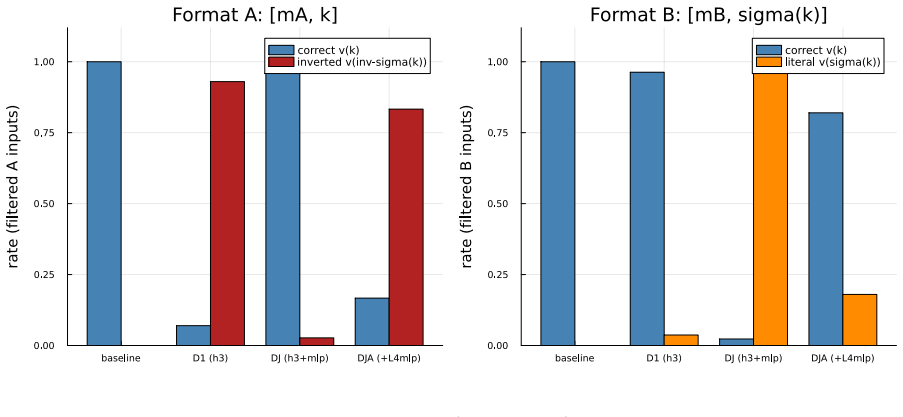
- [Section 8 and Remark 6] Assumption 3 (Stable Base Computation) is invoked in every proof of Section 5, but the empirical configurations actually tested go beyond it. The DJA configurations in Section 8 include carriers in deeper layers, and Section 8.1's mixed subsets span all three layers; for these subsets, deleting a head in one layer changes the residual input of every downstream MLP and head, so the ablated selector is not s_S(x)=s(x)−q_S(x). Theorem 3 bounds exactly one same-block interaction (a head and its own layer's MLP), and Proposition 3 applies only when that block feeds the readout directly. Remark 6 explicitly leaves attention–attention and cross-layer violations unquantified. Consequently, for the multi-layer configurations there is no bound on s_true_S(x)−s_S(x), and the agreement rates in Figure 2 and the collapse rates in Table 1 cannot be attributed to Theorems 1–2 for those subsets. The paper should either restrict the theoretical claims to configurations covered by Theorem 3 or supply a quantitative transfer bound for cross-layer subsets.
- [Abstract and Section 1] The abstract states that 'the single-block interaction result extends past one residual block', but this extension is not proved in the present manuscript. Section 8.1 explicitly says that a multi-layer polarity-reversal instance is 'not covered by this paper's own two-carrier, single-block composition (Theorem 3)', and Remark 6 leaves the propagation of Δ(x) across layers at the level of a heuristic product of attenuation and amplification factors. The extension is deferred to a companion paper that is not part of this submission. The abstract and introduction should attribute the extension to the companion paper or state it as an open problem, rather than presenting it as a result of the present work.
- [Section 8.1 (polarity-reversal discussion)] The polarity-reversal scan invokes Corollary 2 to conclude that at least one subset in each reversing pair fails the exact collapse hypotheses. Corollary 2 is proved under Assumptions 1 and 3, which are exactly the assumptions that fail for the multi-layer subsets in that scan (for example, adding layer-2's MLP to a layer-1 and layer-3 pair). The theorem therefore does not license the inference for those cases. The observation is an empirical consistency check, not a consequence of Corollary 2, and the text should say so.
minor comments (5)
- [Theorem 1] Condition (ii) reads 'no format contrast survives outside S'; this appears to be a typo for 'no further contrast' or simply 'no contrast', and is confusing as printed.
- [Throughout] The paper refers repeatedly to 'a companion analysis' for the closed-form curvature constant, the real-pretrained-model test, and the exact cross-layer identity, but never cites or otherwise identifies that companion. Since these references are used in the abstract and Section 1 to support claims, please add a citation or clearly mark them as unavailable to the reader.
- [Section 8.1] The carrier threshold is widened from r≥0.25 to r≥0.15 to obtain enough configurations for the interaction/fidelity check. The text acknowledges this, but the replication correlation of −0.90 is computed on the 15 configurations selected by the widened threshold; because the threshold choice was made after seeing the carrier counts, this number should be described as exploratory rather than confirmatory.
- [Section 8 and Figure 2] The textual description of the shaded band ('interaction10.41' and 'fall to4.49') would be easier to read with explicit logit units and with the number of configurations in each group labeled on the figure.
- [Section 8, Table 1] The phrases 'Inverted-Arate0.93' and 'Best inverted-Arate' lack a space; the table header would benefit from a conventional spacing (e.g., 'inverted-A rate').
Circularity Check
No significant circularity: the core theorems are algebraic derivations from stated assumptions; the only self-citation (the companion analysis exhibiting Lambda) is deferred support, not an input-to-output reduction.
full rationale
The derivation chain is self-contained rather than circular. Section 4 fixes the additive residual model and Assumptions 1, 3, and 4; Theorem 1's collapse criterion is obtained by substituting the definitions of qbar_S and Psi_S into the ablated selector s_S, so the iff is an algebraic identity from clean-network quantities, not a fitted parameter renamed as a prediction. Theorem 2 is likewise the definition of patching plus Lemma 1's exact flip inequality, and Corollary 4 is an explicit construction. Theorem 3 is a Taylor expansion with an explicit integral remainder; its second-order bound is conditional on a bounded-curvature hypothesis, and the paper states that the constant can be exhibited in a companion analysis rather than exhibiting it here (Section 7, Remark 5). That is a missing support or deferred self-citation, not a circular reduction, and it does not infect Theorems 1-2. The experimental section is transparently partly post hoc: Section 8 says it 'reuse[s] the setting and the measurements of the empirical study these theorems were written to explain,' and it reports its own negative results (the out-of-sample band failure, the 10% robust-certificate rate). Using the same data to motivate and then illustrate a theory is a validation weakness, not equation-level circularity. Assumption 3 fails beyond the single block, as the paper itself shows in Section 7 and Remark 6; this is a scope limitation on the transfer of the idealized theorems, not circularity, because the theorems are still proved from the assumption and their algebraic content is independent of the untested cross-layer generalization.
Assumptions & free parameters
free parameters (4)
- carrier selection threshold r =
0.25, widened to 0.15 for the second task in Section 8.1.
- ablation subspace rank k =
Smallest k reaching 90 percent of squared singular value energy, capped at k<=4 for heads and k<=8 for MLPs.
- agreement thresholds C1a and C1b =
0.90 for C1a and +/-0.10 for C1b, fixed before probing.
- robust-collapse tolerances epsilon1 and epsilon2 =
Set to measured per-pair absolute values of bar q_S and Psi_S.
assumptions (6)
- domain assumption Assumption 1 (Residual Additivity): F(x)=F0(x)+sum_i alpha_i(x)v_i with v_i independent of x.
- domain assumption Assumption 3 (Stable Base Computation): F0 and every non-deleted carrier term are unchanged by deleting S.
- domain assumption Assumption 4 (Linear Readout): binary decision is sign of s(x)=psi(F(x))+b.
- domain assumption Assumption 2 (Low-Rank Support): dim span(v_i) is much less than d.
- ad hoc to paper Bounded curvature: ||D^2g||_op <= Lambda on the segment from r1(x)-eta(x) to r1(x).
- standard math Standard calculus facts: chain rule, fundamental theorem of calculus, operator norm inequalities.
invented entities (1)
-
carrier
Cite this review
Pith. "Pith review of A Theory of Conditional Collapse under Low-Rank Weight-Space Ablations: I. The Single-Block Theory and Synthetic Validation." pith.science (2026). https://pith.science/paper/RLGWVD4J
@misc{pith2026260803620,
  author       = {Pith},
  title        = {Pith review of: A Theory of Conditional Collapse under Low-Rank Weight-Space Ablations: I. The Single-Block Theory and Synthetic Validation},
  year         = {2026},
  howpublished = {\url{https://pith.science/paper/RLGWVD4J}},
  note         = {Machine review of arXiv:2608.03620}
}
abstract
Activation patching and weight-space ablation both claim a component is causally responsible for a behavior, yet they act on different objects: one forward pass versus the parameters behind every forward pass. We ask when they agree. We study an idealized model where a conditional computation is carried additively through a residual stream, $F(x)=F_0(x)+\sum_i\alpha_i(x)v_i$, read out by a linear functional, and prove three exact results. First, deleting a subset of carriers collapses a matched input pair onto the same unconditional output \emph{if and only if} the removal is symmetric on the pair and leaves no outside contrast; the error is deterministic, and we give its exact form even when the two conditions hold only approximately. Second, patching a carrier moves the readout by its donor-receiver \emph{contrast}, while ablating it moves the readout by its \emph{absolute level}; neither bounds the other, and we construct pairs where every single-carrier patch flips the decision while no single-carrier ablation does. Third, for an attention head composed with its own layer's normalization and MLP, we derive an exact first-order interaction formula with a provably second-order remainder, vanishing identically when only the MLP is ablated but not, in general, when a head is. Small transformers trained on a synthetic conditional task illustrate all three predictions: across thirty-nine ablation configurations the measured interaction is strongly rank-correlated with the idealized model's predictive accuracy (Spearman $-0.83$), and a second task and architecture reproduces the same pattern, including a further polarity reversal. The single-block interaction result extends past one residual block, and the synthetic validation is tested against a real pretrained model, in a companion paper that takes this theory further along both axes.
Figures

Reference graph
Works this paper leans on
-
[1]
Vig, J., Gehrmann, S., Belinkov, Y., Qian, S., Nevo, D., Singer, Y., Shieber, S. (2020). Investigating Gender Bias in Language Models Using Causal Mediation Analysis.Advances in Neural Information Processing Systems 33
2020
-
[2]
Geiger, A., Lu, H., Icard, T., Potts, C. (2021). Causal Abstractions of Neural Networks. Advances in Neural Information Processing Systems 34
2021
-
[3]
AMathematical Framework forTransformer Circuits.Transformer Circuits Thread
Elhage, N., Nanda, N., Olsson, C., et al.(2021). AMathematical Framework forTransformer Circuits.Transformer Circuits Thread
2021
-
[4]
Meng, K., Bau, D., Andonian, A., Belinkov, Y. (2022). Locating and Editing Factual Asso- ciations in GPT.Advances in Neural Information Processing Systems 35
2022
-
[5]
Wang, K., Variengien, A., Conmy, A., Shlegeris, B., Steinhardt, J. (2023). Interpretability in the Wild: a Circuit for Indirect Object Identification in GPT-2 small.ICLR
2023
-
[6]
Elhage, N., et al. (2022). Toy Models of Superposition.Transformer Circuits Thread
2022
-
[7]
McGrath, T., Rahtz, M., Kramár, J., Mikulik, V., Legg, S. (2023). The Hydra Effect: Emergent Self-Repair in Language Model Computations.arXiv:2307.15771. 24
arXiv 2023
-
[8]
Goldowsky-Dill, N., MacLeod, C., Sato, L., Arora, A. (2023). Localizing Model Behavior with Path Patching.arXiv:2304.05969
arXiv 2023
Show all 16 references
-
[9]
N., Lynch, A., Heimersheim, S., Garriga-Alonso, A
Conmy, A., Mavor-Parker, A. N., Lynch, A., Heimersheim, S., Garriga-Alonso, A. (2023). Towards Automated Circuit Discovery for Mechanistic Interpretability.Advances in Neural Information Processing Systems 36
2023
-
[10]
Arditi, A., Obeso, O., Syed, A., Paleka, D., Panickssery, N., Gurnee, W., Nanda, N. (2024). Refusal in Language Models Is Mediated by a Single Direction.Advances in Neural Infor- mation Processing Systems 37
2024
-
[11]
Makelov, A., Lange, G., Nanda, N. (2024). Is This the Subspace You Are Looking For? An Interpretability Illusion for Subspace Activation Patching.ICLR
2024
-
[12]
Zhang, F., Nanda, N. (2024). Towards Best Practices of Activation Patching in Language Models: Metrics and Methods.ICLR
2024
-
[13]
Geiger, A., Wu, Z., Potts, C., Icard, T., Goodman, N. D. (2024). Finding Alignments Between Interpretable Causal Variables and Distributed Neural Representations.Causal Learning and Reasoning (CLeaR)
2024
-
[14]
Vaidyanathan, S., Arbour, D., Mueller, A., Niekum, S., Jensen, D. (2026). The Curse of Multiple Mediators: Hidden Interaction Effects in Activation Patching.arXiv:2606.27510
2026 arXiv
-
[15]
Gong, Z., Zeng, Z., Yuen, C., Lim, W. Y. B. (2026). Conditional Co-Ablation: Recovering Self-Repair Backups in Transformer Circuits.arXiv:2607.01940
2026 arXiv
-
[16]
Guo, Y., Du, J.-H., Chen, X. (2026). Beyond Importance: Interchange-Sobol Sensitivity Reveals Task-Specific Content Channels in Transformer Components.arXiv:2606.20678. 25
2026 arXiv
Reviewed August 10, 2026 · model on record in the stance chip above.
Discussion (0). Continue with ORCID to comment.