REVIEW 3 major objections 6 minor 5 cited by
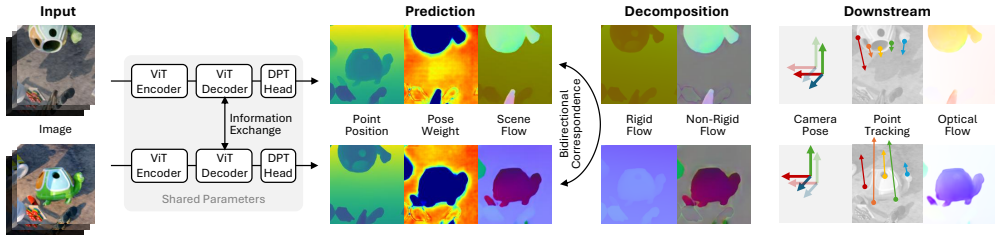
A single per-pixel scene-flow representation can reconstruct a 3D scene and track its motion from two images.
Reviewed by Pith at T0; open to challenge. T0 means a machine referee read the full paper against a public rubric. the ladder, T0–T4 →
A two-view transformer jointly predicting point positions, scene flow, pose weights, and confidence achieves competitive state-of-the-art 4D reconstruction and 3D point tracking without pose-regression heads or bundle adjustment.
T0 review reviewed 2026-08-02 challenge →
load-bearing objection Genuinely new flow-centric formulation with clean math, but the unquantified GT-vs-pseudo supervision split and overstated SOTA claims need fixing. the 3 major comments →
Flow4R: Unifying 4D Reconstruction and Tracking with Scene Flow
The pith
A machine-rendered reading of the paper's core claim, the machinery that carries it, and where it could break.
The reading
Core claim
The paper's central claim is that 4D perception can be formulated entirely in terms of camera-space scene flow: the motion of each point relative to the camera, independent of any coordinate-system choice. The network takes two images and predicts the minimal property set consisting of point positions, scene flow, pose weights, and confidence maps for each image, symmetrically for both views. From these, the rigid transformation between views is solved by minimizing a pose-weight-weighted SE(3) error, splitting the scene flow into a rigid camera part and a non-rigid object part. 3D point positions in the other view's frame, focal length, and optical flow all follow by projection. The authors
What carries the argument
The central object is the camera-space scene flow map, defined per pixel as the vector carrying a 3D point from one image to its corresponding location in the other image's coordinate system and time. It is paired with a pose weight map that sums to one over pixels and encodes which pixels are reliable for solving the camera pose; the rigid transformation is the weighted least-squares SE(3) fit aligning predicted point positions with their flowed counterparts. This decomposition unifies the tasks: once the rigid transformation is known, rigid flow is computed directly, non-rigid flow is the residual, 3D point tracks are obtained by applying the inverse transformation, focal length by minimiz
Load-bearing premise
The method depends on the correctness of the depth maps and camera poses used to synthesize its rigid-flow motion labels for static scenes; if a large fraction of those depths and poses are estimates produced by another model, the learned scene flow inherits those errors and a bias toward static scenes.
What would settle it
Train Flow4R on a balanced set of dynamic videos that have ground-truth depth and pose, then compare against the same model trained with the paper's synthesized rigid-flow labels for identical scenes. If the ground-truth-trained model's dynamic-point tracking accuracy is substantially higher, the rigid-flow supervision premise fails. A simpler check: run the model on a dynamic scene with no static pixels in view and see whether the solved camera pose remains accurate.
If this is right
- Camera pose, focal length, optical flow, and 3D point tracks can be read out from a single set of per-pixel predictions, so one model can replace several task-specific modules.
- Static reconstruction datasets with accurate depth can be used to supervise motion via synthesized rigid flow, so abundant static data helps dynamic tracking without needing dynamic ground truth.
- Anchored pairing of frames lets the model extend to long video sequences with scale alignment, enabling tracking over many frames without bundle adjustment or pose-graph optimization.
- Because the pose weight map learns which pixels are reliable, the model can switch reference frames at inference by changing this map, adapting to scenes where the intuitive 'static' reference differs.
Where Pith is reading between the lines
- The pose weight map is implicitly learning a prior over what 'static' means in the training data. A testable extension is to expose the model to videos with moving reference frames and check whether the map shifts accordingly; if it does not, the learned prior may be brittle outside its training distribution.
- Since flow is defined relative to the camera, the representation is coordinate-system invariant; this suggests Flow4R-style models may generalize better to unseen camera trajectories than shared-frame point-map models, a claim that could be tested by cross-dataset pose-error evaluation.
- The paper's own conclusion concedes that motion quality lags depth quality due to scarce flow data. A concrete next step is to add self-supervised cycle consistency on unlabeled video — forward flow from one frame to the next should invert backward flow — which could tighten dynamic tracking without new annotated data.
- Deriving optical flow by projecting predicted 3D points gives a geometric constraint that 2D optical-flow losses do not directly enforce; comparing Flow4R's optical flow against a dedicated flow network on occluded regions would test whether this geometric prior helps.
Editorial analysis
A structured set of objections, weighed in public.
Referee Report
Summary. Flow4R proposes a two-view transformer that predicts a per-pixel property set S = {P, F, W, C} (3D point positions, scene flow, pose weights, confidence) and uses closed-form operations (Eqs. 1-9) to derive camera pose, rigid/non-rigid flow decomposition, point tracks, focal length, and optical flow. The network is trained jointly on 22 static and dynamic datasets with losses for point positions (Eq. 10), 3D motion (Eq. 11), 2D motion (Eq. 12), pose weights (Eq. 13), and rigid flow (Eq. 14), and is evaluated on the WorldTrack benchmark for 3D point tracking and dynamic 3D reconstruction. The paper claims state-of-the-art performance and argues that scene flow is a unifying representation that removes the need for explicit pose regressors or bundle adjustment.
Significance. If the central claims hold, Flow4R offers an elegant and compact formulation: a single shared decoder predicts geometry and bidirectional motion, with downstream tasks obtained by simple algebraic operations. The derivations in §3.1 are internally consistent, and the evaluation against externally established benchmarks (WorldTrack) and baselines is a strength. The ablation in Table 3 supports the design choice of predicting P_vt rather than F. The model is comparatively small (0.4B parameters) and the qualitative results suggest meaningful generalization. However, the empirical demonstration is weakened by incomplete reporting of training-label provenance, and the 'state-of-the-art' claim is not supported on all benchmarks. These issues are fixable, but they are load-bearing for the paper's central supervision story.
major comments (3)
- [§4 (Training Details) and §3.3 (Eqs. 13-14)] The losses L_W and L_Fv require ground-truth depth and camera pose. Section 4 lists 22 datasets but never states which provide true GT depth/pose, which provide scene-flow/optical-flow/track labels, and which rely on pseudo-labels from DUSt3R, CUT3R, MonST3R, or CoTracker. For internet-image datasets such as MegaDepth, BlendedMVS, and DL3DV, dense GT depth and relative pose are not available, so their labels must be teacher estimates. Because L_W and L_Fv are the principal signals tying scene flow to camera motion, a large pseudo-label share would mean the claimed clean supervision is not actually demonstrated, and teacher static-scene bias could suppress dynamic motion. Please report the exact GT-vs-pseudo split per dataset and, ideally, an ablation or subset analysis with true GT only.
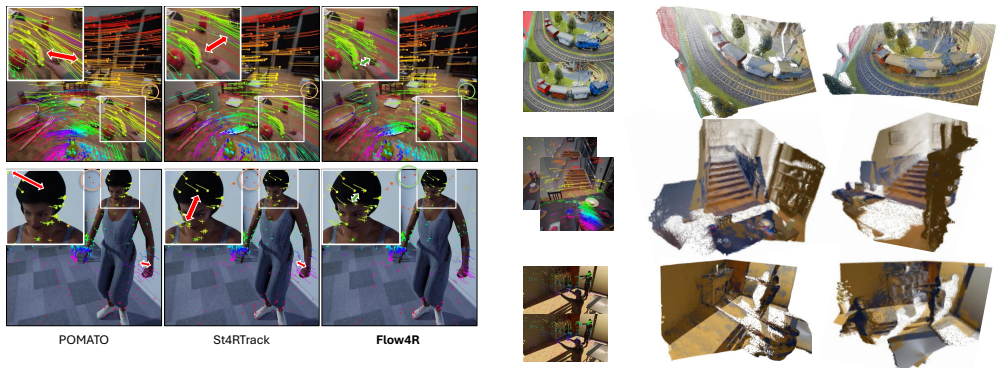
- [Abstract, §1, Tables 1-2] The abstract and Section 1 claim 'state-of-the-art performance,' but Tables 1-2 show Flow4R trailing St4RTrack on Panoptic all-points (64.3 vs 69.7), on ADT dynamic points (70.9 vs 75.3), and on TUM-Dynamics reconstruction APD (79.87 vs 83.42). The claim should be qualified, e.g., 'competitive or state-of-the-art on most benchmarks.' The current phrasing overstates the results and is not supported by the data.
- [§3.3 (Eq. 13) and §4] The pose-weight loss is described as 'self-supervised' or 'unsupervised,' but it uses ground-truth camera pose and depth through \bar{T}\bar{P}. When these come from preprocessed pseudo-labels, the loss is effectively teacher-supervised. This distinction matters for interpreting the learned pose weight map and for reproducibility. Please clarify which datasets provide the ground-truth pose used in Eq. (13) versus pseudo-pose.
minor comments (6)
- [§3.3 (Eq. 14)] The notation \bar{P}_v is used before being defined. Define it explicitly as the ground-truth point position in the second view, obtained by applying the ground-truth camera pose to the back-projected depth.
- [§3.2] The scale alignment step says 'align the predicted positions and flows of subsequent pairs by the scaling factors s1/s2, s1/s3...'. Clarify whether P_vt and W/C are also scaled, and specify how the average norm is computed when points are partially occluded or out of view.
- [§3.1 (Eq. 7)] The focal-length estimation assumes a known optical center c and identical focal lengths on both axes. State whether c is assumed to be the image center or estimated, and discuss the impact of this assumption on the optical-flow computation in Eq. (9).
- [Notation] The symbol f is used both for focal length (Eq. 7) and optical flow (Eq. 9, Table 5). This is confusing; consider using f_x for focal length or \mathbf{f} for optical flow.
- [§4] The sentence 'we use the data processing code or preprocessed data by DUSt3R, CUT3R, MonST3R, and CoTracker' is vague. Please specify which datasets and which preprocessing pipelines are used, and cite exact versions or commit hashes if available.
- [References] Several references are listed as 2026 preprints or in-press works (e.g., [2], [12], [16], [25], [42], [63], [75]). Verify that the cited versions are publicly available or update the citations.
Circularity Check
No significant circularity: downstream quantities are explicit closed-form functions of the directly predicted maps, and the one representational exchangeability (F = P_vt − P) is disclosed and ablated.
full rationale
The derivation chain in Sec. 3.1 is algebraic and self-contained: given the predicted point position P and the predicted transformed position P_vt (or, equivalently, scene flow F via Eq. (1)), camera pose, non-rigid flow, 3D tracking, focal length, and optical flow are obtained by explicit formulas (Eqs. (2)–(9)). The only apparent equivalence—F and P_vt are interchangeable since F = P_vt − P—is openly stated in Sec. 3.3 and empirically ablated in Tab. 3, so no prediction is being silently relabeled as an independent result. The pose-weight loss LW in Eq. (13) is described as self-supervised but actually uses ground-truth camera pose T̄; this is a labeling inconsistency, not a circular derivation, because W is an auxiliary map trained against an external ground-truth quantity. The rigid-flow supervision in Eq. (14) is computed from ground-truth depth and pose for static scenes and serves as legitimate geometric supervision; the concern that some training data may rely on teacher-pseudo-labels from DUSt3R, CUT3R, MonST3R, or CoTracker affects supervision quality and generalization, not logical circularity. Evaluation is performed on external WorldTrack benchmark test sets against external baselines, and the authors' self-citations (e.g., [6] in related work) are not load-bearing for the central claim. Overall, no step in the paper reduces by construction to its own inputs.
Axiom & Free-Parameter Ledger
free parameters (3)
- Loss weights λ1-λ5 and confidence-entropy α =
λ1=1, λ2=λ4=λ5=0.5, λ3=0.3, α=0.2
- Prediction target: P_vt vs F =
P_vt, supervised by P̄_vt
- Training recipe constants =
224→512 resolution, 900K→84K pairs/epoch, 50-frame pairing window, lr 1e-4→1e-6
axioms (4)
- standard math The weighted least-squares camera solve (Eq. 2) is a consistent estimator of the relative transform when W identifies static pixels; P_vt ≈ T̂P for static points (Eq. 3).
- domain assumption Scene motion is modeled as one dominant rigid transform plus per-pixel non-rigid residual flow (Eqs. 2-5).
- domain assumption Depth, intrinsics, and relative pose are available — or reliably estimated by DUSt3R/CUT3R/MonST3R/CoTracker preprocessing — for static training pairs, making rigid-flow supervision valid.
- domain assumption Anchor-view point-norm ratios provide consistent world-scale alignment across anchored pairs, and two views within 50 frames give sufficient baseline.
invented entities (2)
-
Pose weight map W
independent evidence
-
Minimal property set S = {P, F, W, C}
independent evidence
Cite this review
Pith. "Pith review of Flow4R: Unifying 4D Reconstruction and Tracking with Scene Flow." pith.science (2026). https://pith.science/paper/RLUO6EU7
@misc{pith2026260214021,
  author       = {Pith},
  title        = {Pith review of: Flow4R: Unifying 4D Reconstruction and Tracking with Scene Flow},
  year         = {2026},
  howpublished = {\url{https://pith.science/paper/RLUO6EU7}},
  note         = {Machine review of arXiv:2602.14021}
}
read the original abstract
Reconstructing and tracking dynamic 3D scenes is a fundamental challenge in computer vision. Existing methods typically decouple geometry from motion: static multi-view reconstruction systems assume a rigid world, whereas dynamic tracking frameworks rely on explicit ego-motion estimation or separate object motion models. In this work, we propose Flow4R, a unified framework that treats relative scene flow as the central representation linking 3D structure, camera ego-motion, and dynamic object motion. Given a two-view input, Flow4R employs a shared Vision Transformer to predict a compact, pixel-aligned property set comprising 3D point positions, scene flow, pose weights, and confidence maps. This flow-centric formulation allows local geometry and bidirectional motion to be jointly inferred in a single feedforward pass, eliminating the need for explicit pose regression heads or complex bundle adjustment. By training jointly on static and dynamic datasets, Flow4R achieves state-of-the-art performance on 4D reconstruction and tracking benchmarks, demonstrating the power of the flow-centric formulation for spatiotemporal scene understanding.
Figures



Forward citations
Cited by 5 Pith papers
-
ASTRA: Asynchronous Spatio-Temporal Reconstruction via Trajectory Alignment
ASTRA jointly estimates camera time offsets and dynamic Gaussian geometry by aligning projected 3D motion with observed 2D trajectory tracks, improving robustness to large asynchrony.
-
DynaTok: Token-Based 4D Reconstruction from Partial Point Clouds
DynaTok introduces a token-based framework for correspondence-free 4D reconstruction from partial point cloud sequences via latent encoding, transformer aggregation, residual decoupling, and flow-matching decoding.
-
BA-T: An Iterative Transformer for Two-View Bundle Adjustment
BA-T is an iterative Transformer that implements bundle adjustment as a repeatable lightweight layer to progressively refine pose and geometry predictions in two-view 3D reconstruction while using far fewer decoder pa...
-
Good Token Hunting: A Hitchhiker's Guide to Token Selection for Visual Geometry Transformers
A two-stage diversity-plus-entropy token selection framework speeds up visual geometry transformers by over 85% on 500-image scenes while preserving baseline accuracy.
-
Rethinking Dense Optical Flow without Test-Time Scaling
Dense optical flow can be estimated accurately in one forward pass by combining DINO-v2 semantic priors and monocular depth geometric cues via global matching, reaching 2.81 EPE on Sintel Final without any refinement.
Reference graph
Works this paper leans on
-
[1]
Map-free visual relocalization: Metric pose relative to a single image
Eduardo Arnold, Jamie Wynn, Sara Vicente, Guillermo Garcia-Hernando, Aron Monszpart, Victor Prisacariu, Dani- yar Turmukhambetov, and Eric Brachmann. Map-free visual relocalization: Metric pose relative to a single image. In European Conference on Computer Vision, pages 690–708. Springer, 2022. 6
2022
-
[2]
L4P: Towards unified low-level 4D vision perception
Abhishek Badki, Hang Su, Bowen Wen, and Orazio Gallo. L4P: Towards unified low-level 4D vision perception. InIn- ternational Conference on 3D Vision (3DV), 2026. 3
2026
-
[3]
Arkitscenes: A di- verse real-world dataset for 3d indoor scene understanding using mobile rgb-d data
Gilad Baruch, Zhuoyuan Chen, Afshin Dehghan, Yuri Fei- gin, Peter Fu, Thomas Gebauer, Daniel Kurz, Tal Dimry, Brandon Joffe, Arik Schwartz, et al. Arkitscenes: A di- verse real-world dataset for 3d indoor scene understanding using mobile rgb-d data. InThirty-fifth Conference on Neural Information Processing Systems Datasets and Benchmarks Track (Round 1). 6
-
[4]
Vir- tual kitti 2.arXiv preprint arXiv:2001.10773, 2020
Yohann Cabon, Naila Murray, and Martin Humenberger. Vir- tual kitti 2.arXiv preprint arXiv:2001.10773, 2020. 6
Pith/arXiv arXiv 2001
-
[5]
MUSt3R: Multi-view network for stereo 3D recon- struction
Yohann Cabon, Lucas Stoffl, Leonid Antsfeld, Gabriela Csurka, Boris Chidlovskii, Jerome Revaud, and Vincent Leroy. MUSt3R: Multi-view network for stereo 3D recon- struction. InCVPR, pages 1050–1060, 2025. 3
2025
-
[6]
Back on track: Bundle adjustment for dynamic scene re- construction
Weirong Chen, Ganlin Zhang, Felix Wimbauer, Rui Wang, Nikita Araslanov, Andrea Vedaldi, and Daniel Cremers. Back on track: Bundle adjustment for dynamic scene re- construction. InProceedings of the IEEE/CVF International Conference on Computer Vision (ICCV), pages 4951–4960,
-
[7]
Scannet: Richly-annotated 3d reconstructions of indoor scenes
Angela Dai, Angel X Chang, Manolis Savva, Maciej Hal- ber, Thomas Funkhouser, and Matthias Nießner. Scannet: Richly-annotated 3d reconstructions of indoor scenes. In Proceedings of the IEEE conference on computer vision and pattern recognition, pages 5828–5839, 2017. 6
2017
-
[8]
Light3r- sfm: Towards feed-forward structure-from-motion
Sven Elflein, Qunjie Zhou, and Laura Leal-Taix ´e. Light3r- sfm: Towards feed-forward structure-from-motion. InPro- ceedings of the Computer Vision and Pattern Recognition Conference, pages 16774–16784, 2025. 3
2025
-
[9]
Black, Trevor Darrell, and Angjoo Kanazawa
Haiwen Feng*, Junyi Zhang*, Qianqian Wang, Yufei Ye, Pengcheng Yu, Michael J. Black, Trevor Darrell, and Angjoo Kanazawa. St4RTrack: Simultaneous 4D reconstruction and tracking in the world. InProceedings of the IEEE/CVF In- ternational Conference on Computer Vision, 2025. 2, 3, 4, 6, 7
2025
-
[10]
Kubric: A scalable dataset generator
Klaus Greff, Francois Belletti, Lucas Beyer, Carl Doersch, Yilun Du, Daniel Duckworth, David J Fleet, Dan Gnanapra- gasam, Florian Golemo, Charles Herrmann, et al. Kubric: A scalable dataset generator. InProceedings of the IEEE/CVF conference on computer vision and pattern recognition, pages 3749–3761, 2022. 6
2022
-
[11]
Enhancing 3d reconstruction for dynamic scenes
Jisang Han, Honggyu An, Jaewoo Jung, Takuya Narihira, Junyoung Seo, Kazumi Fukuda, Chaehyun Kim, Sunghwan Hong, Yuki Mitsufuji, and Seungryong Kim. Enhancing 3d reconstruction for dynamic scenes. InThe Thirty-ninth An- nual Conference on Neural Information Processing Systems,
-
[12]
Yu Hu, Chong Cheng, Sicheng Yu, Xiaoyang Guo, and Hao Wang. Vggt4d: Mining motion cues in visual geometry transformers for 4d scene reconstruction.arXiv preprint arXiv:2511.19971, 2025. 3
arXiv 2025
-
[13]
Panoptic studio: A massively multiview system for social motion capture
Hanbyul Joo, Hao Liu, Lei Tan, Lin Gui, Bart Nabbe, Iain Matthews, Takeo Kanade, Shohei Nobuhara, and Yaser Sheikh. Panoptic studio: A massively multiview system for social motion capture. InProceedings of the IEEE inter- national conference on computer vision, pages 3334–3342,
-
[14]
Dy- namicstereo: Consistent dynamic depth from stereo videos
Nikita Karaev, Ignacio Rocco, Benjamin Graham, Natalia Neverova, Andrea Vedaldi, and Christian Rupprecht. Dy- namicstereo: Consistent dynamic depth from stereo videos. InProceedings of the IEEE/CVF Conference on Computer Vision and Pattern Recognition, pages 13229–13239, 2023. 6
2023
-
[15]
Co- tracker: It is better to track together
Nikita Karaev, Ignacio Rocco, Benjamin Graham, Natalia Neverova, Andrea Vedaldi, and Christian Rupprecht. Co- tracker: It is better to track together. InEuropean conference on computer vision, pages 18–35. Springer, 2024. 6
2024
-
[16]
Any4d: Unified feed-forward metric 4d reconstruction
Jay Karhade, Nikhil Keetha, Yuchen Zhang, Tanisha Gupta, Akash Sharma, Sebastian Scherer, and Deva Ramanan. Any4d: Unified feed-forward metric 4d reconstruction. arXiv preprint arXiv:2512.10935, 2025. 3
arXiv 2025
-
[17]
MapAnything: Universal feed- forward metric 3D reconstruction
Nikhil Keetha, Norman M ¨uller, Johannes Sch ¨onberger, Lorenzo Porzi, Yuchen Zhang, Tobias Fischer, Arno Knapitsch, Duncan Zauss, Ethan Weber, Nelson Antunes, Jonathon Luiten, Manuel Lopez-Antequera, Samuel Rota Bul`o, Christian Richardt, Deva Ramanan, Sebastian Scherer, and Peter Kontschieder. MapAnything: Universal feed- forward metric 3D reconstructio...
2026
-
[18]
Ro- bust consistent video depth estimation
Johannes Kopf, Xuejian Rong, and Jia-Bin Huang. Ro- bust consistent video depth estimation. InProceedings of the IEEE/CVF Conference on Computer Vision and Pattern Recognition, pages 1611–1621, 2021. 3
2021
-
[19]
Ground- ing image matching in 3D with MASt3R
Vincent Leroy, Yohann Cabon, and J´erˆome Revaud. Ground- ing image matching in 3D with MASt3R. InEuropean Con- ference on Computer Vision, pages 71–91. Springer, 2024. 4, 6, 7
2024
-
[20]
Megadepth: Learning single- view depth prediction from internet photos
Zhengqi Li and Noah Snavely. Megadepth: Learning single- view depth prediction from internet photos. InProceed- ings of the IEEE conference on computer vision and pattern recognition, pages 2041–2050, 2018. 6
2041
-
[21]
Megasam: Accurate, fast and ro- bust structure and motion from casual dynamic videos
Zhengqi Li, Richard Tucker, Forrester Cole, Qianqian Wang, Linyi Jin, Vickie Ye, Angjoo Kanazawa, Aleksander Holyn- ski, and Noah Snavely. Megasam: Accurate, fast and ro- bust structure and motion from casual dynamic videos. In Proceedings of the Computer Vision and Pattern Recognition Conference, pages 10486–10496, 2025. 3
2025
-
[22]
Zero-shot monocular scene flow estima- tion in the wild
Yiqing Liang, Abhishek Badki, Hang Su, James Tompkin, and Orazio Gallo. Zero-shot monocular scene flow estima- tion in the wild. InProceedings of the Computer Vision and Pattern Recognition Conference, pages 21031–21044, 2025. 3
2025
-
[23]
Pixel-perfect structure-from- motion with featuremetric refinement
Philipp Lindenberger, Paul-Edouard Sarlin, Viktor Lars- son, and Marc Pollefeys. Pixel-perfect structure-from- motion with featuremetric refinement. InProceedings of 9 the IEEE/CVF international conference on computer vision, pages 5987–5997, 2021. 2
2021
-
[24]
Dl3dv-10k: A large-scale scene dataset for deep learning-based 3d vision
Lu Ling, Yichen Sheng, Zhi Tu, Wentian Zhao, Cheng Xin, Kun Wan, Lantao Yu, Qianyu Guo, Zixun Yu, Yawen Lu, et al. Dl3dv-10k: A large-scale scene dataset for deep learning-based 3d vision. InProceedings of the IEEE/CVF Conference on Computer Vision and Pattern Recognition, pages 22160–22169, 2024. 6
2024
-
[25]
Trace any- thing: Representing any video in 4d via trajectory fields
Xinhang Liu, Yuxi Xiao, Donny Y Chen, Jiashi Feng, Yu- Wing Tai, Chi-Keung Tang, and Bingyi Kang. Trace any- thing: Representing any video in 4d via trajectory fields. arXiv preprint arXiv:2510.13802, 2025. 3
arXiv 2025
-
[26]
A large dataset to train convolutional networks for disparity, optical flow, and scene flow estimation
Nikolaus Mayer, Eddy Ilg, Philip Hausser, Philipp Fischer, Daniel Cremers, Alexey Dosovitskiy, and Thomas Brox. A large dataset to train convolutional networks for disparity, optical flow, and scene flow estimation. InProceedings of the IEEE conference on computer vision and pattern recog- nition, pages 4040–4048, 2016. 2
2016
-
[27]
Spring: A high-resolution high- detail dataset and benchmark for scene flow, optical flow and stereo
Lukas Mehl, Jenny Schmalfuss, Azin Jahedi, Yaroslava Nali- vayko, and Andr ´es Bruhn. Spring: A high-resolution high- detail dataset and benchmark for scene flow, optical flow and stereo. InProceedings of the IEEE/CVF Conference on Computer Vision and Pattern Recognition, pages 4981– 4991, 2023. 2, 6
2023
-
[28]
Openmvg: Open multiple view geometry
Pierre Moulon, Pascal Monasse, Romuald Perrot, and Re- naud Marlet. Openmvg: Open multiple view geometry. In International Workshop on Reproducible Research in Pattern Recognition, pages 60–74. Springer, 2016. 2
2016
-
[29]
Newcombe, Dieter Fox, and Steven M
Richard A. Newcombe, Dieter Fox, and Steven M. Seitz. Dynamicfusion: Reconstruction and tracking of non-rigid scenes in real-time. InThe IEEE Conference on Computer Vision and Pattern Recognition (CVPR), 2015. 3
2015
-
[30]
Delta: Dense efficient long-range 3d track- ing for any video
Tuan Duc Ngo, Peiye Zhuang, Evangelos Kalogerakis, Chuang Gan, Sergey Tulyakov, Hsin-Ying Lee, and Chaoyang Wang. Delta: Dense efficient long-range 3d track- ing for any video. InThe Thirteenth International Confer- ence on Learning Representations, 2025. 3
2025
-
[31]
Global structure-from-motion revisited
Linfei Pan, D ´aniel Bar´ath, Marc Pollefeys, and Johannes L Sch¨onberger. Global structure-from-motion revisited. In ECCV, pages 58–77. Springer, 2024. 2
2024
-
[32]
Aria digital twin: A new benchmark dataset for egocentric 3d machine perception
Xiaqing Pan, Nicholas Charron, Yongqian Yang, Scott Pe- ters, Thomas Whelan, Chen Kong, Omkar Parkhi, Richard Newcombe, and Yuheng Carl Ren. Aria digital twin: A new benchmark dataset for egocentric 3d machine perception. In Proceedings of the IEEE/CVF International Conference on Computer Vision, pages 20133–20143, 2023. 6
2023
-
[33]
A benchmark dataset and evaluation methodology for video object segmentation
Federico Perazzi, Jordi Pont-Tuset, Brian McWilliams, Luc Van Gool, Markus Gross, and Alexander Sorkine-Hornung. A benchmark dataset and evaluation methodology for video object segmentation. InProceedings of the IEEE conference on computer vision and pattern recognition, pages 724–732,
-
[34]
Habitat 3.0: A co-habitat for humans, avatars and robots, 2023
Xavi Puig, Eric Undersander, Andrew Szot, Mikael Dallaire Cote, Ruslan Partsey, Jimmy Yang, Ruta Desai, Alexan- der William Clegg, Michal Hlavac, Tiffany Min, Theo Gervet, Vladimir V ondrus, Vincent-Pierre Berges, John Turner, Oleksandr Maksymets, Zsolt Kira, Mrinal Kalakr- ishnan, Jitendra Malik, Devendra Singh Chaplot, Unnat Jain, Dhruv Batra, Akshara R...
2023
-
[35]
Com- mon objects in 3d: Large-scale learning and evaluation of real-life 3d category reconstruction
Jeremy Reizenstein, Roman Shapovalov, Philipp Henzler, Luca Sbordone, Patrick Labatut, and David Novotny. Com- mon objects in 3d: Large-scale learning and evaluation of real-life 3d category reconstruction. InProceedings of the IEEE/CVF international conference on computer vision, pages 10901–10911, 2021. 6
2021
-
[36]
Hypersim: A photorealistic syn- thetic dataset for holistic indoor scene understanding
Mike Roberts, Jason Ramapuram, Anurag Ranjan, Atulit Kumar, Miguel Angel Bautista, Nathan Paczan, Russ Webb, and Joshua M Susskind. Hypersim: A photorealistic syn- thetic dataset for holistic indoor scene understanding. In Proceedings of the IEEE/CVF international conference on computer vision, pages 10912–10922, 2021. 6
2021
-
[37]
Habitat: A Platform for Embodied AI Research
Manolis Savva, Abhishek Kadian, Oleksandr Maksymets, Yili Zhao, Erik Wijmans, Bhavana Jain, Julian Straub, Jia Liu, Vladlen Koltun, Jitendra Malik, Devi Parikh, and Dhruv Batra. Habitat: A Platform for Embodied AI Research. In Proceedings of the IEEE/CVF International Conference on Computer Vision (ICCV), 2019. 6
2019
-
[38]
Structure- from-motion revisited
Johannes L Schonberger and Jan-Michael Frahm. Structure- from-motion revisited. InProceedings of the IEEE con- ference on computer vision and pattern recognition, pages 4104–4113, 2016. 2
2016
-
[39]
A benchmark and a baseline for robust multi- view depth estimation
Philipp Schr ¨oppel, Jan Bechtold, Artemij Amiranashvili, and Thomas Brox. A benchmark and a baseline for robust multi- view depth estimation. In2022 International Conference on 3D Vision (3DV), pages 637–645. IEEE, 2022. 6
2022
-
[40]
A benchmark for the evalua- tion of rgb-d slam systems
J ¨urgen Sturm, Nikolas Engelhard, Felix Endres, Wolfram Burgard, and Daniel Cremers. A benchmark for the evalua- tion of rgb-d slam systems. In2012 IEEE/RSJ international conference on intelligent robots and systems, pages 573–580. IEEE, 2012. 6
2012
-
[41]
Dynamic point maps: A versatile representation for dynamic 3d reconstruction
Edgar Sucar, Zihang Lai, Eldar Insafutdinov, and Andrea Vedaldi. Dynamic point maps: A versatile representation for dynamic 3d reconstruction. InProceedings of the IEEE/CVF International Conference on Computer Vision (ICCV), 2025. 3, 4
2025
-
[42]
V-dpm: 4d video reconstruction with dynamic point maps.arXiv preprint arXiv:2601.09499, 2026
Edgar Sucar, Eldar Insafutdinov, Zihang Lai, and Andrea Vedaldi. V-dpm: 4d video reconstruction with dynamic point maps.arXiv preprint arXiv:2601.09499, 2026. 3
arXiv 2026
-
[43]
Scalability in perception for autonomous driving: Waymo open dataset
Pei Sun, Henrik Kretzschmar, Xerxes Dotiwalla, Aurelien Chouard, Vijaysai Patnaik, Paul Tsui, James Guo, Yin Zhou, Yuning Chai, Benjamin Caine, et al. Scalability in perception for autonomous driving: Waymo open dataset. InProceed- ings of the IEEE/CVF conference on computer vision and pattern recognition, pages 2446–2454, 2020. 6
2020
-
[44]
Theia: A fast and scalable structure-from-motion library
Christopher Sweeney, Tobias Hollerer, and Matthew Turk. Theia: A fast and scalable structure-from-motion library. In ACM MM, pages 693–696, 2015. 2
2015
-
[45]
Habitat 2.0: Training home assistants to rearrange their habitat
Andrew Szot, Alex Clegg, Eric Undersander, Erik Wijmans, Yili Zhao, John Turner, Noah Maestre, Mustafa Mukadam, Devendra Chaplot, Oleksandr Maksymets, Aaron Gokaslan, Vladimir V ondrus, Sameer Dharur, Franziska Meier, Woj- ciech Galuba, Angel Chang, Zsolt Kira, Vladlen Koltun, Ji- tendra Malik, Manolis Savva, and Dhruv Batra. Habitat 2.0: Training home as...
-
[46]
Mv-dust3r+: Single-stage scene reconstruction from sparse views in 2 seconds
Zhenggang Tang, Yuchen Fan, Dilin Wang, Hongyu Xu, Rakesh Ranjan, Alexander Schwing, and Zhicheng Yan. Mv-dust3r+: Single-stage scene reconstruction from sparse views in 2 seconds. InProceedings of the Computer Vi- sion and Pattern Recognition Conference, pages 5283–5293,
-
[47]
Smd-nets: Stereo mixture density networks
Fabio Tosi, Yiyi Liao, Carolin Schmitt, and Andreas Geiger. Smd-nets: Stereo mixture density networks. InProceedings of the IEEE/CVF conference on computer vision and pattern recognition, pages 8942–8952, 2021. 6
2021
-
[48]
Piece- wise rigid scene flow
Christoph V ogel, Konrad Schindler, and Stefan Roth. Piece- wise rigid scene flow. InProceedings of the IEEE Inter- national Conference on Computer Vision, pages 1377–1384,
-
[49]
3D reconstruction with spatial memory
Hengyi Wang and Lourdes Agapito. 3D reconstruction with spatial memory. In3DV, 2025. 3
2025
-
[50]
Haonan Wang, Hanyu Zhou, Haoyue Liu, and Luxin Yan. 4d-vggt: A general foundation model with spatiotemporal awareness for dynamic scene geometry estimation.arXiv preprint arXiv:2511.18416, 2025. 3
arXiv 2025
-
[51]
Vggsfm: Visual geometry grounded deep structure from motion
Jianyuan Wang, Nikita Karaev, Christian Rupprecht, and David Novotny. Vggsfm: Visual geometry grounded deep structure from motion. InProceedings of the IEEE/CVF con- ference on computer vision and pattern recognition, pages 21686–21697, 2024. 2
2024
-
[52]
Vggt: Vi- sual geometry grounded transformer
Jianyuan Wang, Minghao Chen, Nikita Karaev, Andrea Vedaldi, Christian Rupprecht, and David Novotny. Vggt: Vi- sual geometry grounded transformer. InProceedings of the Computer Vision and Pattern Recognition Conference, pages 5294–5306, 2025. 2, 3, 8
2025
-
[53]
Continuous 3D per- ception model with persistent state
Qianqian Wang, Yifei Zhang, Aleksander Holynski, Alexei A Efros, and Angjoo Kanazawa. Continuous 3D per- ception model with persistent state. InCVPR, pages 10510– 10522, 2025. 3, 6
2025
-
[54]
DUSt3R: Geometric 3D vision made easy
Shuzhe Wang, Vincent Leroy, Yohann Cabon, Boris Chidlovskii, and J ´erˆome Revaud. DUSt3R: Geometric 3D vision made easy. 2024 ieee. InCVF Conference on Com- puter Vision and Pattern Recognition (CVPR), pages 20697– 20709, 2023. 2, 3, 4, 5, 6, 7
2024
-
[55]
Tartanair: A dataset to push the limits of visual slam
Wenshan Wang, Delong Zhu, Xiangwei Wang, Yaoyu Hu, Yuheng Qiu, Chen Wang, Yafei Hu, Ashish Kapoor, and Se- bastian Scherer. Tartanair: A dataset to push the limits of visual slam. In2020 IEEE/RSJ International Conference on Intelligent Robots and Systems (IROS), pages 4909–4916. IEEE, 2020. 6
2020
-
[56]
Yifan Wang, Jianjun Zhou, Haoyi Zhu, Wenzheng Chang, Yang Zhou, Zizun Li, Junyi Chen, Jiangmiao Pang, Chunhua Shen, and Tong He.π 3: Scalable permutation-equivariant visual geometry learning, 2025. 3
2025
-
[57]
Springer Science & Business Media,
Andreas Wedel and Daniel Cremers.Stereo scene flow for 3D motion analysis. Springer Science & Business Media,
-
[58]
Efficient dense scene flow from sparse or dense stereo data
Andreas Wedel, Clemens Rabe, Tobi Vaudrey, Thomas Brox, Uwe Franke, and Daniel Cremers. Efficient dense scene flow from sparse or dense stereo data. InEuropean conference on computer vision, pages 739–751. Springer, 2008. 2
2008
-
[59]
CroCo v2: Improved cross-view completion pre- training for stereo matching and optical flow
Philippe Weinzaepfel, Thomas Lucas, Vincent Leroy, Yohann Cabon, Vaibhav Arora, Romain Br ´egier, Gabriela Csurka, Leonid Antsfeld, Boris Chidlovskii, and J´erˆome Re- vaud. CroCo v2: Improved cross-view completion pre- training for stereo matching and optical flow. InICCV, 2023. 6
2023
-
[60]
CroCo: Self- supervised pre-training for 3D vision tasks by cross-view completion
Weinzaepfel, Philippe and Leroy, Vincent and Lucas, Thomas and Br ´egier, Romain and Cabon, Yohann and Arora, Vaibhav and Antsfeld, Leonid and Chidlovskii, Boris and Csurka, Gabriela and Revaud J ´erˆome. CroCo: Self- supervised pre-training for 3D vision tasks by cross-view completion. InNeurIPS, 2022. 6
2022
-
[61]
Rgbd objects in the wild: Scaling real-world 3d object learning from rgb-d videos
Hongchi Xia, Yang Fu, Sifei Liu, and Xiaolong Wang. Rgbd objects in the wild: Scaling real-world 3d object learning from rgb-d videos. InProceedings of the IEEE/CVF Con- ference on Computer Vision and Pattern Recognition, pages 22378–22389, 2024. 6
2024
-
[62]
Spatialtracker: Tracking any 2d pixels in 3d space
Yuxi Xiao, Qianqian Wang, Shangzhan Zhang, Nan Xue, Sida Peng, Yujun Shen, and Xiaowei Zhou. Spatialtracker: Tracking any 2d pixels in 3d space. InProceedings of the IEEE/CVF Conference on Computer Vision and Pattern Recognition, pages 20406–20417, 2024. 7
2024
-
[63]
Spatialtrackerv2: 3d point tracking made easy
Yuxi Xiao, Jianyuan Wang, Nan Xue, Nikita Karaev, Yuri Makarov, Bingyi Kang, Xing Zhu, Hujun Bao, Yujun Shen, and Xiaowei Zhou. Spatialtrackerv2: 3d point tracking made easy. InProceedings of the IEEE/CVF International Confer- ence on Computer Vision, 2025. 3
2025
-
[64]
Liang, Mikael Henaff, Hao Tang, Ang Cao, Joyce Chai, Franziska Meier, and Matt Feiszli
Jianing Yang, Alexander Sax, Kevin J. Liang, Mikael Henaff, Hao Tang, Ang Cao, Joyce Chai, Franziska Meier, and Matt Feiszli. Fast3r: Towards 3d reconstruction of 1000+ im- ages in one forward pass. InProceedings of the IEEE/CVF Conference on Computer Vision and Pattern Recognition (CVPR), 2025. 3
2025
-
[65]
Blendedmvs: A large- scale dataset for generalized multi-view stereo networks
Yao Yao, Zixin Luo, Shiwei Li, Jingyang Zhang, Yufan Ren, Lei Zhou, Tian Fang, and Long Quan. Blendedmvs: A large- scale dataset for generalized multi-view stereo networks. In Proceedings of the IEEE/CVF conference on computer vi- sion and pattern recognition, pages 1790–1799, 2020. 6
2020
-
[66]
Scannet++: A high-fidelity dataset of 3d in- door scenes
Chandan Yeshwanth, Yueh-Cheng Liu, Matthias Nießner, and Angela Dai. Scannet++: A high-fidelity dataset of 3d in- door scenes. InProceedings of the IEEE/CVF International Conference on Computer Vision, pages 12–22, 2023. 6
2023
-
[67]
Tapip3d: Tracking any point in persistent 3d geome- try
Bowei Zhang, Lei Ke, Adam W Harley, and Katerina Fragki- adaki. Tapip3d: Tracking any point in persistent 3d geome- try. InThe Thirty-ninth Annual Conference on Neural Infor- mation Processing Systems, 2025. 3
2025
-
[68]
Ef- ficiently reconstructing dynamic scenes one d4rt at a time
Chuhan Zhang, Guillaume Le Moing, Skanda Koppula, Ig- nacio Rocco, Liliane Momeni, Junyu Xie, Shuyang Sun, Rahul Sukthankar, Jo ¨elle K Barral, Raia Hadsell, et al. Ef- ficiently reconstructing dynamic scenes one d4rt at a time. arXiv preprint arXiv:2512.08924, 2025. 3
arXiv 2025
-
[69]
MonST3R: A simple approach for estimating geometry in the presence of motion
Junyi Zhang, Charles Herrmann, Junhwa Hur, Varun Jam- pani, Trevor Darrell, Forrester Cole, Deqing Sun, and Ming- Hsuan Yang. MonST3R: A simple approach for estimating geometry in the presence of motion. InICLR, 2025. 3, 4, 6, 7
2025
-
[70]
Pomato: Marrying 11 pointmap matching with temporal motion for dynamic 3d re- construction
Songyan Zhang, Yongtao Ge, Jinyuan Tian, Guangkai Xu, Hao Chen, Chen Lv, and Chunhua Shen. Pomato: Marrying 11 pointmap matching with temporal motion for dynamic 3d re- construction. InProceedings of the IEEE/CVF International Conference on Computer Vision, 2025. 2, 3, 4, 7
2025
-
[71]
Structure and motion from casual videos
Zhoutong Zhang, Forrester Cole, Zhengqi Li, Michael Ru- binstein, Noah Snavely, and William T Freeman. Structure and motion from casual videos. InEuropean Conference on Computer Vision, pages 20–37. Springer, 2022. 3
2022
-
[72]
Pointodyssey: A large-scale synthetic dataset for long-term point tracking
Yang Zheng, Adam W Harley, Bokui Shen, Gordon Wet- zstein, and Leonidas J Guibas. Pointodyssey: A large-scale synthetic dataset for long-term point tracking. InProceed- ings of the IEEE/CVF International Conference on Com- puter Vision, pages 19855–19865, 2023. 6
2023
-
[73]
Kaichen Zhou, Yuhan Wang, Grace Chen, Xinhai Chang, Gaspard Beaudouin, Fangneng Zhan, Paul Pu Liang, and Mengyu Wang. Page-4d: Disentangled pose and ge- ometry estimation for 4d perception.arXiv preprint arXiv:2510.17568, 2025. 3
Pith/arXiv arXiv 2025
-
[74]
Omniworld: A multi-domain and multi-modal dataset for 4d world modeling, 2025
Yang Zhou, Yifan Wang, Jianjun Zhou, Wenzheng Chang, Haoyu Guo, Zizun Li, Kaijing Ma, Xinyue Li, Yating Wang, Haoyi Zhu, Mingyu Liu, Dingning Liu, Jiange Yang, Zhou- jie Fu, Junyi Chen, Chunhua Shen, Jiangmiao Pang, Kaipeng Zhang, and Tong He. Omniworld: A multi-domain and multi-modal dataset for 4d world modeling, 2025. 6
2025
-
[75]
Streaming 4d visual geometry transformer
Dong Zhuo, Wenzhao Zheng, Jiahe Guo, Yuqi Wu, Jie Zhou, and Jiwen Lu. Streaming 4d visual geometry transformer. In The Thirteenth International Conference on Learning Rep- resentations, 2026. 3 A. Appendix Table 4. Key training hyperparameters. Setting Stage 1 Stage 2 Epochs 100 100 Resolution 224 512 Pairs per epoch 900K 84K Batch size 256 64 Warmup epoc...
2026
This paper was first reviewed by deepseek-v4-flash on August 2, 2026.
discussion (0)
Sign in with ORCID, Apple, or X to comment. Anyone can read and Pith papers without signing in.