REVIEW 3 major objections 5 minor 1 cited by
The "Terrascope": On the Possibility of Using the Earth as an Atmospheric Lens
T0 review · 3 major / 5 minor · reviewed 2026-08-14 · deepseek-v4-flash
Pith's one-line read Earth's atmosphere refracts distant starlight into a focal line starting near the Moon's orbit, and a small detector at the Earth's Hill radius could achieve photon-collecting amplifications of tens of thousands.
desk verdict First quantitative treatment of Earth as a refractive lens; the concept is real and the ray tracing is solid, but the headline amplification rests on an unquantified atmospheric-stability argument that the paper's own seeing estimate contradicts. read the letter →
The pith
A machine-rendered reading of the paper's core claim, the machinery that carries it, and where it could break.
The reading
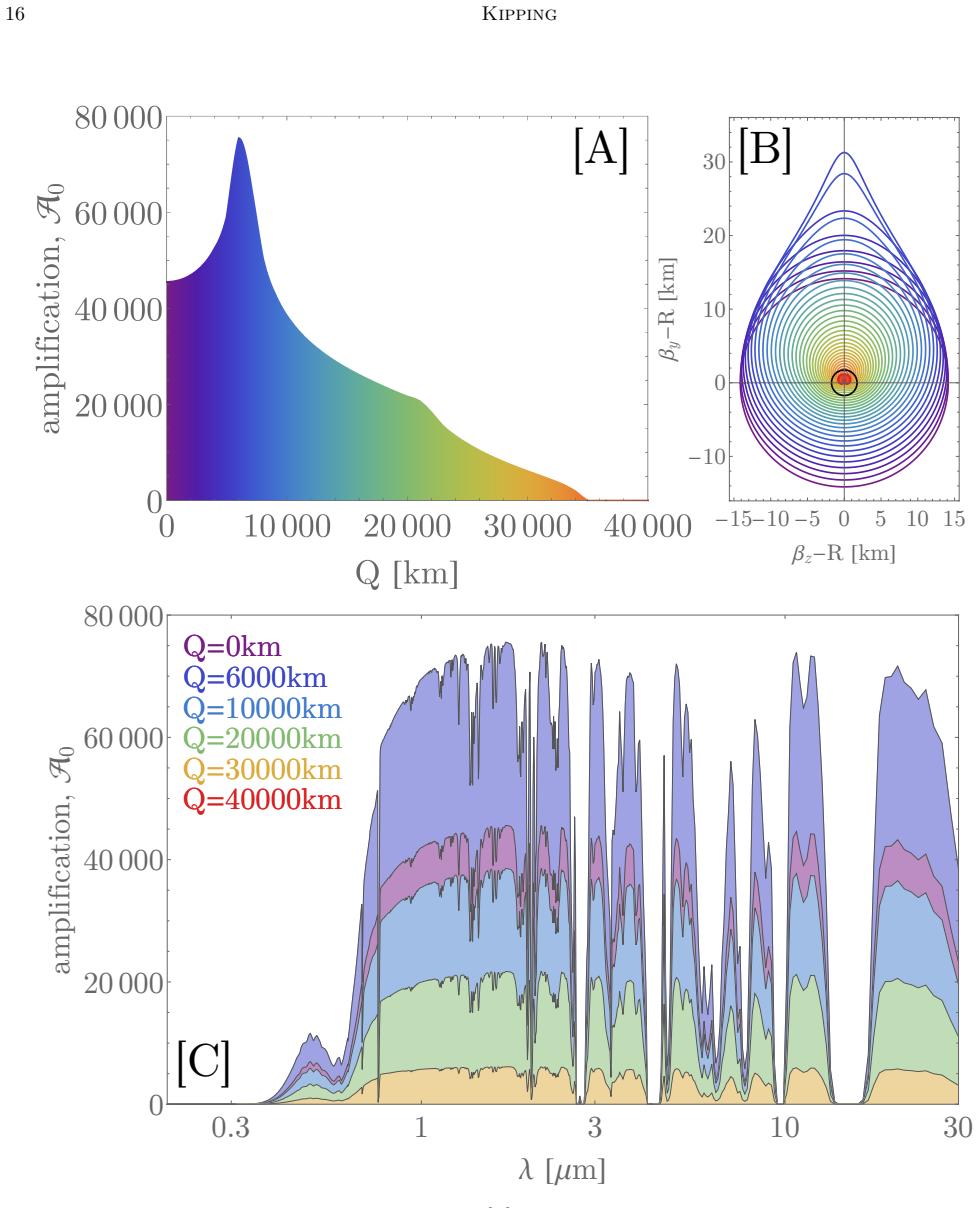
The author checks this with numerical ray tracing through six standard atmosphere models, over wavelengths from 0.2 to 30 micrometres. Extinction reduces the gain to about 45,000 for a detector at Earth's Hill radius, and clouds block less than ten percent of rays there because lensed rays stay above 13.7 km. A source can drift off-axis by about 19,000 km before the gain halves, giving a lensing event lasting about 20 hours. Avoiding daylight lowers the usable gain by another factor of two, to about 22,500, matching the collected photons of a 150-metre telescope.
The calculation assumes a smooth, stable, spherical atmosphere and ignores weather, turbulence, airglow, and day-long stability of the ring. If those effects can be managed, a tiny spacecraft could act as a giant light bucket for faint point sources behind Earth.
Extended reading notes
Core claim
A 1 m detector at the Earth's Hill radius, using the atmosphere as a refractive lens with extinction included, is calculated to produce an amplification of about 45,000 for a lensing timescale of about 20 hours; halved to about 22,500 in daylight, this is equivalent to a 150 m optical/infrared telescope for point sources.
Load-bearing premise
Section 2.1 assumes a time-invariant, spherically symmetric 1D atmosphere, and Section 5.4 asserts without a quantitative model that local pressure anomalies at different altitudes compensate so that the focused ring thickness, and therefore the amplification, is unchanged. If real weather, turbulence, or horizontal density gradients shift the caustic by more than the ring thickness (about a millimetre for a 1 m detector) over the 20-hour event, the headline amplification will not be realized.
Signed reviews
Editorial analysis
A structured set of objections, weighed in public.
Referee Report
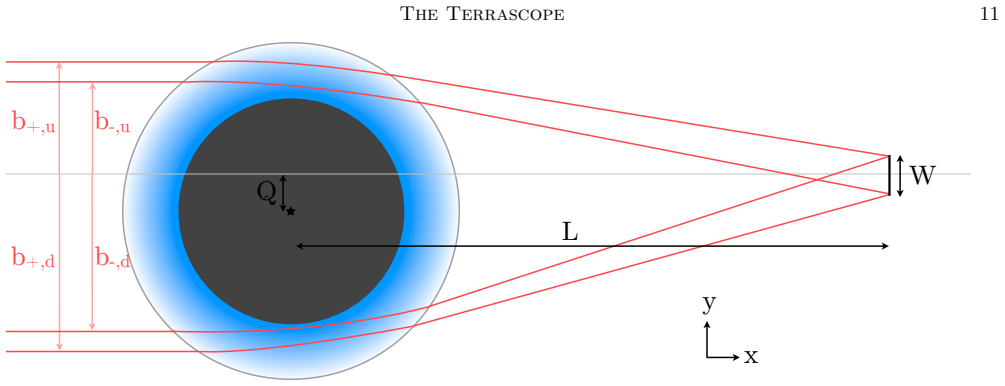
Summary. The paper proposes using the Earth's atmosphere as a refractive lens for an orbiting detector placed beyond the inner focus of the atmospheric refraction, deriving an analytic scaling A≈8HΔ/W and verifying it with numerical ray tracing through six one-dimensional standard atmospheric models. Extinction is included using LOWTRAN7 clear-sky transmission and a HIRS-based cloud model. The paper claims that a 1 m detector at the Earth's Hill radius would achieve an amplification of ~45,000 (halved to ~22,500 in daylight), equivalent to a 150 m optical/infrared telescope, with a lensing timescale of ~20 hours.
Significance. If the headline amplification were robust, the terascope would be a transformative concept, offering enormous collecting area at modest cost. The numerical machinery—over ten million ray-tracing experiments, Gaussian-process interpolation, and validation across six standard atmospheres—is internally consistent and represents a solid foundation for studying atmospheric lensing. The analytic scaling provides a useful heuristic, although it is partly a calibration. The central unresolved question is not the geometric ray tracing but the sensitivity of the focused flux to real atmospheric turbulence, which the paper's own seeing estimate calls into question.
major comments (3)
- [§5.1 and §5.4] The paper's seeing estimate is inconsistent with the claimed robustness of the amplification. Section 5.1 states that the lensed rays traverse ~20 airmasses and that seeing will be of order tens of arcseconds. At L=R_Hill≈1.5×10^9 m, a 10 arcsec blur corresponds to a linear scale Lθ≈7.5×10^4 m at the detector, whereas the detector diameter is W=1 m. If the lensed light from the annular aperture is spread over this seeing disk, the fraction intercepted by the detector is ~(W/Lθ)^2≈2×10^-10, reducing the geometric amplification of ~45,000 to a value far below unity. Section 5.4's compensation argument addresses smooth radial pressure anomalies that shift the ring, but it does not model the small-scale stochastic density fluctuations that produce seeing; such fluctuations cause random angular deflections that do not cancel along the path. A quantitative treatment of turbulence and its effect on the focused flux is required before the headline amplification can be considered credible.
- [§3.4] The analytic estimate A≈8ϵHΔ/W is presented as a derived scaling, but HΔ=6.911 km is taken from the numerical ray-tracing training set (it is described as the scale height 'for all rays' in the simulations) rather than derived from the atmospheric refractivity profile. It is therefore a calibration of the numerical model, not an independent prediction. The numerical ray tracing stands on its own, but the abstract's claim that 'analytic estimates are derived' overstates the status of Eq. (32).
- [§5.2] The claimed source-separation ability of ~0.25 milliarcseconds for a 1 m detector at 1 µm is inconsistent with the tens-of-arcsecond seeing quoted in Section 5.1. The diffraction-limited resolution of the terascope is not achievable if the atmosphere blurs the image by several orders of magnitude more; the relevant resolution limit is set by the seeing, not by λHΔ/(WR). This section should be revised to state the seeing-limited resolution.
minor comments (5)
- [Eq. (27)] The equation for the lower ray should use Δ[b−] rather than Δ[b+]; as written it is dimensionally inconsistent with the stated geometry.
- [Eq. (9)] The second term in the expansion of sinαj should be sinθr,j cosθi,j, not sinθi,j cosθi,j.
- [Eq. (5)] The denominator contains '(N−1)j' in the printed text; this should be '(N−1)h'.
- [Abstract/Fig. 6] The abstract's statement that the focal line commences at ~85% of the Earth-Moon separation is not representative of the full range shown in Figure 6, where F varies from ~200,000 km to ~350,000 km depending on wavelength and atmospheric model; the 85% value should be qualified.
- [§5.3] The daylight factor of two is an unquantified assumption; the text says the amplification is 'likely halved,' but no model for the background surface brightness or the efficacy of the proposed suppression strategies is given.
Assumptions & free parameters
free parameters (3)
- H_delta effective refractive scale height =
6.911 km
- Depth-distance fit coefficients a0, a1, a2 =
a0=15.54 km, a1=1.829, a2=551.1 km
- Broken power-law cloud model parameters =
two slopes, one offset, one transition point per 1-degree location
assumptions (8)
- domain assumption The atmosphere is one-dimensional, static, and spherically symmetric with constant properties within each shell.
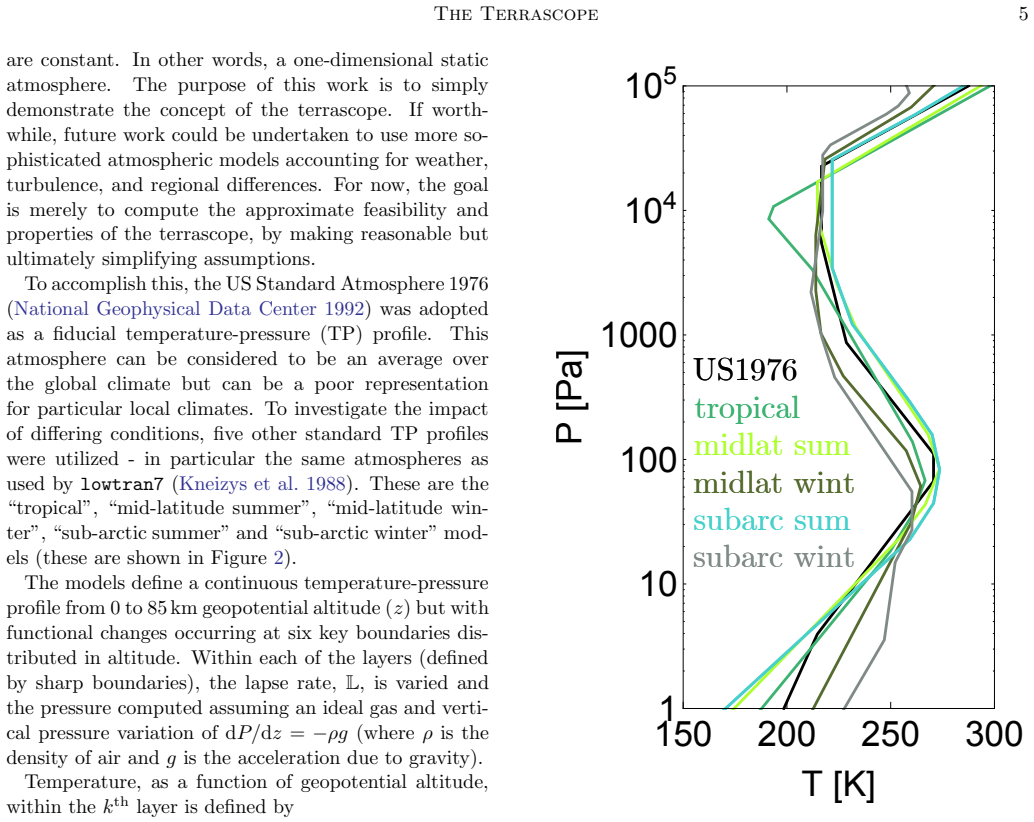
- domain assumption Six standard temperature-pressure profiles (US Standard 1976 plus five LOWTRAN7 climates) are representative of Earth's atmosphere.
- domain assumption LOWTRAN7 ground-to-space transmission at zenith angle 90 degrees, squared, approximates extinction along the refracted grazing path.
- domain assumption Interception by any cloud reduces transmission to zero.
- domain assumption HIRS effective cloud fraction N_epsilon converts to cloud frequency N via N approximately (1/2)N_epsilon for high clouds.
- domain assumption The target source is a point source and the incident wavefront is plane-parallel.
- ad hoc to paper Pressure and temperature anomalies at different altitudes compensate so that the ring thickness, and thus amplification, is unchanged.
- ad hoc to paper Daylight scattering halves the usable amplification because any sunlit part of the Earth contributes an irreducible background.
Cite this review
Pith. "Pith review of The "Terrascope": On the Possibility of Using the Earth as an Atmospheric Lens." pith.science (2026). https://pith.science/paper/RLVBJBW7
@misc{pith2026190800490,
  author       = {Pith},
  title        = {Pith review of: The "Terrascope": On the Possibility of Using the Earth as an Atmospheric Lens},
  year         = {2026},
  howpublished = {\url{https://pith.science/paper/RLVBJBW7}},
  note         = {Machine review of arXiv:1908.00490}
}
abstract
Distant starlight passing through the Earth's atmosphere is refracted by an angle of just over one degree near the surface. This focuses light onto a focal line starting at an inner (and chromatic) boundary out to infinity - offering an opportunity for pronounced lensing. It is shown here that the focal line commences at ~85% of the Earth-Moon separation, and thus placing an orbiting detector between here and one Hill radius could exploit this refractive lens. Analytic estimates are derived for a source directly behind the Earth (i.e. on-axis) showing that starlight is lensed into a thin circular ring of thickness $W H_{\Delta}/R$, yielding an amplification of $8 H_{\Delta}/W$, where $H_{\Delta}$ is the Earth's refractive scale height, $R$ is its geopotential radius and $W$ is the detector diameter. These estimates are verified through numerical ray-tracing experiments from optical to 30 micron light with standard atmospheric models. The numerical experiments are extended to include extinction from both a clear atmosphere and one with clouds. It is found that a detector at one Hill radius is least affected by extinction since lensed rays travel no deeper than 13.7 km, within the stratosphere and above most clouds. Including extinction, a 1 metre Hill radius 'terrascope' is calculated to produce an amplification of ~45,000 for a lensing timescale of ~20 hours. In practice, the amplification is likely halved in order to avoid daylight scattering i.e. 22,500 ($\Delta$mag=10.9) for $W=$1 metre, or equivalent to a 150 metre optical/infrared telescope.
Figures


Figures from the paper (10 more)




Forward citations
Cited by 1 Pith paper
-
OWL-MOON : Very high resolution spectro-imaging and Earth-Moon interferometry: exoplanets to cosmology
OWL-MOON is a mission concept for a 50-100 m lunar telescope that would enable direct imaging and spectroscopy of hundreds to thousands of exoplanets and Earth-Moon intensity interferometry at 200 pico-arcsecond angul...
Reference graph
Works this paper leans on
-
[1]
Birch, K. P. & Downs, M. J., 1994, Metrologia, 31,
work page 1994
-
[6]
D., 2003, Reports on Progress in Physics, 66,
Monnier, J. D., 2003, Reports on Progress in Physics, 66,
work page 2003
-
[71]
Einstein, A., 1916, Annalen der Physik, 49,
work page 1916
-
[119]
Edl´ en, B., 1994, Metrologia, 2,
work page 1994
-
[315]
Cassini, J. D., 1740, “Tables astronomiques”, p. 34 Conrad, C., Gordon, R. F., Bean. A. L., 1969, “Earth Eclipses the Sun - Apollo 12”, NASA JPL https://moon.nasa.gov/resources/199/earth-eclipses-the- sun-apollo-12/ Eddington A. S., 1919, Obs, 42,
work page 1969
-
[409]
Hubbard, W. B., Nicholson, P. D., Lellough, E., et al., 1978, Icarus, 72,
work page 1978
-
[553]
Gaussian Processes for Machine Learning
Rasmussen, C. E. & Williams, C., 2006, “Gaussian Processes for Machine Learning”, MIT Press, Cambridge Michael, S. L., 1999, “Statistical Interpolation of Spatial Data: Some Theory for Kriging”, Springer, New York Turyshev, S. G. & Andersson, B.-G., 2003, MNRAS, 341,
work page 2006
-
[563]
von Eshleman R., 1979, Sci, 205,
work page 1979
Show all 14 references
-
[577]
T., Meinel, A
van Belle, G. T., Meinel, A. B. & Meinel, M. P., 2004, in SPIE Conf. Ser. 5489, ed. J. M. Oschmann, Jr.,
2004
-
[635]
User’s guide to LOWTRAN7
Kneizys, F. X., Shettle, E. P., Abreu, L. W., Chetwynd, J. H., Anderson, G. P., Gallery, W. O., Selby, J. E. A., Clough, S. A., 1988, “User’s guide to LOWTRAN7”, Air Force Geophysics Lab, Tech. Rep. The Terrascope 19 Kraus, J. D., 1986, Radio Astronomy, Cygnus-Quasar Books, Po...
1988
-
[769]
The Crisis in Space Astrophysics and Planetary Science: How Commercial Space and Program Design Principles will let us Escape
Elvis, M., 2016, “The Crisis in Space Astrophysics and Planetary Science: How Commercial Space and Program Design Principles will let us Escape”, Frontier Research in Astrophysics II (arXix e-prints:1609.09428). Heidmann, J. & Maccone, C., 1994, Acta Astron., 32,
2016 arXiv
-
[789]
standard atmosphere (1976), 1992, Planet
National Geophysical Data Center: U.S. standard atmosphere (1976), 1992, Planet. Space Sci., 40,
1976
-
[1133]
SPIE, 3356, 665 Wylie, D
Wang, Y., 1998, Proc. SPIE, 3356, 665 Wylie, D. P., Menzel, P. W., Woolf, H., M. & Strabala, K. I., 1994, Journal of Climate, 31,
1998
-
[1972]
Wylie, D. P. & Menzel, P. W., K. I., 1994, Journal of Climate, 12, 170
1994
Reviewed August 14, 2026 · model on record in the stance chip above.
Discussion (0). Continue with ORCID to comment.