REVIEW 4 major objections 5 minor 92 references
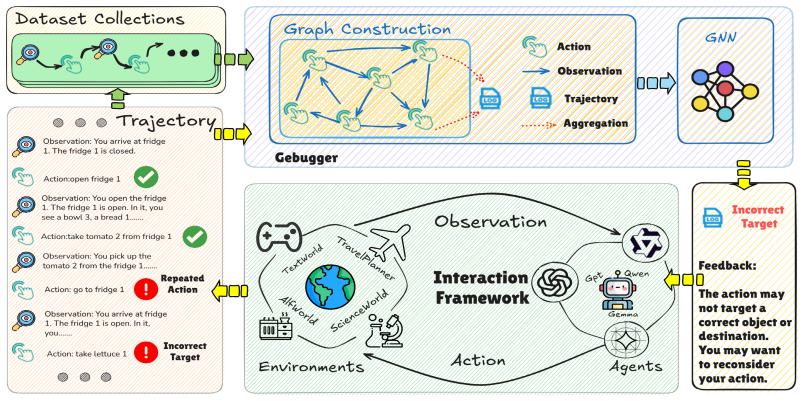
A graph-based debugger flags bad LLM-agent actions before they run, raising long-horizon task success by 14.69% on average without fine-tuning.
Reviewed by Pith at T0; open to challenge. T0 means a machine referee read the full paper against a public rubric. the ladder, T0–T4 →
T0 review · grok-4.5
2026-07-31 00:43 UTC pith:RNLRG7GS
load-bearing objection Useful graph+GNN pre-execution sandbox with real detection gains, but the 14.7% PR headline is confounded with multi-attempt retry and is not cleanly credited to detector quality. the 4 major comments →
Leveraging Trajectory Graphs for Pre-Execution Error Diagnosis in Agentic LLM Systems
The pith
A machine-rendered reading of the paper's core claim, the machinery that carries it, and where it could break.
Core claim
Modeling past agent trajectories as an action-centric probabilistic graph and classifying the current proposed action with a GNN (Graph Debugger) produces reliable pre-execution error labels; feeding those labels back through in-context learning (Trajectory Graph Copilot) raises agent pass ratios by 14.69% on average across AlfWorld, TextWorld, ScienceWorld, and TravelPlanner without fine-tuning the agent LLM.
What carries the argument
Graph Debugger: trajectories are converted into an action-centric graph (unique actions as nodes, observations as edge attributes); a GNN treats error diagnosis as node classification over six step-level labels and returns only a warning, which the agent uses to self-correct via in-context learning.
Load-bearing premise
The error type of the current action is fully determined by a local neighborhood of actions and observations in the built graph, so the rest of the trajectory and the true latent state can be ignored once that neighborhood is known.
What would settle it
On the same labeled trajectory sets, if the graph detector fails to beat strong sequence and retrieval baselines on step-level accuracy, or if wiring its warnings into the agent loop fails to raise pass ratio above the vanilla agent and the same baselines on held-out tasks, the central claim is false.
If this is right
- Long-horizon LLM agents can be improved by a separate diagnostic plug-in without changing their weights.
- Pre-action error warnings reduce compounding failures more than post-hoc trajectory-level rewards.
- Action-centric graphs reach a given error-detection accuracy with fewer samples than sequence classifiers.
- The same six error categories transfer across embodied and tool-use planning environments.
- Feedback is most effective when placed in the user prompt with short label explanations and a small retry budget.
Where Pith is reading between the lines
- Continuously adding new trajectories to the same action-centric graph could turn the copilot into an online memory that improves with deployment.
- If milestone-based labeling is too expensive, weaker progress signals might still train a usable detector under the same graph inductive bias.
- Pairing the pre-execution warning with deliberate search (branch-and-prune) could cut wasted branches earlier than either method alone.
- Very large or continuous action spaces may need hierarchical or clustered action nodes before the graph stays tractable.
Editorial analysis
A structured set of objections, weighed in public.
Referee Report
Summary. The paper proposes Trajectory Graph Copilot, a fine-tuning-free plug-in that diagnoses proposed agent actions before execution. Historical trajectories are converted into an action-centric probabilistic graph (nodes = actions, edges = observations); a GNN (TextGCN-style) performs step-level multi-class error detection over six milestone- and procedure-based labels (N.E., I.A., R.A., I.T., P.M., C.M.). Flagged actions trigger in-context regeneration. Empirically, Graph Debugger outperforms text-classification, retrieval, RAG, and LLM-as-judge baselines on detection accuracy across AlfWorld, TextWorld, ScienceWorld, and TravelPlanner with three agent LLMs (Table 1); the full copilot raises average pass ratio by 14.69% over vanilla ReAct-style agents (Figure 3). A short information-theoretic argument (Theorem 4.2, Assumption 4.1) claims lower Bayes risk and sample complexity for the graph representation versus sequence models.
Significance. If the causal claim holds, the work offers a practical, model-agnostic sandbox for long-horizon LLM agents that avoids costly fine-tuning and supplies finer-grained feedback than trajectory-level rewards. Strengths include multi-environment, multi-backbone evaluation; ablations on graph directionality/features, feedback placement, attempts, threshold, and noise; micro-F1 significance tables with repeats; and an explicit inductive test-time graph-injection procedure (Appendix C.6). The theory is a standard sufficiency / data-processing argument rather than a deep new result, but it usefully motivates the graph design. The main contribution is empirical systems work on pre-execution diagnosis.
major comments (4)
- [§5.2, Figure 3, Appendix C.4, Figure 4, Tables 17–18] Central agent-improvement claim is confounded with multi-attempt resampling. Section 5.2, Figure 3, and Appendix C.4 share a protocol of up to three regenerations whenever any detector flags an error. Weaker detectors (TF-IDF, GTR, Gemma3-RAG, GPT-4o zero-shot) also raise PR over vanilla, sometimes comparably (e.g., ScienceWorld). Figure 4 and Tables 17–18 show PR rising with attempt count and remaining competitive under noisy or sample-free feedback; GR often falls while PR rises, consistent with forced re-sampling. Without a fixed-budget control that isolates label quality (matched flag-rate random labels; always-retry with null feedback text; single-attempt only), the headline +14.69% cannot be cleanly attributed to Graph Debugger’s diagnostic accuracy rather than extra decoding budget plus any textual nudge.
- [§4, Assumption 4.1, Theorem 4.2, Appendix C.1] Assumption 4.1 (Conditional Sufficiency) is load-bearing for Theorem 4.2’s Bayes-risk and sample-complexity ordering, yet is only illustrated by a short milestone example (Appendix C.1). If error labels depend on long-range history or latent state outside the constructed Markov blanket (e.g., global inventory or unobserved room connectivity), both the theory ordering and the GNN’s local inductive bias are unsupported. The paper should either empirically test blanket sufficiency (ablate neighborhood size / history length vs. full-trajectory classifiers) or clearly scope the theorem as conditional on the assumption holding for the chosen Y.
- [Appendix C.2, D.1, Table 1] Step-level labels are drafted by Gemma3 then rule-filtered (Appendix C.2); Gemma3 is also an evaluation backbone and a RAG/judge baseline. Appendix D.1 reports high Cohen’s κ with GPT-OSS-120B on ScienceWorld only. This is a mild circularity/bias risk for all supervised detection numbers in Table 1 and for feedback quality when the same model family is the agent. A human-audited subset across all four environments, or labels held out from any eval backbone, would strengthen the claim that Graph Debugger’s gains are not partly label-model artifacts.
- [Appendix B, proof of Theorem 4.2] In the sample-complexity derivation (Appendix B, paragraph 4), the final strict-inequality clause reads “with strict inequality if I(Y;S)<I(Y;U)”; this contradicts the preceding I(Y;S)≥I(Y;U) ordering and should be I(Y;S)>I(Y;U). The rest of the Fano argument is standard but the typo undermines confidence in the write-up of the only formal result.
minor comments (5)
- [Figure 1] Figure 1’s milestone-state numbering (b0→b6→b3→b4) is hard to follow; a linear expert path with explicit subgoal labels would clarify the error taxonomy.
- [§3.2, Eq. (1)] Equation (1) uses ξ for trajectories in one place and T for the trajectory set; notation for observation-attributed edges vs. trajectory-to-action links could be separated more cleanly.
- [Table 1] Table 1 bold/underline rules are occasionally inconsistent with the stated “best / second-best” criterion (e.g., TravelPlanner GPT4o-mini TF-IDF vs. Ours).
- [§6 Limitation] Limitation section correctly notes the need for historical trajectories but does not quantify graph construction cost or cold-start performance with very small trajectory pools; a brief scaling curve would help practitioners.
- [Throughout / header] Several typos: “incroporates”, “V oeneky”, “Dirar Homouz”; arXiv ID date “29 Jul 2026” looks like a placeholder.
Circularity Check
No significant circularity: theory is standard sufficiency/Bayes-risk ordering under an explicit assumption; empirical gains are measured on held-out tasks, not forced by construction.
full rationale
The paper’s load-bearing claims are (i) Theorem 4.2 (graph representation S as Markov blanket has Bayes risk ≤ any other representation U, hence lower sample complexity) and (ii) the empirical 14.69% average pass-ratio lift from using Graph Debugger as ICL feedback. Theorem 4.2 is a standard information-theoretic argument: under Assumption 4.1 (Y ⊥ X\S | S), S is sufficient so R*(S) = R*(X) ≤ R*(U), with the sample-complexity inequality following from Fano/mutual-information bounds. The assumption is stated explicitly and illustrated with a milestone example; it is not defined in terms of the claimed accuracy numbers. Detection is supervised classification on train/val trajectories with held-out test tasks; the GNN is not algebraically forced to reproduce a fitted scalar that is then reported as the headline result. Agent improvement is measured by Pass Ratio on held-out environment tasks under a shared multi-attempt protocol—an empirical outcome, not a quantity recovered from the training objective by construction. Label drafting uses an LLM plus rule filters, with a cross-model re-annotation check (Appendix D.1); that is ordinary annotation noise risk, not a circular reduction of claim to input. No uniqueness theorem is imported from overlapping authors, no ansatz is smuggled via self-citation, and no known empirical pattern is merely renamed. Confounding of multi-attempt retry with detector quality (the skeptic’s causal concern) is a validity issue, not circularity. Score 0 is therefore appropriate.
Axiom & Free-Parameter Ledger
free parameters (4)
- GNN confidence threshold =
0.6
- Maximum regeneration attempts =
3
- GNN architecture and training hyperparameters =
3-layer GCN; lr=1e-3; wd=5e-5
- Number of failure examples in ICL feedback =
3
axioms (6)
- domain assumption Long-horizon LLM agent interaction is well-modeled as a POMDP with language-valued G, A, O (Section 2).
- ad hoc to paper Assumption 4.1: there exists Markov blanket S = MB_G(Y) such that Y ⊥ X\S | S (Section 4).
- ad hoc to paper Six error categories (N.E., I.A., R.A., I.T., P.M., C.M.) defined via milestones and procedural faults are the right Y space for ‘productive vs erroneous’ actions (Section 2, Appendix C.1).
- domain assumption Observations can replace latent states as edge attributes while still encoding transition structure useful for error diagnosis (Section 3.1).
- domain assumption Pretrained Bert embeddings plus NLTK normalization sufficiently represent actions/observations for GNN message passing (Section 3.2).
- standard math Data-processing inequality, Fano-style bounds, and sufficiency imply R*(S) ≤ R*(U) and m_g ≤ m_seq (Theorem 4.2 / Appendix B).
invented entities (2)
-
Graph Debugger (action-centric trajectory PGM + GNN error probe)
no independent evidence
-
Trajectory Graph Copilot
no independent evidence
read the original abstract
Large Language Model~(LLM)-based agents have demonstrated exceptional performance across a wide range of complex interactive tasks. However, they often struggle with long-horizon interactive tasks common in domains, such as embodied AI. The complexity and vast action spaces in these settings lead to compounding errors, where a single suboptimal action can derail an entire trajectory, causing the agent to exhaust its limited step budget on inefficient or unrecoverable paths. To overcome this without costly fine-tuning, we draw inspiration from software debugging, where execution logs are analyzed to preemptively catch errors. We propose \textit{Trajectory Graph Copilot}, a novel framework that acts as a ``copilot'' for LLM agents by diagnosing potential action errors before they are executed. At its core,\textit{Graph Debugger} models historical trajectories as a probabilistic graph and uses a Graph Neural Network to identify sequential action patterns that frequently lead to failure. Functioning as a proactive diagnostic sandbox, our method provides early warnings on potentially flawed actions, prompting the agent to self-correct. This pre-action error diagnosis prevents costly mistakes, significantly enhancing the agent's ability to complete long-horizon tasks successfully. The extensive experiments on four benchmarks with three LLM agents demonstrate a $14.69\%$ pass ratio improvement on average.
Figures



Reference graph
Works this paper leans on
-
[1]
Graph of thoughts: Solving elaborate problems with large language models
Maciej Besta, Nils Blach, Ales Kubicek, Robert Gerstenberger, Michal Podstawski, Lukas Gianinazzi, Joanna Gajda, Tomasz Lehmann, Hubert Niewiadomski, Piotr Nyczyk, et al. Graph of thoughts: Solving elaborate problems with large language models. InProceedings of the AAAI conference on artificial intelligence, volume 38, pages 17682–17690, 2024
2024
-
[2]
O’Reilly Media, Inc., 2009
Steven Bird, Edward Loper, and Ewan Klein.Natural language processing with Python. O’Reilly Media, Inc., 2009
2009
-
[3]
Springer, 2006
Christopher M Bishop and Nasser M Nasrabadi.Pattern recognition and machine learning, volume 4. Springer, 2006
2006
-
[4]
Grounding large language models in interactive environments with online reinforcement learning
Thomas Carta, Clément Romac, Thomas Wolf, Sylvain Lamprier, Olivier Sigaud, and Pierre- Yves Oudeyer. Grounding large language models in interactive environments with online reinforcement learning. In Andreas Krause, Emma Brunskill, Kyunghyun Cho, Barbara En- gelhardt, Sivan Sabato, and Jonathan Scarlett, editors,Proceedings of the 40th International Conf...
2023
-
[5]
Agentboard: An analytical evaluation board of multi-turn llm agents.Advances in neural information processing systems, 37:74325–74362, 2024
Ma Chang, Junlei Zhang, Zhihao Zhu, Cheng Yang, Yujiu Yang, Yaohui Jin, Zhenzhong Lan, Lingpeng Kong, and Junxian He. Agentboard: An analytical evaluation board of multi-turn llm agents.Advances in neural information processing systems, 37:74325–74362, 2024
2024
-
[6]
Fireact: Toward language agent fine-tuning.arXiv preprint arXiv:2310.05915, 2023
Baian Chen, Chang Shu, Ehsan Shareghi, Nigel Collier, Karthik Narasimhan, and Shunyu Yao. Fireact: Toward language agent fine-tuning.arXiv preprint arXiv:2310.05915, 2023
Pith/arXiv arXiv 2023
-
[7]
Yaran Chen, Wenbo Cui, Yuanwen Chen, Mining Tan, Xinyao Zhang, Dongbin Zhao, and He Wang. Robogpt: an intelligent agent of making embodied long-term decisions for daily instruction tasks.arXiv preprint arXiv:2311.15649, 2023
Pith/arXiv arXiv 2023
-
[8]
Textworld: A learning environment for text-based games.CoRR, abs/1806.11532, 2018
Marc-Alexandre Côté, Ákos Kádár, Xingdi Yuan, Ben Kybartas, Tavian Barnes, Emery Fine, James Moore, Ruo Yu Tao, Matthew Hausknecht, Layla El Asri, Mahmoud Adada, Wendy Tay, and Adam Trischler. Textworld: A learning environment for text-based games.CoRR, abs/1806.11532, 2018
Pith/arXiv arXiv 2018
-
[9]
Bert: Pre-training of deep bidirectional transformers for language understanding
Jacob Devlin, Ming-Wei Chang, Kenton Lee, and Kristina Toutanova. Bert: Pre-training of deep bidirectional transformers for language understanding. InProceedings of the 2019 Conference of the North American Chapter of the Association for Computational Linguistics: Human Language Technologies, pages 4171–4186. Association for Computational Linguistics, 2019
2019
-
[10]
Retrieval augmented language model pre-training
Kelvin Guu, Kenton Lee, Zora Tung, Panupong Pasupat, and Mingwei Chang. Retrieval augmented language model pre-training. InInternational conference on machine learning, pages 3929–3938. PMLR, 2020
2020
-
[11]
Reasoning with language model is planning with world model.arXiv preprint arXiv:2305.14992, 2023
Shibo Hao, Yi Gu, Haodi Ma, Joshua Jiahua Hong, Zhen Wang, Daisy Zhe Wang, and Zhit- ing Hu. Reasoning with language model is planning with world model.arXiv preprint arXiv:2305.14992, 2023
Pith/arXiv arXiv 2023
-
[12]
Goucher, Adam Perelman, Aditya Ramesh, Aidan Clark, AJ Ostrow, Akila Welihinda, et al
Aaron Hurst, Adam Lerer, Adam P. Goucher, Adam Perelman, Aditya Ramesh, Aidan Clark, AJ Ostrow, Akila Welihinda, et al. Gpt-4o system card, 2024
2024
-
[13]
Md Ashraful Islam, Mohammed Eunus Ali, and Md Rizwan Parvez. Mapcoder: Multi-agent code generation for competitive problem solving.arXiv preprint arXiv:2405.11403, 2024. 10
Pith/arXiv arXiv 2024
-
[14]
Jansen and Marc-Alexandre Côté
Peter A. Jansen and Marc-Alexandre Côté. Textworldexpress: Simulating text games at one million steps per second.arXiv, 2022
2022
-
[15]
Tomoyuki Kagaya, Thong Jing Yuan, Yuxuan Lou, Jayashree Karlekar, Sugiri Pranata, Akira Kinose, Koki Oguri, Felix Wick, and Yang You. Rap: Retrieval-augmented planning with contextual memory for multimodal llm agents.arXiv preprint arXiv:2402.03610, 2024
Pith/arXiv arXiv 2024
-
[16]
Kipf and Max Welling
Thomas N. Kipf and Max Welling. Semi-supervised classification with graph convolutional networks. InInternational Conference on Learning Representations, 2017
2017
-
[17]
The MIT Press, 2009
Daphane Koller.Probabilistic Graphical Models: Principles and Techniques. The MIT Press, 2009
2009
-
[18]
Complex knowledge base question answering: A survey.IEEE Transactions on Knowledge and Data Engineering, 35(11):11196–11215, 2022
Yunshi Lan, Gaole He, Jinhao Jiang, Jing Jiang, Wayne Xin Zhao, and Ji-Rong Wen. Complex knowledge base question answering: A survey.IEEE Transactions on Knowledge and Data Engineering, 35(11):11196–11215, 2022
2022
-
[19]
Dhrl: A graph-based approach for long-horizon and sparse hierarchical reinforcement learning.Advances in Neural Information Processing Systems, 35:13668–13678, 2022
Seungjae Lee, Jigang Kim, Inkyu Jang, and H Jin Kim. Dhrl: A graph-based approach for long-horizon and sparse hierarchical reinforcement learning.Advances in Neural Information Processing Systems, 35:13668–13678, 2022
2022
-
[20]
Retrieval-augmented generation for knowledge-intensive nlp tasks.Advances in neural information processing systems, 33:9459–9474, 2020
Patrick Lewis, Ethan Perez, Aleksandra Piktus, Fabio Petroni, Vladimir Karpukhin, Naman Goyal, Heinrich Küttler, Mike Lewis, Wen-tau Yih, Tim Rocktäschel, et al. Retrieval-augmented generation for knowledge-intensive nlp tasks.Advances in neural information processing systems, 33:9459–9474, 2020
2020
-
[21]
Kun Li, Tianhua Zhang, Xixin Wu, Hongyin Luo, James Glass, and Helen Meng. Decoding on graphs: Faithful and sound reasoning on knowledge graphs through generation of well-formed chains.arXiv preprint arXiv:2410.18415, 2024
Pith/arXiv arXiv 2024
-
[22]
Embodied agent interface: Benchmarking llms for embodied decision making.Advances in Neural Information Processing Systems, 37:100428–100534, 2024
Manling Li, Shiyu Zhao, Qineng Wang, Kangrui Wang, Yu Zhou, Sanjana Srivastava, Cem Gokmen, Tony Lee, Erran Li Li, Ruohan Zhang, et al. Embodied agent interface: Benchmarking llms for embodied decision making.Advances in Neural Information Processing Systems, 37:100428–100534, 2024
2024
-
[23]
A survey on text classification: From traditional to deep learning.ACM Transactions on Intelligent Systems and Technology (TIST), 13(2):1–41, 2022
Qian Li, Hao Peng, Jianxin Li, Congying Xia, Renyu Yang, Lichao Sun, Philip S Yu, and Lifang He. A survey on text classification: From traditional to deep learning.ACM Transactions on Intelligent Systems and Technology (TIST), 13(2):1–41, 2022
2022
-
[24]
Pre-trained language models for interactive decision-making.Advances in Neural Information Processing Systems, 35:31199–31212, 2022
Shuang Li, Xavier Puig, Chris Paxton, Yilun Du, Clinton Wang, Linxi Fan, Tao Chen, De-An Huang, Ekin Akyürek, Anima Anandkumar, et al. Pre-trained language models for interactive decision-making.Advances in Neural Information Processing Systems, 35:31199–31212, 2022
2022
-
[25]
Injecting structured knowledge into llms via graph neural networks
Zichao Li, Zong Ke, and Puning Zhao. Injecting structured knowledge into llms via graph neural networks. InProceedings of the 1st Joint Workshop on Large Language Models and Structure Modeling (XLLM 2025), pages 16–25, 2025
2025
-
[26]
Prompt compression with context-aware sentence encoding for fast and improved llm inference
Barys Liskavets, Maxim Ushakov, Shuvendu Roy, Mark Klibanov, Ali Etemad, and Shane K Luke. Prompt compression with context-aware sentence encoding for fast and improved llm inference. InProceedings of the AAAI Conference on Artificial Intelligence, volume 39, pages 24595–24604, 2025
2025
-
[27]
Fairness and bias in robot learning.Proceedings of the IEEE, 112(4):305–330, 2024
Laura Londoño, Juana Valeria Hurtado, Nora Hertz, Philipp Kellmeyer, Silja V oeneky, and Abhinav Valada. Fairness and bias in robot learning.Proceedings of the IEEE, 112(4):305–330, 2024
2024
-
[28]
Decoupled weight decay regularization
Ilya Loshchilov and Frank Hutter. Decoupled weight decay regularization. InInternational Conference on Learning Representations, 2019
2019
-
[29]
Linhao Luo, Zicheng Zhao, Gholamreza Haffari, Yuan-Fang Li, Chen Gong, and Shirui Pan. Graph-constrained reasoning: Faithful reasoning on knowledge graphs with large language models.arXiv preprint arXiv:2410.13080, 2024. 11
Pith/arXiv arXiv 2024
-
[30]
A survey on vision- language-action models for embodied ai.arXiv preprint arXiv:2405.14093, 2024
Yueen Ma, Zixing Song, Yuzheng Zhuang, Jianye Hao, and Irwin King. A survey on vision- language-action models for embodied ai.arXiv preprint arXiv:2405.14093, 2024
Pith/arXiv arXiv 2024
-
[31]
Gnn-rag: Graph neural retrieval for efficient large lan- guage model reasoning on knowledge graphs
Costas Mavromatis and George Karypis. Gnn-rag: Graph neural retrieval for efficient large lan- guage model reasoning on knowledge graphs. InFindings of the Association for Computational Linguistics: ACL 2025, pages 16682–16699, 2025
2025
-
[32]
Large dual encoders are generalizable retrievers
Jianmo Ni, Chen Qu, Jing Lu, Zhuyun Dai, Gustavo Hernandez Abrego, Ji Ma, Vincent Zhao, Yi Luan, Keith Hall, Ming-Wei Chang, et al. Large dual encoders are generalizable retrievers. InProceedings of the 2022 Conference on Empirical Methods in Natural Language Processing, pages 9844–9855, 2022
2022
-
[33]
OpenAI. Chatgpt. 2022
2022
-
[34]
Gpt-4o mini: advancing cost-efficient intelligence
OpenAI. Gpt-4o mini: advancing cost-efficient intelligence. https://openai.com/ index/gpt-4o-mini-advancing-cost\-efficient-intelligence/ , 2024. Accessed: July 31, 2026
2024
-
[35]
Graphical models for probabilistic and causal reasoning.Quantified representation of uncertainty and imprecision, pages 367–389, 1998
Judea Pearl. Graphical models for probabilistic and causal reasoning.Quantified representation of uncertainty and imprecision, pages 367–389, 1998
1998
-
[36]
Graph retrieval-augmented generation: A survey.arXiv preprint arXiv:2408.08921, 2024
Boci Peng, Yun Zhu, Yongchao Liu, Xiaohe Bo, Haizhou Shi, Chuntao Hong, Yan Zhang, and Siliang Tang. Graph retrieval-augmented generation: A survey.arXiv preprint arXiv:2408.08921, 2024
Pith/arXiv arXiv 2024
-
[37]
Virtualhome: Simulating household activities via programs
Xavier Puig, Kevin Ra, Marko Boben, Jiaman Li, Tingwu Wang, Sanja Fidler, and Antonio Torralba. Virtualhome: Simulating household activities via programs. InProceedings of the IEEE conference on computer vision and pattern recognition, pages 8494–8502, 2018
2018
-
[38]
Chatdev: Communicative agents for software development
Chen Qian, Wei Liu, Hongzhang Liu, Nuo Chen, Yufan Dang, Jiahao Li, Cheng Yang, Weize Chen, Yusheng Su, Xin Cong, et al. Chatdev: Communicative agents for software development. arXiv preprint arXiv:2307.07924, 2023
Pith/arXiv arXiv 2023
-
[39]
Term-weighting approaches in automatic text retrieval
Gerard Salton and Christopher Buckley. Term-weighting approaches in automatic text retrieval. Information processing & management, 24(5):513–523, 1988
1988
-
[40]
Reflex- ion: language agents with verbal reinforcement learning
Noah Shinn, Federico Cassano, Ashwin Gopinath, Karthik Narasimhan, and Shunyu Yao. Reflex- ion: language agents with verbal reinforcement learning. In A. Oh, T. Naumann, A. Globerson, K. Saenko, M. Hardt, and S. Levine, editors,Advances in Neural Information Processing Systems, volume 36, pages 8634–8652. Curran Associates, Inc., 2023
2023
-
[41]
Mohit Shridhar, Xingdi Yuan, Marc-Alexandre Côté, Yonatan Bisk, Adam Trischler, and Matthew Hausknecht. Alfworld: Aligning text and embodied environments for interactive learning.arXiv preprint arXiv:2010.03768, 2020
Pith/arXiv arXiv 2010
-
[42]
Yifan Song, Da Yin, Xiang Yue, Jie Huang, Sujian Li, and Bill Yuchen Lin. Trial and error: Exploration-based trajectory optimization for llm agents.arXiv preprint arXiv:2403.02502, 2024
Pith/arXiv arXiv 2024
-
[43]
MIT press Cambridge, 1998
Richard S Sutton, Andrew G Barto, et al.Reinforcement learning: An introduction, volume 1. MIT press Cambridge, 1998
1998
-
[44]
A comprehensive survey of text classification techniques and their research applications: Observational and experimental insights.Computer Science Review, 54:100664, 2024
Kamal Taha, Paul D Yoo, Chan Yeun, Dirar Homouz, and Aya Taha. A comprehensive survey of text classification techniques and their research applications: Observational and experimental insights.Computer Science Review, 54:100664, 2024
2024
-
[45]
Gemini Team, Petko Georgiev, Ving Ian Lei, Ryan Burnell, Libin Bai, Anmol Gulati, Garrett Tanzer, Damien Vincent, Zhufeng Pan, Shibo Wang, et al. Gemini 1.5: Unlocking multimodal understanding across millions of tokens of context.arXiv preprint arXiv:2403.05530, 2024
Pith/arXiv arXiv 2024
-
[46]
Gemma 3 technical report.arXiv preprint arXiv:2503.19786, 2025
Gemma Team, Aishwarya Kamath, Johan Ferret, Shreya Pathak, et al. Gemma 3 technical report.arXiv preprint arXiv:2503.19786, 2025. 12
Pith/arXiv arXiv 2025
-
[47]
Llama: Open and efficient foundation language models.arXiv preprint arXiv:2302.13971, 2023
Hugo Touvron, Thibaut Lavril, Gautier Izacard, Xavier Martinet, Marie-Anne Lachaux, Timo- thée Lacroix, Baptiste Rozière, Naman Goyal, Eric Hambro, Faisal Azhar, et al. Llama: Open and efficient foundation language models.arXiv preprint arXiv:2302.13971, 2023
Pith/arXiv arXiv 2023
-
[48]
Hanlin Wang, Chak Tou Leong, Jian Wang, and Wenjie Li. E2cl: exploration-based error correction learning for embodied agents.arXiv preprint arXiv:2409.03256, 2024
Pith/arXiv arXiv 2024
-
[49]
Hanlin Wang, Jian Wang, Chak Tou Leong, and Wenjie Li. Steca: Step-level trajectory calibration for llm agent learning.arXiv preprint arXiv:2502.14276, 2025
Pith/arXiv arXiv 2025
-
[50]
Text embeddings by weakly-supervised contrastive pre-training
Liang Wang, Nan Yang, Xiaolong Huang, Binxing Jiao, Linjun Yang, Daxin Jiang, Rangan Majumder, and Furu Wei. Text embeddings by weakly-supervised contrastive pre-training. arXiv preprint arXiv:2212.03533, 2022
Pith/arXiv arXiv 2022
-
[51]
Peiyi Wang, Lei Li, Zhihong Shao, RX Xu, Damai Dai, Yifei Li, Deli Chen, Yu Wu, and Zhifang Sui. Math-shepherd: Verify and reinforce llms step-by-step without human annotations.arXiv preprint arXiv:2312.08935, 2023
Pith/arXiv arXiv 2023
-
[52]
Scienceworld: Is your agent smarter than a 5th grader?arXiv preprint arXiv:2203.07540, 2022
Ruoyao Wang, Peter Jansen, Marc-Alexandre Côté, and Prithviraj Ammanabrolu. Scienceworld: Is your agent smarter than a 5th grader?arXiv preprint arXiv:2203.07540, 2022
Pith/arXiv arXiv 2022
-
[53]
MiniLMv2: Multi-head self-attention relation distillation for compressing pretrained transformers
Wenhui Wang, Hangbo Bao, Shaohan Huang, Li Dong, and Furu Wei. MiniLMv2: Multi-head self-attention relation distillation for compressing pretrained transformers. InFindings of the Association for Computational Linguistics: ACL-IJCNLP 2021, pages 2140–2151, Online, August 2021. Association for Computational Linguistics
2021
-
[54]
Xinyi Wang, Alfonso Amayuelas, Kexun Zhang, Liangming Pan, Wenhu Chen, and William Yang Wang. Understanding reasoning ability of language models from the perspective of reasoning paths aggregation.arXiv preprint arXiv:2402.03268, 2024
Pith/arXiv arXiv 2024
-
[55]
Xuezhi Wang, Jason Wei, Dale Schuurmans, Quoc Le, Ed Chi, Sharan Narang, Aakanksha Chowdhery, and Denny Zhou. Self-consistency improves chain of thought reasoning in language models.arXiv preprint arXiv:2203.11171, 2022
Pith/arXiv arXiv 2022
-
[56]
Chain-of-thought prompting elicits reasoning in large language models
Jason Wei, Xuezhi Wang, Dale Schuurmans, Maarten Bosma, Fei Xia, Ed Chi, Quoc V Le, Denny Zhou, et al. Chain-of-thought prompting elicits reasoning in large language models. Advances in neural information processing systems, 35:24824–24837, 2022
2022
-
[57]
Autogen: Enabling next-gen llm applications via multi-agent conversations
Qingyun Wu, Gagan Bansal, Jieyu Zhang, Yiran Wu, Beibin Li, Erkang Zhu, Li Jiang, Xiaoyun Zhang, Shaokun Zhang, Jiale Liu, et al. Autogen: Enabling next-gen llm applications via multi-agent conversations. InFirst Conference on Language Modeling, 2024
2024
-
[58]
Can graph learning improve planning in llm-based agents?Advances in Neural Information Processing Systems, 37:5338–5383, 2024
Xixi Wu, Yifei Shen, Caihua Shan, Kaitao Song, Siwei Wang, Bohang Zhang, Jiarui Feng, Hong Cheng, Wei Chen, Yun Xiong, et al. Can graph learning improve planning in llm-based agents?Advances in Neural Information Processing Systems, 37:5338–5383, 2024
2024
-
[59]
The rise and potential of large language model based agents: A survey.Science China Information Sciences, 68(2):121101, 2025
Zhiheng Xi, Wenxiang Chen, Xin Guo, Wei He, Yiwen Ding, Boyang Hong, Ming Zhang, Junzhe Wang, Senjie Jin, Enyu Zhou, et al. The rise and potential of large language model based agents: A survey.Science China Information Sciences, 68(2):121101, 2025
2025
-
[60]
Language models meet world models: Embodied experiences enhance language models
Jiannan Xiang, Tianhua Tao, Yi Gu, Tianmin Shu, Zirui Wang, Zichao Yang, and Zhiting Hu. Language models meet world models: Embodied experiences enhance language models. Advances in neural information processing systems, 36:75392–75412, 2023
2023
-
[61]
Yuchen Xiao, Yanchao Sun, Mengda Xu, Udari Madhushani, Jared Vann, Deepeka Garg, and Sumitra Ganesh. O3d: Offline data-driven discovery and distillation for sequential decision- making with large language models.arXiv preprint arXiv:2310.14403, 2023
Pith/arXiv arXiv 2023
-
[62]
Travelplanner: A benchmark for real-world planning with language agents
Jian Xie, Kai Zhang, Jiangjie Chen, Tinghui Zhu, Renze Lou, Yuandong Tian, Yanghua Xiao, and Yu Su. Travelplanner: A benchmark for real-world planning with language agents. In Forty-first International Conference on Machine Learning, 2024
2024
-
[63]
Revealing the barriers of language agents in planning.arXiv preprint arXiv:2410.12409, 2024
Jian Xie, Kexun Zhang, Jiangjie Chen, Siyu Yuan, Kai Zhang, Yikai Zhang, Lei Li, and Yanghua Xiao. Revealing the barriers of language agents in planning.arXiv preprint arXiv:2410.12409, 2024. 13
Pith/arXiv arXiv 2024
-
[64]
Weimin Xiong, Yifan Song, Xiutian Zhao, Wenhao Wu, Xun Wang, Ke Wang, Cheng Li, Wei Peng, and Sujian Li. Watch every step! llm agent learning via iterative step-level process refinement.arXiv preprint arXiv:2406.11176, 2024
Pith/arXiv arXiv 2024
-
[65]
How powerful are graph neural networks? InInternational Conference on Learning Representations, 2019
Keyulu Xu, Weihua Hu, Jure Leskovec, and Stefanie Jegelka. How powerful are graph neural networks? InInternational Conference on Learning Representations, 2019
2019
-
[66]
An Yang, Baosong Yang, Beichen Zhang, Binyuan Hui, et al. Qwen2.5 technical report. arXiv:2412.15115 [cs.CL], 2024
Pith/arXiv arXiv 2024
-
[67]
Rui Yang, Hanyang Chen, Junyu Zhang, Mark Zhao, Cheng Qian, Kangrui Wang, Qineng Wang, Teja Venkat Koripella, Marziyeh Movahedi, Manling Li, et al. Embodiedbench: Comprehensive benchmarking multi-modal large language models for vision-driven embodied agents.arXiv preprint arXiv:2502.09560, 2025
Pith/arXiv arXiv 2025
-
[68]
Gpt4tools: Teaching large language model to use tools via self-instruction.Advances in Neural Information Processing Systems, 36:71995–72007, 2023
Rui Yang, Lin Song, Yanwei Li, Sijie Zhao, Yixiao Ge, Xiu Li, and Ying Shan. Gpt4tools: Teaching large language model to use tools via self-instruction.Advances in Neural Information Processing Systems, 36:71995–72007, 2023
2023
-
[69]
Graph convolutional networks for text classi- fication
Liang Yao, Chengsheng Mao, and Yuan Luo. Graph convolutional networks for text classi- fication. InProceedings of the AAAI conference on artificial intelligence, volume 33, pages 7370–7377, 2019
2019
-
[70]
Tree of thoughts: Deliberate problem solving with large language models.Ad- vances in neural information processing systems, 36:11809–11822, 2023
Shunyu Yao, Dian Yu, Jeffrey Zhao, Izhak Shafran, Tom Griffiths, Yuan Cao, and Karthik Narasimhan. Tree of thoughts: Deliberate problem solving with large language models.Ad- vances in neural information processing systems, 36:11809–11822, 2023
2023
-
[71]
React: Synergizing reasoning and acting in language models
Shunyu Yao, Jeffrey Zhao, Dian Yu, Nan Du, Izhak Shafran, Karthik Narasimhan, and Yuan Cao. React: Synergizing reasoning and acting in language models. InInternational Conference on Learning Representations (ICLR), 2023
2023
-
[72]
Xi Ye, Semih Yavuz, Kazuma Hashimoto, Yingbo Zhou, and Caiming Xiong. Rng-kbqa: Generation augmented iterative ranking for knowledge base question answering.arXiv preprint arXiv:2109.08678, 2021
Pith/arXiv arXiv 2021
-
[73]
Da Yin, Faeze Brahman, Abhilasha Ravichander, Khyathi Chandu, Kai-Wei Chang, Yejin Choi, and Bill Yuchen Lin. Agent lumos: Unified and modular training for open-source language agents.arXiv preprint arXiv:2311.05657, 2023
Pith/arXiv arXiv 2023
-
[74]
Che Rin Yu, Daewon Chae, Dabin Seo, Sangwon Lee, Hyeongwoo Im, and Jinkyu Kim. Scene graph-guided proactive replanning for failure-resilient embodied agent.arXiv preprint arXiv:2508.11286, 2025
Pith/arXiv arXiv 2025
-
[75]
Siyu Yuan, Zehui Chen, Zhiheng Xi, Junjie Ye, Zhengyin Du, and Jiecao Chen. Agent-r: Train- ing language model agents to reflect via iterative self-training.arXiv preprint arXiv:2501.11425, 2025
Pith/arXiv arXiv 2025
-
[76]
Kechi Zhang, Jia Li, Ge Li, Xianjie Shi, and Zhi Jin. Codeagent: Enhancing code generation with tool-integrated agent systems for real-world repo-level coding challenges.arXiv preprint arXiv:2401.07339, 2024
Pith/arXiv arXiv 2024
-
[77]
Arl: An adaptive reinforcement learning framework for complex question answering over knowledge base.Information Processing & Management, 59(3):102933, 2022
Qixuan Zhang, Xinyi Weng, Guangyou Zhou, Yi Zhang, and Jimmy Xiangji Huang. Arl: An adaptive reinforcement learning framework for complex question answering over knowledge base.Information Processing & Management, 59(3):102933, 2022
2022
-
[78]
Active example selection for in-context learning
Yiming Zhang, Shi Feng, and Chenhao Tan. Active example selection for in-context learning. InProceedings of the 2022 Conference on Empirical Methods in Natural Language Processing, pages 9134–9148, 2022
2022
-
[79]
Judging llm-as-a-judge with mt-bench and chatbot arena.Advances in neural information processing systems, 36:46595–46623, 2023
Lianmin Zheng, Wei-Lin Chiang, Ying Sheng, Siyuan Zhuang, Zhanghao Wu, Yonghao Zhuang, Zi Lin, Zhuohan Li, Dacheng Li, Eric Xing, et al. Judging llm-as-a-judge with mt-bench and chatbot arena.Advances in neural information processing systems, 36:46595–46623, 2023. 14
2023
-
[80]
Trad: Enhancing llm agents with step-wise thought retrieval and aligned decision
Ruiwen Zhou, Yingxuan Yang, Muning Wen, Ying Wen, Wenhao Wang, Chunling Xi, Guoqiang Xu, Yong Yu, and Weinan Zhang. Trad: Enhancing llm agents with step-wise thought retrieval and aligned decision. InProceedings of the 47th International ACM SIGIR Conference on Research and Development in Information Retrieval, pages 3–13, 2024
2024
discussion (0)
Sign in with ORCID, Apple, or X to comment. Anyone can read and Pith papers without signing in.