REVIEW 3 major objections 6 minor 65 references
Using schematic models to understand the microscopic basis for inverted solubility in $\gamma$D-crystallin
T0 review · 3 major / 6 minor · reviewed 2026-08-14 · deepseek-v4-flash
Pith's one-line read Inverted solubility in γD-crystallin is not the simple hydrophobic effect it was thought to be.
desk verdict A careful, honest computational test of the hydrophobicity story for inverted solubility, but the headline conclusion is more parameter-dependent than the abstract suggests. read the letter →
The pith
A machine-rendered reading of the paper's core claim, the machinery that carries it, and where it could break.
The reading
What carries the argument
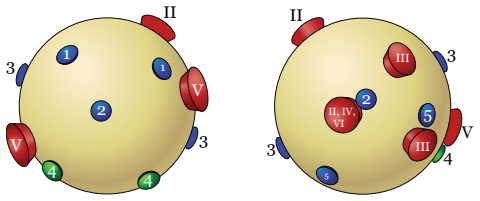
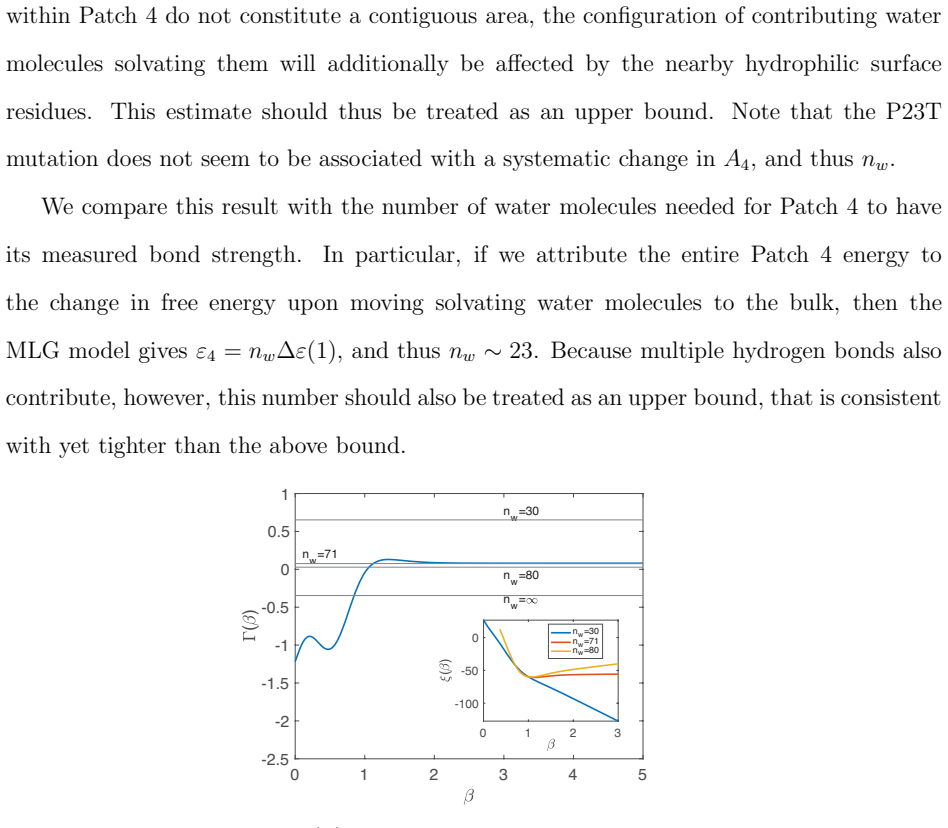
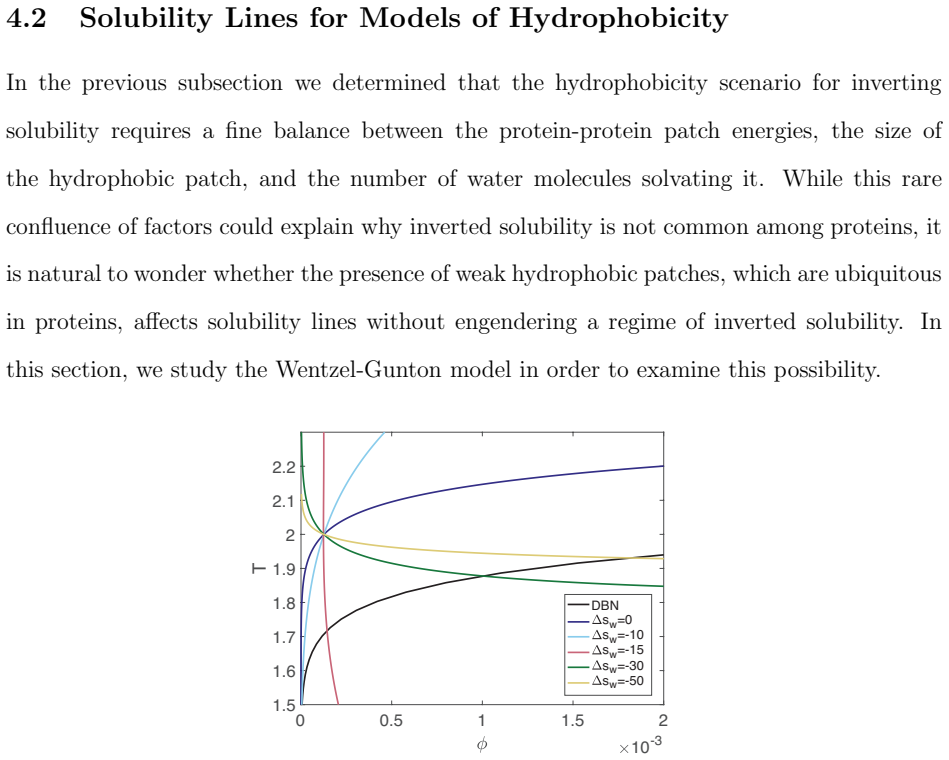
The load-bearing object is a schematic patchy-particle model in which each protein is a hard sphere with a set of adhesive patches whose positions, ranges, and energies are taken from the DBI (inverted-solubility) and DBN (normal-solubility) crystal contacts; Patch 4, which contains residue 23, carries a temperature-dependent energy. Three forms for that temperature dependence are compared: the MLG four-state water model (water in ordered or disordered states in the shell or bulk, with energy and degeneracy parameters from the model), the Wentzel–Gunton linear model, and a tanh-based temperature-(de)activation model. Solubility lines come from equating the fluid chemical potential, obtained from the second virial coefficient, with the crystal chemical potential, obtained from thermodynamic integration from the crystal reference state. The argument's crux is the inversion condition of Eq. (23): the chemical-potential slope is positive, giving inverted solubility, when $\Gamma(\beta) > \varepsilon_{\rm tot}/(2 n_w) - \Delta\varepsilon(1)/2$, where $n_w$ is the number of water molecules solvating Patch 4 and $\Gamma$ collects the temperature derivatives of the water-state entropy and energy. This identity determines the threshold water count and makes the conclusion hinge on $n_w$ and on the water-model degeneracies.
What would settle it
Measure the actual number of water molecules in the first solvation shell around the residue-23 patch (for example by neutron diffraction or by simulations with a more sophisticated water model) and compare it with the model's threshold: if the measured count is below $n_w^* \approx 71$ (or $\approx 35$ for halved patch energies), the hydrophobic-effect scenario is falsified for this protein; if it meets or exceeds the threshold, the scenario remains viable.
Extended reading notes
Core claim
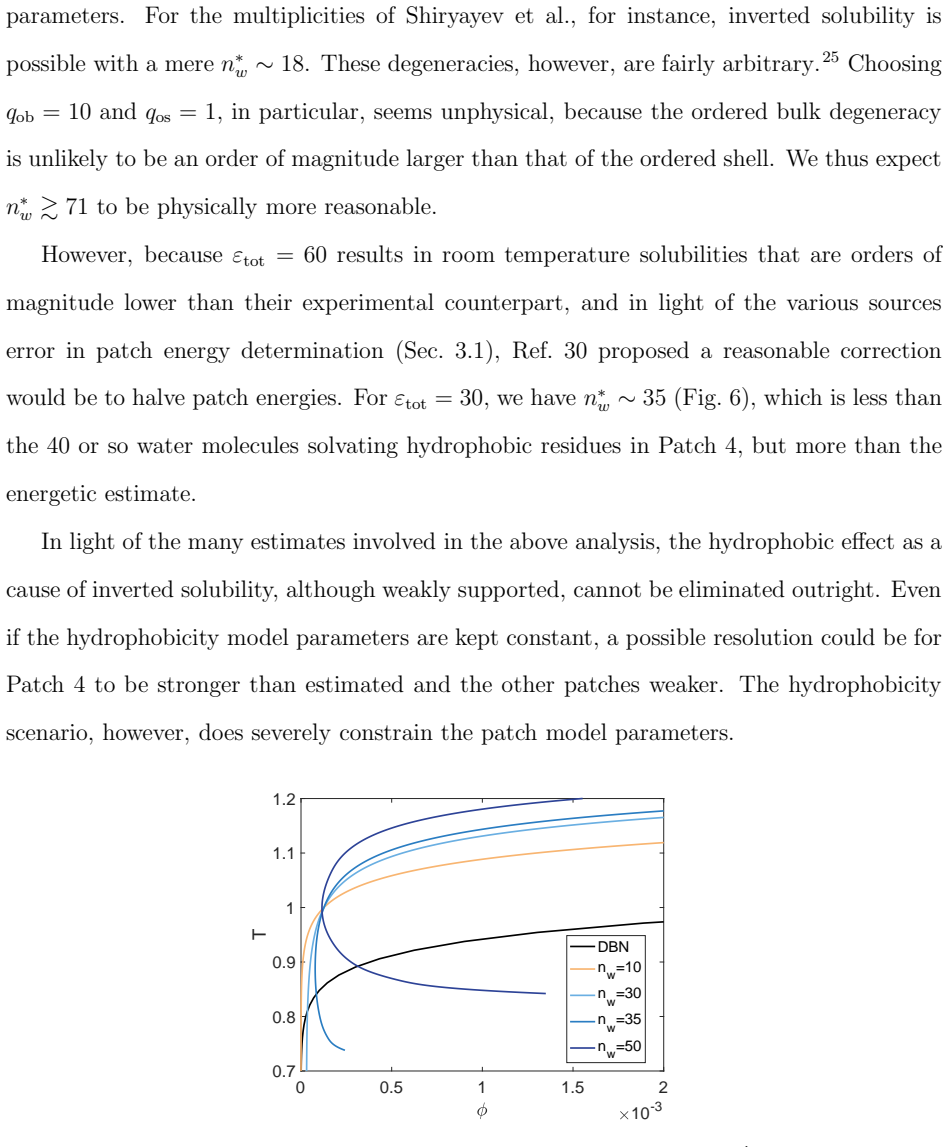
On the authors' own terms, the central claim is that the hydrophobic-effect scenario for inverted solubility in γD-crystallin is not supported by the microscopic evidence available. Surface hydrophobicity computed from crystal structures with five different scales does not discernibly increase when residue 23 is mutated to threonine, serine, or valine. In the schematic patchy model, the two hydrophobicity-based potentials produce solubility inversion only when the number of water molecules $n_w$ solvating the residue-23 patch exceeds a threshold set by Eq. (23), $\Gamma(\beta) > \varepsilon_{\rm tot}/(2 n_w) - \Delta\varepsilon(1)/2$. Using the paper's chosen water-model degeneracies this threshold is $n_w^* \approx 71$, above the estimated available count of roughly 43–48; halving the patch energies to match experimental solubility lowers it to $n_w^* \approx 35$, just below that count. The paper therefore concludes that inverted solubility due to hydrophobicity may be possible but requires a fine balance between patch strength and the temperature-dependent contribution, which may explain why the phenomenon is rare. In the generic temperature-deactivated patch model, the inverted-solubility regime is robust to parameter perturbations, and the temperature-dependent interaction has a negligible effect on the liquid-liquid critical point.
Load-bearing premise
The conclusion that hydrophobic support is weak depends on which set of water-state degeneracies is used in the model; with one alternative set, the needed number of water molecules drops below the estimated available count, which would flip the conclusion.
Editorial extensions
If this is right
- If the paper is right, surface hydrophobicity scales provide no consistent microscopic signature for the solubility-inverting P23T mutation, so the earlier dye-binding inference of increased hydrophobicity does not survive scrutiny.
- Hydrophobic-effect models imply that inverted solubility should be rare, because it appears only when the patch strength, the number of solvating water molecules, and the temperature dependence are finely balanced.
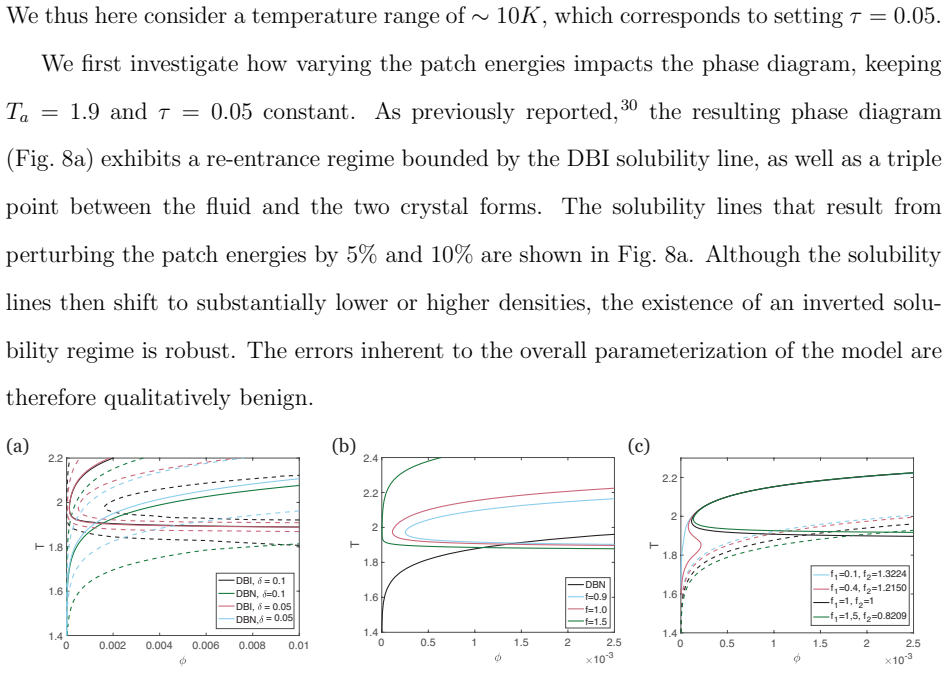
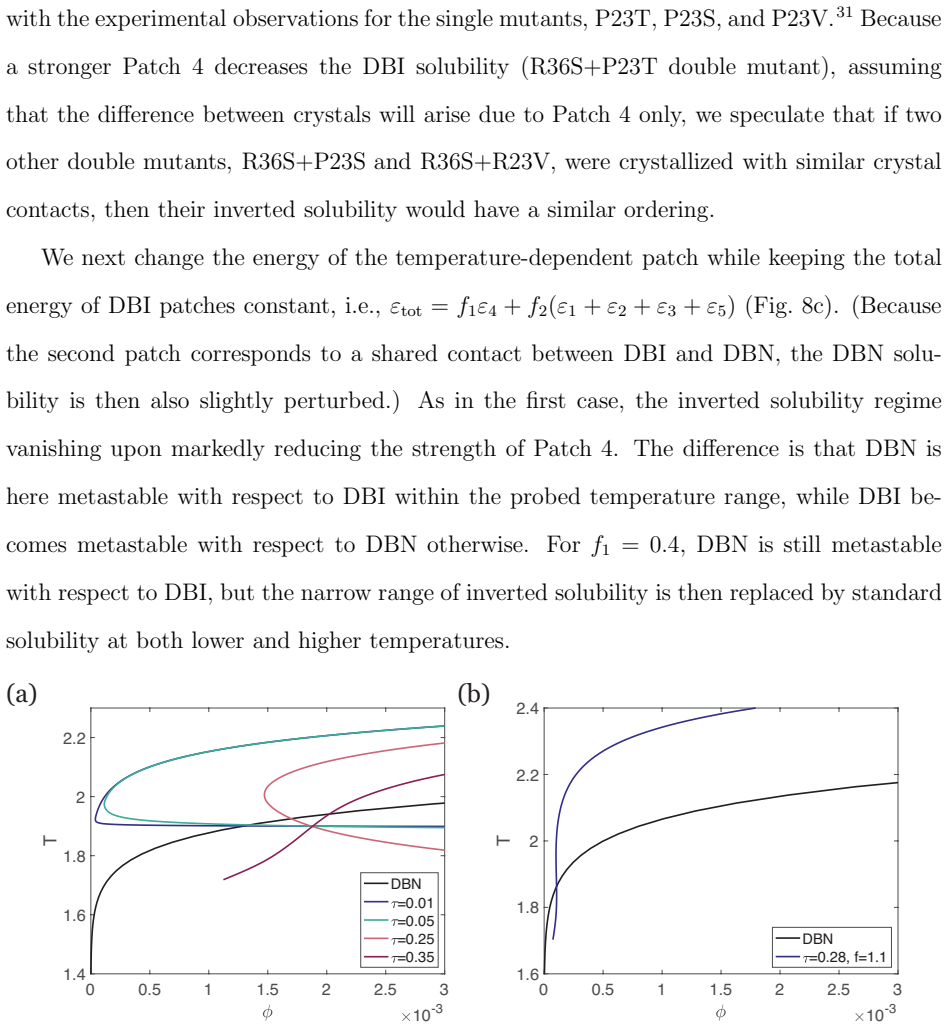
- The temperature-deactivated patch model reproduces the DBI inverted-solubility regime and remains inverted under 5–10% perturbations of patch energies, so it stays viable as a generic explanation without specifying the microscopic cause.
- The temperature-dependent Patch 4 interaction leaves the liquid-liquid binodal essentially unchanged ($T_c \approx 1.85$), matching experiments; a closed-loop binodal appears only for Patch 4 energies above $\varepsilon_4 > 36$, far outside estimated error.
- Because increasing Patch 4 strength lowers DBI solubility, the model predicts that R36S+P23S and R36S+P23V double mutants, if they crystallize with similar contacts, would show inverted solubility ordered by the strength of their residue-23 patch.
Reading between the lines
- Because the threshold $n_w^*$ depends on the water-model degeneracies, the paper's 'weak support' verdict is conditional: with the alternative degeneracy set considered in Sec. 4.1, inversion would need only about 18 water molecules, below the estimated 43–48 available, so a hydrophobicity explanation would then be viable.
- A direct experimental measure of water structure around residue 23—for example neutron diffraction or hydrogen-deuterium exchange—would be a sharper test than hydrophobicity scales, because $n_w$ and its temperature dependence are the physical quantities that decide between the three models.
- The same fine-balance argument may generalize to other proteins with inverted solubility: the phenomenon should be more likely when a single strong crystal-contact patch is solvated by a large, contiguous hydrophobic area, and less likely when hydrophobic residues are scattered.
- A testable extension would be to tune $n_w$ experimentally with cosolutes or by mutating nearby residues to alter local water exposure; the model predicts that crossing the $n_w^*$ threshold at fixed patch strength should flip a normal-solubility mutant into an inverted one.
Signed reviews
Editorial analysis
A structured set of objections, weighed in public.
Referee Report
Summary. The paper investigates whether inverted solubility in human γD-crystallin P23T mutants is caused by increased surface hydrophobicity. It first measures SASA-weighted hydrophobicity with five amino-acid scales in six crystal structures and finds no consistent, statistically significant increase associated with P23T. It then studies a patchy-particle model of the DBI and DBN crystal forms in which Patch 4, containing residue 23, has a temperature-dependent energy given by one of three models: the MLG two-state water model, the Wentzel–Gunton linear model, and a generic temperature-deactivation model. The authors derive an explicit inversion condition, Eq. (23), identify the number of waters n_w needed to invert solubility, compare it to structural estimates of available hydrophobic waters (43–48), and map solubility lines and critical temperatures. They conclude that hydrophobic-effect-driven inversion is possible only in a narrow parameter window and that microscopic support in γD-crystallin is weak, while the generic deactivation model robustly captures the phenomenology and leaves the microscopic cause open.
Significance. If accepted, the paper offers a useful cautionary result: surface-hydrophobicity scales do not support the earlier dye-binding inference, and the hydrophobic scenario requires a fine balance of parameters, helping explain why inverted solubility is rare. The paper is transparent: the analytical derivation of the inversion condition is explicit, the limitations of the ground-state crystal free-energy approximation are stated, and the authors flag the arbitrariness of MLG degeneracies. It also provides specific falsifiable predictions, including the ordering of hypothetical R36S+P23S/P23V double mutants and the absence of closed-loop binodals unless Patch 4 is more than doubled in strength. The main limitation is that the key threshold n_w* is sensitive to parameter choices that the paper itself acknowledges as reasonable, so the headline conclusion is more parameter-dependent than the abstract suggests.
major comments (3)
- [Sec. 4.1, Eq. (23), Figs. 5 and 6] The central conclusion that hydrophobic support is weak depends on a threshold that the paper's own parameter choices straddle. With the Silverstein et al. degeneracies and εtot=60, n_w*≈71 exceeds the estimated 43–48 available hydrophobic waters; with the Shiryayev et al. degeneracies, n_w*≈18; and with the halved patch-energy calibration εtot=30 that Sec. 4.1 calls reasonable, n_w*≈35. Because the halved calibration was introduced to bring computed solubilities into line with experiment, the hydrophobic scenario is quantitatively sufficient under at least one plausible, self-consistent parameter set. The manuscript should either justify a preferred parameter set or soften the abstract's 'weakly supported' claim to 'inconclusive'.
- [Sec. 4.1 and Eq. (23)] The inversion condition is stated inconsistently. Eq. (23) reads Γ(β)=εtot/(2nw)−Δε(1)/2, while the text immediately below Eq. (23) states Γ(β)>εtot/(2nw)−Δε(1)/nw. Since the reported n_w* values are derived from this condition, this discrepancy needs to be resolved before the threshold analysis is reliable.
- [Sec. 2, Fig. 1] The surface-hydrophobicity comparison draws on crystal structures solved in different lattices, and the Patch 4 SASA is evaluated within the crystal context of each structure. The paper addresses coordinate uncertainty but does not discuss whether the different lattice environments of 1HK0, 4JGF, 2G98, 1H4A, 6ETA and 6ETC bias the comparison of a given surface patch. A brief discussion of this possible bias, or a restriction of the claim to the structures themselves, would strengthen the first pillar of the conclusion.
minor comments (6)
- [Fig. 1 caption] The sentence 'Proteins to the left of the black vertical line exhibit normal solubility, and those to the left exhibit inverted solubility' should read '...and those to the right...'.
- [Author affiliation] In the affiliations, 'I reland' should be 'Ireland'.
- [Eq. (12)] The notation −ε′_4 = ... on the left-hand side is confusing; please define ε′_4 explicitly rather than writing the negative of the patch energy.
- [Sec. 4.1] The text contains the LaTeX artifact 'n_w* /greaterorsimilar71'; it should be typeset as n_w* ≳ 71.
- [References and data availability] Reference 33 is incomplete ('Schrödinger, LLC'), and the data/SI DOI placeholders 'https://doi.org/10.7924/XXXXXXX' and 'DOI: 10.1021/XXXX' need to be completed before publication.
- [Eq. (27)] The integral limits are written awkwardly as '4.5 Å ∫ 3 Å'; please typeset this as an integral from 3 Å to 4.5 Å.
Circularity Check
No significant circularity: the paper's inferences are model-based and not reduced to fitted inputs by construction.
full rationale
The paper makes no disguised fit: the hydrophobic-effect models (MLG and Wentzel-Gunton) are parameterized from literature values and all-atom MD, and the free parameter n_w is scanned against a separately estimated SASA-based water count. Eq. (23) is an analytic threshold derived from the model, not a parameter fitted to the target solubility inversion. The temperature-deactivated patch model (Eq. 13) does encode inversion by construction, since Patch 4 turns off at low temperature, but the paper does not present that model as a first-principles prediction; it explicitly calls it a generic description inherited from the authors' prior work (Ref. 30) and uses it only to probe robustness. The central 'weak support for hydrophobicity' conclusion rests on surface-hydrophobicity measurements (Sec. 2) and on the n_w* threshold; the threshold's sensitivity to MLG degeneracies and to halved patch energies is openly acknowledged in Sec. 4.1 and is a parameter-uncertainty or correctness concern, not circularity. No load-bearing step reduces to a self-citation or to the quantity it claims to predict.
Assumptions & free parameters
free parameters (5)
- nw (water molecules solvating Patch 4) =
43-48 estimated from SASA; threshold n*>=71 for epsilon_tot=60, n*>=35 for epsilon_tot=30
- epsilon_tot (DBI total patch energy scale) =
60 kBTref, or 30 after halving to match experimental solubility
- MLG water-state parameters =
E_ob=-5.82, E_db=-1.69, E_os=-5.90, E_ds=-0.56 kBTref; q_ob=1.5, q_db=30, q_os=1, q_ds=48
- Wentzel-Gunton Delta_s_w =
varied from 0 to -50
- Temperature-deactivation parameters T_a and tau =
T_a=1.9, tau=0.05
assumptions (6)
- domain assumption Each patch in the model corresponds to a crystal contact in DBI or DBN, and only the patch containing residue 23 is temperature-dependent.
- domain assumption The fluid equation of state can be truncated at the second virial coefficient, with B3 negligible because triply-bonded triplets cannot form.
- domain assumption The crystal chemical potential can be approximated by the ground-state energy with all bonds active, so that <U(beta)> is approximately U0(beta), and <dU/dbeta> is approximately dU/dbeta.
- domain assumption The MLG four-state water model and the Silverstein et al. energy and degeneracy values describe the hydrophobic effect around protein patches.
- domain assumption Hydrophobicity scales (GRAVY, ww, hh, mf, tt) are adequate proxies for the protein-water interactions that set solubility behavior.
- standard math Wertheim's perturbation theory with a hard-sphere reference gives a reliable estimate of the liquid-liquid binodal and critical temperature.
Cite this review
Pith. "Pith review of Using schematic models to understand the microscopic basis for inverted solubility in $\gamma$D-crystallin." pith.science (2026). https://pith.science/paper/RNQ4SDRZ
@misc{pith2026190805693,
  author       = {Pith},
  title        = {Pith review of: Using schematic models to understand the microscopic basis for inverted solubility in $\gamma$D-crystallin},
  year         = {2026},
  howpublished = {\url{https://pith.science/paper/RNQ4SDRZ}},
  note         = {Machine review of arXiv:1908.05693}
}
abstract
Inverted solubility--a crystal melting upon cooling--is observed in a handful of proteins, such as carbomonoxy hemoglobin and $\gamma$D-crystallin. In human $\gamma$D-crystallin, the phenomenon is associated with the mutation of the 23$^\mathrm{rd}$ residue, a proline, to a threonine, serine or valine. One proposed microscopic mechanism for this effect entails an increase in hydrophobicity upon mutagenesis. Recent crystal structures of a double mutant that includes the P23T mutation allows for a more careful investigation of this proposal. Here, we first measure the surface hydrophobicity of various mutant structures of this protein and determine that it does not discernibly increase upon the mutating the 23$^\mathrm{rd}$ residue. We then investigate the solubility inversion regime with a schematic patchy particle model that includes one of three models for temperature-dependent patch energies: two of the hydrophobic effect, and a more generic description. We conclude that while solubility inversion due to the hydrophobic effect may be possible, microscopic evidence to support it in $\gamma$D-crystallin is weak. More generally, we find that solubility inversion requires a fine balance between patch strengths and the temperature-dependent contribution, which may explain why inverted solubility is not commonly observed in proteins. In any event, we also find that the temperature-dependent interaction has only a negligible impact on the critical properties of the $\gamma$D-crystallin, in line with previous experimental observations.
Figures

Figures from the paper (7 more)


Reference graph
Works this paper leans on
-
[1]
J.; Charbonneau, P.; Zaccarelli, E.; Asherie, N
McManus, J. J.; Charbonneau, P.; Zaccarelli, E.; Asherie, N. The physics of protein self-assembly. Current opinion in colloid & interface science 2016, 22, 73--79
2016
-
[2]
Soft matter perspective on protein crystal assembly
Fusco, D.; Charbonneau, P. Soft matter perspective on protein crystal assembly. Colloids and Surfaces B: Biointerfaces 2016, 137, 22--31
2016
-
[3]
Hagan, M. F. Modeling viral capsid assembly. Advances in chemical physics 2014, 155, 1
work page 2014
-
[4]
S ari \'c , A.; Chebaro, Y. C.; Knowles, T. P.; Frenkel, D. Crucial role of nonspecific interactions in amyloid nucleation. Proceedings of the National Academy of Sciences 2014, 111, 17869--17874
work page 2014
-
[5]
Suzuki, Y.; Cardone, G.; Restrepo, D.; Zavattieri, P. D.; Baker, T. S.; Tezcan, F. A. Self-assembly of coherently dynamic, auxetic, two-dimensional protein crystals. Nature 2016, 533, 369
work page 2016
-
[6]
Pieters, B. J.; van Eldijk, M. B.; Nolte, R. J.; Mecinovi \'c , J. Natural supramolecular protein assemblies. Chemical Society Reviews 2016, 45, 24--39
work page 2016
-
[7]
Glotzer, S. C.; Solomon, M. J. Anisotropy of building blocks and their assembly into complex structures. Nature materials 2007, 6, 557
work page 2007
-
[8]
Huang, P.-S.; Boyken, S. E.; Baker, D. The coming of age of de novo protein design. Nature 2016, 537, 320
work page 2016
Show all 65 references
-
[9]
N.; Radford, R
Salgado, E. N.; Radford, R. J.; Tezcan, F. A. Metal-directed protein self-assembly. Accounts of chemical research 2010, 43, 661--672
2010
-
[10]
B.; Gray, J
Koehler Leman, J.; Ulmschneider, M. B.; Gray, J. J. Computational modeling of membrane proteins. Proteins: Structure, Function, and Bioinformatics 2015, 83, 1--24
2015
-
[11]
Protein Self-Assembly; Springer, 2019; pp 209--227
Altan, I.; Charbonneau, P. Protein Self-Assembly; Springer, 2019; pp 209--227
2019
-
[12]
Determination of phase diagrams via computer simulation: methodology and applications to water, electrolytes and proteins
Vega, C.; Sanz, E.; Abascal, J.; Noya, E. Determination of phase diagrams via computer simulation: methodology and applications to water, electrolytes and proteins. Journal of Physics: Condensed Matter 2008, 20, 153101
2008
-
[13]
Phase diagram of a tetrahedral patchy particle model for different interaction ranges
Romano, F.; Sanz, E.; Sciortino, F. Phase diagram of a tetrahedral patchy particle model for different interaction ranges. The Journal of Chemical Physics 2010, 132, 184501
2010
-
[14]
R.; Frenkel, D
ten Wolde, P. R.; Frenkel, D. Enhancement of protein crystal nucleation by critical density fluctuations. Science 1997, 277, 1975--1978
1997
-
[15]
Role of the range in the fluid- crystal coexistence for a patchy particle model
Romano, F.; Sanz, E.; Sciortino, F. Role of the range in the fluid- crystal coexistence for a patchy particle model. The Journal of Physical Chemistry B 2009, 113, 15133--15136
2009
-
[16]
Lomakin, A.; Asherie, N.; Benedek, G. B. Aeolotopic interactions of globular proteins. Proceedings of the National Academy of Sciences 1999, 96, 9465--9468
1999
-
[17]
Bianchi, E.; Blaak, R.; Likos, C. N. Patchy colloids: state of the art and perspectives. Physical Chemistry Chemical Physics 2011, 13, 6397--6410
2011
-
[18]
Introduction to protein crystallization
McPherson, A. Introduction to protein crystallization. Methods 2004, 34, 254--265
2004
-
[19]
R.; Puttamadappa, S
Pande, A.; Zhang, J.; Banerjee, P. R.; Puttamadappa, S. S.; Shekhtman, A.; Pande, J. NMR study of the cataract-linked P23T mutant of human D-crystallin shows minor changes in hydrophobic patches that reflect its retrograde solubility. Biochemical and biophysical research commu...
2009
-
[20]
S.; Banerjee, P
Pande, A.; Ghosh, K. S.; Banerjee, P. R.; Pande, J. Increase in surface hydrophobicity of the cataract-associated P23T mutant of human D-crystallin is responsible for its dramatically lower, retrograde solubility. Biochemistry 2010, 49, 6122--6129
2010
-
[21]
G.; Feeling-Taylor, A.; Yau, S.-T.; Petsev, D
Vekilov, P. G.; Feeling-Taylor, A.; Yau, S.-T.; Petsev, D. Solvent entropy contribution to the free energy of protein crystallization. Acta Crystallographica Section D: Biological Crystallography 2002, 58, 1611--1616
2002
-
[22]
N.; Thomas, B
Petsev, D. N.; Thomas, B. R.; Yau, S.-T.; Tsekova, D.; Nanev, C.; Wilson, W. W.; Vekilov, P. G. Temperature-independent solubility and interactions between apoferritin monomers and dimers in solution. Journal of crystal growth 2001, 232, 21--29
2001
-
[23]
L.; Gunton, J
Shiryayev, A.; Pagan, D. L.; Gunton, J. D.; Rhen, D.; Saxena, A.; Lookman, T. Role of solvent for globular proteins in solution. The Journal of chemical physics 2005, 122, 234911
2005
-
[24]
Wentzel, N.; Gunton, J. D. Effect of solvent on the phase diagram of a simple anisotropic model of globular proteins. The Journal of Physical Chemistry B 2008, 112, 7803--7809
2008
-
[25]
Hydrophobic interaction model for upper and lower critical solution temperatures
Moelbert, S.; De Los Rios, P. Hydrophobic interaction model for upper and lower critical solution temperatures. Macromolecules 2003, 36, 5845--5853
2003
-
[26]
A two-state model of hydrophobic hydration that produces compensating enthalpy and entropy changes
Lee, B.; Graziano, G. A two-state model of hydrophobic hydration that produces compensating enthalpy and entropy changes. Journal of the American Chemical Society 1996, 118, 5163--5168
1996
-
[27]
Search for a realistic view of hydrophobic effects
Muller, N. Search for a realistic view of hydrophobic effects. Accounts of Chemical Research 1990, 23, 23--28
1990
-
[28]
M.; Westbrook, J.; Feng, Z.; Gilliland, G.; Bhat, T
Berman, H. M.; Westbrook, J.; Feng, Z.; Gilliland, G.; Bhat, T. N.; Weissig, H.; Shindyalov, I. N.; Bourne, P. E. The protein data bank. Nucleic acids research 2000, 28, 235--242
2000
-
[29]
K.; McManus, J
James, S.; Quinn, M. K.; McManus, J. J. The self assembly of proteins; probing patchy protein interactions. Physical Chemistry Chemical Physics 2015, 17, 5413--5420
2015
-
[30]
R.; James, S.; Quinn, M
Khan, A. R.; James, S.; Quinn, M. K.; Altan, I.; Charbonneau, P.; McManus, J. J. Temperature-dependent interactions explain normal and inverted solubility in a D-crystallin mutant. Biophysical Journal 2019,
2019
-
[31]
J.; Lomakin, A.; Ogun, O.; Pande, A.; Basan, M.; Pande, J.; Benedek, G
McManus, J. J.; Lomakin, A.; Ogun, O.; Pande, A.; Basan, M.; Pande, J.; Benedek, G. B. Altered phase diagram due to a single point mutation in human D-crystallin. Proceedings of the National Academy of Sciences 2007, 104, 16856--16861
2007
-
[32]
Schr\"odinger, LLC ,
-
[33]
J.; Bruno, A
Fusco, D.; Barnum, T. J.; Bruno, A. E.; Luft, J. R.; Snell, E. H.; Mukherjee, S.; Charbonneau, P. Statistical analysis of crystallization database links protein physico-chemical features with crystallization mechanisms. PLoS One 2014, 9, e101123
2014
-
[34]
Kyte, J.; Doolittle, R. F. A simple method for displaying the hydropathic character of a protein. Journal of molecular biology 1982, 157, 105--132
1982
-
[35]
C.; White, S
Wimley, W. C.; White, S. H. Experimentally determined hydrophobicity scale for proteins at membrane interfaces. Nature Structural and Molecular Biology 1996, 3, 842
1996
-
[36]
H.; von Heijne, G
Hessa, T.; Kim, H.; Bihlmaier, K.; Lundin, C.; Boekel, J.; Andersson, H.; Nilsson, I.; White, S. H.; von Heijne, G. Recognition of transmembrane helices by the endoplasmic reticulum translocon. Nature 2005, 433, 377
2005
-
[37]
P.; Fleming, K
Moon, C. P.; Fleming, K. G. Side-chain hydrophobicity scale derived from transmembrane protein folding into lipid bilayers. Proceedings of the National Academy of Sciences 2011, 108, 10174--10177
2011
-
[38]
transmembrane tendency
Zhao, G.; London, E. An amino acid “transmembrane tendency” scale that approaches the theoretical limit to accuracy for prediction of transmembrane helices: relationship to biological hydrophobicity. Protein science 2006, 15, 1987--2001
2006
-
[39]
B.; Pande, J
Basak, A.; Bateman, O.; Slingsby, C.; Pande, A.; Asherie, N.; Ogun, O.; Benedek, G. B.; Pande, J. High-resolution X-ray crystal structures of human D crystallin (1.25 ) and the R58H mutant (1.15 ) associated with aculeiform cataract. Journal of molecular biology 2003, 328, 1137--1147
2003
-
[40]
M.; Jung, J.; Gronenborn, A
Ji, F.; Koharudin, L. M.; Jung, J.; Gronenborn, A. M. Crystal structure of the cataract-causing P23T D-crystallin mutant. Proteins: Structure, Function, and Bioinformatics 2013, 81, 1493--1498
2013
-
[41]
Link between a novel human D-crystallin allele and a unique cataract phenotype explained by protein crystallography
Kmoch, S.; Brynda, J.; Asfaw, B.; Bezou s ka, K.; Nov \'a k, P.; R ez \'a c ov \'a , P.; Ondrov \'a , L.; Filipec, M.; Sedl \'a c ek, J.; Elleder, M. Link between a novel human D-crystallin allele and a unique cataract phenotype explained by protein crystallography. Human mole...
2000
-
[42]
S ali, A.; Blundell, T. L. Comparative protein modelling by satisfaction of spatial restraints. Journal of molecular biology 1993, 234, 779--815
1993
-
[43]
F.; Goddard, T
Pettersen, E. F.; Goddard, T. D.; Huang, C. C.; Couch, G. S.; Greenblatt, D. M.; Meng, E. C.; Ferrin, T. E. UCSF Chimera—a visualization system for exploratory research and analysis. Journal of computational chemistry 2004, 25, 1605--1612
2004
-
[44]
J.; De Simone, A.; Wang, J.; Charbonneau, P
Fusco, D.; Headd, J. J.; De Simone, A.; Wang, J.; Charbonneau, P. Characterizing protein crystal contacts and their role in crystallization: rubredoxin as a case study. Soft matter 2014, 10, 290--302
2014
-
[45]
J.; van der Spoel, D.; van Drunen, R
Berendsen, H. J.; van der Spoel, D.; van Drunen, R. GROMACS: a message-passing parallel molecular dynamics implementation. Computer physics communications 1995, 91, 43--56
1995
-
[46]
Umbrella sampling
K \"a stner, J. Umbrella sampling. Wiley Interdisciplinary Reviews: Computational Molecular Science 2011, 1, 932--942
2011
-
[47]
Evaluating the performance of the ff99SB force field based on NMR scalar coupling data
Wickstrom, L.; Okur, A.; Simmerling, C. Evaluating the performance of the ff99SB force field based on NMR scalar coupling data. Biophysical journal 2009, 97, 853--856
2009
-
[48]
V.; Charbonneau, P
Altan, I.; Fusco, D.; Afonine, P. V.; Charbonneau, P. Learning about Biomolecular Solvation from Water in Protein Crystals. The Journal of Physical Chemistry B 2018, 122, 2475--2486
2018
-
[49]
Dynamic personalities of proteins
Henzler-Wildman, K.; Kern, D. Dynamic personalities of proteins. Nature 2007, 450, 964
2007
-
[50]
A.; Haymet, A.; Dill, K
Silverstein, K. A.; Haymet, A.; Dill, K. A. Molecular model of hydrophobic solvation. The Journal of chemical physics 1999, 111, 8000--8009
1999
-
[51]
A.; Haymet, A.; Dill, K
Silverstein, K. A.; Haymet, A.; Dill, K. A. A simple model of water and the hydrophobic effect. Journal of the American Chemical Society 1998, 120, 3166--3175
1998
-
[52]
W.; Feller, D.; Dixon, D
Feyereisen, M. W.; Feller, D.; Dixon, D. A. Hydrogen bond energy of the water dimer. The Journal of Physical Chemistry 1996, 100, 2993--2997
1996
-
[53]
Fluids with highly directional attractive forces
Wertheim, M. Fluids with highly directional attractive forces. I. Statistical thermodynamics. Journal of statistical physics 1984, 35, 19--34
1984
-
[54]
Fluids with highly directional attractive forces
Wertheim, M. Fluids with highly directional attractive forces. II. Thermodynamic perturbation theory and integral equations. Journal of statistical physics 1984, 35, 35--47
1984
-
[55]
Sear, R. P. Phase behavior of a simple model of globular proteins. The Journal of chemical physics 1999, 111, 4800--4806
1999
-
[56]
de las Heras, D.; da Gama, M. M. T. Temperature (de) activated patchy colloidal particles. Journal of Physics: Condensed Matter 2016, 28, 244008
2016
-
[57]
DNA-functionalized colloids: Physical properties and applications
Geerts, N.; Eiser, E. DNA-functionalized colloids: Physical properties and applications. Soft Matter 2010, 6, 4647--4660
2010
-
[58]
Chen, B.; Siepmann, J. I. A novel Monte Carlo algorithm for simulating strongly associating fluids: Applications to water, hydrogen fluoride, and acetic acid. The Journal of Physical Chemistry B 2000, 104, 8725--8734
2000
-
[59]
P.; Krauth, W.; Wilson, D
Bernard, E. P.; Krauth, W.; Wilson, D. B. Event-chain Monte Carlo algorithms for hard-sphere systems. Physical Review E 2009, 80, 056704
2009
-
[60]
Fluid--fluid coexistence in colloidal systems with short-ranged strongly directional attraction
Kern, N.; Frenkel, D. Fluid--fluid coexistence in colloidal systems with short-ranged strongly directional attraction. The Journal of chemical physics 2003, 118, 9882--9889
2003
-
[61]
Crystallization of asymmetric patchy models for globular proteins in solution
Fusco, D.; Charbonneau, P. Crystallization of asymmetric patchy models for globular proteins in solution. Physical Review E 2013, 88, 012721
2013
-
[62]
Frenkel, D.; Ladd, A. J. New Monte Carlo method to compute the free energy of arbitrary solids. Application to the fcc and hcp phases of hard spheres. The Journal of chemical physics 1984, 81, 3188--3193
1984
-
[63]
K.; Sciortino, F.; Evans, G
Liu, H.; Kumar, S. K.; Sciortino, F.; Evans, G. T. Vapor-liquid coexistence of fluids with attractive patches: An application of Wertheim’s theory of association. The Journal of chemical physics 2009, 130, 044902
2009
-
[64]
A.; Kuhne, T
Kessler, J.; Elgabarty, H.; Spura, T.; Karhan, K.; Partovi-Azar, P.; Hassanali, A. A.; Kuhne, T. D. Structure and dynamics of the instantaneous water/vapor interface revisited by path-integral and ab initio molecular dynamics simulations. The Journal of Physical Chemistry B 20...
2015
-
[65]
" id="W5M0MpCehiHzreSzNTczkc9d
Tainter, C. J.; Shi, L.; Skinner, J. L. Reparametrized E3B (explicit three-body) water model using the TIP4P/2005 model as a reference. Journal of chemical theory and computation 2015, 11, 2268--2277 mcitethebibliography document orientationTorsion.eps0000664000000000000000000...
2005
Reviewed August 14, 2026 · model on record in the stance chip above.
Discussion (0). Continue with ORCID to comment.