Emergence of Thermodynamics from Equilibration in Isolated Quantum Systems
Pith reviewed 2026-06-30 10:07 UTC · model grok-4.3
The pith
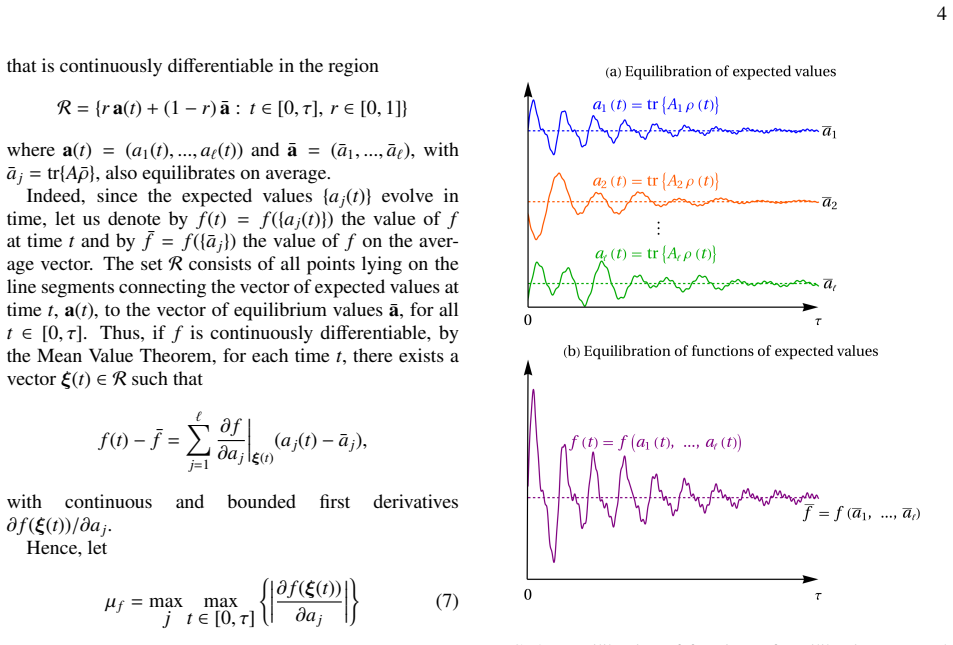
Any continuously differentiable function of equilibrating expectation values also equilibrates.
A machine-rendered reading of the paper's core claim, the machinery that carries it, and where it could break.
Core claim
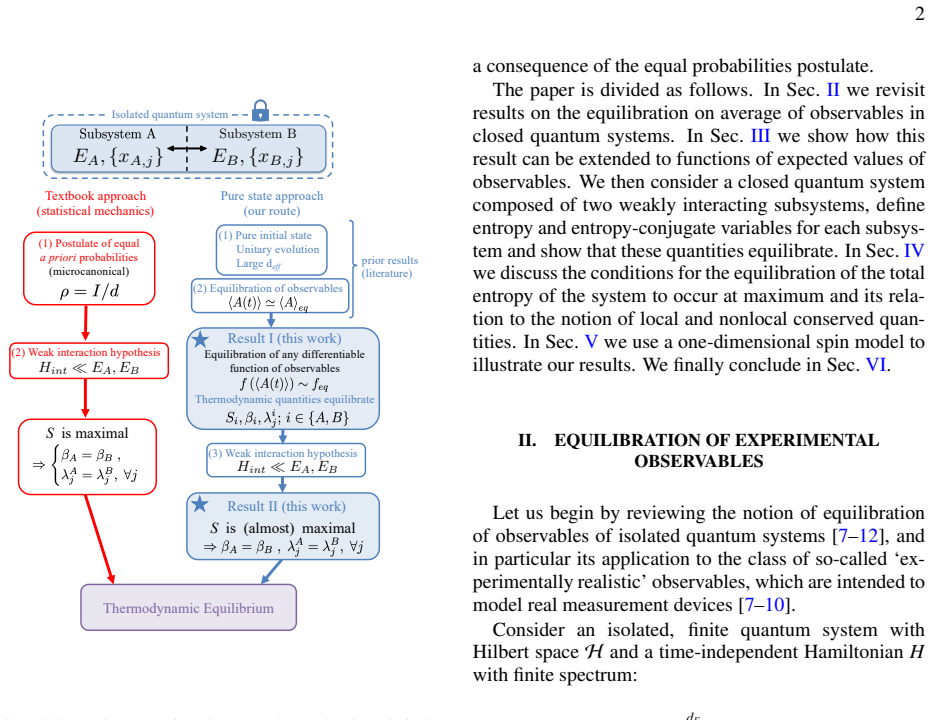
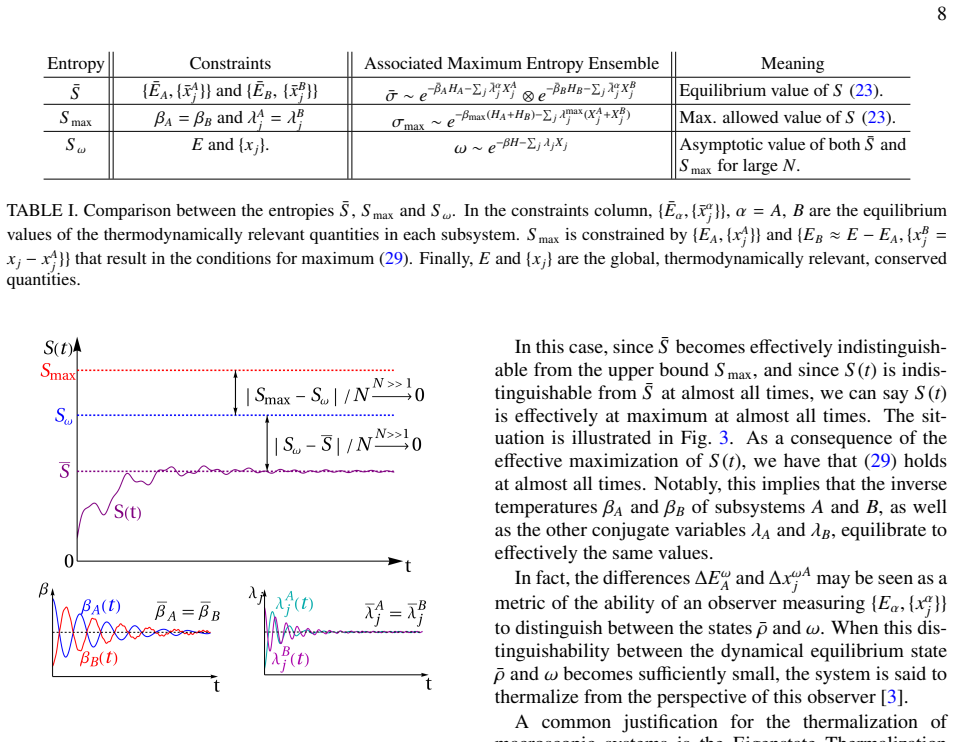
We establish that any continuously differentiable function of equilibrating expectation values also equilibrates. We apply this result to a bipartite isolated system, showing that the entropy and conjugate variables of each subsystem—defined through Jaynes' maximum entropy principle—equilibrate. Moreover, with the assumption that their equilibrium properties depend solely on local conserved quantities, we show the dynamical maximization of the total entropy, enforcing equality of conjugate variables across subsystems.
What carries the argument
The theorem that any continuously differentiable function of equilibrating expectation values also equilibrates.
If this is right
- Entropy defined via the maximum entropy principle on subsystems equilibrates.
- Conjugate variables such as inverse temperature equalize between subsystems.
- The total entropy of the composite system increases and reaches a maximum under the dynamics.
- Thermodynamic equilibrium conditions follow directly from unitary evolution.
Where Pith is reading between the lines
- The result may apply to other derived quantities in statistical mechanics that are smooth functions of expectation values.
- It suggests checking whether the same inheritance holds when the maximum entropy principle is replaced by other state-construction rules.
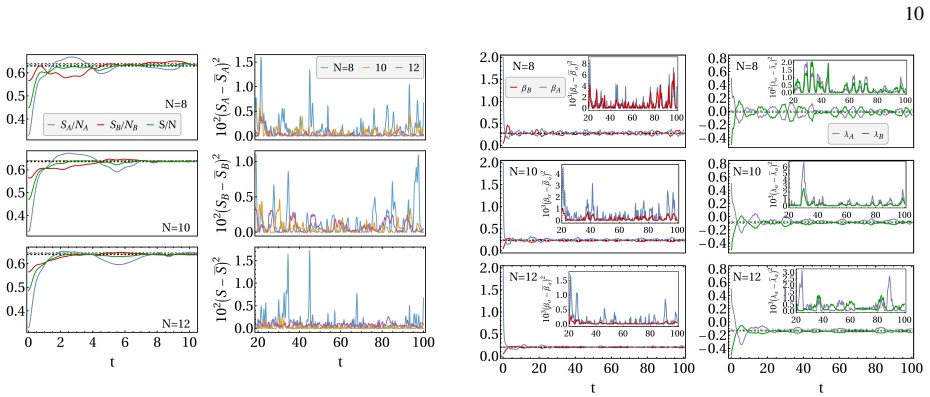
- Numerical simulations on small spin chains could test the predicted equality of conjugate variables after long times.
Load-bearing premise
The equilibrium properties of the subsystems depend solely on local conserved quantities.
What would settle it
An explicit example of an isolated quantum system in which expectation values equilibrate but a continuously differentiable function of those values, such as the Jaynes entropy of a subsystem, fails to equilibrate.
Figures
read the original abstract
Understanding how macroscopic thermodynamic behavior emerges from microscopic quantum dynamics remains an open problem. While equilibration of quantum observables is well established, thermodynamics also relies on variables not directly associated with linear operators, but which are defined instead as functions of expectation values. Whether and how such derived quantities inherit equilibration properties is an open question. Here, we establish that any continuously differentiable function of equilibrating expectation values also equilibrates. We apply this result to a bipartite isolated system, showing that the entropy and conjugate variables of each subsystem -- defined through Jaynes' maximum entropy principle -- equilibrate. Moreover, with the assumption that their equilibrium properties depend solely on local conserved quantities, we show the dynamical maximization of the total entropy, enforcing equality of conjugate variables across subsystems. These results provide a direct dynamical justification for entropy maximization and the emergence of thermodynamic equilibrium conditions, showing that fundamental principles of thermodynamics follow from the unitary evolution of quantum systems.
Editorial analysis
A structured set of objections, weighed in public.
Referee Report
Summary. The paper claims that any continuously differentiable function of equilibrating expectation values in an isolated quantum system also equilibrates. Applied to a bipartite system, this implies that subsystem entropies and their conjugate variables (defined via Jaynes' maximum-entropy construction) equilibrate. Under the additional modeling assumption that equilibrium properties of each subsystem depend solely on local conserved quantities, the dynamics are shown to maximize the total entropy and enforce equality of conjugate variables across subsystems, thereby deriving thermodynamic equilibrium conditions from unitary evolution.
Significance. If the central claims hold, the work supplies a direct dynamical route from quantum equilibration to the maximization of entropy and the equality of intensive variables, using only standard quantum mechanics plus an explicit assumption on local conserved quantities. This strengthens the microscopic foundation of thermodynamics without introducing fitted parameters or hidden circularities in the stated derivation.
minor comments (3)
- §3, after Eq. (12): the statement that the function f is 'continuously differentiable' should be accompanied by an explicit statement of the domain (e.g., whether the expectation values remain in a compact set) to make the limit interchange rigorous.
- §4.2, paragraph following Eq. (19): the phrase 'dynamical maximization of the total entropy' would benefit from a one-sentence clarification that this is conditional on the local-conserved-quantities assumption rather than derived from unitarity alone.
- Figure 2 caption: the plotted curves are not labeled with the specific initial states or subsystem sizes used; adding this information would improve reproducibility.
Simulated Author's Rebuttal
We thank the referee for the careful reading, positive assessment of significance, and recommendation of minor revision. No specific major comments were provided in the report, so we have no individual points to address at this stage. We are prepared to incorporate any minor suggestions that may arise in a revised version.
Circularity Check
No significant circularity; derivation self-contained under explicit assumptions
full rationale
The central claims rest on a standard result from real analysis (continuous differentiability preserves limits of equilibrating expectation values) applied to Jaynes' maximum-entropy construction, both of which are external to the paper and not derived from its own fitted quantities or self-citations. The entropy-maximization and conjugate-variable equality results are explicitly conditioned on the modeling assumption that equilibrium properties depend only on local conserved quantities; this premise is stated openly rather than smuggled in via definition or prior self-work. No load-bearing step reduces by the paper's equations to a tautology or to a parameter fitted from the target observable itself. The derivation therefore remains non-circular.
Axiom & Free-Parameter Ledger
axioms (2)
- domain assumption Jaynes' maximum entropy principle is used to define subsystem entropy and conjugate variables from expectation values
- ad hoc to paper Equilibrium properties of each subsystem depend solely on local conserved quantities
Reference graph
Works this paper leans on
-
[1]
Pure state quantum statistical mechanics and black holes
S. Lloyd, Pure state quantum statistical mechanics and black holes (2013), arXiv:1307.0378 [quant-ph]
work page internal anchor Pith review Pith/arXiv arXiv 2013
-
[2]
Pure State Quantum Statistical Mechanics
C. Gogolin, Pure state quantum statistical mechanics (2010), arXiv:1003.5058 [quant-ph]
work page internal anchor Pith review Pith/arXiv arXiv 2010
-
[3]
Gogolin and J
C. Gogolin and J. Eisert, Equilibration, thermalisation, and the emergence of statistical mechanics in closed quan- tum systems, Reports on Progress in Physics79, 056001 (2016)
2016
-
[4]
Popescu, A
S. Popescu, A. J. Short, and A. Winter, Entanglement and the foundations of statistical mechanics, Nature Physics2, 754–758 (2006)
2006
-
[5]
Goldstein, J
S. Goldstein, J. L. Lebowitz, R. Tumulka, and N. Zangh `ı, Canonical typicality, Phys. Rev. Lett.96, 050403 (2006)
2006
-
[6]
P. S. Correia, G. D. Carvalho, T. R. de Oliveira, R. O. Vallejos, and F. de Melo, Canonical typicality under gen- eral quantum channels, Phys. Rev. Lett.133, 060401 (2024)
2024
-
[7]
Reimann, Foundation of statistical mechanics under experimentally realistic conditions, Phys
P. Reimann, Foundation of statistical mechanics under experimentally realistic conditions, Phys. Rev. Lett.101, 190403 (2008)
2008
-
[8]
Reimann, Canonical thermalization, New Journal of Physics12, 055027 (2010)
P. Reimann, Canonical thermalization, New Journal of Physics12, 055027 (2010)
2010
-
[9]
Reimann, Equilibration of isolated macroscopic quan- tum systems under experimentally realistic conditions, Physica Scripta86, 058512 (2012)
P. Reimann, Equilibration of isolated macroscopic quan- tum systems under experimentally realistic conditions, Physica Scripta86, 058512 (2012)
2012
-
[10]
Reimann and M
P. Reimann and M. Kastner, Equilibration of isolated macroscopic quantum systems, New Journal of Physics 14, 043020 (2012)
2012
-
[11]
A. J. Short, Equilibration of quantum systems and subsys- tems, New Journal of Physics13, 053009 (2011)
2011
-
[12]
A. J. Short and T. C. Farrelly, Quantum equilibration in finite time, New Journal of Physics14, 013063 (2012)
2012
-
[13]
M. R. Passos and T. R. de Oliveira, Quantum equilibration under extended experimentally realistic conditions, Phys. Rev. A111, 022218 (2025)
2025
-
[14]
Linden, S
N. Linden, S. Popescu, A. J. Short, and A. Winter, Quan- 16 tum mechanical evolution towards thermal equilibrium, Phys. Rev. E79, 061103 (2009)
2009
-
[15]
Entropy production as correlation between system and reservoir
M. Esposito, K. Lindenberg, and C. Van den Broeck, Entropy production as correlation between system and reservoir, New Journal of Physics12, 013013 (2010), arXiv:0908.1125
work page internal anchor Pith review Pith/arXiv arXiv 2010
-
[16]
Microscopic diagonal entropy and its connection to basic thermodynamic relations
A. Polkovnikov, Microscopic diagonal entropy and its connection to basic thermodynamic relations, Annals of Physics326, 486 (2011), arXiv:0806.2862
work page internal anchor Pith review Pith/arXiv arXiv 2011
-
[17]
Tasaki, Quantum statistical mechanical derivation of the second law of thermodynamics: A hybrid setting ap- proach, Phys
H. Tasaki, Quantum statistical mechanical derivation of the second law of thermodynamics: A hybrid setting ap- proach, Phys. Rev. Lett.116, 170402 (2016)
2016
-
[18]
G. T. Landi and M. Paternostro, Irreversible entropy pro- duction: From classical to quantum, Rev. Mod. Phys.93, 035008 (2021)
2021
-
[19]
Strasberg and A
P. Strasberg and A. Winter, First and second law of quan- tum thermodynamics: A consistent derivation based on a microscopic definition of entropy, PRX Quantum2, 030202 (2021)
2021
-
[20]
A. D. Varizi and P. S. Correia, Entropy production from maximum entropy principle: A unifying approach, Phys. Rev. E110, 024109 (2024)
2024
-
[21]
J. Schindler, P. Strasberg, N. Galke, A. Winter, and M. G. Jabbour, Unification of observational entropy with maxi- mum entropy principles (2025), arXiv:2503.15612 [quant- ph]
-
[22]
E. T. Jaynes, Information theory and statistical mechanics, Phys. Rev.106, 620 (1957)
1957
-
[23]
E. H. Wichmann, Density matrices arising from incom- plete measurements, Journal of Mathematical Physics4, 884 (1963)
1963
-
[24]
T. N. Ikeda, N. Sakumichi, A. Polkovnikov, and M. Ueda, The second law of thermodynamics under unitary evolu- tion and external operations, Annals of Physics354, 338 (2015)
2015
-
[25]
Meier, T
F. Meier, T. Rivlin, T. Debarba, J. Xuereb, M. Huber, and M. P. Lock, Emergence of a second law of thermodynam- ics in isolated quantum systems, PRX Quantum6, 010309 (2025)
2025
-
[26]
R. V . Jensen and R. Shankar, Statistical behavior in deter- ministic quantum systems with few degrees of freedom, Phys. Rev. Lett.54, 1879 (1985)
1985
-
[27]
Srednicki, Chaos and quantum thermalization, Phys
M. Srednicki, Chaos and quantum thermalization, Phys. Rev. E50, 888 (1994)
1994
-
[28]
J. M. Deutsch, Quantum statistical mechanics in a closed system, Phys. Rev. A43, 2046 (1991)
2046
-
[29]
Tasaki, From quantum dynamics to the canonical dis- tribution: General picture and a rigorous example, Phys
H. Tasaki, From quantum dynamics to the canonical dis- tribution: General picture and a rigorous example, Phys. Rev. Lett.80, 1373 (1998)
1998
-
[30]
Rigol, V
M. Rigol, V . Dunjko, and M. Olshanii, Thermalization and its mechanism for generic isolated quantum systems, Na- ture452, 854 (2008)
2008
-
[31]
Sirker, N
J. Sirker, N. P. Konstantinidis, F. Andraschko, and N. Sedl- mayr, Locality and thermalization in closed quantum sys- tems, Phys. Rev. A89, 042104 (2014)
2014
-
[32]
(5) combines results from [10, 12]
The bound in Eq. (5) combines results from [10, 12]. In- deed, one can show that tr{A(ρ(t)−¯ρ)} 2 τ ≤ ||M||S, where S= P m,n |tr{P mρ(t)Pn A}| ≤ ||A|| 2 min{1/deff,3 max’n pn} andMis the matrix with entriesM mn,kl = exp[i(Em −E n −E k +E l)t] τ .||M|| ≤max kl |Mmn,kl|, withM mn,kl =1 for degenerate gaps (E k −E l =E m −E n) and|M mn,kl|=4 sin 2[(Em−E n−E ...
-
[33]
That is,gis the maximal number of equal energy differ- ences among all possible pairs of distinct energy eigenval- ues
-
[34]
Landau and E
L. Landau and E. Lifshitz,Statistical Physics: Volume 5, v. 5 (Pergamon Press, 1969)
1969
-
[35]
This is due to entanglement and allows even small quantum system to equilibrate and thermalize [43]
Note that this exponential scaling for the decay of fluc- tuations with the system size is stronger than the 1/ √ N expected from textbook statistical mechanics. This is due to entanglement and allows even small quantum system to equilibrate and thermalize [43]
-
[36]
(10) and (13), H=H A ⊗1 B +1 A ⊗H B +H I andX j =X A j ⊗1 B +1 A ⊗X B j , respectively
Formally we should write, instead of Eqs. (10) and (13), H=H A ⊗1 B +1 A ⊗H B +H I andX j =X A j ⊗1 B +1 A ⊗X B j , respectively. But for simplicity of notation, we will omit the identities everywhere. Likewise we useE A =tr{H A ρ} andx A j =tr{X A j ρ}instead of the accurateE A =tr{H A ⊗ 1B ρ}=tr{H A ρA}andx A j =tr{X A j ⊗1 B ρ}=tr{X A j ρA}, withρ A =t...
-
[37]
Equivalently, we are assuming the energy associated with the interaction, tr{H I ρ(t)}, can always be ignored when compared to the energies of the subsystemsE A andE B
-
[38]
R. S. Ingarden, A. Kossakowski, and M. Ohya,Informa- tion Dynamics and Open Systems: Classical and Quantum Approach, 1st ed., Fundamental Theories of Physics Nº 86 (Springer, 1997)
1997
-
[39]
Muschik, Empirical foundation and axiomatic treat- ment of non-equilibrium temperature, Archive for Ratio- nal Mechanics and Analysis66, 379 (1977)
W. Muschik, Empirical foundation and axiomatic treat- ment of non-equilibrium temperature, Archive for Ratio- nal Mechanics and Analysis66, 379 (1977)
1977
-
[40]
Muschik and G
W. Muschik and G. Brunk, A concept of non-equilibrium temperature, International Journal of Engineering Science 15, 377 (1977)
1977
-
[41]
Wilming, T
H. Wilming, T. R. de Oliveira, A. J. Short, and J. Eis- ert, Equilibration times in closed quantum many-body sys- tems, inThermodynamics in the Quantum Regime: Fun- damental Aspects and New Directions, edited by F. Binder, L. A. Correa, C. Gogolin, J. Anders, and G. Adesso (Springer International Publishing, Cham, 2018) pp. 435– 455
2018
-
[42]
T. R. de Oliveira, C. Charalambous, D. Jonathan, M. Lewenstein, and A. Riera, Equilibration time scales in closed many-body quantum systems, New Journal of Physics20, 033032 (2018)
2018
-
[43]
P. S. Correia, G. D. Carvalho, and T. R. de Oliveira, Ne- cessity of entanglement for the typicality argument in sta- tistical mechanics, Phys. Rev. A113, L060202 (2026)
2026
discussion (0)
Sign in with ORCID, Apple, or X to comment. Anyone can read and Pith papers without signing in.