REVIEW 1 major objections 4 minor 1 cited by
Non-ideal MHD simulations of hot Jupiter atmospheres
T0 review · 1 major / 4 minor · reviewed 2026-08-07 · deepseek-v4-flash
Pith's one-line read Hot Jupiter winds generate local magnetic fields of up to ~10^3 G at the shear layer, far exceeding the assumed interior field and breaking the linear regime even in cool planets.
desk verdict Solid, transparent non-ideal MHD study; the hot-planet result is robust, but the cold-planet 'comparable to background' claim rests on an unconstrained seed radial field. read the letter →
The pith
A machine-rendered reading of the paper's core claim, the machinery that carries it, and where it could break.
The reading
What carries the argument
The carrying mechanism is the 1D plane-parallel induction equation solved over a vertical column at the substellar point, fed by wind and thermodynamic profiles taken from published GCMs of five planets spanning $T_{\rm eq} \sim 1200$–2400 K. The operative balance is the stationary winding–Ohmic equilibrium, $\partial B_x/\partial t \simeq \partial_z(v_x B_z) + \partial_z(J_y/\sigma) \simeq 0$: the vertical shear of the zonal wind, $\partial_z v_x$, acting on a seed radial field $B_z$, generates the azimuthal field $B_x$ and its supporting meridional current $J_y$, which Ohmic dissipation limits. The non-ideal electric field entering the induction equation is $\mathbf{E} = -\mathbf{v}\times\mathbf{B} + \mathbf{J}/\sigma + (\mathbf{J}\times\mathbf{B})/(e n_e) - ((\mathbf{J}\times\mathbf{B})\times\mathbf{B})/(\nu_{in}\rho_i)$, so the relative weight of the Hall and ambipolar terms grows with the locally amplified $B_x$ rather than with the faint background field. Conductivity is computed along each column from thermal potassium ionization, and the seed for winding is an imposed radial component $B_z^{\rm in} = 0.1\,B_y^{\rm in}$, justified by the expectation of field misalignment or multipolar structure. A notable diagnostic subtlety in the paper is that at stationarity the advective-to-Ohmic ratio as defined by the full curl terms is $\sim 1$ by construction, so the authors use the standard estimate $R_m = vL/\eta$, which in the non-linear regime acts as an order-of-magnitude measure of the induced-to-background field ratio.
What would settle it
One decisive check is to measure or bound the radial (vertical) component of the magnetic field at the substellar point of a hot Jupiter. If spectropolarimetric mapping or the ion-neutral velocity offset method shows B_z much smaller than 0.1 B_y there — as would hold for a nearly aligned dipole, where B_z approaches zero at the equator — then the predicted fields of $10^{2}$–$10^{3}$ G at p ~ 1 bar could not arise from 1D winding, and the claim that the linear regime fails for most hot Jupiters would weaken in proportion. Within the paper's own setup, the linear scaling of |Bx|max with the seed (8 G at 0.003 G up to 870 G at 0.3 G) already shows that the headline field strengths are directly hostage to that assumed seed ratio.
Extended reading notes
Core claim
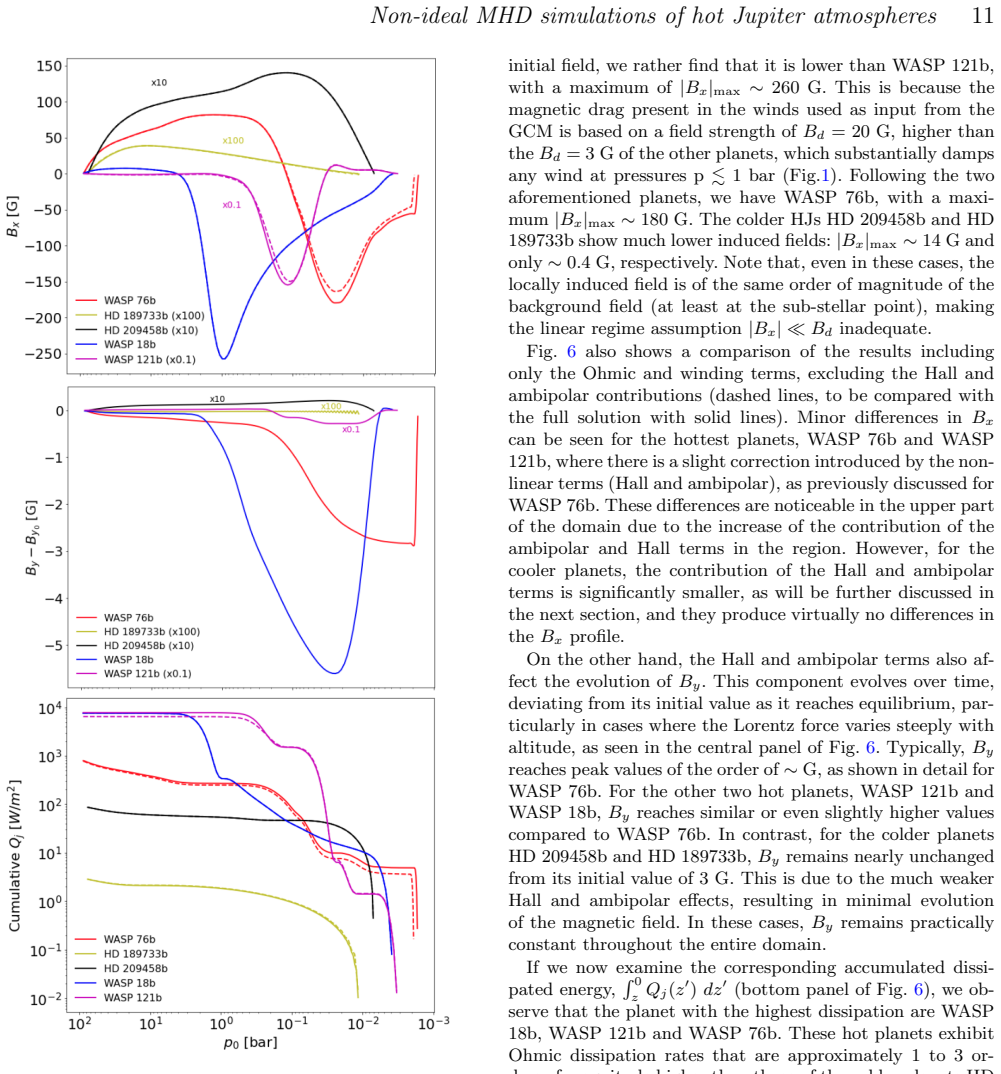
The paper's central claim is that atmospheric magnetic induction in hot Jupiters operates in the non-linear regime: at the substellar point, the azimuthal field created by the wind, $B_x$, is locally much larger than the assumed planetary background field, even for the coldest model considered. The equilibrium balance between winding and Ohmic dissipation, $\partial B_x/\partial t \simeq \partial_z(v_x B_z) + \partial_z(J_y/\sigma) \simeq 0$, yields azimuthal fields of order $10^1$–$10^3$ G at the shear layer near $p \sim 1$ bar — up to $\sim$1,550 G in WASP-121b — far exceeding the 3–20 G background fields assumed in the input GCMs. The induced field scales linearly with the seed radial field $B_z$, and the associated Ohmic dissipation scales quadratically, with local heating efficiencies of $\sim 10^{-6}$–$10^{-3}$ of the irradiation from the radiative layers alone. The Hall and ambipolar terms are subdominant to the winding–Ohmic balance, but in the hottest planets they generate a meridional field component $B_y$ and azimuthal currents $J_x$ that twist the field geometry at $p \lesssim 1$ bar and drive meridional and vertical flows. Because even HD 189733b ($T_{\rm eq} \sim 1200$ K) induces a field comparable to its assumed background, the authors conclude that the perturbative regime 'might be appropriate for the low-irradiated end of the HJ sample only.'
Load-bearing premise
The paper assumes that at the substellar point the planet's magnetic field has a radial component equal to 10% of its horizontal component, and the entire winding effect that produces the large fields scales linearly with that assumed radial component.
Editorial extensions
If this is right
- At the substellar point of the five modeled planets, the wind shear winds the seed field into azimuthal fields of ~10^1–10^3 G near 1 bar, and even the coolest case, HD 189733b, produces an induced field comparable to its assumed 3 G background.
- Because the induced field exceeds the background in essentially all modeled cases, Ohmic dissipation and magnetic drag calculations that treat induction as a linear perturbation apply only to the least irradiated hot Jupiters.
- The Hall and ambipolar terms, while secondary to the winding–Ohmic balance, twist the field and generate meridional and vertical flows at p <~ 1 bar in the hottest planets, effects a global circulation model would need to evolve self-consistently.
- Most Ohmic energy is released in the shear region around 0.1 to a few bar, so extending the simulated column to 1000 bar raises the peak field but leaves the cumulative dissipated energy nearly unchanged.
- The induced field grows linearly with the seed radial field, so the amplification and the heating efficiency scale with the planet's internal field strength and geometry.
Reading between the lines
- If the real radial component of the planetary field at the substellar point is much smaller than the assumed 10% of the meridional component, the predicted amplification and heating would shrink in proportion, so the paper's regime conclusion is conditional on field misalignment or multipolar structure rather than on a pure aligned dipole.
- The predicted Bx profiles and the ion-neutral drift velocities they imply could be confronted with high-resolution transmission spectroscopy of the hottest planets, since the ambipolar drift grows in the outer layers where the winding–Ohmic balance weakens.
- The same 1D column machinery, applied to the anti-stellar point or to terminators, would likely show weaker winding because of slower winds and lower temperatures, suggesting the substellar column is the most favorable place to detect atmospheric magnetic effects.
Editorial analysis
A structured set of objections, weighed in public.
Referee Report
Summary. The paper presents 1D plane-parallel non-ideal MHD simulations of vertical atmospheric columns at the substellar points of several hot Jupiters, using GCM-derived wind and thermodynamic profiles. The simulations evolve the induction equation for the azimuthal and meridional magnetic field components, including winding, Ohmic, Hall, and ambipolar terms, with the wind and temperature profiles forced toward prescribed backgrounds. The converged solutions are characterized by a winding--Ohmic balance, with local azimuthal fields reaching up to ~10^3 G in the hottest cases and local heating efficiencies of ~10^-6 to 10^-3. The authors find that Hall and ambipolar terms are subdominant but can modify the field geometry at p <~ 1 bar for the hottest planets, and they argue that even the coldest model considered (HD 189733b, Teq ~ 1200 K) produces an induced field locally comparable to the assumed background, so that the perturbative regime is not generally applicable.
Significance. The paper is a careful and useful contribution. Its strengths are the use of multiple realistic GCM input profiles, the inclusion of Hall and ambipolar terms in addition to the usual winding--Ohmic balance, explicit resolution and boundary-condition sensitivity studies (Apps. A and B), and unusually candid discussion of the model's limitations. If the quantitative results are accepted, they strengthen the case that non-linear magnetic induction is important in hot Jupiter upper atmospheres and provide concrete local Ohmic heating efficiencies that can inform future dissipation and GCM studies. The main caveat, developed below, is that the quantitative and qualitative conclusions for the cooler planets are controlled by an externally imposed and unconstrained seed radial magnetic field; the hot-planet conclusions are more robust.
major comments (1)
- [Sec. 2.5, Table 2, Fig. 10] The paper's headline conclusion that even the coldest model (HD 189733b, Teq ~ 1200 K) induces fields locally comparable to the background, and the associated statement that the perturbative regime is appropriate only for the low-irradiated end, is carried by the hand-chosen seed value Bin_z = 0.1 Bin_y. Because the winding balance in Eq. (17) is proportional to Bz, and Fig. 10 shows Bx scaling linearly with Bin_z (with Qj and the heating efficiency scaling quadratically), reducing the seed from 0.3 G to 0.03 G at the substellar point would lower HD 189733b's |Bx|max from 0.39 G to roughly 0.04 G, nearly two orders of magnitude below the 3 G background. The manuscript offers a plausible qualitative justification for a nonzero radial field coming from tilted and multipolar components, but no quantitative or observationally grounded estimate of its amplitude is provided. The cold-planet conclusion and the absolute efficiencies in Table 2 should therefore be presented as explicitly conditional on Bin_z, or the authors should supply a physically motivated range for the radial seed field.
minor comments (4)
- [Sec. 2.3] The planet names 'HD 20958b' and 'HD 1898733b' in the text should be corrected to 'HD 209458b' and 'HD 189733b'.
- [Sec. 3.4] In the paragraph discussing ion-neutral relative velocities, 'HD 209458Bb' should read 'HD 209458b'.
- [Throughout] The planet name is repeatedly typeset as 'W ASP 76b' with an internal space; it should appear as 'WASP-76b' (or consistently as 'WASP 76b').
- [Apps. A and B] The appendix figures are each captioned 'Figure 1', which will confuse cross-referencing; they should be renumbered as Figure A1 and Figure B1.
Circularity Check
No equation-level circularity: the simulation solves a stated induction equation with prescribed inputs, and the seed-field sensitivity of the cold-planet conclusion is transparent rather than a hidden fit.
full rationale
The central derivation is a numerical solution of the induction equation formed by eqs. (3)-(6) with the electric field of eq. (7), using wind and thermodynamic profiles taken from external GCMs and a seed field stated directly in Section 2.5: "we introduce a small but non-zero initial radial component, that we fix by default as Bin_z = 0.1 Bin_y". The headline induced-field values, Ohmic dissipation rates, and efficiencies in Table 2 are outputs of this evolution; no parameter is fitted to reproduce |Bx|max or epsilon. The nearest candidate for a reduction is the linear dependence of the winding result on the seed: Section 3.6 states that "Bx roughly scales with Bz" and that "the dissipated heat Qj ... and the heating efficiency, scale quadratically with Bin_z", so the cold-planet conclusion (HD 189733b, |Bx|max = 0.39 G against Bd = 3 G) is conditional on the assumed Bin_z = 0.1 Bin_y. However, the paper explicitly acknowledges and explores this conditionality, and the target result is not used to define or fit the seed. This is a transparent sensitivity limitation, not circular reasoning. The GCM inputs already contain a magnetic drag computed from the same background field Bd used as the simulation seed (Section 2.3, eq. 16), so the demonstration that the induced field can exceed Bd is an internal-consistency check of the perturbative-drag assumption, not a conclusion obtained by assuming itself. Self-citations to Soriano-Guerrero et al. (2023) supply the perturbative formulation, forcing parameters, and time-unit definitions, but these are standard numerical choices rather than an unverified uniqueness theorem or ansatz that carries the central claim. The paper's own caveats in the Final Remarks ("our results should not be taken as fully self-consistent... (i) they are local simulations of sub-stellar columns... (ii) the GCM models... implicitly assum[e] a linear regime... (iii) we conservatively confine the induction to the domain considered") further confirm that the claims are presented as conditional. No circular step can be exhibited with a specific equation-level reduction; the score of 2 reflects only the presence of minor self-citations that are not load-bearing.
Assumptions & free parameters
free parameters (2)
- Radial seed field Bin_z =
0.3 G by default (Bd/10), 2 G for WASP 18b; sensitivity runs at 0.03 and 0.003 G
- Deep-extension adiabatic index gamma_deep =
1.12
assumptions (6)
- domain assumption GCM substellar wind and p(T) profiles adequately represent the atmospheres of the modeled planets.
- domain assumption Potassium-only Saha ionization (Eq. 13) gives acceptable electron fractions, hence conductivities.
- domain assumption The weakly-ionized, isotropic Ohm's law (Eq. 7) applies in the M1 coupling regime.
- domain assumption A 1D plane-parallel column with purely vertical gradients captures the dominant induction at the substellar point.
- ad hoc to paper Magnetic field components are fixed to their background values at both boundaries (no induced field at the edges).
- ad hoc to paper Wind and temperature profiles are held fixed by external forcing, so magnetic feedback on the azimuthal wind is absent.
Cite this review
Pith. "Pith review of Non-ideal MHD simulations of hot Jupiter atmospheres." pith.science (2026). https://pith.science/paper/RSVU3NLW
@misc{pith2026250514342,
  author       = {Pith},
  title        = {Pith review of: Non-ideal MHD simulations of hot Jupiter atmospheres},
  year         = {2026},
  howpublished = {\url{https://pith.science/paper/RSVU3NLW}},
  note         = {Machine review of arXiv:2505.14342}
}
abstract
In Hot Jupiters (HJs), atmospherically induced magnetic fields are expected to play an important role in controlling the wind circulation and in determining their inflated radii. Here we perform 1D plane-parallel magnetohydrodynamic (MHD) simulations of HJ atmospheric columns, using the wind and thermodynamic profiles generated by global circulation models of different exo-planets. We quantitatively investigate the effects of magnetic field winding and Ohmic dissipation (previously considered in several works), with the addition of Hall drift and ambipolar diffusion. The main effect is the magnetic field winding in the full non-linear regime, with local azimuthal fields reaching maximum values up to ${\cal O}(10^2)$ G at the shear layer (typical pressure $\sim 1$ bar), much stronger than the assumed background field generated in the planetary interior. The associated meridional currents undergo Ohmic dissipation, with local heating efficiencies of at least $\sim$ ${10^{-6}}-10^{-3}$ (considering only these shallow layers). In addition to the dominant winding vs. Ohmic balance, the presence of the Hall and ambipolar terms have a non-negligible contribution in shaping and twisting the induced magnetic field at $p\lesssim 1$ bar; however this effect is only apparent for the hottest planets. Our results, though limited by construction to a plane-parallel approximation of the sub-stellar columns and with a simplified setup that cannot consistently include the magnetic drag on the wind, assess the non-linearity and complexity of the magnetic induction in HJs atmospheres, and call for a self-consistent inclusion of MHD effects in Ohmic dissipation studies and circulation models, beyond the often-assumed perturbative regime.
Figures


Figures from the paper (8 more)




Forward citations
Cited by 1 Pith paper
-
Rossby number regime, convection suppression, and dynamo-generated magnetism in inflated hot Jupiters
Inflated hot Jupiters with outer-envelope heat deposition have suppressed deep convection and surface magnetic fields at or below Jupiter's, which may explain the absence of detected coherent radio emission.
Reference graph
Works this paper leans on
-
[1]
Arbona A., Artigues A., Bona-Casas C., Mass \'o J., Mi \ n ano B., Rigo A., Trias M., Bona C., 2013, @doi [Computer Physics Communications] 10.1016/j.cpc.2013.04.012 , https://ui.adsabs.harvard.edu/abs/2013CoPhC.184.2321A 184, 2321
-
[2]
Arbona A., Mi \ n ano B., Rigo A., Bona C., Palenzuela C., Artigues A., Bona-Casas C., Mass \'o J., 2018, @doi [Computer Physics Communications] 10.1016/j.cpc.2018.03.015 , https://ui.adsabs.harvard.edu/abs/2018CoPhC.229..170A 229, 170
-
[3]
Batygin K., Stevenson D. J., 2010, @doi [ ] 10.1088/2041-8205/714/2/L238 , https://ui.adsabs.harvard.edu/abs/2010ApJ...714L.238B 714, L238
-
[4]
Batygin K., Stevenson D. J., Bodenheimer P. H., 2011, @doi [ ] 10.1088/0004-637X/738/1/1 , https://ui.adsabs.harvard.edu/abs/2011ApJ...738....1B 738, 1
-
[5]
Batygin K., Stanley S., Stevenson D. J., 2013, @doi [ ] 10.1088/0004-637X/776/1/53 , https://ui.adsabs.harvard.edu/abs/2013ApJ...776...53B 776, 53
-
[6]
Beltz H., Rauscher E., Kempton E. M. R., Malsky I., Ochs G., Arora M., Savel A., 2022, @doi [ ] 10.3847/1538-3881/ac897b , https://ui.adsabs.harvard.edu/abs/2022AJ....164..140B 164, 140
-
[7]
Bodenheimer P., Lin D. N. C., Mardling R. A., 2001, @doi [ ] 10.1086/318667 , https://ui.adsabs.harvard.edu/abs/2001ApJ...548..466B 548, 466
doi:10.1086/318667 2001
-
[8]
Bonitz M., et al., 2024, @doi [Physics of Plasmas] 10.1063/5.0219405 , https://ui.adsabs.harvard.edu/abs/2024PhPl...31k0501B 31, 110501
Show all 79 references
-
[9]
B., 2007, @doi [ ] 10.1086/514326 , https://ui.adsabs.harvard.edu/abs/2007ApJ...661..502B 661, 502
Burrows A., Hubeny I., Budaj J., Hubbard W. B., 2007, @doi [ ] 10.1086/514326 , https://ui.adsabs.harvard.edu/abs/2007ApJ...661..502B 661, 502
2007 doi
-
[10]
Chabrier G., Baraffe I., 2007, @doi [ ] 10.1086/518473 , https://ui.adsabs.harvard.edu/abs/2007ApJ...661L..81C 661, L81
2007 doi
-
[11]
M., Krishan V., 2001, @doi [ ] 10.1046/j.1365-8711.2001.04461.x , https://ui.adsabs.harvard.edu/abs/2001MNRAS.323L..23C 323, L23
Chitre S. M., Krishan V., 2001, @doi [ ] 10.1046/j.1365-8711.2001.04461.x , https://ui.adsabs.harvard.edu/abs/2001MNRAS.323L..23C 323, L23
2001
-
[12]
Cho J. Y. K., Menou K., Hansen B. M. S., Seager S., 2008, @doi [ ] 10.1086/524718 , https://ui.adsabs.harvard.edu/abs/2008ApJ...675..817C 675, 817
2008 doi
-
[13]
Connerney J. E. P., et al., 2022, @doi [Journal of Geophysical Research: Planets] https://doi.org/10.1029/2021JE007055 , 127, e2021JE007055
2022 doi
-
[14]
Coulombe L.-P., et al., 2023, @doi [ ] 10.1038/s41586-023-06230-1 , https://ui.adsabs.harvard.edu/abs/2023Natur.620..292C 620, 292
2023 doi
-
[15]
J., French M., Nettelmann N., Redmer R., Wicht J., 2022, @doi [ ] 10.1093/mnras/stac2849 , https://ui.adsabs.harvard.edu/abs/2022MNRAS.517.3113D 517, 3113
Dietrich W., Kumar S., Poser A. J., French M., Nettelmann N., Redmer R., Wicht J., 2022, @doi [ ] 10.1093/mnras/stac2849 , https://ui.adsabs.harvard.edu/abs/2022MNRAS.517.3113D 517, 3113
2022 doi
-
[16]
Dobbs-Dixon I., Lin D. N. C., 2008, @doi [ ] 10.1086/523786 , https://ui.adsabs.harvard.edu/abs/2008ApJ...673..513D 673, 513
2008 doi
-
[17]
T., Roberge W
Draine B. T., Roberge W. G., Dalgarno A., 1983, @doi [ ] 10.1086/160617 , https://ui.adsabs.harvard.edu/abs/1983ApJ...264..485D 264, 485
1983 doi
-
[18]
Felipe García T., 2010, Phd thesis, University of La Laguna
2010
-
[19]
J., Dawson R
Fortney J. J., Dawson R. I., Komacek T. D., 2021, @doi [Journal of Geophysical Research (Planets)] 10.1029/2020JE006629 , https://ui.adsabs.harvard.edu/abs/2021JGRE..12606629F 126, e06629
2021 doi
-
[20]
French M., Becker A., Lorenzen W., Nettelmann N., Bethkenhagen M., Wicht J., Redmer R., 2012, @doi [The Astrophysical Journal Supplement Series] 10.1088/0067-0049/202/1/5 , 202, 5
2012 doi
-
[21]
Gastine T., Wicht J., 2021, @doi [Icarus] https://doi.org/10.1016/j.icarus.2021.114514 , 368, 114514
2021
-
[22]
Ginzburg S., Sari R., 2015, @doi [ ] 10.1088/0004-637X/803/2/111 , https://ui.adsabs.harvard.edu/abs/2015ApJ...803..111G 803, 111
2015 doi
-
[23]
Ginzburg S., Sari R., 2016, @doi [ ] 10.3847/0004-637X/819/2/116 , https://ui.adsabs.harvard.edu/abs/2016ApJ...819..116G 819, 116
2016 doi
-
[24]
Guillot T., 2010, @doi [ ] 10.1051/0004-6361/200913396 , https://ui.adsabs.harvard.edu/abs/2010A&A...520A..27G 520, A27
2010 doi
-
[25]
T., Anderson R
Gunney B. T., Anderson R. W., 2016, @doi [Journal of Parallel and Distributed Computing] https://doi.org/10.1016/j.jpdc.2015.11.005 , 89, 65
2016 doi
-
[26]
arXiv:2208.03387
Hardy R., Cumming A., Charbonneau P., 2022, arXiv e-prints, https://ui.adsabs.harvard.edu/abs/2022arXiv220803387H p. arXiv:2208.03387
2022 arXiv
-
[27]
P., 2015, @doi [Annual Review of Earth and Planetary Sciences] 10.1146/annurev-earth-060614-105146 , https://ui.adsabs.harvard.edu/abs/2015AREPS..43..509H 43, 509
Heng K., Showman A. P., 2015, @doi [Annual Review of Earth and Planetary Sciences] 10.1146/annurev-earth-060614-105146 , https://ui.adsabs.harvard.edu/abs/2015AREPS..43..509H 43, 509
2015 doi
-
[28]
J., 2011, @doi [ ] 10.1111/j.1365-2966.2011.18315.x , https://ui.adsabs.harvard.edu/abs/2011MNRAS.413.2380H 413, 2380
Heng K., Menou K., Phillipps P. J., 2011, @doi [ ] 10.1111/j.1365-2966.2011.18315.x , https://ui.adsabs.harvard.edu/abs/2011MNRAS.413.2380H 413, 2380
2011
-
[29]
D., Kohn S
Hornung R. D., Kohn S. R., 2002, @doi [Concurrency and Computation: Practice and Experience] 10.1002/cpe.652 , 14, 347
2002 doi
-
[30]
P., Fortney J
Kataria T., Showman A. P., Fortney J. J., Stevenson K. B., Line M. R., Kreidberg L., Bean J. L., D \'e sert J.-M., 2015, @doi [ ] 10.1088/0004-637X/801/2/86 , https://ui.adsabs.harvard.edu/abs/2015ApJ...801...86K 801, 86
2015 doi
-
[31]
Knierim H., Batygin K., Bitsch B., 2022, @doi [ ] 10.1051/0004-6361/202142588 , https://ui.adsabs.harvard.edu/abs/2022A&A...658L...7K 658, L7
2022 doi
-
[32]
A., et al., 2007, @doi [ ] 10.1038/nature05782 , https://ui.adsabs.harvard.edu/abs/2007Natur.447..183K 447, 183
Knutson H. A., et al., 2007, @doi [ ] 10.1038/nature05782 , https://ui.adsabs.harvard.edu/abs/2007Natur.447..183K 447, 183
2007 doi
-
[33]
Koll D. D. B., Komacek T. D., 2018, @doi [ ] 10.3847/1538-4357/aaa3de , https://ui.adsabs.harvard.edu/abs/2018ApJ...853..133K 853, 133
2018 doi
-
[34]
D., Youdin A
Komacek T. D., Youdin A. N., 2017, @doi [ ] 10.3847/1538-4357/aa7b75 , https://ui.adsabs.harvard.edu/abs/2017ApJ...844...94K 844, 94
2017 doi
-
[35]
D., Thorngren D
Komacek T. D., Thorngren D. P., Lopez E. D., Ginzburg S., 2020, @doi [ ] 10.3847/1538-4357/ab7eb4 , https://ui.adsabs.harvard.edu/abs/2020ApJ...893...36K 893, 36
2020 doi
-
[36]
D., Tan X., Gao P., Lee E
Komacek T. D., Tan X., Gao P., Lee E. K. H., 2022, @doi [ ] 10.3847/1538-4357/ac7723 , https://ui.adsabs.harvard.edu/abs/2022ApJ...934...79K 934, 79
2022 doi
-
[37]
T., Yelle R
Koskinen T. T., Yelle R. V., Lavvas P., Cho J. Y.-K., 2014, @doi [The Astrophysical Journal] 10.1088/0004-637X/796/1/16 , 796, 16
2014 doi
-
[38]
Kumar S., Poser A. J., Sch \"o ttler M., Kleinschmidt U., Dietrich W., Wicht J., French M., Redmer R., 2021, @doi [ ] 10.1103/PhysRevE.103.063203 , https://ui.adsabs.harvard.edu/abs/2021PhRvE.103f3203K 103, 063203
2021 doi
-
[39]
C., 2011, @doi [ ] 10.1088/2041-8205/729/1/L7 , https://ui.adsabs.harvard.edu/abs/2011ApJ...729L...7L 729, L7
Laughlin G., Crismani M., Adams F. C., 2011, @doi [ ] 10.1088/2041-8205/729/1/L7 , https://ui.adsabs.harvard.edu/abs/2011ApJ...729L...7L 729, L7
2011 doi
-
[40]
Li J., Goodman J., 2010, @doi [ ] 10.1088/0004-637X/725/1/1146 , https://ui.adsabs.harvard.edu/abs/2010ApJ...725.1146L 725, 1146
2010 doi
-
[41]
M., Stevenson D
Liu J., Goldreich P. M., Stevenson D. J., 2008, @doi [ ] 10.1016/j.icarus.2007.11.036 , https://ui.adsabs.harvard.edu/abs/2008Icar..196..653L 196, 653
2008 doi
-
[42]
D., Fortney J
Lopez E. D., Fortney J. J., 2016, @doi [ ] 10.3847/0004-637X/818/1/4 , https://ui.adsabs.harvard.edu/abs/2016ApJ...818....4L 818, 4
2016 doi
-
[43]
Lou Y.-Q., 1993, @doi [Journal of Geophysical Research: Space Physics] https://doi.org/10.1029/93JA01033 , 98, 11483
1993 doi
-
[44]
T., Lee E
Malsky I., Rauscher E., Roman M. T., Lee E. K. H., Beltz H., Savel A., Kempton E. M. R., Cinque L., 2024, @doi [ ] 10.3847/1538-4357/ad0b70 , https://ui.adsabs.harvard.edu/abs/2024ApJ...961...66M 961, 66
2024 doi
-
[45]
Menou K., 2012, @doi [Astrophys. J. Lett.] 10.1088/2041-8205/754/1/L9 , 754, L9
2012 doi
-
[46]
Menou K., 2019, @doi [Monthly Notices of the Royal Astronomical Society: Letters] 10.1093/mnrasl/slz041 , 485, L98
2019 doi
-
[47]
Palenzuela C., et al., 2018, @doi [Classical and Quantum Gravity] 10.1088/1361-6382/aad7f6 , https://ui.adsabs.harvard.edu/abs/2018CQGra..35r5007P 35, 185007
2018 doi
-
[48]
Palenzuela C., Mi \ n ano B., Arbona A., Bona-Casas C., Bona C., Mass \'o J., 2021, @doi [Computer Physics Communications] 10.1016/j.cpc.2020.107675 , https://ui.adsabs.harvard.edu/abs/2021CoPhC.25907675P 259, 107675
2021
-
[49]
P., Wardle M., 2008, @doi [ ] 10.1111/j.1365-2966.2008.12998.x , https://ui.adsabs.harvard.edu/abs/2008MNRAS.385.2269P 385, 2269
Pandey B. P., Wardle M., 2008, @doi [ ] 10.1111/j.1365-2966.2008.12998.x , https://ui.adsabs.harvard.edu/abs/2008MNRAS.385.2269P 385, 2269
2008
-
[50]
P., Lian Y., 2013, @doi [ ] 10.1051/0004-6361/201321132 , https://ui.adsabs.harvard.edu/abs/2013A&A...558A..91P 558, A91
Parmentier V., Showman A. P., Lian Y., 2013, @doi [ ] 10.1051/0004-6361/201321132 , https://ui.adsabs.harvard.edu/abs/2013A&A...558A..91P 558, A91
2013 doi
-
[51]
Parmentier V., et al., 2018, @doi [ ] 10.1051/0004-6361/201833059 , https://ui.adsabs.harvard.edu/abs/2018A&A...617A.110P 617, A110
2018 doi
-
[52]
P., 2013, @doi [ ] 10.1088/0004-637X/776/2/134 , https://ui.adsabs.harvard.edu/abs/2013ApJ...776..134P 776, 134
Perez-Becker D., Showman A. P., 2013, @doi [ ] 10.1088/0004-637X/776/2/134 , https://ui.adsabs.harvard.edu/abs/2013ApJ...776..134P 776, 134
2013 doi
-
[53]
Perna R., Menou K., Rauscher E., 2010a, @doi [ ] 10.1088/0004-637X/719/2/1421 , https://ui.adsabs.harvard.edu/abs/2010ApJ...719.1421P 719, 1421
-
[54]
Perna R., Menou K., Rauscher E., 2010b, @doi [ ] 10.1088/0004-637X/724/1/313 , https://ui.adsabs.harvard.edu/abs/2010ApJ...724..313P 724, 313
-
[55]
Perna R., Heng K., Pont F., 2012, @doi [ ] 10.1088/0004-637X/751/1/59 , https://ui.adsabs.harvard.edu/abs/2012ApJ...751...59P 751, 59
2012 doi
-
[56]
Popescu Braileanu B., Keppens R., 2021, @doi [ ] 10.1051/0004-6361/202140872 , https://ui.adsabs.harvard.edu/abs/2021A&A...653A.131P 653, A131
2021 doi
-
[57]
Rauscher E., Menou K., 2010, @doi [ ] 10.1088/0004-637X/714/2/1334 , https://ui.adsabs.harvard.edu/abs/2010ApJ...714.1334R 714, 1334
2010 doi
-
[58]
Rauscher E., Menou K., 2012, @doi [ ] 10.1088/0004-637X/750/2/96 , https://ui.adsabs.harvard.edu/abs/2012ApJ...750...96R 750, 96
2012 doi
-
[59]
Rauscher E., Menou K., 2013, @doi [ ] 10.1088/0004-637X/764/1/103 , https://ui.adsabs.harvard.edu/abs/2013ApJ...764..103R 764, 103
2013 doi
-
[60]
M., Komacek T
Rogers T. M., Komacek T. D., 2014, @doi [ ] 10.1088/0004-637X/794/2/132 , https://ui.adsabs.harvard.edu/abs/2014ApJ...794..132R 794, 132
2014 doi
-
[61]
M., McElwaine J
Rogers T. M., McElwaine J. N., 2017, @doi [ ] 10.3847/2041-8213/aa72da , https://ui.adsabs.harvard.edu/abs/2017ApJ...841L..26R 841, L26
2017 doi
-
[62]
M., Showman A
Rogers T. M., Showman A. P., 2014, @doi [ ] 10.1088/2041-8205/782/1/L4 , https://ui.adsabs.harvard.edu/abs/2014ApJ...782L...4R 782, L4
2014 doi
-
[63]
Roman M., Rauscher E., 2017, @doi [The Astrophysical Journal] 10.3847/1538-4357/aa8ee4 , 850, 17
2017 doi
-
[64]
Ryu T., Zingale M., Perna R., 2018, @doi [ ] 10.1093/mnras/sty2638 , https://ui.adsabs.harvard.edu/abs/2018MNRAS.481.5517R 481, 5517
2018 doi
-
[65]
B., Beltz H., Komacek T
Savel A. B., Beltz H., Komacek T. D., Tsai S.-M., Kempton E. M.-R., 2024, @doi [The Astrophysical Journal Letters] 10.3847/2041-8213/ad5a0a , 969, L27
2024 doi
-
[66]
T., Xiang C., 2007, @doi [Journal of Geophysical Research: Space Physics] https://doi.org/10.1029/2006JA012164 , 112
Shen F., Feng X., Wu S. T., Xiang C., 2007, @doi [Journal of Geophysical Research: Space Physics] https://doi.org/10.1029/2006JA012164 , 112
2007 doi
-
[67]
P., Guillot T., 2002, @doi [ ] 10.1051/0004-6361:20020101 , https://ui.adsabs.harvard.edu/abs/2002A&A...385..166S 385, 166
Showman A. P., Guillot T., 2002, @doi [ ] 10.1051/0004-6361:20020101 , https://ui.adsabs.harvard.edu/abs/2002A&A...385..166S 385, 166
2002 doi
-
[68]
P., Cooper C
Showman A. P., Cooper C. S., Fortney J. J., Marley M. S., 2008, @doi [The Astrophysical Journal] 10.1086/589325 , 682, 559
2008 doi
-
[69]
P., Fortney J
Showman A. P., Fortney J. J., Lian Y., Marley M. S., Freedman R. S., Knutson H. A., Charbonneau D., 2009, @doi [ ] 10.1088/0004-637X/699/1/564 , https://ui.adsabs.harvard.edu/abs/2009ApJ...699..564S 699, 564
2009 doi
-
[70]
P., Lewis N
Showman A. P., Lewis N. K., Fortney J. J., 2015, @doi [ ] 10.1088/0004-637X/801/2/95 , https://ui.adsabs.harvard.edu/abs/2015ApJ...801...95S 801, 95
2015 doi
-
[71]
Soriano-Guerrero C., Viganò D., Perna R., Akgün T., Palenzuela C., 2023, @doi [Monthly Notices of the Royal Astronomical Society] 10.1093/mnras/stad2311 , 525, 626
2023 doi
-
[72]
P., Fortney J
Thorngren D. P., Fortney J. J., 2018, @doi [ ] 10.3847/1538-3881/aaba13 , https://ui.adsabs.harvard.edu/abs/2018AJ....155..214T 155, 214
2018 doi
-
[73]
J., 2019, @doi [ ] 10.3847/2041-8213/ab43d0 , https://ui.adsabs.harvard.edu/abs/2019ApJ...884L...6T 884, L6
Thorngren D., Gao P., Fortney J. J., 2019, @doi [ ] 10.3847/2041-8213/ab43d0 , https://ui.adsabs.harvard.edu/abs/2019ApJ...884L...6T 884, L6
2019 doi
-
[74]
B., McKay C
Toon O. B., McKay C. P., Ackerman T. P., Santhanam K., 1989, @doi [Journal of Geophysical Research: Atmospheres] https://doi.org/10.1029/JD094iD13p16287 , 94, 16287
1989 doi
-
[75]
A., Horch E
Wang J., Fischer D. A., Horch E. P., Huang X., 2015, @doi [ ] 10.1088/0004-637X/799/2/229 , https://ui.adsabs.harvard.edu/abs/2015ApJ...799..229W 799, 229
2015 doi
-
[76]
Wu Y., Lithwick Y., 2013, @doi [ ] 10.1088/0004-637X/763/1/13 , https://ui.adsabs.harvard.edu/abs/2013ApJ...763...13W 763, 13
2013 doi
-
[77]
N., Mitchell J
Youdin A. N., Mitchell J. L., 2010, @doi [ ] 10.1088/0004-637X/721/2/1113 , https://ui.adsabs.harvard.edu/abs/2010ApJ...721.1113Y 721, 1113
2010 doi
-
[78]
Q., Yan H., Liu T
Zhao S. Q., Yan H., Liu T. Z., Liu M., Shi M., 2021, @doi [The Astrophysical Journal] 10.3847/1538-4357/ac2ffe , 923, 253
2021 doi
-
[79]
write newline
" write newline "" before.all 'output.state := FUNCTION fin.entry write newline FUNCTION new.block output.state before.all = 'skip after.block 'output.state := if FUNCTION new.sentence output.state after.block = 'skip output.state before.all = 'skip after.sentence 'output.stat...
Reviewed August 7, 2026 · model on record in the stance chip above.
Discussion (0). Sign in to comment.