REVIEW 3 major objections 6 minor 12 references
Designing an Optimal Ion Adsorber at the Nanoscale: The Unusual Nucleation of AgNP/Co$^{2+}$ -- Ni$^{2+}$ Binary Mixtures
T0 review · 3 major / 6 minor · reviewed 2026-08-14 · deepseek-v4-flash
Pith's one-line read One interaction-strength parameter, not particle size, decides the shape of ion-capturing silver nanoparticle clusters.
desk verdict Solid parameter-scan simulations undercut by a self-contradictory ion-to-λ mapping; the modeling is useful but the headline explanation doesn't hold. read the letter →
The pith
A machine-rendered reading of the paper's core claim, the machinery that carries it, and where it could break.
The reading
What carries the argument
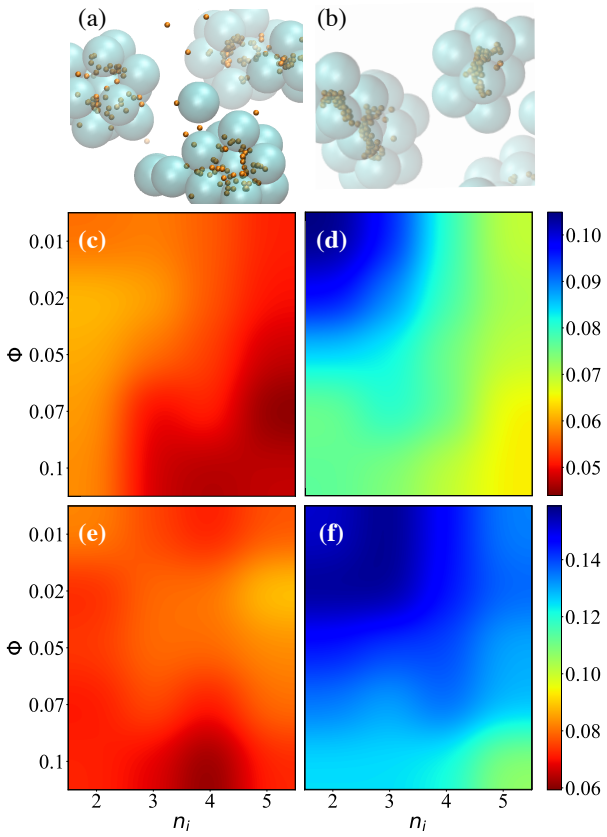
The central object is a two-species attractive Lennard-Jones mixture with pair potential $v(r)=v_0(r)+\lambda_{(i,n)}v_{\mathrm{att}}(r)$, where the dimensionless parameter $\lambda_{(i,n)}$ controls the attraction between ions and nanoparticles, self-interactions are set to zero, $q=R_n/r_i$ sets the size asymmetry, and $\phi$ sets the volume fraction. The segregation parameter $s$, the average distance between the centres of mass of ions and nanoparticles normalized by the cluster radius of gyration, diagnoses whether ions are internal (positive $s$) or exposed on the surface ($s\simeq 0$). The simulations show that $\lambda$ is the switch: weak cross-attraction gives low $s$, metastable elongated structures, and continued growth, while strong cross-attraction gives high $s$, compact segregated clusters, and arrested growth.
What would settle it
Measure the binding free energy of Co2+ and Ni2+ to the 3-MPS-functionalised silver nanoparticle surface, by isothermal titration calorimetry, surface plasmon resonance, or atomistic simulation, and compare the sign of the difference with the model's assignment; if Ni2+ binds more strongly than Co2+, the claimed mapping to the compact-versus-branched morphologies would not hold.
Extended reading notes
Core claim
The central claim is that the internal structure of the aggregates is dominated by the crossed ion/nanoparticle interaction strength, while the size ratio between ions and nanoparticles plays only a minor role. In simulations with the same volume fraction and ion count, changing the size ratio q from 5 to 10 has little effect on aggregate morphology, whereas changing the cross-interaction strength from 3 to 5 switches the system from branched, surface-exposed clusters that keep growing to compact, segregated clusters whose growth is arrested. The paper concludes that Co2+ corresponds to the strong-interaction, compact-cluster branch and Ni2+ to the weak-interaction, branched branch, and that this difference ultimately traces to the ions' hydration and water-exchange behavior rather than to ionic radius.
Load-bearing premise
The mapping of Co2+ to strong effective interaction and Ni2+ to weak effective interaction is assumed from water-exchange chemistry rather than measured, and the paper's Discussion contains a sentence attributing the stronger interaction to Ni2+, so if the true ordering of the interaction strengths is reversed the simulations no longer explain the difference between compact and branched aggregates.
Editorial extensions
If this is right
- A 60 percent change in the cross-interaction strength (from 3 to 5) changes the aggregate from branched with exposed ions to compact with segregated ions, so small changes in effective attraction can switch morphology.
- Doubling the size ratio q from 5 to 10 changes the mean aggregation number but barely changes the internal arrangement of ions, so nanoparticle size alone cannot explain the Co2+/Ni2+ difference.
- Clusters formed under strong interaction grow only weakly when ion concentration increases, matching the compact Co2+ behavior; clusters under weak interaction grow strongly with ion concentration, matching the branched Ni2+ behavior.
- Nanoparticle size q and coating-controlled interaction strength give two independent design dials: q controls aggregate size, and the interaction strength controls whether ions are buried and insulated from solution.
- Because ions in strong-interaction clusters are fully segregated inside, such nanoparticles act as efficient two-step filters that capture ions and can then be separated together with them.
Reading between the lines
- The same two-branch behavior would be expected for other divalent metal ions once their effective binding to a given coating is known: weakly binding ions should give branched, surface-exposed aggregates and strongly binding ions compact, ion-insulating clusters.
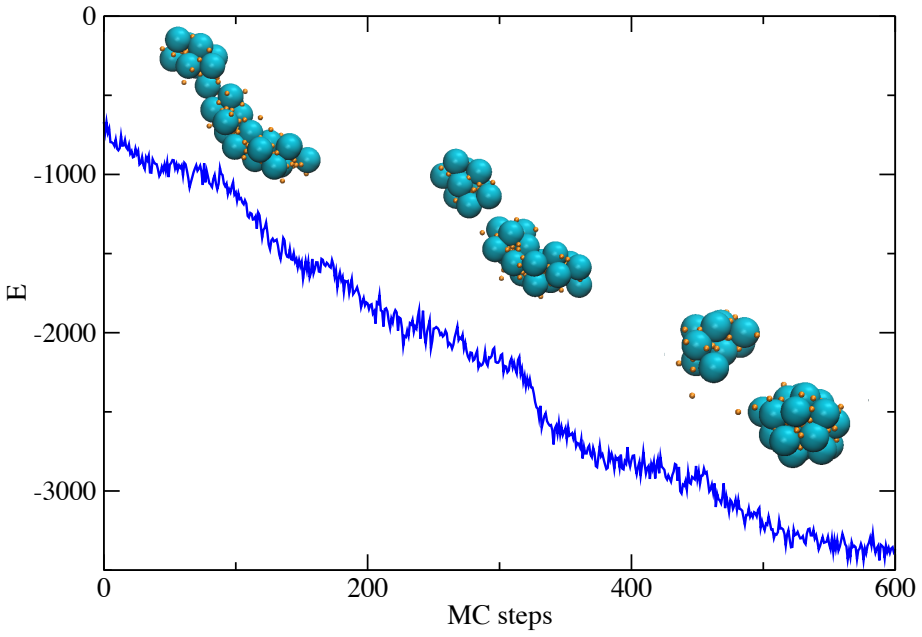
- The energy plots showing metastable elongated structures suggest the branched Ni2+-type aggregates are kinetic traps, so a testable extension is that prolonged annealing or gentle heating should convert them toward the compact morphology without changing the ion.
- Varying thiol grafting density to move the effective interaction across the transition region would both test the model and produce a library of coatings tuned to specific ions, turning the two-branch phase behavior into a practical adsorption design map.
Signed reviews
Editorial analysis
A structured set of objections, weighed in public.
Referee Report
Summary. The paper presents a coarse-grained Monte Carlo study of an asymmetric additive Lennard-Jones binary mixture that is intended to mimic silver nanoparticles (AgNPs) and divalent metal ions in water. The model has two key parameters: the size ratio q = Rn/ri and the cross-interaction strength λ that tunes the ion-nanoparticle attraction in Eq. (1), while same-species interactions are repulsive. The simulations scan q = 5 and 10, λ = 3 and 5, volume fractions φ ∈ [0.01, 0.1], and ion numbers ni = 600–1500. The central simulation result is that λ, not q, controls the internal structure of the aggregates: weak λ yields clusters with exposed ions and continued growth into branched/metastable structures, while strong λ yields compact clusters with ions encapsulated inside a nanoparticle shell, quantified by a segregation parameter s defined in Eq. (5). The authors compare these two regimes with the experimental TEM observation that AgNP/Co2+ forms compact micellar aggregates whereas AgNP/Ni2+ forms branched aggregates (Fig. 1), and they interpret the difference in terms of the different hydration and water-exchange properties of the two ions. They conclude that tuning λ (e.g., via grafting density) can serve as a design principle for optimal ion adsorbers.
Significance. If the central claim is sustained, the paper provides a simple and potentially useful design principle: the effective cross-interaction between nanoparticles and ions, rather than the size ratio, determines whether ions are exposed or encapsulated in self-assembled aggregates. The simulation study itself is systematic and internally consistent: the authors scan a reasonable parameter range, introduce a scalar segregation parameter to characterize morphology, and the dominant role of λ over q is clearly demonstrated within the model. The design prediction that λ can be controlled through nanoparticle functionalization is falsifiable and could guide future experiments. However, the explanatory step connecting the model to Co2+ and Ni2+ is not established: λ is not measured or independently computed for these ions, and the manuscript contains a sentence in the Discussion that directly contradicts the required assignment. As it stands, the simulations are hypothesis-generating: they show that different λ values produce the two observed morphologies, but they do not demonstrate that Co2+ and Ni2+ realize the corresponding λ values.
major comments (3)
- [Discussion] The sentence "The different water exchange rate appears to be responsible for the induction of a stronger effective interaction between AgNPs and Ni2+" directly contradicts the Conclusions, where "Branched clusters are formed by binary mixtures where the crossed interactions are weak" is applied to the experimental Ni2+ case. Since the experimental AgNP/Ni2+ system produces branched clusters (Fig. 1), the simulation-to-experiment mapping requires Ni2+ to be the weak-λ ion, not the strong-λ ion. This contradiction is load-bearing because the entire explanation of Fig. 1 rests on the direction of the λ assignment. Please correct the sentence or provide a consistent mapping, and state explicitly which ion is assigned to the strong-λ and weak-λ regimes.
- [Methods/Results] The parameter λ is a free parameter; the values λ = 3 and 5 are scanned but never connected to measurable properties of Co2+ or Ni2+ or to the functionalized AgNP surface. Without an independent estimate of λ for each ion, the comparison with experiment is a by-eye morphological match, and the claim that the simulations explain the experimental difference is underdetermined because either ion could be assigned to either λ regime. Please provide an order-of-magnitude estimate of λ from atomistic calculations, binding experiments, or a physical argument linking λ to water-exchange rates and surface chemistry.
- [Discussion] The comparison between simulation and experiment is only qualitative. The experimental data in Fig. 2 (plasmon shift Δλ and FWHM broadening vs ion concentration) are never quantitatively compared with simulation outputs such as mean aggregation number or cluster-size growth with ni. The text states only that the simulation trends are "similar" to the experimental ones. A quantitative comparison, for example the slope of aggregation number vs ni or a shape metric such as aspect ratio or fractal dimension of the simulated clusters, would be needed to substantiate the claim that the model reproduces the distinct growth behaviors of the Co2+ and Ni2+ systems.
minor comments (6)
- [Methods, Eq. (5)] The definition of the segregation parameter s is garbled. Please rewrite the expression with explicit sums, averages, and clear definitions of P(x), rn, ri, and Rc_g.
- [Methods, after Eq. (4)] The statement "for λ=0 we recover the full, generalised Lennard-Jones potential" appears to be the opposite of the model: with λ=0, v(r)=v0(r), which is the purely repulsive Weeks-Chandler-Andersen part, not the full LJ potential. If the full attractive potential is recovered at λ=1, please correct the statement.
- [Results/Discussion] The manuscript states that the hydrated radii of Co2+ and Ni2+ differ by about 20%, while the simulations compare q=5 and q=10, a factor of two. Please clarify how the simulated q range relates to the experimental q (approximately 12, given Rn~1.2 nm and ri~0.1 nm).
- [Figures 3 and 4] No error bars or independent runs are reported. Single-run data with spline interpolation cannot support the quantitative claims as strongly as they appear; please report statistical uncertainties or at least state the run-to-run variability.
- [Conclusions] The statement that "λ can be as well controlled by the grafting density of thiols onto the AgNPs" is presented without evidence. If this is speculative, please mark it as such or provide a supporting reference.
- [Figure 4 caption] The panel labels "(c), (e)" are repeated in the caption; please check the panel lettering and make the caption consistent with the figure panels.
Circularity Check
The simulation scan of λ and q is internally independent, but the paper's explanation of the Co2+/Ni2+ experimental difference rests on a post-hoc, internally contradicted assignment of ions to λ values.
-
fitted input called prediction
[Discussion, first paragraph; Conclusions, final paragraph]
"By comparing computational and experimental results, we can make a few hypotheses on what are the key parameters influencing the two different aggregation paths seen in Figure 1. ... The different water exchange rate appears to be responsible for the induction of a stronger effective interaction between AgNPs and Ni2+. ... Branched clusters are formed by binary mixtures where the crossed interactions are weak, so that ions remain on the surface of the clusters and do not get completely adsorbed by the nanoparticles."
The simulations show that λ=3 yields weak-segregation/branched clusters and λ=5 yields compact/segregated clusters. To claim these results explain the experiment, the paper must identify Co2+ with the strong-λ outcome and Ni2+ with the weak-λ outcome. That identification is not measured or computed; it is made after the experimental morphologies are known, so the 'computational predictions compared to experiments' is a post-hoc labeling rather than an independent test. The Discussion's own sentence assigning a stronger effective interaction to Ni2+ contradicts this required labeling, since branched Ni2+ clusters are elsewhere assigned to weak crossed interactions.
full rationale
The Monte Carlo scan is not circular by itself: q and λ are varied over a grid, not fitted to the target morphologies, and the finding that λ affects cluster internal structure more than q is a legitimate emergent result of the model. The circularity enters only in the explanatory step that maps the real ions onto the simulation parameters. The paper never independently determines whether Co2+ or Ni2+ corresponds to the strong or weak λ; the mapping is inferred after seeing that strong λ gives compact clusters and weak λ gives branched clusters, matching the known experimental morphologies. This is further undermined by the Discussion's explicit statement that Ni2+ induces a stronger effective interaction, which contradicts the Conclusions' assignment of branched Ni2+ clusters to weak crossed interactions. Therefore the claimed prediction of the Co2+/Ni2+ morphological difference reduces to a post-hoc assignment, even though the underlying simulation study has independent content. The circularity score is accordingly moderate: the simulation is self-contained, but the central comparative claim is partly constructed to match the experimental outcome.
Assumptions & free parameters
free parameters (4)
- lambda (cross interaction strength) =
3 and 5 (scanned)
- q (size ratio Rn/ri) =
5 and 10 (scanned)
- volume fraction phi =
0.01 to 0.1 (scanned)
- ion count ni =
600, 900, 1200, 1500
assumptions (5)
- domain assumption The experimental AgNP/ion mixtures can be represented as additive asymmetric Lennard-Jones binary mixtures with isotropic, pairwise additive interactions and implicit solvent.
- domain assumption Cross-species attraction is the only attractive channel; identical species interact purely repulsively (lambda_ii = lambda_nn = 0).
- ad hoc to paper Differences in water exchange rates between Co2+ and Ni2+ map to a difference in the effective cross-interaction lambda in the direction assumed.
- domain assumption Hydrated ionic radii differ by about 20%, captured by q=5 versus q=10.
- domain assumption NVT Monte Carlo with Nn=300 and ni up to 1500 and the chosen number of MC steps yields equilibrium aggregates representative of the experimental process.
Cite this review
Pith. "Pith review of Designing an Optimal Ion Adsorber at the Nanoscale: The Unusual Nucleation of AgNP/Co$^{2+}$ -- Ni$^{2+}$ Binary Mixtures." pith.science (2026). https://pith.science/paper/RSYGPGTN
@misc{pith2026190801184,
  author       = {Pith},
  title        = {Pith review of: Designing an Optimal Ion Adsorber at the Nanoscale: The Unusual Nucleation of AgNP/Co$^2+$ -- Ni$^2+$ Binary Mixtures},
  year         = {2026},
  howpublished = {\url{https://pith.science/paper/RSYGPGTN}},
  note         = {Machine review of arXiv:1908.01184}
}
abstract
Selective removal of heavy metals from water is a complex topic. We present a theoretical computational approach, supported by experimental evidences, to design a functionalized nanomaterial that is able to selectively capture metallic ions from water in a self-assembling process. A theoretical model is used to map an experimental mixture of Ag nanoparticles and either Co$^{2+}$ or Ni$^{2+}$ onto an additive highly asymmetric attractive Lennard Jones binary mixture. Extensive NVT (constant number of particles, volume, and temperature) Monte Carlo simulations are performed to derive a set of parameters that first induce aggregation among the two species in solution and then affect the morphology of the aggregates. The computational predictions are thus compared with the experimental results. The gathered insights can be used as guidelines for the prediction of an optimal design of a new generation of selective nanoparticles to be used for metallic ion adsorption and hence for maximizing the trapping of ions in an aqueous solution.
Figures


Figures from the paper (2 more)
Reference graph
Works this paper leans on
-
[1]
(1) Rajaganapathy, V.; Xavier, F.; Sreekumar, D.; Mandal, P. Heavy Metal Contamination in Soil, Water and Fodder and their Presence in Livestock and Products : A Review. Journal of Environmental Science and Technology 2011, 4, 234–249. (2) Jarup, L. Impact of environmental pollution on health: balancing risk. Br. Med. Bull. 2003, 68, 167–182. (3) Pedrero,...
work page 2011
-
[5]
Gibbs free energy of hydration at 298.15 K. J. Chem. Soc., Faraday Trans. 1991, 87, 2995–2999. (26) Huissmann, S.; Blaak, R.; Likos, C. N. Star Polymers in Solvents of Varying Quality. Macromolecules 2009, 42, 2806–2816. (27) Tang, J.; Wu, P.; Hou, X.; Xu, K. Modification-free and N-acetyl-L-cysteine-induced colorimetric response of AuNPs: A mechanistic st...
work page 1991
-
[190]
17 (14) Ramezanzadeh, M.; Asghari, M.; Ramezanzadeh, B.; Bahlakeh, G. Fabrication of an efficient system for Zn ions removal from industrial wastewater based on graphene oxide nanosheets decorated with highly crystalline polyaniline nanofibers (GO-PANI): Exper- imental and ab initio quantum mechanics approaches. Chemical Engineering Journal 2018, 337, 385 –
work page 2018
-
[302]
(10) Lou, T.; Chen, Z.; Wang, Y.; Chen, L. Blue-to-Red Colorimetric Sensing Strategy for Hg2+ and Ag + via Redox-Regulated Surface Chemistry of Gold Nanoparticles. ACS Applied Materials & Interfaces 2011, 3, 1568–1573, PMID: 21469714. (11) Fu, X.; Lou, T.; Chen, Z.; Lin, M.; Feng, W.; Chen, L. “Turn-on” Fluorescence Detec- tion of Lead Ions Based on Accel...
work page 2011
-
[306]
Plas- monic Sensor Based on Interaction between Silver Nanoparticles and Ni 2+ or Co 2+ in Water
18 (22) Mochi, F.; Burratti, L.; Fratoddi, I.; Venditti, I.; Battocchio, C.; Carlini, L.; Iucci, G.; Casalboni, M.; De Matteis, F.; Casciardi, S.; Nappini, S.; Pis, I.; Prosposito, P. Plas- monic Sensor Based on Interaction between Silver Nanoparticles and Ni 2+ or Co 2+ in Water. Nanomaterials 2018, 8,
work page 2018
-
[397]
(15) Chen, L.; Fu, X.; Lu, W.; Chen, L. Highly Sensitive and Selective Colorimetric Sens- ing of Hg 2+ Based on the Morphology Transition of Silver Nanoprisms. ACS Applied Materials & Interfaces 2013, 5, 284–290, PMID: 23237272. (16) Ratnarathorn, N.; Chailapakul, O.; Dungchai, W. Highly sensitive colorimetric detec- tion of lead using maleic acid functio...
work page 2013
-
[488]
(23) Prosposito, P.; Mochi, F.; Ciotta, E.; Casalboni, M.; De Matteis, F.; Venditti, I.; Fontana, L.; Testa, G.; Fratoddi, I. Hydrophilic silver nanoparticles with tunable op- tical properties: application for the detection of heavy metals in water. Beilstein J. Nanotechnol. 2016, 7,
work page 2016
-
[618]
Fenton-like Reaction-Mediated Etching of Gold Nanorods for Visual Detection of Co2+
(17) Zhang, Z.; Chen, Z.; Pan, D.; Chen, L. Fenton-like Reaction-Mediated Etching of Gold Nanorods for Visual Detection of Co2+. Langmuir 2015, 31, 643–650, PMID: 25486441. (18) Zhang, Z.; Zhang, J.; Lou, T.; Pan, D.; Chen, L.; Qu, C.; Chen, Z. Label-free colori- metric sensing of cobalt(ii) based on inducing aggregation of thiosulfate stabilized gold nan...
work page 2015
Show all 12 references
-
[1654]
(24) Shannon, R. D. Revised effective ionic radii and systematic studies of interatomic dis- tances in halides and chalcogenides. Acta Cryst. 1976, A32,
1976
-
[1901]
(32) Flett, D. S. Cobalt-Nickel Separation in Hydrometallurgy: a Review. Chemistry for Sustainable Development 2004, 12,
2004
-
[2614]
(8) Priyadarshini, E.; Pradhan, Gold nanoparticles as efficient sensors in colorimetric de- tection of toxic metal ions: A review. Sens. Actuators B Chem. 2017, 238, 888–902. (9) Dinh, V.-P.; Le, N.-C.; Tuyen, L. A.; Hung, N. Q.; Nguyen, V.-D.; Nguyen, N.-T. Insight into adsorpt...
2017
-
[8982]
K.; Polley, N.; Chakrabarti, S.; Lemmens, P.; Pal, S
(20) Sarkar, P. K.; Polley, N.; Chakrabarti, S.; Lemmens, P.; Pal, S. K. Nanosurface Energy Transfer Based Highly Selective and Ultrasensitive ‘‘Turn on” Fluorescence Mercury Sensor. ACS Sensors 2016, 1, 789–797. (21) Feng, J.; Jin, W.; Huang, P.; Wu, F. Highly selective color...
2016
Reviewed August 14, 2026 · model on record in the stance chip above.
Discussion (0). Continue with ORCID to comment.