REVIEW 4 major objections 6 minor 38 references
STR-Match: Matching SpatioTemporal Relevance Score for Training-Free Video Editing
T0 review · 4 major / 6 minor · reviewed 2026-08-06 · deepseek-v4-flash
Pith's one-line read STR-Match claims that matching a spatiotemporal relevance score extracted from self- and temporal-attention maps of a T2V diffusion model, via latent optimization, yields state-of-the-art training-free video editing with temporal…
desk verdict Solid training-free video editing method with a genuinely new attention score, but the empirical evidence is thinner than the claims; worth peer review. read the letter →
The pith
A machine-rendered reading of the paper's core claim, the machinery that carries it, and where it could break.
The reading
What carries the argument
The STR score: for pixels p, q in frames i, j, directional relevance g(Ii(p) → Ij(q)) = Attn(Ii(p) → Ij(p))·Attn(Ij(p) → Ij(q)) + Attn(Ii(p) → Ii(q))·Attn(Ii(q) → Ij(q)), combining temporal attention along the same pixel position with spatial self-attention inside each frame; bidirectional relevance sums both directions, and the STR score aggregates across neighboring frames. This quantity is then matched between source and target by gradient descent on the latent, which is the load-bearing optimization target.
What would settle it
Measure the correlation between LaVie's temporal-attention maps and optical flow (RAFT) on videos with large object deformation; if the maps do not point along the flow, the STR score cannot be tracking motion. Additionally, randomizing or zeroing the temporal-attention maps during optimization should destroy motion preservation if the mechanism is load-bearing.
Extended reading notes
Core claim
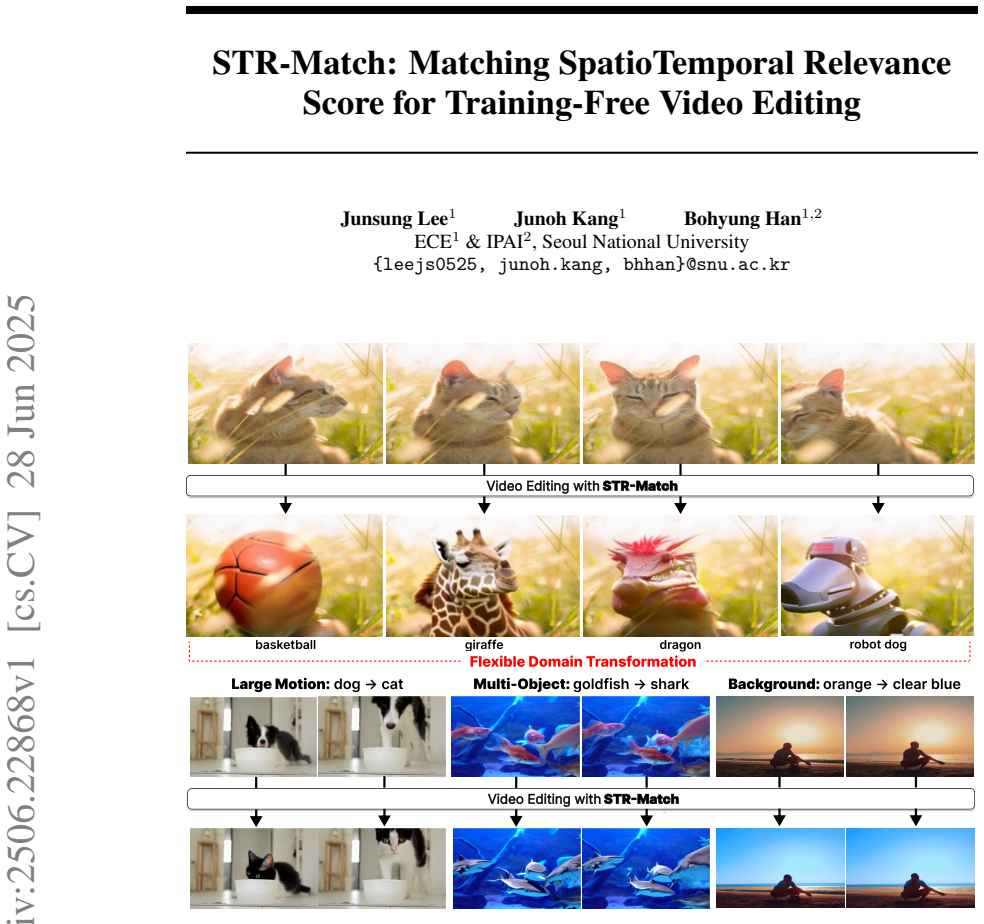
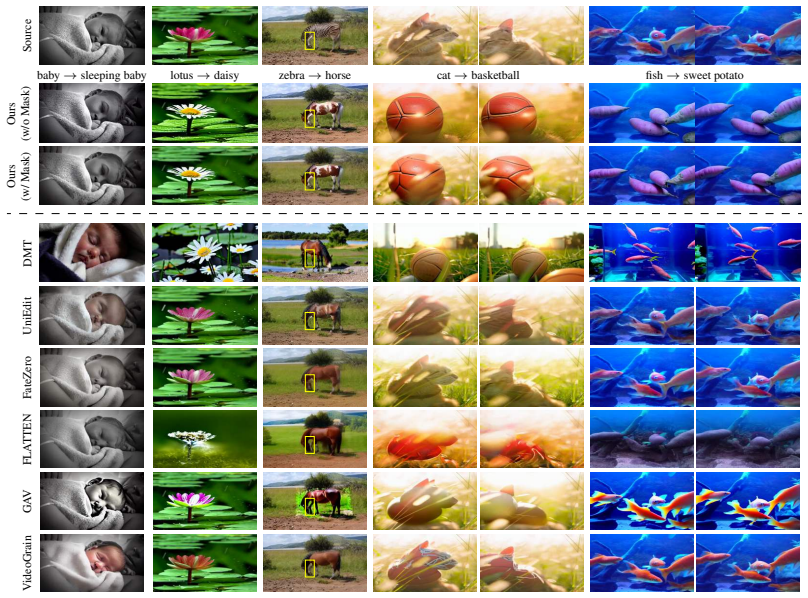
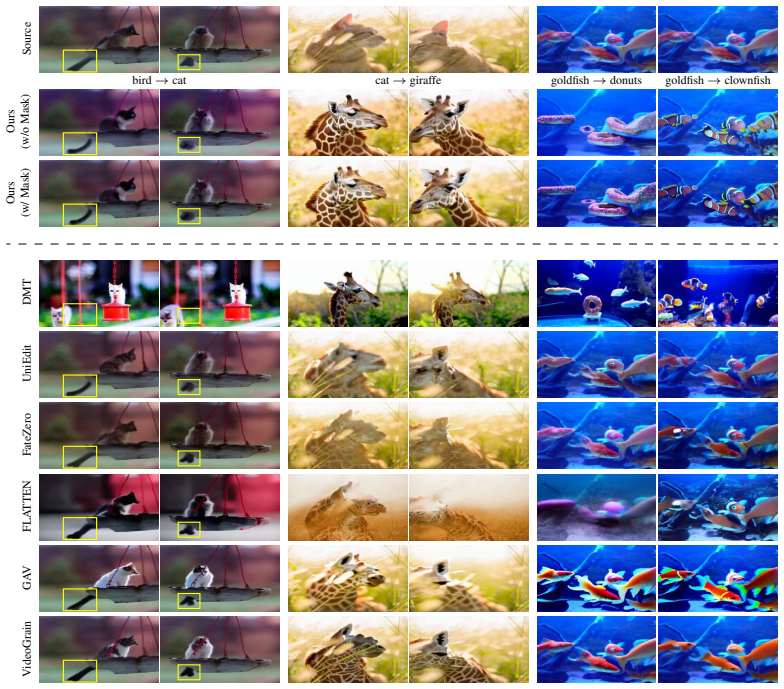
STR-Match's central claim is that the product-like combination of self- and temporal-attention maps—the STR score—summarizes spatiotemporal pixel relevance well enough to guide latent optimization: the target latent is stepped so that the negative cosine similarity between source and target STR scores decreases at every denoising timestep. Starting from the source noisy latent and optionally mixing in the source latent where a mask says nothing should change, this produces edited videos that keep the source's motion and background while letting the object's shape and identity change drastically, e.g., cat to basketball or fish to sweet potato. The paper reports that this outperforms existing training-free methods on frame consistency, CLIP fidelity, background preservation, and motion error, with the mask-free version already beating prior T2V-based optimizers on most metrics.
Load-bearing premise
The method assumes the 1D temporal attention maps in the pretrained T2V model encode trustworthy inter-frame pixel correspondences at the same spatial location, so that matching them actually preserves motion; if those maps are noisy or semantically shallow under large shape changes, the STR score is a poor optimization target.
Editorial extensions
If this is right
- Any T2V model with temporal modules (e.g., LaVie, Zeroscope) can adopt STR-Match without retraining, as demonstrated on Zeroscope.
- Because the score is built from attention maps, the method is compatible with mask-based localization, preserving background exactly when a mask is available.
- The method removes the need for 3D attention or external optical-flow models for consistency, cutting the memory and engineering overhead of prior editing pipelines.
- STR-Match reports the strongest background-preservation (BG-LPIPS) and motion-error numbers among T2V-based editing baselines when combined with the mask.
- It establishes the STR score as an alternative to direct attention-map concatenation for guidance, being more flexible and producing higher fidelity under large shape changes.
Reading between the lines
- The STR score could be inverted or visualized to localize which pixels the model considers motion-relevant, potentially serving as an interpretability tool for T2V models.
- One could test whether the same score transfers to image editing or to source and target videos from different base prompts, since the score only needs attention maps.
- A likely failure mode the paper notes is editing multiple objects simultaneously or when object size changes significantly; a natural extension is to add per-object masks or scale-adaptive normalization to the score.
- Since the score is computed from attention maps that are not always retained by newer models with 3D attention (e.g., CogVideoX), STR-Match as presented is tied to older T2V architectures, which may limit its shelf life unless attention maps are re-exposed.
Editorial analysis
A structured set of objections, weighed in public.
Referee Report
Summary. The paper proposes STR-Match, a training-free video editing method built on the pretrained T2V model LaVie. It defines an STR score that multiplicatively combines spatial self-attention and temporal attention maps, and during latent optimization maximizes cosine similarity between the source and target STR scores (Eq. 5). An optional latent mask blends source latents into background regions (Eq. 6). The method is evaluated on 54 videos against six training-free baselines using frame consistency, CLIP similarity, background LPIPS, and motion error. The paper claims consistent improvements in visual quality and spatiotemporal consistency, especially under large domain shifts.
Significance. If the central mechanism is validated, STR-Match is a simple and useful contribution: it requires no training, no 3D attention, and is presented as applicable to any T2V model with temporal modules. The algorithm is clearly described with pseudocode (Algorithm 1), and the qualitative results, particularly for large-shape and large-domain edits, are visually interesting. The paper also includes an ablation on the guidance strength lambda and a qualitative demonstration on Zeroscope, which strengthen the presentation. However, the quantitative support is currently inconclusive: the reported advantages over baselines are small and sometimes negative, no error bars or repeated runs are given, and the core assumption about temporal attention maps is not independently validated. The significance therefore depends on whether the identified weaknesses can be addressed with additional analysis.
major comments (4)
- [Section 3, Eq. (2)] The central mechanism assumes that elements of the 1D temporal attention map, Attn(Ii(p) -> Ij(p)), encode meaningful inter-frame pixel correspondences at the same spatial location. This premise is asserted but never validated. The paper provides no visualization of these maps, no comparison with optical flow or tracking, and no analysis of what they capture under large shape changes or significant domain shifts. If the maps are noisy, semantically shallow, or dominated by static cues, the STR score is a poor optimization target and the core mechanism loses its justification. Please provide direct evidence that these attention values correspond to real pixel-level motion or correspondence, or at least an analysis of failure cases.
- [Section 4.2, Eq. (5)] The optimization objective is a single scalar cosine similarity between the entire source and target STR tensors. Because the STR score aggregates relevance over all spatial locations and neighboring frames, the scalar similarity can be dominated by large static background regions. High cosine similarity could then be achieved trivially by aligning background statistics while leaving object-level spatiotemporal correspondences misaligned. The paper does not report per-region or per-object analysis, nor does it discuss why the scalar pooling is not diluted by background dominance. Please add an experiment or analysis that shows the matching loss actually aligns object-level relevance, rather than global statistics.
- [Section 5.3, Table 3] The abstract and Section 5.3 claim that STR-Match 'consistently outperforms' existing methods, but Table 3 shows that DMT has higher CLIP similarity (31.94 vs. 31.68) and VideoGrain has lower background LPIPS (0.062 vs. 0.103) than the best STR-Match variant. In addition, no error bars, significance tests, or repeated runs are reported, and the evaluation set is only 54 videos. The limitation statement in Appendix B further states that 'these metrics are incomplete and often fail to reflect the true quality of videos.' This combination means the quantitative claims are not supported as stated. Please either soften the claims to match the evidence or provide statistical support and a more thorough evaluation protocol.
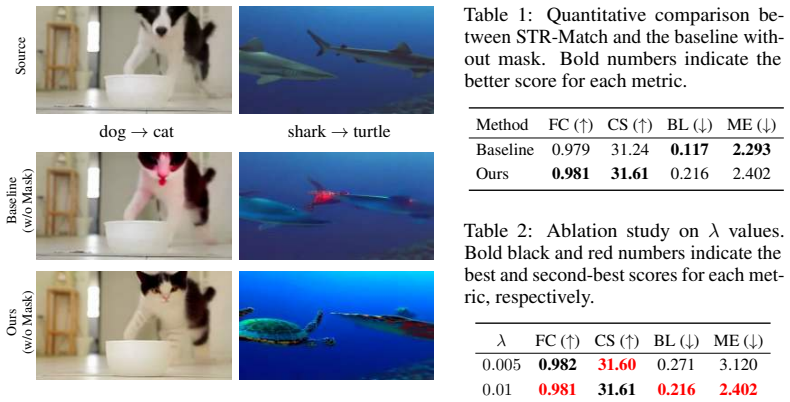
- [Section 5.4, Table 1 and Eq. (6)] The ablation does not isolate the contribution of the STR score. The 'with mask' variant uses source-latent mixing in Eq. (6), which independently improves background and motion preservation; its leading BL (0.103) and ME (1.932) scores therefore do not specifically validate the STR loss. The sole ablation comparing STR-Match to the concatenation baseline (Table 1) actually shows the baseline is better on BL (0.117 vs. 0.216) and ME (2.293 vs. 2.402), with only marginal FC and CS gains of 0.002 and 0.37, and no repeated runs or error bars. To support the claim that the STR score is the source of improvement, please provide an ablation that holds the mask strategy fixed and varies only the optimization target, with multiple runs and variance reporting.
minor comments (6)
- [Abstract and Section 5.3] The phrase 'consistently outperforms' is too strong given the mixed metric values in Table 3; consider replacing it with a more nuanced summary of the results.
- [Section 4.1 and Algorithm 1] The dilation function in Eq. (6) is referenced but not defined; please specify the dilation kernel and whether it is applied in latent or image space.
- [Section 5.4, Table 2] The text says smaller lambda values yield higher fidelity (FC, CS), but Table 2 shows lambda=0.005 has FC 0.982 and CS 31.60 while lambda=0.01 has FC 0.981 and CS 31.61; the relationship is not monotonic. Please clarify or revise the interpretation.
- [Appendix A.2] The Zeroscope generalization result is only qualitative; adding at least one quantitative comparison would strengthen the claim of model agnosticism.
- [Throughout] There are several typos and stylistic issues, including 'addtional', 'predifined', 'fatihfulness', 'quantitavely', and 'transformatiomn' in the conclusion. These should be corrected.
- [Section 5.1] No code or evaluation dataset is provided; releasing the code and the 54-video benchmark would substantially improve reproducibility, especially because the evaluation set includes internet videos that may not be publicly listed.
Circularity Check
No significant circularity: the STR score is an ad hoc, training-free construction from attention maps, not a fitted quantity, and the derivation does not reduce to its inputs.
full rationale
The paper's load-bearing step is Eq. (5), where the target latent is optimized against a cosine loss between source and target STR scores (Eqs. 2-4). The STR score is defined directly from LaVie's self- and temporal-attention outputs; it is not fit to the evaluation metrics or to the edited videos. The objective is a regularizer, not a prediction, so there is no fitted-input-called-prediction reduction. The sole ablation (Table 1) compares STR matching with a concatenation baseline; while the baseline is better on BL and ME, this is a fairness or attribution issue, not a circular step. The two self-citations ([8] and [11]) appear in a list of alternative image-editing approaches and are not load-bearing: no uniqueness theorem or prior premise is imported from them to justify STR-Match. Quantitative evaluation is conducted against external benchmarks (TGVE dataset, VBench FC, CLIP similarity, LPIPS, RAFT motion error), so the central claim is falsifiable outside the paper's own construction. The unvalidated assumption that 1D temporal attention maps encode useful inter-frame correspondences is an empirical premise, not a circular one; it may be a correctness or evidence risk, but it does not make the derivation equivalent to its inputs.
Assumptions & free parameters
free parameters (2)
- guidance strength lambda =
0.01, with range [0.005, 0.015] for selected qualitative cases
- ablation L2 loss weight =
0.08
assumptions (3)
- domain assumption Self-attention and temporal-attention maps of a pretrained T2V model reliably encode per-pixel semantic and inter-frame relevance.
- ad hoc to paper Equation 2 is a faithful directional relevance measure: Attn(Ii(p) -> Ij(p)) * Attn(Ij(p) -> Ij(q)) + Attn(Ii(p) -> Ii(q)) * Attn(Ii(q) -> Ij(q)).
- ad hoc to paper Matching cosine similarity of STR scores between source and target latents preserves source motion while allowing appearance change.
invented entities (1)
-
STR score Omega_STR
Cite this review
Pith. "Pith review of STR-Match: Matching SpatioTemporal Relevance Score for Training-Free Video Editing." pith.science (2026). https://pith.science/paper/RTSIOFLW
@misc{pith2026250622868,
  author       = {Pith},
  title        = {Pith review of: STR-Match: Matching SpatioTemporal Relevance Score for Training-Free Video Editing},
  year         = {2026},
  howpublished = {\url{https://pith.science/paper/RTSIOFLW}},
  note         = {Machine review of arXiv:2506.22868}
}
read the original abstract
Previous text-guided video editing methods often suffer from temporal inconsistency, motion distortion, and-most notably-limited domain transformation. We attribute these limitations to insufficient modeling of spatiotemporal pixel relevance during the editing process. To address this, we propose STR-Match, a training-free video editing algorithm that produces visually appealing and spatiotemporally coherent videos through latent optimization guided by our novel STR score. The score captures spatiotemporal pixel relevance across adjacent frames by leveraging 2D spatial attention and 1D temporal modules in text-to-video (T2V) diffusion models, without the overhead of computationally expensive 3D attention mechanisms. Integrated into a latent optimization framework with a latent mask, STR-Match generates temporally consistent and visually faithful videos, maintaining strong performance even under significant domain transformations while preserving key visual attributes of the source. Extensive experiments demonstrate that STR-Match consistently outperforms existing methods in both visual quality and spatiotemporal consistency.
Figures


Figures from the paper (6 more)



Reference graph
Works this paper leans on
-
[1]
Denoising diffusion probabilistic models
Jonathan Ho, Ajay Jain, and Pieter Abbeel. Denoising diffusion probabilistic models. In NeurIPS, 2020. 9
work page 2020
-
[2]
Denoising diffusion implicit models
Jiaming Song, Chenlin Meng, and Stefano Ermon. Denoising diffusion implicit models. In ICLR, 2021
2021
-
[3]
Score-based generative modeling through stochastic differential equations
Yang Song, Jascha Sohl-Dickstein, Diederik P Kingma, Abhishek Kumar, Stefano Ermon, and Ben Poole. Score-based generative modeling through stochastic differential equations. In ICLR, 2021
2021
-
[4]
Masactrl: Tuning-free mutual self-attention control for consistent image synthesis and editing
Mingdeng Cao, Xintao Wang, Zhongang Qi, Ying Shan, Xiaohu Qie, and Yinqiang Zheng. Masactrl: Tuning-free mutual self-attention control for consistent image synthesis and editing. In ICCV, 2023
work page 2023
-
[5]
Prompt-to-prompt image editing with cross attention control
Amir Hertz, Ron Mokady, Jay Tenenbaum, Kfir Aberman, Yael Pritch, and Daniel Cohen-Or. Prompt-to-prompt image editing with cross attention control. In ICLR, 2023
2023
-
[6]
Plug-and-play diffusion features for text-driven image-to-image translation
Narek Tumanyan, Michal Geyer, Shai Bagon, and Tali Dekel. Plug-and-play diffusion features for text-driven image-to-image translation. In CVPR, 2023
2023
-
[7]
Zero-shot image-to-image translation
Gaurav Parmar, Krishna Kumar Singh, Richard Zhang, Yijun Li, Jingwan Lu, and Jun-Yan Zhu. Zero-shot image-to-image translation. In SIGGRAPH, 2023
work page 2023
-
[8]
Diffusion-based conditional image editing through optimized inference with guidance
Hyunsoo Lee, Minsoo Kang, and Bohyung Han. Diffusion-based conditional image editing through optimized inference with guidance. In WACV, 2025
work page 2025
Show all 38 references
-
[9]
Contrastive learning guided latent diffusion model for image-to-image translation
Qi Si, Bo Wang, and Zhao Zhang. Contrastive learning guided latent diffusion model for image-to-image translation. arXiv preprint arXiv:2503.20484, 2025
2025 arXiv
-
[10]
Imagic: Text-based real image editing with diffusion models
Bahjat Kawar, Shiran Zada, Oran Lang, Omer Tov, Huiwen Chang, Tali Dekel, Inbar Mosseri, and Michal Irani. Imagic: Text-based real image editing with diffusion models. In CVPR, 2023
2023
-
[11]
Diffusion-based image-to-image translation by noise correction via prompt interpolation
Junsung Lee, Minsoo Kang, and Bohyung Han. Diffusion-based image-to-image translation by noise correction via prompt interpolation. In ECCV, 2024
2024
-
[12]
Fatezero: Fusing attentions for zero-shot text-based video editing
Chenyang Qi, Xiaodong Cun, Yong Zhang, Chenyang Lei, Xintao Wang, Ying Shan, and Qifeng Chen. Fatezero: Fusing attentions for zero-shot text-based video editing. In ICCV, 2023
2023
-
[13]
Ground-a-video: Zero-shot grounded video editing using text-to-image diffusion models
Hyeonho Jeong and Jong Chul Ye. Ground-a-video: Zero-shot grounded video editing using text-to-image diffusion models. In ICLR, 2024
2024
-
[14]
Flatten: Optical flow-guided attention for consistent text-to-video editing
Yuren Cong, Mengmeng Xu, Christian Simon, Shoufa Chen, Jiawei Ren, Yanping Xie, Juan- Manuel Perez-Rua, Bodo Rosenhahn, Tao Xiang, and Sen He. Flatten: Optical flow-guided attention for consistent text-to-video editing. In ICLR, 2024
2024
-
[15]
Videograin: Modulating space-time attention for multi-grained video editing
Xiangpeng Yang, Linchao Zhu, Hehe Fan, and Yi Yang. Videograin: Modulating space-time attention for multi-grained video editing. In ICLR, 2025
2025
-
[16]
Motionflow: Attention-driven motion transfer in video diffusion models
Tuna Han Salih Meral, Hidir Yesiltepe, Connor Dunlop, and Pinar Yanardag. Motionflow: Attention-driven motion transfer in video diffusion models. arXiv preprint arXiv:2412.05275, 2024
2024 arXiv
-
[17]
Space-time diffusion features for zero-shot text-driven motion transfer
Danah Yatim, Rafail Fridman, Omer Bar-Tal, Yoni Kasten, and Tali Dekel. Space-time diffusion features for zero-shot text-driven motion transfer. In CVPR, 2024
2024
-
[18]
Training-free motion-guided video generation with enhanced temporal consistency using motion consistency loss
Xinyu Zhang, Zicheng Duan, Dong Gong, and Lingqiao Liu. Training-free motion-guided video generation with enhanced temporal consistency using motion consistency loss. arXiv preprint arXiv:2501.07563, 2025
2025 arXiv
-
[19]
Uniedit: A unified tuning-free framework for video motion and appearance editing
Jianhong Bai, Tianyu He, Yuchi Wang, Junliang Guo, Haoji Hu, Zuozhu Liu, and Jiang Bian. Uniedit: A unified tuning-free framework for video motion and appearance editing. arXiv preprint arXiv:2402.13185, 2024
2024 arXiv
-
[20]
Videocrafter2: Overcoming data limitations for high-quality video diffusion models
Haoxin Chen, Yong Zhang, Xiaodong Cun, Menghan Xia, Xintao Wang, Chao Weng, and Ying Shan. Videocrafter2: Overcoming data limitations for high-quality video diffusion models. In CVPR, 2024. 10
2024
-
[21]
Lavie: High-quality video generation with cascaded latent diffusion models
Yaohui Wang, Xinyuan Chen, Xin Ma, Shangchen Zhou, Ziqi Huang, Yi Wang, Ceyuan Yang, Yinan He, Jiashuo Yu, Peiqing Yang, et al. Lavie: High-quality video generation with cascaded latent diffusion models. In IJCV, 2024
2024
-
[22]
xformers: A modular and hack- able transformer modelling library
Benjamin Lefaudeux, Francisco Massa, Diana Liskovich, Wenhan Xiong, Vittorio Caggiano, Sean Naren, Min Xu, Jieru Hu, Marta Tintore, Susan Zhang, Patrick Labatut, Daniel Haziza, Luca Wehrstedt, Jeremy Reizenstein, and Grigory Sizov. xformers: A modular and hack- able transforme...
2022
-
[23]
Flashattention: Fast and memory-efficient exact attention with io-awareness
Tri Dao, Dan Fu, Stefano Ermon, Atri Rudra, and Christopher Ré. Flashattention: Fast and memory-efficient exact attention with io-awareness. In NeurIPS, 2022
2022
-
[24]
Cogvideox: Text-to-video diffusion models with an expert transformer
Zhuoyi Yang, Jiayan Teng, Wendi Zheng, Ming Ding, Shiyu Huang, Jiazheng Xu, Yuanming Yang, Wenyi Hong, Xiaohan Zhang, Guanyu Feng, et al. Cogvideox: Text-to-video diffusion models with an expert transformer. In ICLR, 2025
2025
-
[25]
Open-sora 2.0: Training a commercial-level video generation model in $200k
Xiangyu Peng, Zangwei Zheng, Chenhui Shen, Tom Young, Xinying Guo, Binluo Wang, Hang Xu, Hongxin Liu, Mingyan Jiang, Wenjun Li, et al. Open-sora 2.0: Training a commercial-level video generation model in $200k. arXiv preprint arXiv:2503.09642, 2025
2025 arXiv
-
[26]
Gligen: Open-set grounded text-to-image generation
Yuheng Li, Haotian Liu, Qingyang Wu, Fangzhou Mu, Jianwei Yang, Jianfeng Gao, Chunyuan Li, and Yong Jae Lee. Gligen: Open-set grounded text-to-image generation. In CVPR, 2023
2023
-
[27]
Raft: Recurrent all-pairs field transforms for optical flow
Zachary Teed and Jia Deng. Raft: Recurrent all-pairs field transforms for optical flow. In ECCV, 2020
2020
-
[28]
Zoedepth: Zero-shot transfer by combining relative and metric depth
Shariq Farooq Bhat, Reiner Birkl, Diana Wofk, Peter Wonka, and Matthias Müller. Zoedepth: Zero-shot transfer by combining relative and metric depth. arXiv preprint arXiv:2302.12288, 2023
2023 arXiv
-
[29]
Adding conditional control to text-to-image diffusion models
Lvmin Zhang, Anyi Rao, and Maneesh Agrawala. Adding conditional control to text-to-image diffusion models. In ICCV, 2023
2023
-
[30]
Segment and track anything
Yangming Cheng, Liulei Li, Yuanyou Xu, Xiaodi Li, Zongxin Yang, Wenguan Wang, and Yi Yang. Segment and track anything. arXiv preprint arXiv:2305.06558, 2023
2023 arXiv
-
[31]
Simple open-vocabulary object detection
Matthias Minderer, Alexey Gritsenko, Austin Stone, Maxim Neumann, Dirk Weissenborn, Alexey Dosovitskiy, Aravindh Mahendran, Anurag Arnab, Mostafa Dehghani, Zhuoran Shen, et al. Simple open-vocabulary object detection. In ECCV, 2022
2022
-
[32]
Classifier-free diffusion guidance
Jonathan Ho and Tim Salimans. Classifier-free diffusion guidance. In NeurIPS Workshop, 2021
2021
-
[33]
Cvpr 2023 text guided video editing competition
Jay Zhangjie Wu, Xiuyu Li, Difei Gao, Zhen Dong, Jinbin Bai, Aishani Singh, Xiaoyu Xiang, Youzeng Li, Zuwei Huang, Yuanxi Sun, et al. Cvpr 2023 text guided video editing competition. arXiv preprint arXiv:2310.16003, 2023
2023 arXiv
-
[34]
Videollama 3: Frontier multimodal foundation models for image and video understanding
Boqiang Zhang, Kehan Li, Zesen Cheng, Zhiqiang Hu, Yuqian Yuan, Guanzheng Chen, Sicong Leng, Yuming Jiang, Hang Zhang, Xin Li, et al. Videollama 3: Frontier multimodal foundation models for image and video understanding. arXiv preprint arXiv:2501.13106, 2025
2025 arXiv
-
[35]
Vbench: Comprehensive benchmark suite for video generative models
Ziqi Huang, Yinan He, Jiashuo Yu, Fan Zhang, Chenyang Si, Yuming Jiang, Yuanhan Zhang, Tianxing Wu, Qingyang Jin, Nattapol Chanpaisit, et al. Vbench: Comprehensive benchmark suite for video generative models. In CVPR, 2024
2024
-
[36]
Amt: All-pairs multi-field transforms for efficient frame interpolation
Zhen Li, Zuo-Liang Zhu, Ling-Hao Han, Qibin Hou, Chun-Le Guo, and Ming-Ming Cheng. Amt: All-pairs multi-field transforms for efficient frame interpolation. In CVPR, 2023
2023
-
[37]
Clipscore: A reference-free evaluation metric for image captioning
Jack Hessel, Ari Holtzman, Maxwell Forbes, Ronan Le Bras, and Yejin Choi. Clipscore: A reference-free evaluation metric for image captioning. In EMNLP, 2021
2021
-
[38]
The unreason- able effectiveness of deep features as a perceptual metric
Richard Zhang, Phillip Isola, Alexei A Efros, Eli Shechtman, and Oliver Wang. The unreason- able effectiveness of deep features as a perceptual metric. In CVPR, 2018. 11 Appendix A Qualitative results A.1 Additional comparisons with other methods We provide video files on our ...
2018
Reviewed August 6, 2026 · model on record in the stance chip above.
Discussion (0). Sign in to comment.