Quantum Reservoir Computing for Short-Term Power Load Forecasting in Resource-Constrained Energy Systems
Pith reviewed 2026-06-27 06:53 UTC · model grok-4.3
The pith
A 6-bit quantized readout in fixed quantum reservoir computing matches full-precision accuracy on energy load forecasts while cutting memory use by 81.2%.
A machine-rendered reading of the paper's core claim, the machinery that carries it, and where it could break.
Core claim
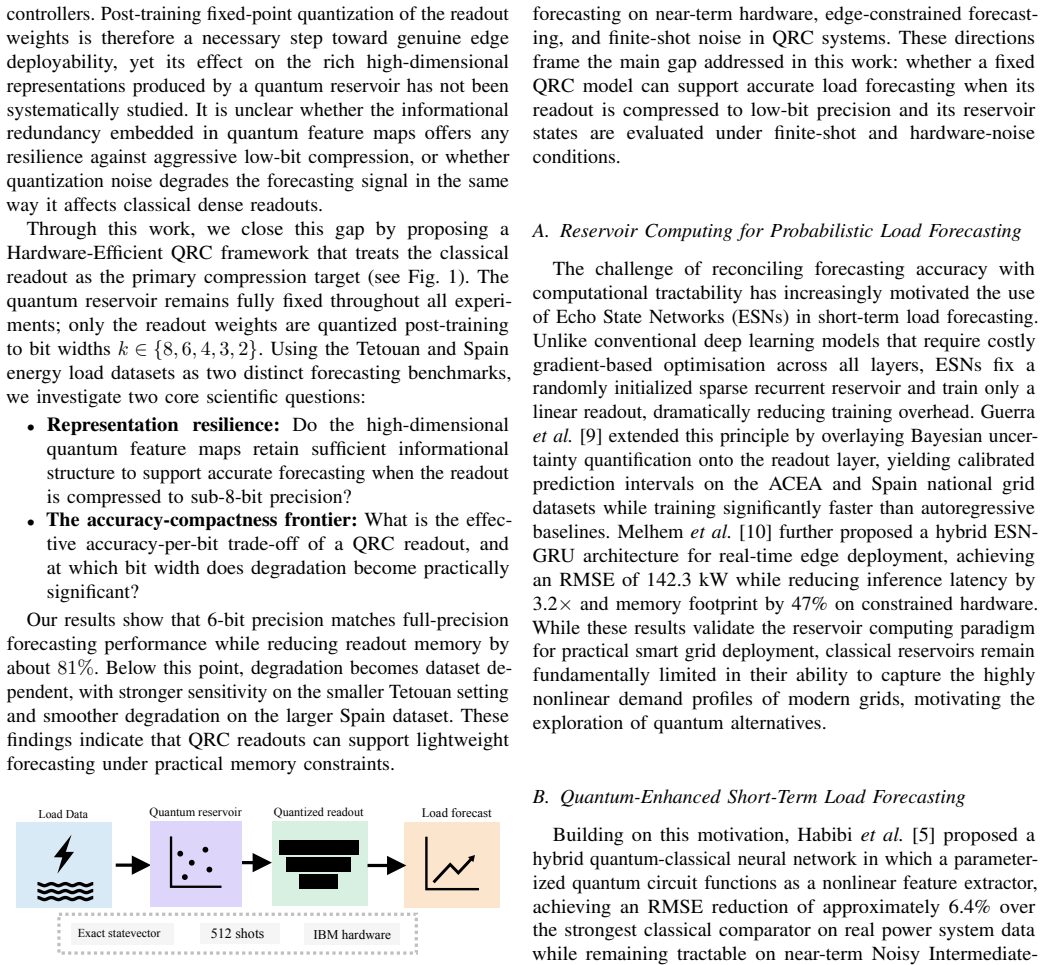
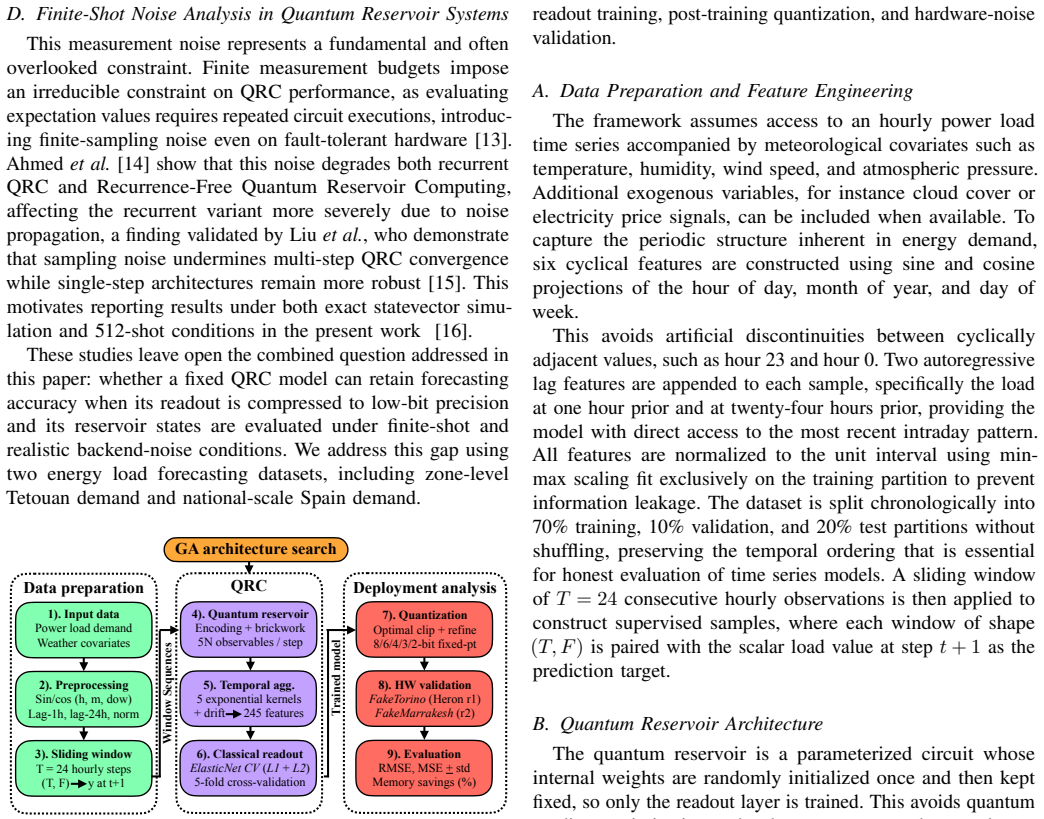
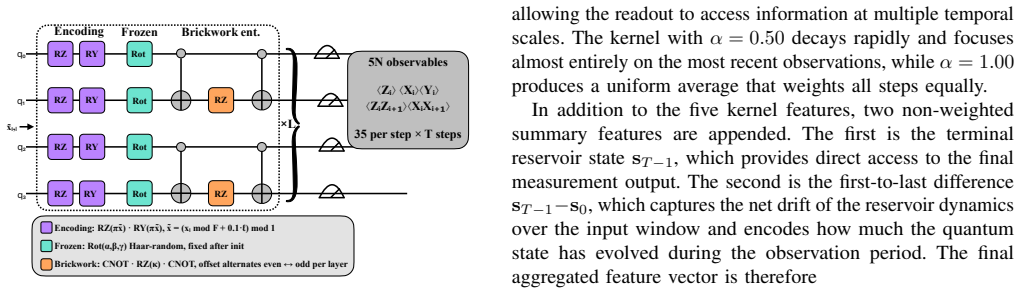
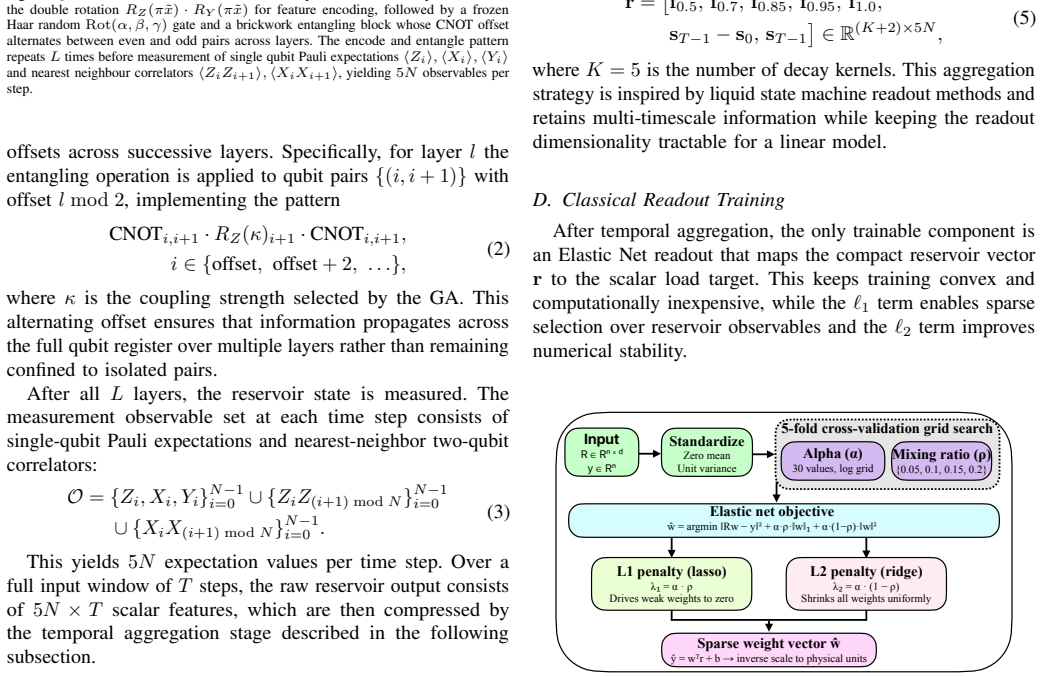
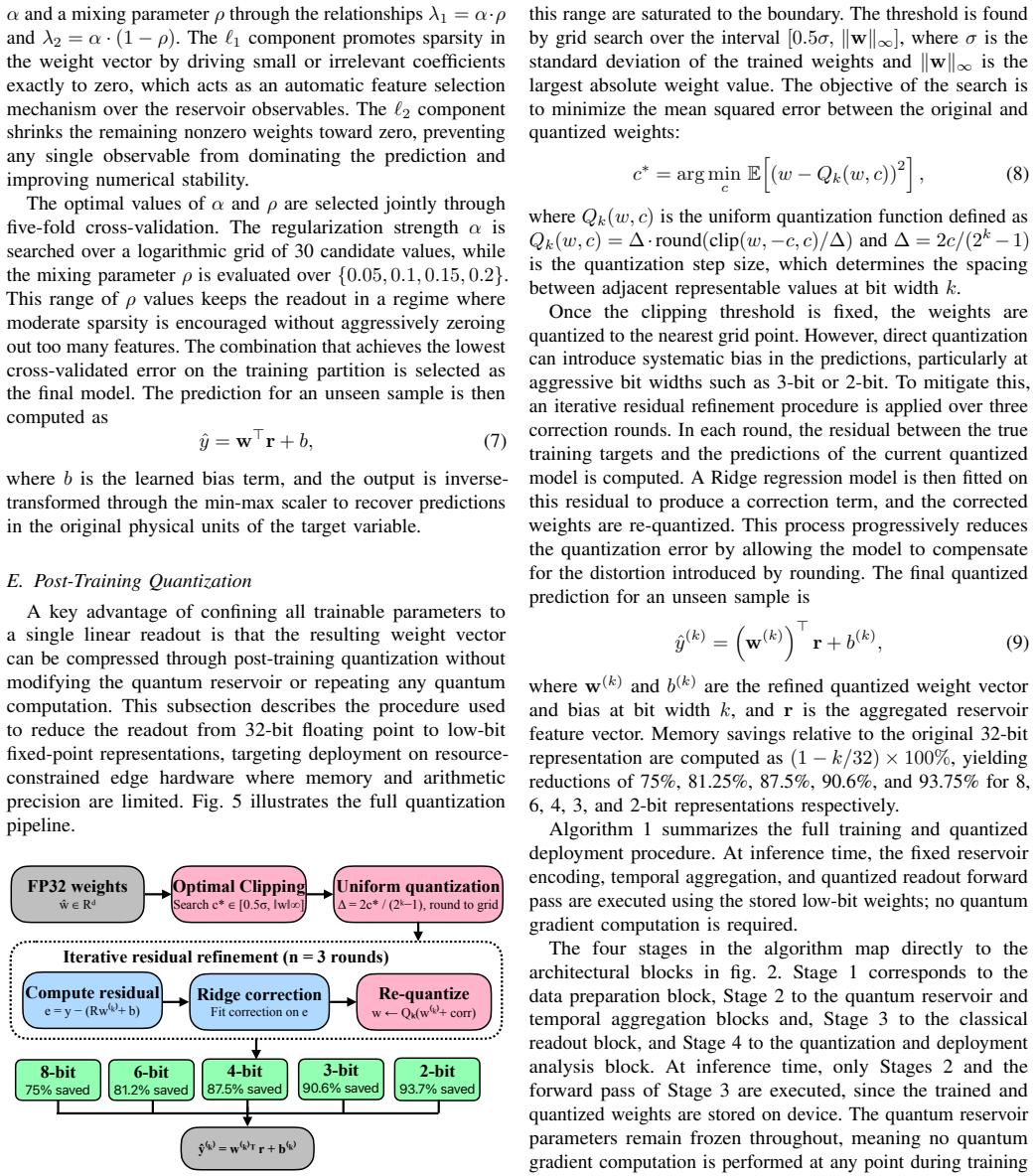
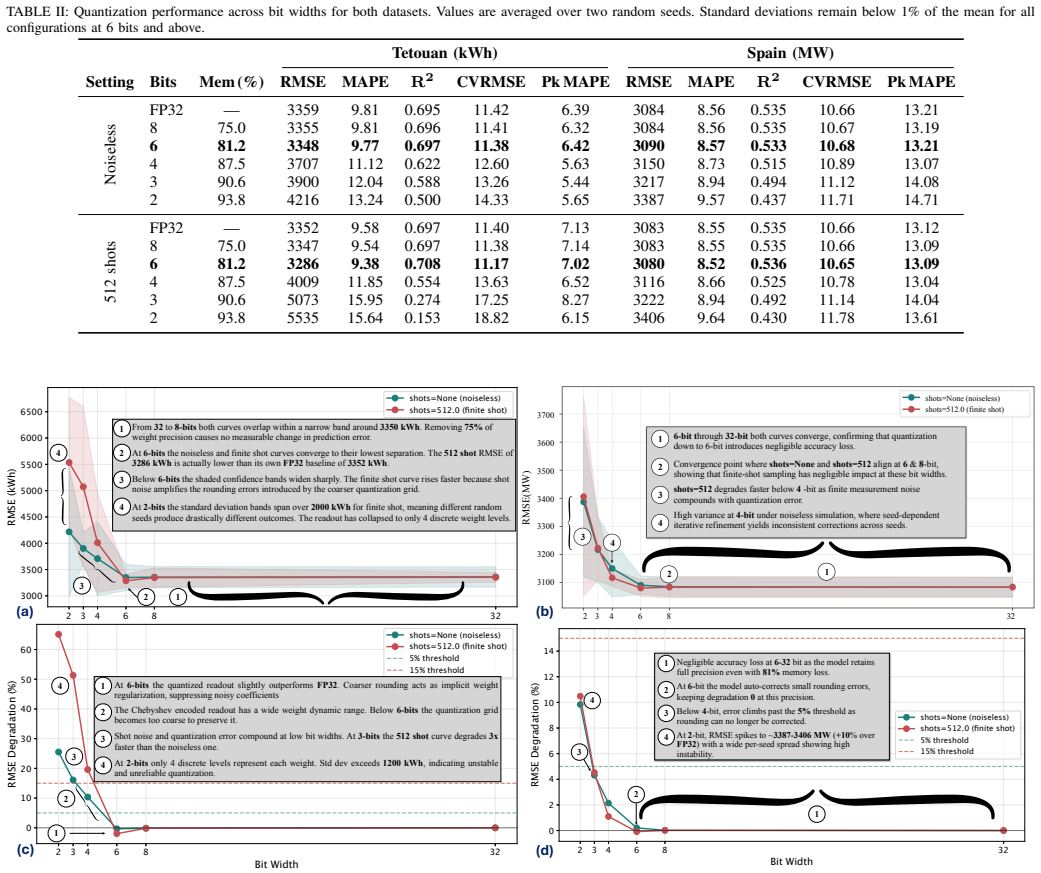
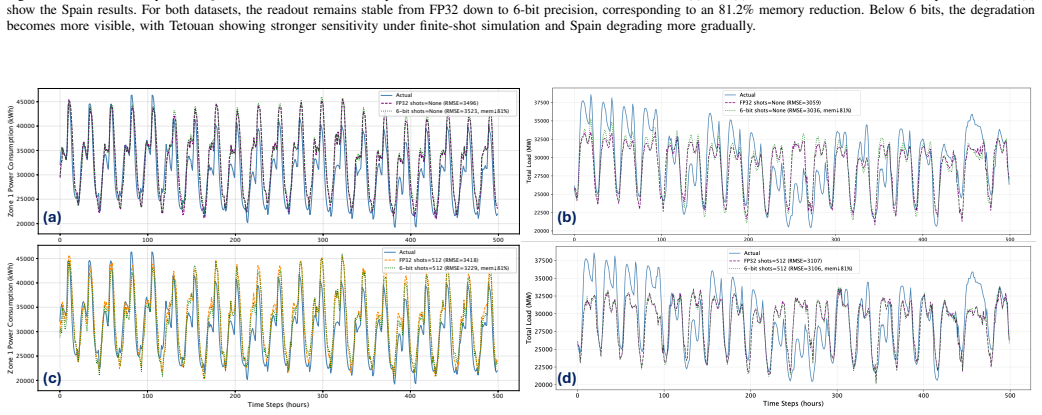
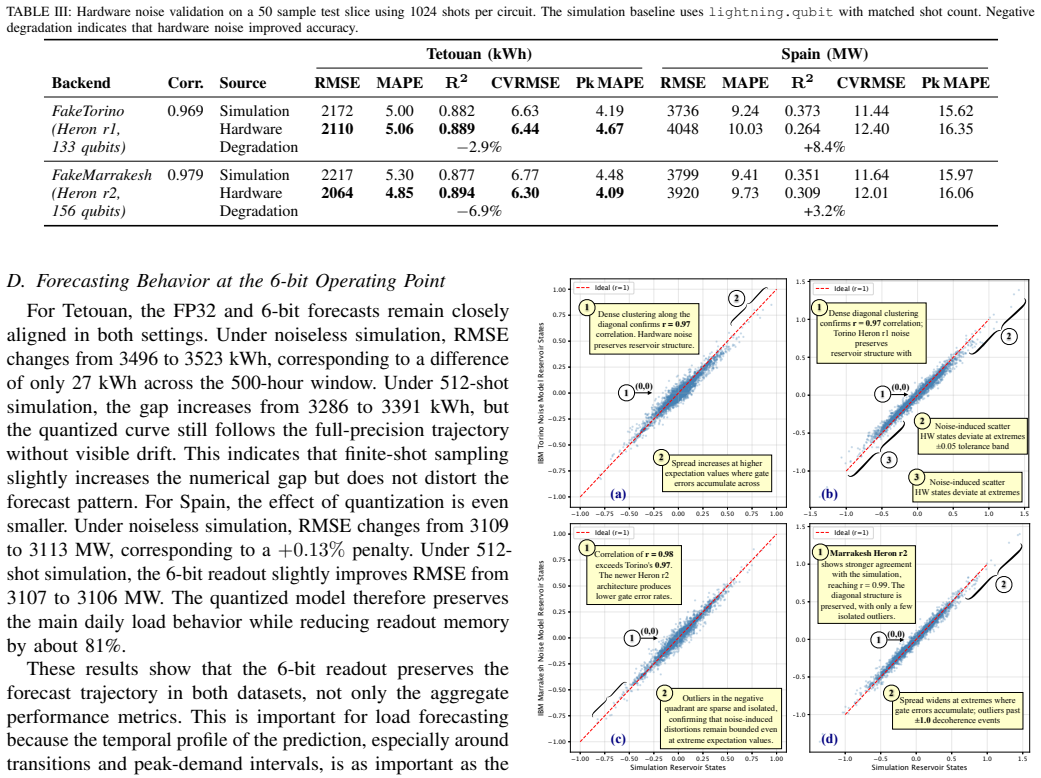
A fixed quantum reservoir maps temporal input windows to high-dimensional features; an Elastic Net trained on those features, once quantized to 6-bit fixed-point precision, delivers the same short-term load forecasting accuracy as full precision on the Tetouan and Spain datasets, reduces readout memory by 81.2 percent, and transfers without retraining to noisy reservoir states produced by realistic hardware-noise models.
What carries the argument
The fixed quantum reservoir that produces high-dimensional features from input windows, paired with post-training fixed-point quantization applied only to the Elastic Net readout weights.
If this is right
- Resource-constrained edge devices could host the quantized readout without needing full-precision arithmetic.
- The trained readout can be deployed directly onto noisy quantum hardware states without additional training steps.
- Quantization thresholds may vary by dataset, with some showing graceful degradation below 6 bits.
- The same fixed-reservoir-plus-quantized-readout pattern extends to other short-term time-series tasks on near-term quantum processors.
Where Pith is reading between the lines
- If the reservoir features prove general across domains, the same 6-bit compression could apply to other quantum machine-learning readouts.
- Running the setup on actual quantum hardware rather than noise models would test whether the transfer property survives real device variability.
- Combining the quantization step with classical dimensionality reduction on the reservoir outputs might push memory savings further while preserving accuracy.
Load-bearing premise
The fixed quantum reservoir always produces stable, informative features that remain useful to the Elastic Net after quantization and under the tested noise conditions.
What would settle it
A clear drop in forecasting accuracy at 6-bit precision on a new, independent energy-load dataset run under the same finite-shot and noise conditions would show the preservation result does not hold.
Figures
read the original abstract
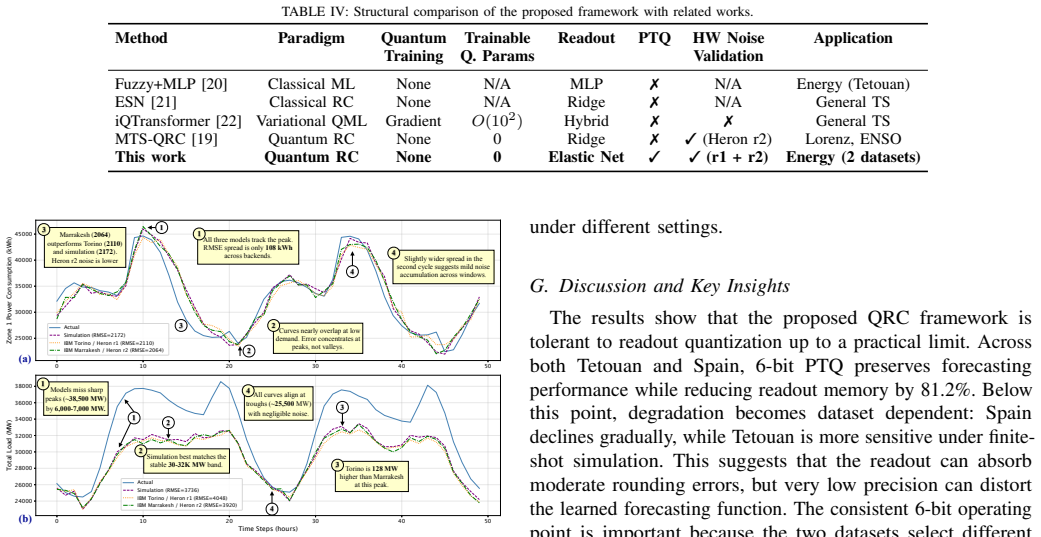
Short-term load forecasting is essential for reliable energy management, but practical deployment on edge devices requires models that remain accurate under limited memory, finite measurement budgets, and hardware noise. This work proposes a hardware-efficient Quantum Reservoir Computing (QRC) framework for energy load forecasting, where a fixed quantum reservoir transforms temporal input windows into high-dimensional features and only a classical Elastic Net readout is trained. To reduce deployment cost, the trained readout is compressed using post-training fixed-point quantization at bit widths from 8 to 2 bits. The framework is evaluated on the Tetouan and Spain energy load datasets under exact statevector simulation, 512-shot finite sampling, and realistic hardware-noise models from IBM FakeTorino and IBM FakeMarrakesh. Results show that 6-bit readout precision preserves full-precision forecasting performance while reducing readout memory by 81.2%. Below this point, degradation becomes dataset dependent, with Tetouan showing stronger sensitivity and Spain degrading more gradually. Hardware-noise validation further shows that the trained readout transfers to noisy reservoir states without retraining. These findings support quantized QRC as a resource-aware forecasting approach for near-term quantum time-series applications.
Editorial analysis
A structured set of objections, weighed in public.
Referee Report
Summary. The paper proposes a hardware-efficient Quantum Reservoir Computing (QRC) framework for short-term power load forecasting on edge devices. A fixed quantum reservoir maps temporal input windows to high-dimensional features; only a classical Elastic Net readout is trained. Post-training fixed-point quantization is applied to the readout at bit widths from 8 to 2 bits. Evaluation on the Tetouan and Spain energy datasets under statevector simulation, 512-shot sampling, and IBM FakeTorino/Marrakesh noise models shows that 6-bit readout precision preserves full-precision forecasting performance (reducing readout memory by 81.2%) while the trained readout transfers to noisy reservoir states without retraining. Below 6 bits, performance degradation is dataset-dependent.
Significance. If the central empirical claims hold, the work provides concrete evidence that post-training quantization of the classical readout in fixed QRC can achieve substantial memory savings with negligible accuracy loss under realistic noise, supporting resource-aware deployment of quantum time-series models in energy systems. The direct hardware-noise validation and cross-dataset testing are positive elements; the result is falsifiable via the reported simulation protocols.
major comments (3)
- [Abstract / Evaluation] Abstract and evaluation setup: the headline claim that 6-bit readout preserves full-precision performance across statevector, shot, and hardware-noise regimes lacks reported statistical significance tests, exact hyperparameter values for the Elastic Net and reservoir circuit, and dataset sizes or train/test splits. These omissions make it impossible to verify the robustness of the preservation result or reproduce the exact conditions under which the 81.2% memory reduction holds.
- [Framework / Results] Framework description and results: the central premise that the fixed quantum reservoir produces sufficiently informative features for the Elastic Net to remain accurate after coefficient quantization is invoked without any ablation on reservoir depth, entanglement pattern, or alternative feature maps. If feature quality is dataset-specific or shifts under the tested noise models, the observed 6-bit preservation would not generalize beyond the two reported datasets.
- [Results] Results section: the statement that the trained readout transfers to noisy reservoir states without retraining is presented as a key finding, yet no quantitative comparison (e.g., error deltas or confidence intervals) is supplied between the noiseless and hardware-noise cases at each bit width, weakening the support for the transfer claim.
minor comments (2)
- [Methods] Notation for the quantized readout coefficients and the precise definition of the 81.2% memory reduction (e.g., which parameters are counted) should be stated explicitly in the methods.
- [Figures] Figure captions and axis labels for forecasting error vs. bit width should include the exact datasets and noise models used in each panel for immediate readability.
Simulated Author's Rebuttal
We thank the referee for the constructive feedback. We address each major comment below, indicating revisions where appropriate to enhance reproducibility and strengthen the empirical support.
read point-by-point responses
-
Referee: [Abstract / Evaluation] Abstract and evaluation setup: the headline claim that 6-bit readout preserves full-precision performance across statevector, shot, and hardware-noise regimes lacks reported statistical significance tests, exact hyperparameter values for the Elastic Net and reservoir circuit, and dataset sizes or train/test splits. These omissions make it impossible to verify the robustness of the preservation result or reproduce the exact conditions under which the 81.2% memory reduction holds.
Authors: We agree these details are essential for reproducibility. The revised manuscript will report the exact Elastic Net hyperparameters (alpha and l1_ratio), reservoir circuit specifications (qubit count, circuit depth, and entanglement structure), full dataset sizes, and explicit train/test split ratios. We will also include statistical significance tests (e.g., paired t-tests across 10 independent runs) comparing 6-bit versus full-precision performance to substantiate the preservation claim under all three simulation regimes. revision: yes
-
Referee: [Framework / Results] Framework description and results: the central premise that the fixed quantum reservoir produces sufficiently informative features for the Elastic Net to remain accurate after coefficient quantization is invoked without any ablation on reservoir depth, entanglement pattern, or alternative feature maps. If feature quality is dataset-specific or shifts under the tested noise models, the observed 6-bit preservation would not generalize beyond the two reported datasets.
Authors: The fixed-reservoir design is intentional to highlight hardware efficiency and zero-reservoir training cost, which is central to the resource-constrained deployment goal. While we recognize that systematic ablations on depth or entanglement would provide additional insight, they fall outside the scope of demonstrating readout quantization benefits. The manuscript already shows consistent 6-bit preservation across two distinct datasets and under hardware noise; we will add a short paragraph explaining the fixed-reservoir rationale and noting that reservoir optimization is reserved for future work. revision: partial
-
Referee: [Results] Results section: the statement that the trained readout transfers to noisy reservoir states without retraining is presented as a key finding, yet no quantitative comparison (e.g., error deltas or confidence intervals) is supplied between the noiseless and hardware-noise cases at each bit width, weakening the support for the transfer claim.
Authors: We concur that explicit quantitative comparisons are needed. The revision will include a table (or supplementary figure) reporting RMSE/MAE values, absolute deltas, and standard deviations from multiple trials for noiseless versus IBM FakeTorino/Marrakesh cases at every bit width, directly supporting the no-retraining transfer result. revision: yes
Circularity Check
No circularity: all claims are direct empirical measurements on public datasets
full rationale
The paper reports forecasting performance under exact simulation, finite shots, and hardware noise models as measured outcomes on the Tetouan and Spain datasets. No equations, parameter fits, or self-citations are presented that reduce any reported result to a fitted input or self-referential definition by construction. The fixed-reservoir premise is an explicit modeling choice whose validity is tested empirically rather than assumed via prior self-work; the 6-bit quantization result is likewise a measured preservation of error, not a statistical artifact forced by the training procedure itself. This is the standard case of a self-contained empirical study.
Axiom & Free-Parameter Ledger
free parameters (2)
- Elastic Net regularization parameters
- Reservoir circuit parameters (depth, entanglement pattern)
axioms (2)
- domain assumption A fixed, untrained quantum circuit suffices as a feature map for the temporal forecasting task.
- domain assumption IBM FakeTorino and FakeMarrakesh noise models are representative of near-term hardware behavior for this workload.
Reference graph
Works this paper leans on
-
[1]
Edge computing and transfer learning-based short-term load forecasting for residential and commercial buildings,
M. S. Iqbal and M. Adnan, “Edge computing and transfer learning-based short-term load forecasting for residential and commercial buildings,” Energy and Buildings, vol. 329, p. 115273, 2025
2025
-
[2]
Energy-aware deep learn- ing on resource-constrained hardware,
J. Millar, H. Haddadi, and A. Madhavapeddy, “Energy-aware deep learn- ing on resource-constrained hardware,”arXiv preprint arXiv:2505.12523, 2025
arXiv 2025
-
[3]
Deep learning for time series forecasting: a survey,
X. Kong, Z. Chen, W. Liu, K. Ning, L. Zhang, S. Muhammad Marier, Y . Liu, Y . Chen, and F. Xia, “Deep learning for time series forecasting: a survey,”International Journal of Machine Learning and Cybernetics, vol. 16, no. 7, pp. 5079–5112, 2025
2025
-
[4]
S. A. F. Mortezanejad and R. Wang, “Addressing challenges in time series forecasting: A comprehensive comparison of machine learning techniques,”arXiv preprint arXiv:2503.20148, 2025
arXiv 2025
-
[5]
Electrical load forecasting in power systems based on quantum computing using time series-based quantum artificial intelligence,
M. R. Habibi, S. Golestan, Y . Wu, J. M. Guerrero, and J. C. Vasquez, “Electrical load forecasting in power systems based on quantum computing using time series-based quantum artificial intelligence,”Scientific Reports, vol. 15, no. 1, p. 7429, 2025
2025
-
[6]
Optimizing smart grid load forecasting via a hybrid long short-term memory-xgboost framework: Enhancing accuracy, robustness, and energy management,
F. Dakheel and M. C ¸evik, “Optimizing smart grid load forecasting via a hybrid long short-term memory-xgboost framework: Enhancing accuracy, robustness, and energy management,”Energies, vol. 18, no. 11, p. 2842, 2025
2025
-
[7]
Harnessing disordered-ensemble quantum dynamics for machine learning,
K. Fujii and K. Nakajima, “Harnessing disordered-ensemble quantum dynamics for machine learning,”Physical Review Applied, vol. 8, no. 2, p. 024030, 2017
2017
-
[8]
Barren plateaus in quantum neural network training landscapes,
J. R. McClean, S. Boixo, V . N. Smelyanskiy, R. Babbush, and H. Neven, “Barren plateaus in quantum neural network training landscapes,”Nature Communications, vol. 9, no. 1, p. 4812, 2018
2018
-
[9]
Probabilistic load forecasting with reservoir computing,
M. Guerra, S. Scardapane, and F. M. Bianchi, “Probabilistic load forecasting with reservoir computing,”IEEE Access, vol. 11, pp. 145 989– 146 002, 2023
2023
-
[10]
Edgeai-powered hybrid esn-gru model for high-accuracy and efficient short-term load forecasting in smart grids,
S. B. Melhem, M. Golec, S. Alrabaee, M. Alshaikh, and M. Uyar, “Edgeai-powered hybrid esn-gru model for high-accuracy and efficient short-term load forecasting in smart grids,”IEEE Access, vol. 13, pp. 198 241–198 251, 2025
2025
-
[11]
Late breaking results: Hardware-efficient quantum reservoir computing via quantized readout,
P. Pathak, M. Od, N. Innan, and M. Shafique, “Late breaking results: Hardware-efficient quantum reservoir computing via quantized readout,” arXiv preprint arXiv:2604.06075, 2026
Pith/arXiv arXiv 2026
-
[12]
Edge-based short-term energy demand prediction,
A. Lekidis and E. I. Papageorgiou, “Edge-based short-term energy demand prediction,”Energies, vol. 16, no. 14, p. 5435, 2023
2023
-
[13]
Reduction of finite sampling noise in quantum neural networks,
D. A. Kreplin and M. Roth, “Reduction of finite sampling noise in quantum neural networks,”Quantum, vol. 8, p. 1385, 2024
2024
-
[14]
Optimal training of finitely sampled quantum reservoir computers for forecasting of chaotic dynamics,
O. Ahmed, F. Tennie, and L. Magri, “Optimal training of finitely sampled quantum reservoir computers for forecasting of chaotic dynamics,” Quantum Machine Intelligence, vol. 7, no. 1, p. 31, 2025
2025
-
[15]
Practical quantum reservoir computing in rydberg atom arrays,
D.-S. Liu, Q.-X. Jie, C.-L. Zou, X.-F. Ren, and G.-C. Guo, “Practical quantum reservoir computing in rydberg atom arrays,”Physical Review A, vol. 113, no. 4, p. 042401, 2026
2026
-
[16]
Generalization error in quantum machine learning in the presence of sampling noise,
F. Hu and X. Gao, “Generalization error in quantum machine learning in the presence of sampling noise,”arXiv preprint arXiv:2410.14654, 2024
arXiv 2024
-
[17]
UCI Machine Learning Repository (2018), DOI: https://doi.org/10.24432/C5B034
A. Salam and A. E. Hibaoui, “Power consumption of tetouan city,” https: //doi.org/10.24432/C5B034, 2018, uCI Machine Learning Repository
-
[18]
Hourly energy demand, generation and weather data for spain,
N. Jhana, “Hourly energy demand, generation and weather data for spain,” https://www.kaggle.com/datasets/nicholasjhana/ energy-consumption-generation-prices-and-weather, 2019, accessed: 2026
2019
-
[19]
Multivariate time series forecasting with gate-based quantum reservoir computing on nisq hardware,
W. Hamhoum, S. Cherkaoui, J.-F. Laprade, O. Ahmed, and S. Wang, “Multivariate time series forecasting with gate-based quantum reservoir computing on nisq hardware,”arXiv preprint arXiv:2510.13634, 2025
arXiv 2025
-
[20]
A hybrid time series forecasting approach integrating fuzzy clustering and machine learning for enhanced power consumption prediction,
K. Alsalem, “A hybrid time series forecasting approach integrating fuzzy clustering and machine learning for enhanced power consumption prediction,”Scientific Reports, vol. 15, no. 1, p. 6447, 2025
2025
-
[21]
Echo state networks for time series forecasting: Hyperpa- rameter sweep and benchmarking,
A. H ¨außer, “Echo state networks for time series forecasting: Hyperpa- rameter sweep and benchmarking,”arXiv preprint arXiv:2602.03912, 2026
Pith/arXiv arXiv 2026
-
[22]
Quantum neural network architectures for multivariate time-series forecasting,
S. Ranilla-Cortina, D. A. Aranda, J. Ballesteros, J. Bonilla, N. Monrio, E. F. Combarro, and J. Ranilla, “Quantum neural network architectures for multivariate time-series forecasting,”arXiv preprint arXiv:2510.21168, 2025
arXiv 2025
discussion (0)
Sign in with ORCID, Apple, or X to comment. Anyone can read and Pith papers without signing in.