REVIEW 3 major objections 6 minor 2 cited by
PureMagic: A Dynamic Scheduler for Lattice Surgery
T0 review · 3 major / 6 minor · reviewed 2026-08-03 · deepseek-v4-flash
Pith's one-line read PureMagic reallocates magic-state cultivation qubits to routing on demand, cutting schedule volume by up to 223% and using up to 80% fewer logical qubits.
desk verdict Novel dynamic scheduler that repurposes cultivation patches for routing, with a credible volume story but a misleading magic-prep-time metric and an abstract that overclaims; worth refereeing after revision. read the letter →
The pith
A machine-rendered reading of the paper's core claim, the machinery that carries it, and where it could break.
The reading
What carries the argument
The key mechanism is the dual-purpose ancilla patch: every non-data qubit in the layout is both a cultivation site for magic states and a candidate routing patch for lattice-surgery merges. The scheduler's greedy MINFIT algorithm packs approximately shortest Steiner trees for independent Pauli products each cycle, and when it seizes a cultivating patch, the cultivation is terminated (with the exponential renewal assumption) and restarted afterward. The second load-bearing piece is the exponential cultivation-time model (Eq. 3), which makes cancellation memoryless so that an interrupted cultivation is statistically a fresh start; this is what turns preemption into a tail-cutting device.
What would settle it
Measure the actual cost and statistical memory of interrupting a cultivation run on a surface-code testbed, comparing the distribution of time-to-success for a restarted patch versus a fresh patch; even a one-cycle fixed restart overhead or any correlation between successive attempts will shift the reported average preparation times (2.7–10 cycles) and could erase the 4.5x reduction on low-parallelism circuits like DNN8.
Extended reading notes
Core claim
The paper's central claim is that a lattice-surgery compiler need not dedicate any qubits to routing. In PureMagic scheduling, every non-data patch continuously attempts to cultivate a magic state; when the scheduler needs a path between data qubits, it seizes any convenient cultivating patches, cancels their attempts, and uses them as a Steiner tree for the Pauli product. Once the product finishes, the patches resume cultivation. Because cultivation is modeled as memoryless and restartable, this policy (1) removes idle ancillas entirely, (2) increases the number of concurrent cultivators, and (3) truncates the long tail of the cultivation-time distribution, cutting mean magic-state preparat
Load-bearing premise
The entire value proposition depends on magic-state cultivation being cancellable at any cycle with no lost progress and no restart overhead, so that an interrupted attempt is statistically a fresh exponential draw.
Editorial extensions
If this is right
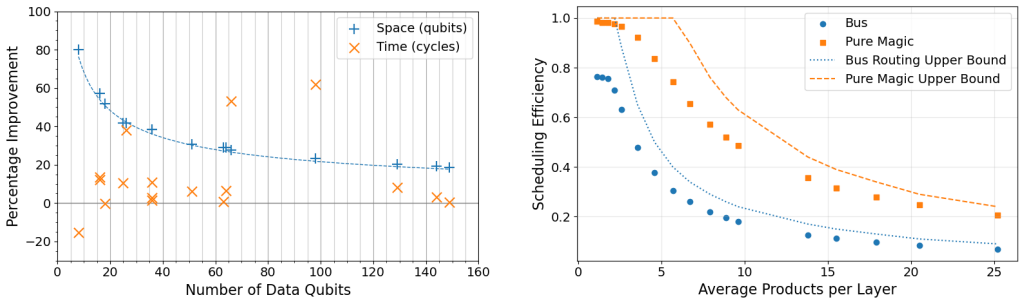
- Surface-code compilers can eliminate dedicated bus patches, reducing logical-qubit count by up to 80% and shrinking the scheduler's space-time volume by up to 223% relative to bus routing.
- The benefit grows with circuit parallelism: at average Pauli-product rates above about 10 per layer, the scheduler's relative gain rises because magic-state supply becomes the bottleneck and PureMagic supplies more cultivators.
- The scheduler's gains persist even if cultivation becomes slower: the relative improvement over bus routing increases as the expected cultivation time grows, which matters for future high-fidelity T states.
- Average magic-state preparation time falls from about 26 cycles to 2.7–10 cycles on the tested circuits because routing interrupts the longest cultivation attempts.
Reading between the lines
- Inference: The same preemption principle could be applied to any stochastic resource-production process with a heavy tail and zero-cost restarts, not just magic-state cultivation, suggesting a general design rule for fault-tolerant architectures: treat resource generation as preemptible work.
- Inference: If the memoryless-exponential assumption is replaced by a realistic cultivation model that has memory (e.g., stage-dependent success probabilities or a restart cost), the tail-cutting benefit may shrink; a concrete test would be to rerun the 17 benchmarks with a log-normal or phase-type distribution fitted to the same cultivation data and compare average preparation times.
- Inference: The dual-purpose ancilla idea also implies a new hardware-level requirement: a qubit patch must support both cultivation and lattice-surgery merge/split with no extra fabrication overhead, and the transition between the two modes must be fast enough to avoid scheduling bubbles; if the mode switch costs more than a cycle, the volume gains degrade.
Editorial analysis
A structured set of objections, weighed in public.
Referee Report
Summary. The paper proposes Pure Magic, a dynamic scheduler for surface-code lattice surgery that eliminates dedicated bus patches by repurposing all ancilla patches for both magic-state cultivation and routing. Cultivation is interrupted when a patch is needed for routing and restarted afterward; the authors argue this naturally truncates the long tail of probabilistic cultivation times. The scheduler greedily packs Steiner forests and is evaluated on 17 Benchpress circuits plus random circuits. The paper reports 19%–223% improvements in scheduling efficiency over a bus-routing baseline, 19%–80% reductions in logical qubits, and 2.6×–9.7× reductions in average magic-state preparation time. A comparison with Silva et al. benchmarks is also presented.
Significance. The core idea—using every ancilla patch as a dual-purpose cultivation/routing resource—is timely and potentially valuable for surface-code compilation with magic-state cultivation. Strengths include an open-source implementation, evaluation against an independent bus-routing baseline and Silva et al., and a useful sensitivity analysis of cultivation time and parallelism. However, the headline claim of reduced magic-state preparation time is built on a censored statistic and an unverified memoryless-restart model for cultivation; the abstract also advertises results (29 circuits, DASCOT/FLASQ comparisons) that are absent from the full text. If the volume improvements survive correction of these issues, the paper would be a meaningful contribution, but as written the central speedup claim is not established.
major comments (3)
- [Abstract vs. Full Text] The abstract reports 29 benchmark circuits, a comparison against DASCOT with 'up to 21x' efficiency improvement, and near-optimal FLASQ bounds. The full text reports 17 benchmark circuits in Table I and contains no DASCOT or FLASQ evaluation. The abstract also promises a 'weight limit on Tableau transpilation' that is not discussed anywhere in the body. These claims are not supported by the manuscript and must be reconciled or removed.
- [Section V-B, Table II] The 'Avg. Magic Cultivation' values for Pure Magic (2.67–10.09 cycles vs. ~26 cycles for bus routing) are a length-biased statistic. The table note states that 'those terminated before cultivation is ready are not counted.' For an exponential distribution with preemption at rate ν, completed attempts have mean 1/(μ+ν), which is smaller than 1/μ, yet the memoryless property implies the expected time from an arbitrary restart to completion is still 1/μ. Thus the reported 2.6–9.7x reduction reflects selection bias, not an increase in per-ancilla throughput. The paper does not establish that interruption has zero overhead or that cultivation is memoryless (Eq. 3 is assumed, not derived). If restarts cost even one cycle or cultivation has a minimum duration, the throughput gain shrinks; the volume improvements in Table II may survive, but the claimed magic-state preparation speedup is not sup
- [Section III-B and IV] The exponential model of Eq. (3) is fitted to MCMC simulations from Gidney et al., but the memoryless property is not verified. Real cultivation has injection, check-grow-stabilize, and escape stages (Section II-C), which likely impose a minimum duration and a re-initialization cost. The scheduler's 'cut the tail' benefit relies on the strong assumption that cultivation 'can be terminated and restarted at any time' with no lost progress (Section IV). This assumption is load-bearing for the reported time reductions and should be backed by evidence or explicitly stated as a worst-case approximation with sensitivity analysis.
minor comments (6)
- [Section I] Duplicate word in 'there are only only data and ancilla qubits.'
- [Section III-B] 'Gidney at. al.' should be 'Gidney et al.'; also 'Figure 15a' in the text refers to the cited paper, not the current manuscript—consider clarifying.
- [Section V-B] The text says 'the right-most columns in Table I' but the average cultivation columns are in Table II.
- [Section V-B / Figure 10] The text states that for the 8-qubit circuit the 'overall efficiency improvement is 47%,' while Table II reports 59% for DNN 8. The discrepancy likely comes from different metrics (volume vs. scheduling efficiency), but the text should define which quantity is being reported and keep the numbers consistent.
- [Section V-C] In the paragraph beginning 'For 64 data qubits, the bus routing architecture has a total of 60 magic qubits,' the phrase 'there are only 2.3 magic state qubits ready each cycle' conflates a rate (qubits/cycle) with a count. Minor rewording would improve clarity.
- [Figure 10] The fitted constant α=216 is introduced without explanation. State how it is estimated.
Circularity Check
The reported 2.6–9.7x magic-cultivation speedup is built into the metric and the exponential model; volume gains vs bus routing remain externally grounded.
-
self definitional
[Section V-B / Table II caption; uses Eq. 3 from Section III-B and the Section IV restart rule]
"TABLE II: ... The averages for cultivation are computed over the number of cycles magic qubits take to become ready; those terminated before cultivation is ready are not counted. ... As expected from Equation 3, the average cycles taken for bus routing are about 26, whereas for Pure Magic scheduling, they vary from 2.67 to 10.09."
Cultivation time is modeled as Exp(λ) (Eq. 3). PureMagic interrupts cultivations for routing and restarts them. The table's 'Avg. Magic Cultivation' for Pure Magic is therefore the mean of Exp(λ) conditioned on completing before the next routing interruption, i.e. 1/(λ+ν) with interruption rate ν, which is < 1/λ by construction. The headline 'reduction' from ~26 to 2.67–10.09 cycles is a censoring identity of this model, not a measured improvement in per-ancilla magic-state production; the wall-clock interval between completed states (including restarts and routing occupation) is ≥ 1/λ. The paper's own caption admits the censoring, so the claimed speedup is definitional.
full rationale
The central volume-efficiency and qubit-reduction claims (19–223%, 19–80%) are computed against an independent bus-routing scheduler and Silva et al.'s published results, so they are not circular; the comparison to Silva uses an external benchmark and reproduces/improves their efficiencies. No load-bearing self-citation is present (Gidney et al., Silva et al., DASCOT, etc. are all external). However, one headline claim—reduced average magic-state preparation time (2.6–9.7x, 'as few as 2.7 cycles')—is an artifact of the paper's own measurement definition: Table II averages only completed cultivations, and under the assumed memoryless exponential model, preemption by routing makes the completed-attempt mean 1/(λ+ν) < 1/λ. This is a mathematical consequence of the metric plus model, not an independent empirical result, so the paper is partially circular. The unverified free-restart/zero-overhead cultivation assumption is a correctness risk, not a circularity, and is not counted here.
Assumptions & free parameters
free parameters (2)
- lambda (cultivation rate) =
0.00227 (stated; inconsistent with the paper's 26-cycle mean / 19-cycle median; should be ~0.0385 if mean=26)
- alpha (layout scaling constant) =
216
assumptions (6)
- domain assumption Cultivation can be canceled and restarted at any time with negligible overhead
- domain assumption Cultivation time is exponentially distributed (memoryless)
- standard math Surface-code patch abstraction with double-qubit patches and edge-based lattice surgery
- domain assumption Volume N*T is a valid error proxy under i.i.d. physical errors
- domain assumption Magic cultivation parameters (fault-distance 3, p_L ~ 4e-6, final distance 17) from Gidney et al. apply
- domain assumption Twist-based Y measurements or equivalent are available
invented entities (1)
-
Dual-purpose ancilla patch (Pure Magic resource)
Cite this review
Pith. "Pith review of PureMagic: A Dynamic Scheduler for Lattice Surgery." pith.science (2026). https://pith.science/paper/RVKPTDCR
@misc{pith2026251206484,
  author       = {Pith},
  title        = {Pith review of: PureMagic: A Dynamic Scheduler for Lattice Surgery},
  year         = {2026},
  howpublished = {\url{https://pith.science/paper/RVKPTDCR}},
  note         = {Machine review of arXiv:2512.06484}
}
read the original abstract
Fault-tolerant quantum computation on surface codes requires magic states for universal computation. Traditional distillation factories deliver magic states deterministically but consume large areas of logical qubits, forcing static, peripheral placement. Magic state cultivation reduces magic state preparation to a single logical qubit, but is inherently stochastic, making static scheduling infeasible. We introduce PureMagic, a dynamic scheduler that eliminates dedicated bus patches by repurposing all ancilla patches for both routing and cultivation. When a patch is needed for routing, cultivation is interrupted and restarted afterward, naturally cutting off the long tail of cultivation times and ensuring no ancilla is ever idle. We also introduce a weight limit on Tableau transpilation that trades gate count for parallelism, which PureMagic is particularly well-suited to exploit. Across 29 benchmark circuits, PureMagic achieves 43% to 152% efficiency improvement over bus routing, uses 19% to 80% fewer logical qubits, and reduces average magic state preparation time by 4.5x. Compared to DASCOT, a state-of-the-art static scheduler, PureMagic is up to 21x more efficient when magic state preparation costs are included. PureMagic's scheduled volumes fall between the conservative and optimistic FLASQ theoretical lower bounds, demonstrating near-optimal use of ancilla resources.
Figures


Figures from the paper (9 more)




Forward citations
Cited by 2 Pith papers
-
Harvest: Resource-Aware Quantum Compilation for Magic State Protocols
Harvest co-optimizes placement, routing, scheduling, and magic-state supply for lattice-surgery quantum programs, reporting up to 17.8x speedup over sequential execution and reclaiming up to 72% of unused magic-state patches.
-
Position: Quantum Program Generation Must Prioritize Validity Over Probabilistic Scaling
The paper argues that probabilistic scaling alone cannot fix the validity gap in quantum circuit generation, so quantum code assistants must build verification into generation rather than filter outputs after the fact.
Reference graph
Works this paper leans on
-
[1]
Improved simulation of stabilizer circuits,
S. Aaronson and D. Gottesman, “Improved simulation of stabilizer circuits,”Physical Review A, vol. 70, no. 5, Nov. 2004. [Online]. Available: http://dx.doi.org/10.1103/PhysRevA.70.052328
-
[2]
BQSKit: Berkeley quantum synthesis toolkit,
BQSKit Development Team, “BQSKit: Berkeley quantum synthesis toolkit,” https://github.com/BQSKit/bqskit, 2024, accessed: 2025-01-16
2024
-
[3]
Universal quantum computation with ideal Clifford gates and noisy ancillas,
S. Bravyi and A. Kitaev, “Universal quantum computation with ideal Clifford gates and noisy ancillas,”Physical Review A, vol. 71, no. 2, p. 022316, 2005
2005
-
[4]
Trading classical and quantum computational resources,
S. Bravyi, G. Smith, and J. A. Smolin, “Trading classical and quantum computational resources,”Phys. Rev. X, vol. 6, p. 021043, Jun
-
[5]
Correlated decoding of logical algo- rithms with transversal gates,
M. Cain, C. Zhao, H. Zhou, N. Meister, J. P. B. Ataides, A. Jaffe, D. Bluvstein, and M. D. Lukin, “Correlated decoding of logical algo- rithms with transversal gates,”Physical Review Letters, vol. 133, no. 24, p. 240602, 2024
2024
-
[6]
Universal quantum computing with twist-free and temporally encoded lattice surgery,
C. Chamberland and E. T. Campbell, “Universal quantum computing with twist-free and temporally encoded lattice surgery,”PRX Quantum, vol. 3, p. 010331, Feb 2022. [Online]. Available: https://link.aps.org/ doi/10.1103/PRXQuantum.3.010331
-
[7]
Low overhead quantum computation using lattice surgery,
A. G. Fowler and C. Gidney, “Low overhead quantum computation using lattice surgery,” 2018
2018
-
[8]
Surface codes: Towards practical large-scale quantum computation,
A. G. Fowler, M. Mariantoni, J. M. Martinis, and A. N. Cleland, “Surface codes: Towards practical large-scale quantum computation,”Physical Review A, vol. 86, no. 3, p. 032324, 2012
2012
Show all 31 references
-
[9]
How to factor 2048 bit rsa integers with less than a million noisy qubits,
C. Gidney, “How to factor 2048 bit rsa integers with less than a million noisy qubits,” 2025. [Online]. Available: https: //arxiv.org/abs/2505.15917
-
[10]
Magic state cultivation: growing t states as cheap as cnot gates,
C. Gidney, N. Shutty, and C. Jones, “Magic state cultivation: growing t states as cheap as cnot gates,” 2024. [Online]. Available: https://arxiv.org/abs/2409.17595
2024 arXiv
-
[11]
Locality-aware pauli-based computation for local magic state preparation,
Y . Hirano and K. Fujii, “Locality-aware pauli-based computation for local magic state preparation,” 2025. [Online]. Available: https: //arxiv.org/abs/2504.12091
2025
-
[12]
Surface code quantum computing by lattice surgery,
D. Horsman, A. G. Fowler, S. Devitt, and R. Van Meter, “Surface code quantum computing by lattice surgery,”New Journal of Physics, vol. 14, no. 12, p. 123011, 2012
2012
-
[13]
Fault-tolerant quantum computation by anyons,
A. Y . Kitaev, “Fault-tolerant quantum computation by anyons,”Annals of Physics, vol. 303, no. 1, pp. 2–30, 2003
2003
-
[14]
Lsqca: Resource-efficient load/store architecture for limited-scale fault-tolerant quantum computing,
T. Kobori, Y . Suzuki, Y . Ueno, T. Tanimoto, S. Todo, and Y . Tokunaga, “Lsqca: Resource-efficient load/store architecture for limited-scale fault-tolerant quantum computing,” in2025 IEEE International Symposium on High Performance Computer Architecture (HPCA). IEEE, Mar. 202...
2025
-
[15]
A fast algorithm for steiner trees,
L. Kou, G. Markowsky, and L. Berman, “A fast algorithm for steiner trees,”Acta informatica, vol. 15, no. 2, pp. 141–145, 1981
1981
-
[16]
Packing steiner forests,
L. C. Lau, “Packing steiner forests,” inInternational Conference on Integer Programming and Combinatorial Optimization. Springer, 2005, pp. 362–376
2005
-
[17]
Realistic cost to execute practical quantum circuits using direct clifford+t lattice surgery compilation,
T. Leblond, C. Dean, G. Watkins, and R. Bennink, “Realistic cost to execute practical quantum circuits using direct clifford+t lattice surgery compilation,”ACM Transactions on Quantum Computing, vol. 5, no. 4, Oct. 2024. [Online]. Available: https://doi.org/10.1145/3689826
2024 doi
-
[18]
On the terminal steiner tree problem,
G. Lin and G. Xue, “On the terminal steiner tree problem,”Information Processing Letters, vol. 84, no. 2, pp. 103–107, 2002
2002
-
[19]
A game of surface codes: Large-scale quantum computing with lattice surgery,
D. Litinski, “A game of surface codes: Large-scale quantum computing with lattice surgery,”Quantum, vol. 3, p. 128, Mar. 2019. [Online]. Available: http://dx.doi.org/10.22331/q-2019-03-05-128
2019 doi
-
[20]
Dependency-aware compilation for surface code quantum architectures,
A. Molavi, A. Xu, S. Tannu, and A. Albarghouthi, “Dependency-aware compilation for surface code quantum architectures,”Proc. ACM Program. Lang., vol. 9, no. OOPSLA1, Apr. 2025. [Online]. Available: https://doi.org/10.1145/3720416
2025 doi
-
[21]
Benchmarking the performance of quantum computing software for quantum circuit creation, manipulation and compilation,
P. D. Nation, A. A. Saki, S. Brandhofer, L. Bello, S. Garion, M. Treinish, and A. Javadi-Abhari, “Benchmarking the performance of quantum computing software for quantum circuit creation, manipulation and compilation,”Nature Computational Science, pp. 1–9, 2025
2025
-
[22]
Quantum computation with realistic magic-state factories,
J. O’Gorman and E. T. Campbell, “Quantum computation with realistic magic-state factories,”Physical Review A, vol. 95, no. 3, Mar. 2017
2017
-
[23]
Fault-tolerant quantum computation with high threshold in two dimensions,
R. Raussendorf and J. Harrington, “Fault-tolerant quantum computation with high threshold in two dimensions,”Physical review letters, vol. 98, no. 19, p. 190504, 2007
2007
-
[24]
Fold-transversal surface code cultivation,
K. Sahay, P.-K. Tsai, K. Chang, Q. Su, T. B. Smith, S. Singh, and S. Puri, “Fold-transversal surface code cultivation,” 2025. [Online]. Available: https://arxiv.org/abs/2509.05212
2025
-
[25]
Multi-qubit lattice surgery scheduling
A. Silva, X. Zhang, Z. Webb, M. Kramer, C.-W. Yang, X. Liu, J. Lemieux, K.-W. Chen, A. Scherer, and P. Ronagh, “Multi-qubit lattice surgery scheduling.” Schloss Dagstuhl – Leibniz-Zentrum f ¨ur Informatik, 2024. [Online]. Available: https://drops.dagstuhl.de/entities/ document...
2024 doi
-
[26]
Multiple particle interference and quantum error correction,
A. Steane, “Multiple particle interference and quantum error correction,” Proceedings of the Royal Society A: Mathematical, Physical and Engi- neering Sciences, vol. 452, 01 1996
1996
-
[27]
A sat scalpel for lattice surgery: Representation and synthesis of subroutines for surface-code fault-tolerant quantum computing,
D. B. Tan, M. Y . Niu, and C. Gidney, “A sat scalpel for lattice surgery: Representation and synthesis of subroutines for surface-code fault-tolerant quantum computing,” in2024 ACM/IEEE 51st Annual International Symposium on Computer Architecture (ISCA). IEEE, Jun. 2024, p. 32...
2024
-
[28]
Efficient magic state cultivation on the surface code,
Y . Vaknin, S. Jacoby, A. Grimsmo, and A. Retzker, “Efficient magic state cultivation on the surface code,” 2025. [Online]. Available: https://arxiv.org/abs/2502.01743
2025
-
[29]
Matching generalized-bicycle codes to neutral atoms for low-overhead fault-tolerance,
J. Viszlai, W. Yang, S. F. Lin, J. Liu, N. Nottingham, J. M. Baker, and F. T. Chong, “Matching generalized-bicycle codes to neutral atoms for low-overhead fault-tolerance,” 2024. [Online]. Available: https://arxiv.org/abs/2311.16980
2024 arXiv
-
[30]
Tour de gross: A modular quantum computer based on bivariate bicycle codes,
T. J. Yoder, E. Schoute, P. Rall, E. Pritchett, J. M. Gambetta, A. W. Cross, M. Carroll, and M. E. Beverland, “Tour de gross: A modular quantum computer based on bivariate bicycle codes,” 2025. [Online]. Available: https://arxiv.org/abs/2506.03094 11
2025 arXiv
-
[2016]
Available: https://link.aps.org/doi/10.1103/PhysRevX.6
[Online]. Available: https://link.aps.org/doi/10.1103/PhysRevX.6. 021043
Reviewed August 3, 2026 · model on record in the stance chip above.
Discussion (0). Sign in to comment.