REVIEW 2 major objections 2 minor 27 references
Explicit Signal-Adaptive Sequential Optimal Execution Quotes
T0 review · 2 major / 2 minor · reviewed 2026-06-30 · grok-4.3
Pith's one-line read Four optimal execution problems with sequential limit-order quoting reduce to explicitly solvable triangular finite-dimensional HJB systems.
desk verdict The paper claims explicit closed-form solutions for four signal-dependent limit-order execution problems via HJB reduction to a triangular ODE system, but the claim's generality hinges on unstated restrictions on the intensity functions. read the letter →
The pith
A machine-rendered reading of the paper's core claim, the machinery that carries it, and where it could break.
The reading
What carries the argument
The triangular finite-dimensional structure of the Hamilton-Jacobi-Bellman equations that arises after substitution of the optimal controls and permits explicit recursive solution for value functions and quotes.
What would settle it
A specific choice of intensity functions for which the resulting Hamilton-Jacobi-Bellman equation fails to decouple into triangular form and whose numerical solution differs from the claimed explicit formula.
Extended reading notes
Core claim
For general price-impact and inventory-penalty functions, the Hamilton-Jacobi-Bellman equations corresponding to the four execution criteria all reduce to a triangular finite-dimensional structure which can be solved explicitly, leading to fully explicit value functions and optimal quotes across all cases, together with proofs of well-posedness, admissibility, and verification.
Load-bearing premise
The intensity functions of the point processes and the general forms of price impact and inventory penalty permit the Hamilton-Jacobi-Bellman equations to reduce to an explicitly solvable triangular finite-dimensional system.
Editorial extensions
If this is right
- Explicit formulas connect the quoting strategies that arise under the four different execution criteria.
- The closed-form solutions support long-horizon asymptotic analysis of optimal execution.
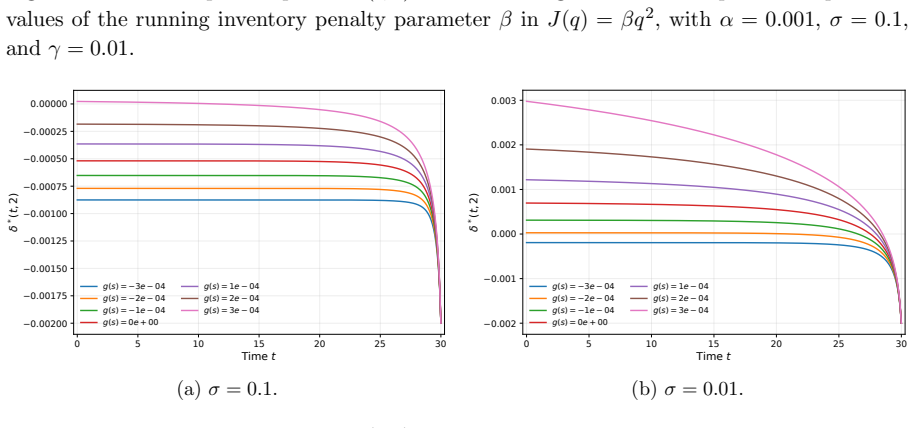
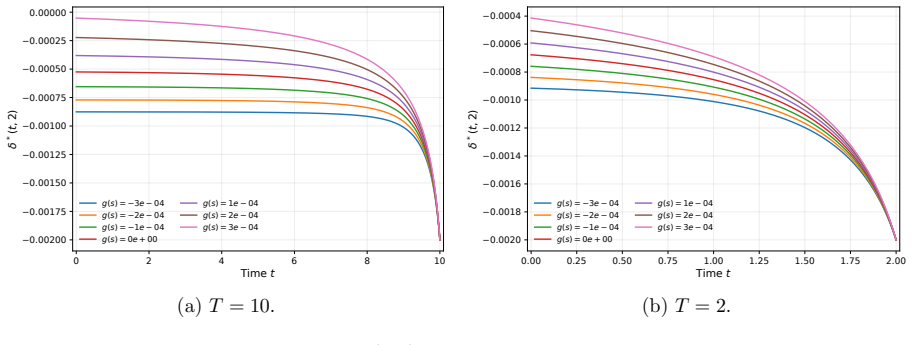
- Signal-dependent drift enters the explicit quotes and can substantially alter the optimal strategy.
- The same triangular reduction applies uniformly to expected-wealth and CARA-utility objectives, with or without running inventory penalties.
Reading between the lines
- The explicit structure may allow direct comparison of quoting rules when additional market signals are introduced beyond the current drift term.
- Verification results established for general impact and penalty functions could extend to related stochastic-control problems that share the same point-process execution mechanism.
- Long-horizon asymptotics derived from the closed forms might yield practical rules of thumb for traders managing large inventories over extended periods.
Signed reviews
Editorial analysis
A structured set of objections, weighed in public.
Referee Report
Summary. This paper develops a unified explicit solution theory for optimal execution through sequential limit-order placement in a limit order book. It incorporates signal-dependent drift, price impact, inventory risk, and execution risk via point processes with quote-dependent intensities. Four execution criteria are formulated (expected terminal wealth, with running inventory penalty, CARA utility, and CARA with penalty). The central claim is that, for general price-impact and inventory-penalty functions, the associated HJB equations reduce to a triangular finite-dimensional structure solvable explicitly, yielding closed-form value functions and optimal quotes, together with well-posedness, admissibility, and verification results. The explicit formulas are used to connect criteria and perform asymptotics, with numerical illustrations of signal effects.
Significance. If the claimed reduction to an explicitly solvable triangular finite-dimensional system holds under the stated generality, the contribution would be substantial: it would deliver closed-form solutions for sequential quote optimization (typically numerical) and explicit links across utility criteria. The well-posedness and verification theorems, together with the asymptotic analysis, would strengthen the result. The numerical demonstration that signal-dependent drift materially alters optimal quotes is a concrete practical strength.
major comments (2)
- [Abstract] Abstract: The assertion that the four HJB equations reduce to a triangular finite-dimensional structure 'for general price-impact and inventory-penalty functions' is load-bearing for the explicit-solvability claim. Because the control (quote) enters the generator inside the intensity of the point process, the supremum over admissible quotes generally produces a non-explicit optimization problem unless the intensity admits a very specific structural interaction with the impact and penalty terms (e.g., separability or exponential form that closes the system into a finite set of ODEs). The manuscript must delineate the precise class of intensity functions for which the triangular closure holds; without this, the reduction does not follow from generality of impact/penalty alone.
- [Model and HJB sections] Model and HJB sections: The well-posedness, admissibility, and verification results rest on the same finite-dimensional reduction. If the intensity is permitted to be an arbitrary function of the quote, the value function may retain a functional dependence that prevents the claimed explicit triangular ODE system; a concrete counter-example or additional structural hypothesis on the intensity is needed to confirm that the reduction is valid beyond specially chosen intensities.
minor comments (2)
- The abstract packs many technical claims into a single paragraph; separating the model assumptions from the solvability result would improve readability.
- Notation for the quote-dependent intensity should be introduced with an explicit functional dependence (e.g., λ(t, q, …)) at first use to avoid ambiguity with the control variable.
Simulated Author's Rebuttal
We thank the referee for the careful and constructive review. The comments correctly identify that the explicit triangular reduction requires structural assumptions on the intensity functions in addition to the generality claimed for impact and penalty terms. We address both points by committing to explicit delineation of the admissible intensity class in the revision.
read point-by-point responses
-
Referee: [Abstract] Abstract: The assertion that the four HJB equations reduce to a triangular finite-dimensional structure 'for general price-impact and inventory-penalty functions' is load-bearing for the explicit-solvability claim. Because the control (quote) enters the generator inside the intensity of the point process, the supremum over admissible quotes generally produces a non-explicit optimization problem unless the intensity admits a very specific structural interaction with the impact and penalty terms (e.g., separability or exponential form that closes the system into a finite set of ODEs). The manuscript must delineate the precise class of intensity functions for which the triangular closure holds; without this, the reduction does not follow from generality of impact/penalty alone.
Authors: We agree that the reduction to an explicitly solvable triangular system requires specific structural assumptions on the intensity in addition to generality of the impact and penalty functions. The manuscript works with intensities (such as exponential forms λ(δ) = A exp(−Bδ)) that permit closed-form pointwise optimization and preserve finite-dimensional closure. We will revise the abstract to qualify the claim as holding 'for general price-impact and inventory-penalty functions together with intensities belonging to the admissible class defined in Section 2' and add an explicit delineation of this class (separability conditions ensuring the optimal quote yields an ODE system without residual functional dependence). revision: yes
-
Referee: [Model and HJB sections] Model and HJB sections: The well-posedness, admissibility, and verification results rest on the same finite-dimensional reduction. If the intensity is permitted to be an arbitrary function of the quote, the value function may retain a functional dependence that prevents the claimed explicit triangular ODE system; a concrete counter-example or additional structural hypothesis on the intensity is needed to confirm that the reduction is valid beyond specially chosen intensities.
Authors: The observation is correct: arbitrary intensities generally destroy the finite-dimensional structure. Our well-posedness, admissibility, and verification theorems are proved under the structural hypothesis that the intensity allows explicit attainment of the supremum and closure into a triangular ODE system. We will insert a precise statement of this hypothesis (including the required separability or exponential form) in the model section and note that the results hold within this class rather than for fully arbitrary intensities. This removes any ambiguity without requiring a counter-example. revision: yes
Circularity Check
No circularity; derivation proceeds from standard HJB setup to claimed explicit reduction
full rationale
The paper formulates the four execution criteria via point-process intensities depending on quotes, derives the associated HJB equations from first principles, and asserts that these reduce to an explicitly solvable triangular finite-dimensional system for general price-impact and inventory-penalty functions. No self-citations, fitted parameters renamed as predictions, or self-definitional loops appear in the load-bearing steps; the reduction is presented as a direct consequence of the model structure rather than an input redefined as output. The derivation chain is therefore self-contained against external benchmarks.
Assumptions & free parameters
assumptions (2)
- domain assumption Fills occur according to point processes with intensities depending on quotes
- ad hoc to paper The problems admit reduction to triangular finite-dimensional structure
Cite this review
Pith. "Pith review of Explicit Signal-Adaptive Sequential Optimal Execution Quotes." pith.science (2026). https://pith.science/paper/RW5FN23L
@misc{pith2026260524242,
  author       = {Pith},
  title        = {Pith review of: Explicit Signal-Adaptive Sequential Optimal Execution Quotes},
  year         = {2026},
  howpublished = {\url{https://pith.science/paper/RW5FN23L}},
  note         = {Machine review of arXiv:2605.24242}
}
read the original abstract
This paper develops a unified explicit solution theory for optimal execution through sequential limit-order placement in a limit order book. Rather than controlling only the trading speed of a metaorder, we determine how individual limit orders should be quoted over time. The model incorporates signal-dependent drift, price impact, inventory risk, and execution risk, with fills modeled by point processes whose intensities depend on the submitted quotes. We formulate four execution criteria: expected terminal wealth, expected terminal wealth with running inventory penalty, CARA utility of terminal wealth, and CARA utility with running inventory penalty. For general price-impact and inventory-penalty functions, we derive the corresponding HJB equations and show that all four problems reduce to a triangular finite-dimensional structure which can be solved explicitly, leading to fully explicit value functions and optimal quotes across all cases. We also prove well-posedness, admissibility, and verification results. The explicit formulas reveal connections between quoting strategies under different criteria, support long-horizon asymptotic analysis, and show numerically that signal-dependent drift can substantially affect optimal execution.
Figures


Figures from the paper (8 more)



Reference graph
Works this paper leans on
-
[1]
Optimal execution of portfolio transactions.Journal of Risk, 3:5–40, 2001
Robert Almgren and Neil Chriss. Optimal execution of portfolio transactions.Journal of Risk, 3:5–40, 2001
work page 2001
-
[2]
Marco Avellaneda and Sasha Stoikov. High-frequency trading in a limit order book.Quan- 36 0 5 10 15 20 25 30 Time t 0.000 0.002 0.004 0.006 0.008 0.010δ * (t, 1) g(s, t) = −3e − 04ξ(t) g(s, t) = −2e − 04ξ(t) g(s, t) = −1e − 04ξ(t) g(s, t) = 0e + 00ξ(t) g(s, t) = 1e − 04ξ(t) g(s, t) = 2e − 04ξ(t) g(s, t) = 3e − 04ξ(t) (a)q= 1. 0 5 10 15 20 25 30 Time t −0....
work page 2008
-
[3]
Optimal Quoting under Adverse Selection and Price Reading
Alexander Barzykin, Philippe Bergault, Olivier Gu´ eant, and Malo Lemmel. Optimal quot- ing under adverse selection and price reading.Available at arXiv 2508.20225, 2025
work page Pith review arXiv 2025
-
[4]
Fx market making with internal liquidity.Available at SSRN 5859484, 2025
Alexander Barzykin, Robert Boyce, and Eyal Neuman. Fx market making with internal liquidity.Available at SSRN 5859484, 2025
work page 2025
-
[5]
Liquidation in limit order books with controlled intensity.Mathematical Finance, 24:627–650, 10 2014
Erhan Bayraktar and Michael Ludkovski. Liquidation in limit order books with controlled intensity.Mathematical Finance, 24:627–650, 10 2014
work page 2014
-
[6]
Kyle Bechler and Michael Ludkovski. Optimal execution with dynamic order flow imbal- ance.SIAM Journal on Financial Mathematics, 6(1):1123–1151, 2015
work page 2015
-
[7]
Philippe Bergault, David Evangelista, Olivier Gu´ eant, and Douglas Vieira. Closed-form approximations in multi-asset market making.Applied Mathematical Finance, 28:101–142, 3 2021. 37 0 5 10 15 20 25 30 Time t −0.0020 −0.0018 −0.0016 −0.0014 −0.0012 −0.0010 −0.0008 −0.0006δ * (t, 2) g(s) = −3e − 04 g(s) = −2e − 04 g(s) = −1e − 04 g(s) = 0e + 00 g(s) = 1e...
work page 2021
-
[8]
Optimal control of execution costs.Journal of financial markets, 1(1):1–50, 1998
Dimitris Bertsimas and Andrew W Lo. Optimal control of execution costs.Journal of financial markets, 1(1):1–50, 1998
work page 1998
Show all 27 references
-
[9]
Market making with exogenous competition.SIAM Journal on Financial Mathematics, 16(2):692–706, 2025
Robert Boyce, Martin Herdegen, and Leandro S´ anchez-Betancourt. Market making with exogenous competition.SIAM Journal on Financial Mathematics, 16(2):692–706, 2025
2025
-
[10]
Multi-asset market impact and order flow common- ality.Available at SSRN 3706390, 2020
Francesco Capponi and Rama Cont. Multi-asset market impact and order flow common- ality.Available at SSRN 3706390, 2020
2020
-
[11]
Enhancing trading strategies with order book signals.Applied Mathematical Finance, 25(1):1–35, 2018
´Alvaro Cartea, Ryan Donnelly, and Sebastian Jaimungal. Enhancing trading strategies with order book signals.Applied Mathematical Finance, 25(1):1–35, 2018
2018
-
[12]
Optimal execution with limit and market orders
´Alvaro Cartea and Sebastian Jaimungal. Optimal execution with limit and market orders. Quantitative Finance, 15(8):1279–1291, 2015
2015
-
[13]
Incorporating order-flow into optimal execution
´Alvaro Cartea and Sebastian Jaimungal. Incorporating order-flow into optimal execution. Mathematics and Financial Economics, 10:339–364, 2016. 38 0 5 10 15 20 25 30 Time t 0.00000 0.00025 0.00050 0.00075 0.00100 0.00125 0.00150δ * (t, 1) g(s) = −3e − 04 g(s) = −2e − 04 g(s) =...
2016
-
[14]
Cambridge University Press, 2015
´Alvaro Cartea, Sebastian Jaimungal, and Jos´ e Penalva.Algorithmic and high-frequency trading. Cambridge University Press, 2015
2015
-
[15]
Buy low, sell high: A high frequency trading perspective.SIAM Journal on Financial Mathematics, 5(1):415–444, 2014
´Alvaro Cartea, Sebastian Jaimungal, and Jason Ricci. Buy low, sell high: A high frequency trading perspective.SIAM Journal on Financial Mathematics, 5(1):415–444, 2014
2014
-
[16]
Optimal order placement in limit order markets.Quan- titative Finance, 17(1):21–39, 2017
Rama Cont and Arseniy Kukanov. Optimal order placement in limit order markets.Quan- titative Finance, 17(1):21–39, 2017
2017
-
[17]
The price impact of order book events
Rama Cont, Arseniy Kukanov, and Sasha Stoikov. The price impact of order book events. Journal of Financial Econometrics, 12(1):47–88, 2014
2014
-
[18]
Optimal high-frequency trading with limit and market orders.Quantitative Finance, 13(1):79–94, 2013
Fabien Guilbaud and Huyen Pham. Optimal high-frequency trading with limit and market orders.Quantitative Finance, 13(1):79–94, 2013
2013
-
[19]
General intensity shapes in optimal liquidation
Olivier Gu´ eant and Charles Albert Lehalle. General intensity shapes in optimal liquidation. Mathematical Finance, 25:457–495, 7 2015. 39 0 2 4 6 8 10 Time t −0.00200 −0.00175 −0.00150 −0.00125 −0.00100 −0.00075 −0.00050 −0.00025 0.00000 δ * (t, 2) g(s) = −3e − 04 g(s) = −2e ...
2015
-
[20]
Optimal portfolio liquidation with limit orders.SIAM Journal on Financial Mathematics, 3:740–764, 11 2012
Olivier Gu´ eant, Charles Albert Lehalle, and Joaquin Fernandez-Tapia. Optimal portfolio liquidation with limit orders.SIAM Journal on Financial Mathematics, 3:740–764, 11 2012
2012
-
[21]
Dealing with the inventory risk: A solution to the market making problem.Mathematics and Financial Economics, 7:477–507, 9 2013
Olivier Gu´ eant, Charles Albert Lehalle, and Joaquin Fernandez-Tapia. Dealing with the inventory risk: A solution to the market making problem.Mathematics and Financial Economics, 7:477–507, 9 2013
2013
-
[22]
Hawkes processes and their applications to finance: a review.Quantitative Finance, 18(2):193–198, 2018
Alan G Hawkes. Hawkes processes and their applications to finance: a review.Quantitative Finance, 18(2):193–198, 2018
2018
-
[23]
Thomas Ho and Hans R. Stoll. Optimal dealer pricing under transactions and return uncertainty.Journal of Financial Economics, 9(1):47–73, 1981
1981
-
[24]
Deep order flow imbalance: Ex- tracting alpha at multiple horizons from the limit order book.Mathematical Finance, 33(4):1044–1081, 2023
Petter N Kolm, Jeremy Turiel, and Nicholas Westray. Deep order flow imbalance: Ex- tracting alpha at multiple horizons from the limit order book.Mathematical Finance, 33(4):1044–1081, 2023
2023
-
[25]
Limit order strategic placement with adverse selection risk and the role of latency.Market Microstructure and Liquidity, 03(01):1750009, 2017
Charles-Albert Lehalle and Othmane Mounjid. Limit order strategic placement with adverse selection risk and the role of latency.Market Microstructure and Liquidity, 03(01):1750009, 2017
2017
-
[26]
Optimal liquidity- based trading tactics.Stochastic Systems, 11(4):368–390, 2021
Charles-Albert Lehalle, Othmane Mounjid, and Mathieu Rosenbaum. Optimal liquidity- based trading tactics.Stochastic Systems, 11(4):368–390, 2021
2021
-
[27]
Fill probabilities in a limit order book with state-dependent stochastic order flows.Available at arXiv 2403.02572, 2026
Felix Lokin and Fenghui Yu. Fill probabilities in a limit order book with state-dependent stochastic order flows.Available at arXiv 2403.02572, 2026. 40 5 10 15 20 25 30 Time t 1 2 3 4 5 6 7 8 9 10Inventory level q −0.0175 −0.0150 −0.0125 −0.0100 −0.0075 −0.0050 −0.0025 0.0000...
2026
Reviewed June 30, 2026 · model on record in the stance chip above.
Discussion (0). Continue with ORCID to comment.