REVIEW 4 major objections 5 minor 31 references
DINO-CoDT: Multi-class Collaborative Detection and Tracking with Vision Foundation Models
T0 review · 4 major / 5 minor · reviewed 2026-08-07 · deepseek-v4-flash
Pith's one-line read This paper claims that a global spatial attention detector paired with DINOv2 re-identification and velocity-adaptive tracklet management can extend collaborative perception to multiple road-user classes at once.
desk verdict There is a real and useful multi-class collaborative detection result here, but the tracking contribution is not supported by the paper's own ablations; the paper deserves refereeing, but the tracking modules need a much tighter story. read the letter →
The pith
A machine-rendered reading of the paper's core claim, the machinery that carries it, and where it could break.
The reading
What carries the argument
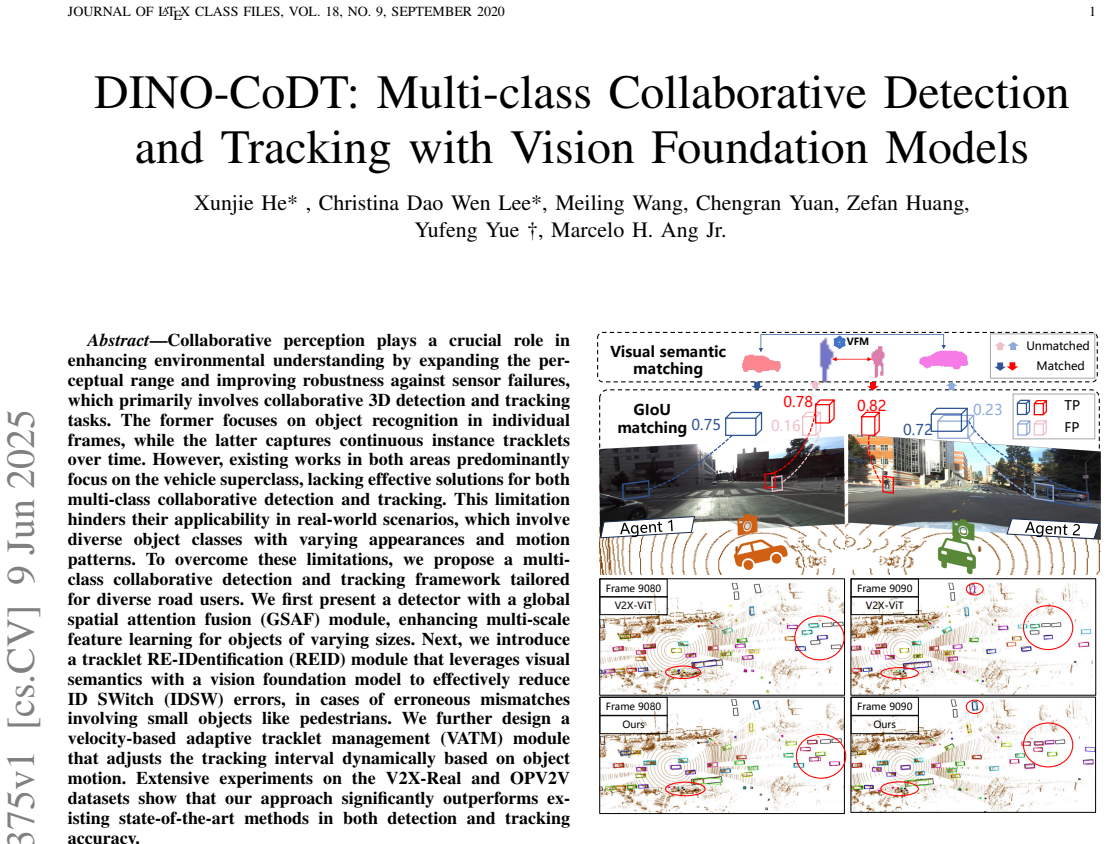
The detection side is carried by the Global Spatial Attention Fusion (GSAF) module: BEV features from all agents are split into scale-specific branches, processed with multi-scale self-attention using non-overlapping windows of size $w_s \times w_s$, and recombined by an inter-agent adaptive weighting $\beta_{m\to n}(i,j)$ computed by a shared MLP. The tracking side is carried by the Tracklet REID module, which projects unmatched detections onto raw multi-view images from all agents via camera intrinsics and ego-to-camera transforms, crops the regions, embeds them with the 31st layer of DINOv2, and matches them against a tracklet look-up table by cosine similarity. The Velocity-based Adaptive Tracklet Management module sets each tracklet's maximum age as $A_t^j = A_c + \alpha\sqrt{v_x^2+v_y^2}$, so faster-moving objects are allowed to live longer, with class-specific Kalman motion models underneath.
What would settle it
Rerun the V2X-Real pedestrian experiment with identical detections and tracker settings but feed the REID module only compressed BEV features or only the ego agent's own camera images, with no images from other agents. The paper attributes the full-module IDSW drop from 4016 to 3746 and the sAMOTA gain from 18.37 to 23.75 to the three modules together; if withholding cross-agent images eliminates the IDSW reduction or most of the sAMOTA gain, the central claim that multi-agent image sharing drives the improvement would be falsified.
Extended reading notes
Core claim
The central claim is that the vehicle-only ceiling in collaborative perception is not intrinsic, and that a single framework can handle multiple road-user classes simultaneously by pairing better fusion with appearance-based identity repair. On the paper's own terms, DINO-CoDT is the first framework to extend collaborative perception to multiple classes at once, and it establishes this by fusing LiDAR and camera BEV features with a global spatial attention fusion module, then repairing tracking associations with visual semantic matching from DINOv2 and managing tracklet lifetimes via a velocity-dependent max-age formula. On V2X-Real the full system reports AP@0.3 of 53.3 and AP@0.5 of 45.6 across vehicle, pedestrian, and truck superclasses, improving on V2X-ViT by 6.8 and 8.3 points; on the pedestrian split it reports sAMOTA 23.75 versus 18.37 and reduces IDSW from 4016 to 3746. On OPV2V, a vehicle-only simulated set, it reports AP@0.5 of 89.8 versus V2X-ViT's 85.9 and sAMOTA 57.98 versus 51.90, which the authors read as evidence that the multi-class design generalizes.
Load-bearing premise
The tracking story assumes every connected agent can send the ego agent raw multi-view camera images, or image crops, of unmatched detections in real time, since the REID module crops and embeds those images; if bandwidth or sensor asynchrony blocks that image sharing, the ID-switch reduction collapses.
Editorial extensions
If this is right
- A detector with GSAF can be plugged into existing BEV collaborative pipelines and improve small-object detection: the reported pedestrian AP@0.3 rises from the V2X-ViT baseline's 37.4 to 41.5.
- A foundation-model embedding bank can serve as a cross-agent appearance memory, so ID switches in pedestrian tracking drop without task-specific fine-tuning, from 4016 to 3746 with all modules active.
- Velocity-adaptive death thresholds imply that fixed max-age parameters are a bottleneck for multi-class tracking and that motion statistics should be used per class.
- The same pipeline transfers to vehicle-only simulated data on OPV2V with gains over baselines, so adding multi-class support need not cost vehicle-only performance.
- If the reported numbers hold, DINO-CoDT offers the first demonstration that collaborative perception can produce stable tracklets for pedestrians and trucks, not just vehicles.
Reading between the lines
- A natural extension not developed in the paper is to compress the raw image crops that the REID module requests, sending deep embeddings or sharply compressed patches only for unmatched detections; whether DINOv2 matching still works on those compressed inputs is a testable design choice.
- The ablation as reported suggests the largest tracking gain comes from the GSAF detector itself, which lifts pedestrian sAMOTA by 4.61 points, while the REID and VATM modules each contribute under 0.2 points on their own; a fairer comparison of the tracking-specific modules would measure them against a stronger detector.
- The same appearance-only DINOv2 layer-31 embedding could be reused for multi-camera pedestrian tracking across non-overlapping views outside V2X settings, since the matching is purely visual and does not require shared spatial coordinates.
- VATM's linear velocity term could be replaced by learned per-class death policies or acceleration-aware rules; the paper only tunes the single scalar $\alpha$ globally and reports marginal pedestrian gains.
Editorial analysis
A structured set of objections, weighed in public.
Referee Report
Summary. The paper proposes DINO-CoDT, a multi-class collaborative perception framework comprising a Global Spatial Attention Fusion (GSAF) module for multi-agent detection, a Tracklet RE-IDentification (REID) module that uses DINOv2 visual embeddings to reduce identity switches, and a Velocity-based Adaptive Tracklet Management (VATM) module. The method is evaluated on the V2X-Real and OPV2V datasets, reporting large detection gains (e.g., +6.8% AP@0.3 on V2X-Real) and tracking improvements in sAMOTA and MOTA. The central claim is that this is the first multi-class collaborative detection-and-tracking framework and that it significantly outperforms existing methods in both tasks.
Significance. If the detection results are reproducible, the GSAF-based multi-scale fusion is a meaningful step for multi-class collaborative perception, and the use of DINOv2 for cross-agent re-identification is a plausible direction for reducing ID switches. The paper is also among the first to evaluate collaborative tracking on a multi-class real-world benchmark. However, the evidence for the tracking-specific contribution is currently weak: the ablation confounds detection and tracking improvements, and the paper's own data show that the full system increases IDSW relative to its detector-only variant. The significance is therefore conditional on a substantial re-analysis of the experimental results.
major comments (4)
- [Section IV-E-1, Table V] The ablation for Module A (GSAF) is confounded by the addition of the camera modality. The baseline V2X-ViT is a LiDAR-only detector, whereas the row with Module A uses an extended multi-modal fusion framework that includes ResNet+LSS image features. The reported +4.1 AP@0.3 for pedestrians therefore cannot be attributed solely to GSAF; it may be due to the inclusion of cameras. To support the detection claim, the authors should ablate GSAF within the same multi-modal detector (i.e., with camera features enabled but without GSAF) rather than against a LiDAR-only baseline.
- [Section IV-E-1, Table V] The paper's central tracking claim is that the REID module reduces IDSW, citing a reduction from 4016 to 3927 in the text. However, those numbers refer to the REID module added to the baseline in isolation, not to the complete system. In the full system (A+B+C), IDSW=3746, which is 430 higher than the detector-only variant A (IDSW=3316). Thus, when combined with the improved detector, the REID and VATM modules increase IDSW rather than reduce it. The text should report and discuss the full-system IDSW and the interaction between modules; the current narrative is internally inconsistent.
- [Table VI] The REID module's benefit is marginal. With DINOv2, sAMOTA increases from 22.98 to 23.43 and IDSW decreases by only 15 (from 3316 to 3301), while ResNet-18 and ResNet-50 variants increase IDSW to 3823 and 3867. Describing the DINOv2 result as a 'significant performance improvement' is an overstatement. The authors should provide effect sizes or significance tests, and discuss whether a 15-switch reduction is meaningful relative to the total number of ground-truth tracks.
- [Section IV-B-2 and III-G] The REID module requires raw multi-view images from all connected agents at every frame; Section IV-B-2 states 'we use camera images from all connected agents to perform re-identification'. This appears to conflict with the detector's bandwidth-compression design, which shares compressed BEV features to limit communication. The paper does not quantify the bandwidth of transmitting raw camera images, nor does it explain how image sharing coexists with the stated bandwidth constraints. If raw images are not shared, the REID module as described cannot operate; if they are shared, the bandwidth argument for the detector is undermined.
minor comments (5)
- [Table III] The header of Table III contains a duplicated 'AMOTA' column; the first should be 'sAMOTA' and the second 'AMOTA'.
- [Section III-G, Eqs. (5)-(6)] The notation 'aTego' is confusing; please define the transformation matrix explicitly and explain how it differs across agents.
- [Section IV-E-1] When discussing Module B, the text says 'reduction in ID Switches from 4016 to 3927' without clarifying that this is the isolated B row relative to the baseline, not the full system. Please make this explicit to avoid confusion.
- [Section IV-F, Fig. 5] Please state whether the qualitative examples in Fig. 5 are from the test split and whether the same hyperparameters were used as in the quantitative evaluation.
- [Section V] The conclusion reports '+5.38% on sAMOTA' without specifying that this improvement is for the pedestrian superclass only, as in Table V. Please qualify the claim.
Circularity Check
No load-bearing circularity; self-citation to DINO-MOT is not used to justify the central results.
full rationale
DINO-CoDT is evaluated against external benchmarks (V2X-Real and OPV2V) and against independent baselines including F-Cooper, AttFuse, V2X-ViT, and no/late/early fusion. The proposed modules are ablated in Tables V and VI using externally defined metrics (AP, sAMOTA, AMOTA, MOTA, IDSW), so the empirical claims are not defined in terms of the method's own parameters. No equation in the paper constructs its predicted quantity from that same quantity: the GSAF attention weights in Eqs. (1)-(3) are learned from intermediate features with ground-truth supervision; the REID cosine similarity in Eq. (9) compares externally pretrained DINOv2 embeddings of crops against a look-up table; and the VATM death age in Eq. (10) is a linear function of estimated velocity with a tuned hyperparameter alpha, not a fit to the reported tracking metric. The only self-citation is DINO-MOT [25], which shares two authors with this paper and is cited for the look-up-table maintenance convention, but the REID module's contribution is independently supported by the in-paper comparison against ResNet encoders in Table VI and by benchmarking against external methods. The paper's Table V does contain an internal inconsistency: the full system reports more pedestrian IDSW (3746) than the detector-only variant (3316), which undercuts the IDSW-reduction narrative; however, this is a correctness or consistency concern, not circular derivation, because the metrics are externally grounded rather than self-defined. Overall, the central detection and tracking claims rest on benchmark comparisons and ablations that do not reduce to the method's inputs by construction.
Assumptions & free parameters
free parameters (5)
- alpha (velocity weight in VATM) =
not given; optimal range 1.0-1.2 in Fig. 4
- beta (visual similarity threshold) =
not given
- initial max age A_c per class =
not given
- IoU matching thresholds =
not given; Fig. 4 shows optimal range
- confidence threshold =
0.1
assumptions (4)
- domain assumption DINOv2 layer 31 features are discriminative for re-identifying pedestrians and vehicles across camera viewpoints and agents.
- domain assumption Class-specific motion models approximate real motion: constant yaw rate and acceleration for vehicles and pedestrians, constant velocity for trucks.
- domain assumption Camera images from all agents are available for re-identification at runtime.
- standard math The 3D IoU + Hungarian/greedy association is a valid base tracker for fair comparison.
Cite this review
Pith. "Pith review of DINO-CoDT: Multi-class Collaborative Detection and Tracking with Vision Foundation Models." pith.science (2026). https://pith.science/paper/RXHSCV5Q
@misc{pith2026250607375,
  author       = {Pith},
  title        = {Pith review of: DINO-CoDT: Multi-class Collaborative Detection and Tracking with Vision Foundation Models},
  year         = {2026},
  howpublished = {\url{https://pith.science/paper/RXHSCV5Q}},
  note         = {Machine review of arXiv:2506.07375}
}
read the original abstract
Collaborative perception plays a crucial role in enhancing environmental understanding by expanding the perceptual range and improving robustness against sensor failures, which primarily involves collaborative 3D detection and tracking tasks. The former focuses on object recognition in individual frames, while the latter captures continuous instance tracklets over time. However, existing works in both areas predominantly focus on the vehicle superclass, lacking effective solutions for both multi-class collaborative detection and tracking. This limitation hinders their applicability in real-world scenarios, which involve diverse object classes with varying appearances and motion patterns. To overcome these limitations, we propose a multi-class collaborative detection and tracking framework tailored for diverse road users. We first present a detector with a global spatial attention fusion (GSAF) module, enhancing multi-scale feature learning for objects of varying sizes. Next, we introduce a tracklet RE-IDentification (REID) module that leverages visual semantics with a vision foundation model to effectively reduce ID SWitch (IDSW) errors, in cases of erroneous mismatches involving small objects like pedestrians. We further design a velocity-based adaptive tracklet management (VATM) module that adjusts the tracking interval dynamically based on object motion. Extensive experiments on the V2X-Real and OPV2V datasets show that our approach significantly outperforms existing state-of-the-art methods in both detection and tracking accuracy.
Figures


Figures from the paper (2 more)


Reference graph
Works this paper leans on
-
[1]
Macim: Multi-agent collaborative implicit mapping,
Y . Deng, Y . Tang, Y . Yang, D. Wang, and Y . Yue, “Macim: Multi-agent collaborative implicit mapping,”IEEE Robotics and Automation Letters, 2024
work page 2024
-
[2]
Y . Tang, M. Wang, Y . Deng, Y . Yang, Z. Lan, and Y . Yue, “Multi- view robust collaborative localization in high outlier ratio scenes based on semantic features,” in2023 IEEE/RSJ International Conference on Intelligent Robots and Systems (IROS). IEEE, 2023, pp. 11 042–11 047
work page 2023
-
[3]
Collaborative 3d object detection for autonomous vehicles via learnable communications,
J. Wang, Y . Zeng, and Y . Gong, “Collaborative 3d object detection for autonomous vehicles via learnable communications,”IEEE Trans. Intell. Transp. Syst., vol. 24, no. 9, pp. 9804–9816, 2023. JOURNAL OF LATEX CLASS FILES, VOL. 18, NO. 9, SEPTEMBER 2020 11
work page 2023
-
[4]
Q. Chen, X. Ma, S. Tang, J. Guo, Q. Yang, and S. Fu, “F-cooper: Feature based cooperative perception for autonomous vehicle edge computing system using 3D point clouds,” inProc. 4th ACM/IEEE Symp. Edge Comput., 2019, pp. 88–100
work page 2019
-
[5]
V2x-vit: Vehicle-to-everything cooperative perception with vision transformer,
R. Xu, H. Xiang, Z. Tu, X. Xia, M.-H. Yang, and J. Ma, “V2x-vit: Vehicle-to-everything cooperative perception with vision transformer,” inEur. Conf. Comput. Vis.Springer, 2022, pp. 107–124
work page 2022
-
[6]
Robust collaborative perception against temporal information disturbance,
X. He, Y . Li, T. Cui, M. Wang, T. Liu, and Y . Yue, “Robust collaborative perception against temporal information disturbance,” in2024 ieee International Conference on Robotics and Automation (ICRA). IEEE, 2024, pp. 16 207–16 213
work page 2024
-
[7]
R. Xu, H. Xiang, X. Xia, X. Han, J. Li, and J. Ma, “Opv2v: An open benchmark dataset and fusion pipeline for perception with vehicle-to- vehicle communication,” inProc IEEE Int. Conf. Rob. Autom.IEEE, 2022, pp. 2583–2589
work page 2022
-
[8]
V2x-real: a largs-scale dataset for vehicle-to-everything cooperative perception,
H. Xiang, Z. Zheng, X. Xia, R. Xu, L. Gao, Z. Zhou, X. Han, X. Ji, M. Li, Z. Menget al., “V2x-real: a largs-scale dataset for vehicle-to-everything cooperative perception,” inEuropean Conference on Computer Vision. Springer, 2024, pp. 455–470
work page 2024
Show all 31 references
-
[9]
Efficient vehicle- infrastructure collaborative perception based on vehicle re-identification and mini-icp algorithm,
C. Sun, Y . Wang, Y . Deng, H. Li, R. Zhou, and J. Guo, “Efficient vehicle- infrastructure collaborative perception based on vehicle re-identification and mini-icp algorithm,”IEEE Trans. Intell. Transp. Syst., vol. 25, no. 7, pp. 6580–6593, 2024
2024
-
[10]
V2vformer++: Multi-modal vehicle-to-vehicle cooperative perception via global-local transformer,
H. Yin, D. Tian, C. Lin, X. Duan, J. Zhou, D. Zhao, and D. Cao, “V2vformer++: Multi-modal vehicle-to-vehicle cooperative perception via global-local transformer,”IEEE Transactions on Intelligent Trans- portation Systems, vol. 25, no. 2, pp. 2153–2166, 2023
2023
-
[11]
Probabilistic 3d multi-object cooperative tracking for autonomous driving via differ- entiable multi-sensor kalman filter,
H.-k. Chiu, C.-Y . Wang, M.-H. Chen, and S. F. Smith, “Probabilistic 3d multi-object cooperative tracking for autonomous driving via differ- entiable multi-sensor kalman filter,”IEEE International Conference on Robotics and Automation (ICRA), 2024
2024
-
[12]
Fast-poly: A fast polyhedral algorithm for 3d multi-object tracking,
X. Li, D. Liu, Y . Wu, X. Wu, L. Zhao, and J. Gao, “Fast-poly: A fast polyhedral algorithm for 3d multi-object tracking,”IEEE Robotics and Automation Letters, 2024
2024
-
[13]
Dinov2: Learning robust visual features without supervision,
M. Oquab, T. Darcet, T. Moutakanni, H. V o, M. Szafraniec, V . Khalidov, P. Fernandez, D. Haziza, F. Massa, A. El-Noubyet al., “Dinov2: Learning robust visual features without supervision,”Transactions on Machine Learning Research Journal, pp. 1–31, 2024
2024
-
[14]
Conftrack: Kalman filter-based multi-person tracking by utilizing confidence score of detection box,
H. Jung, S. Kang, T. Kim, and H. Kim, “Conftrack: Kalman filter-based multi-person tracking by utilizing confidence score of detection box,” inProceedings of the IEEE/CVF winter conference on applications of computer vision, 2024, pp. 6583–6592
2024
-
[15]
AB3DMOT: A Baseline for 3D Multi-Object Tracking and New Evaluation Metrics,
X. Weng, J. Wang, D. Held, and K. Kitani, “AB3DMOT: A Baseline for 3D Multi-Object Tracking and New Evaluation Metrics,”ECCVW, 2020
2020
-
[16]
Cooper: Cooperative perception for connected autonomous vehicles based on 3d point clouds,
Q. Chen, S. Tang, Q. Yang, and S. Fu, “Cooper: Cooperative perception for connected autonomous vehicles based on 3d point clouds,” in2019 IEEE 39th International Conference on Distributed Computing Systems (ICDCS). IEEE, 2019, pp. 514–524
2019
-
[17]
Cooperative perception for 3d object detection in driving scenarios using infrastruc- ture sensors,
E. Arnold, M. Dianati, R. de Temple, and S. Fallah, “Cooperative perception for 3d object detection in driving scenarios using infrastruc- ture sensors,”IEEE Transactions on Intelligent Transportation Systems, vol. 23, no. 3, pp. 1852–1864, 2020
2020
-
[18]
Object detection with discriminatively trained part-based models,
P. F. Felzenszwalb, R. B. Girshick, D. McAllester, and D. Ramanan, “Object detection with discriminatively trained part-based models,” IEEE transactions on pattern analysis and machine intelligence, vol. 32, no. 9, pp. 1627–1645, 2009
2009
-
[19]
V2vnet: Vehicle-to-vehicle communication for joint perception and prediction,
T.-H. Wang, S. Manivasagam, M. Liang, B. Yang, W. Zeng, and R. Ur- tasun, “V2vnet: Vehicle-to-vehicle communication for joint perception and prediction,” inEur. Conf. Comput. Vis.Springer, 2020, pp. 605– 621
2020
-
[20]
When2com: Multi-agent perception via communication graph grouping,
Y .-C. Liu, J. Tian, N. Glaser, and Z. Kira, “When2com: Multi-agent perception via communication graph grouping,” inIEEE Conf. Comput. Vis. Pattern Recog., 2020, pp. 4106–4115
2020
-
[21]
Where2comm: Communication-efficient collaborative perception via spatial confidence maps,
Y . Hu, S. Fang, Z. Lei, Y . Zhong, and S. Chen, “Where2comm: Communication-efficient collaborative perception via spatial confidence maps,” inProc Adv. Neural. Inf. Process. Syst., vol. 35, 2022, pp. 4874– 4886
2022
-
[22]
Select2Col: Leveraging spatial-temporal importance of se- mantic information for efficient collaborative perception,
Y . Liu, Q. Huang, R. Li, X. Chen, Z. Zhao, S. Zhao, Y . Zhu, and H. Zhang, “Select2Col: Leveraging spatial-temporal importance of se- mantic information for efficient collaborative perception,”IEEE Trans. Veh. Technol., vol. 73, no. 9, pp. 12 556–12 569, 2024
2024
-
[23]
Collaboration helps camera overtake lidar in 3D detection,
Y . Hu, Y . Lu, R. Xu, W. Xie, S. Chen, and Y . Wang, “Collaboration helps camera overtake lidar in 3D detection,” inIEEE Conf. Comput. Vis. Pattern Recog., 2023, pp. 9243–9252
2023
-
[24]
CoBEVT: Coop- erative bird’s eye view semantic segmentation with sparse transformers,
R. Xu, Z. Tu, H. Xiang, W. Shao, B. Zhou, and J. Ma, “CoBEVT: Coop- erative bird’s eye view semantic segmentation with sparse transformers,” inConf. Robot. Learn.PMLR, 2023, pp. 989–1000
2023
-
[25]
Dino-mot: 3d multi-object tracking with visual foundation model for pedestrian re- identification using visual memory mechanism,
M. Y . Lee, C. D. W. Lee, J. Li, and M. H. Ang Jr, “Dino-mot: 3d multi-object tracking with visual foundation model for pedestrian re- identification using visual memory mechanism,”IEEE Robotics and Automation Letters, 2024
2024
-
[26]
Quasi- dense similarity learning for multiple object tracking,
J. Pang, L. Qiu, X. Li, H. Chen, Q. Li, T. Darrell, and F. Yu, “Quasi- dense similarity learning for multiple object tracking,” inProceedings of the IEEE/CVF Conference on Computer Vision and Pattern Recognition (CVPR), June 2021, pp. 164–173
2021
-
[27]
Simple online and realtime tracking with a deep association metric,
N. Wojke, A. Bewley, and D. Paulus, “Simple online and realtime tracking with a deep association metric,” in2017 IEEE international conference on image processing (ICIP). IEEE, 2017, pp. 3645–3649
2017
-
[28]
Samba: Synchronized set-of-sequences modeling for end-to-end multi- ple object tracking,
M. Segu, L. Piccinelli, S. Li, Y .-H. Yang, L. Van Gool, and B. Schiele, “Samba: Synchronized set-of-sequences modeling for end-to-end multi- ple object tracking,”arXiv preprint arXiv:2410.01806, 2024
2024 arXiv
-
[29]
Bevfusion: Multi-task multi-sensor fusion with unified bird’s-eye view representation,
Z. Liu, H. Tang, A. Amini, X. Yang, H. Mao, D. L. Rus, and S. Han, “Bevfusion: Multi-task multi-sensor fusion with unified bird’s-eye view representation,” in2023 IEEE international conference on robotics and automation (ICRA). IEEE, 2023, pp. 2774–2781
2023
-
[30]
Assignment algorithms for multi-robot multi- target tracking with sufficient and limited sensing capability,
P. Li and L. Zhou, “Assignment algorithms for multi-robot multi- target tracking with sufficient and limited sensing capability,” in2023 IEEE/RSJ International Conference on Intelligent Robots and Systems (IROS). IEEE, 2023, pp. 11 035–11 041
2023
-
[31]
Anyloc: Towards universal visual place recognition,
N. Keetha, A. Mishra, J. Karhade, K. M. Jatavallabhula, S. Scherer, M. Krishna, and S. Garg, “Anyloc: Towards universal visual place recognition,”IEEE Robotics and Automation Letters, vol. 9, no. 2, pp. 1286–1293, 2023
2023
Reviewed August 7, 2026 · model on record in the stance chip above.
Discussion (0). Sign in to comment.