Twilight of the WIMP: Comprehensive Phenomenology of Electroweak Triplet Dark Matter
Pith reviewed 2026-06-29 10:51 UTC · model grok-4.3
The pith
The Y=0 fermion triplet is the only surviving electroweak triplet dark matter candidate, with its parameter space now accessible to near-future indirect detection experiments.
A machine-rendered reading of the paper's core claim, the machinery that carries it, and where it could break.
Core claim
After applying relic density, direct detection, and indirect detection constraints, the scalar triplet with Y=0 is ruled out, both Y=2 triplets are excluded by direct detection, and the viable parameter space of the Y=0 fermion triplet dark matter lies within the projected sensitivity of near-future experiments, particularly indirect detection signatures.
What carries the argument
The Z2-stabilized electroweak triplet scalar and fermion fields with Y=0 or Y=2, whose parameter spaces are scanned for consistency with cosmological and experimental limits.
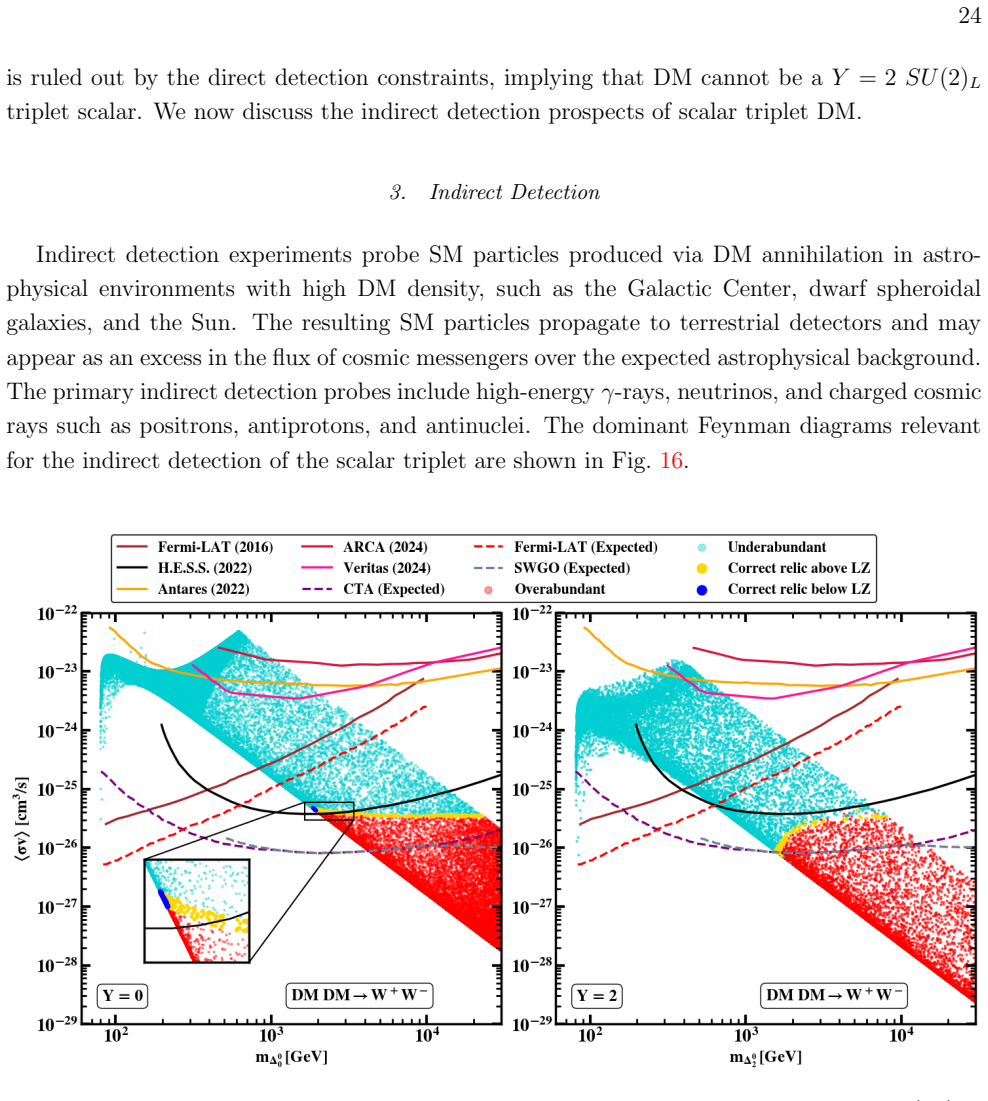
If this is right
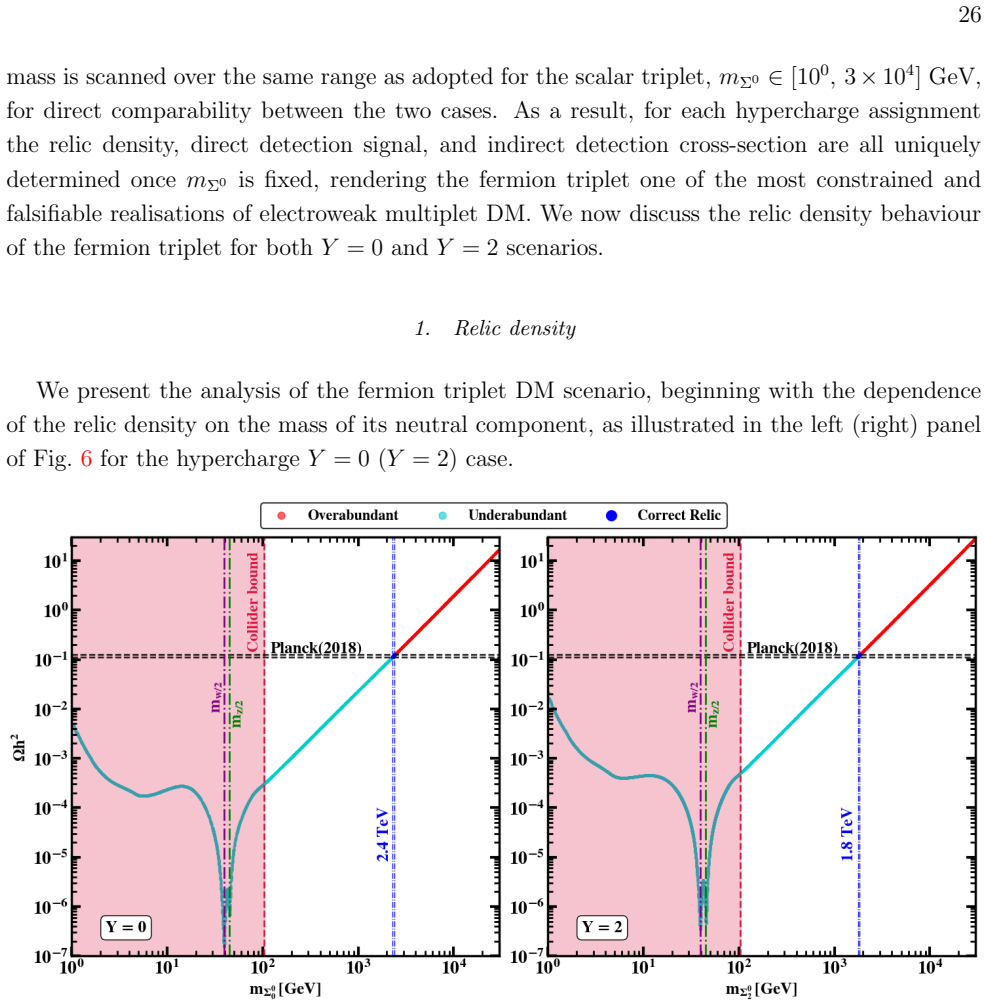
- Scalar triplet with Y=0 is excluded by relic density combined with direct and indirect detection.
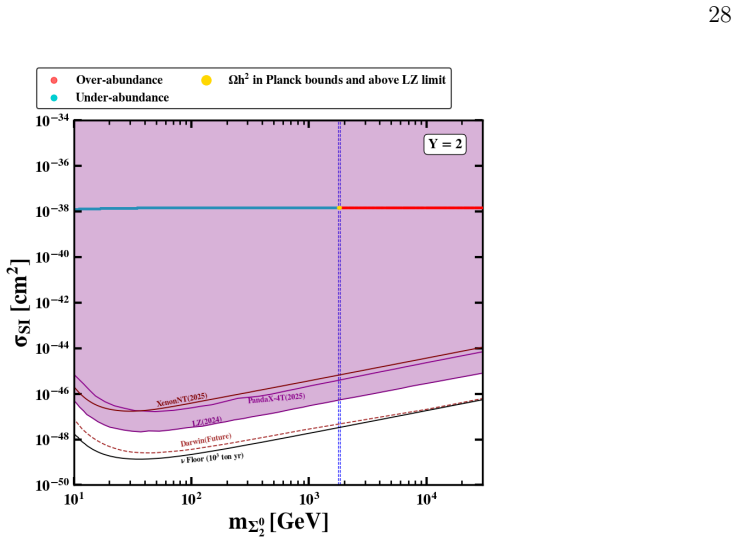
- Y=2 scalar and fermion triplets are ruled out by current direct detection limits due to large spin-independent scattering.
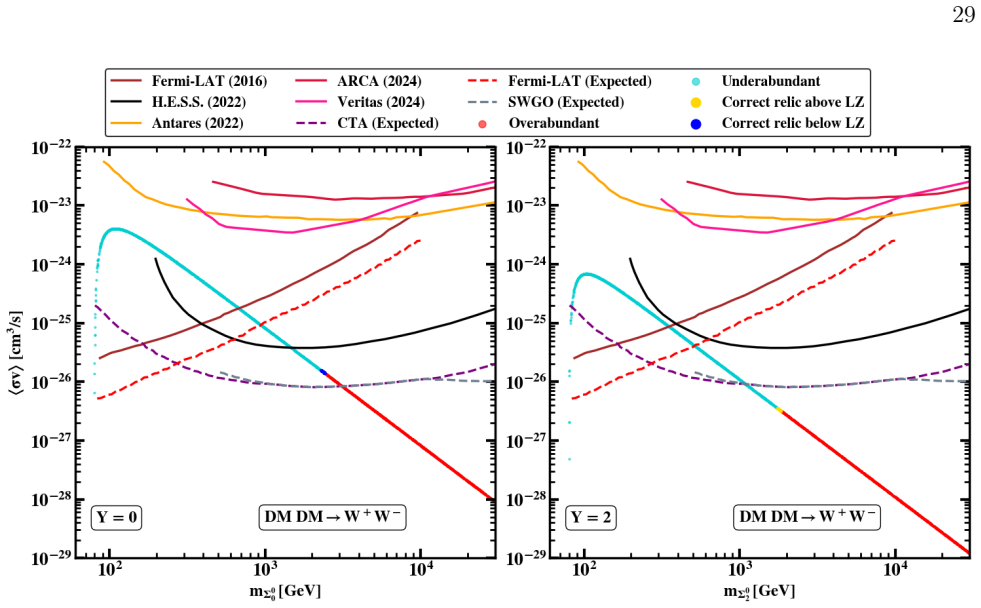
- The Y=0 fermion triplet remains viable and its allowed regions will be probed by near-future indirect detection experiments.
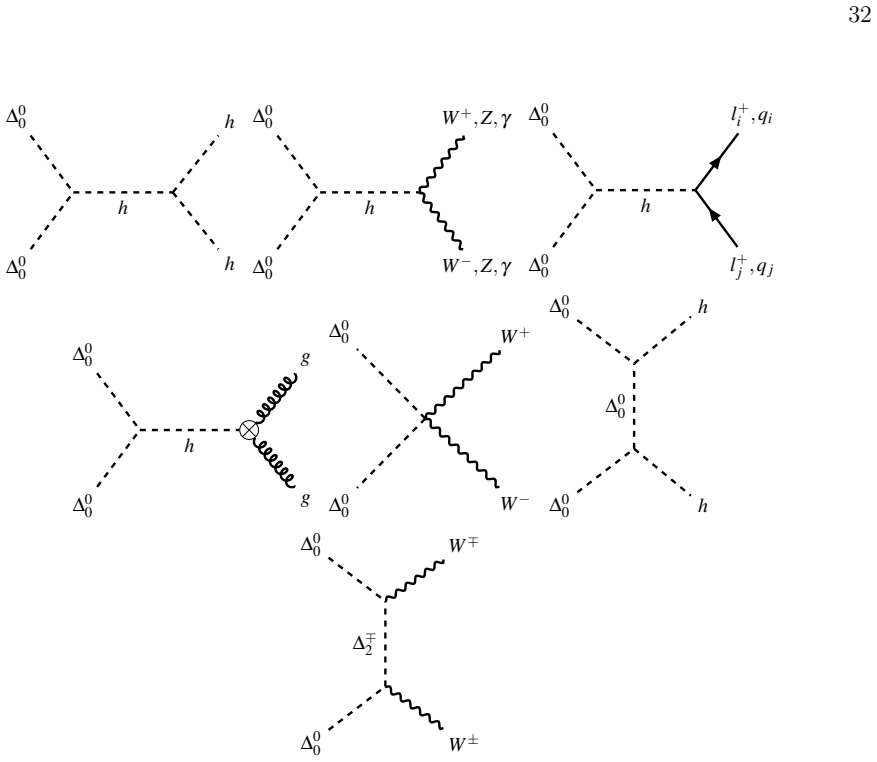
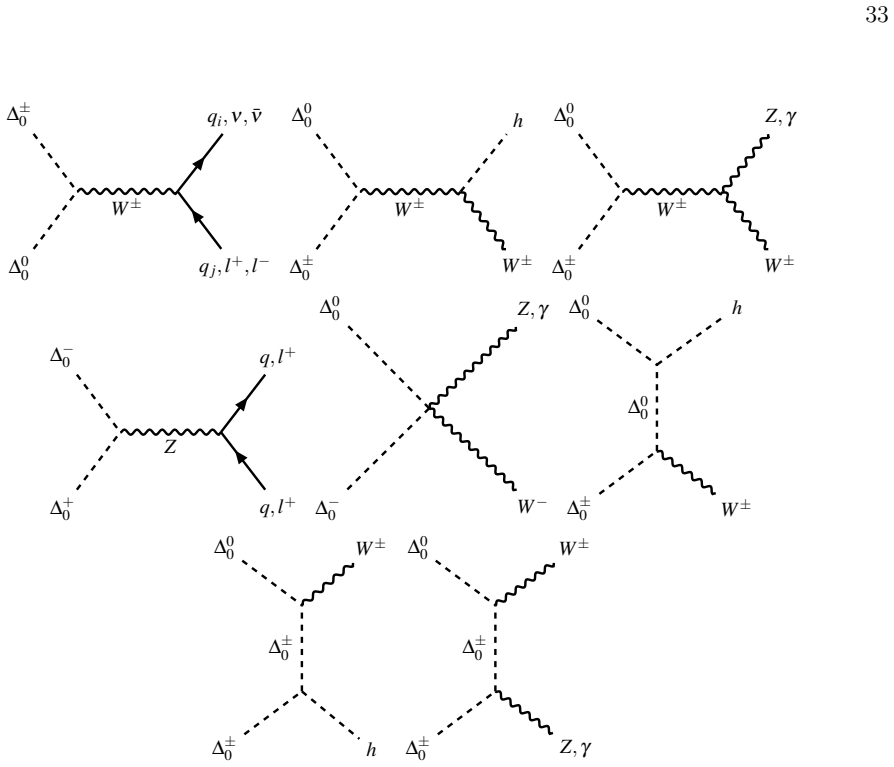
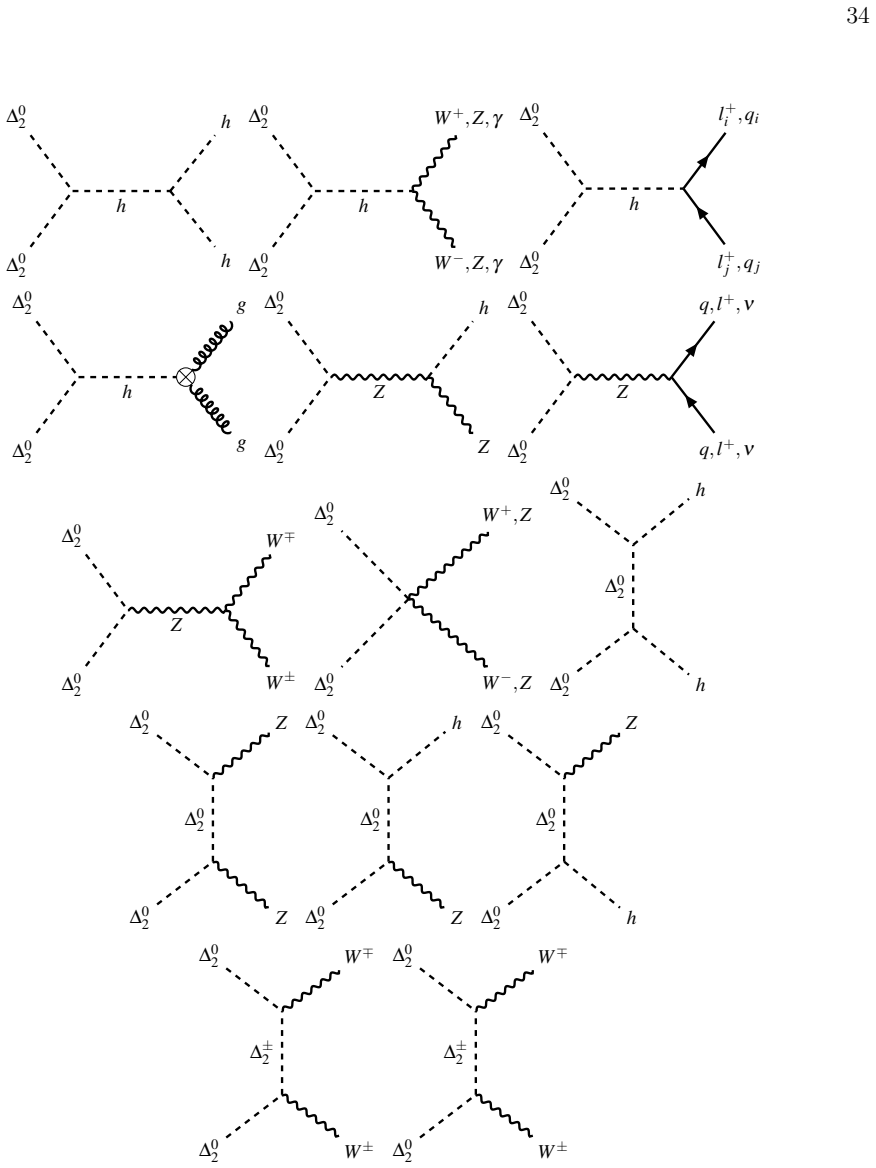
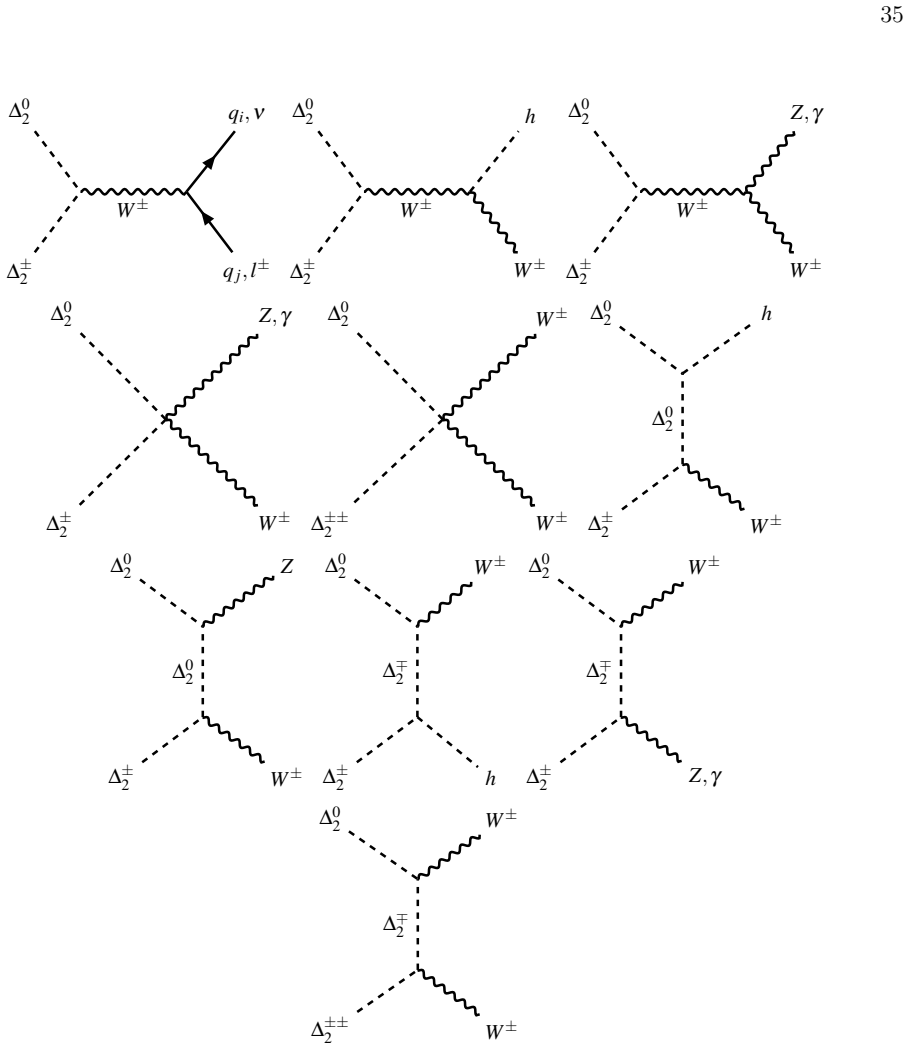
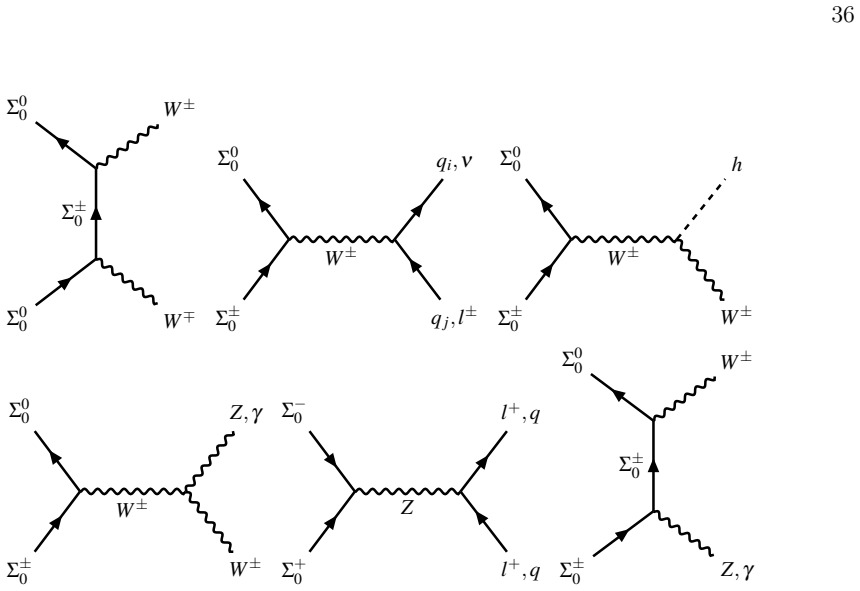
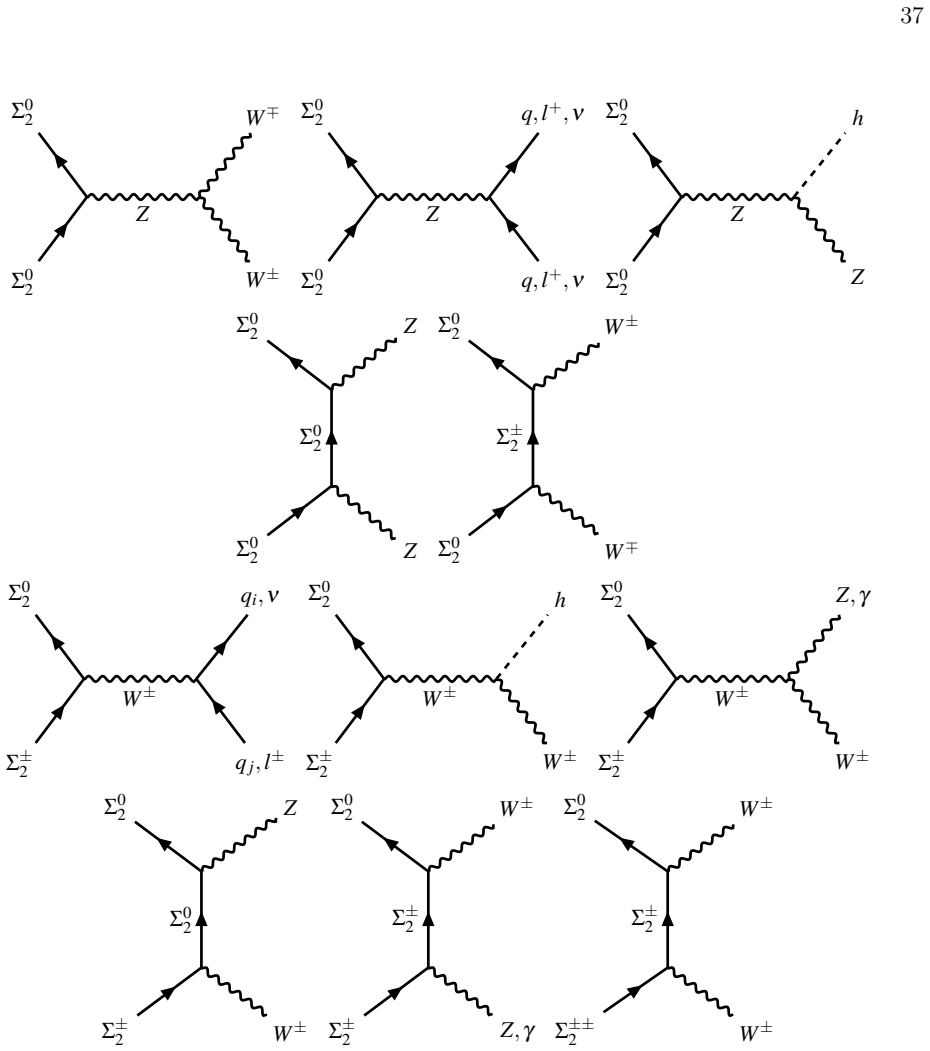
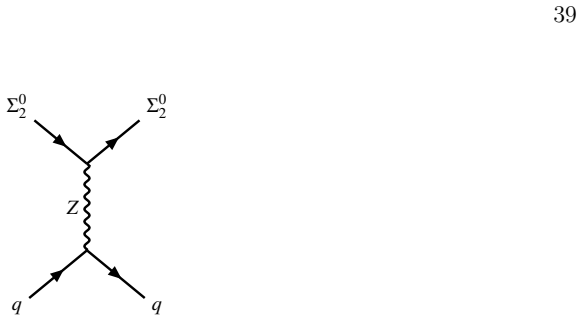
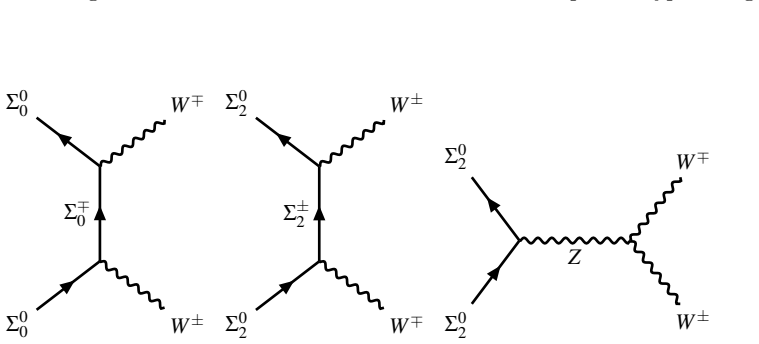
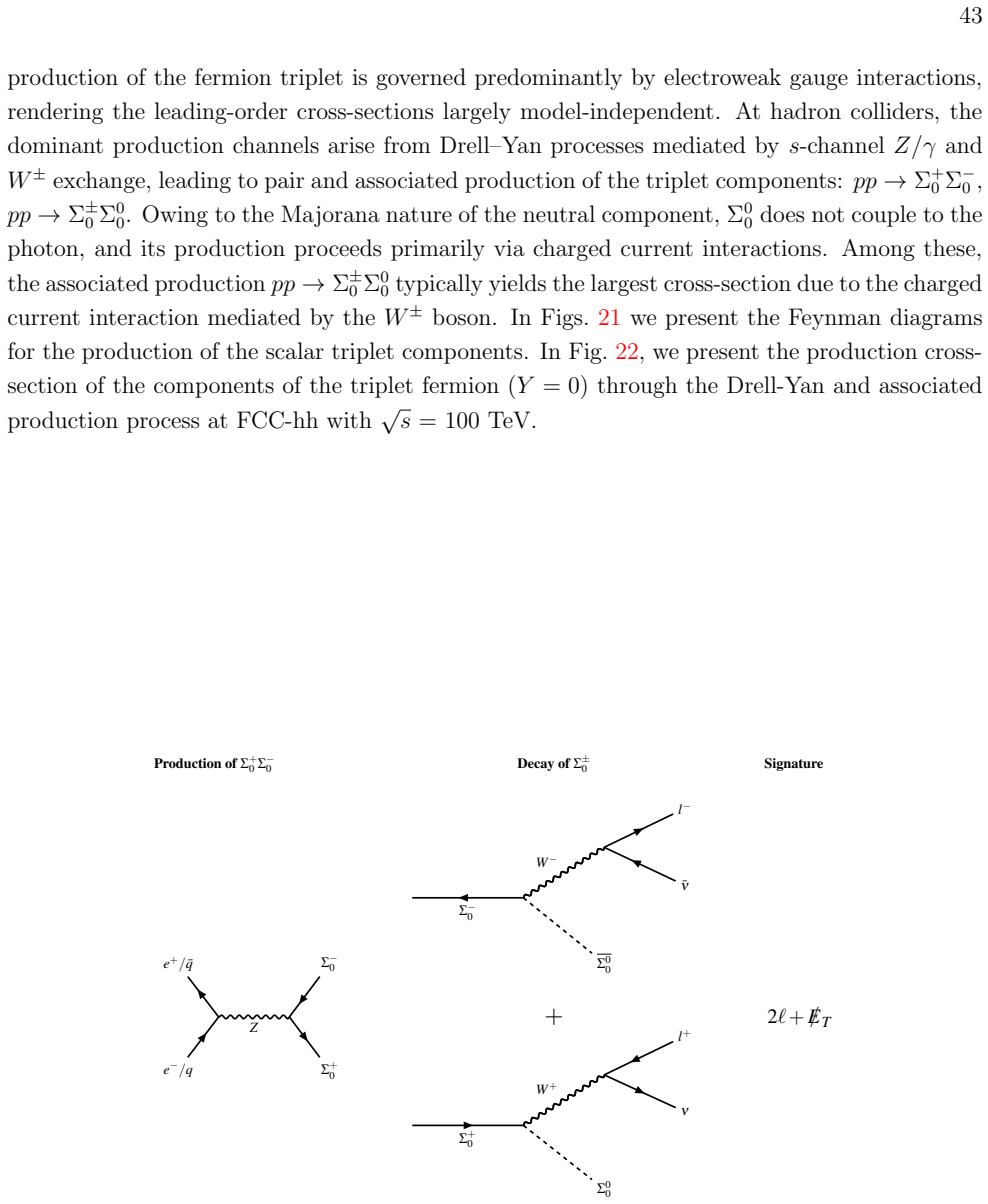
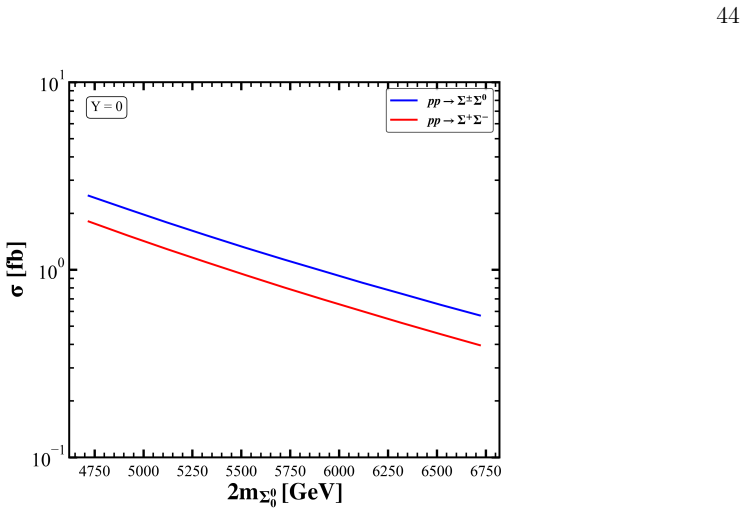
- Collider prospects for these models are outlined in the appendix.
Where Pith is reading between the lines
- If no signal appears in upcoming indirect detection, the thermal WIMP triplet scenario would be strongly disfavored.
- Similar comprehensive scans could be applied to other minimal dark matter extensions to identify surviving candidates.
- Non-thermal production mechanisms could reopen excluded parameter spaces if the thermal assumption is relaxed.
Load-bearing premise
The relic density is set exclusively by thermal freeze-out in the minimal model without additional production mechanisms or co-annihilations.
What would settle it
A null result from all planned indirect detection experiments that covers the entire remaining viable mass range for the Y=0 fermion triplet would falsify the model's viability under current assumptions.
Figures
read the original abstract
We present a comprehensive study of dark matter phenomenology in standard model extensions featuring an electroweak triplet scalar or fermion with hypercharge $Y = 0$ or $Y = 2$. These minimal triplet extensions provide well-motivated dark matter candidates stabilised by the $Z_2$ discrete symmetry. We perform a detailed analysis of the parameter space consistent with current cosmological and experimental constraints, including the relic abundance, direct detection limits, and indirect detection bounds. We find that the scalar triplet with $Y=0$ is ruled out by a combination of relic density, direct detection and indirect detection constraints. On the other hand, the scalar and fermionic triplets with $Y=2$ are both excluded by current direct detection experiments due to their large spin-independent scattering cross-sections. The viable parameter space of the remaining $Y=0$ fermion triplet dark matter lies within the projected sensitivity of near-future experiments, particularly those targeting indirect detection signatures. Collider prospects for these triplet extensions are also discussed in the Appendix.
Editorial analysis
A structured set of objections, weighed in public.
Referee Report
Summary. The manuscript presents a comprehensive phenomenological analysis of dark matter candidates arising in minimal Standard Model extensions containing an electroweak triplet scalar or fermion with hypercharge Y=0 or Y=2, stabilized by a Z_2 discrete symmetry. It confronts the model predictions with relic-density, direct-detection, and indirect-detection constraints and concludes that the scalar triplet with Y=0 is excluded by the combination of these limits, that both the scalar and fermionic Y=2 triplets are ruled out by current direct-detection bounds, and that the remaining Y=0 fermionic triplet has viable parameter space lying within the projected reach of near-future indirect-detection experiments. Collider prospects are discussed in an appendix.
Significance. If the central results hold, the work supplies a clear and up-to-date delineation of the viable parameter space for these minimal triplet dark-matter models, demonstrating that most variants are already excluded while the surviving candidate is directly testable by near-term indirect searches. The analysis rests on standard thermal freeze-out (including the co-annihilations inherent to the triplet) together with loop-suppressed direct detection and tree-level plus Sommerfeld-enhanced indirect rates; this constitutes a strength, as the exclusions are derived from independent external limits rather than by construction.
minor comments (2)
- Abstract: a short parenthetical statement of the approximate mass window still allowed for the Y=0 fermion triplet would make the final claim more quantitative without lengthening the text appreciably.
- Appendix: the collider discussion would benefit from explicit reference to the production cross sections or parton-level processes that set the sensitivity reach, even if only at leading order.
Simulated Author's Rebuttal
We thank the referee for their positive assessment of our work and their recommendation to accept the manuscript. No major comments were raised in the report.
Circularity Check
No significant circularity identified
full rationale
The paper performs standard thermal freeze-out relic density calculations (including co-annihilations), applies loop-suppressed direct detection rates, and computes tree-level plus Sommerfeld-enhanced indirect detection rates for the minimal Z2-stabilized electroweak triplet extensions. These predictions are then confronted with independent external experimental limits and projected sensitivities rather than being fitted to reproduce them. No load-bearing step reduces by construction to a self-definition, a fitted input renamed as a prediction, or a self-citation chain; the central claim that only the Y=0 fermion triplet remains viable and lies within near-future indirect detection reach follows directly from the minimal-model assumptions and external benchmarks.
Axiom & Free-Parameter Ledger
free parameters (1)
- triplet mass
axioms (2)
- domain assumption Z2 discrete symmetry stabilizes the lightest triplet state as dark matter
- domain assumption Relic abundance determined by thermal freeze-out in the minimal extension
invented entities (1)
-
Electroweak triplet scalar or fermion with Y=0 or Y=2
no independent evidence
Reference graph
Works this paper leans on
-
[1]
(8) At tree level, the components of the scalar triplet are degenerate in mass, as no term in the scalar potential can create mass splitting. Since the neutral component of the scalar triplet field ∆0 0 does not acquire a VEV ( ⟨∆0 0⟩ = 0), electroweak symmetry breaking does not induce any additional mass splitting, and the components remain degenerate at...
-
[2]
So, we are imposing BR(h → ∆0 0∆0 0), BR(h → ∆0 2∆0
-
[3]
Therefore, the Higgs does not couple to the neutral triplet fermion at tree level, and the Higgs invisible decay into these dark sector particles is absent
< 0.107 (32) For fermion triplet DM with Y=0 or Y=2, a gauge and Z2 symmetry-invariant renormalisable Yukawa interaction with the SM Higgs doublet cannot be constructed. Therefore, the Higgs does not couple to the neutral triplet fermion at tree level, and the Higgs invisible decay into these dark sector particles is absent. 13 D. LEP Constraints LEP prov...
-
[4]
In particular, pair production processes such as e+e− → γ∗/Z → ∆++ 2 ∆−− 2 provide strong constraints
In addition to singly charged scalar production, the presence of doubly charged scalars leads to distinctive signatures. In particular, pair production processes such as e+e− → γ∗/Z → ∆++ 2 ∆−− 2 provide strong constraints. LEP searches for doubly charged scalars impose lower bounds of approximately m∆±± 2 ≳ 100 GeV , with comparable bounds on the singly ...
-
[5]
In this case, the neutral component has a non-vanishing coupling to the Z-boson, and all components participate in electroweak interactions. As a result, LEP-I measurements of the Z-boson width constrain the decays, Z → Σ0 2Σ0 2, Z → Σ+ 2 Σ− 2 , Z → Σ++ 2 Σ−− 2 , which leads to the bounds 2 mΣ0 2 > m Z, 2 mΣ+ 2 > m Z, 2 mΣ++ 2 > m Z . Furthermore, kinemat...
-
[6]
The doubly charged scalar leads to striking collider signatures through decays like ∆±± 2 → ℓ±ℓ± or ∆ ±± 2 → W ±W ±
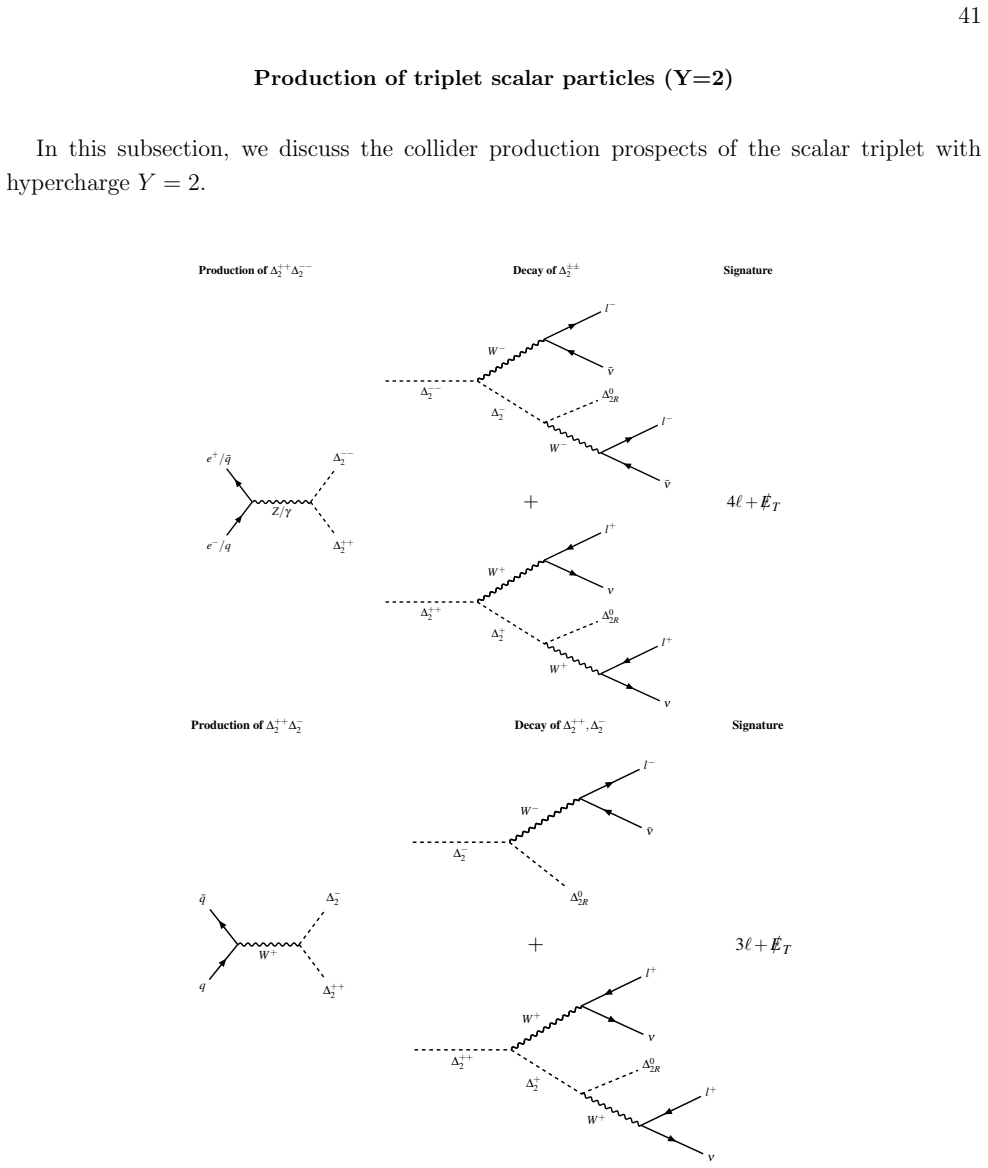
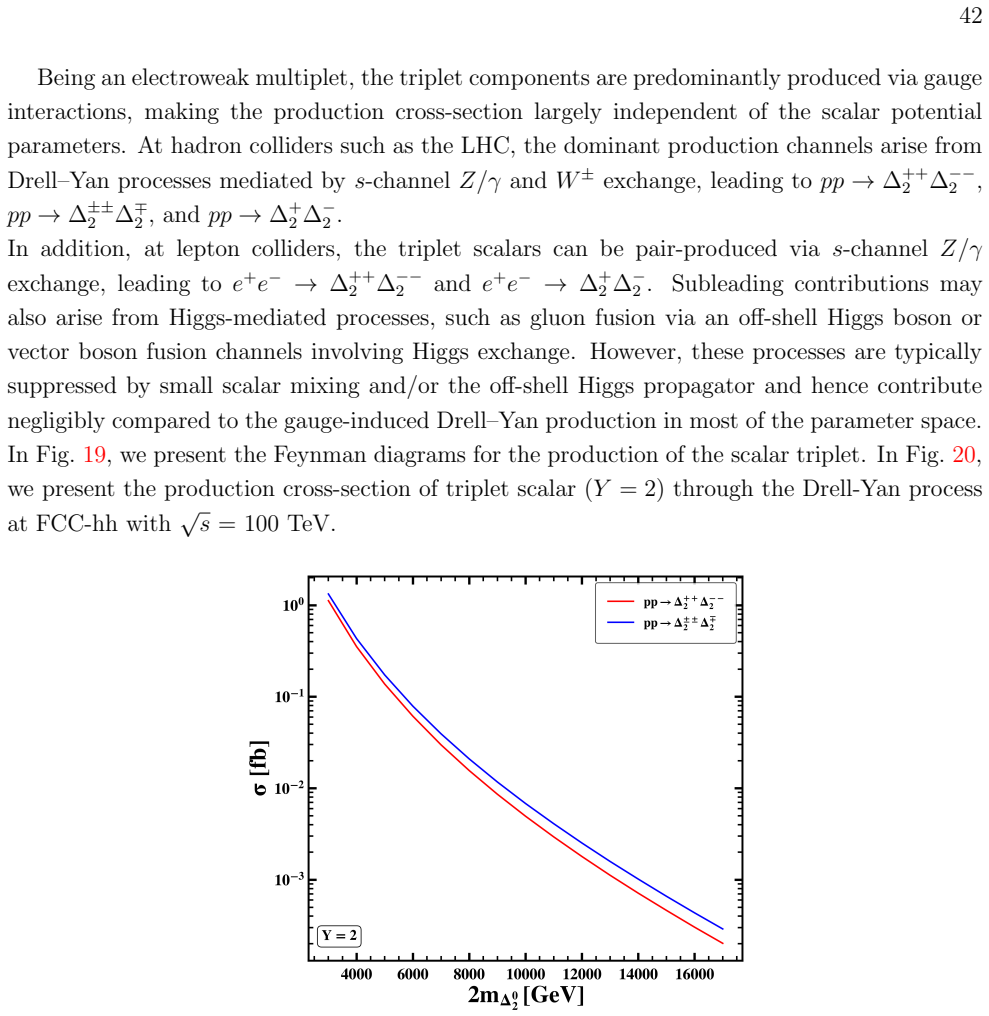
At the LHC, these states can be produced through electroweak processes such as pp → ∆++ 2 ∆−− 2 and pp → ∆±± 2 ∆∓ 2 . The doubly charged scalar leads to striking collider signatures through decays like ∆±± 2 → ℓ±ℓ± or ∆ ±± 2 → W ±W ±. Searches for same-sign dilepton final states at the LHC place strong bounds on the mass of the doubly charged scalar, typi...
-
[7]
Results are shown separately for the two hypercharge assignments of the scalar triplet: Y = 0 (left panels) and Y = 2 (right panels)
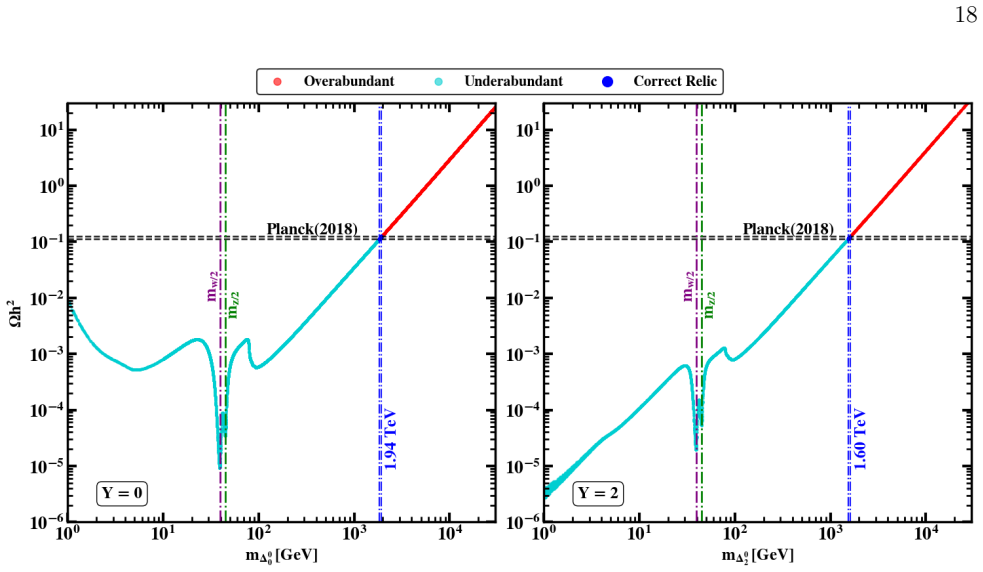
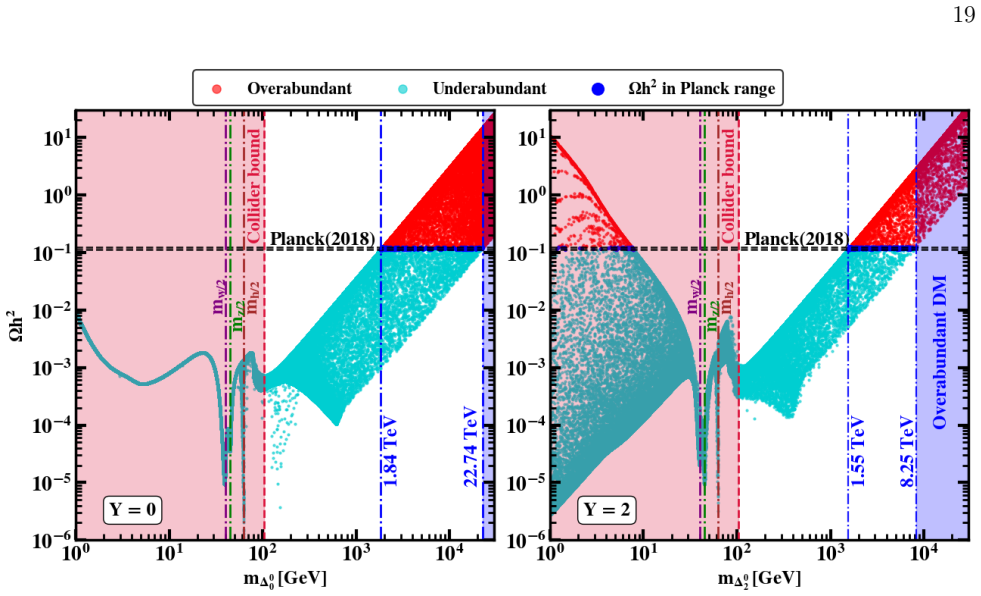
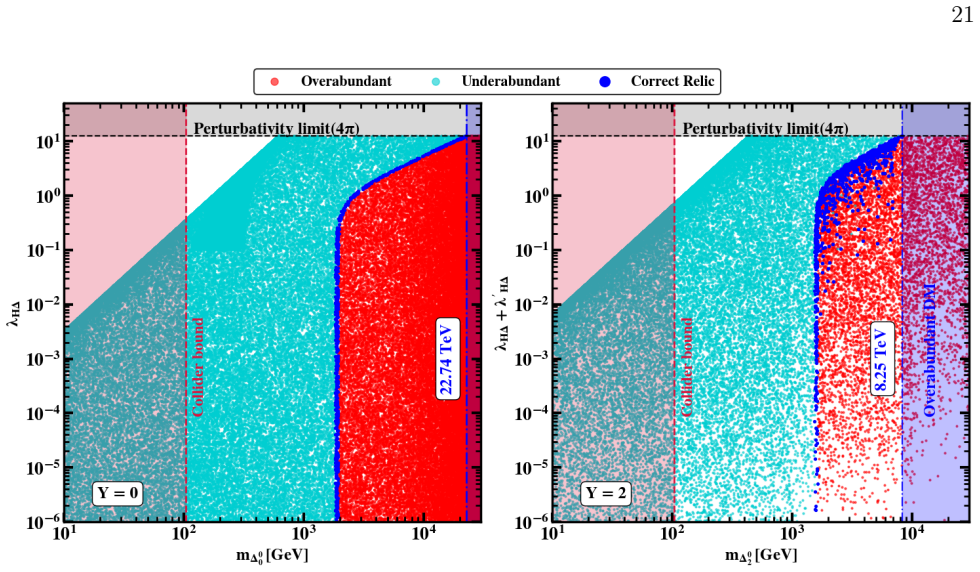
Relic Density We present the relic density Ωh2 of the scalar triplet DM candidate as a function of its mass. Results are shown separately for the two hypercharge assignments of the scalar triplet: Y = 0 (left panels) and Y = 2 (right panels). The dark-turquoise, red, and blue points represent under-abundant, over-abundant, and correct relic density, respe...
-
[8]
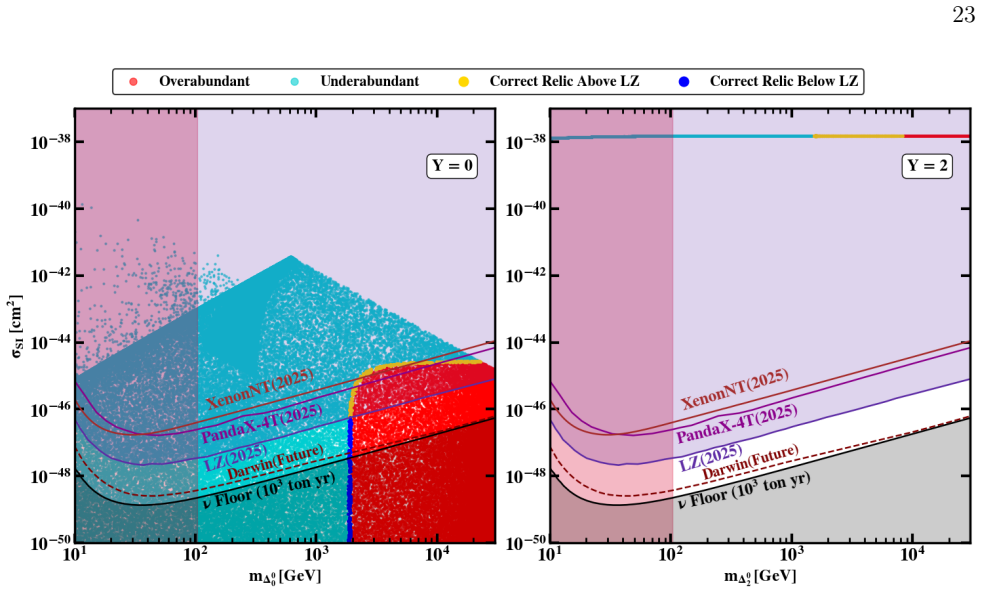
Direct Detection After identifying the region of parameter space compatible with the observed relic density, we investigate the implications for direct detection experiments. Direct Detection experiments aim to observe the rare elastic scattering of galactic DM particles off nuclei in terrestrial detectors, measuring the small recoil energies ( ∼keV) depo...
2025
-
[9]
The resulting SM particles propagate to terrestrial detectors and may appear as an excess in the flux of cosmic messengers over the expected astrophysical background
Indirect Detection Indirect detection experiments probe SM particles produced via DM annihilation in astro- physical environments with high DM density, such as the Galactic Center, dwarf spheroidal galaxies, and the Sun. The resulting SM particles propagate to terrestrial detectors and may appear as an excess in the flux of cosmic messengers over the expe...
-
[10]
6 for the hypercharge Y = 0 (Y = 2) case
Relic density We present the analysis of the fermion triplet DM scenario, beginning with the dependence of the relic density on the mass of its neutral component, as illustrated in the left (right) panel of Fig. 6 for the hypercharge Y = 0 (Y = 2) case. FIG. 6: Relic density as a function of triplet fermion DM mass. The color scheme is same as that used i...
-
[11]
This is due to the absence of Higgs and Z couplings for the neutral component, while W -mediated interactions are inelastic and kinematically suppressed
Direct Detection For the fermion triplet with Y = 0, the spin-independent and spin-dependent direct detection cross-sections vanish at tree level. This is due to the absence of Higgs and Z couplings for the neutral component, while W -mediated interactions are inelastic and kinematically suppressed. Consequently, only loop-induced processes generate extre...
-
[12]
Indirect Detection To quantify the indirect detection signal, we compute the thermally averaged DM annihilation cross-section with the W +W − channel providing the dominant contribution. Fig. 8 displays the thermally averaged annihilation cross-section ⟨σv⟩ into the W +W − final state as a function of the DM mass for the fermion triplet with hypercharge Y...
-
[13]
Among these, the associated production pp → Σ± 0 Σ0 0 typically yields the largest cross-section due to the charged current interaction mediated by the W ± boson
Owing to the Majorana nature of the neutral component, Σ 0 0 does not couple to the photon, and its production proceeds primarily via charged current interactions. Among these, the associated production pp → Σ± 0 Σ0 0 typically yields the largest cross-section due to the charged current interaction mediated by the W ± boson. In Figs. 21 we present the Fey...
-
[14]
Planck 2018 results. VI. Cosmological parameters
Planck Collaboration, N. Aghanim et al. , “Planck 2018 results. VI. Cosmological parameters,” Astron. Astrophys. 641 (2020) A6, arXiv:1807.06209 [astro-ph.CO] . [Erratum: Astron.Astrophys. 652, C4 (2021)]
work page internal anchor Pith review Pith/arXiv arXiv 2018
-
[15]
Precise Relic WIMP Abundance and its Impact on Searches for Dark Matter Annihilation
G. Steigman, B. Dasgupta, and J. F. Beacom, “Precise Relic WIMP Abundance and its Impact on Searches for Dark Matter Annihilation,” Phys. Rev. D 86 (2012) 023506, arXiv:1204.3622 [hep-ph]
work page internal anchor Pith review Pith/arXiv arXiv 2012
-
[16]
Revisiting Freeze-out: Analytical Approaches and Generalizations,
D. Frumkin et al. , “Revisiting Freeze-out: Analytical Approaches and Generalizations,” arXiv:2207.01635 [hep-ph]
-
[17]
Gauge Singlet Scalars as Cold Dark Matter
J. McDonald, “Gauge singlet scalars as cold dark matter,” Phys. Rev. D 50 (1994) 3637–3649, arXiv:hep-ph/0702143
work page internal anchor Pith review Pith/arXiv arXiv 1994
-
[18]
A. Bandyopadhyay, S. Chakraborty, A. Ghosal, and D. Majumdar, “Constraining Scalar Singlet Dark Matter with CDMS, XENON and DAMA and Prediction for Direct Detection Rates,” JHEP 11 (2010) 065, arXiv:1003.0809 [hep-ph]
work page internal anchor Pith review Pith/arXiv arXiv 2010
-
[19]
Update on scalar singlet dark matter
J. M. Cline, K. Kainulainen, P. Scott, and C. Weniger, “Update on scalar singlet dark matter,” Phys. Rev. D 88 (2013) 055025, arXiv:1306.4710 [hep-ph] . [Erratum: Phys.Rev.D 92, 039906 (2015)]. 45
work page internal anchor Pith review Pith/arXiv arXiv 2013
-
[20]
Verifiable Radiative Seesaw Mechanism of Neutrino Mass and Dark Matter
E. Ma, “Verifiable radiative seesaw mechanism of neutrino mass and dark matter,” Phys. Rev. D 73 (2006) 077301, arXiv:hep-ph/0601225
work page internal anchor Pith review Pith/arXiv arXiv 2006
-
[21]
Revisiting the scotogenic model with scalar dark matter,
I. M. ´Avila, G. Cottin, and M. A. D´ ıaz, “Revisiting the scotogenic model with scalar dark matter,” J. Phys. G 49 no. 6, (2022) 065001, arXiv:2108.05103 [hep-ph]
-
[22]
CDF-II W-boson mass anomaly in the canonical Scotogenic neutrino–dark matter model,
A. Batra, S. K. A, S. Mandal, H. Prajapati, and R. Srivastava, “CDF-II W-boson mass anomaly in the canonical Scotogenic neutrino–dark matter model,” Mod. Phys. Lett. A 38 no. 18n19, (2023) 2350090, arXiv:2204.11945 [hep-ph]
-
[23]
Scotogenic dark symmetry as a residual subgroup of Standard Model symmetries,
S. Centelles Chuli´ a, R. Cepedello, E. Peinado, and R. Srivastava, “Scotogenic dark symmetry as a residual subgroup of Standard Model symmetries,” Chin. Phys. C 44 no. 8, (2020) 083110, arXiv:1901.06402 [hep-ph]
-
[24]
Observable Signatures of Scotogenic Dirac Model,
S.-Y. Guo and Z.-L. Han, “Observable Signatures of Scotogenic Dirac Model,” JHEP 12 (2020) 062, arXiv:2005.08287 [hep-ph]
-
[25]
CDF-II W boson mass in the Dirac Scotogenic model,
S. Centelles Chuli´ a, R. Srivastava, and S. Yadav, “CDF-II W boson mass in the Dirac Scotogenic model,” Mod. Phys. Lett. A 38 no. 7, (2023) , arXiv:2206.11903 [hep-ph]
-
[26]
Predictions from scoto-seesaw with A4 modular symmetry,
R. Kumar, P. Mishra, M. K. Behera, R. Mohanta, and R. Srivastava, “Predictions from scoto-seesaw with A4 modular symmetry,” Phys. Lett. B 853 (2024) 138635, arXiv:2310.02363 [hep-ph]
-
[27]
Cutting the scotogenic loop: adding flavor to dark matter,
R. Kumar, N. Nath, and R. Srivastava, “Cutting the scotogenic loop: adding flavor to dark matter,” JHEP 12 (2024) 036, arXiv:2406.00188 [hep-ph]
-
[28]
Comprehensive phenomenology of the Dirac Scotogenic Model: Novel low-mass dark matter,
S. Centelles Chuli´ a, R. Srivastava, and S. Yadav, “Comprehensive phenomenology of the Dirac Scotogenic Model: Novel low-mass dark matter,” JHEP 04 (2025) 038, arXiv:2409.18513 [hep-ph]
-
[29]
Type-III scotogenic model: Inflation, dark matter, and collider phenomenology,
L. Singh, R. Srivastava, S. Verma, and S. Yadav, “Type-III scotogenic model: Inflation, dark matter, and collider phenomenology,” Phys. Rev. D 112 no. 9, (2025) 095014, arXiv:2501.13171 [hep-ph]
-
[30]
Dirac Scoto inverse-seesaw from A 4 flavor symmetry,
R. Kumar, N. Nath, R. Srivastava, and S. Yadav, “Dirac Scoto inverse-seesaw from A 4 flavor symmetry,” JHEP 10 (2025) 088, arXiv:2505.01407 [hep-ph]
-
[31]
Flavor imprints on novel low mass dark matter,
R. Kumar, H. K. Prajapati, R. Srivastava, and S. Yadav, “Flavor imprints on novel low mass dark matter,” JHEP 11 (2025) 094, arXiv:2510.02972 [hep-ph]
-
[32]
Triplet Scalars and Dark Matter at the LHC
P. Fileviez Perez, H. H. Patel, M. J. Ramsey-Musolf, and K. Wang, “Triplet Scalars and Dark Matter at the LHC,” Phys. Rev. D 79 (2009) 055024, arXiv:0811.3957 [hep-ph]
work page internal anchor Pith review Pith/arXiv arXiv 2009
-
[33]
Dark Matter in Inert Triplet Models
T. Araki, C. Q. Geng, and K. I. Nagao, “Dark Matter in Inert Triplet Models,” Phys. Rev. D 83 (2011) 075014, arXiv:1102.4906 [hep-ph]
work page internal anchor Pith review Pith/arXiv arXiv 2011
-
[34]
Neutral currents and the Higgs mechanism,
D. A. Ross and M. J. G. Veltman, “Neutral currents and the Higgs mechanism,” Nucl. Phys. B 95 (1975) 135–147. 46
1975
-
[35]
Higgs mass bounds in a Triplet Model
J. R. Forshaw, D. A. Ross, and B. E. White, “Higgs mass bounds in a triplet model,” JHEP 10 (2001) 007, arXiv:hep-ph/0107232
work page internal anchor Pith review Pith/arXiv arXiv 2001
-
[36]
Collider Probes of Real Triplet Scalar Dark Matter,
C.-W. Chiang, G. Cottin, Y. Du, K. Fuyuto, and M. J. Ramsey-Musolf, “Collider Probes of Real Triplet Scalar Dark Matter,” JHEP 01 (2021) 198, arXiv:2003.07867 [hep-ph]
-
[37]
M. Cirelli, N. Fornengo, and A. Strumia, “Minimal dark matter,” Nucl. Phys. B 753 (2006) 178–194, arXiv:hep-ph/0512090
work page internal anchor Pith review Pith/arXiv arXiv 2006
-
[38]
Two-loop mass splittings in electroweak multiplets: winos and minimal dark matter
J. McKay and P. Scott, “Two-loop mass splittings in electroweak multiplets: winos and minimal dark matter,” Phys. Rev. D 97 no. 5, (2018) 055049, arXiv:1712.00968 [hep-ph]
work page internal anchor Pith review Pith/arXiv arXiv 2018
-
[39]
The Higgs Potential in the Type II Seesaw Model
A. Arhrib, R. Benbrik, M. Chabab, G. Moultaka, M. C. Peyranere, L. Rahili, and J. Ramadan, “The Higgs Potential in the Type II Seesaw Model,” Phys. Rev. D 84 (2011) 095005, arXiv:1105.1925 [hep-ph]
work page internal anchor Pith review Pith/arXiv arXiv 2011
-
[40]
Electroweak precision tests for triplet scalars,
Y. Cheng, X.-G. He, F. Huang, J. Sun, and Z.-P. Xing, “Electroweak precision tests for triplet scalars,” Nucl. Phys. B 989 (2023) 116118, arXiv:2208.06760 [hep-ph]
-
[41]
SPheno 3.1: extensions including flavour, CP-phases and models beyond the MSSM
W. Porod and F. Staub, “SPheno 3.1: Extensions including flavour, CP-phases and models beyond the MSSM,” Comput. Phys. Commun. 183 (2012) 2458–2469, arXiv:1104.1573 [hep-ph]
work page internal anchor Pith review Pith/arXiv arXiv 2012
-
[42]
Review of particle physics,
Particle Data Group Collaboration, S. Navas et al. , “Review of particle physics,” Phys. Rev. D 110 no. 3, (2024) 030001
2024
-
[43]
ATLAS Collaboration, G. Aad et al. , “Combination of searches for invisible decays of the Higgs boson using 139 fb −1 of proton-proton collision data at s=13 TeV collected with the ATLAS experiment,” Phys. Lett. B 842 (2023) 137963, arXiv:2301.10731 [hep-ex]
-
[44]
LEP, ALEPH, DELPHI, L3, OPAL, Line Shape Sub-Group of the LEP Electroweak Working Group Collaboration, “Combination procedure for the precise determination of Z boson parameters from results of the LEP experiments,” arXiv:hep-ex/0101027
work page internal anchor Pith review Pith/arXiv arXiv
-
[45]
Invisible Z-Boson Decays at e+e- Colliders
M. Carena, A. de Gouvea, A. Freitas, and M. Schmitt, “Invisible Z Boson Decays at e+e− Colliders,” Phys. Rev. D 68 (2003) 113007, arXiv:hep-ph/0308053
work page internal anchor Pith review Pith/arXiv arXiv 2003
-
[46]
Precision Electroweak Measurements on the Z Resonance
ALEPH, DELPHI, L3, OPAL, SLD, LEP Electroweak Working Group, SLD Electroweak Group, SLD Heavy Flavour Group Collaboration, S. Schael et al. , “Precision electroweak measurements on the Z resonance,” Phys. Rept. 427 (2006) 257–454, arXiv:hep-ex/0509008
work page internal anchor Pith review Pith/arXiv arXiv 2006
-
[47]
Search for Chargino and Neutralino Production at sqrt(s) = 192-209 GeV at LEP
OPAL Collaboration, G. Abbiendi et al. , “Search for chargino and neutralino production at s**(1/2) = 192-GeV to 209 GeV at LEP,” Eur. Phys. J. C 35 (2004) 1–20, arXiv:hep-ex/0401026
work page internal anchor Pith review Pith/arXiv arXiv 2004
-
[48]
OPAL Collaboration, G. Abbiendi et al. , “Search for anomalous production of dilepton events with missing transverse momentum in e+ e- collisions at s**(1/2) = 183-Gev to 209-GeV,” Eur. 47 Phys. J. C 32 (2004) 453–473, arXiv:hep-ex/0309014
work page internal anchor Pith review Pith/arXiv arXiv 2004
-
[49]
A. e. a. A. C. Heister, “Search for charginos nearly mass degenerate with the lightest neutralino in e+e− collisions at centre-of-mass energies up to 209 gev,” Phys. Lett. B 533 (2002) 223–236, arXiv:hep-ex/0203020
work page internal anchor Pith review Pith/arXiv arXiv 2002
-
[50]
G. e. a. O. C. Abbiendi, “Search for doubly charged higgs bosons with the opal detector at lep,” Phys. Lett. B 577 (2003) 93–108, arXiv:hep-ex/0308052
work page internal anchor Pith review Pith/arXiv arXiv 2003
-
[51]
Search for Doubly-Charged Higgs Bosons at LEP
P. e. a. L. C. Achard, “Search for doubly charged higgs bosons at lep,” Phys. Lett. B 576 (2003) 18–30, arXiv:hep-ex/0309076
work page internal anchor Pith review Pith/arXiv arXiv 2003
-
[52]
Absolute mass lower limit for the lightest neutralino of the MSSM from e+ e- data at s**(1/2) up to 209-GeV,
ALEPH Collaboration, A. Heister et al. , “Absolute mass lower limit for the lightest neutralino of the MSSM from e+ e- data at s**(1/2) up to 209-GeV,” Phys. Lett. B 583 (2004) 247–263
2004
-
[53]
A Review of the Supersymmetry Searches at LEP
ALEPH, DELPHI, L3, and O. Collaborations, “Search for charginos nearly mass degenerate with the lightest neutralino at lep,” arXiv:hep-ex/0305007 [hep-ex]
work page internal anchor Pith review Pith/arXiv arXiv
-
[54]
Radiative Type III Seesaw Model and its collider phenomenology
F. von der Pahlen, G. Palacio, D. Restrepo, and O. Zapata, “Radiative Type III Seesaw Model and its collider phenomenology,” Phys. Rev. D 94 no. 3, (2016) 033005, arXiv:1605.01129 [hep-ph]
work page internal anchor Pith review Pith/arXiv arXiv 2016
-
[55]
ATLAS Collaboration, G. Aad et al. , “Search for long-lived charginos based on a disappearing-track signature using 136 fb −1 of pp collisions at √s = 13 TeV with the ATLAS detector,” Eur. Phys. J. C 82 no. 7, (2022) 606, arXiv:2201.02472 [hep-ex]
-
[56]
ATLAS Collaboration, M. Aaboud et al. , “Search for doubly charged Higgs boson production in multi-lepton final states with the ATLAS detector using proton–proton collisions at √s = 13 TeV,” Eur. Phys. J. C 78 no. 3, (2018) 199, arXiv:1710.09748 [hep-ex]
work page internal anchor Pith review Pith/arXiv arXiv 2018
-
[57]
A. Collaboration, “Search for long-lived charginos based on a disappearing-track signature in pp collisions at √s = 13 tev with the atlas detector,” Phys. Rev. D 101 (2020) 052005, arXiv:1911.12606 [hep-ex]
-
[58]
C. Collaboration, “Search for disappearing tracks in proton-proton collisions at √s = 13 tev,” JHEP 08 (2018) 016, arXiv:1804.07321 [hep-ex]
work page internal anchor Pith review Pith/arXiv arXiv 2018
-
[59]
Electroweak limits on general new vector bosons,
F. del Aguila, J. de Blas, and M. Perez-Victoria, “Electroweak limits on general new vector bosons,” JHEP 09 (2010) 033, arXiv:1005.3998 [hep-ph]
-
[60]
R. Franceschini, T. Hambye, and A. Strumia, “Type-iii seesaw at lhc,” Phys. Rev. D 78 (2008) 033002, arXiv:0805.1613 [hep-ph]
work page internal anchor Pith review Pith/arXiv arXiv 2008
-
[61]
A. Batra, H. B. Cˆ amara, and F. R. Joaquim, “Dark linear seesaw mechanism,” Phys. Lett. B 843 (2023) 138012, arXiv:2305.01687 [hep-ph]
-
[62]
WIMP Dark Matter Search using a 3.1 tonne × year Exposure of the XENONnT Experiment,
XENON Collaboration, E. Aprile et al. , “WIMP Dark Matter Search using a 3.1 tonne × year Exposure of the XENONnT Experiment,” arXiv:2502.18005 [hep-ex] . 48
-
[63]
First Dark Matter Search Results from the LUX-ZEPLIN (LZ) Experiment
LZ Collaboration, J. Aalbers et al. , “First Dark Matter Search Results from the LUX-ZEPLIN (LZ) Experiment,” Phys. Rev. Lett. 131 no. 4, (2023) 041002, arXiv:2207.03764 [hep-ex]
work page internal anchor Pith review Pith/arXiv arXiv 2023
-
[64]
Dark Matter Search Results from 4.2 Tonne-Years of Exposure of the LUX-ZEPLIN (LZ) Experiment
LZ Collaboration, J. Aalbers et al. , “Dark Matter Search Results from 4.2 Tonne-Years of Exposure of the LUX-ZEPLIN (LZ) Experiment,” Phys. Rev. Lett. 135 no. 1, (2025) 011802, arXiv:2410.17036 [hep-ex]
work page internal anchor Pith review Pith/arXiv arXiv 2025
-
[65]
Dark Matter Search Results from 1.54 Tonne ·Year Exposure of PandaX-4T,
PandaX Collaboration, Z. Bo et al. , “Dark Matter Search Results from 1.54 Tonne ·Year Exposure of PandaX-4T,” Phys. Rev. Lett. 134 no. 1, (2025) 011805, arXiv:2408.00664 [hep-ex]
-
[66]
Searching for Dark Matter Annihilation in Recently Discovered Milky Way Satellites with Fermi-LAT
Fermi-LAT, DES Collaboration, A. Albert et al. , “Searching for Dark Matter Annihilation in Recently Discovered Milky Way Satellites with Fermi-LAT,” Astrophys. J. 834 no. 2, (2017) 110, arXiv:1611.03184 [astro-ph.HE]
work page internal anchor Pith review Pith/arXiv arXiv 2017
-
[67]
Search for Dark Matter Annihilation Signals in the H.E.S.S. Inner Galaxy Survey,
H.E.S.S. Collaboration, H. Abdalla et al. , “Search for Dark Matter Annihilation Signals in the H.E.S.S. Inner Galaxy Survey,” Phys. Rev. Lett. 129 no. 11, (2022) 111101, arXiv:2207.10471 [astro-ph.HE]
-
[68]
Indirect search for dark matter with a combined analysis of dwarf spheroidal galaxies from VERITAS,
VERITAS Collaboration, A. Acharyya et al. , “Indirect search for dark matter with a combined analysis of dwarf spheroidal galaxies from VERITAS,” Phys. Rev. D 110 no. 6, (2024) 063034, arXiv:2407.16518 [astro-ph.HE]
-
[69]
First searches for dark matter with the KM3NeT neutrino telescopes,
KM3NeT Collaboration, S. Aiello et al. , “First searches for dark matter with the KM3NeT neutrino telescopes,” JCAP 03 (2025) 058, arXiv:2411.10092 [astro-ph.HE]
-
[70]
FeynRules 2.0 - A complete toolbox for tree-level phenomenology
A. Alloul, N. D. Christensen, C. Degrande, C. Duhr, and B. Fuks, “FeynRules 2.0 - A complete toolbox for tree-level phenomenology,” Comput. Phys. Commun. 185 (2014) 2250–2300, arXiv:1310.1921 [hep-ph]
work page internal anchor Pith review Pith/arXiv arXiv 2014
-
[71]
micrOMEGAs2.0: a program to calculate the relic density of dark matter in a generic model
G. Belanger, F. Boudjema, A. Pukhov, and A. Semenov, “MicrOMEGAs 2.0: A Program to calculate the relic density of dark matter in a generic model,” Comput. Phys. Commun. 176 (2007) 367–382, arXiv:hep-ph/0607059
work page internal anchor Pith review Pith/arXiv arXiv 2007
-
[72]
micrOMEGAs4.1: two dark matter candidates
G. B´ elanger, F. Boudjema, A. Pukhov, and A. Semenov, “micrOMEGAs4.1: two dark matter candidates,” Comput. Phys. Commun. 192 (2015) 322–329, arXiv:1407.6129 [hep-ph]
work page internal anchor Pith review Pith/arXiv arXiv 2015
-
[73]
G. Alguero, G. Belanger, F. Boudjema, S. Chakraborti, A. Goudelis, S. Kraml, A. Mjallal, and A. Pukhov, “micrOMEGAs 6.0: N-component dark matter,” Comput. Phys. Commun. 299 (2024) 109133, arXiv:2312.14894 [hep-ph]
-
[74]
Perturbativity Constraints in BSM Models
M. E. Krauss and F. Staub, “Perturbativity Constraints in BSM Models,” Eur. Phys. J. C 78 no. 3, (2018) 185, arXiv:1709.03501 [hep-ph]
work page internal anchor Pith review Pith/arXiv arXiv 2018
-
[75]
DARWIN: towards the ultimate dark matter detector
DARWIN Collaboration, J. Aalbers et al. , “DARWIN: towards the ultimate dark matter detector,” JCAP 11 (2016) 017, arXiv:1606.07001 [astro-ph.IM] . 49
work page internal anchor Pith review Pith/arXiv arXiv 2016
-
[76]
D. Aristizabal Sierra, V. De Romeri, L. J. Flores, and D. K. Papoulias, “Impact of COHERENT measurements, cross section uncertainties and new interactions on the neutrino floor,” JCAP 01 no. 01, (2022) 055, arXiv:2109.03247 [hep-ph]
-
[77]
New light mediators and the neutrino fog: Implications from XENONnT nuclear recoil data
V. De Romeri, A. Majumdar, D. K. Papoulias, and R. Srivastava, “New light mediators and the neutrino fog: Implications from XENONnT nuclear recoil data,” arXiv:2512.08853 [hep-ph]
work page internal anchor Pith review Pith/arXiv arXiv
-
[78]
Footprint of Triplet Scalar Dark Matter in Direct, Indirect Search and Invisible Higgs Decay
S. Yaser Ayazi and S. M. Firouzabadi, “Footprint of Triplet Scalar Dark Matter in Direct, Indirect Search and Invisible Higgs Decay,” Cogent Phys. 2 (2015) 1047559, arXiv:1501.06176 [hep-ph]
work page internal anchor Pith review Pith/arXiv arXiv 2015
-
[79]
CTA Consortium Collaboration, B. S. Acharya et al. , Science with the Cherenkov Telescope Array. WSP, 11, 2018. arXiv:1709.07997 [astro-ph.IM]
work page internal anchor Pith review Pith/arXiv arXiv 2018
-
[80]
A. Viana, H. Schoorlemmer, A. Albert, V. de Souza, J. P. Harding, and J. Hinton, “Searching for Dark Matter in the Galactic Halo with a Wide Field of View TeV Gamma-ray Observatory in the Southern Hemisphere,” JCAP 12 (2019) 061, arXiv:1906.03353 [astro-ph.HE]
discussion (0)
Sign in with ORCID, Apple, or X to comment. Anyone can read and Pith papers without signing in.