REVIEW 5 major objections 5 minor 35 references
Semi-IIN: Semi-supervised Intra-inter modal Interaction Learning Network for Multimodal Sentiment Analysis
T0 review · 5 major / 5 minor · reviewed 2026-08-11 · deepseek-v4-flash
Pith's one-line read A 1.6M-parameter network tops prior multimodal sentiment models.
desk verdict A clean two-branch masked attention architecture with a learned gate, but the self-training stage's confidence filter is vacuous on MOSEI and the SOTA claim rests on an unfair comparison. read the letter →
The pith
A machine-rendered reading of the paper's core claim, the machinery that carries it, and where it could break.
The reading
What carries the argument
The load-bearing object is a pair of attention masks added to the standard attention score $QK^T/\sqrt{d_k}$ before the softmax: $\mathrm{IntraMASK}_{ij}=0$ when tokens $i$ and $j$ belong to the same modality and $-\infty$ otherwise, while $\mathrm{InterMASK}_{ij}=0$ when they belong to different modalities and $-\infty$ otherwise. This forces the network to compute, in separate units (IntraMAU and InterMAU), a within-modality context and a cross-modality context. A sigmoid gate with per-sample inputs then mixes the two fused representations, dynamically choosing how much modality-specific versus modality-complementary knowledge to use.
What would settle it
Run the same pipeline with pseudo-labels replaced by labels from a completely wrong task (or shuffled labels) and compare final accuracy; if the gain over the no-self-training baseline persists, the claimed benefit is not coming from meaningful pseudo-labels. Alternatively, sweep the confidence threshold k smoothly and show that tiny perturbations erase the improvement, which would indicate the result hinges on a fragile choice rather than a robust mechanism.
Extended reading notes
Core claim
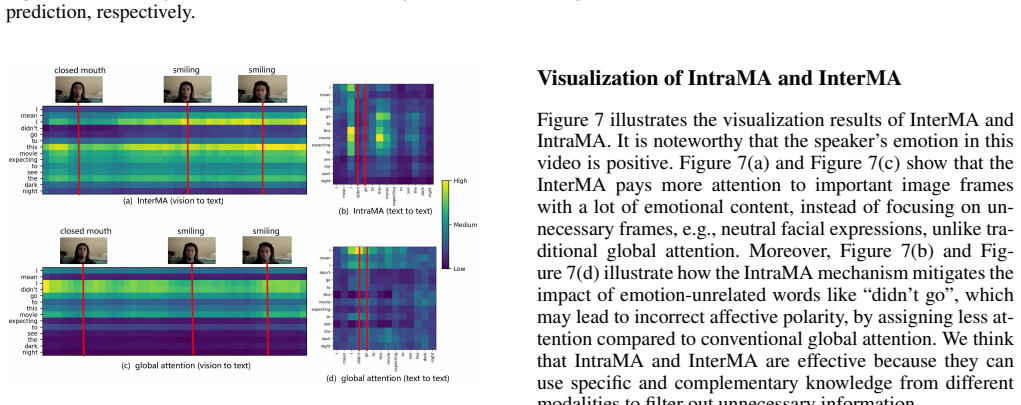
On its own terms, Semi-IIN establishes that a transformer-style architecture with two separate masked attention paths—one attending only within each modality (IntraMA) and one attending only across modalities (InterMA)—captures cleaner emotional cues than unrestricted global attention. A sigmoid gate blends the two paths' fused outputs, and the gate is learned per sample. Combined with self-training that keeps only top-k confident pseudo-labels (k=40 for MOSI, all unlabeled instances for MOSEI), the model reaches state-of-the-art numbers: MAE 0.679, Corr 0.822, Acc-7 46.50 on MOSI, and MAE 0.497, Corr 0.804, Acc-7 55.89 on MOSEI, surpassing the RoBERTa-large baseline TCDN on both datasets with only 1.6M trainable parameters.
Load-bearing premise
The self-training stage assumes that the top-k most confident predictions generated on the AMI meeting corpus are accurate enough to improve a sentiment model trained on YouTube review videos, despite AMI having no sentiment labels and a different domain.
Editorial extensions
If this is right
- Explicitly separating intra- and inter-modal attention and gating their combination improves multimodal sentiment analysis over a single global attention baseline.
- The self-training strategy, with top-k confidence pseudo-labels from AMI, improves performance even when a small fraction of labeled data is available.
- The best configuration adds only 0.3M parameters over the baseline and still outperforms it, showing that targeted masking, not model size, drives the gain.
- Strong results with only 1.6M parameters and short training times (90 seconds on MOSI, 20 minutes on MOSEI) suggest the design is practical for larger-scale multimodal tasks.
- The gated dual-branch design offers a new point in the design space between full cross-modal fusion and strict unimodal processing.
Reading between the lines
- The learned gate could be studied as a per-sample router; one testable hypothesis is that gate values correlate with annotation ambiguity or with which modality carries the dominant emotional signal.
- The top-k confidence self-training on AMI is sensitive to domain shift, so ablation with alternative unlabeled corpora or confidence thresholds could isolate whether the gain comes from pseudo-label content or simply from retraining on more data.
- The masked-attention-plus-gate pattern may transfer to other multimodal tasks where some inputs are noisy, such as emotion recognition in the wild, where the model can learn to ignore a corrupted modality.
- The reported performance drop at 50% and 75% labeled-data ratios suggests that pseudo-label balance matters; a confidence-threshold curriculum might stabilize and extend the self-training gains.
Signed reviews
Editorial analysis
A structured set of objections, weighed in public.
Referee Report
Summary. The paper proposes Semi-IIN, a semi-supervised multimodal sentiment analysis network. The architecture combines two masked attention mechanisms (IntraMA and InterMA) to capture intra-modal and inter-modal token interactions separately, a gating mechanism to fuse the two branches, and a self-training stage in which a model trained on labeled MOSI/MOSEI data generates pseudo-labels for the unlabeled AMI meeting corpus with a top-k confidence selection. Experiments on CMU-MOSI and CMU-MOSEI report improved metrics over existing methods, including the RoBERTa-large baseline TCDN, and the conclusion states that Semi-IIN sets a new state of the art for MSA. Code is provided and supplementary comparisons with MMML are included.
Significance. The masked-attention design is a clean and lightweight contribution: explicitly separating intra- and inter-modal attention masks with a learned gate is a reasonable way to model token-level interactions, and the paper offers ablations, case studies, and attention visualizations. The reported training efficiency and public code are also strengths. If the performance claims survive a controlled comparison, the method would be a useful addition to multimodal sentiment analysis. However, the central empirical claim is not currently established because the main comparison is uncontrolled with respect to the use of additional unlabeled data, the pseudo-label confidence filter is vacuous for MOSEI, and the claimed SOTA is contradicted by the paper's own supplementary MMML results on some metrics.
major comments (5)
- [Experiment, Table 1] The headline comparison in Table 1 is not controlled for the use of additional unlabeled data. Semi-IIN is trained with a self-training stage on the AMI corpus, whereas TCDN and the other baselines are fully supervised. The reported improvements over TCDN (0.016 MAE and 0.017 Corr on MOSI; 0.024 MAE and 0.45% Acc-2 on MOSEI) could therefore come from the extra unlabeled corpus rather than from the proposed architecture. The paper should include baselines trained under the same semi-supervised protocol, or reframe the contribution as a semi-supervised method and compare against semi-supervised baselines only.
- [Self-training, Algorithm 1] For MOSEI, k is set to the total number of unlabeled instances, so the top-k confidence filter in Algorithm 1 (line 7) selects all pseudo-labeled samples and performs no confidence-based filtering. This makes the claimed 'dependable pseudo-labels' mechanism vacuous for the larger dataset, and the MOSEI results in Table 1 depend entirely on unvalidated pseudo-labels from AMI, a meeting corpus with a different domain and no sentiment annotations. Please report pseudo-label accuracy on a held-out labeled subset and perform a k-sweep (for example k=20, 40, 60, and all) with the corresponding test metrics.
- [Dataset and Self-training sections] The use of AMI as the unlabeled corpus is underspecified. The paper does not describe how the 100 hours of meeting recordings are segmented into samples, whether the same feature extractors (RoBERTa, Fabnet, HuBERT) are applied to AMI data, or how many pseudo-labeled samples are added for each class. Without these details and without evidence that the pseudo-labels are reliable under the domain shift from YouTube review videos to meeting recordings, the self-training contribution cannot be evaluated. Figure 4 compounds this concern: performance drops when the labeled-data ratio is 50% or 75%, so the semi-supervised gain is not robust across labeled-data proportions.
- [Supplementary Tables 4-5 and Conclusion] The conclusion states that Semi-IIN 'sets the new SOTA result for MSA', but the paper's own supplementary comparison shows MMML achieving higher Corr (0.846 vs 0.822) and Acc-7 (47.48 vs 46.50) on MOSI. The SOTA claim should be restricted to the metrics and settings where Semi-IIN actually leads, and the comparison with MMML should be discussed in the main text, including the trade-offs in parameters and training time.
- [Experiment, Comparison to State-of-the-art Methods] No error bars, standard deviations, or significance tests are reported for any of the metrics in Table 1. Several improvements over the strongest baseline are small (e.g., 0.016 MAE, 0.45% accuracy), and without repeated runs or a paired significance test it is not possible to tell whether the differences are meaningful. Please report the mean and standard deviation over at least 3-5 seeds for the proposed method and the closest baselines, or provide statistical significance tests.
minor comments (5)
- [References] The reference list appears twice: once after the Conclusion and once after the Supplementary Materials; please remove the duplicate.
- [Algorithm 1] Algorithm 1 contains the typos 'caculate' in lines 3 and 11, and the variable n in the Feature fusion section (l ∈ [1, n]) is not defined before use.
- [Equation (16)] Equation (16) uses the notation 'all ∈ Rdh×dh' and 'b1 and b'1 ∈ Rdh' without proper superscripts; the dimensionalities should be written as R^{dh×dh} and R^{dh}.
- [Table 1] Table 1 abbreviates 'MulT' as 'Mult' for one baseline, and the caption does not explain the practical difference between the aligned and unaligned settings; please make the table self-contained.
- [Figure 3] Figure 3 and the surrounding text refer to 'masked tokens' and 'unmasked tokens' without explicitly connecting them to the IntraMASK and InterMASK matrices defined in equations (11)-(12); please clarify this relationship.
Circularity Check
No significant circularity: Semi-IIN's reported improvements are empirical comparisons on held-out benchmarks, not derivations that reduce to the paper's inputs.
full rationale
Semi-IIN's central claims are empirical. The architecture is specified in Eqs. (1)-(18), trained with the loss functions in Eqs. (19)-(23), and evaluated on the held-out test splits of CMU-MOSI and CMU-MOSEI against published baselines in Table 1. No predicted quantity is defined in terms of the target metric, and no parameter is fitted to the test labels. The self-training component (Algorithm 1) generates pseudo-labels on the unlabeled AMI corpus and retrains the model, which is a standard semi-supervised procedure rather than a derivation that reduces to its own inputs; final metrics are measured on labeled test data, not on the pseudo-labels. The paper itself notes in Figure 4 that performance decreases at 50% and 75% labeled ratios, and the MOSEI setting of k equal to the total number of unlabeled instances makes the described top-k confidence filter vacuous for that dataset; these are legitimate validity and robustness concerns about pseudo-label quality and hyperparameter selection, but they are not circularity. There is no load-bearing self-citation, no imported uniqueness theorem, and no ansatz smuggled in via citation. Therefore no specific circular step can be exhibited, and the honest finding is no circularity.
Assumptions & free parameters
free parameters (6)
- lambda1 regression loss weight =
0.6
- lambda2 pseudo-label classification loss weight =
0.2
- top-k threshold for MOSI pseudo-labels =
40
- top-k threshold for MOSEI pseudo-labels =
total number of unlabeled instances
- Conv1D kernel sizes kt, kv, ka1, ka2 =
not reported
- number of masked attention units n =
not reported
assumptions (4)
- domain assumption Pre-trained feature extractors RoBERTa, Fabnet, and HuBERT provide adequate token-level representations for text, vision, and audio.
- domain assumption AMI meeting recordings are a suitable unlabeled source for sentiment learning on MOSI and MOSEI.
- ad hoc to paper The pre-defined IntraMASK and InterMASK matrices correctly separate relevant intra-modal and inter-modal token relations.
- domain assumption Top-k confidence pseudo-labels are reliable enough for retraining.
Cite this review
Pith. "Pith review of Semi-IIN: Semi-supervised Intra-inter modal Interaction Learning Network for Multimodal Sentiment Analysis." pith.science (2026). https://pith.science/paper/S34FPURO
@misc{pith2026241209784,
  author       = {Pith},
  title        = {Pith review of: Semi-IIN: Semi-supervised Intra-inter modal Interaction Learning Network for Multimodal Sentiment Analysis},
  year         = {2026},
  howpublished = {\url{https://pith.science/paper/S34FPURO}},
  note         = {Machine review of arXiv:2412.09784}
}
read the original abstract
Despite multimodal sentiment analysis being a fertile research ground that merits further investigation, current approaches take up high annotation cost and suffer from label ambiguity, non-amicable to high-quality labeled data acquisition. Furthermore, choosing the right interactions is essential because the significance of intra- or inter-modal interactions can differ among various samples. To this end, we propose Semi-IIN, a Semi-supervised Intra-inter modal Interaction learning Network for multimodal sentiment analysis. Semi-IIN integrates masked attention and gating mechanisms, enabling effective dynamic selection after independently capturing intra- and inter-modal interactive information. Combined with the self-training approach, Semi-IIN fully utilizes the knowledge learned from unlabeled data. Experimental results on two public datasets, MOSI and MOSEI, demonstrate the effectiveness of Semi-IIN, establishing a new state-of-the-art on several metrics. Code is available at https://github.com/flow-ljh/Semi-IIN.
Figures


Figures from the paper (4 more)


Reference graph
Works this paper leans on
-
[1]
, " * write output.state after.block = add.period write newline
ENTRY address archivePrefix author booktitle chapter edition editor eid eprint howpublished institution isbn journal key month note number organization pages publisher school series title type volume year label extra.label sort.label short.list INTEGERS output.state before.all mid.sentence after.sentence after.block FUNCTION init.state.consts #0 'before.a...
-
[2]
write newline
" write newline "" before.all 'output.state := FUNCTION n.dashify 't := "" t empty not t #1 #1 substring "-" = t #1 #2 substring "--" = not "--" * t #2 global.max substring 't := t #1 #1 substring "-" = "-" * t #2 global.max substring 't := while if t #1 #1 substring * t #2 global.max substring 't := if while FUNCTION word.in bbl.in capitalize " " * FUNCT...
-
[3]
Carletta, J.; Ashby, S.; Bourban, S.; Flynn, M.; Guillemot, M.; Hain, T.; Kadlec, J.; Karaiskos, V.; Kraaij, W.; Kronenthal, M.; et al. 2005. The AMI meeting corpus: A pre-announcement. In International workshop on machine learning for multimodal interaction, 28--39. Springer
work page 2005
-
[4]
Chen, C.; Hong, H.; Guo, J.; and Song, B. 2023 a . Inter-intra modal representation augmentation with trimodal collaborative disentanglement network for multimodal sentiment analysis. IEEE/ACM Transactions on Audio, Speech, and Language Processing, 31: 1476--1488
work page 2023
-
[5]
Chen, H.; Guo, C.; Li, Y.; Zhang, P.; and Jiang, D. 2023 b . Semi-Supervised Multimodal Emotion Recognition with Class-Balanced Pseudo-labeling. In Proceedings of the 31st ACM International Conference on Multimedia, 9556--9560
work page 2023
-
[6]
Cheng, Z.; Lin, Y.; Chen, Z.; Li, X.; Mao, S.; Zhang, F.; Ding, D.; Zhang, B.; and Peng, X. 2023. Semi-supervised multimodal emotion recognition with expression mae. In Proceedings of the 31st ACM International Conference on Multimedia, 9436--9440
work page 2023
-
[7]
Han, W.; Chen, H.; and Poria, S. 2021. Improving multimodal fusion with hierarchical mutual information maximization for multimodal sentiment analysis. arXiv preprint arXiv:2109.00412
arXiv 2021
-
[8]
Hazarika, D.; Zimmermann, R.; and Poria, S. 2020. Misa: Modality-invariant and-specific representations for multimodal sentiment analysis. In Proceedings of the 28th ACM international conference on multimedia, 1122--1131
2020
Show all 35 references
-
[9]
H.; Lakhotia, K.; Salakhutdinov, R.; and Mohamed, A
Hsu, W.-N.; Bolte, B.; Tsai, Y.-H. H.; Lakhotia, K.; Salakhutdinov, R.; and Mohamed, A. 2021. Hubert: Self-supervised speech representation learning by masked prediction of hidden units. IEEE/ACM Transactions on Audio, Speech, and Language Processing, 29: 3451--3460
2021
-
[10]
Hu, G.; Lu, G.; and Zhao, Y. 2021. Bidirectional hierarchical attention networks based on document-level context for emotion cause extraction. In Findings of the Association for Computational Linguistics: EMNLP 2021, 558--568
2021
-
[11]
Hu, P.; Zhu, H.; Peng, X.; and Lin, J. 2020. Semi-supervised multi-modal learning with balanced spectral decomposition. In Proceedings of the AAAI Conference on Artificial Intelligence, volume 34, 99--106
2020
-
[12]
Lian, Z.; Liu, B.; and Tao, J. 2022. Smin: Semi-supervised multi-modal interaction network for conversational emotion recognition. IEEE Transactions on Affective Computing
2022
-
[13]
Lian, Z.; Sun, H.; Sun, L.; Chen, K.; Xu, M.; Wang, K.; Xu, K.; He, Y.; Li, Y.; Zhao, J.; et al. 2023. Mer 2023: Multi-label learning, modality robustness, and semi-supervised learning. In Proceedings of the 31st ACM International Conference on Multimedia, 9610--9614
2023
-
[14]
Liang, J.; Li, R.; and Jin, Q. 2020. Semi-supervised multi-modal emotion recognition with cross-modal distribution matching. In Proceedings of the 28th ACM international conference on multimedia, 2852--2861
2020
-
[15]
Liu, Y.; Ott, M.; Goyal, N.; Du, J.; Joshi, M.; Chen, D.; Levy, O.; Lewis, M.; Zettlemoyer, L.; and Stoyanov, V. 2019. Roberta: A robustly optimized bert pretraining approach. arXiv preprint arXiv:1907.11692
2019 arXiv
-
[16]
B.; Liang, P
Liu, Z.; Shen, Y.; Lakshminarasimhan, V. B.; Liang, P. P.; Zadeh, A.; and Morency, L.-P. 2018. Efficient low-rank multimodal fusion with modality-specific factors. arXiv preprint arXiv:1806.00064
2018 arXiv
-
[17]
Lv, F.; Chen, X.; Huang, Y.; Duan, L.; and Lin, G. 2021. Progressive modality reinforcement for human multimodal emotion recognition from unaligned multimodal sequences. In Proceedings of the IEEE/CVF Conference on Computer Vision and Pattern Recognition, 2554--2562
2021
-
[18]
Parthasarathy, S.; and Busso, C. 2020. Semi-supervised speech emotion recognition with ladder networks. IEEE/ACM transactions on audio, speech, and language processing, 28: 2697--2709
2020
-
[19]
Poria, S.; Hazarika, D.; Majumder, N.; and Mihalcea, R. 2020. Beneath the tip of the iceberg: Current challenges and new directions in sentiment analysis research. IEEE Transactions on Affective Computing
2020
-
[20]
K.; Lee, S.; Zadeh, A.; Mao, C.; Morency, L.-P.; and Hoque, E
Rahman, W.; Hasan, M. K.; Lee, S.; Zadeh, A.; Mao, C.; Morency, L.-P.; and Hoque, E. 2020. Integrating multimodal information in large pretrained transformers. In Proceedings of the conference. Association for Computational Linguistics. Meeting, volume 2020, 2359. NIH Public Access
2020
-
[21]
Sun, Z.; Sarma, P.; Sethares, W.; and Liang, Y. 2020. Learning relationships between text, audio, and video via deep canonical correlation for multimodal language analysis. In Proceedings of the AAAI Conference on Artificial Intelligence, volume 34, 8992--8999
2020
-
[22]
H.; Bai, S.; Liang, P
Tsai, Y.-H. H.; Bai, S.; Liang, P. P.; Kolter, J. Z.; Morency, L.-P.; and Salakhutdinov, R. 2019. Multimodal transformer for unaligned multimodal language sequences. In Proceedings of the conference. Association for Computational Linguistics. Meeting, volume 2019, 6558. NIH Pu...
2019
-
[23]
H.; Liang, P
Tsai, Y.-H. H.; Liang, P. P.; Zadeh, A.; Morency, L.-P.; and Salakhutdinov, R. 2018. Learning factorized multimodal representations. arXiv preprint arXiv:1806.06176
2018 arXiv
-
[24]
N.; Kaiser, .; and Polosukhin, I
Vaswani, A.; Shazeer, N.; Parmar, N.; Uszkoreit, J.; Jones, L.; Gomez, A. N.; Kaiser, .; and Polosukhin, I. 2017. Attention is all you need. Advances in neural information processing systems, 30
2017
-
[25]
Wang, K.; Lian, Z.; Sun, L.; Liu, B.; Tao, J.; and Fan, Y. 2022. Emotional reaction analysis based on multi-label graph convolutional networks and dynamic facial expression recognition transformer. In Proceedings of the 3rd International on Multimodal Sentiment Analysis Worksh...
2022
-
[26]
Wiles, O.; Koepke, A.; and Zisserman, A. 2018. Self-supervised learning of a facial attribute embedding from video. arXiv preprint arXiv:1808.06882
2018 arXiv
-
[27]
Yang, J.; Yu, Y.; Niu, D.; Guo, W.; and Xu, Y. 2023. ConFEDE: Contrastive Feature Decomposition for Multimodal Sentiment Analysis. In Proceedings of the 61st Annual Meeting of the Association for Computational Linguistics (Volume 1: Long Papers), 7617--7630
2023
-
[28]
Yu, T.; Gao, H.; Lin, T.-E.; Yang, M.; Wu, Y.; Ma, W.; Wang, C.; Huang, F.; and Li, Y. 2023. Speech-Text Pre-training for Spoken Dialog Understanding with Explicit Cross-Modal Alignment. In Proceedings of the 61st Annual Meeting of the Association for Computational Linguistics...
2023
-
[29]
Yu, W.; Xu, H.; Yuan, Z.; and Wu, J. 2021. Learning modality-specific representations with self-supervised multi-task learning for multimodal sentiment analysis. In Proceedings of the AAAI conference on artificial intelligence, volume 35, 10790--10797
2021
-
[30]
Yuan, Z.; Fang, J.; Xu, H.; and Gao, K. 2024. Multimodal Consistency-Based Teacher for Semi-Supervised Multimodal Sentiment Analysis. IEEE/ACM Transactions on Audio, Speech, and Language Processing
2024
-
[31]
Zadeh, A.; Chen, M.; Poria, S.; Cambria, E.; and Morency, L.-P. 2017. Tensor fusion network for multimodal sentiment analysis. arXiv preprint arXiv:1707.07250
2017 arXiv
-
[32]
Zadeh, A.; Zellers, R.; Pincus, E.; and Morency, L.-P. 2016. Mosi: multimodal corpus of sentiment intensity and subjectivity analysis in online opinion videos. arXiv preprint arXiv:1606.06259
2016 arXiv
-
[33]
B.; Liang, P
Zadeh, A. B.; Liang, P. P.; Poria, S.; Cambria, E.; and Morency, L.-P. 2018. Multimodal language analysis in the wild: Cmu-mosei dataset and interpretable dynamic fusion graph. In Proceedings of the 56th Annual Meeting of the Association for Computational Linguistics (Volume 1...
2018
-
[34]
Zhang, D.; Li, S.; Zhu, Q.; and Zhou, G. 2020. Multi-modal sentiment classification with independent and interactive knowledge via semi-supervised learning. IEEE Access, 8: 22945--22954
2020
-
[35]
Zhang, H.; Xu, H.; and Lin, T.-E. 2021. Deep open intent classification with adaptive decision boundary. In Proceedings of the AAAI Conference on Artificial Intelligence, volume 35, 14374--14382
2021
Reviewed August 11, 2026 · model on record in the stance chip above.
Discussion (0). Continue with ORCID to comment.