REVIEW 4 major objections 4 minor 44 references
Predicting Large-scale Urban Network Dynamics with Energy-informed Graph Neural Diffusion
T0 review · 4 major / 4 minor · reviewed 2026-08-06 · deepseek-v4-flash
Pith's one-line read Treating urban forecasting as graph denoising yields a linear-time Transformer that beats GNN and Transformer baselines on four large-scale benchmarks.
desk verdict Strong engineering with a weak theory wrapper; the empirical scalability results are real and worth refereeing, but the bounded-error proof is not. read the letter →
The pith
A machine-rendered reading of the paper's core claim, the machinery that carries it, and where it could break.
The reading
What carries the argument
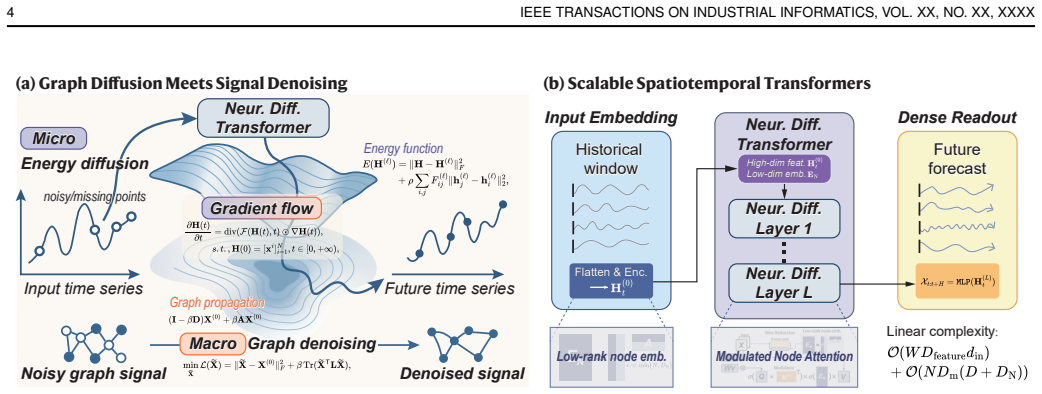
The load-bearing object is the modulated node attention of Eq. (22), $\tilde{A} = \text{Softmax}(H W_Q M^\top / \sqrt{D_m}) \, \text{Softmax}(E_N^\top)$, which replaces the full $N \times N$ attention matrix with a product of two $N \times r$ factors, where $E_N$ is a static low-rank node embedding learned under the low-rank adapted embedding (LRAE) parameterization $E_N \approx E_N^r P$. This factorization is what converts the $O(N^2)$ spatial attention into the $O(N)$ steps listed in Section IV-E. Lemma 1, borrowed from a Johnson-Lindenstrauss argument, is meant to guarantee the low-rank approximation has bounded error when the projection matrix is random.
What would settle it
Construct a synthetic network whose optimal forecast depends on pairwise coupling strengths that are deliberately non-low-rank, for example a distinct learned interaction for each node pair. If ScaleSTF's error gap to the full-attention model does not close as the rank $r$ grows into the hundreds, the low-rank attention premise fails.
Extended reading notes
Core claim
On the paper's own terms, the central discovery is that one can build a spatiotemporal Transformer whose spatial attention is induced by low-dimensional node embeddings and still surpass existing GNN and Transformer baselines on large networks. Concretely, Section V claims ScaleSTF 'consistently achieves SOTA performance in all metrics in all tasks' across GLA, GBA, PV-US, and CER-En, with average MAE gains of roughly 7 to 11 percent over the second-best model and larger gains in long-horizon 192-step forecasting. The supporting theory is a pair of propositions and a corollary: the layerwise update of neural diffusion is the gradient flow of a regularized Dirichlet energy, its fixed point equals the minimum of a Laplacian-regularized denoising objective, and therefore message-passing forecasters are iterative denoisers of the observed time series.
Load-bearing premise
The load-bearing premise is that a fixed low-dimensional node embedding can express all the pairwise attention patterns that matter for forecasting; if the decisive correlations require node-specific fine-grained interactions, the linear-time attention will discard exactly the information that made Transformers accurate.
Editorial extensions
If this is right
- ScaleSTF's linear spatial complexity means forecasting on sensor networks with thousands of nodes fits on one GPU, where canonical self-attention runs out of memory.
- Compared with the STAEformer baseline, the paper reports up to 18x faster training, 7x less GPU memory, and 6x fewer parameters with comparable or better accuracy.
- Because the model is a graph denoising process, it degrades gracefully when 80 percent of input observations are masked, indicating a natural path to imputation tasks.
- The equivalence between diffusion and denoising gives a principled way to choose architecture: GNNs, MLP-Mixers, and Transformers become different choices of the same diffusivity function, not unrelated designs.
- Long-horizon forecasting (192 steps) is where the resource gap is largest; ScaleSTF maintains accuracy while memory stays near the level of a plain MLP.
Reading between the lines
- One extension the paper leaves implicit is that the same low-rank denoising view should transfer directly to spatiotemporal imputation and anomaly detection, since both are recovery problems over the same sensor graph.
- The learned low-rank node embeddings could be reused as a cheap graph-structure prior for other tasks: the GBA case study suggests sensors close in embedding space share congestion delay patterns, so the embeddings may encode functional network topology without an explicit adjacency matrix.
- If the low-rank attention hypothesis holds on the tested systems, a natural stress test is to scale beyond five thousand nodes, where the O(N) complexity should keep training feasible on a single GPU while full-attention models remain impossible.
Editorial analysis
A structured set of objections, weighed in public.
Referee Report
Summary. The paper proposes ScaleSTF, a spatiotemporal Transformer for large-scale urban network forecasting, inspired by an energy-driven graph neural diffusion interpretation. The model uses a low-rank adapted node embedding (LRAE) and a modulated node attention mechanism that factorizes the full attention map into two softmax products, reducing complexity to linear in the number of nodes. The authors derive formal motivation from a continuous diffusion equation and a graph signal denoising formulation (Propositions 1-2, Corollary 1) and provide a theoretical guarantee for the low-rank attention approximation (Lemma 1). Empirically, the model is evaluated on four large-scale real-world datasets (GLA, GBA, PV-US, CER-En) and several medium-scale/synthetic benchmarks, reporting state-of-the-art accuracy on the large-scale tasks and large efficiency gains (up to 18x speedup, 7x memory reduction, 6x parameter savings) over a SOTA Transformer baseline. The paper also includes ablations, robustness studies under missing data and noise, and a case study on learned embeddings.
Significance. If the results hold, ScaleSTF addresses a practically important trade-off between accuracy and scalability in spatiotemporal forecasting: it shows large accuracy improvements over GNN and MLP baselines on datasets with thousands of nodes while running with linear complexity. The efficiency gains over STAEformer are striking and well documented. The paper's physical motivation (energy diffusion and graph denoising) is conceptually appealing and could inform future architecture design. However, the theoretical contributions are not rigorously established: the main lemma that underpins the claimed bounded-error low-rank attention is, as written, invalid, and the empirical low-rank observation is partly circular because it uses the model's own low-rank embeddings. Nevertheless, the empirical evidence alone is substantial and could support the paper's practical claims if the theoretical overstatements are fixed or removed.
major comments (4)
- [IV-D, Lemma 1, Eqs. (21)-(24)] The proof of Lemma 1 is not valid. The step in Eq. (24), σ(QK^T E)σ(E^T) ≈ σ(QK^T)σ(EE^T), does not follow from any property of the softmax function, which is row-normalized and does not factor across matrix products. The Johnson-Lindenstrauss lemma cited from [41] applies to linear random projections of the attention matrix, not to the product of two softmax kernels. Moreover, in the model the node embedding E is learned (Eq. (18)), not a random Gaussian matrix, so the JL condition on E is not satisfied. Consequently, Eq. (22) is not shown to be a bounded-error approximation of the full attention matrix As(H). Since the linear-complexity claim and the 'guaranteed' low-rank property both pass through Eq. (22), this is a load-bearing gap. The authors should either provide a correct proof with explicit assumptions on the learned E and the softmax structure, or remove the guarantee claim and present Eq. (22) as a heuristic design choice validated empirically.
- [III-D, Eq. (12)] The first-order Taylor expansion (I + βL)^{-1} ≈ I − βL is valid only when the spectral radius of βL is sufficiently small. No such condition is established for the graph Laplacian L or the regularization parameter β used in the paper. Because Proposition 2 and Corollary 1 rely on this expansion to connect the diffusion process to graph denoising, the validity of the approximation should either be demonstrated with an eigenvalue bound or the claims should be softened to an informal motivation.
- [III-E, Fig. 2(a)] The empirical evidence for low-rank node representations in Fig. 2(a) is obtained by computing the homogeneity of the learned node embeddings from the model's own LRAE module (Eq. (18)), which is low-rank by construction. This is circular as evidence for the low-rank hypothesis. The authors should instead analyze the raw signal matrix X_t directly (e.g., via SVD of the time-series matrix), or reframe the figure as a sanity check that the learned embeddings indeed capture a low-rank manifold, not as independent empirical support for the theoretical framework.
- [V-C, Table III] The statement in Section V-B that 'ScaleSTF consistently achieves SOTA performance in all metrics in all tasks' is too strong when read together with Table III: on AirQuality, STAEformer achieves lower MAE at @1, @2, and @3 (11.05, 14.83, 17.56 versus 11.19, 15.10, 17.90). The claim should be qualified to the large-scale benchmarks in Table II, or the average metric should be defined with an explicit horizon-averaging rule. The current 'Avg.' column is also inconsistent with the preceding columns (e.g., for AirQuality, the mean of 11.05, 14.83, 17.56 is 14.48, not 21.97), so the computation of the average must be clarified.
minor comments (4)
- [IV-C, Eq. (18)] The equation E_N ≈ E_N^r E_N^{r,T} X_t = E_N^r P has a dimension mismatch: if P ∈ R^{r × D_N} is a learnable adapter, then E_N^r P is the intended low-rank parameterization, but the intermediate expression E_N^{r,T} X_t has dimensions r × d_in, not r × D_N. Please rewrite Eq. (18) to clearly define the low-rank factorization E_N = E_N^r P and explain the connection to the POD in Eq. (4) without the misleading matrix product.
- [IV-D, Eq. (22)] The notation 'Softmax(E_N^T)' is ambiguous about the axis along which the softmax is applied. To form a valid attention map, the softmax should normalize over the node dimension (i.e., columns of E_N, not rows of E_N^T). The current notation suggests a distribution over N nodes for each row of E_N^T, which would not yield the intended N × D_N attractor matrix. Please clarify the orientation and define the softmax axis precisely.
- [IV-D, Lemma 1 statement] The probability bound '> 1 − O(1)' in Lemma 1 is not informative; a correct Johnson-Lindenstrauss bound would provide a decaying failure probability such as 1 − O(1/N). Please replace the statement with an explicit tail bound that matches the cited result.
- [V-A, Implementation and Hyperparameters] The statement that hyperparameters and code 'will be released after publication' is not sufficient for reproducibility. Please provide a detailed description of hyperparameters, training details, and data splits, as well as a code link in the manuscript or supplementary material.
Circularity Check
Central SOTA and scalability claims are externally benchmarked and not circular; one motivational 'low-rank evidence' step is self-definitional because it reads low-rankness off the model's own low-rank embedding.
-
self definitional
[Section III-E, Fig. 2(a); Section IV-C, Eq. (18)]
"In Fig. 2 (a), we obtain the learned node embedding vectors (see Section IV-C) and compute the cosine similarity as the homogeneity score for node representations. This matrix indicates the collective patterns on the graph (network) and shows significant structures. More intuitively, we display its singular values and find a clear truncated distribution, i.e., a low-rank pattern."
The embedding used for this empirical observation is LRAE from Eq. (18), EN ≈ ErN P with r ≪ min{N,DN}, which is rank-constrained by construction. Therefore the truncated singular-value distribution in Fig. 2(a) is a consequence of the model's low-rank parameterization, not independent evidence that urban network dynamics are low-dimensional. The argument is self-definitional: the data's low-rank structure is invoked to justify LRAE, while the evidence for low-rankness is generated by LRAE itself. This step does not, however, determine the SOTA results, which are measured against external baselines and datasets.
full rationale
The paper's central claims — SOTA accuracy and linear-complexity scalability — are validated against external benchmarks (GLA, GBA, PV-US, CER-En, AirQuality, Elergone) and compared with independent baselines; no fitted parameter is renamed as a prediction, and no load-bearing result rests on a self-citation chain. The energy-diffusion derivation (Propositions 1 and 2) is a mathematical reformulation of message passing as gradient flow on a defined energy, so it is an identity rather than a circular prediction. The questionable point is Section III-E: the low-rank 'empirical observation' uses the model's own rank-r embedding (Eq. 18), so the low-rank spectrum is built in rather than discovered. This is a genuine but limited circularity in the motivational argument and does not by itself force the benchmark outcomes, hence score 3 rather than 6+. The Lemma 1 proof gap raised by the skeptic is a correctness and technical-risk issue, not a circularity, and is therefore not scored as a circular step.
Assumptions & free parameters
free parameters (3)
- LRAE rank r =
16 (chosen after tuning; Fig. 10)
- Number of neural diffusion layers L =
not stated precisely (tuned)
- Feature dimensions D, D_m, D_N =
not stated
assumptions (4)
- domain assumption Urban network dynamics follow a coupled dynamical system d xi/dt = E_i(x_i) + sum_j a_ij I(x_i, x_j) (Eq. 3)
- domain assumption Dynamics of large networks reside in a low-dimensional subspace (low-rank hypothesis, cited [33], [34])
- standard math First-order Taylor expansion (I + beta L)^{-1} ≈ I - beta L is accurate for the chosen beta (Eq. 12)
- standard math Johnson-Lindenstrauss lemma applies to the softmax attention matrix (Lemma 1, referencing [41])
Cite this review
Pith. "Pith review of Predicting Large-scale Urban Network Dynamics with Energy-informed Graph Neural Diffusion." pith.science (2026). https://pith.science/paper/S37G3ZSV
@misc{pith2026250800037,
  author       = {Pith},
  title        = {Pith review of: Predicting Large-scale Urban Network Dynamics with Energy-informed Graph Neural Diffusion},
  year         = {2026},
  howpublished = {\url{https://pith.science/paper/S37G3ZSV}},
  note         = {Machine review of arXiv:2508.00037}
}
read the original abstract
Networked urban systems facilitate the flow of people, resources, and services, and are essential for economic and social interactions. These systems often involve complex processes with unknown governing rules, observed by sensor-based time series. To aid decision-making in industrial and engineering contexts, data-driven predictive models are used to forecast spatiotemporal dynamics of urban systems. Current models such as graph neural networks have shown promise but face a trade-off between efficacy and efficiency due to computational demands. Hence, their applications in large-scale networks still require further efforts. This paper addresses this trade-off challenge by drawing inspiration from physical laws to inform essential model designs that align with fundamental principles and avoid architectural redundancy. By understanding both micro- and macro-processes, we present a principled interpretable neural diffusion scheme based on Transformer-like structures whose attention layers are induced by low-dimensional embeddings. The proposed scalable spatiotemporal Transformer (ScaleSTF), with linear complexity, is validated on large-scale urban systems including traffic flow, solar power, and smart meters, showing state-of-the-art performance and remarkable scalability. Our results constitute a fresh perspective on the dynamics prediction in large-scale urban networks.
Figures


Figures from the paper (8 more)


Reference graph
Works this paper leans on
-
[41]
Linformer: Self-attention with linear complexity,
S. Wang, B. Z. Li, M. Khabsa, H. Fang, and H. Ma, “Linformer: Self-attention with linear complexity,” arXiv preprint arXiv:2006.04768, 2020
arXiv 2006
-
[1]
Predicting network dynamics without requiring the knowledge of the interaction graph,
B. Prasse and P. Van Mieghem, “Predicting network dynamics without requiring the knowledge of the interaction graph,” Proceedings of the National Academy of Sciences , vol. 119, no. 44, p. e2205517119, 2022
work page 2022
-
[2]
Difformer: Scalable (graph) transformers induced by energy constrained diffusion,
Q. Wu, C. Yang, W. Zhao, Y . He, D. Wipf, and J. Yan, “Difformer: Scalable (graph) transformers induced by energy constrained diffusion,” arXiv preprint arXiv:2301.09474 , 2023
arXiv 2023
-
[3]
Grand: Graph neural diffusion,
B. Chamberlain, J. Rowbottom, M. I. Gorinova, M. Bronstein, S. Webb, and E. Rossi, “Grand: Graph neural diffusion,” in International confer- ence on machine learning . PMLR, 2021, pp. 1407–1418
2021
-
[4]
Grand++: Graph neural diffusion with a source term,
M. Thorpe, T. Nguyen, H. Xia, T. Strohmer, A. Bertozzi, S. Osher, and B. Wang, “Grand++: Graph neural diffusion with a source term,” ICLR, 2022
work page 2022
-
[5]
Diffusion convolutional re- current neural network: Data-driven traffic forecasting,
Y . Li, R. Yu, C. Shahabi, and Y . Liu, “Diffusion convolutional re- current neural network: Data-driven traffic forecasting,” arXiv preprint arXiv:1707.01926, 2017
arXiv 2017
-
[6]
Graph wavenet for deep spatial-temporal graph modeling,
Z. Wu, S. Pan, G. Long, J. Jiang, and C. Zhang, “Graph wavenet for deep spatial-temporal graph modeling,” arXiv preprint arXiv:1906.00121 , 2019
arXiv 1906
-
[7]
Adaptive graph convolutional recurrent network for traffic forecasting,
L. Bai, L. Yao, C. Li, X. Wang, and C. Wang, “Adaptive graph convolutional recurrent network for traffic forecasting,” Advances in neural information processing systems, vol. 33, pp. 17 804–17 815, 2020
2020
Show all 44 references
-
[8]
Scalable spatiotem- poral graph neural networks,
A. Cini, I. Marisca, F. M. Bianchi, and C. Alippi, “Scalable spatiotem- poral graph neural networks,” arXiv preprint arXiv:2209.06520 , 2022
2022 arXiv
-
[9]
Largest: A benchmark dataset for large- scale traffic forecasting,
X. Liu, Y . Xia, Y . Liang, J. Hu, Y . Wang, L. Bai, C. Huang, Z. Liu, B. Hooi, and R. Zimmermann, “Largest: A benchmark dataset for large- scale traffic forecasting,” Advances in Neural Information Processing Systems, vol. 36, 2024
2024
-
[10]
Do we really need graph neural networks for traffic forecasting?
X. Liu, Y . Liang, C. Huang, H. Hu, Y . Cao, B. Hooi, and R. Zimmer- mann, “Do we really need graph neural networks for traffic forecasting?” arXiv preprint arXiv:2301.12603 , 2023
2023 arXiv
-
[11]
Spatial-temporal identity: A simple yet effective baseline for multivariate time series forecasting,
Z. Shao, Z. Zhang, F. Wang, W. Wei, and Y . Xu, “Spatial-temporal identity: A simple yet effective baseline for multivariate time series forecasting,” in Proceedings of the 31st ACM International Conference on Information & Knowledge Management , 2022, pp. 4454–4458
2022
-
[12]
Channel-aware low-rank adaptation in time series forecasting,
T. Nie, Y . Mei, G. Qin, J. Sun, and W. Ma, “Channel-aware low-rank adaptation in time series forecasting,” in Proceedings of the 33rd ACM International Conference on Information and Knowledge Management , 2024, pp. 3959–3963
2024
-
[13]
Spatio-temporal adaptive embedding makes vanilla transformer sota for traffic forecasting,
H. Liu, Z. Dong, R. Jiang, J. Deng, J. Deng, Q. Chen, and X. Song, “Spatio-temporal adaptive embedding makes vanilla transformer sota for traffic forecasting,” in Proceedings of the 32nd ACM international conference on information and knowledge management, 2023, pp. 4125– 4129
2023
-
[14]
Pdformer: Propagation delay-aware dynamic long-range transformer for traffic flow prediction,
J. Jiang, C. Han, W. X. Zhao, and J. Wang, “Pdformer: Propagation delay-aware dynamic long-range transformer for traffic flow prediction,” in Proceedings of the AAAI conference on artificial intelligence , vol. 37, no. 4, 2023, pp. 4365–4373
2023
-
[15]
Spatio-temporal graph convolutional networks: A deep learning framework for traffic forecasting,
B. Yu, H. Yin, and Z. Zhu, “Spatio-temporal graph convolutional networks: A deep learning framework for traffic forecasting,” arXiv preprint arXiv:1709.04875, 2017
2017 arXiv
-
[16]
Diffusion convolutional recurrent neural network: Data-driven traffic forecasting,
Y . Li, R. Yu, C. Shahabi, and Y . Liu, “Diffusion convolutional recurrent neural network: Data-driven traffic forecasting,” in International Con- ference on Learning Representations , 2018
2018
-
[17]
Autoformer: Decomposition trans- formers with auto-correlation for long-term series forecasting,
H. Wu, J. Xu, J. Wang, and M. Long, “Autoformer: Decomposition trans- formers with auto-correlation for long-term series forecasting,”Advances in Neural Information Processing Systems , vol. 34, pp. 22 419–22 430, 2021
2021
-
[18]
Fedformer: Frequency enhanced decomposed transformer for long-term series fore- casting,
T. Zhou, Z. Ma, Q. Wen, X. Wang, L. Sun, and R. Jin, “Fedformer: Frequency enhanced decomposed transformer for long-term series fore- casting,” in International Conference on Machine Learning . PMLR, 2022, pp. 27 268–27 286
2022
-
[19]
Imputeformer: Low rankness-induced transformers for generalizable spatiotemporal impu- tation,
T. Nie, G. Qin, W. Ma, Y . Mei, and J. Sun, “Imputeformer: Low rankness-induced transformers for generalizable spatiotemporal impu- tation,” in Proceedings of the 30th ACM SIGKDD Conference on Knowledge Discovery and Data Mining , 2024, pp. 2260–2271
2024
-
[20]
Diffusion equation and stochastic processes,
S. Bochner, “Diffusion equation and stochastic processes,” Proceedings of the National Academy of Sciences , vol. 35, no. 7, pp. 368–370, 1949
1949
-
[21]
Trans- formers in time series: A survey,
Q. Wen, T. Zhou, C. Zhang, W. Chen, Z. Ma, J. Yan, and L. Sun, “Trans- formers in time series: A survey,” arXiv preprint arXiv:2202.07125 , 2022
2022 arXiv
-
[22]
Spatial-temporal transformer networks for traffic flow forecasting,
M. Xu, W. Dai, C. Liu, X. Gao, W. Lin, G.-J. Qi, and H. Xiong, “Spatial-temporal transformer networks for traffic flow forecasting,” arXiv preprint arXiv:2001.02908 , 2020
2001 arXiv
-
[23]
A lightweight and accurate spatial-temporal transformer for traffic forecasting,
G. Li, S. Zhong, X. Deng, L. Xiang, S.-H. G. Chan, R. Li, Y . Liu, M. Zhang, C.-C. Hung, and W.-C. Peng, “A lightweight and accurate spatial-temporal transformer for traffic forecasting,” IEEE Transactions on Knowledge and Data Engineering, vol. 35, no. 11, pp. 10 967–10 980, 2022
2022
-
[24]
Cola: Cross-city mobility transformer for human trajectory simulation,
Y . Wang, T. Zheng, Y . Liang, S. Liu, and M. Song, “Cola: Cross-city mobility transformer for human trajectory simulation,” in Proceedings of the ACM Web Conference 2024 , 2024, pp. 3509–3520
2024
-
[25]
A foundation model for unified urban spatio-temporal flow prediction,
Y . Yuan, J. Ding, C. Han, D. Jin, and Y . Li, “A foundation model for unified urban spatio-temporal flow prediction,” arXiv preprint arXiv:2411.12972, 2024
2024 arXiv
-
[26]
Mtanet: Multitask-aware network with hierarchical multimodal fusion for rgb-t urban scene understand- ing,
W. Zhou, S. Dong, J. Lei, and L. Yu, “Mtanet: Multitask-aware network with hierarchical multimodal fusion for rgb-t urban scene understand- ing,” IEEE Transactions on Intelligent Vehicles, vol. 8, no. 1, pp. 48–58, 2022. 12 IEEE TRANSACTIONS ON INDUSTRIAL INFORMATICS, VOL. XX,...
2022
-
[27]
Embedded control gate fusion and attention residual learning for rgb–thermal urban scene parsing,
W. Zhou, Y . Lv, J. Lei, and L. Yu, “Embedded control gate fusion and attention residual learning for rgb–thermal urban scene parsing,” IEEE Transactions on Intelligent Transportation Systems , vol. 24, no. 5, pp. 4794–4803, 2023
2023
-
[28]
Mmsmcnet: Modal memory sharing and morphological complementary networks for rgb-t urban scene semantic segmentation,
W. Zhou, H. Zhang, W. Yan, and W. Lin, “Mmsmcnet: Modal memory sharing and morphological complementary networks for rgb-t urban scene semantic segmentation,” IEEE Transactions on Circuits and Systems for Video Technology, vol. 33, no. 12, pp. 7096–7108, 2023
2023
-
[29]
Mdnet: Mamba-effective diffusion- distillation network for rgb-thermal urban dense prediction,
W. Zhou, H. Wu, and Q. Jiang, “Mdnet: Mamba-effective diffusion- distillation network for rgb-thermal urban dense prediction,” IEEE Transactions on Circuits and Systems for Video Technology , 2024
2024
-
[30]
A novel scene coupling semantic mask network for remote sensing image segmentation,
X. Ma, R. Lian, Z. Wu, R. Guan, T. Hong, M. Zhao, M. Ma, J. Nie, Z. Du, S. Song et al., “A novel scene coupling semantic mask network for remote sensing image segmentation,” ISPRS Journal of Photogram- metry and Remote Sensing , vol. 221, pp. 44–63, 2025
2025
-
[31]
Stnet: Spatial and temporal feature fusion network for change detection in remote sensing images,
X. Ma, J. Yang, T. Hong, M. Ma, Z. Zhao, T. Feng, and W. Zhang, “Stnet: Spatial and temporal feature fusion network for change detection in remote sensing images,” in 2023 IEEE International Conference on Multimedia and Expo (ICME) . IEEE, 2023, pp. 2195–2200
2023
-
[32]
Citytft: A temporal fusion transformer-based surrogate model for urban building energy modeling,
T.-Y . Dai, D. Niyogi, and Z. Nagy, “Citytft: A temporal fusion transformer-based surrogate model for urban building energy modeling,” Applied Energy, vol. 389, p. 125712, 2025
2025
-
[33]
The low-rank hypothesis of complex systems,
V . Thibeault, A. Allard, and P. Desrosiers, “The low-rank hypothesis of complex systems,” Nature Physics, vol. 20, no. 2, pp. 294–302, 2024
2024
-
[34]
Predicting multiple observations in complex systems through low-dimensional embeddings,
T. Wu, X. Gao, F. An, X. Sun, H. An, Z. Su, S. Gupta, J. Gao, and J. Kurths, “Predicting multiple observations in complex systems through low-dimensional embeddings,” Nature Communications, vol. 15, no. 1, p. 2242, 2024
2024
-
[35]
Rosenberg, The Laplacian on a Riemannian manifold: an introduction to analysis on manifolds
S. Rosenberg, The Laplacian on a Riemannian manifold: an introduction to analysis on manifolds . Cambridge University Press, 1997, no. 31
1997
-
[36]
Understanding convolution on graphs via energies,
F. Di Giovanni, J. Rowbottom, B. P. Chamberlain, T. Markovich, and M. M. Bronstein, “Understanding convolution on graphs via energies,” arXiv preprint arXiv:2206.10991 , 2022
2022 arXiv
-
[37]
Revisiting graph neural networks: All we have is low-pass filters,
H. Nt and T. Maehara, “Revisiting graph neural networks: All we have is low-pass filters,” arXiv preprint arXiv:1905.09550 , 2019
1905 arXiv
-
[38]
A generalization of vit/mlp-mixer to graphs,
X. He, B. Hooi, T. Laurent, A. Perold, Y . LeCun, and X. Bresson, “A generalization of vit/mlp-mixer to graphs,” in International conference on machine learning . PMLR, 2023, pp. 12 724–12 745
2023
-
[39]
Taming local effects in graph-based spatiotemporal forecasting,
A. Cini, I. Marisca, D. Zambon, and C. Alippi, “Taming local effects in graph-based spatiotemporal forecasting,” Advances in Neural Infor- mation Processing Systems , vol. 36, 2024
2024
-
[40]
Tsmixer: An all-mlp architecture for time series forecasting,
S.-A. Chen, C.-L. Li, N. Yoder, S. O. Arik, and T. Pfister, “Tsmixer: An all-mlp architecture for time series forecasting,” arXiv preprint arXiv:2303.06053, 2023
2023 arXiv
-
[42]
U-air: When urban air quality inference meets big data,
Y . Zheng, F. Liu, and H.-P. Hsieh, “U-air: When urban air quality inference meets big data,” in Proceedings of the 19th ACM SIGKDD international conference on Knowledge discovery and data mining , 2013, pp. 1436–1444
2013
-
[43]
itrans- former: Inverted transformers are effective for time series forecasting,
Y . Liu, T. Hu, H. Zhang, H. Wu, S. Wang, L. Ma, and M. Long, “itrans- former: Inverted transformers are effective for time series forecasting,” arXiv preprint arXiv:2310.06625 , 2023
2023 arXiv
-
[44]
Decoupled dynamic spatial-temporal graph neural network for traffic forecasting,
Z. Shao, Z. Zhang, W. Wei, F. Wang, Y . Xu, X. Cao, and C. S. Jensen, “Decoupled dynamic spatial-temporal graph neural network for traffic forecasting,” arXiv preprint arXiv:2206.09112 , 2022. Tong Nie received the B.S. degree from the college of civil engineering, Tongji Univ...
2022 arXiv
Reviewed August 6, 2026 · model on record in the stance chip above.
Discussion (0). Sign in to comment.