Theoretical determination of the binding energies of methanol and related species onto amorphous solid water ice
Pith reviewed 2026-06-26 03:50 UTC · model grok-4.3
The pith
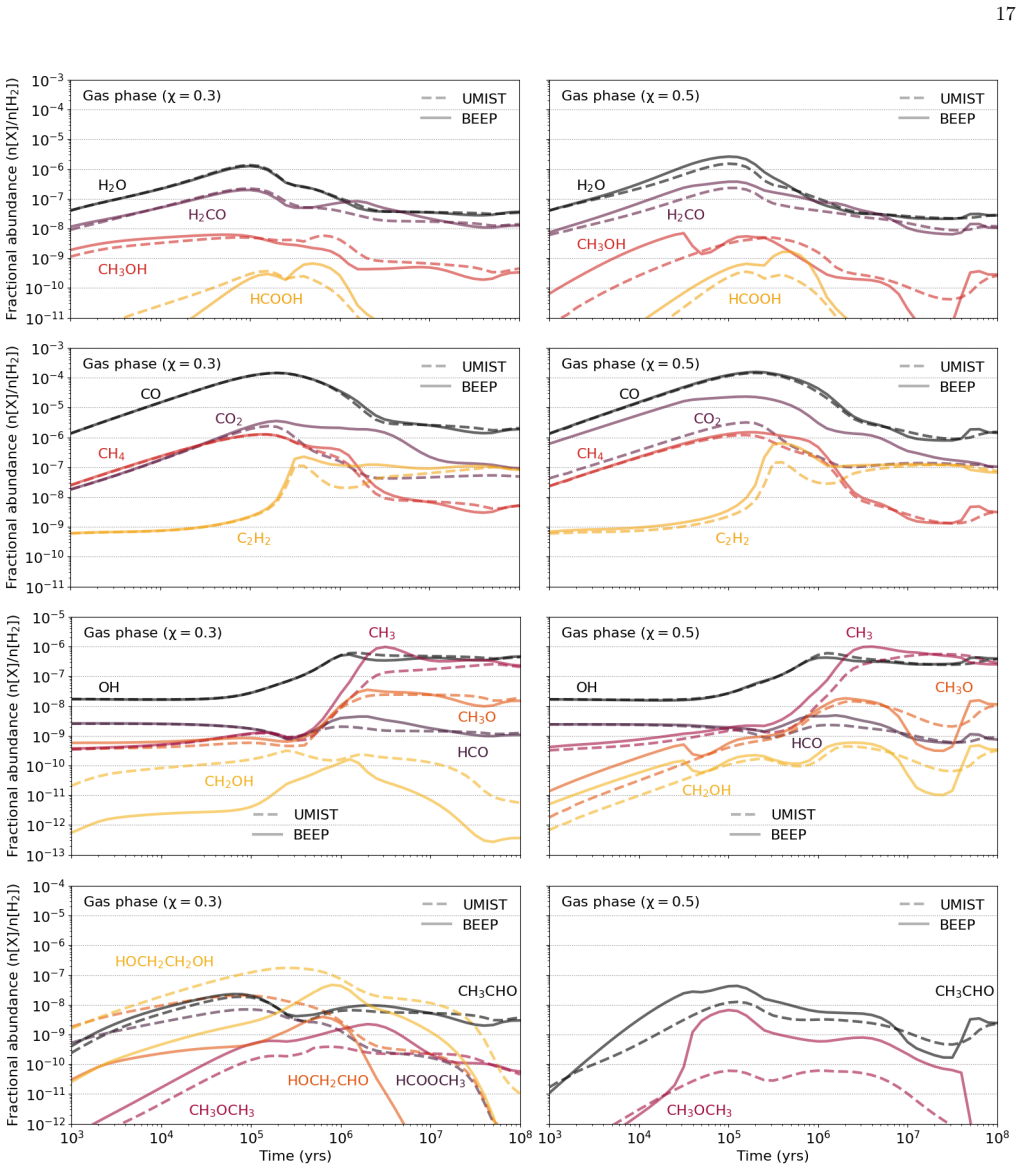
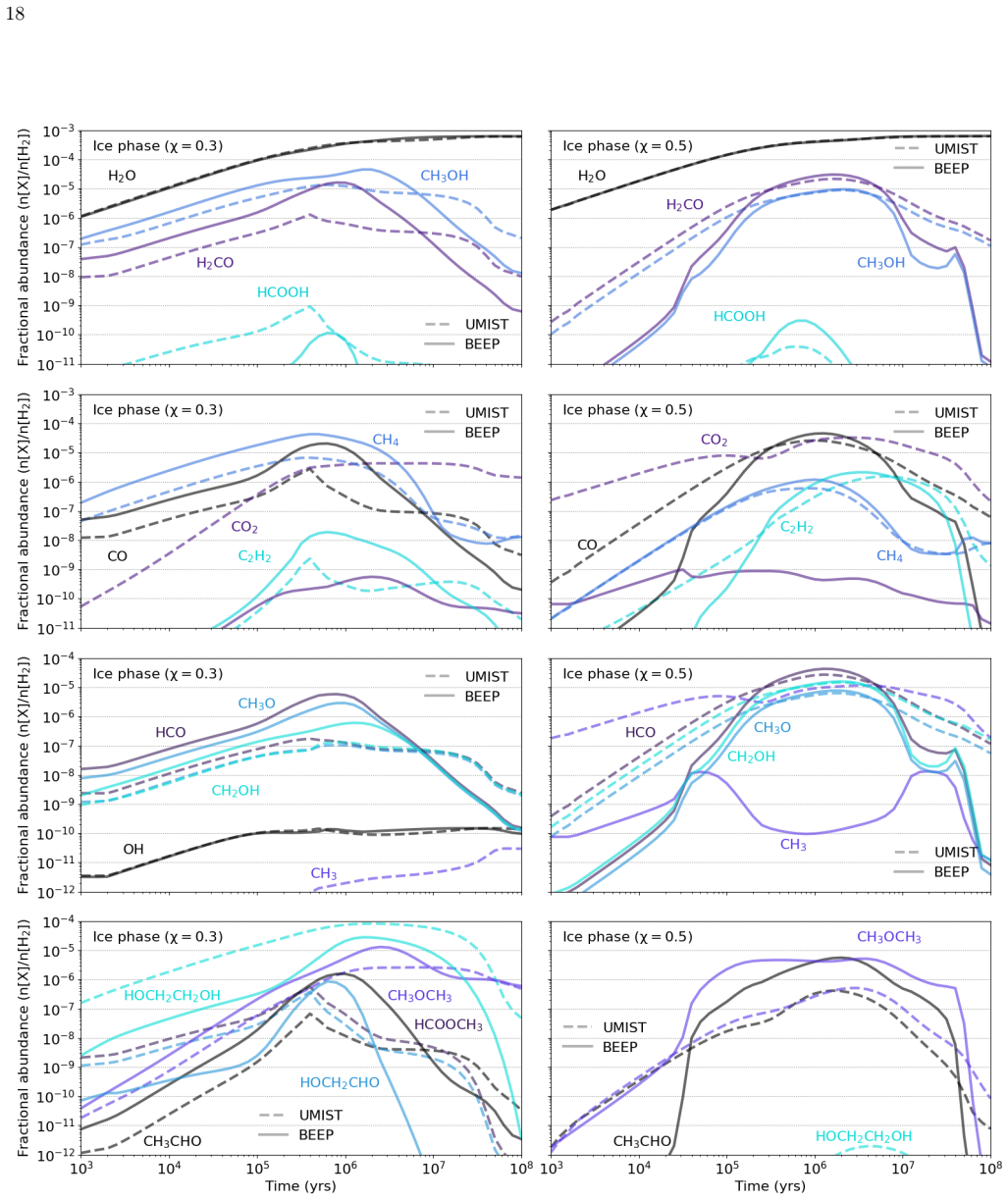
Binding energies computed for methanol and related species on amorphous ice surfaces lead to higher predicted radical abundances in astrochemical models when rates use transition state theory.
A machine-rendered reading of the paper's core claim, the machinery that carries it, and where it could break.
Core claim
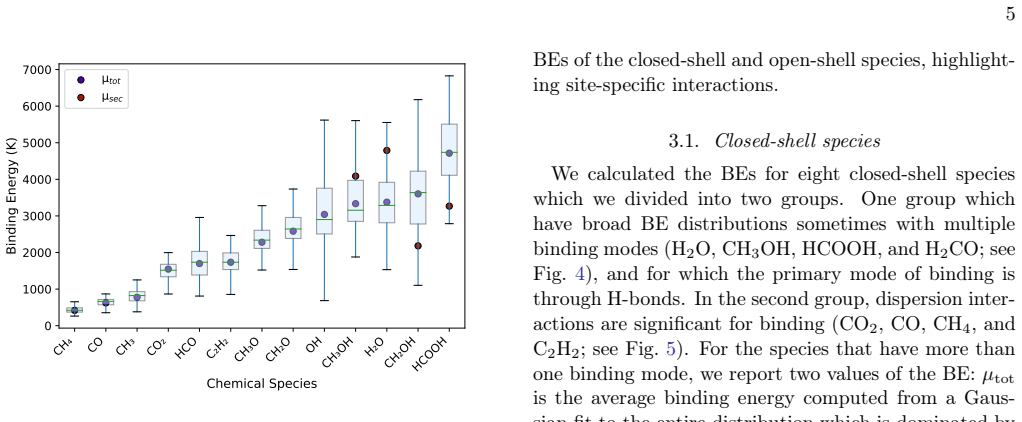
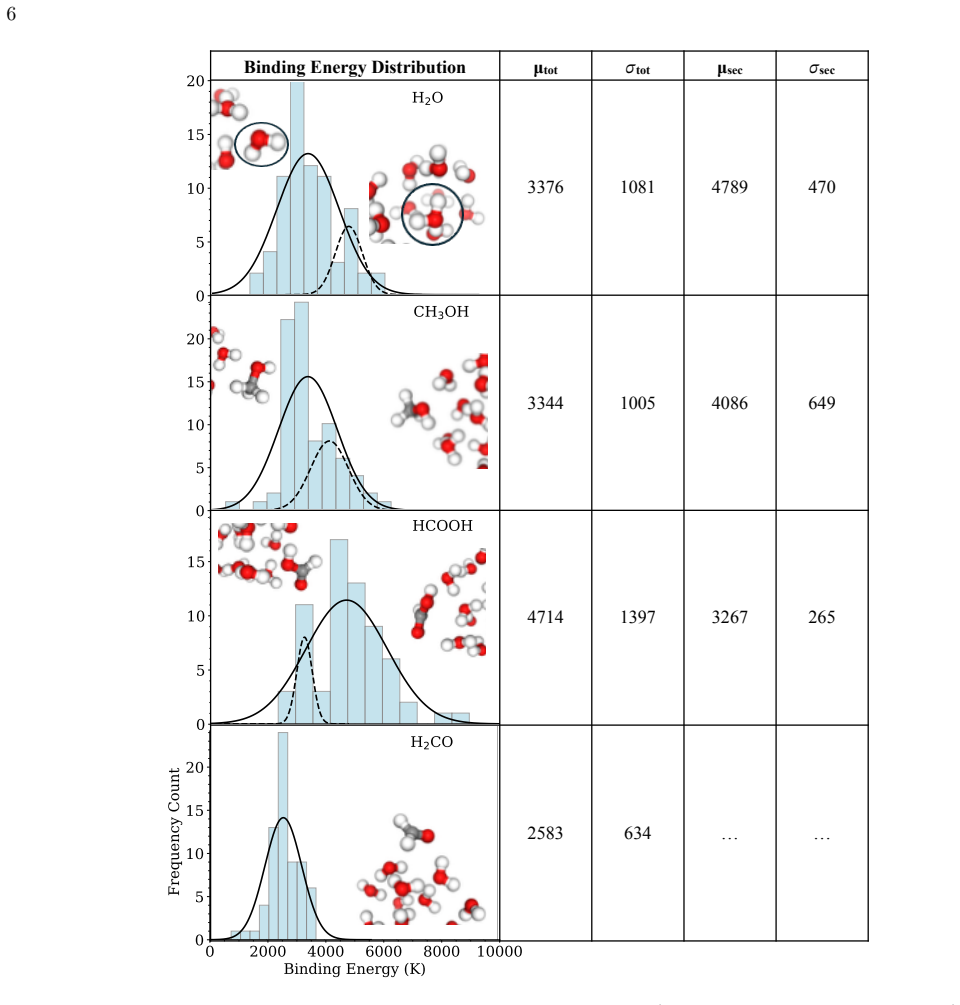
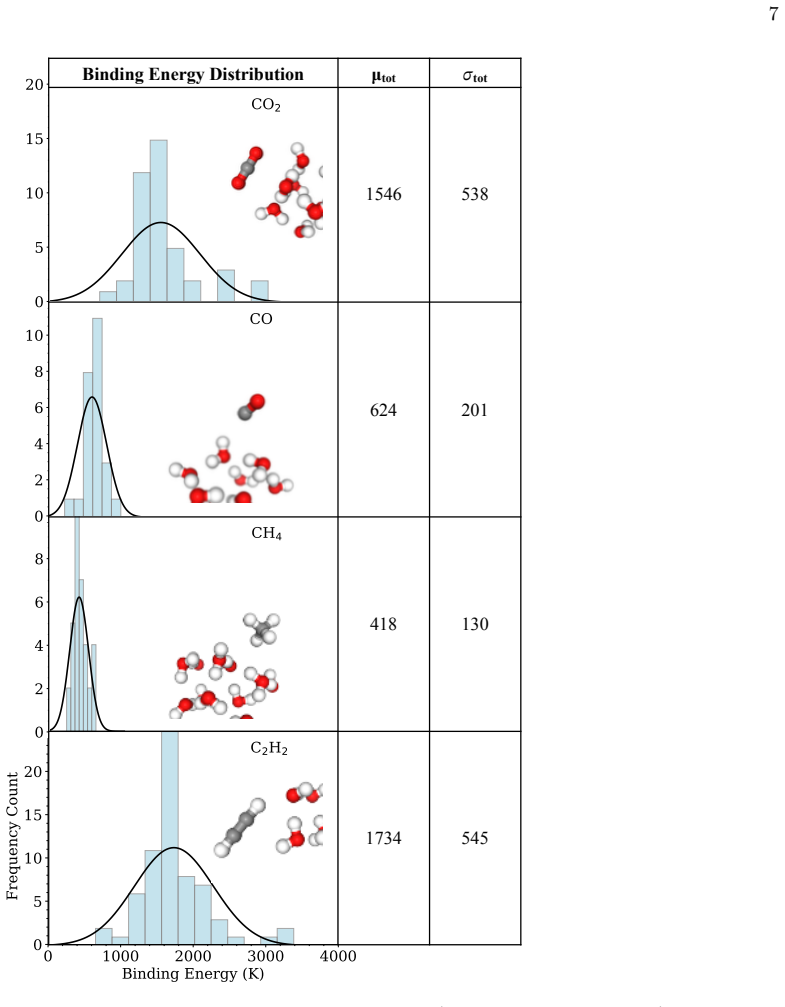
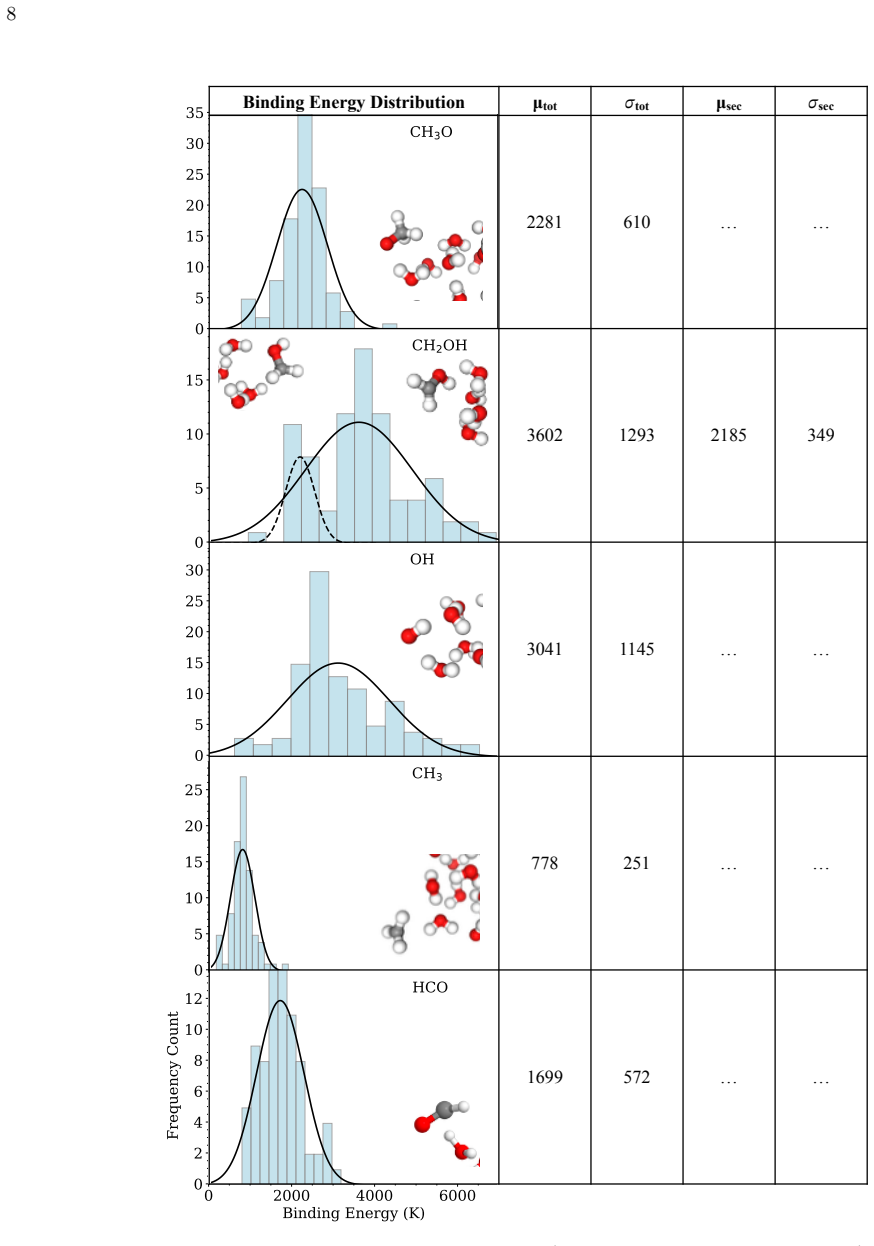
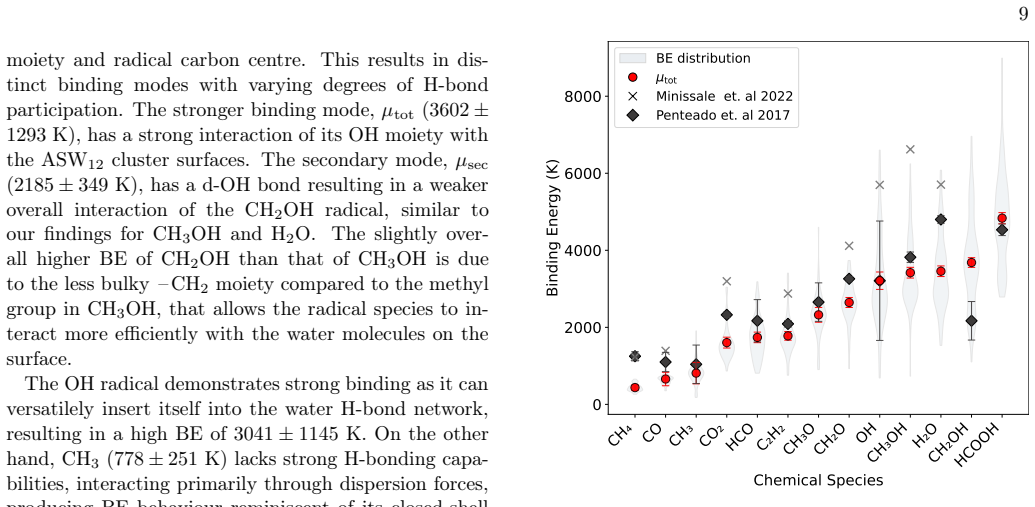
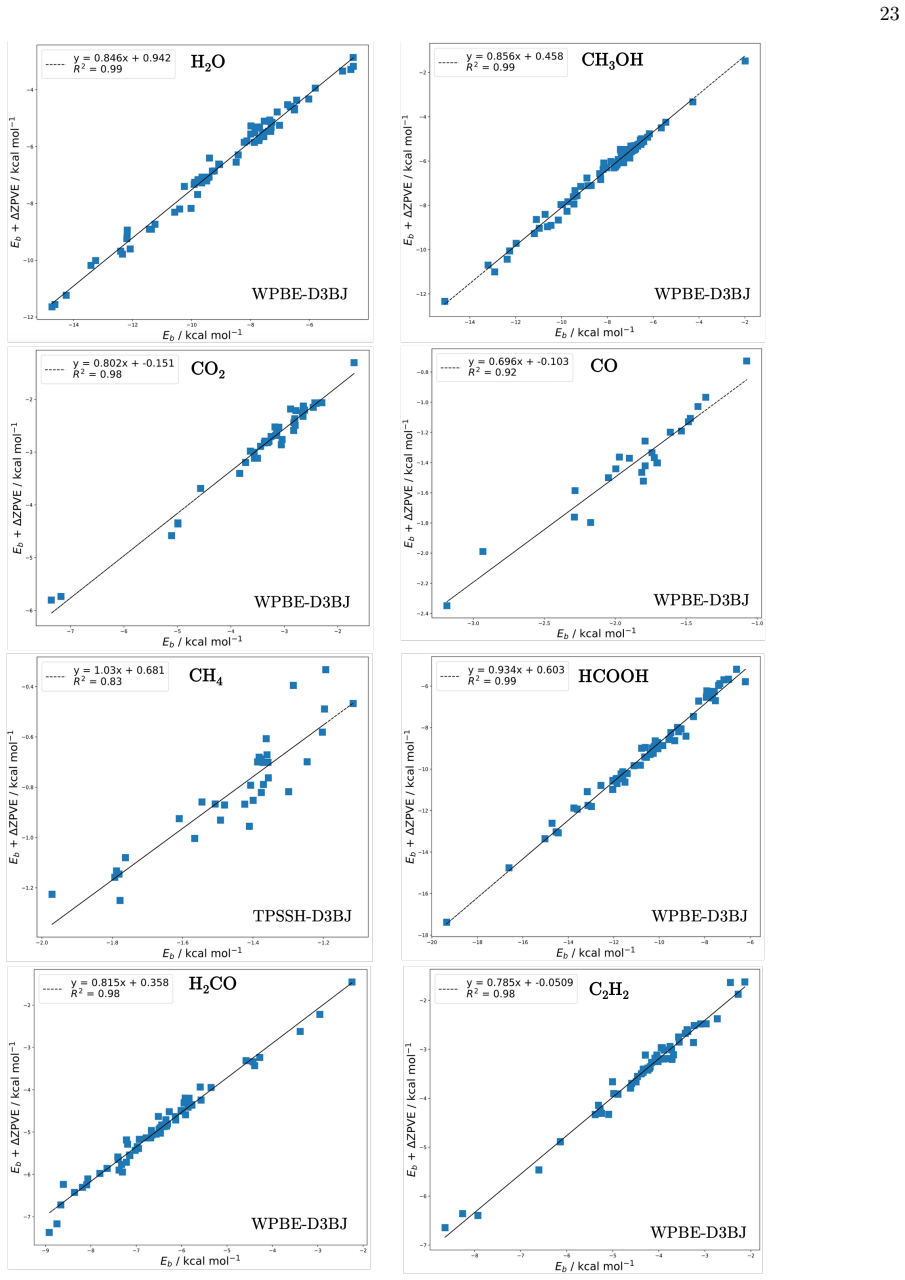
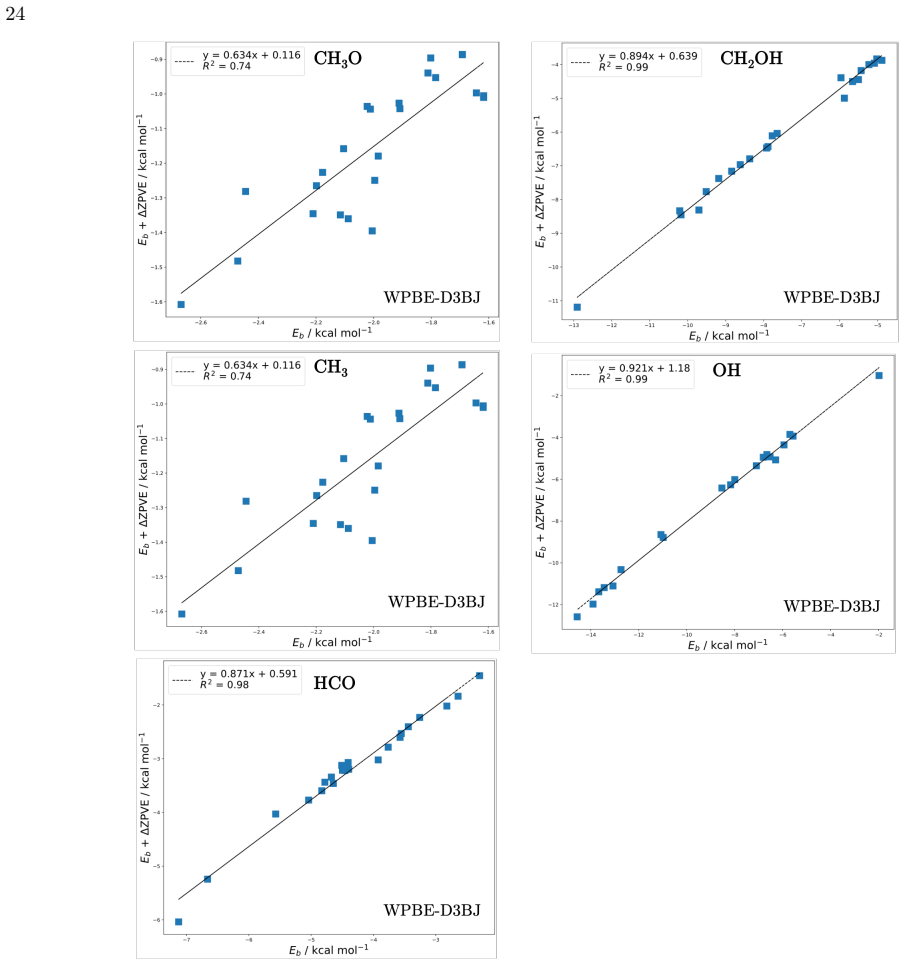
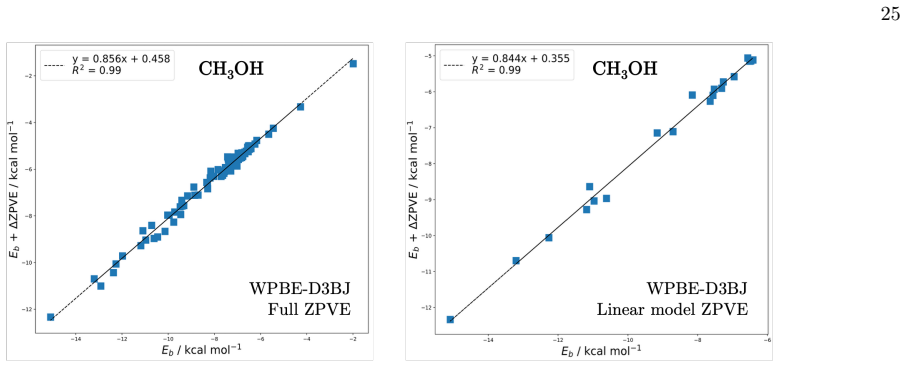
A self-consistent set of binding energies for methanol, H2O, HCOOH, OH, CO, CO2, CH4, CH3, CH2OH and HCO on amorphous solid water clusters is obtained via the refined DFT protocol. Hydrogen-bonding species display high binding energies with wide distributions due to structural heterogeneity of the ice surface, whereas weakly interacting species are governed by narrower dispersion interactions. Open-shell radicals CH2OH and OH bind more strongly than HCO and CH3. When these binding energies enter an astrochemical model with transition-state-theory pre-exponential factors, the calculation of grain-surface rates proves sensitive and the model yields higher radical abundances on the ice under ef
What carries the argument
Refined dispersion-corrected DFT protocol on ASW clusters that supplies binding-energy distributions, combined with transition state theory recalculation of the pre-exponential factor for grain-surface reaction rates.
If this is right
- Grain-surface reaction rates become sensitive to the specific method used to obtain binding energies and pre-exponential factors.
- Higher abundances of key radicals such as CH2OH and OH appear on the ice when surface diffusion is efficient.
- Self-consistent binding energies supply reliable theoretical benchmarks for species that lack experimental data.
- Formation efficiencies of complex organic molecules shift when models adopt the new binding energies and rate treatment.
Where Pith is reading between the lines
- The breadth of the computed binding energy distributions implies that models should average over many surface sites rather than adopt a single representative value.
- The elevated radical abundances could accelerate certain pathways to larger organics in cold cores if surface diffusion remains efficient.
- These binding energies may help interpret temperature-programmed desorption features observed in laboratory ice experiments or in protostellar spectra.
- Applying the same protocol to larger or more realistic ice models could test how cluster size influences the width of the binding distributions.
Load-bearing premise
The refined DFT protocol accurately captures the binding interactions on realistic amorphous solid water surfaces.
What would settle it
An experimental measurement of the methanol binding energy distribution on amorphous solid water that lies substantially outside the range produced by the DFT calculations.
Figures
read the original abstract
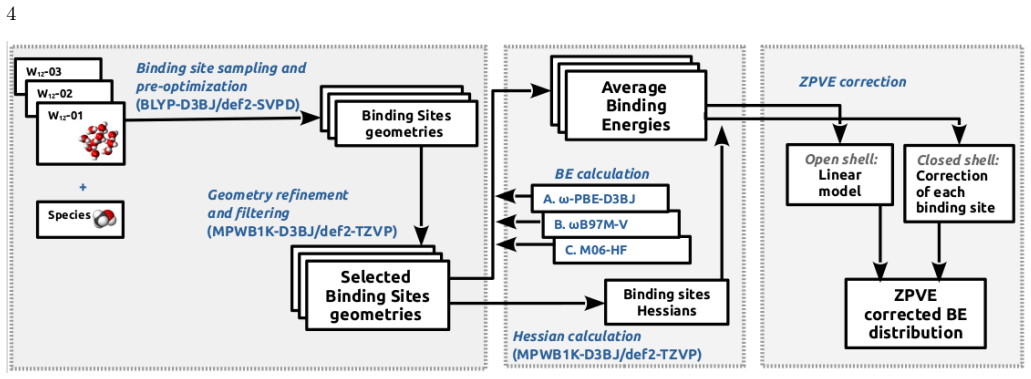
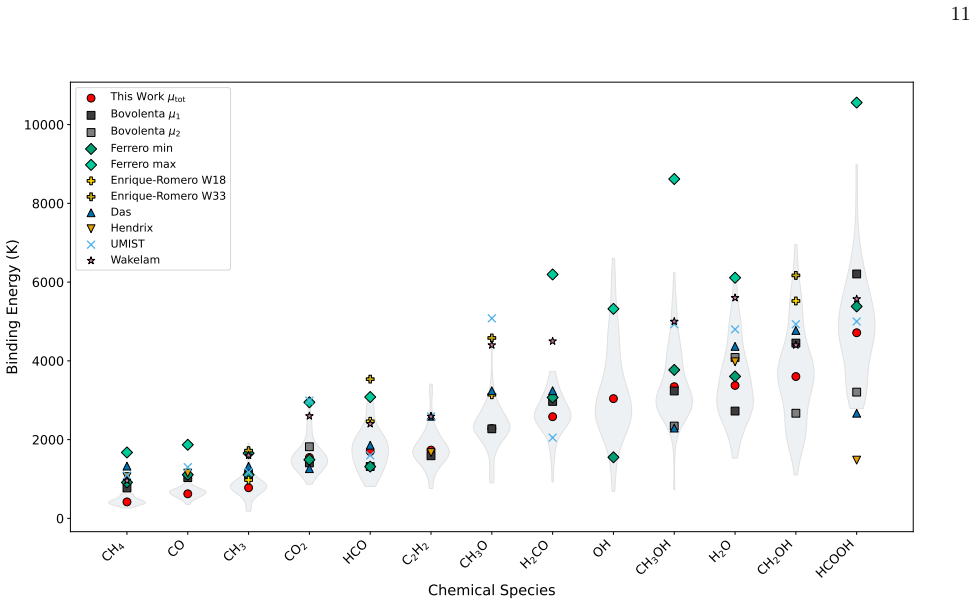
The formation and survival of complex organic molecules (COMs) in cold interstellar environments depends on their interactions with icy dust grain surfaces. Methanol, a key COM detected in cold cores and protoplanetary disks, is believed to form on amorphous solid water (ASW) through surface reactions and reside there until it is desorbed into the gas phase. We present a theoretical study of the binding energies (BEs) of methanol and its photolysis-derived species on ASW clusters by means of dispersion-corrected density functional theory (DFT) using a refined protocol implemented in the Binding Energy Evaluation Platform (BEEP). Molecules capable of hydrogen bonding, such as H2O, CH3OH, HCOOH, and OH, exhibit high BEs and broad BE distributions that reflect the structural heterogeneity of the ASW surface. In contrast, weakly interacting volatiles including CO, CO2, CH4, and CH3 display narrower distributions dominated by dispersion interactions. Open-shell radicals such as CH2OH and OH bind more strongly than HCO and CH3 due to their ability to form directional hydrogen bonds. Incorporation of our BEs into an astrochemical model, in conjunction with a recalculation of the pre-exponential factor using transition state theory, demonstrates the sensitivity of model results to the method of calculation of the grain-surface reaction rates. The new approach generally predicts a higher abundance of radicals on the ice that are key reactants for the formation of COMs when surface diffusion is assumed to be efficient. These findings emphasize the importance of incorporating BEs that have been determined in a self-consistent manner into astrochemical models, and provide reliable theoretical benchmarks for species with limited experimental data.
Editorial analysis
A structured set of objections, weighed in public.
Referee Report
Summary. The paper computes binding energies (BEs) of methanol, its photolysis products, and related species on amorphous solid water (ASW) clusters using dispersion-corrected DFT implemented in the BEEP platform. It reports broad BE distributions for H-bonding species (H2O, CH3OH, HCOOH, OH) versus narrower dispersion-dominated distributions for volatiles (CO, CO2, CH4, CH3), with open-shell radicals CH2OH and OH binding more strongly than HCO and CH3. These BEs, combined with transition-state-theory pre-exponential factors, are inserted into an astrochemical model; the resulting grain-surface rates yield higher abundances of key radicals when surface diffusion is efficient, underscoring the sensitivity of COM-formation predictions to the choice of BE and rate methodology.
Significance. If the DFT protocol yields physically accurate BEs, the work supplies self-consistent theoretical benchmarks for species with sparse experimental data and quantifies how BE choice propagates into radical abundances that control COM formation. The explicit demonstration of model sensitivity to both BEs and TST prefactors is a concrete, falsifiable contribution to grain-surface astrochemistry.
major comments (2)
- [Abstract / Methods] Abstract and Methods: the central claim that the new BEs plus TST prefactors produce higher radical abundances (and therefore altered COM formation) is load-bearing on the accuracy of the DFT BEs for open-shell species (CH2OH, OH). No benchmarks against TPD experiments, CCSD(T) cluster calculations, or periodic-slab results are reported, nor are error bars or cluster-size convergence tests provided; systematic DFT errors in H-bond/dispersion balance could shift the BE distributions enough to change which species remain mobile or retained.
- [Results / Astrochemical model] Results / Astrochemical model section: the model outcome is stated to be sensitive to the method of rate calculation, yet no quantitative sensitivity analysis (e.g., Monte-Carlo sampling of the reported BE distributions or comparison runs with literature BEs) is shown to demonstrate that the reported increase in radical abundance exceeds the uncertainty arising from the BE spread itself.
minor comments (2)
- Notation for binding-energy distributions (mean, width, skewness) should be defined explicitly when first introduced and used consistently in figures and tables.
- Figure captions should state the number of ASW cluster configurations sampled and the precise functional/basis-set combination employed in BEEP.
Simulated Author's Rebuttal
We thank the referee for their thoughtful and constructive report. The comments correctly identify areas where additional justification and analysis would strengthen the manuscript. We respond to each major comment below and indicate the revisions we will make.
read point-by-point responses
-
Referee: [Abstract / Methods] Abstract and Methods: the central claim that the new BEs plus TST prefactors produce higher radical abundances (and therefore altered COM formation) is load-bearing on the accuracy of the DFT BEs for open-shell species (CH2OH, OH). No benchmarks against TPD experiments, CCSD(T) cluster calculations, or periodic-slab results are reported, nor are error bars or cluster-size convergence tests provided; systematic DFT errors in H-bond/dispersion balance could shift the BE distributions enough to change which species remain mobile or retained.
Authors: We acknowledge that the current manuscript does not contain direct benchmarks of the DFT BEs against TPD data, CCSD(T) calculations, or periodic-slab results, nor does it report explicit error bars or full cluster-size convergence tests for the open-shell species. The BEEP protocol was chosen for internal consistency across the full set of species, but we agree this leaves the absolute accuracy open to the systematic errors noted. In the revised manuscript we will add (i) a dedicated paragraph on the expected accuracy of the chosen dispersion-corrected functional for H-bonding and radical species, drawing on existing literature benchmarks for closed-shell analogues, (ii) cluster-size convergence data for at least two representative open-shell radicals, and (iii) a qualitative discussion of how a ±20 % shift in the BE distributions would affect the mobility conclusions. New high-level CCSD(T) or periodic calculations are outside the scope of the present study and will be noted as desirable future work. revision: partial
-
Referee: [Results / Astrochemical model] Results / Astrochemical model section: the model outcome is stated to be sensitive to the method of rate calculation, yet no quantitative sensitivity analysis (e.g., Monte-Carlo sampling of the reported BE distributions or comparison runs with literature BEs) is shown to demonstrate that the reported increase in radical abundance exceeds the uncertainty arising from the BE spread itself.
Authors: We agree that a quantitative demonstration is needed to show the reported abundance increase is robust against the width of the BE distributions themselves. In the revised version we will add a new subsection (or appendix) that performs (a) Monte-Carlo sampling of the BE distributions reported in the paper and (b) direct comparison runs using a standard literature BE set. These additional calculations will quantify whether the higher radical abundances persist outside the uncertainty envelope set by the BE spread. revision: yes
Circularity Check
No significant circularity: BEs from independent DFT; model results are downstream predictions
full rationale
The paper's derivation begins with binding energies computed via dispersion-corrected DFT using a refined BEEP protocol on ASW clusters. These BEs (and TST-derived pre-factors) serve as inputs to an astrochemical model that then predicts radical abundances. No step reduces the BEs or central claims to model outputs by construction, fitted parameters renamed as predictions, or load-bearing self-citations. The chain is self-contained: computational method produces inputs, model produces independent downstream results. No quotes exhibit self-definitional, fitted-input, or uniqueness-imported circularity.
Axiom & Free-Parameter Ledger
axioms (1)
- domain assumption Dispersion-corrected DFT provides reliable binding energies for molecules on ASW ice surfaces
Reference graph
Works this paper leans on
-
[1]
The effects of snowlines on C/O in planetary atmospheres
The Effects of Snowlines on C/O in Planetary Atmospheres. , keywords =. doi:10.1088/2041-8205/743/1/L16 , archivePrefix =. 1110.5567 , primaryClass =
work page internal anchor Pith review Pith/arXiv arXiv doi:10.1088/2041-8205/743/1/l16 2041
-
[2]
Imaging of the CO Snow Line in a Solar Nebula Analog
Imaging of the CO Snow Line in a Solar Nebula Analog. Science , keywords =. doi:10.1126/science.1239560 , archivePrefix =. 1307.7439 , primaryClass =
work page internal anchor Pith review Pith/arXiv arXiv doi:10.1126/science.1239560
-
[3]
Minimum Core Masses for Giant Planet Formation With Realistic Equations of State and Opacities
Minimum Core Masses for Giant Planet Formation with Realistic Equations of State and Opacities. , keywords =. doi:10.1088/0004-637X/800/2/82 , archivePrefix =. 1412.5185 , primaryClass =
work page internal anchor Pith review Pith/arXiv arXiv doi:10.1088/0004-637x/800/2/82
-
[4]
An old disk still capable of forming a planetary system. , keywords =. doi:10.1038/nature11805 , archivePrefix =. 1303.1107 , primaryClass =
-
[5]
Reactive Desorption and Radiative Association as Possible Drivers of Complex Molecule Formation in the Cold Interstellar Medium. , keywords =. 2013 , month =. doi:10.1088/0004-637X/769/1/34 , archivePrefix =. 1303.7266 , primaryClass =
work page internal anchor Pith review Pith/arXiv arXiv doi:10.1088/0004-637x/769/1/34 2013
-
[6]
van Dishoeck, Ewine F. and Bergin, Edwin A. , title =. ExoFrontiers , publisher =. 2021 , series =. doi:10.1088/2514-3433/abfa8fch14 , isbn =
-
[7]
Astrochemistry and compositions of planetary systems. , keywords =. doi:10.1016/j.physrep.2020.09.004 , archivePrefix =. 2010.03529 , primaryClass =
-
[8]
, year = 2009, month = sep, volume =
Eric Herbst and Ewine F. van Dishoeck , title =. Annual Review of Astronomy and Astrophysics , year =. doi:10.1146/annurev-astro-082708-101654 , url =
-
[9]
Astrochemistry During the Formation of Stars. , keywords =. doi:10.1146/annurev-astro-032620-021927 , archivePrefix =. 2006.07071 , primaryClass =
-
[10]
Tafalla, M. and Kumar, M. S. N. and Bachiller, R. , year=. Star formation in the vicinity of the IC 348 cluster , volume=. Astronomy & Astrophysics , publisher=. doi:10.1051/0004-6361:20065505 , number=
-
[11]
Models of Gas-Grain Chemistry in Dense Interstellar Clouds with Complex Organic Molecules. , keywords =. doi:10.1086/191713 , adsurl =
-
[12]
Öberg, Karin I. , year=. Photochemistry and Astrochemistry: Photochemical Pathways to Interstellar Complex Organic Molecules , volume=. Chemical Reviews , publisher=. doi:10.1021/acs.chemrev.5b00694 , number=
-
[13]
Complex Chemistry in Star-Forming Regions: An Expanded Gas-Grain Warm-up Chemical Model
Complex Chemistry in Star-forming Regions: An Expanded Gas-Grain Warm-up Chemical Model. , keywords =. doi:10.1086/588035 , archivePrefix =. 0803.1214 , primaryClass =
work page internal anchor Pith review Pith/arXiv arXiv doi:10.1086/588035
-
[14]
Mechanistical Studies on the Irradiation of Methanol in Extraterrestrial Ices. , keywords =. doi:10.1086/511296 , adsurl =
-
[15]
Formation rates of complex organics in UV irradiated CH\_3OH-rich ices. I. Experiments. , keywords =. doi:10.1051/0004-6361/200912559 , archivePrefix =. 0908.1169 , primaryClass =
work page internal anchor Pith review Pith/arXiv arXiv doi:10.1051/0004-6361/200912559
-
[16]
Chuang, K.-J. and Fedoseev, G. and Ioppolo, S. and van Dishoeck, E.F. and Linnartz, H. , year=. H-atom addition and abstraction reactions in mixed CO, H2CO and CH3OH ices – an extended view on complex organic molecule formation , volume=. Monthly Notices of the Royal Astronomical Society , publisher=. doi:10.1093/mnras/stv2288 , number=
-
[17]
Walsh, Catherine and Loomis, Ryan A. and Öberg, Karin I. and Kama, Mihkel and van ’t Hoff, Merel L. R. and Millar, Tom J. and Aikawa, Yuri and Herbst, Eric and Widicus Weaver, Susanna L. and Nomura, Hideko , year=. FIRST DETECTION OF GAS-PHASE METHANOL IN A PROTOPLANETARY DISK , volume=. The Astrophysical Journal Letters , publisher=. doi:10.3847/2041-820...
-
[18]
Soft X-Ray Irradiation of Methanol Ice: Formation of Products as a Function of Photon Energy. , keywords =. doi:10.1088/0004-637X/778/2/162 , adsurl =
-
[19]
Collings, M. P. and Anderson, M. A. and Chen, R. and Dever, J. W. and Viti, S. and Williams, D. A. and McCoustra, M. R. S. , title =. Monthly Notices of the Royal Astronomical Society , volume =. 2004 , doi =
2004
-
[20]
and Collings, Mark P
Fraser, Helen J. and Collings, Mark P. and McCoustra, Martin R. S. and Williams, David A. , title =. Monthly Notices of the Royal Astronomical Society , volume =. 2001 , doi =
2001
-
[21]
Garrod, R. T. and Herbst, E. , title =. Astronomy & Astrophysics , volume =. 2006 , doi =
2006
-
[22]
Interactions of adsorbed CO$_2$ on water ice at low temperatures
Interactions of adsorbed CO2 on water ice at low temperatures. Physical Chemistry Chemical Physics (Incorporating Faraday Transactions) , keywords =. doi:10.1039/C4CP01622J , archivePrefix =. 1406.6161 , primaryClass =
work page internal anchor Pith review Pith/arXiv arXiv doi:10.1039/c4cp01622j
-
[23]
Adsorption Energies of Carbon, Nitrogen, and Oxygen Atoms on the Low-temperature Amorphous Water Ice: A Systematic Estimation from Quantum Chemistry Calculations. , keywords =. doi:10.3847/1538-4357/aaaa6a , archivePrefix =. 1801.08716 , primaryClass =
work page internal anchor Pith review Pith/arXiv arXiv doi:10.3847/1538-4357/aaaa6a
-
[24]
Density-functional exchange-energy approximation with correct asymptotic behavior , author =. Phys. Rev. A , volume =. 1988 , month =. doi:10.1103/PhysRevA.38.3098 , url =
-
[25]
Development of the Colle-Salvetti correlation-energy formula into a functional of the electron density , author =. Phys. Rev. B , volume =. 1988 , month =. doi:10.1103/PhysRevB.37.785 , url =
-
[26]
Chemical Physics Letters , year = 1989, month = may, volume =
Results obtained with the correlation energy density functionals of becke and Lee, Yang and Parr. Chemical Physics Letters , year = 1989, month = may, volume =. doi:10.1016/0009-2614(89)87234-3 , adsurl =
-
[27]
Balanced basis sets of split valence, triple zeta valence and quadruple zeta valence quality for H to Rn: Design and assessment of accuracy. Physical Chemistry Chemical Physics (Incorporating Faraday Transactions) , year = 2005, month = jan, volume =. doi:10.1039/B508541A , adsurl =
-
[28]
and Vogt-Geisse, Stefan and Bovino, Stefano and Grassi, Tommaso , year=
Bovolenta, Giulia M. and Vogt-Geisse, Stefan and Bovino, Stefano and Grassi, Tommaso , year=. Binding Energy Evaluation Platform: A Database of Quantum Chemical Binding Energy Distributions for the Astrochemical Community , volume=. The Astrophysical Journal Supplement Series , publisher=. doi:10.3847/1538-4365/ac7f31 , number=
-
[29]
Theoretical Chemistry Accounts , volume =
Doron Rappoport and Filipp Furche , title =. Theoretical Chemistry Accounts , volume =. 2010 , doi =
2010
-
[30]
Physical Chemistry Chemical Physics , volume =
Arnim Hellweg and Doron Rappoport , title =. Physical Chemistry Chemical Physics , volume =. 2015 , doi =
2015
-
[31]
The Journal of Chemical Physics , volume =
A consistent and accurate ab initio parametrization of density functional dispersion correction (DFT-D) for the 94 elements H-Pu. The Journal of Chemical Physics , volume =. 2010 , doi =
2010
-
[32]
Density-functional thermochemistry. III. The role of exact exchange. , year = 1993, month = apr, volume =. doi:10.1063/1.464913 , adsurl =
-
[33]
Truhlar , title =
Yan Zhao and Donald G. Truhlar , title =. The Journal of Physical Chemistry A , year =
-
[34]
Physical Chemistry Chemical Physics , year =
Florian Weigend and Reinhart Ahlrichs , title =. Physical Chemistry Chemical Physics , year =
-
[35]
Some procedures with reduced errors
The calculation of small molecular interactions by the differences of separate total energies. Some procedures with reduced errors. Molecular Physics , year = 1970, month = jan, volume =. doi:10.1080/00268977000101561 , adsurl =
-
[36]
Perdew and Kieron Burke and Matthias Ernzerhof , title =
John P. Perdew and Kieron Burke and Matthias Ernzerhof , title =. Physical Review Letters , year =
-
[37]
The Journal of Chemical Physics , volume =
Mardirossian, Narbe and Head-Gordon, Martin , title =. The Journal of Chemical Physics , volume =. 2016 , month =. doi:10.1063/1.4952647 , url =
-
[38]
Truhlar , title =
Yan Zhao and Donald G. Truhlar , title =. Theoretical Chemistry Accounts , year =
-
[39]
and van Mourik, Tanja and Dunning, Thom H
Wilson, Paul J. and van Mourik, Tanja and Dunning, Thom H. , title =. J. Mol. Struct.: THEOCHEM , volume =. 2001 , doi =
2001
-
[40]
Journal of Computational Chemistry , volume =
Grimme, Stefan and Ehrlich, Stephan and Goerigk, Lars , title =. Journal of Computational Chemistry , volume =. 2011 , doi =
2011
-
[41]
The Journal of Chemical Physics , year =
Mardirossian, Narbe and Head-Gordon, Martin , title =. The Journal of Chemical Physics , year =
-
[42]
and Scuseria, Gustavo E
Staroverov, Victor N. and Scuseria, Gustavo E. and Tao, Jianmin and Perdew, John P. , title =. The Journal of Chemical Physics , year =
-
[43]
Binding Energies of Interstellar Molecules on Crystalline and Amorphous Models of Water Ice by Ab Initio Calculations. , keywords =. doi:10.3847/1538-4357/abb953 , archivePrefix =. 2009.09763 , primaryClass =
-
[44]
Assessing realistic binding energies of some essential interstellar radicals with amorphous solid water: A fully quantum chemical approach. , keywords =. doi:10.1051/0004-6361/202451642 , archivePrefix =. 2408.14660 , primaryClass =
-
[45]
Das, Ankan and Sil, Milan and Gorai, Prasanta and Chakrabarti, Sandip K. and Loison, J. C. , year=. An Approach to Estimate the Binding Energy of Interstellar Species , volume=. The Astrophysical Journal Supplement Series , publisher=. doi:10.3847/1538-4365/aac886 , number=
-
[46]
Molecular Physics , keywords =
Quantum chemical exploration of the binding motifs and binding energies of neutral molecules, radicals and ions with small water clusters: characterisation and astrochemical implications. Molecular Physics , keywords =. doi:10.1080/00268976.2023.2252100 , adsurl =
-
[47]
Three-dimensional, Off-lattice Monte Carlo Kinetics Simulations of Interstellar Grain Chemistry and Ice Structure. , keywords =. doi:10.1088/0004-637X/778/2/158 , archivePrefix =. 1310.2512 , primaryClass =
work page internal anchor Pith review Pith/arXiv arXiv doi:10.1088/0004-637x/778/2/158
-
[48]
, year = 2025, month = may, volume =
Gaseous methanol in cold environments: is thermal desorption from low binding energy sites the explanation?. , year = 2025, month = may, volume =. doi:10.1093/mnras/staf476 , adsurl =
-
[49]
Astronomy and Astrophysics , year = 2013, volume = 550, pages =
The UMIST Database for Astrochemistry 2012. Astronomy and Astrophysics , year = 2013, volume = 550, pages =. doi:10.1051/0004-6361/201220465 , adsurl =
-
[50]
Calculation of Wavefunction Components in Ursell-Type Expansion Using Quantum-Field Theoretical Methods , author=
On the Correlation Problem in Atomic and Molecular Systems. Calculation of Wavefunction Components in Ursell-Type Expansion Using Quantum-Field Theoretical Methods , author=. Journal of Chemical Physics , year=
-
[51]
Note on an Approximation Treatment for Many-Electron Systems , author =. Phys. Rev. , volume =. 1934 , month =. doi:10.1103/PhysRev.46.618 , url =
-
[52]
Self‐consistent molecular orbital methods. XX. A basis set for correlated wave functions , author=. Journal of Chemical Physics , year=
-
[53]
Michoulier, Eric and Toubin, Céline and Simon, Aude and Mascetti, Joëlle and Aupetit, Christian and Noble, Jennifer A. , year=. Perturbation of the Surface of Amorphous Solid Water by the Adsorption of Polycyclic Aromatic Hydrocarbons , volume=. The Journal of Physical Chemistry C , publisher=. doi:10.1021/acs.jpcc.9b09499 , number=
-
[54]
P. N. Perera and K. R. Fega and C. Lawrence and E. J. Sundstrom and J. Tomlinson-Phillips and Dor Ben-Amotz and Michael D. Fayer , journal =. Observation of Water Dangling OH Bonds around Dissolved Nonpolar Groups , urldate =
-
[55]
Ultrafast Reorientation of Dangling OH Groups at the Air-Water Interface Using Femtosecond Vibrational Spectroscopy , author =. Phys. Rev. Lett. , volume =. 2011 , month =. doi:10.1103/PhysRevLett.107.116102 , url =
-
[56]
Henkelman, Graeme and Feibelman, Peter J. , title =. The Journal of Chemical Physics , volume =. 2016 , month =. doi:10.1063/1.4940921 , url =
-
[57]
and Plesset, M
Møller, C. and Plesset, M. S. , title =. Phys. Rev. , volume =. 1934 , doi =
1934
-
[58]
Sensitivity analysis of grain surface chemistry to binding energies of ice species
Sensitivity Analysis of Grain Surface Chemistry to Binding Energies of Ice Species. , keywords =. doi:10.3847/1538-4357/aa78f9 , archivePrefix =. 1708.01450 , primaryClass =
work page internal anchor Pith review Pith/arXiv arXiv doi:10.3847/1538-4357/aa78f9
-
[59]
Binding energies: new values and impact on the efficiency of chemical desorption
Binding energies: New values and impact on the efficiency of chemical desorption. Molecular Astrophysics , keywords =. doi:10.1016/j.molap.2017.01.002 , archivePrefix =. 1701.06492 , primaryClass =
work page internal anchor Pith review Pith/arXiv arXiv doi:10.1016/j.molap.2017.01.002 2017
-
[60]
Noble, J. A. and Congiu, E. and Dulieu, F. and Fraser, H. J. , year=. Thermal desorption characteristics of CO, O2 and CO2 on non-porous water, crystalline water and silicate surfaces at submonolayer and multilayer coverages: Desorption from H2O(np), H2O(c) and SiOx , ISSN=. doi:10.1111/j.1365-2966.2011.20351.x , journal=
-
[61]
Thermal desorption of formamide and methylamine from graphite and amorphous water ice surfaces
Thermal desorption of formamide and methylamine from graphite and amorphous water ice surfaces. , keywords =. doi:10.1051/0004-6361/201731006 , archivePrefix =. 1801.08897 , primaryClass =
work page internal anchor Pith review Pith/arXiv arXiv doi:10.1051/0004-6361/201731006
-
[62]
The Journal of Physical Chemistry C , year =
Desorption Kinetics of Ar, Kr, Xe, N2, O2, CO, Methane, Ethane, and Propane from Graphene and Amorphous Solid Water Surfaces , author =. The Journal of Physical Chemistry C , year =
-
[63]
The desorption of H _ 2 CO from interstellar grains analogues. , keywords =. doi:10.1051/0004-6361/201219437 , adsurl =
-
[64]
Desorption Kinetics and Binding Energies of Small Hydrocarbons
Desorption Kinetics and Binding Energies of Small Hydrocarbons. , keywords =. doi:10.3847/1538-4357/ab0e7b , archivePrefix =. 1903.09720 , primaryClass =
work page internal anchor Pith review Pith/arXiv arXiv doi:10.3847/1538-4357/ab0e7b 1903
-
[65]
Photodesorption of water ice: a molecular dynamics study
Photodesorption of water ice. A molecular dynamics study. , keywords =. doi:10.1051/0004-6361:200810374 , archivePrefix =. 0810.1916 , primaryClass =
work page internal anchor Pith review Pith/arXiv arXiv doi:10.1051/0004-6361:200810374 1916
-
[66]
JIRAM, the Image Spectrometer in the Near Infrared on Board the Juno Mission to Jupiter. Astrobiology , keywords =. doi:10.1089/ast.2007.0167 , adsurl =
-
[67]
, year = 2011, month = sep, volume =
Comets as Building Blocks. , year = 2011, month = sep, volume =. doi:10.1146/annurev-astro-081710-102506 , adsurl =
-
[68]
Chemodynamical Deuterium Fractionation in the Early Solar Nebula: The Origin of Water on Earth and in Asteroids and Comets. , keywords =. doi:10.1088/0004-637X/784/1/39 , archivePrefix =. 1401.6035 , primaryClass =
work page internal anchor Pith review Pith/arXiv arXiv doi:10.1088/0004-637x/784/1/39
-
[69]
Knopf and Markus Ammann , title =
Daniel A. Knopf and Markus Ammann , title =. Atmospheric Chemistry and Physics , volume =. 2021 , doi =
2021
-
[70]
Noble, J. A. and Diana, S. and Dulieu, F. , title =. Monthly Notices of the Royal Astronomical Society , volume =. 2015 , month =. doi:10.1093/mnras/stv2157 , url =
-
[71]
Efficient Formation of Formaldehyde and Methanol by the Addition of Hydrogen Atoms to CO in H _ 2 O-CO Ice at 10 K. , keywords =. doi:10.1086/341412 , adsurl =
-
[72]
Combined quantum chemical and modeling study of CO hydrogenation on water ice. , keywords =. doi:10.1051/0004-6361/201424046 , adsurl =
-
[73]
An inherited complex organic molecule reservoir in a warm planet-hosting disk. Nature Astronomy , keywords =. doi:10.1038/s41550-021-01352-w , archivePrefix =. 2104.08348 , primaryClass =
-
[74]
Molpeceres, G. and Enrique-Romero, J. and Aikawa, Y. , year=. Cracking the puzzle of CO2 formation on interstellar ices: Quantum chemical and kinetic study of the CO + OH → CO2 + H reaction , volume=. doi:10.1051/0004-6361/202347097 , journal=
-
[75]
2020 , eprint=
High level ab initio binding energy distribution of molecules on interstellar ices: Hydrogen fluoride , author=. 2020 , eprint=
2020
-
[76]
Observations of the Icy Universe
Observations of the icy universe. , keywords =. doi:10.1146/annurev-astro-082214-122348 , archivePrefix =. 1501.05317 , primaryClass =
work page internal anchor Pith review Pith/arXiv arXiv doi:10.1146/annurev-astro-082214-122348
-
[77]
H. Linnartz and S. Ioppolo and G. Fedoseev , title =. International Reviews in Physical Chemistry , volume =. 2015 , publisher =. doi:10.1080/0144235X.2015.1046679 , URL =
-
[78]
Experimental evidence for water formation on interstellar dust grains by hydrogen and oxygen atoms
Experimental evidence for water formation on interstellar dust grains by hydrogen and oxygen atoms. , keywords =. doi:10.1051/0004-6361/200912079 , archivePrefix =. 0903.3120 , primaryClass =
work page internal anchor Pith review Pith/arXiv arXiv doi:10.1051/0004-6361/200912079
-
[79]
Gas-Grain Processes for the Formation of CH _ 4 and H _ 2 O: Reactions of H Atoms with C, O, and CO in the Solid Phase at 12 K. , keywords =. doi:10.1086/305572 , adsurl =
-
[80]
Chemical Physics Letters , keywords =
Formation of formaldehyde and methanol from the reactions of H atoms with solid CO at 10-20 K. Chemical Physics Letters , keywords =. doi:10.1016/0009-2614(94)01066-8 , adsurl =
discussion (0)
Sign in with ORCID, Apple, or X to comment. Anyone can read and Pith papers without signing in.