REVIEW 2 major objections 4 minor 20 references
Thermal Activation of Divergent Distillable Entanglement under Non-Abelian Strong Symmetry
T0 review · 2 major / 4 minor · reviewed 2026-08-02 · deepseek-v4-flash
Pith's one-line read This paper shows that heating, when confined to a non-Abelian strong-symmetry sector, can produce distillable entanglement that diverges with system size, starting from a zero-temperature state with no entanglement across the cut.
desk verdict Exact dimer-chain activation is solid and elegant; the universal theorem is a well-argued claim resting on a sketched technical lemma that needs either a full proof or a conjecture label. read the letter →
The pith
A machine-rendered reading of the paper's core claim, the machinery that carries it, and where it could break.
The reading
What carries the argument
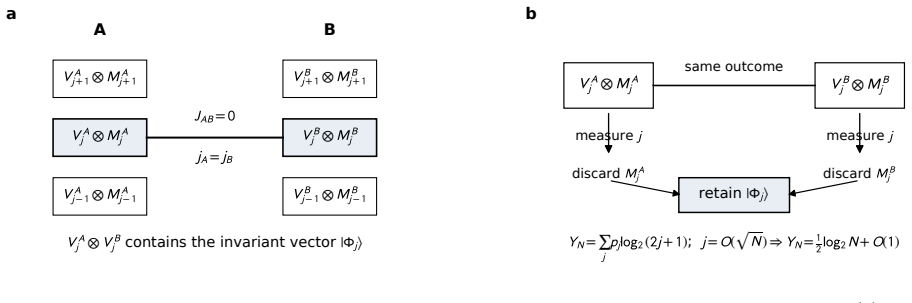
The carrying object is the representation-space distillation identity: for any invariant-subspace state, E_D >= sum_lambda p_lambda log2(d_lambda), where p_lambda is the probability that both halves carry representation lambda and d_lambda = dim V_lambda. For SU(2), d_j = 2j+1, so the yield is Y_N = sum_j p_j log2(2j+1). The thermodynamic input is a uniform complex-twist cluster expansion (Lemma B.1): log Tr exp(-beta H_A + i X . M_n)/Z_A = n phi_beta(X) + b_n,beta(X) with derivatives through third order bounded uniformly in n. This produces Gaussian saddles around the two central elements of SU(2), giving a half-chain spin distribution of width sqrt(N), a cubic low-spin tail, and a linear C
What would settle it
In the dimer chain, start from the factorized singlet-dimer ground state, heat within the total-spin-zero sector to a fixed T > 0, and measure the half-chain spin labels via a Schur transform: the yield should grow as 1/2 log2 N + C(T). A plateau or saturation in E_D as N increases would refute the activation claim. For the generic theorem, exact diagonalization of a small SU(2)-invariant chain can test whether the cumulative distribution of j/sqrt(N) approaches an order-one limiting shape and whether Y_N - 1/2 log2 N stays bounded; a spin distribution width that collapses to O(1) or a residua
Extended reading notes
Core claim
The central discovery is that sector-constrained thermal fluctuations become a distillable resource. For a state supported in the invariant subspace of a compact group, the yield Y_N = sum_j p_j log2(2j+1) is always a lower bound on distillable entanglement, because the unique invariant vector in each matched representation pair is maximally entangled with Schmidt rank 2j+1. In the dimer chain this bound is tight at every finite size: E_D = E_F = Y_N exactly, with E_D = 0 at T=0 and E_D = 1/2 log2 N + 1/2 log2[2 kappa(beta)] + (1 - gamma/2)/ln 2 + o(1) at every fixed T>0. The general theorem extends the leading coefficient to a broad class of local SU(2)-invariant chains at sufficiently high
Load-bearing premise
The broad theorem rests on a high-temperature cluster expansion that stays uniformly convergent when the half-chain is twisted by a complex SU(2) rotation; if that uniformity fails, the universal 1/2 log2 N coefficient for generic local chains is unproven (the exactly solved dimer chain does not depend on this assumption).
Editorial extensions
If this is right
- In the dimer chain the limits do not commute: fixing any T > 0 and increasing N gives unbounded distillable entanglement, while taking T -> 0 first leaves E_D = 0.
- For a broad class of local SU(2)-invariant chains, global-singlet thermal states contain at least ~1/2 log2 N distillable ebits across an equal bipartition throughout a nonzero high-temperature window, independent of microscopic coupling details.
- The resource is operationally extractable: local measurement of the half-chain spin label followed by discarding the multiplicity spaces is an LOCC distillation protocol requiring no knowledge of the Hamiltonian.
- The finite-size onset in the dimer chain is controlled by the activity x = L e^{-Delta/T}, so an order-one resource appears already at T_*(N) ~ Delta / ln N, i.e., at temperatures exponentially small relative to the gap.
- Abelian strong symmetries cannot produce this effect, because their irreducible representations have dimension one; the growing Schmidt rank comes specifically from the non-Abelian dimension 2j+1.
Reading between the lines
- The paper does not claim this, but the same sector-constrained mechanism plausibly extends to higher-rank compact groups, where the Weyl dimension formula would replace 2j+1 and could change the universal prefactor from 1/2 to a rank-dependent constant.
- A testable experimental probe in a simulator with SU(2) symmetry would be to prepare a global singlet, couple it weakly to a symmetry-preserving heat bath, and Schur-sample both halves; the predicted rescaled distribution of j/sqrt(N) should converge to h(u) = 4 u^2 e^{-u^2}/sqrt(pi) in the dimer case.
- If the protocol is repeated on many copies, the distilled ebits could serve as a private-key resource, linking this thermal-entanglement effect to quantum cryptographic tasks; the paper does not discuss that connection.
- The exact dimer equality E_D = E_F = Y_N may be special to the decoupled structure; in generic chains the lower bound E_D >= Y_N is likely the robust statement, and the entanglement of formation could exceed the representation yield.
Signed reviews
Editorial analysis
A structured set of objections, weighed in public.
Referee Report
Summary. The paper proposes a mechanism by which thermalization constrained to a non-Abelian strong-symmetry sector creates distillable entanglement that diverges with system size. It defines a representation-space distillation protocol that measures the half-chain SU(2) labels; for any state supported in the invariant subspace this yields E_D ≥ Y_N with Y_N = Σ_j p_j log2(2j+1). For an exactly solvable dimer chain with a product-singlet ground state, the authors prove E_D = E_F = Y_N exactly at every finite size and derive the fixed-temperature asymptotic E_D = 1/2 log2 N + O(1), together with an exact Bessel crossover F(x) in the double-scaling limit. They further state Theorem 1 asserting Y_N = 1/2 log2 N + O_β(1) and E_D ≥ Y_N for all finite-range, uniformly bounded, locally SU(2)-invariant chains with reflection symmetry at sufficiently high temperature, and present finite-size exact-diagonalization data for a J1–J2 chain.
Significance. If the general theorem holds, this is a notable conceptual result: it shows that heating can convert O(√N) thermal spin fluctuations into an unbounded operational resource starting from an unentangled ground state, and it identifies the non-Abelian dimension as the source of the logarithmic coefficient. The dimer result is exact, derived without fitted parameters, and passes the β=0 check against the known maximally-mixed-sector result. The Bessel crossover is a concrete, falsifiable prediction, and numerical/ancillary code is provided. However, the universal statement for generic chains is currently conditional on Lemma B.1; the manuscript's own proof of that lemma is only an outline, so the theorem is not yet fully established.
major comments (2)
- [Appendix B, Lemma B.1; Methods 4.4] Theorem 1's universal 1/2 log2 N coefficient is derived from Lemma B.1, but the proof of the lemma is not complete as written. The polymer expansion of Refs. [17,18] is invoked for the non-Hermitian one-site source K_{β,z} in (B.9), and the passage from convergence of the expansion to the decomposition (B.5) with the uniform derivative bounds (B.6) is asserted. In particular a nontrivial analyticity/uniformity argument is needed to show that the boundary term b_{n,β}(z) and its derivatives through third order are bounded independently of n; these bounds are later used in Lemma C.1 (C.2) and in the saddle normalization. Without a rigorous derivation, the n^{-3/2} Gaussian saddle and hence Theorem 1 are not proved for generic local chains. The exact dimer result (Sec. 2.2) is independent and is not affected. Please give a complete proof or a precise theorem with hypotheses covering this co
- [Appendix E, Lemma E.1] The QBP stability transfer is a second load-bearing step for Theorem 1. The lemma states exponential decay ∥η−η_R∥ ≤ Ce^{−μR}, the support/bandwidth property, and the moment bound (E.4), but it does not identify the QBP locality theorem being used or verify its hypotheses (finite range, high temperature, uniform constants independent of N) for the β interval of the theorem. Since the proof chooses R = q log N and needs n²e^{−μR} to be negligible, uniformity of μ matters. This is standard technology, but it should be made explicit before Theorem 1 can be accepted.
minor comments (4)
- [Sec. 2.2, Eq. (8) and Eq. (12)] The stated Hamiltonian H_dim = (Δ/2)∑P_r^{(1)} gives a triplet gap Δ/2, so the Boltzmann weight should be e^{−βΔ/2} unless Δ is defined as twice the physical gap. Please reconcile with y = e^{−βΔ} and with the crossover scale in Eq. (21).
- [Eq. (12) and Abstract] N = 4L in the dimer model, so replacing log2 L by log2 N shifts the additive constant by 1. The O(1) claim in the theorem is unaffected, but the displayed constant C(T) should be stated in one variable.
- [Abstract and Sec. 2.3] The phrase "universal Bessel-function crossover" refers to the exact dimer model, not to all chains in Theorem 1. Please make this explicit to avoid overgeneralizing.
- [Sec. 4.5, Eq. (41)] The identity ∑_j j(j+1)|a_j|² = ∫ ||∇f||² is used without derivation; a one-line integration-by-parts/Parseval statement would help.
Circularity Check
No circularity: the derivation is self-contained or rests on external, non-self-cited analytic ingredients; the general theorem's reliance on Lemma B.1 is a rigor gap, not a circular step.
full rationale
The derivation chain is not circular. The dimer result is exact and self-contained: the Hamiltonian (Eq. 6) fixes the thermal weights y = e^{-βΔ}; the representation coefficients a_{L,j}(y) are computed by character integrals (Eqs. 8–9); and the identities E_D = E_F = Y_N (Eq. 11) follow from an explicit LOCC protocol (lower bound) and a convex-decomposition upper bound, not from assuming the logarithmic scaling. The asymptotic E_D = 1/2 log_2 N + C(T) + o(1) (Eq. 12) is obtained from a two-center saddle applied to these exact coefficients; no parameter is fitted to the predicted quantity. The general Theorem 1 is conditional on Lemma B.1 (uniform complex-twist cluster expansion) and on external quantum-belief-propagation results [17–20]. These are cited mathematical tools, not self-citations, and they do not assume the target Y_N scaling; they supply the √N representation width from which the logarithmic coefficient follows. The proof of Lemma B.1 is compressed and the non-Hermitian twist is delicate, so Theorem 1 may be less rigorous than claimed, but that is an omitted-proof/correctness concern, not circularity. The J1–J2 numerical section is illustrative and does not feed parameters back into the theorem. No load-bearing step reduces by construction to its own input.
Assumptions & free parameters
free parameters (1)
- J2/J1 ratio =
0.37
assumptions (6)
- standard math Schur-duality decomposition of Inv(H_A tensor H_B) and maximal entanglement of the invariant vector |Phi_lambda> (Eq. 3).
- domain assumption Uniform complex-twist cluster expansion (Lemma B.1): log Tr exp(-beta H_A + iX.M_n)/Z_A = n phi_beta(X) + b_n,beta(X) with uniform derivative bounds, for beta < beta_ce.
- domain assumption Quantum belief propagation representation e^{-beta(H^{(0)}+V_∂)} = eta e^{-beta H^{(0)}} eta^dagger with ||eta||, ||eta^{-1}|| bounded and exponentially decaying tail (Lemma E.1, Eq. 31).
- domain assumption Strong-symmetry thermal ensemble: rho_beta,0 = P0 e^{-beta H} P0 / Z is the equilibrium state of a strongly SU(2)-symmetric, detailed-balanced, singlet-sector-ergodic dynamics.
- domain assumption Reflection symmetry about the central bipartition and the class of Hamiltonians: fixed finite-period unit cell, uniformly bounded finite-range interaction, exact local SU(2) invariance.
- standard math E_D <= E_F and additivity of E_F over tensor products.
Cite this review
Pith. "Pith review of Thermal Activation of Divergent Distillable Entanglement under Non-Abelian Strong Symmetry." pith.science (2026). https://pith.science/paper/S4H6BDV6
@misc{pith2026260712710,
  author       = {Pith},
  title        = {Pith review of: Thermal Activation of Divergent Distillable Entanglement under Non-Abelian Strong Symmetry},
  year         = {2026},
  howpublished = {\url{https://pith.science/paper/S4H6BDV6}},
  note         = {Machine review of arXiv:2607.12710}
}
abstract
Heating usually destroys quantum entanglement. We show that thermalization constrained to a non-Abelian strong-symmetry sector can instead generate a distillable resource that diverges with system size. In an exactly solvable local dimer chain, entanglement across an equal bipartition is exactly zero at $T=0$, whereas every fixed $T>0$ yields $E_D=\frac12\log_2 N+C(T)+o(1)$. Measurements of the two half-chain representation labels convert thermally populated non-Abelian sectors into standard ebits. More generally, for global-singlet thermal states of finite-range, uniformly bounded, locally $SU(2)$-invariant chains, there is a nonzero high-temperature interval in which the protocol yield satisfies $Y_N=\frac12\log_2 N+O_\beta(1)$ and $E_D\geq Y_N$. For the dimer chain, the full finite-size onset is governed by a universal Bessel-function crossover with $T_*(N)=\Delta/[\ln N+O(1)]$. Exact diagonalization of a frustrated $J_1$-$J_2$ chain shows the expected finite-size signatures. Thus thermal fluctuations can create entanglement across a macroscopic cut and convert it into an unbounded operational quantum resource.
Figures


Reference graph
Works this paper leans on
-
[1]
Quantum entanglement
Ryszard Horodecki, Paweł Horodecki, Michał Horodecki, and Karol Horodecki. “Quantum entanglement”. Rev. Mod. Phys. 81, 865–942 (2009)
2009
-
[2]
Entanglement in many-body systems
Luigi Amico, Rosario Fazio, Andreas Oster- loh, and Vlatko Vedral. “Entanglement in many-body systems”. Rev. Mod. Phys. 80, 517–576 (2008)
2008
-
[3]
Ex- ponential clustering of bipartite quantum en- tanglementatarbitrarytemperatures
Tomotaka Kuwahara and Keiji Saito. “Ex- ponential clustering of bipartite quantum en- tanglementatarbitrarytemperatures”. Phys. Rev. X12, 021022 (2022)
2022
-
[4]
High-temperature Gibbs states are unentangled and efficiently preparable
Ainesh Bakshi, Allen Liu, Ankur Moitra, and Ewin Tang. “High-temperature Gibbs states are unentangled and efficiently preparable”. In 2024 IEEE 65th Annual Symposium on Foundations of Com- puter Science (FOCS). Pages 1027–1036. IEEE (2024)
2024
-
[5]
Entanglement in quan- tum spin chains is strictly finite at any tem- perature
Ainesh Bakshi, Soonwon Choi, and Saúl Pilatowsky-Cameo. “Entanglement in quan- tum spin chains is strictly finite at any tem- perature” (2026). arXiv:2602.13386
arXiv 2026
-
[6]
Spatial entanglement sudden death in spin chains at all temper- atures
Samuel O. Scalet. “Spatial entanglement sudden death in spin chains at all temper- atures” (2026). arXiv:2602.20694
arXiv 2026
-
[7]
Natural thermal and magnetic en- tanglement in the 1D Heisenberg model
M. C. Arnesen, Sougato Bose, and Vlatko Vedral. “Natural thermal and magnetic en- tanglement in the 1D Heisenberg model”. Phys. Rev. Lett.87, 017901 (2001)
2001
-
[8]
High temperature macro- scopic entanglement
Vlatko Vedral. “High temperature macro- scopic entanglement”. New J. Phys. 6, 102 (2004)
2004
Show all 20 references
-
[9]
A note on symmetry reductions of the Lindblad equa- 10 tion: transport in constrained open spin chains
Berislav Buča and Tomaž Prosen. “A note on symmetry reductions of the Lindblad equa- 10 tion: transport in constrained open spin chains”. New J. Phys.14, 073007 (2012)
2012
-
[10]
En- tanglement and private information in many- body thermal states
Samuel J. Garratt and Max McGinley. “En- tanglement and private information in many- body thermal states”. Phys. Rev. Lett.136, 100802 (2026)
2026
-
[11]
Symmetry enforces en- tanglement at high temperatures
Amir-Reza Negari, Leonardo A. Lessa, and Subhayan Sahu. “Symmetry enforces en- tanglement at high temperatures” (2025). arXiv:2508.20166
2025
-
[12]
Non- Abelian symmetry can increase entangle- ment entropy
Shayan Majidy, Aleksander Lasek, David A. Huse, and Nicole Yunger Halpern. “Non- Abelian symmetry can increase entangle- ment entropy”. Phys. Rev. B 107, 045102 (2023)
2023
-
[13]
Non-Abelian symmetry-resolved entanglement entropy
Eugenio Bianchi, Pietro Donà, and Rishabh Kumar. “Non-Abelian symmetry-resolved entanglement entropy”. SciPost Phys. 17, 127 (2024)
2024
-
[14]
En- tanglement of zero-angular-momentum mix- tures and black-hole entropy
Etera R. Livine and Daniel R. Terno. “En- tanglement of zero-angular-momentum mix- tures and black-hole entropy”. Phys. Rev. A 72, 022307 (2005)
2005
-
[15]
Symmetry-enforced entangle- ment in maximally mixed states
Amin Moharramipour, Leonardo A. Lessa, Chong Wang, Timothy H. Hsieh, and Sub- hayan Sahu. “Symmetry-enforced entangle- ment in maximally mixed states”. PRX Quantum5, 040336 (2024)
2024
-
[16]
Highlyentangledstationary states from strong symmetries
Yahui Li, Frank Pollmann, Nicholas Read, andPabloSala. “Highlyentangledstationary states from strong symmetries”. Phys. Rev. X15, 011068 (2025)
2025
-
[17]
Large de- viations for quantum spin systems
Karel Netočný and Frank Redig. “Large de- viations for quantum spin systems”. J. Stat. Phys.117, 521–547 (2004)
2004
-
[18]
High-temperature cluster expansion for clas- sical and quantum spin lattice systems with multi-body interactions
Tong Xuan Nguyen and Roberto Fernández. “High-temperature cluster expansion for clas- sical and quantum spin lattice systems with multi-body interactions”. J. Stat. Phys.191, 13 (2024)
2024
-
[19]
Quantum belief propaga- tion: An algorithm for thermal quantum sys- tems
M. B. Hastings. “Quantum belief propaga- tion: An algorithm for thermal quantum sys- tems”. Phys. Rev. B76, 201102(R) (2007)
2007
-
[20]
From decay of correlations to locality and stability of the Gibbs state
Ángela Capel, Massimo Moscolari, Stefan Teufel, and Tom Wessel. “From decay of correlations to locality and stability of the Gibbs state”. Commun. Math. Phys. 406, 43 (2025). 11 Supplemental Material for “Thermal Activation of Divergent Distillable Entanglement under Non-Abeli...
2025
Reviewed August 2, 2026 · model on record in the stance chip above.
Discussion (0). Continue with ORCID to comment.