REVIEW 4 major objections 7 minor 1 cited by
Question Answering on Patient Medical Records with Private Fine-Tuned LLMs
T0 review · 4 major / 7 minor · reviewed 2026-08-10 · deepseek-v4-flash
Pith's one-line read Fine-tuned 8B model beats GPT-4 on medical-record QA
desk verdict A useful, reproducible pilot on private fine-tuned FHIR QA, but the head-to-head with GPT-4 is undermined by a query-leaking Task 1 split and a 100-example GPT-4-written Task 2 test. read the letter →
The pith
A machine-rendered reading of the paper's core claim, the machinery that carries it, and where it could break.
The reading
What carries the argument
The central machinery is a two-stage decomposition of semantic QA over EHRs: Task 1 is binary classification $F(q,r) = I\{0,1\}$ deciding whether a FHIR resource $r$ is relevant to query $q$, and Task 2 generates a patient-friendly answer conditioned on the query and the relevant resources. The adaptation mechanism is QLoRA fine-tuning (rank 16, 5 epochs) applied to 8-12B base models, which keeps the models small enough for private hosting. The supervision pipeline uses Synthea to generate synthetic FHIR records and GPT-4 to write queries, relevance labels, and reference answers; METEOR is the evaluation metric for answer generation. The comparison set includes GPT-4, GPT-4o, and Meditron-7B.
What would settle it
Re-run both tasks on a test set whose queries and resources are entirely new, with human clinicians writing the gold labels and reference answers; if the fine-tuned models no longer beat GPT-4 on F1 and METEOR, the reported advantage does not generalize.
Extended reading notes
Core claim
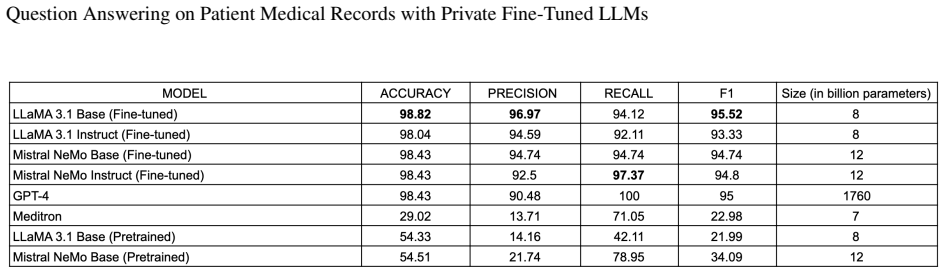
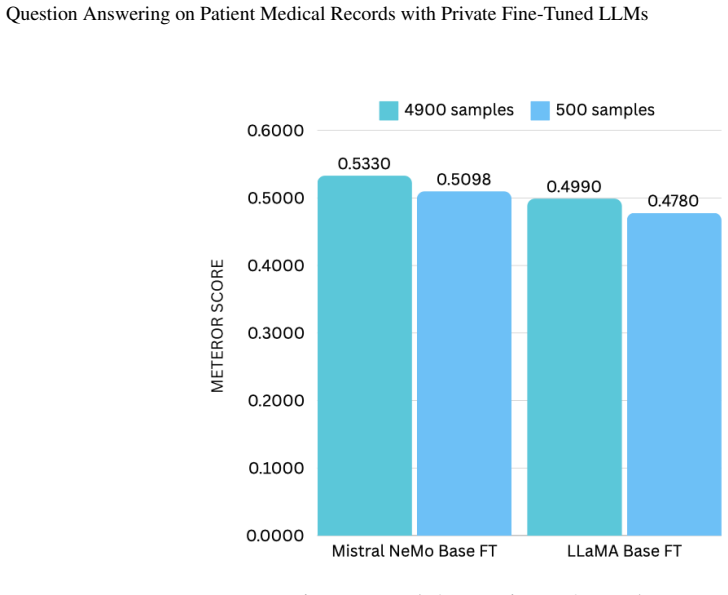
The paper's central claim is that fine-tuned, openly available models match or beat frontier models on a two-stage FHIR question-answering pipeline when each stage is optimized separately. On Task 1, the fine-tuned LLaMA 3.1 Base 8B reaches 98.82% accuracy and 95.52% F1, compared with GPT-4's 98.43% accuracy and 95% F1. On Task 2, the fine-tuned Mistral NeMo Base 12B reaches a METEOR score of 0.5333, versus 0.3752 for GPT-4. The paper also claims that increasing training data from 500 to 4,900 examples improves Task 2 METEOR by about 4-5 points, that sequential fine-tuning on one task sharply degrades performance on the other, and that LLM-as-a-judge evaluation shows a clear self-preference bias only when the judging model knows it is evaluating its own output.
Load-bearing premise
The evaluation assumes both that GPT-4's relevance labels and reference answers are correct ground truth and that the random split of 5,000 resource-level examples never puts resources from the same query into both training and test.
Editorial extensions
If this is right
- A privately hostable 8-12B model can serve as the core of a FHIR question-answering system without sending patient data to a cloud API, at accuracy comparable to or better than GPT-4.
- Fine-tuning on task-specific synthetic data is what unlocks the gains: pretrained Llama 3.1 Base and Mistral NeMo Base score only around 54% accuracy on Task 1 before fine-tuning.
- More fine-tuning data helps: models trained on 4,900 examples beat those trained on 500 by roughly 4-5 points of METEOR on Task 2.
- Sequential fine-tuning is fragile: moving from Task 1 to Task 2 drops Task 1 F1 from 95.52 to 31.62, and extending the prompt with classification instructions only recovers it to 56.62.
- LLM-as-a-judge evaluation shows only minor self-preference in blind comparisons, but a clear 13-point win-rate drop for GPT-4 once it knows it is judging its own response.
Reading between the lines
- If the results hold on independently annotated data, the practical takeaway is that parameter-efficient fine-tuning of mid-size open models can substitute for frontier API calls in structured EHR QA, and that private deployment need not cost accuracy.
- The 0.55% F1 margin on Task 1 is small enough that a different split or annotation source could flip the ordering; the METEOR margin is larger, but METEOR computed against GPT-4-written references may reward models that imitate GPT-4's phrasing.
- Because the same GPT-4 that generated the labels and references is the benchmark being outperformed, the fairest next test would be an external human-annotated evaluation set with stricter query-level separation.
- The architecture-dependent sequential fine-tuning results (Mistral loses, LLaMA gains) point to multi-task learning or continual pre-training as more reliable routes to a single model handling both tasks.
Signed reviews
Editorial analysis
A structured set of objections, weighed in public.
Referee Report
Summary. The paper proposes a two-stage semantic QA pipeline over synthetic FHIR patient records: Task 1 classifies whether a FHIR resource is relevant to a natural-language query, and Task 2 generates a patient-friendly answer from the relevant resources. The authors generate a synthetic dataset of 5,000 query–resource examples using GPT-4 to create queries, relevance labels, and reference answers, then fine-tune open-weight models (Llama 3.1 8B and Mistral NeMo 12B) with QLoRA. They report that the fine-tuned models outperform GPT-4 on both tasks, with Llama 3.1 Base reaching 98.82% accuracy and 95.52% F1 on Task 1 versus GPT-4's 95.00% F1, and Mistral NeMo Base reaching 0.5333 METEOR on Task 2 versus GPT-4's 0.3752. The paper also studies sequential fine-tuning, training-set size effects, and LLM-as-a-judge self-preference bias.
Significance. If the reported results were reliable, the paper would make a meaningful practical contribution: it demonstrates that small, privately hostable models can potentially match or beat a large API-based model on a structured medical QA task, with public model and dataset release. The exploration of sequential fine-tuning and narcissistic evaluation is also a useful addition to the literature. However, the central empirical claim rests on an evaluation design with a likely train/test leakage in Task 1, a circular gold-standard construction, and very small test sets with no uncertainty quantification. These issues are load-bearing for the headline conclusion, so the current manuscript does not provide trustworthy evidence for its main claim.
major comments (4)
- [Section 4.1.1, Dataset Creation] The 95-5 split is described only as 'a 95-5 training-test split for the dataset' with no grouping by query or patient. Since each query generates 10 examples (one per FHIR resource), a random example-level split will place rows from the same query in both training and test, allowing the model to memorize query–resource associations during training and apply them to held-out rows of the same query. This directly inflates the reported Task 1 accuracy (98.82%) and F1 (95.52%). The same concern applies to Task 2: the 10 queries per patient share the same pool of resources, so an ungrouped split can leak patient-level information. The evaluation must be grouped by query (or patient), and results should be reported on never-seen queries only.
- [Section 4.1.2, Task 2 Data Preparation] The reference answers used for METEOR scoring are generated by GPT-4, and the fine-tuned models are trained on GPT-4-generated answers. The reported 'outperform GPT-4' result on Task 2 therefore measures how closely the models reproduce GPT-4's own text, not agreement with an independent ground truth. An external human or clinical gold standard is needed to support the claim that the fine-tuned models answer queries correctly. Additionally, the test set contains only 100 examples, so the 0.5333 vs. 0.3752 METEOR difference is reported without any confidence interval or significance test, making it impossible to assess whether the margin is real.
- [Section 5.1.1, Experiment 1] The headline Task 1 result is a 0.55% F1 margin (95.52% vs. 95.00%) on roughly 250 test examples. No confidence intervals, bootstrap estimates, or significance tests are provided. At this sample size, the margin is within sampling noise; the authors should report uncertainty estimates and a paired significance test (e.g., McNemar's test for the binary labels) before claiming that the fine-tuned model outperforms GPT-4. The same applies to other comparisons in Sections 5.2.1 and 5.2.3.
- [Sections 4.1.1 and 4.1.2, Dataset Creation] Even apart from the split issue, the gold labels are circular: GPT-4 generates the query, decides which resources are 'relevant' or 'irrelevant,' and later writes the reference answers. The benchmark is internally consistent, but it does not establish that these labels reflect real medical relevance or that the reference answers are clinically correct. The paper's conclusion that fine-tuned models 'outperform GPT-4' should be reframed as 'better approximate GPT-4's judgments' unless human-validated labels and references are introduced.
minor comments (7)
- [Abstract] The phrase '42% on Meteor Task in Task2' is imprecise; the reported numbers indicate a relative METEOR improvement of about 42%, not a percentage-point gain. Please state the metric and the comparison explicitly.
- [Section 5.2.2, Experiment 2] The sentence 'LLaMA Base fine-tuned with 4900 examples showed a 4.39% higher METEOR score compared to Mistral NeMo Base fine-tuned with 500 examples' confounds model choice with dataset size; the dataset-size conclusion should compare the same model trained on 500 vs. 4,900 examples.
- [Section 4.2, Fine-tuning] Only LoRA rank 16 and 5 epochs are reported for all fine-tuning runs, with no sensitivity analysis or rationale for these hyperparameter choices.
- [Figures 3–9] The text contains duplicated figure numbers (e.g., 'Figure 3 3', 'Figure 4 4'), which should be corrected.
- [Section 5.1.1] The claim that GPT-4 has 1760B parameters is based on an unverified public estimate; please cite a source or remove the specific number.
- [Section 5.2.4, Experiment 4] The judge model 'Claude Sonnet' is named without a version; please specify the exact model version used for reproducibility.
- [Section 6.2, Limitations] The limitations section mentions only the use of synthetic patient data; the reliance on GPT-4 for labels and reference answers, the lack of statistical significance testing, and the small test-set sizes are equally important limitations and should be acknowledged.
Circularity Check
Core 'outperform GPT-4' claims reduce to self-referential GPT-4-generated labels/references plus query-level train/test leakage, not independent prediction.
-
fitted input called prediction
[Section 4.1.1, Dataset Creation (Task 1 split)]
"This process was repeated 10 times per patient, resulting in a total of 5,000 JSON files containing queries, patient IDs, relevance label, and resource. For LLM fine-tuning, the inputs are the query and resource, and the output is relevance label. We used a 95-5 training-test split for the dataset."
Each query is generated from a batch of 10 FHIR resources and attached to all 10 rows, so the dataset has 10 rows sharing identical query text. A random 95-5 row-level split places rows of the same query in both training and test with near-certainty. A model trained on 9 rows of a query can memorize that query's relevance pattern and apply it to the held-out row of the same query. The reported Task 1 F1 margin (95.52% vs GPT-4's 95.00%) therefore measures recall of training-set query-resource associations, not generalization to new patient questions; the 'prediction' on leaked queries is forced by the training input by construction.
-
self definitional
[Section 4.1.1 steps 2-3 and Section 5.1.1 (Task 1 labels)]
"GPT-4 was employed to generate a natural language query based on one or more of the 10 selected FHIR resources. ... GPT-4 labeled the resources as 'relevant' if they were used to generate the query and 'irrelevant' if they were not."
The ground-truth relevance labels used for both fine-tuning and evaluation are GPT-4's own judgments. The fine-tuned models are trained to reproduce these labels, and GPT-4 is then benchmarked against the same labels. The claim that a fine-tuned model 'outperforms GPT-4 by 0.55% F1' reduces to whether a student trained on GPT-4's labels can match GPT-4's own labeling behavior more consistently than GPT-4 does in a single prompt pass; it is not evidence of superior medical relevance judgment independent of the benchmark's author.
1 more flagged steps
-
fitted input called prediction
[Section 4.1.2 and Section 5.2.1 (Task 2 references and METEOR)]
"For each of them, GPT-4 was used to create a relevant answer. ... Finally, we had 5,000 examples of (query, [list of relevant resources], answer). ... We chose METEOR score [24] as the evaluation metric."
The reference answers against which METEOR is computed are GPT-4 generations, and these same GPT-4 generations are the training targets for the fine-tuned models. A model trained on (query, resources) -> GPT-4 answer is optimized to reproduce GPT-4's answer distribution, and METEOR then measures lexical and stem overlap with that same distribution. The headline '42% higher METEOR than GPT-4' (0.5333 vs 0.3752) therefore compares GPT-4's zero-shot output with a distilled imitator trained and scored on GPT-4's own references; the margin is an imitation-fidelity score rather than an independent quality advantage.
full rationale
The paper's central empirical claim—that 8B-12B fine-tuned models outperform GPT-4 on FHIR QA—is not backed by an independent evaluation. Task 1's relevance labels are produced by GPT-4, the same model family used as the comparison baseline, and the fine-tuned models are trained on those labels. Task 2's reference answers are also GPT-4 generations, and the fine-tuned models are trained on those same references and scored by METEOR against them. In addition, the 95-5 and 98-2 splits are described only at the dataset level; because Task 1 generates 10 rows per query, a row-level split places identical query text in both training and test, enabling memorization of query-resource relevance patterns. Thus the reported F1 and METEOR margins reduce to how well a student model imitates GPT-4's own labeling and answering behavior, not to generalization on unseen patient questions. There are no external benchmarks or human-validated labels to break this self-reference; the blind LLM-as-a-judge experiment in Experiment 4 is itself an LLM judge and is not applied to Task 1. No self-citation load-bearing chain appears, but the central comparison is self-referential by construction, so a score of 7 is appropriate.
Assumptions & free parameters
free parameters (6)
- LoRA rank =
16
- Training epochs =
5
- Task 1 train-test split =
95/5
- Task 2 train-test split =
98/2 (4,900 train / 100 test)
- FHIR resources per query =
10
- Training dataset sizes =
4,900 and 500 examples
assumptions (5)
- domain assumption Synthea-generated FHIR records are representative of real EHRs for QA training and evaluation.
- ad hoc to paper GPT-4-generated relevance labels and reference answers constitute valid ground truth for Task 1 and Task 2.
- ad hoc to paper Splitting the 5,000 resource-level examples randomly does not leak query or patient information between train and test.
- domain assumption METEOR is a valid proxy for clinical answer quality.
- domain assumption QLoRA fine-tuning preserves the base model's relevant language capabilities.
Cite this review
Pith. "Pith review of Question Answering on Patient Medical Records with Private Fine-Tuned LLMs." pith.science (2026). https://pith.science/paper/S5772GEJ
@misc{pith2026250113687,
  author       = {Pith},
  title        = {Pith review of: Question Answering on Patient Medical Records with Private Fine-Tuned LLMs},
  year         = {2026},
  howpublished = {\url{https://pith.science/paper/S5772GEJ}},
  note         = {Machine review of arXiv:2501.13687}
}
read the original abstract
Healthcare systems continuously generate vast amounts of electronic health records (EHRs), commonly stored in the Fast Healthcare Interoperability Resources (FHIR) standard. Despite the wealth of information in these records, their complexity and volume make it difficult for users to retrieve and interpret crucial health insights. Recent advances in Large Language Models (LLMs) offer a solution, enabling semantic question answering (QA) over medical data, allowing users to interact with their health records more effectively. However, ensuring privacy and compliance requires edge and private deployments of LLMs. This paper proposes a novel approach to semantic QA over EHRs by first identifying the most relevant FHIR resources for a user query (Task1) and subsequently answering the query based on these resources (Task2). We explore the performance of privately hosted, fine-tuned LLMs, evaluating them against benchmark models such as GPT-4 and GPT-4o. Our results demonstrate that fine-tuned LLMs, while 250x smaller in size, outperform GPT-4 family models by 0.55% in F1 score on Task1 and 42% on Meteor Task in Task2. Additionally, we examine advanced aspects of LLM usage, including sequential fine-tuning, model self-evaluation (narcissistic evaluation), and the impact of training data size on performance. The models and datasets are available here: https://huggingface.co/genloop
Figures


Figures from the paper (6 more)




Forward citations
Cited by 1 Pith paper
-
Scaling Laws for Hypernetwork-Based Knowledge Injection in Large Language Models
Hypernetwork-generated LoRA adapters for knowledge injection show power-law scaling in width, depth, target size, and per-example fact count, and steeper out-of-distribution scaling than LoRA or full fine-tuning on Me...
Reference graph
Works this paper leans on
-
[2]
CMS Interoperability and Patient Access Final Rule (CMS-9115-F) | CMS — cms.gov. https://www.cms.gov/priorities/key-initiatives/ burden-reduction/interoperability/policies-and-regulations/ cms-interoperability-and-patient-access-final-rule-cms-9115-f . (accessed 26 Dec. 2024). 13 Question Answering on Patient Medical Records with Private Fine-Tuned LLMs
work page 2024
-
[3]
An act to accelerate the discovery, development, and delivery of 21st century cures, and for other purposes. Accession Number: PLAW-114publ255, PLAW-114publ255 Call Number: AE 2.110:, AE 2.110/3:, AE 2.110:114-255, AE 2.110:, AE 2.110/3:, AE 2.110:114-255 Source: DGPO, DGPO
-
[4]
https://www.apple.com/healthcare/ health-records/
Healthcare - Health Records — apple.com. https://www.apple.com/healthcare/ health-records/. (accessed 26 Dec. 2024)
work page 2024
-
[5]
Almutairi, Sulaiman Al Mashrafi, and Talib Al Kalbani
Hilal Al Shamsi, Abdullah G. Almutairi, Sulaiman Al Mashrafi, and Talib Al Kalbani. Impli- cations of language barriers for healthcare: A systematic review. 35(2):e122
-
[6]
https://arxiv.org/abs/2402.06196
Large Language Models: A Survey — arxiv.org. https://arxiv.org/abs/2402.06196. [Accessed 26-12-2024]
arXiv 2024
-
[7]
Office for Civil Rights (OCR). Health information privacy. Last Modified: 2024-04- 19T18:24:31-0400
work page 2024
-
[8]
California consumer privacy act (CCPA) | state of california - department of justice - office of the attorney general
-
[9]
Biometric information privacy act (BIPA) | ACLU of illinois
Show all 25 references
-
[10]
LLaMA: Open and efficient foundation language models
Hugo Touvron, Thibaut Lavril, Gautier Izacard, Xavier Martinet, Marie-Anne Lachaux, Timothée Lacroix, Baptiste Rozière, Naman Goyal, Eric Hambro, Faisal Azhar, Aurelien Rodriguez, Armand Joulin, Edouard Grave, and Guillaume Lample. LLaMA: Open and efficient foundation language models
-
[11]
Aaron Grattafiori, Abhimanyu Dubey, Abhinav Jauhri, Abhinav Pandey, Abhishek Kadian, Ahmad Al-Dahle, Aiesha Letman, Akhil Mathur, Alan Schelten, Alex Vaughan, Amy Yang, Angela Fan, Anirudh Goyal, Anthony Hartshorn, Aobo Yang, Archi Mitra, Archie Sravanku- mar, Artem Korenev, A...
2024
-
[12]
Albert Q. Jiang, Alexandre Sablayrolles, Arthur Mensch, Chris Bamford, Devendra Singh Chaplot, Diego de las Casas, Florian Bressand, Gianna Lengyel, Guillaume Lample, Lucile Saulnier, Lélio Renard Lavaud, Marie-Anne Lachaux, Pierre Stock, Teven Le Scao, Thibaut Lavril, Thomas ...
2023
-
[13]
Parameter-efficient transfer learning for nlp
Neil Houlsby, Andrei Giurgiu, Stanislaw Jastrzebski, Bruna Morrone, Quentin De Laroussilhe, Andrea Gesmundo, Mona Attariyan, and Sylvain Gelly. Parameter-efficient transfer learning for nlp. In International conference on machine learning , pages 2790–2799. PMLR, 2019
2019
-
[14]
Hu, Yelong Shen, Phillip Wallis, Zeyuan Allen-Zhu, Yuanzhi Li, Shean Wang, Lu Wang, and Weizhu Chen
Edward J. Hu, Yelong Shen, Phillip Wallis, Zeyuan Allen-Zhu, Yuanzhi Li, Shean Wang, Lu Wang, and Weizhu Chen. LoRA: Low-rank adaptation of large language models
-
[15]
QLoRA: Efficient finetuning of quantized LLMs
Tim Dettmers, Artidoro Pagnoni, Ari Holtzman, and Luke Zettlemoyer. QLoRA: Efficient finetuning of quantized LLMs. 16 Question Answering on Patient Medical Records with Private Fine-Tuned LLMs
-
[16]
Yerebakan, Yoshihisa Shinagawa, and Yuan Luo
Yikuan Li, Hanyin Wang, Halid Z. Yerebakan, Yoshihisa Shinagawa, and Yuan Luo. FHIR-GPT: Enhancing health data interoperability with large language models. Pages: 2023.10.17.23297028
2023
-
[17]
Agentic LLM workflows for generating patient-friendly medical reports
Malavikha Sudarshan, Sophie Shih, Estella Yee, Alina Yang, John Zou, Cathy Chen, Quan Zhou, Leon Chen, Chinmay Singhal, and George Shih. Agentic LLM workflows for generating patient-friendly medical reports
-
[18]
LLM on FHIR – demystifying health records
Paul Schmiedmayer, Adrit Rao, Philipp Zagar, Vishnu Ravi, Aydin Zahedivash, Arash Ferey- dooni, and Oliver Aalami. LLM on FHIR – demystifying health records
-
[19]
SUPaHOT: Universally scalable and private method to demystify FHIR health records
Michael Brockman, Nina Boord, and Hamed Hemkat. SUPaHOT: Universally scalable and private method to demystify FHIR health records
-
[20]
Meditron-7b: Scaling medical pretraining for large language models, 2023
Zeming Chen, Alejandro Hernández-Cano, Angelika Romanou, Antoine Bonnet, Kyle Matoba, Francesco Salvi, Matteo Pagliardini, Simin Fan, Andreas Köpf, Amirkeivan Mohtashami, Alexandre Sallinen, Alireza Sakhaeirad, Vinitra Swamy, Igor Krawczuk, Deniz Bayazit, Axel Marmet, Syrielle...
2023
-
[21]
Retrieval-augmented generation for large language models: A survey, 2024
Yunfan Gao, Yun Xiong, Xinyu Gao, Kangxiang Jia, Jinliu Pan, Yuxi Bi, Yi Dai, Jiawei Sun, Meng Wang, and Haofen Wang. Retrieval-augmented generation for large language models: A survey, 2024
2024
-
[22]
Retrieval-augmented generation for natural language processing: A survey, 2024
Shangyu Wu, Ying Xiong, Yufei Cui, Haolun Wu, Can Chen, Ye Yuan, Lianming Huang, Xue Liu, Tei-Wei Kuo, Nan Guan, and Chun Jason Xue. Retrieval-augmented generation for natural language processing: A survey, 2024
2024
-
[23]
Synthea: An approach, method, and software mechanism for generating synthetic patients and the synthetic electronic health care record
Jason Walonoski, Mark Kramer, Joseph Nichols, Andre Quina, Chris Moesel, Dylan Hall, Carlton Duffett, Kudakwashe Dube, Thomas Gallagher, and Scott McLachlan. Synthea: An approach, method, and software mechanism for generating synthetic patients and the synthetic electronic hea...
-
[24]
Meteor: An automatic metric for mt evaluation with improved correlation with human judgments
Satanjeev Banerjee and Alon Lavie. Meteor: An automatic metric for mt evaluation with improved correlation with human judgments. In Proceedings of the acl workshop on intrinsic and extrinsic evaluation measures for machine translation and/or summarization, pages 65–72, 2005
2005
-
[25]
LLMs as narcissistic evaluators: When ego inflates evaluation scores
Yiqi Liu, Nafise Sadat Moosavi, and Chenghua Lin. LLMs as narcissistic evaluators: When ego inflates evaluation scores
-
[26]
resource
Arjun Panickssery, Samuel R. Bowman, and Shi Feng. LLM evaluators recognize and favor their own generations. 17 Question Answering on Patient Medical Records with Private Fine-Tuned LLMs A Appendix A.1 GPT-4 Prompt for Query Generation: Task 1 To generate natural language quer...
2018
Reviewed August 10, 2026 · model on record in the stance chip above.
Discussion (0). Continue with ORCID to comment.