REVIEW 4 major objections 5 minor 44 references
Person Re-Identification System at Semantic Level based on Pedestrian Attributes Ontology
T0 review · 4 major / 5 minor · reviewed 2026-08-07 · deepseek-v4-flash
Pith's one-line read Pedestrian attributes used as a pre-filter lift person re-identification mAP by at least 9.3% on Market1501.
desk verdict A genuinely simple idea — pre-filter the gallery by semantic attributes — but the experiment is set up so the reported Re-ID gain is likely a selection artifact. read the letter →
The pith
A machine-rendered reading of the paper's core claim, the machinery that carries it, and where it could break.
The reading
What carries the argument
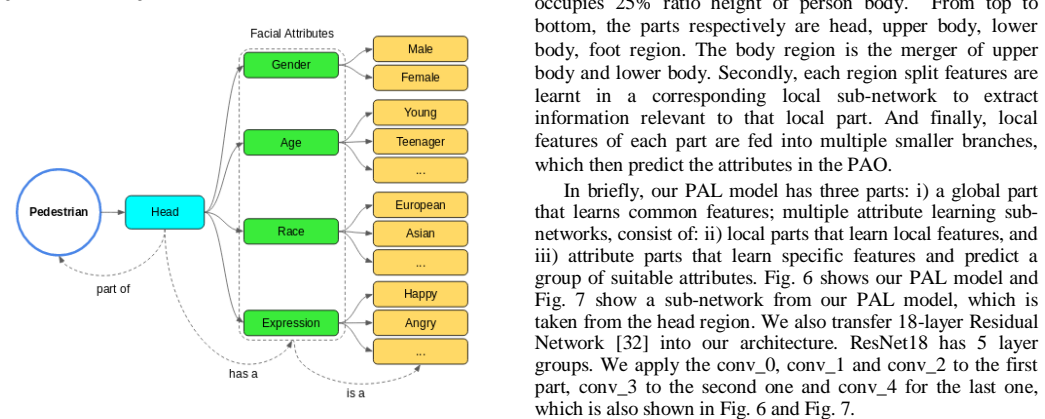
The load-bearing mechanism is the Pedestrian Attribute Ontology (PAO), a hand-built hierarchical tree that maps attributes to body regions (head, upper body, lower body, whole body, foot) and to clothing categories. Coupled with it is a Local Multi-task DCNN that horizontally splits a mid-layer feature map into region-specific sub-networks, each predicting only the attributes of its region, which exploits the ontology's inter-group and inner-group correlations. The Imbalance Data Solver then grid-searches each attribute's probability threshold to maximize the Matthews correlation coefficient on the training set, turning raw probabilities into binary labels used to filter gallery candidates. The filtering step removes candidates whose binary attribute vector disagrees with the query before nearest-neighbor matching on 256-dimensional global features.
What would settle it
Re-run the pre-filtering experiment on Market1501 with the five attributes chosen by F1 score on a separate validation split (or on a different attribute-annotated Re-ID benchmark such as DukeMTMC-reID), and check whether the at-least-9.3% mAP gain over the global-features-only baseline persists. A second check: measure the fraction of query images whose true gallery match is removed by the "down black" filter; if that fraction is non-trivial, the top-k gains may partly reflect a smaller gallery rather than better ranking.
Extended reading notes
Core claim
The paper's central claim is that predicting pedestrian attributes with a local multi-task model and thresholding the predictions with per-attribute Matthews correlation coefficients yields binary semantic descriptors strong enough to pre-filter the gallery for person re-identification. On Market1501, filtering with the five attributes with the highest F1 scores improves mean average precision from 65.1% to at least 74.4%, and the single attribute "down black" achieves Top-1 85.2%, Top-5 95.3%, Top-10 96.9% and mAP 74.8%, compared with 81.4%, 91.8%, 94.7% and 65.1% for the deep global features alone. The authors further show that using only one best attribute per body region outperforms concatenating global and local deep features in most positions. They conclude that semantic pre-filtering is a viable complement, and that gains should grow as attribute recognition improves.
Load-bearing premise
The reported improvement assumes that choosing the five best attributes (and then the single best, "down black") by inspecting results on the same Market1501 test set does not inflate the measured gain; no held-out attribute-selection protocol or significance test is provided.
Editorial extensions
If this is right
- When attribute predictions are reliable, semantic pre-filtering can be added to any existing feature-based Re-ID system as an inference-time wrapper, with no change to the feature extractor.
- The reported results imply that the quality ceiling of this approach is set by attribute recognition: improving per-attribute F1 scores should translate directly into higher Re-ID mAP.
- Using all attributes of a region hurts performance compared with using the single best attribute, so selective filtering—not full semantic matching—is the recommended strategy.
- mAP gains of 9.3–10.1 points with only modest changes in top-k accuracy indicate the filter mainly removes easy negatives, re-ranking the top-ranked candidates.
Reading between the lines
- Because the attribute set is chosen and evaluated on the same test set, the true out-of-sample gain is likely lower; a pre-registered attribute-selection protocol would give a fairer estimate.
- The hard binary filter could be softened into a ranking penalty (e.g., adding an attribute-mismatch distance to the Euclidean feature distance), which would be more robust to attribute prediction errors.
- The same ontology-plus-local-branch architecture could be transferred to attribute-annotated benchmarks with different label vocabularies, letting the PAO be re-built per dataset and testing whether the pre-filter effect generalizes.
- If integrated into video surveillance, the two-stage query (semantic filter then feature match) also gives an operator a human-readable reason for each elimination, which could aid explainability.
Editorial analysis
A structured set of objections, weighed in public.
Referee Report
Summary. The paper proposes a unified person re-identification system combining a Pedestrian Attribute Ontology (PAO), a Local Multi-task DCNN for attribute recognition, and an Imbalance Data Solver (IDS) that adjusts per-attribute thresholds using the Matthews correlation coefficient. At inference, predicted pedestrian attributes are used to pre-filter gallery candidates before deep-feature matching. Experiments on Market1501 report that pre-filtering with five selected attributes improves mAP by at least 9.3% over the deep-feature baseline, and that pre-filtering with the single attribute 'down black' outperforms three attribute-based Re-ID methods in mAP, top-5, and top-10 accuracy.
Significance. If the reported improvement were a stable out-of-sample effect, semantic pre-filtering would be a simple, explainable complement to deep Re-ID, and the PAO/IDS components would be of interest to the attribute-based Re-ID community. The paper does contribute a clear architecture for local attribute prediction and a sensible MCC-based treatment of attribute imbalance. However, the central quantitative claim is not currently supported: the decisive experiments select the best attribute on the same test set used for evaluation, the final comparison does not evaluate the proposed full system, and no variance or significance information is provided. These issues are load-bearing rather than cosmetic.
major comments (4)
- [§IV.D.1 and Table IV] The five attributes used for pre-filtering are chosen after inspecting attribute F1-scores in Table III, and the single 'best' attribute (down black) is then selected after evaluating the same Market1501 test set in Table IV. This is test-set selection: the reported mAP gain of at least 9.3% is the maximum over the five chosen attributes, not the performance of a pre-specified filter. To establish the claim, the authors need a held-out protocol (e.g., select attributes on a validation split and report on a disjoint test split) or a pre-registered fixed rule; otherwise the gain is expected to overestimate the true effect.
- [§IV.D.3 and Table VI] The comparison row labeled 'Ours, pre-filtering by attribute down black' does not evaluate the proposed unified system (PAO + Local MDCNN + IDS). It applies a single attribute filter on top of the ResNet50 deep-feature baseline. The headline comparison therefore tests a component, not the stated contribution, and the three comparison methods are not re-run under the same backbone or evaluation protocol, so the claimed superiority is not controlled.
- [§IV.D.2 and Table V] Using all local attributes for pre-filtering is consistently worse than using global+local deep features in all four positions (e.g., mAP drops from 56.8% to 53.3% for the head and from 61.1% to 47.8% for the lower region). Only an individually selected best attribute improves results. This shows that the ontology-based multi-attribute pre-filtering, as proposed, does not deliver the claimed benefit; the positive result depends entirely on post-hoc selection of a single attribute.
- [Tables II, IV, V, VI] No error bars, repeated runs, or significance tests are reported for any of the key comparisons. Several top-k differences between conditions are very small (e.g., 0.1–0.3% in Table IV), and without variance information it is impossible to determine whether the reported improvements are meaningful or the result of chance variation.
minor comments (5)
- [§IV.D.1] The text lists 'lower length' as one of the five selected attributes, but Table IV and §IV.D.2 use 'lower type'. These are distinct attributes, so the selection procedure is ambiguous and should be corrected.
- [§III] The phrase 'Online Phrase' should read 'Online Phase'.
- [Equation (1)] The TripletLoss formula is missing a closing parenthesis, which makes the margin term ambiguous.
- [Equation (2)] The average binary cross-entropy formula has garbled subscripts; the terms involving the ground-truth label are not fully typeset.
- [§IV.D.1] The statement that mAP values 'increase remarkably, at least 9.3%' does not specify whether this is an absolute or relative increase; from Table IV it appears to be absolute percentage points, but this should be stated explicitly.
Circularity Check
The reported Re-ID improvement is a post-hoc selected maximum over attributes evaluated on the same Market1501 test set; the semantic pre-filtering claim is therefore partly circular.
-
fitted input called prediction
[Section IV.D.1 and Section IV.D.3 (Tables IV and VI)]
"As depicted in Table IV, pre-filtering by attribute down black gives best results in top-K accuracy, and by attribute up red gives best result in mAP. ... We use attribute 'down black' which has the best performance in improving Re-ID results in comparison with related works."
The paper selects the five highest-F1 attributes using Table III, then measures Re-ID gains for each on the same Market1501 query/gallery test set, and finally chooses 'down black' for the headline comparison because it gives the best Re-ID improvements on that same set. The reported mAP gain (74.8% vs 65.1% baseline) and top-K results are thus the output of a selection procedure over candidate filters evaluated on the test set, not an out-of-sample prediction of the semantic pre-filtering method. The improvement is partly an artifact of choosing the most favorable attribute after inspecting the target metric; no held-out validation or significance test is provided to separate the method's effect from selection bias.
full rationale
The derivation chain has one serious empirical circularity: the 'prediction' that attribute pre-filtering improves Re-ID is anchored in a post-hoc choice of the attribute that performed best on the same test set used for the final comparison. This is a fitted-input-called-prediction pattern, so the central claim is not fully self-contained. By contrast, the PAO design's reliance on the authors' prior ontology [39] is not load-bearing circularity: the paper's own ablation (Baseline vs ONTO vs ONTO+MCC vs ONTO+MCC+LM, Table III) independently tests the ontology and imbalance components on attribute F1, and the self-citation does not by itself force the Re-ID outcome. The remaining concern is statistical: because the headline result is selected from five attributes and the five were themselves screened by test-set F1, the mAP gain is a selected maximum, not an independent estimate. This warrants a partial-circularity score of 6, rather than a higher score, because the attribute recognition model improvements are shown by direct comparison and are not definitionally equivalent to the Re-ID result.
Assumptions & free parameters
free parameters (3)
- Per-attribute decision thresholds =
Not reported individually; chosen by grid search from 0.01 to 0.99 with step 0.01 maximizing MCC on training data
- Pre-filter attribute subset and winning attribute =
down black (with the five highest-F1 attributes: up red, up white, up yellow, lower type, down black)
- Triplet margin and training hyperparameters =
Margin m, batch size, and triplet sampling not specified; lr=3e-4, 60 epochs, image size 192x96
assumptions (5)
- domain assumption Manual grouping of 25 attributes into head, body, upper, and lower regions is a valid semantic structure for attribute learning.
- ad hoc to paper Horizontally splitting the mid-layer feature map into four equal 25% height parts aligns with body regions.
- domain assumption Market1501-attribute annotations are reliable ground truth.
- domain assumption MCC-optimal per-attribute thresholds computed on training data transfer to the test set.
- domain assumption ImageNet-pretrained ResNet features plus triplet loss are a sufficient baseline for measuring the attribute-filter benefit.
invented entities (1)
-
Pedestrian Attribute Ontology (PAO)
Cite this review
Pith. "Pith review of Person Re-Identification System at Semantic Level based on Pedestrian Attributes Ontology." pith.science (2026). https://pith.science/paper/S5REMSAN
@misc{pith2026250604143,
  author       = {Pith},
  title        = {Pith review of: Person Re-Identification System at Semantic Level based on Pedestrian Attributes Ontology},
  year         = {2026},
  howpublished = {\url{https://pith.science/paper/S5REMSAN}},
  note         = {Machine review of arXiv:2506.04143}
}
read the original abstract
Person Re-Identification (Re-ID) is a very important task in video surveillance systems such as tracking people, finding people in public places, or analysing customer behavior in supermarkets. Although there have been many works to solve this problem, there are still remaining challenges such as large-scale datasets, imbalanced data, viewpoint, fine grained data (attributes), the Local Features are not employed at semantic level in online stage of Re-ID task, furthermore, the imbalanced data problem of attributes are not taken into consideration. This paper has proposed a Unified Re-ID system consisted of three main modules such as Pedestrian Attribute Ontology (PAO), Local Multi-task DCNN (Local MDCNN), Imbalance Data Solver (IDS). The new main point of our Re-ID system is the power of mutual support of PAO, Local MDCNN and IDS to exploit the inner-group correlations of attributes and pre-filter the mismatch candidates from Gallery set based on semantic information as Fashion Attributes and Facial Attributes, to solve the imbalanced data of attributes without adjusting network architecture and data augmentation. We experimented on the well-known Market1501 dataset. The experimental results have shown the effectiveness of our Re-ID system and it could achieve the higher performance on Market1501 dataset in comparison to some state-of-the-art Re-ID methods.
Figures


Figures from the paper (5 more)


Reference graph
Works this paper leans on
-
[39]
Large -Scale Coarse-to-Fine Object Retrieval Ontology and Deep Local Multitask Learning,
N. Ly, T. Do, B. Nguyen, “Large -Scale Coarse-to-Fine Object Retrieval Ontology and Deep Local Multitask Learning,” Computational Intelligence and Neu roscience 2019, 2019, pp. 1 –40. doi:10.1155/2019/1483294
-
[1]
Person Re -Identification; Springer Publishing Company,
S. Gong, M. Cristani, S. Yan, C. C. Loy, “Person Re -Identification; Springer Publishing Company,” Incorporated, 2014
work page 2014
-
[2]
Symmetry -driven accumulation of l ocal features for human characterization and re -identification,
L. Bazzani, M. Cristani, V. Murino, “Symmetry -driven accumulation of l ocal features for human characterization and re -identification,” Computer Vision and Image Understanding 2013, 117, pp. 130 –144. doi:10.1016/j.cviu.2012.10.008
-
[3]
Gabor -LBP Based Region Covariance Descriptor for Person Re -identification,
Y. Zhang, S. Li, “Gabor -LBP Based Region Covariance Descriptor for Person Re -identification,” Image and Graphics (ICIG), 2011 Sixth International Conference on 2011. doi:10.1109/ICIG.2011.40
-
[4]
Person Re -Identification by Support Vector Ranking,
B. Prosser, W. S. Zheng, S. Gong, T. Xiang, “Person Re -Identification by Support Vector Ranking,” 2010, Vol. 2, pp. 1 –11. doi:10.5244/C.24.21
-
[5]
Person Re -Identification Using Kernel-Based Metric Learning Methods,
M. Gou, F. Xi ong, O. Camps, M. Sznaier, “Person Re -Identification Using Kernel-Based Metric Learning Methods,” 2014. doi:10.1007/978 - 3-319-10584-0_1
doi:10.1007/978 2014
-
[6]
A fast multi -scale covariance descriptor for object re -identification,
W. Ayedi, H. Snoussi, M. Abid, “A fast multi -scale covariance descriptor for object re -identification,” Pattern Recogni tion Letters - PRL 2011, 33. doi:10.1016/j.patrec.2011.09.006
-
[7]
Multiple -shot Human Re-Identification by Mean Riemannian Covariance Grid,
S. Ba˛k, E. Corvee, F. Bremond, M. Thonnat, “Multiple -shot Human Re-Identification by Mean Riemannian Covariance Grid,” 2011, pp. 179 – 184. doi:10.1109/AVSS.2011.6027316
Show all 44 references
-
[8]
Person re -identification by Local Maximal Occurrence representation and metric learning,
S. Liao, Y. Hu, X. Zh u, S. Li, “Person re -identification by Local Maximal Occurrence representation and metric learning,” 2015, pp. 2197–2206. doi:10.1109/CVPR.2015.7298832
2015
-
[9]
Distance Metric Learning for Large Margin Nearest Neighbor Classif ication,
K. Weinberger, J. Blitzer, K. Saul, “Distance Metric Learning for Large Margin Nearest Neighbor Classif ication,” 2006; Vol. 10
2006
-
[10]
Is that you? Metric learning approaches for face identification,
M. Guillaumin, J. J. Verbeek, C. Schmid, “Is that you? Metric learning approaches for face identification,” 2009 IEEE 12th International Conference on Computer Vision 2009, pp. 498 –505. (IJACSA) International Journal of Advanced Computer Science and Applications, Vol. 11, No....
2009
-
[11]
Large Scale Metric Learning from Equivalence Constraints,
M. Köstinger, M. Hirzer, P. Wohlhart, P. M. R oth, H. Bischof, “Large Scale Metric Learning from Equivalence Constraints,” 2012. doi:10.1109/CVPR.2012.6247939
2012
-
[12]
Person Re -identification: Past, Present and Future,
L. Zheng, Y. Yang, A. G. Hauptmann, “Person Re -identification: Past, Present and Future,” ArXiv 2016, abs/1610.02984
2016 arXiv
-
[13]
Pose -Driven Deep Convolutional Model for Person Re -identification,
C. Su, J. Li, S. Zhang, J. Xing, W. Gao, Q. Tian, “Pose -Driven Deep Convolutional Model for Person Re -identification,” 2017 IEEE International Conference on Computer Vision (ICCV) 2017, pp. 3980 – 3989
2017
-
[14]
Attent ion driven person re-identification,
F. Yang, K. Yan, S. Lu, H. Jia, X. Xie, W. Gao, “Attent ion driven person re-identification,” Pattern Recognition 2019, 86, 143 –155
2019
-
[15]
Learning Deep Context -aware Features over Body and Latent Parts for Person Re -identification,
D. Li, X. Chen, Z. Zhang, K. Huang, “Learning Deep Context -aware Features over Body and Latent Parts for Person Re -identification,” 2017
2017
-
[16]
AlignedReID: Surpassing Human -Level Performance in Person Re-Identification,
X. Zhang, H. Luo, X. Fan, W. Xiang, Y. Su n, Q. Xiao, W. Jiang, C. Zhang, J. Sun, “AlignedReID: Surpassing Human -Level Performance in Person Re-Identification,” ArXiv 2017, abs/1711.08184
2017 arXiv
-
[17]
Wang, S. Beyond Part Models: Person Retrieval with Refined Part Pooling (and A Strong Convolutional Baseline),
Y. Sun, L. Zheng, Y. Yang, Q. Tian, “Wang, S. Beyond Part Models: Person Retrieval with Refined Part Pooling (and A Strong Convolutional Baseline),” ECCV, 2017
2017
-
[18]
Deep -Person: Learning Discriminative Deep Features for Person Re -Identification,
X. Bai, M. Yang, T. Huang, Z. Dou, R. Yu, Y. Xu, “Deep -Person: Learning Discriminative Deep Features for Person Re -Identification,” 2017
2017
-
[19]
Learning Discriminativ e Features with Multiple Granularities for Person Re -Identification,
G. Wang, Y. Yuan, X. Chen, J. Li, X. Zhou, “Learning Discriminativ e Features with Multiple Granularities for Person Re -Identification,” ACM Multimedia, 2018
2018
-
[20]
End -to-End Comparative Attention Networks for Person Re -Identification,
H. Liu, J. Feng, M. Qi, J. Jiang, S. Yan, “End -to-End Comparative Attention Networks for Person Re -Identification,” IEEE Transactions on Image Processing 2017, 26, pp 3492–3506
2017
-
[21]
Person re - identification using visual attention,
A. Rahimpour, L. Liu, A. Taalimi, Y. Song, H. Qi, “Person re - identification using visual attention,” 2017 IEEE International Conference on Image Processing (ICIP) 2017, pp. 4242 –4246
2017
-
[22]
Discriminative Feature Learning with Foreground Attention for Person Re-Identification,
S. Zhou, J. Wang, D. Meng, Y. Liang, Y. Gong, N. Zheng, “Discriminative Feature Learning with Foreground Attention for Person Re-Identification,” IEEE transactions on image processing : a publication of the IEEE Signal Processing Society 2018
2018
-
[23]
Video -based person re-identification via spatio-temporal attentional and two -stream fusion convolutional networks,
D. Ouyang, Y. Zhang, J. Shao, “Video -based person re-identification via spatio-temporal attentional and two -stream fusion convolutional networks,” Pattern Recognition Letters 2019, 117, 153 –160
2019
-
[24]
Person Re -identification by Deep Learning Attribute -Complementary Information,
A. Schumann, R. Stiefelhagen, “Person Re -identification by Deep Learning Attribute -Complementary Information,” 2017 IEE E Conference on Computer Vision and Pattern Recognition Workshops (CVPRW) 2017, pp.1435–1443
2017
-
[25]
Deep Attributes Driven Multi-Camera Person Re-identification,
C. Su, S. Zhang, J. Xing, W. Gao, Q. Tian, “Deep Attributes Driven Multi-Camera Person Re-identification,” ArXiv 2016, abs/1605.03259
2016 arXiv
-
[26]
Improving Person Re - identification by Attribute and Identity Learning,
Y. Lin, L. Zheng, Z. Zheng , Y. Wu, Y. Yang, “Improving Person Re - identification by Attribute and Identity Learning,” ArXiv 2017, abs/1703.07220
2017 arXiv
-
[27]
Person Reidentification Using Deep Convnets With Multitask Learning,
N. McLaughlin, J. M. del Rincón, P. C. Miller, “Person Reidentification Using Deep Convnets With Multitask Learning,” IEEE Transactions o n Circuits and Systems for Video Technology 2017, 27, pp. 525 –539
2017
-
[28]
Person Re -identification by Mid -level Attribute and Part-based Identity Learning,
G. Zhang, J. Xu, “Person Re -identification by Mid -level Attribute and Part-based Identity Learning,” ACML, 2018
2018
-
[29]
Pedestrian Attribute Recognition with Part -based CNN and Combined Feature Representations,
Y. Chen, S. Duffner, A. Stoian, J. Y. Dufour, A. Baskurt, “Pedestrian Attribute Recognition with Part -based CNN and Combined Feature Representations,” VISIGRAPP, 2018
2018
-
[30]
ImageNet Classification with Deep Convolutional Neural Networks,
A. Krizhevsky, I. Sutskever, G. E. Hinton, “ImageNet Classification with Deep Convolutional Neural Networks,” Neural Information Processing Systems 2012, 25. doi:10.1145/3065386
2012 doi
-
[31]
Very Deep Convolutional Networks for Large-Scale Image Recognition,
K. Simonyan, A. Zisserman, “Very Deep Convolutional Networks for Large-Scale Image Recognition,” arXiv 1409.1556 2014
2014 arXiv
-
[32]
Deep Residual Learning for Image Recognition,
K. He, X. Zhang, S. Ren, J. Sun, “Deep Residual Learning for Image Recognition,” 2016 IEEE Conference on Computer Vision and Pattern Recognition (CVPR) 2016, pp. 770 –778
2016
-
[33]
Deep Ranking for Person Re - Identification via Joint Representation Learning,
S. Z. Chen, C. C. Guo, J. Lai, “Deep Ranking for Person Re - Identification via Joint Representation Learning,” IEEE Transactions on Image Processing 2016, 25, pp. 2353 –2367
2016
-
[34]
Recurrent Convolutional Network for Video -Based Person Re -identification,
N. McLaughlin, J. M. del Rincón, P. C. Miller, “Recurrent Convolutional Network for Video -Based Person Re -identification,” 2016 IEEE Conference on Computer Vision and Pattern Recognition (CVPR) 2016, pp 1325 –1334
2016
-
[35]
Pyramid Person Mat ching Network for Person Re-identification,
C. Mao, Y. Li, Z. Zhang, Y. Zhang, X. Li, “ Pyramid Person Mat ching Network for Person Re-identification,” ACML, 2017
2017
-
[36]
Constrained Deep Metric Learning for Person Re -identification,
H. Shi, X. Zhu, S. Liao, Z. Lei, Y. Yang, S. Z. Li, “Constrained Deep Metric Learning for Person Re -identification,” ArXiv 2015, abs/1511.07545
2015 arXiv
-
[37]
An enhanced deep feature representation for person re -identification,
S. Wu, Y. C. Chen, X. Li, A. Wu, J. You, W. S. Zheng, “An enhanced deep feature representation for person re -identification,” 2016 IEEE Winter Conference on Applications of Computer Vision (WACV) 2016, pp. 1–8
2016
-
[38]
Human Semantic Parsing for Person Re -identification,
M. M. Kalayeh, E. Basaran, M. Gökmen, M. E. Kamasak, M. Shah, “Human Semantic Parsing for Person Re -identification,” 2018 IEEE/CVF Conference on Computer Vision and Pattern Recognition 2018, pp. 1062–1071
2018
-
[40]
DeepFashion: Powering Robust Clothes Recognition and Retrieval with Rich Annotations,
Z. Liu, P. Luo, S. Qiu, X. Wang, X. Tang, “DeepFashion: Powering Robust Clothes Recognition and Retrieval with Rich Annotations,” Proceedings of IEEE Conference on Computer Vision and Pattern Recognition (CVPR), 2016
2016
-
[41]
Toward principles for the design of ontologies used for knowledge sharing,
T. R. Gruber, “Toward principles for the design of ontologies used for knowledge sharing,” Int. J. Hum.-Comput. Stud. 1993, 43, pp. 907 –928
1993
-
[42]
FaceNet: A unified embedding for face recognition and clustering,
F. Schroff, D. Kalenichenko, J. Philbin, “FaceNet: A unified embedding for face recognition and clustering,” 2015 IEEE Conference on Computer Vision and Pattern Recognition (CVPR) 2015, pp. 815 –823
2015
-
[43]
Optimal classifier for imbalanced data using Matthews Correlation Coefficient metric,
S. Boughorbel, F. Jarray, M. El -Anbari, “Optimal classifier for imbalanced data using Matthews Correlation Coefficient metric,” PloS one, 2017
2017
-
[44]
Scalable Person Re -identification: A Benchmark,
L. Zheng , L. Shen, L. Tian, S. Wang, J. Wang, Q. Tian, “Scalable Person Re -identification: A Benchmark,” Computer Vision, IEEE International Conference on, 2015
2015
Reviewed August 7, 2026 · model on record in the stance chip above.
Discussion (0). Sign in to comment.