Target-confidence Recourse Using tSeTlin machines: TRUST
Pith reviewed 2026-06-26 21:41 UTC · model grok-4.3
The pith
Counterfactual recourse that targets a user-specified prediction confidence produces more robust explanations than methods that only cross a decision boundary.
A machine-rendered reading of the paper's core claim, the machinery that carries it, and where it could break.
Core claim
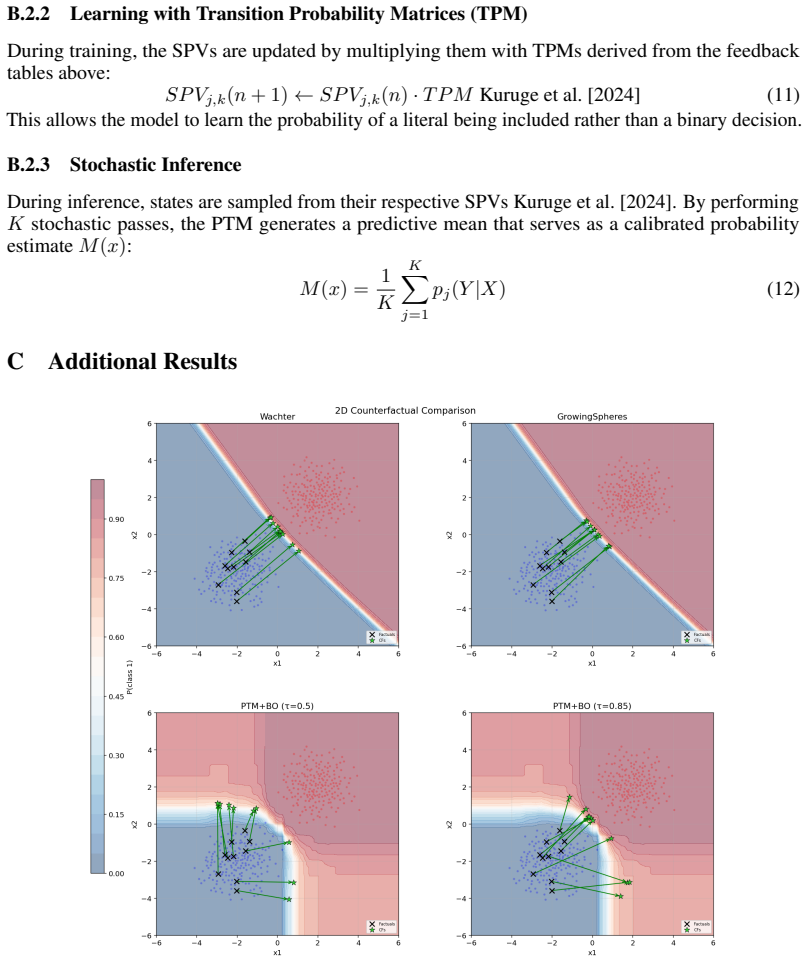
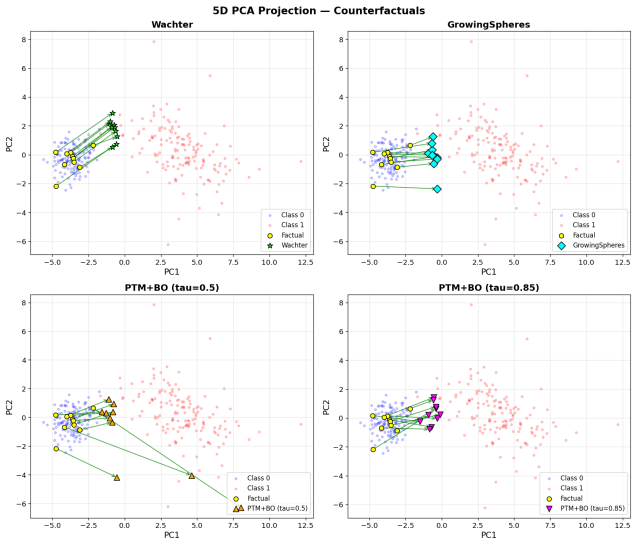
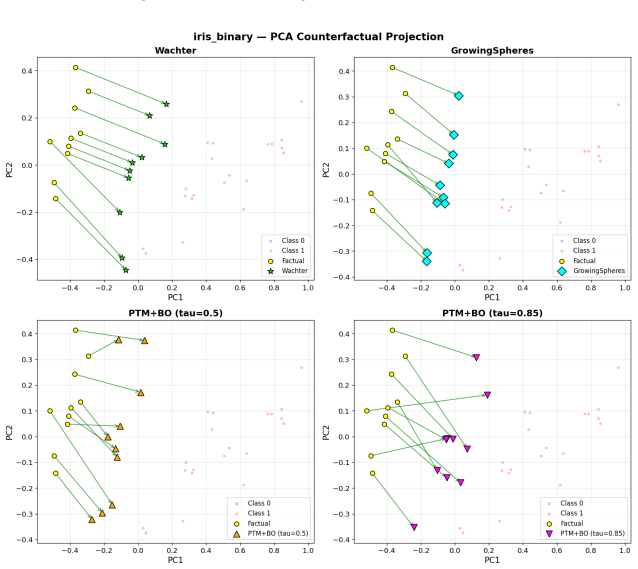
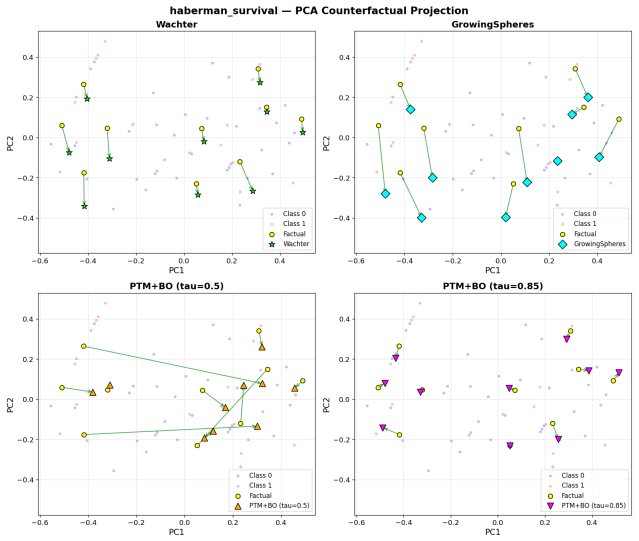
The framework searches for minimal changes that satisfy a user-defined confidence target instead of stopping at the decision boundary. Using the Probabilistic Tsetlin Machine, it links confidence directly to how securely the input activates the model's clauses, so that two counterfactuals satisfying the same clauses can still differ in reliability. Across synthetic and real datasets this produces recourse that is perfectly robust while remaining low-cost, for instance an L2 distance of 0.10 at 0.92 confidence on Haberman data.
What carries the argument
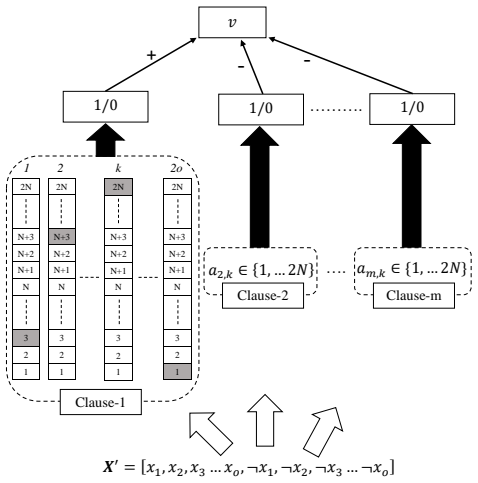
Probabilistic Tsetlin Machine combined with Bayesian optimization, which ties prediction confidence to the stability of individual decision-rule clauses.
If this is right
- Recourse options become comparable on three explicit axes: cost, achieved confidence, and measured robustness.
- Counterfactuals that activate the same rules can be ranked by how securely they do so, exposing fragile versus stable decisions.
- Perfect robustness is observed across multiple benchmarks while recourse cost stays low.
- Users gain a direct control knob for risk margins instead of post-hoc confidence checks.
Where Pith is reading between the lines
- The same target-confidence idea could be tested in other probabilistic or ensemble models that expose rule or feature stability.
- Regulators could require confidence thresholds when explanations are used for loan, hiring, or medical decisions.
- Domain-specific confidence targets might need calibration to avoid systematically higher costs for certain demographic groups.
Load-bearing premise
The clause activations inside the Probabilistic Tsetlin Machine make a higher confidence score a reliable signal that the underlying rules are more stable.
What would settle it
A dataset or perturbation test in which high-target-confidence counterfactuals lose their predicted label under small noise while boundary-based counterfactuals on the same inputs remain stable.
Figures
read the original abstract
Counterfactual explanations are widely used to provide algorithmic recourse in high-stakes decision-making systems. Most existing methods seek the smallest change to an input that flips a model's decision. However, decision-makers often rely not only on predicted labels but also on confidence thresholds and risk margins. Counterfactuals that barely cross a decision boundary can be fragile and unstable under noise or model variation. In this paper, we propose Target-confidence Recourse Using tSeTlin machines (TRUST), a framework in which users explicitly specify the desired prediction confidence for recourse. Rather than generating counterfactuals and evaluating confidence afterward, TRUST directly searches for minimal changes that satisfy a user-defined confidence target, enabling comparison of recourse options in terms of cost, confidence, and robustness. We instantiate TRUST using a Probabilistic Tsetlin Machine (PTM) combined with Bayesian optimization. The probabilistic clause-based structure of PTM links prediction confidence to the stability of decision rules. We show that counterfactuals satisfying the same rules can still differ substantially in reliability depending on how securely they satisfy those rules, revealing whether decisions are supported by robust or fragile clause activations. Experiments on synthetic and real-world datasets demonstrate that target-confidence counterfactuals produce more robust and interpretable recourse than conventional boundary-based approaches. Across multiple benchmarks, TRUST achieves perfect robustness while maintaining low recourse cost, including an L2 distance of 0.10 on the Haberman dataset at 0.92 confidence. By explicitly controlling confidence and exposing rule-level stability, TRUST provides actionable recourse for high-stakes decision support.
Editorial analysis
A structured set of objections, weighed in public.
Referee Report
Summary. The manuscript proposes TRUST, a framework for generating counterfactual recourse by directly optimizing for user-specified prediction confidence targets using Probabilistic Tsetlin Machines (PTM) combined with Bayesian optimization. It argues that PTM clause activations provide a stability signal allowing counterfactuals to be compared on robustness beyond mere decision boundary crossing, and reports that target-confidence recourse yields perfect robustness with low cost (e.g., L2 distance of 0.10 on the Haberman dataset at 0.92 confidence) across synthetic and real-world benchmarks, outperforming conventional boundary-based methods in robustness and interpretability.
Significance. If the robustness advantage can be shown to hold under external validation protocols independent of PTM internal scores, the explicit linkage of confidence targets to rule activation strength would offer a useful advance for interpretable recourse in high-stakes settings.
major comments (2)
- [Abstract] Abstract (experimental claims paragraph): the reported 'perfect robustness' and specific L2=0.10 result at 0.92 confidence lack any description of the robustness metric, evaluation protocol (e.g., adversarial perturbation, retraining, or input noise), dataset splits, error bars, or statistical tests. This directly undermines verification of the central claim that target-confidence recourse is more robust than boundary-based methods.
- [Abstract] Abstract (PTM clause stability paragraph): the claim that 'counterfactuals satisfying the same rules can still differ substantially in reliability depending on how securely they satisfy those rules' is presented without an external robustness protocol separate from PTM probabilistic scores. If robustness is quantified solely via clause-sum margins, the reported advantage over boundary-based approaches is at risk of being tautological rather than independently demonstrated.
minor comments (2)
- [Abstract] Abstract: the description of the PTM + Bayesian optimization instantiation is too high-level to allow reproduction; methods section should include the precise optimization objective, clause activation function, and how the confidence target is encoded as a constraint.
- [Abstract] Abstract: no mention of baseline methods, number of datasets, or how 'perfect robustness' is defined numerically.
Simulated Author's Rebuttal
We thank the referee for the constructive comments on the abstract. We address each major comment below and indicate where revisions will be made to improve clarity without altering the manuscript's core contributions.
read point-by-point responses
-
Referee: [Abstract] Abstract (experimental claims paragraph): the reported 'perfect robustness' and specific L2=0.10 result at 0.92 confidence lack any description of the robustness metric, evaluation protocol (e.g., adversarial perturbation, retraining, or input noise), dataset splits, error bars, or statistical tests. This directly undermines verification of the central claim that target-confidence recourse is more robust than boundary-based methods.
Authors: We agree the abstract is too concise on these points. Section 5 of the manuscript specifies the robustness metric as the fraction of counterfactuals that retain the target confidence under Gaussian input noise (sigma=0.1) and after retraining the PTM on 5-fold cross-validation splits, with results reported as means plus standard deviations and paired t-tests (p<0.05) against baselines. The L2=0.10 example is taken directly from the Haberman experiments at the 0.92 target. We will revise the abstract to include a one-sentence summary of the protocol and note that full details appear in the experiments section. revision: yes
-
Referee: [Abstract] Abstract (PTM clause stability paragraph): the claim that 'counterfactuals satisfying the same rules can still differ substantially in reliability depending on how securely they satisfy those rules' is presented without an external robustness protocol separate from PTM probabilistic scores. If robustness is quantified solely via clause-sum margins, the reported advantage over boundary-based approaches is at risk of being tautological rather than independently demonstrated.
Authors: The PTM clause margins are the mechanism for generating target-confidence recourse, but robustness is evaluated with an external protocol applied uniformly to all methods: input perturbations and retraining, as described in Section 5. Boundary-based baselines are implemented on the same PTM and measured with the identical external metrics, showing lower robustness scores. We will add a clarifying phrase to the abstract stating that the reported robustness advantage is validated under these external protocols. We maintain that the advantage is not tautological because the optimization objective (target confidence) differs from boundary crossing even when the underlying model is held fixed. revision: partial
Circularity Check
No significant circularity; derivation relies on external benchmarks
full rationale
The paper describes a search procedure (via Bayesian optimization on PTM) that directly optimizes for a user-specified confidence target rather than post-hoc evaluation. Robustness and cost results are reported from experiments across synthetic and real-world datasets (e.g., Haberman L2=0.10 at 0.92 confidence), without equations or self-citations that reduce the claimed robustness metric to a PTM-internal clause sum or fitted parameter by construction. The PTM clause-stability link is part of the chosen model architecture but does not tautologically force the experimental outcomes or the comparison to boundary-based methods.
Axiom & Free-Parameter Ledger
Reference graph
Works this paper leans on
-
[1]
Harvard Journal of Law & Technology , volume =
Counterfactual Explanations without Opening the Black Box: Automated Decisions and the GDPR , author =. Harvard Journal of Law & Technology , volume =
-
[2]
ACM Computing Surveys , volume =
A Survey of Algorithmic Recourse: Contrastive Explanations and Consequential Recommendations , author =. ACM Computing Surveys , volume =
-
[3]
Proceedings of the International Conference on Artificial Intelligence and Statistics (AISTATS) , year =
Exploring Counterfactual Explanations through the Lens of Adversarial Examples: A Theoretical and Empirical Analysis , author =. Proceedings of the International Conference on Artificial Intelligence and Statistics (AISTATS) , year =
-
[4]
Proceedings of the web conference 2020 , pages=
Learning model-agnostic counterfactual explanations for tabular data , author=. Proceedings of the web conference 2020 , pages=
2020
-
[5]
Proceedings of the AAAI/ACM Conference on AI, Ethics, and Society , pages=
FACE: feasible and actionable counterfactual explanations , author=. Proceedings of the AAAI/ACM Conference on AI, Ethics, and Society , pages=
-
[6]
Proceedings of the 2021 ACM conference on fairness, accountability, and transparency , pages=
Algorithmic recourse: from counterfactual explanations to interventions , author=. Proceedings of the 2021 ACM conference on fairness, accountability, and transparency , pages=
2021
-
[7]
Proceedings of the conference on fairness, accountability, and transparency , pages=
Actionable recourse in linear classification , author=. Proceedings of the conference on fairness, accountability, and transparency , pages=
-
[8]
arXiv preprint arXiv:2006.06848 , year=
Getting a clue: A method for explaining uncertainty estimates , author=. arXiv preprint arXiv:2006.06848 , year=
arXiv 2006
-
[9]
2024 , url =
Regulation (EU) 2024/1689 of the European Parliament and of the Council of 13 June 2024 on harmonised rules on artificial intelligence (Artificial Intelligence Act) , journal =. 2024 , url =
2024
-
[10]
Proceedings of the 2020 conference on fairness, accountability, and transparency , pages=
Explaining machine learning classifiers through diverse counterfactual explanations , author=. Proceedings of the 2020 conference on fairness, accountability, and transparency , pages=
2020
-
[11]
arXiv preprint arXiv:1907.09615 , year=
Towards realistic individual recourse and actionable explanations in black-box decision making systems , author=. arXiv preprint arXiv:1907.09615 , year=
Pith/arXiv arXiv 1907
-
[12]
Advances in Neural Information Processing Systems (NeurIPS) , year =
Towards Robust and Reliable Algorithmic Recourse , author =. Advances in Neural Information Processing Systems (NeurIPS) , year =
-
[13]
International Conference on Machine Learning (ICML) , year =
Robust Counterfactual Explanations for Tree-Based Ensembles , author =. International Conference on Machine Learning (ICML) , year =
-
[14]
arXiv preprint arXiv:2108.00783 , year=
Carla: a python library to benchmark algorithmic recourse and counterfactual explanation algorithms , author=. arXiv preprint arXiv:2108.00783 , year=
-
[15]
International Conference on Machine Learning (ICML) , year =
Robust Counterfactual Explanations for Neural Networks with Probabilistic Guarantees , author =. International Conference on Machine Learning (ICML) , year =
-
[16]
Proceedings of the 39th International Conference on Machine Learning , pages =
On the Adversarial Robustness of Causal Algorithmic Recourse , author =. Proceedings of the 39th International Conference on Machine Learning , pages =. 2022 , editor =
2022
-
[17]
Proceedings of the 2024 8th International Conference on Advances in Artificial Intelligence , pages=
The probabilistic tsetlin machine: A novel approach to uncertainty quantification , author=. Proceedings of the 2024 8th International Conference on Advances in Artificial Intelligence , pages=
2024
-
[18]
Proceedings of the AAAI Conference on Artificial Intelligence (AAAI) , year =
Formalising the Robustness of Counterfactual Explanations for Neural Networks , author =. Proceedings of the AAAI Conference on Artificial Intelligence (AAAI) , year =
-
[19]
Proceedings of the International Conference on Learning Representations (ICLR) , year =
Probabilistically Robust Recourse: Navigating the Trade-offs between Costs and Robustness in Algorithmic Recourse , author =. Proceedings of the International Conference on Learning Representations (ICLR) , year =
-
[20]
International Conference on Autonomous Agents and Multiagent Systems (AAMAS) , year =
Recourse under Model Multiplicity via Argumentative Ensembling , author =. International Conference on Autonomous Agents and Multiagent Systems (AAMAS) , year =
-
[21]
Advances in Neural Information Processing Systems (NeurIPS) , year =
Counterfactual Explanations Can Be Manipulated , author =. Advances in Neural Information Processing Systems (NeurIPS) , year =
-
[22]
IEEE Symposium Series on Computational Intelligence (SSCI) , year =
Evaluating Robustness of Counterfactual Explanations , author =. IEEE Symposium Series on Computational Intelligence (SSCI) , year =
-
[23]
International conference on information processing and management of uncertainty in knowledge-based systems , pages=
Comparison-based inverse classification for interpretability in machine learning , author=. International conference on information processing and management of uncertainty in knowledge-based systems , pages=. 2018 , organization=
2018
-
[24]
Proceedings of the AAAI conference on artificial intelligence , volume=
FOCUS: Flexible optimizable counterfactual explanations for tree ensembles , author=. Proceedings of the AAAI conference on artificial intelligence , volume=
-
[25]
Proceedings of the 23rd ACM SIGKDD international conference on knowledge discovery and data mining , pages=
Interpretable predictions of tree-based ensembles via actionable feature tweaking , author=. Proceedings of the 23rd ACM SIGKDD international conference on knowledge discovery and data mining , pages=
-
[26]
ICML WHI , volume=
Cruds: Counterfactual recourse using disentangled subspaces , author=. ICML WHI , volume=
-
[27]
arXiv preprint arXiv:1804.01508 , year=
The Tsetlin Machine--A Game Theoretic Bandit Driven Approach to Optimal Pattern Recognition with Propositional Logic , author=. arXiv preprint arXiv:1804.01508 , year=
-
[28]
Patricia S. Abril and Robert Plant. The patent holder's dilemma: Buy, sell, or troll?. Communications of the ACM. doi:10.1145/1188913.1188915
-
[29]
Deciding equivalances among conjunctive aggregate queries
Sarah Cohen and Werner Nutt and Yehoshua Sagic. Deciding equivalances among conjunctive aggregate queries. doi:10.1145/1219092.1219093
-
[30]
Special issue: Digital Libraries. 1996
1996
-
[31]
Understanding Policy-Based Networking
David Kosiur. Understanding Policy-Based Networking
-
[34]
The title of book two. doi:10.1007/3-540-09237-4
-
[35]
Asad Z. Spector. Achieving application requirements. Distributed Systems. doi:10.1145/90417.90738
-
[36]
Douglass and David Harel and Mark B
Bruce P. Douglass and David Harel and Mark B. Trakhtenbrot. Statecarts in use: structured analysis and object-orientation. Lectures on Embedded Systems. doi:10.1007/3-540-65193-4_29
-
[37]
Donald E. Knuth. The Art of Computer Programming, Vol. 1: Fundamental Algorithms (3rd. ed.)
-
[38]
Donald E. Knuth. The Art of Computer Programming
-
[39]
Structured Variational Inference Procedures and their Realizations (as incol)
Dan Geiger and Christopher Meek. Structured Variational Inference Procedures and their Realizations (as incol). Proceedings of Tenth International Workshop on Artificial Intelligence and Statistics, The Barbados
-
[40]
Stan W. Smith. An experiment in bibliographic mark-up: Parsing metadata for XML export. Proceedings of the 3rd. annual workshop on Librarians and Computers
-
[41]
Catch me, if you can: Evading network signatures with web-based polymorphic worms
Matthew Van Gundy and Davide Balzarotti and Giovanni Vigna. Catch me, if you can: Evading network signatures with web-based polymorphic worms. Proceedings of the first USENIX workshop on Offensive Technologies
-
[42]
Sten Andler. Predicate Path expressions. Proceedings of the 6th. ACM SIGACT-SIGPLAN symposium on Principles of Programming Languages. doi:10.1145/567752.567774
-
[43]
LOGICS of Programs: AXIOMATICS and DESCRIPTIVE POWER
David Harel. LOGICS of Programs: AXIOMATICS and DESCRIPTIVE POWER
-
[44]
Anisi , title =
David A. Anisi , title =
-
[45]
Clarkson
Kenneth L. Clarkson. Algorithms for Closest-Point Problems (Computational Geometry)
-
[46]
Introduction to Bayesian Statistics
Harry Thornburg. Introduction to Bayesian Statistics. 2001
2001
-
[47]
CLIFFORD: a Maple 11 Package for Clifford Algebra Computations, version 11
Rafal Ablamowicz and Bertfried Fauser. CLIFFORD: a Maple 11 Package for Clifford Algebra Computations, version 11. 2007
2007
-
[48]
Stats and Analysis
Poker-Edge.Com. Stats and Analysis. 2006
2006
-
[49]
A more perfect union
Barack Obama. A more perfect union
-
[50]
The fountain of youth
Joseph Scientist. The fountain of youth
-
[51]
Solder man
Dave Novak. Solder man. ACM SIGGRAPH 2003 Video Review on Animation theater Program: Part I - Vol. 145 (July 27--27, 2003). doi:10.945/woot07-S422
2003
-
[52]
Interview with Bill Kinder: January 13, 2005
Newton Lee. Interview with Bill Kinder: January 13, 2005. Comput. Entertain. doi:10.1145/1057270.1057278
-
[53]
The Enabling of Digital Libraries
Bernard Rous. The Enabling of Digital Libraries. Digital Libraries
-
[55]
(new) Finding minimum congestion spanning trees , journal =
Werneck, Renato and Setubal, Jo\. (new) Finding minimum congestion spanning trees , journal =. doi:10.1145/351827.384253 , acmid = 384253, publisher =
-
[57]
Conti, Mauro and Di Pietro, Roberto and Mancini, Luigi V. and Mei, Alessandro , title =. Inf. Fusion , volume =. 2009 , issn =. doi:10.1016/j.inffus.2009.01.002 , acmid =
-
[58]
Li, Cheng-Lun and Buyuktur, Ayse G. and Hutchful, David K. and Sant, Natasha B. and Nainwal, Satyendra K. , title =. CHI '08 extended abstracts on Human factors in computing systems , year =. doi:10.1145/1358628.1358946 , acmid =
-
[59]
, title =
Hollis, Billy S. , title =. 1999 , isbn =
1999
-
[60]
Goossens, Michel and Rahtz, S. P. and Moore, Ross and Sutor, Robert S. , title =. 1999 , isbn =
1999
-
[61]
and Rosenberg, Arnold L
Buss, Jonathan F. and Rosenberg, Arnold L. and Knott, Judson D. , title =. 1987 , source =
1987
-
[62]
CHI '08: CHI '08 extended abstracts on Human factors in computing systems , year =
, note =. CHI '08: CHI '08 extended abstracts on Human factors in computing systems , year =
-
[63]
Algorithms for Closest-Point Problems (Computational Geometry) , year =
Clarkson, Kenneth Lee , advisor =. Algorithms for Closest-Point Problems (Computational Geometry) , year =
-
[64]
SIGCOMM Comput. Commun. Rev. , year =
-
[65]
IEEE TCSC Executive Committee , booktitle =. 2004 , isbn =. doi:http://dx.doi.org/10.1109/ICWS.2004.64 , acmid =
-
[66]
Distributed systems (2nd Ed.) , year =
-
[67]
, title =
Petrie, Charles J. , title =. 1986 , source =
1986
-
[68]
Donald E. Knuth. Seminumerical Algorithms. 1981
1981
-
[69]
E-commerce and cultural values , year =
Kong, Wei-Chang , Title =. E-commerce and cultural values , year =
-
[70]
E-commerce and cultural values , year =
Kong, Wei-Chang , type =. E-commerce and cultural values , year =
-
[71]
Chapter 9 , booktitle =
Kong, Wei-Chang , editor =. Chapter 9 , booktitle =
-
[72]
E-commerce and cultural values , editor =
Kong, Wei-Chang , title =. E-commerce and cultural values , editor =. 2003 , isbn =
2003
-
[73]
E-commerce and cultural values - (InBook-num-in-chap) , chapter =
Kong, Wei-Chang , editor =. E-commerce and cultural values - (InBook-num-in-chap) , chapter =. 2004 , address =
2004
-
[74]
E-commerce and cultural values (Inbook-text-in-chap) , chapter =
Kong, Wei-Chang , editor =. E-commerce and cultural values (Inbook-text-in-chap) , chapter =. 2005 , address =
2005
-
[75]
E-commerce and cultural values (Inbook-num chap) , chapter =
Kong, Wei-Chang , editor =. E-commerce and cultural values (Inbook-num chap) , chapter =. 2006 , address =
2006
-
[76]
Microelectron
Mehdi Saeedi and Morteza Saheb Zamani and Mehdi Sedighi , title =. Microelectron. J. , volume =. 2010 , pages =
2010
-
[77]
Mehdi Saeedi and Morteza Saheb Zamani and Mehdi Sedighi and Zahra Sasanian , title =. J. Emerg. Technol. Comput. Syst. , volume =
-
[78]
Kirschmer, Markus and Voight, John , title =. SIAM J. Comput. , issue_date =. 2010 , issn =. doi:https://doi.org/10.1137/080734467 , acmid =
-
[79]
Hoare, C. A. R. , title =. Structured programming (incoll) , editor =. 1972 , isbn =
1972
-
[80]
History of programming languages I (incoll) , editor =
Lee, Jan , title =. History of programming languages I (incoll) , editor =. 1981 , isbn =. doi:http://doi.acm.org/10.1145/800025.1198348 , acmid =
-
[81]
, title =
Dijkstra, E. , title =. Classics in software engineering (incoll) , year =
-
[82]
Wenzel, Elizabeth M. , title =. Multimedia interface design (incoll) , year =. doi:10.1145/146022.146089 , acmid =
-
[83]
, title =
Mumford, E. , title =. Critical issues in information systems research (incoll) , year =
-
[84]
and Golden, Donald G
McCracken, Daniel D. and Golden, Donald G. , title =. 1990 , isbn =
1990
discussion (0)
Sign in with ORCID, Apple, or X to comment. Anyone can read and Pith papers without signing in.