REVIEW 3 major objections 5 minor 102 references
Reinforcement Learning from Wild Animal Videos
T0 review · 3 major / 5 minor · reviewed 2026-08-11 · deepseek-v4-flash
Pith's one-line read A video classifier trained on 8,791 wild-animal clips supplies the reward that teaches a quadruped robot to walk, jump, and stand still, without reference trajectories or per-skill reward functions; the policy transfers to a real robot.
desk verdict A genuine existence proof that wild-animal video classifiers can reward quadruped locomotion, but the reward grounding on robot renders is unvalidated and the walking/running distinction is weak. read the letter →
The pith
A machine-rendered reading of the paper's core claim, the machinery that carries it, and where it could break.
The reading
What carries the argument
The central object is the classifier-as-reward loop: a frozen video classifier $f_\theta$ (a Uniformer-S transformer fine-tuned from Kinetics-400 pretrained weights, with random-convolution augmentations and weight-averaged model soups) turns pixels into a reward $R(s_t,a_t) = \alpha_y f_\theta(x_{\mathrm{robot}}, y) + \beta_y$ on frames captured every five simulation steps, where $y$ is the commanded skill and $\alpha_y, \beta_y$ are per-skill normalization terms. The second load-bearing piece is constrained reinforcement learning: Proximal Policy Optimization combined with Constraints as Terminations (CaT), where every constraint is independent of the skill command so that behavioral differences arise only from the video reward. A symmetry loss on the policy is added because the camera sees the robot from one side only. The argument therefore rests on a division of labor: the video classifier supplies what each skill means, and the embodiment-agnostic constraints supply what is physically possible for the robot.
What would settle it
Feed the trained classifier robot clips with the body masked or blurred while the background and camera motion are preserved: if the 'Walking' or 'Running' probability stays high, the reward is tracking visual confounds rather than the skill. A direct correlation measurement between the classifier score and ground-truth forward velocity or foot air time across policy rollouts would likewise reveal how much of the reward is skill-grounded, and the two-leg walking-in-place failure reported in the paper is a concrete case where the score stayed high while the skill was absent.
Extended reading notes
Core claim
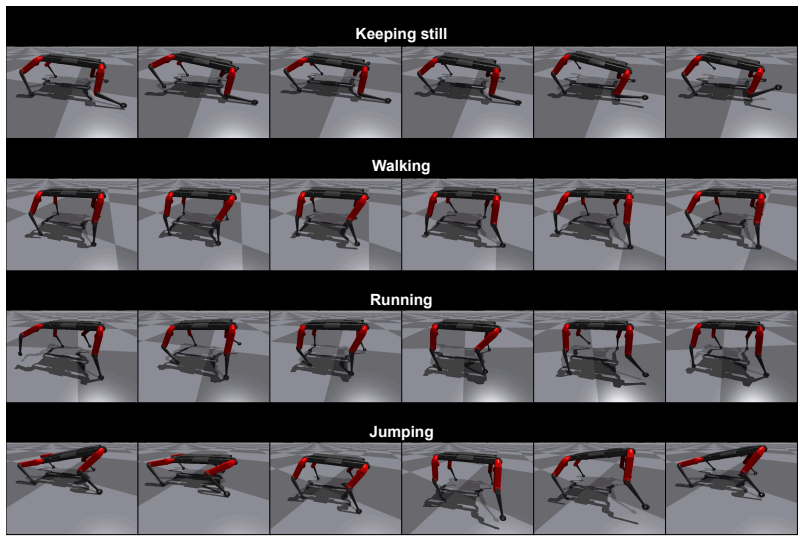
The paper establishes that a video action classifier trained purely on animals in natural habitats can act as a valid scalar reward for robotic locomotion, bridging what the authors call the extreme gap in domain and embodiment between animals and robots. A Uniformer video model is fine-tuned on a single-label subset of the Animal Kingdom dataset covering keeping still, walking, running, and jumping, then frozen. During policy training in a physics simulator, a third-person camera records 8-frame clips of the robot and the classifier's probability for the commanded skill is used as the reward, with zero reward on non-rendering steps and per-skill reward normalization. Task-agnostic constraints (joint limits, torques, foot air time, base orientation) enforce physical plausibility and sim-to-real transferability, and a symmetry loss compensates for the single camera view. The authors report that distinct, recognizable behaviors emerge for each skill command and that the policy deploys on a physical Solo-12 robot, with walking and running appearing as trotting gaits and jumping as rhythmic in-place pumping with flight phases; they also concede that running never produces a proper flying phase and that the behaviors lag the state of the art in learning-based locomotion.
Load-bearing premise
The pipeline assumes that the video classifier, trained only on wild-animal clips, scores the simulated and real robot's movements for the right reason — recognizing the skill in the motion — rather than because of background, camera angle, body pose, or incidental visual artifacts.
Editorial extensions
If this is right
- A video classifier trained on animal footage can reward a quadruped policy, so the same recipe should extend to other skills and other legged embodiments whenever the classifier can recognize the skill across morphologies.
- The no-curating ablation shows the reward signal must be tailored to single labels: training the classifier on the full multi-label dataset with binary cross-entropy prevents walking and running from emerging at all.
- The learned running is only a faster trot without an aerial phase, and walking and running look similar on the real robot; the paper attributes this gap to conventional video classification and standard on-policy RL rather than to the overall approach.
- Sim-to-real transfer succeeds directly, without domain randomization, a result the authors attribute to the task-agnostic constraints — especially the foot air-time constraint — rather than to the reward function itself.
- Because rewards fire every five steps from one camera, the symmetry loss and a camera angle that shows the full body are necessary for walking and running to emerge; extreme camera angles degrade or destroy individual skills.
Reading between the lines
- Editorial inference: the method turns reward engineering into a recognition problem, so the quality ceiling is set by how well the frozen classifier generalizes out of distribution; improvements in video understanding should translate directly into better locomotion skills without changing the RL loop.
- Editorial inference: the two-leg walking-in-place failure reported for the walking skill shows the reward can be gamed by visual artifacts; a direct test would measure how strongly the classifier score correlates with forward velocity and foot contact across rollouts, and a fix would add multi-view or motion-focused scoring.
- Editorial inference: the same scheme could point at other video corpora — human sports footage, finer-grained animal behavior labels, or egocentric clips — to produce rewards for skills that are hard to specify by hand, whenever the visual gap between source and robot is comparable to the one tested here.
- Editorial inference: the sensitivity to dataset size (skills degrade when training drops below 50% of the 8,791 videos) suggests the reward's robustness scales with video diversity rather than with the RL algorithm, making internet-scale data the main lever for future work.
Editorial analysis
A structured set of objections, weighed in public.
Referee Report
Summary. The paper introduces RLWAV, a pipeline in which a video action classifier trained on naturally occurring animal videos from the Animal Kingdom dataset is used as the scalar reward for a constrained reinforcement-learning policy that controls a Solo-12 quadruped in IsaacGym, after which the policy is transferred to the physical robot. The authors report simulation metrics across four skills, ablations of both the classifier and the policy-learning choices, and qualitative real-robot demonstrations. The central claim is that distinct locomotion skills can be acquired from wild animal videos without reference trajectories or skill-specific reward functions.
Significance. If the claim is upheld, the work is a useful step toward using internet-scale video corpora as reward sources for legged locomotion, complementing prior work on human-video-based manipulation rewards. Strengths include the use of a public dataset, multi-seed reporting, systematic ablations (classifier curation, model soup, camera position, constraint removal), and an honest discussion of failure cases and limitations. The main risks are that the learned reward is not demonstrated to be grounded in the intended animal actions when applied to synthetic robot renders, and that the real-robot evidence is qualitative; these gaps directly affect the strength of the central claim. There is no circularity concern because the reward is explicitly a learned classifier score and the evaluation metrics are independent, but the out-of-distribution validity of that classifier score is the load-bearing issue.
major comments (3)
- [§3.2, Eq. (4); §4.2, Fig. 4] The reward used for RL is the classifier score fθ(x_robot, y) on synthetic robot videos, but the classifier is only trained on, and as far as reported only evaluated on, Animal Kingdom natural videos. The paper provides no accuracy, confusion matrix, or per-class reliability of this classifier on robot-domain inputs. This matters because the only validation of the reward is through downstream policy behavior, and the paper's own Figure 4 documents a failure mode in which a walking-in-place policy 'fool[s] the video reward function.' That example shows that high classifier reward can be obtained without performing the commanded skill, so the central claim that the learned behaviors are grounded in animal motion is conditional on an unvalidated out-of-distribution generalization step. I recommend adding a direct evaluation of the video classifier on robot renders (e.g., per-skill classification accuracy or reward-versus-behavior correlation) and, if possible, a reward-hacking analysis or a calibration against the quantitative skill metrics.
- [§4.3] The real-robot experiments are qualitative: no measured forward speeds, jump heights, contact timings, or success rates are reported, and no video classifier scores or manual style ratings are taken on the real robot. As a result, the claim of 'successful transfer' and 'directly deploy' in §4.3 is not quantitatively supported. I ask for quantitative real-robot measurements (e.g., forward velocity, vertical displacement, and optionally stance/duty-factor estimates) and, if style is to be assessed, a small multi-rater study with reported inter-rater agreement.
- [§4.2, Table 1; §4.3] The distinction between walking and running is not established. In Table 1, walking velx = 23.0 ± 15.4 cm/s and running velx = 35.1 ± 12.9 cm/s overlap by more than one standard deviation, and the text concedes that the running policy does not produce flying phases and that on the real robot the two skills 'appear alike.' Since one of the four considered action classes is 'Running,' the abstract-level claim that the robot acquires skills corresponding to the action classes needs either a measurable gait criterion (e.g., duty factor, Froude number, flight-phase duration) or a softened claim that only three distinct behaviors are demonstrated.
minor comments (5)
- [§1, §3.2] There are several typos and minor awkward phrasings: 'activites' in §1, 'fishs' in §3.2, 'adaptatively optimized' in Appendix A.2, and the consistent spacing artifacts in 'RLW A V' throughout the captions. These should be corrected in a revision.
- [Figure 4 and Table 2] The alternative camera positions (Camera 1 through Camera 4) are described only as 'more extreme' and shown in a schematic; the exact placement relative to the robot, field of view, and distance are not specified, making the camera ablation difficult to reproduce. Please provide numerical camera parameters or a precise description in the appendix.
- [Appendix A.2, Eq. (6)] The adaptive reward normalization coefficients α_y and β_y are said to be 'adaptatively optimized' based on reward statistics across actors, but the precise update rule, initialization, and effect on the learned reward scale are not described. Since these coefficients are per-skill free parameters, a brief specification would improve reproducibility.
- [§4.1] The style scores are presented as single numbers without stating how many raters evaluated the rollout videos, whether the ratings were blind to the skill command, or whether any inter-rater agreement was computed. This makes the style column difficult to interpret as evidence of skill quality.
- [§3.3, Appendix A.2] The claim 'without skill-specific reward functions' should be read carefully: the foot air-time constraint is applied uniformly across skills but is specifically designed to enable walking and running (Appendix B shows its removal destroys those skills). This is not a fatal issue, but the wording in §1 and §5 should acknowledge that the method still relies on locomotion-specific inductive biases.
Circularity Check
No significant circularity: the video-classifier reward is an explicit learned input, and skill acquisition is evaluated with independent physical metrics and ablations.
full rationale
The load-bearing claim is that a video classifier trained on Animal Kingdom clips can serve as a reward for training a quadruped policy that exhibits distinct locomotion skills without reference trajectories or skill-specific rewards. The reward is explicitly defined in Section 3.3, Eq. (4), as R(s_t,a_t)=f_theta(x_robot,y), i.e., the classifier score on synthetic robot renders. This is a learned input, not a hidden derivation: the paper never claims the classifier score itself proves skill acquisition. Instead, Section 4.1 defines independent evaluation metrics (|velxy| for keeping still, velx for walking/running, Delta z for jumping, plus manual style ratings), and all reported results in Tables 1 and 2 use those quantities. Crucially, Figure 4 documents a failure case where the robot 'fool[s] the video reward function,' showing the authors explicitly treat high classifier score as insufficient evidence of the commanded skill. This makes the central validation non-circular: the policy is not evaluated by the same objective it optimizes. The skill command y is a one-hot input to the policy, and the constraints are task-agnostic, with differences across skills attributed solely to the learned reward. The self-citations ([20] CaT, [43] SoloParkour, [90] video-conditioned policies) are algorithm/tool citations and related-work context; they are not invoked to justify the video-to-robot grounding claim. In particular, CaT is used to enforce constraints but is not the source of the skill definitions. The paper's principal weakness, namely that the video classifier is never directly evaluated on robot renders and may be exploited via domain shift, is a soundness and generalization concern, not a circularity. The derivation chain is therefore self-contained relative to its stated inputs, and no circular step can be exhibited from the paper's own equations.
Assumptions & free parameters
free parameters (6)
- Reward normalization coefficients alpha_y and beta_y per skill =
not reported
- Third-person camera position =
nominal base camera; Camera 1-4 ablated in Table 2
- Image generation interval =
every 5 RL steps (8 in the 'update 8' ablation)
- Foot air-time constraint threshold t_des_air_time =
not reported
- Constraint thresholds (torque, joint limits, orientation, contact force) =
not reported
- Video classifier training hyperparameters =
lr 3e-5, batch 64, 8 frames, stride 4, stochastic depth in {0.3, 0.4}, weight decay in {0.05, 0.01, 0.1}, epochs in…
assumptions (6)
- domain assumption Animal Kingdom multi-label annotations are reliable enough to train a four-class single-label classifier.
- domain assumption A Uniformer pretrained on Kinetics-400 and fine-tuned on animals will generalize zero-shot to simulated robot videos.
- domain assumption IsaacGym accurately models Solo-12 dynamics and contact so that policies transfer without domain randomization.
- domain assumption Manual style ratings from 0 to 1 are a valid measure of whether a motion is identifiable as the target skill.
- domain assumption The same fixed constraints (air time, symmetry, torques, orientation) are sufficient physical grounding for all skills.
- ad hoc to paper A single third-person camera capturing 8-frame 128x128 videos in simulation provides sufficient information for skill identification.
Cite this review
Pith. "Pith review of Reinforcement Learning from Wild Animal Videos." pith.science (2026). https://pith.science/paper/S6FNZAKX
@misc{pith2026241204273,
  author       = {Pith},
  title        = {Pith review of: Reinforcement Learning from Wild Animal Videos},
  year         = {2026},
  howpublished = {\url{https://pith.science/paper/S6FNZAKX}},
  note         = {Machine review of arXiv:2412.04273}
}
read the original abstract
We propose to learn legged robot locomotion skills by watching thousands of wild animal videos from the internet, such as those featured in nature documentaries. Indeed, such videos offer a rich and diverse collection of plausible motion examples, which could inform how robots should move. To achieve this, we introduce Reinforcement Learning from Wild Animal Videos (RLWAV), a method to ground these motions into physical robots. We first train a video classifier on a large-scale animal video dataset to recognize actions from RGB clips of animals in their natural habitats. We then train a multi-skill policy to control a robot in a physics simulator, using the classification score of a third-person camera capturing videos of the robot's movements as a reward for reinforcement learning. Finally, we directly transfer the learned policy to a real quadruped Solo. Remarkably, despite the extreme gap in both domain and embodiment between animals in the wild and robots, our approach enables the policy to learn diverse skills such as walking, jumping, and keeping still, without relying on reference trajectories nor skill-specific rewards.
Figures


Figures from the paper (4 more)



Reference graph
Works this paper leans on
-
[1]
Radford, J
A. Radford, J. W. Kim, C. Hallacy, A. Ramesh, G. Goh, S. Agarwal, G. Sastry, A. Askell, P. Mishkin, J. Clark, et al. Learning transferable visual models from natural language super- vision. In International conference on machine learning, pages 8748–8763. PMLR, 2021
2021
-
[2]
Rombach, A
R. Rombach, A. Blattmann, D. Lorenz, P. Esser, and B. Ommer. High-resolution image syn- thesis with latent diffusion models. In Proceedings of the IEEE/CVF conference on computer vision and pattern recognition, pages 10684–10695, 2022
2022
-
[3]
Y . Wang, K. Li, Y . Li, Y . He, B. Huang, Z. Zhao, H. Zhang, J. Xu, Y . Liu, Z. Wang, et al. Internvideo: General video foundation models via generative and discriminative learning. arXiv preprint arXiv:2212.03191, 2022
arXiv 2022
- [4]
-
[5]
H. Touvron, T. Lavril, G. Izacard, X. Martinet, M.-A. Lachaux, T. Lacroix, B. Rozi `ere, N. Goyal, E. Hambro, F. Azhar, et al. Llama: Open and efficient foundation language models. arXiv preprint arXiv:2302.13971, 2023. 10
arXiv 2023
-
[6]
P. Molenberghs, R. Cunnington, and J. B. Mattingley. Is the mirror neuron system involved in imitation? a short review and meta-analysis. Neuroscience & Biobehavioral Reviews, 33 (7):975–980, 2009. ISSN 0149-7634. doi:https://doi.org/10.1016/j.neubiorev.2009.03.010
-
[7]
L. Shao, T. Migimatsu, Q. Zhang, K. Yang, and J. Bohg. Concept2robot: Learning manip- ulation concepts from instructions and human demonstrations. The International Journal of Robotics Research, 40(12-14):1419–1434, 2021
2021
-
[8]
S. Bahl, R. Mendonca, L. Chen, U. Jain, and D. Pathak. Affordances from human videos as a versatile representation for robotics. In Proceedings of the IEEE/CVF Conference on Computer Vision and Pattern Recognition, pages 13778–13790, 2023
2023
Show all 102 references
-
[9]
Bharadhwaj, D
H. Bharadhwaj, D. Dwibedi, A. Gupta, S. Tulsiani, C. Doersch, T. Xiao, D. Shah, F. Xia, D. Sadigh, and S. Kirmani. Gen2act: Human video generation in novel scenarios enables generalizable robot manipulation. arXiv preprint arXiv:2409.16283, 2024
2024 arXiv
-
[10]
L. Feng, Y . Zhao, Y . Sun, W. Zhao, and J. Tang. Action recognition using a spatial-temporal network for wild felines. Animals, 11(2):485, 2021
2021
-
[11]
X. L. Ng, K. E. Ong, Q. Zheng, Y . Ni, S. Y . Yeo, and J. Liu. Animal kingdom: A large and diverse dataset for animal behavior understanding. In Proceedings of the IEEE/CVF conference on computer vision and pattern recognition, pages 19023–19034, 2022
2022
-
[12]
J. Chen, M. Hu, D. J. Coker, M. L. Berumen, B. Costelloe, S. Beery, A. Rohrbach, and M. Elhoseiny. Mammalnet: A large-scale video benchmark for mammal recognition and behavior understanding. In Proceedings of the IEEE/CVF conference on computer vision and pattern recognition, ...
2023
-
[13]
X. Peng, E. Coumans, T. Zhang, T. Lee, J. Tan, and S. Levine. Learning agile robotic loco- motion skills by imitating animals. arXiv preprint arXiv:2004.00784, 2020
2004 arXiv
-
[14]
Bohez, S
S. Bohez, S. Tunyasuvunakool, P. Brakel, F. Sadeghi, L. Hasenclever, Y . Tassa, E. Parisotto, J. Humplik, T. Haarnoja, R. Hafner, et al. Imitate and repurpose: Learning reusable robot movement skills from human and animal behaviors. arXiv preprint arXiv:2203.17138, 2022
2022 arXiv
-
[15]
L. Han, Q. Zhu, J. Sheng, C. Zhang, T. Li, Y . Zhang, H. Zhang, Y . Liu, C. Zhou, R. Zhao, et al. Lifelike agility and play in quadrupedal robots using reinforcement learning and generative pre-trained models. Nature Machine Intelligence, 6(7):787–798, 2024
2024
-
[16]
Makoviychuk, L
V . Makoviychuk, L. Wawrzyniak, Y . Guo, M. Lu, K. Storey, M. Macklin, D. Hoeller, N. Rudin, A. Allshire, A. Handa, and G. State. Isaac gym: High performance gpu-based physics simulation for robot learning, 2021
2021
-
[17]
Rudin, D
N. Rudin, D. Hoeller, P. Reist, and M. Hutter. Learning to walk in minutes using massively parallel deep reinforcement learning. In Conference on Robot Learning. PMLR, 2021
2021
-
[18]
Schulman, F
J. Schulman, F. Wolski, P. Dhariwal, A. Radford, and O. Klimov. Proximal policy optimiza- tion algorithms. arXiv preprint arXiv:1707.06347, 2017
2017 arXiv
-
[19]
Y . Kim, H. Oh, J. Lee, J. Choi, G. Ji, M. Jung, D. Youm, and J. Hwangbo. Not only re- wards but also constraints: Applications on legged robot locomotion. IEEE Transactions on Robotics, 2024
2024
-
[20]
Chane-Sane, P.-A
E. Chane-Sane, P.-A. Leziart, T. Flayols, O. Stasse, P. Sou `eres, and N. Mansard. Cat: Con- straints as terminations for legged locomotion reinforcement learning. In IEEE/RSJ Interna- tional Conference on Intelligent Robots and Systems (IROS), 2024
2024
-
[21]
Todorov, T
E. Todorov, T. Erez, and Y . Tassa. Mujoco: A physics engine for model-based control. In 2012 IEEE/RSJ International Conference on Intelligent Robots and Systems , pages 5026–
2012
-
[22]
C. D. Freeman, E. Frey, A. Raichuk, S. Girgin, I. Mordatch, and O. Bachem. Brax - a differentiable physics engine for large scale rigid body simulation, 2021
2021
-
[23]
X. B. Peng, M. Andrychowicz, W. Zaremba, and P. Abbeel. Sim-to-real transfer of robotic control with dynamics randomization. In 2018 IEEE international conference on robotics and automation (ICRA), pages 3803–3810. IEEE, 2018
2018
-
[24]
J. Lee, J. Hwangbo, L. Wellhausen, V . Koltun, and M. Hutter. Learning quadrupedal locomo- tion over challenging terrain. Science robotics, 5(47):eabc5986, 2020
2020
-
[25]
Z. Fu, A. Kumar, J. Malik, and D. Pathak. Minimizing energy consumption leads to the emergence of gaits in legged robots. In Conference on Robot Learning (CoRL), 2021
2021
-
[26]
Z. Li, X. B. Peng, P. Abbeel, S. Levine, G. Berseth, and K. Sreenath. Robust and ver- satile bipedal jumping control through multi-task reinforcement learning. arXiv preprint arXiv:2302.09450, 1, 2023
2023 arXiv
-
[27]
Aractingi, P.-A
M. Aractingi, P.-A. L ´eziart, T. Flayols, J. Perez, T. Silander, and P. Sou`eres. Controlling the solo12 quadruped robot with deep reinforcement learning. Scientific Reports, 13(1):11945, 2023
2023
-
[28]
Bellegarda, Y
G. Bellegarda, Y . Chen, Z. Liu, and Q. Nguyen. Robust high-speed running for quadruped robots via deep reinforcement learning. In IEEE/RSJ International Conference on Intelligent Robots and Systems (IROS), 2022
2022
-
[29]
G. B. Margolis, G. Yang, K. Paigwar, T. Chen, and P. Agrawal. Rapid locomotion via rein- forcement learning. The International Journal of Robotics Research, 43(4):572–587, 2024
2024
-
[30]
T. He, C. Zhang, W. Xiao, G. He, C. Liu, and G. Shi. Agile but safe: Learning collision-free high-speed legged locomotion. arXiv preprint arXiv:2401.17583, 2024
2024 arXiv
-
[31]
Yang and J
I. Yang and J. Hwangbo. Learning rapid turning, aerial reorientation, and balancing using manipulator as a tail. arXiv preprint arXiv:2407.10420, 2024
2024 arXiv
-
[32]
Bellegarda, C
G. Bellegarda, C. Nguyen, and Q. Nguyen. Robust quadruped jumping via deep reinforce- ment learning. arXiv preprint arXiv:2011.07089, 2020
2011 arXiv
-
[33]
G. B. Margolis, T. Chen, K. Paigwar, X. Fu, D. Kim, S. Kim, and P. Agrawal. Learning to jump from pixels. arXiv preprint arXiv:2110.15344, 2021
2021 arXiv
-
[34]
Smith, J
L. Smith, J. C. Kew, T. Li, L. Luu, X. B. Peng, S. Ha, J. Tan, and S. Levine. Learning and adapting agile locomotion skills by transferring experience.Proceedings of Robotics: Science and Systems, 2023
2023
-
[35]
Zhang, J
C. Zhang, J. Sheng, T. Li, H. Zhang, C. Zhou, Q. Zhu, R. Zhao, Y . Zhang, and L. Han. Learn- ing highly dynamic behaviors for quadrupedal robots. arXiv preprint arXiv:2402.13473 , 2024
2024 arXiv
-
[36]
T. Miki, J. Lee, J. Hwangbo, L. Wellhausen, V . Koltun, and M. Hutter. Learning robust perceptive locomotion for quadrupedal robots in the wild. Science Robotics, 7(62):eabk2822, 2022
2022
-
[37]
Hoeller, N
D. Hoeller, N. Rudin, C. Choy, A. Anandkumar, and M. Hutter. Neural scene representation for locomotion on structured terrain.IEEE Robotics and Automation Letters, 7(4):8667–8674, 2022
2022
-
[38]
Agarwal, A
A. Agarwal, A. Kumar, J. Malik, and D. Pathak. Legged locomotion in challenging terrains using egocentric vision. In Conference on robot learning, pages 403–415. PMLR, 2023. 12
2023
-
[39]
R. Yang, G. Yang, and X. Wang. Neural volumetric memory for visual locomotion control. In Proceedings of the IEEE/CVF Conference on Computer Vision and Pattern Recognition , pages 1430–1440, 2023
2023
-
[40]
Zhuang, Z
Z. Zhuang, Z. Fu, J. Wang, C. Atkeson, S. Schwertfeger, C. Finn, and H. Zhao. Robot parkour learning. In Conference on Robot Learning (CoRL), 2023
2023
-
[41]
Hoeller, N
D. Hoeller, N. Rudin, D. Sako, and M. Hutter. Anymal parkour: Learning agile navigation for quadrupedal robots. Science Robotics, 2024
2024
-
[42]
Caluwaerts, A
K. Caluwaerts, A. Iscen, J. C. Kew, W. Yu, T. Zhang, D. Freeman, K.-H. Lee, L. Lee, S. Sal- iceti, V . Zhuang, et al. Barkour: Benchmarking animal-level agility with quadruped robots. arXiv preprint arXiv:2305.14654, 2023
2023 arXiv
-
[43]
Chane-Sane, J
E. Chane-Sane, J. Amigo, T. Flayols, L. Righetti, and N. Mansard. Soloparkour: Constrained reinforcement learning for visual locomotion from privileged experience. In Conference on Robot Learning (CoRL), 2024
2024
-
[44]
S. Luo, S. Li, R. Yu, Z. Wang, J. Wu, and Q. Zhu. Pie: Parkour with implicit-explicit learning framework for legged robots. IEEE Robotics and Automation Letters, 2024
2024
-
[45]
J. Lee, L. Schroth, V . Klemm, M. Bjelonic, A. Reske, and M. Hutter. Evaluation of constrained reinforcement learning algorithms for legged locomotion. arXiv preprint arXiv:2309.15430, 2023
2023 arXiv
-
[46]
X. B. Peng, P. Abbeel, S. Levine, and M. Van de Panne. Deepmimic: Example-guided deep reinforcement learning of physics-based character skills. ACM Transactions On Graphics (TOG), 37(4):1–14, 2018
2018
-
[47]
C. Li, M. Vlastelica, S. Blaes, J. Frey, F. Grimminger, and G. Martius. Learning agile skills via adversarial imitation of rough partial demonstrations. In Conference on Robot Learning, pages 342–352. PMLR, 2023
2023
-
[48]
T. Li, H. Jung, M. Gombolay, Y . K. Cho, and S. Ha. Crossloco: Human motion driven control of legged robots via guided unsupervised reinforcement learning. arXiv preprint arXiv:2309.17046, 2023
2023 arXiv
-
[49]
T. Li, J. Won, A. Clegg, J. Kim, A. Rai, and S. Ha. Ace: Adversarial correspondence em- bedding for cross morphology motion retargeting from human to nonhuman characters. In SIGGRAPH Asia 2023 Conference Papers, pages 1–11, 2023
2023
-
[50]
X. B. Peng, Z. Ma, P. Abbeel, S. Levine, and A. Kanazawa. Amp: Adversarial motion priors for stylized physics-based character control. ACM Transactions on Graphics (ToG), 40(4): 1–20, 2021
2021
-
[51]
Escontrela, X
A. Escontrela, X. B. Peng, W. Yu, T. Zhang, A. Iscen, K. Goldberg, and P. Abbeel. Adversarial motion priors make good substitutes for complex reward functions. In 2022 IEEE/RSJ Inter- national Conference on Intelligent Robots and Systems (IROS), pages 25–32. IEEE, 2022
2022
-
[52]
R. Yang, Z. Chen, J. Ma, C. Zheng, Y . Chen, Q. Nguyen, and X. Wang. Generalized animal imitator: Agile locomotion with versatile motion prior. arXiv preprint arXiv:2310.01408 , 2023
2023 arXiv
-
[53]
Q. Yao, J. Wang, S. Yang, C. Wang, H. Zhang, Q. Zhang, and D. Wang. Imitation and adaptation based on consistency: A quadruped robot imitates animals from videos using deep reinforcement learning. In 2022 IEEE International Conference on Robotics and Biomimetics (ROBIO), pages...
2022
-
[54]
J. Z. Zhang, S. Yang, G. Yang, A. L. Bishop, S. Gurumurthy, D. Ramanan, and Z. Manch- ester. Slomo: A general system for legged robot motion imitation from casual videos. IEEE Robotics and Automation Letters, 2023
2023
-
[55]
Huang, I
W. Huang, I. Mordatch, and D. Pathak. One policy to control them all: Shared modular policies for agent-agnostic control. In International Conference on Machine Learning, pages 4455–4464. PMLR, 2020
2020
-
[56]
Salhotra, I
G. Salhotra, I. Liu, C. Arthur, and G. Sukhatme. Learning robot manipulation from cross- morphology demonstration. arXiv preprint arXiv:2304.03833, 2023
2023 arXiv
-
[57]
G. Feng, H. Zhang, Z. Li, X. B. Peng, B. Basireddy, L. Yue, Z. Song, L. Yang, Y . Liu, K. Sreenath, et al. Genloco: Generalized locomotion controllers for quadrupedal robots. In Conference on Robot Learning, pages 1893–1903. PMLR, 2023
1903
-
[58]
Devin, A
C. Devin, A. Gupta, T. Darrell, P. Abbeel, and S. Levine. Learning modular neural network policies for multi-task and multi-robot transfer. In 2017 IEEE international conference on robotics and automation (ICRA), pages 2169–2176. IEEE, 2017
2017
-
[59]
Padalkar, A
A. Padalkar, A. Pooley, A. Jain, A. Bewley, A. Herzog, A. Irpan, A. Khazatsky, A. Rai, A. Singh, A. Brohan, et al. Open x-embodiment: Robotic learning datasets and rt-x models. arXiv preprint arXiv:2310.08864, 2023
2023 arXiv
-
[60]
J. Yang, D. Sadigh, and C. Finn. Polybot: Training one policy across robots while embracing variability. arXiv preprint arXiv:2307.03719, 2023
2023 arXiv
-
[61]
D. Shah, A. Sridhar, A. Bhorkar, N. Hirose, and S. Levine. Gnm: A general navigation model to drive any robot. In 2023 IEEE International Conference on Robotics and Automation (ICRA), pages 7226–7233. IEEE, 2023
2023
-
[62]
Shafiee, G
M. Shafiee, G. Bellegarda, and A. Ijspeert. Manyquadrupeds: Learning a single locomotion policy for diverse quadruped robots. In2024 IEEE International Conference on Robotics and Automation (ICRA), pages 3471–3477. IEEE, 2024
2024
-
[63]
J. Yang, C. Glossop, A. Bhorkar, D. Shah, Q. Vuong, C. Finn, D. Sadigh, and S. Levine. Pushing the limits of cross-embodiment learning for manipulation and navigation. arXiv preprint arXiv:2402.19432, 2024
2024 arXiv
-
[64]
Qin, Y .-H
Y . Qin, Y .-H. Wu, S. Liu, H. Jiang, R. Yang, Y . Fu, and X. Wang. Dexmv: Imitation learning for dexterous manipulation from human videos. InEuropean Conference on Computer Vision, pages 570–587. Springer, 2022
2022
-
[65]
Mandikal and K
P. Mandikal and K. Grauman. Dexvip: Learning dexterous grasping with human hand pose priors from video. In Conference on Robot Learning, pages 651–661. PMLR, 2022
2022
-
[66]
K. Shaw, S. Bahl, and D. Pathak. Videodex: Learning dexterity from internet videos. In Conference on Robot Learning, pages 654–665. PMLR, 2023
2023
-
[67]
Z. Chen, S. Chen, A. Etienne, I. Laptev, and C. Schmid. ViViDex: Learning vision-based dexterous manipulation from human videos. arXiv:2404.15709, 2024
2024 arXiv
-
[68]
K. Shaw, S. Bahl, A. Sivakumar, A. Kannan, and D. Pathak. Learning dexterity from human hand motion in internet videos. The International Journal of Robotics Research, 43(4):513– 532, 2024
2024
-
[69]
X. B. Peng, A. Kanazawa, J. Malik, P. Abbeel, and S. Levine. Sfv: Reinforcement learning of physical skills from videos. ACM Transactions On Graphics (TOG), 37(6):1–14, 2018. 14
2018
-
[70]
Xiong, Q
H. Xiong, Q. Li, Y .-C. Chen, H. Bharadhwaj, S. Sinha, and A. Garg. Learning by watching: Physical imitation of manipulation skills from human videos. In2021 IEEE/RSJ International Conference on Intelligent Robots and Systems (IROS), pages 7827–7834. IEEE, 2021
2021
-
[71]
S. Bahl, A. Gupta, and D. Pathak. Human-to-robot imitation in the wild. In RSS, 2022
2022
-
[72]
Heppert, M
N. Heppert, M. Argus, T. Welschehold, T. Brox, and A. Valada. Ditto: Demonstration im- itation by trajectory transformation. In IEEE/RSJ International Conference on Intelligent Robots and Systems (IROS), 2024
2024
-
[73]
Smith, N
L. Smith, N. Dhawan, M. Zhang, P. Abbeel, and S. Levine. Avid: Learning multi-stage tasks via pixel-level translation of human videos. arXiv preprint arXiv:1912.04443, 2019
1912 arXiv
-
[74]
Zakka, A
K. Zakka, A. Zeng, P. Florence, J. Tompson, J. Bohg, and D. Dwibedi. Xirl: Cross- embodiment inverse reinforcement learning. Conference on Robot Learning (CoRL), 2021
2021
-
[75]
M. Xu, Z. Xu, C. Chi, M. Veloso, and S. Song. Xskill: Cross embodiment skill discovery. In Conference on Robot Learning, pages 3536–3555. PMLR, 2023
2023
-
[76]
C. Wang, L. Fan, J. Sun, R. Zhang, L. Fei-Fei, D. Xu, Y . Zhu, and A. Anandkumar. Mimicplay: Long-horizon imitation learning by watching human play. arXiv preprint arXiv:2302.12422, 2023
2023 arXiv
-
[77]
S. Nair, A. Rajeswaran, V . Kumar, C. Finn, and A. Gupta. R3m: A universal visual represen- tation for robot manipulation. arXiv preprint arXiv:2203.12601, 2022
2022 arXiv
-
[78]
T. Xiao, I. Radosavovic, T. Darrell, and J. Malik. Masked visual pre-training for motor control. arXiv preprint arXiv:2203.06173, 2022
2022 arXiv
-
[79]
Y . J. Ma, S. Sodhani, D. Jayaraman, O. Bastani, V . Kumar, and A. Zhang. Vip: Towards universal visual reward and representation via value-implicit pre-training. arXiv preprint arXiv:2210.00030, 2022
2022 arXiv
-
[80]
Majumdar, K
A. Majumdar, K. Yadav, S. Arnaud, J. Ma, C. Chen, S. Silwal, A. Jain, V .-P. Berges, T. Wu, J. Vakil, et al. Where are we in the search for an artificial visual cortex for embodied intelli- gence? Advances in Neural Information Processing Systems, 36:655–677, 2023
2023
-
[81]
Y . Seo, K. Lee, S. L. James, and P. Abbeel. Reinforcement learning with action-free pre- training from videos. In International Conference on Machine Learning, 2022
2022
-
[82]
Radosavovic, T
I. Radosavovic, T. Xiao, S. James, P. Abbeel, J. Malik, and T. Darrell. Real-world robot learning with masked visual pre-training. In Conference on Robot Learning, pages 416–426. PMLR, 2023
2023
-
[83]
Y . J. Ma, V . Kumar, A. Zhang, O. Bastani, and D. Jayaraman. Liv: Language-image represen- tations and rewards for robotic control. In International Conference on Machine Learning , pages 23301–23320. PMLR, 2023
2023
-
[84]
Mendonca, S
R. Mendonca, S. Bahl, and D. Pathak. Structured world models from human videos. arXiv preprint arXiv:2308.10901, 2023
2023 arXiv
-
[85]
Y . Ze, Y . Liu, R. Shi, J. Qin, Z. Yuan, J. Wang, and H. Xu. H-index: Visual reinforcement learning with hand-informed representations for dexterous manipulation. Advances in Neural Information Processing Systems, 36, 2024
2024
-
[86]
Schmeckpeper, O
K. Schmeckpeper, O. Rybkin, K. Daniilidis, S. Levine, and C. Finn. Reinforcement learning with videos: Combining offline observations with interaction. arXiv preprint arXiv:2011.06507, 2020. 15
2011 arXiv
-
[87]
L. Fan, G. Wang, Y . Jiang, A. Mandlekar, Y . Yang, H. Zhu, A. Tang, D.-A. Huang, Y . Zhu, and A. Anandkumar. Minedojo: Building open-ended embodied agents with internet-scale knowledge. Advances in Neural Information Processing Systems, 35:18343–18362, 2022
2022
-
[88]
Alakuijala, G
M. Alakuijala, G. Dulac-Arnold, J. Mairal, J. Ponce, and C. Schmid. Learning reward func- tions for robotic manipulation by observing humans. In 2023 IEEE International Conference on Robotics and Automation (ICRA), pages 5006–5012. IEEE, 2023
2023
-
[89]
A. S. Chen, S. Nair, and C. Finn. Learning generalizable robotic reward functions from” in-the-wild” human videos. arXiv preprint arXiv:2103.16817, 2021
2021 arXiv
-
[90]
Chane-Sane, C
E. Chane-Sane, C. Schmid, and I. Laptev. Learning video-conditioned policies for unseen manipulation tasks. In 2023 IEEE International Conference on Robotics and Automation (ICRA), pages 909–916. IEEE, 2023
2023
-
[91]
K. Li, Y . Wang, P. Gao, G. Song, Y . Liu, H. Li, and Y . Qiao. Uniformer: Unified transformer for efficient spatiotemporal representation learning. arXiv preprint arXiv:2201.04676, 2022
2022 arXiv
-
[92]
K. Lee, K. Lee, J. Shin, and H. Lee. Network randomization: A simple technique for gener- alization in deep reinforcement learning. arXiv preprint arXiv:1910.05396, 2019
1910 arXiv
-
[93]
Wortsman, G
M. Wortsman, G. Ilharco, S. Y . Gadre, R. Roelofs, R. Gontijo-Lopes, A. S. Morcos, H. Namkoong, A. Farhadi, Y . Carmon, S. Kornblith, et al. Model soups: averaging weights of multiple fine-tuned models improves accuracy without increasing inference time. In Inter- national con...
2022
-
[94]
A. Rame, M. Kirchmeyer, T. Rahier, A. Rakotomamonjy, P. Gallinari, and M. Cord. Diverse weight averaging for out-of-distribution generalization. Advances in Neural Information Pro- cessing Systems, 2022
2022
-
[95]
W. Yu, G. Turk, and C. K. Liu. Learning symmetric and low-energy locomotion. ACM Transactions on Graphics (TOG), 37(4):1–12, 2018
2018
-
[96]
Abdolhosseini, H
F. Abdolhosseini, H. Y . Ling, Z. Xie, X. B. Peng, and M. Van de Panne. On learning sym- metric locomotion. In Proceedings of the 12th ACM SIGGRAPH Conference on Motion, Interaction and Games, pages 1–10, 2019
2019
-
[97]
Grimminger, A
F. Grimminger, A. Meduri, M. Khadiv, J. Viereck, M. W ¨uthrich, M. Naveau, V . Berenz, S. Heim, F. Widmaier, T. Flayols, et al. An open torque-controlled modular robot architecture for legged locomotion research. IEEE Robotics and Automation Letters , 5(2):3650–3657, 2020
2020
-
[98]
W. Kay, J. Carreira, K. Simonyan, B. Zhang, C. Hillier, S. Vijayanarasimhan, F. Viola, T. Green, T. Back, P. Natsev, et al. The kinetics human action video dataset. arXiv preprint arXiv:1705.06950, 2017
2017 arXiv
-
[99]
Loshchilov, F
I. Loshchilov, F. Hutter, et al. Fixing weight decay regularization in adam. arXiv preprint arXiv:1711.05101, 5, 2017
2017 arXiv
-
[100]
H. Zhang. mixup: Beyond empirical risk minimization. arXiv preprint arXiv:1710.09412, 2017
2017 arXiv
-
[101]
Huang, R
S. Huang, R. F. J. Dossa, C. Ye, J. Braga, D. Chakraborty, K. Mehta, and J. G. Ara´ujo. Cleanrl: High-quality single-file implementations of deep reinforcement learning algorithms. Journal of Machine Learning Research, 2022. 16 A Implementation Details A.1 Animal Video Classif...
2022
-
[5033]
doi:10.1109/IROS.2012.6386109
IEEE, 2012. doi:10.1109/IROS.2012.6386109. 11
2012
Reviewed August 11, 2026 · model on record in the stance chip above.
Discussion (0). Continue with ORCID to comment.