Planet formation at the inner edge of the dead zone II. Outbursts, rings, vortices, and suppression of planetesimal formation
Pith reviewed 2026-06-27 11:30 UTC · model grok-4.3
The pith
Accretion outbursts trigger vortices that suppress planetesimal formation in protoplanetary disks
A machine-rendered reading of the paper's core claim, the machinery that carries it, and where it could break.
Core claim
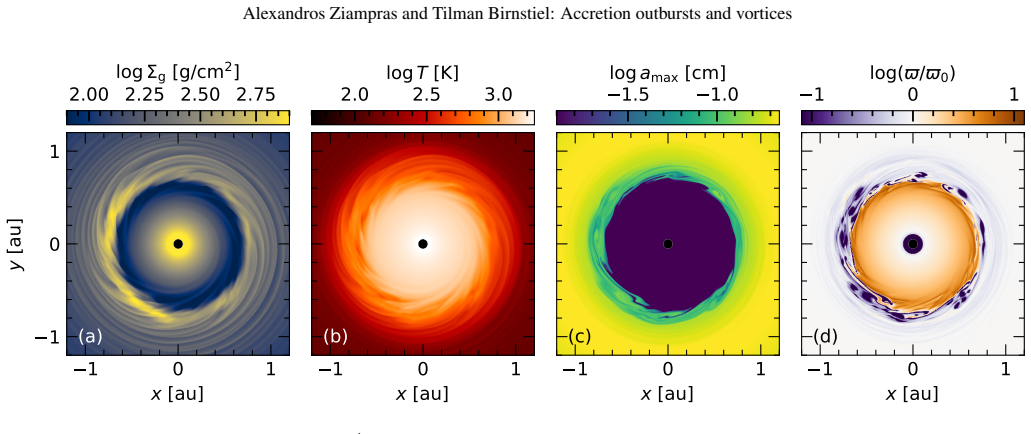
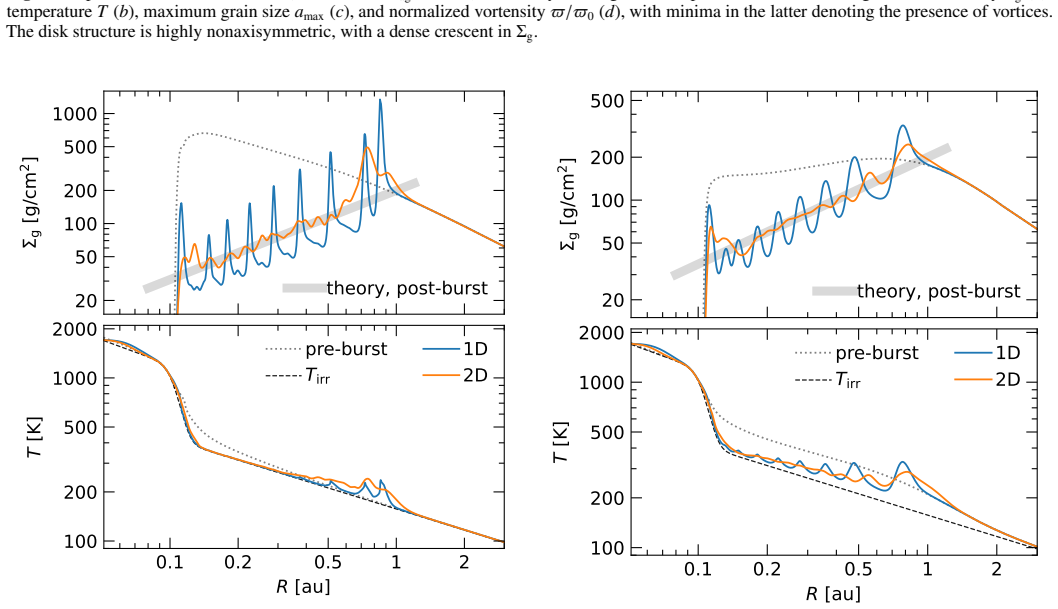
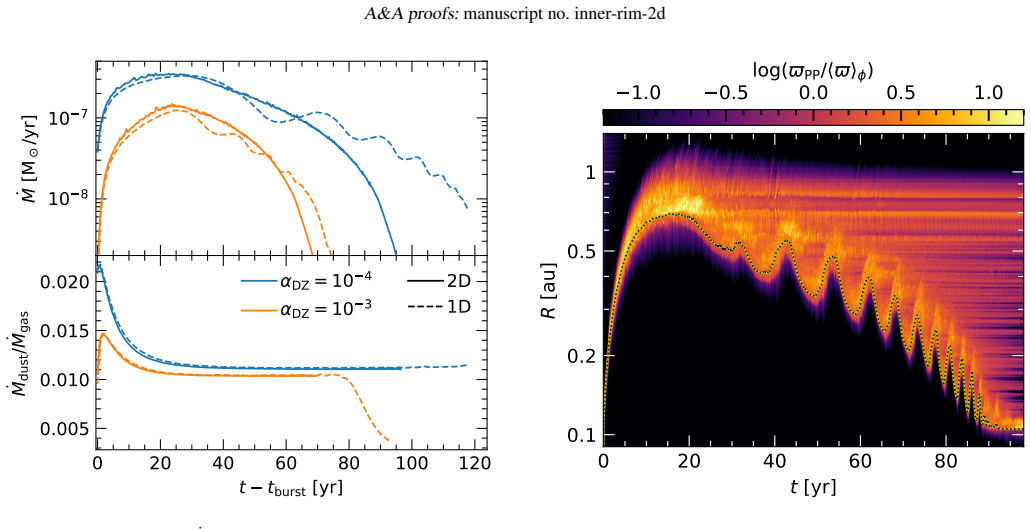
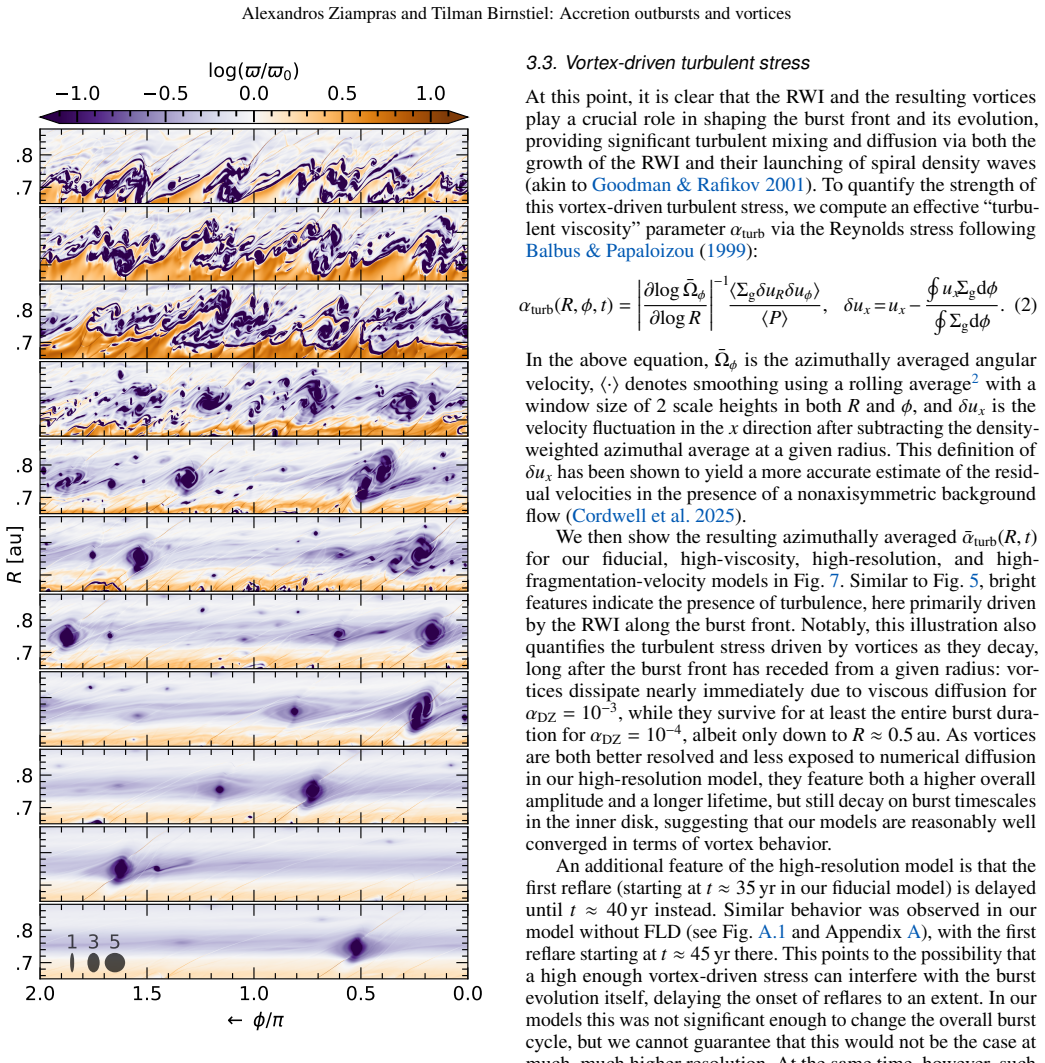
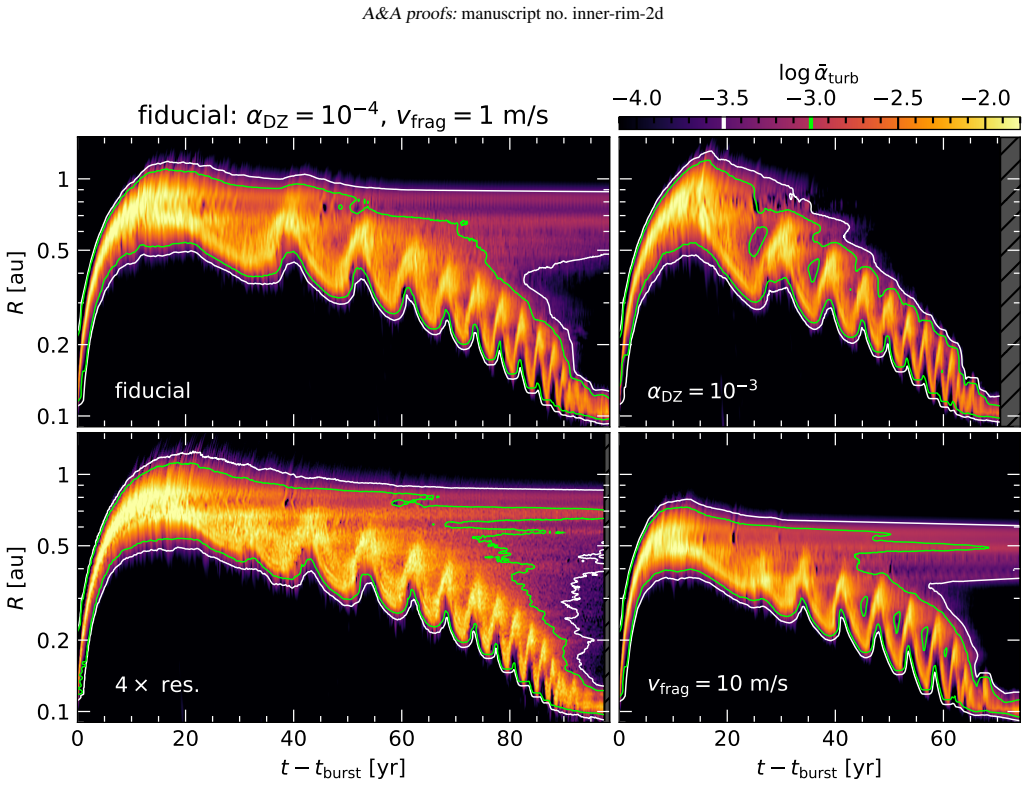
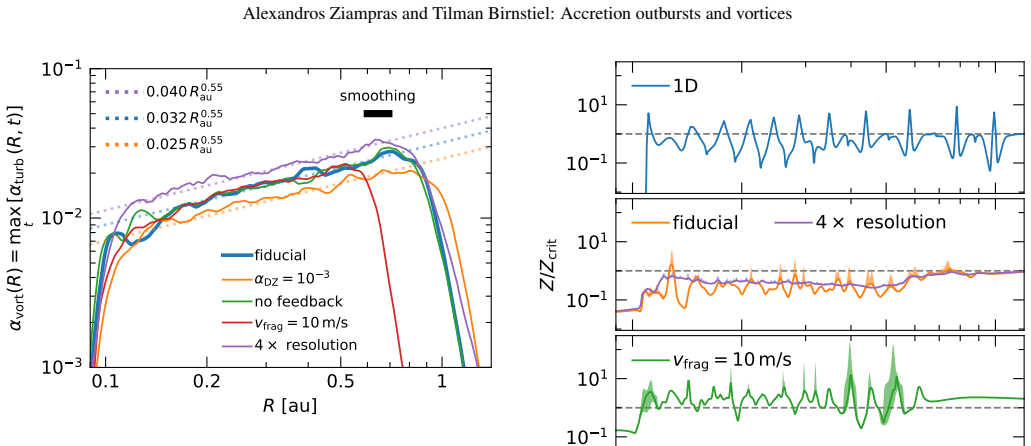
Accretion outbursts are highly unstable to the Rossby-wave instability, with the burst front quickly diffusing into a large number of small-scale vortices that coalesce over time into a single, compact vortex and inducing azimuthal asymmetries. Vortices act as a source of vigorous turbulent diffusion, strongly suppressing planetesimal formation. Our results suggest that azimuthal asymmetries associated with accretion outbursts should be both common and detrimental to planet formation. Nevertheless, planetesimal formation will resume post-burst, as the burst-induced vortices eventually decay and the disk returns to a quiescent state featuring a pressure bump at ~1 au.
What carries the argument
Rossby-wave instability applied to the accretion outburst front in multifluid radiation-hydrodynamical simulations, leading to vortex formation and turbulent diffusion
Load-bearing premise
The two-dimensional vertically integrated simulation setup with growing dust and radiation transport accurately represents the stability and dust behavior in actual three-dimensional disks
What would settle it
Observing an accretion outburst without the formation of vortices or with ongoing planetesimal formation during the burst would contradict the findings
Figures
read the original abstract
Accretion outbursts have been observed in a variety of young stellar objects, but models of their dynamical evolution have been largely limited to axisymmetric models due to their computational cost. We investigate the azimuthal stability of accretion outbursts and the formation of planetesimals during these events. We performed high-resolution 2D, vertically integrated multifluid radiation-hydrodynamical simulations of the inner 10 au of protoplanetary disks with a dynamically growing dust population, including radiation transport and a realistic dust opacity model. Accretion outbursts are highly unstable to the Rossby-wave instability, with the burst front quickly diffusing into a large number of small-scale vortices that coalesce over time into a single, compact vortex and inducing azimuthal asymmetries. Vortices act as a source of vigorous turbulent diffusion, strongly suppressing planetesimal formation. Our results suggest that azimuthal asymmetries associated with accretion outbursts should be both common and detrimental to planet formation. Nevertheless, planetesimal formation will resume post-burst, as the burst-induced vortices eventually decay and the disk returns to a quiescent state featuring a pressure bump at ~1 au.
Editorial analysis
A structured set of objections, weighed in public.
Referee Report
Summary. The manuscript uses high-resolution 2D vertically integrated multifluid radiation-hydrodynamical simulations of the inner 10 au of protoplanetary disks with dynamically growing dust and realistic opacity to study accretion outbursts. It claims that outbursts are highly unstable to the Rossby-wave instability, with the burst front diffusing into small-scale vortices that coalesce into a single compact vortex, inducing azimuthal asymmetries; these vortices drive vigorous turbulent diffusion that strongly suppresses planetesimal formation, although formation resumes post-burst once vortices decay and a pressure bump reforms at ~1 au.
Significance. If the central results hold, the work identifies a mechanism linking observed accretion outbursts to common azimuthal asymmetries that hinder planetesimal formation during the burst phase. The multifluid treatment with radiation transport and realistic dust opacity provides a more complete dynamical picture than prior axisymmetric models.
major comments (2)
- [Methods] Methods section (and abstract): The headline claims on RWI-driven vortex formation and strong suppression of planetesimal formation rest exclusively on the 2D vertically integrated equations; no 3D control runs or explicit justification is provided that vertical shear, buoyancy frequency, and dust sedimentation are adequately captured for linear growth rates and nonlinear vortex lifetime, which is load-bearing for the central claim.
- [Results] Results (vortex diffusion and planetesimal suppression): The quantitative assertion that vortices 'strongly suppress' planetesimal formation via turbulent diffusion lacks reported convergence tests, resolution studies, or error analysis on the dust growth implementation, making the strength of the suppression difficult to evaluate independently.
minor comments (1)
- [Abstract] Abstract: The phrase 'high-resolution' is used without stating the grid resolution or cell count, which would improve reproducibility and clarity.
Simulated Author's Rebuttal
We thank the referee for their constructive and detailed comments on our manuscript. We address each major comment point by point below and outline the revisions we will make.
read point-by-point responses
-
Referee: [Methods] Methods section (and abstract): The headline claims on RWI-driven vortex formation and strong suppression of planetesimal formation rest exclusively on the 2D vertically integrated equations; no 3D control runs or explicit justification is provided that vertical shear, buoyancy frequency, and dust sedimentation are adequately captured for linear growth rates and nonlinear vortex lifetime, which is load-bearing for the central claim.
Authors: We acknowledge the limitation of using 2D vertically integrated simulations. This dimensionality was chosen to enable the high resolution and extended integration times required to follow vortex coalescence and multifluid dust evolution through the outburst and quiescent phases. Full 3D radiation-hydrodynamical runs with the same physics remain computationally prohibitive. We will revise the Methods section to include an explicit discussion of the 2D approximation, referencing prior work on the validity of vertically integrated models for RWI linear growth and nonlinear vortex evolution, while noting that vertical shear and buoyancy are expected to play a secondary role for the azimuthal dynamics studied here. We will also add a brief discussion of dust sedimentation effects. revision: partial
-
Referee: [Results] Results (vortex diffusion and planetesimal suppression): The quantitative assertion that vortices 'strongly suppress' planetesimal formation via turbulent diffusion lacks reported convergence tests, resolution studies, or error analysis on the dust growth implementation, making the strength of the suppression difficult to evaluate independently.
Authors: We agree that convergence and error analysis are needed to support the quantitative strength of the suppression claim. In the revised manuscript we will add a dedicated subsection presenting resolution studies at multiple grid sizes, together with an assessment of numerical convergence in the turbulent diffusion coefficient and its effect on the planetesimal formation threshold. revision: yes
Circularity Check
No circularity: results are direct outputs of described simulations
full rationale
The paper reports outcomes from high-resolution 2D vertically-integrated multifluid radiation-hydrodynamical simulations of disk outbursts. The central claims (RWI instability of the burst front, vortex coalescence, and suppression of planetesimal formation via turbulent diffusion) follow directly from the numerical evolution under the stated equations, opacity model, and initial conditions. No parameter fitting, self-definitional relations, or load-bearing self-citations are present that would make any result equivalent to its inputs by construction. The 2D setup is an explicit modeling choice whose limitations are external to circularity analysis.
Axiom & Free-Parameter Ledger
Reference graph
Works this paper leans on
-
[1]
Outward migration of massive planets
Numerical simulations of type III planetary migration - III. Outward migration of massive planets. , keywords =. doi:10.1111/j.1365-2966.2008.13339.x , archivePrefix =. 0802.2501 , primaryClass =
-
[2]
The New Generation Planetary Population Synthesis (NGPPS). I. Bern global model of planet formation and evolution, model tests, and emerging planetary systems. , keywords =. doi:10.1051/0004-6361/202038553 , archivePrefix =. 2007.05561 , primaryClass =
-
[3]
Hot super-Earth systems from breaking compact resonant chains
Formation of planetary systems by pebble accretion and migration. Hot super-Earth systems from breaking compact resonant chains. , keywords =. doi:10.1051/0004-6361/201935336 , archivePrefix =. 1902.08772 , primaryClass =
-
[4]
On the formation of planetary systems via oligarchic growth in thermally evolving viscous discs. , keywords =. doi:10.1093/mnras/stu1715 , archivePrefix =. 1408.6993 , primaryClass =
-
[5]
Three-dimensional Disk-Planet Torques in a Locally Isothermal Disk. , keywords =. doi:10.1088/0004-637X/724/1/730 , archivePrefix =. 1009.4148 , primaryClass =
-
[6]
Gas accretion onto Jupiter mass planets in discs with laminar accretion flows. , keywords =. doi:10.1051/0004-6361/202244885 , archivePrefix =. 2212.08012 , primaryClass =
-
[7]
Protostars and Planets VII , year = 2023, editor =
Hydro-, Magnetohydro-, and Dust-Gas Dynamics of Protoplanetary Disks. Protostars and Planets VII , year = 2023, editor =. doi:10.48550/arXiv.2203.09821 , archivePrefix =. 2203.09821 , primaryClass =
-
[8]
Thanatology in protoplanetary discs. The combined influence of Ohmic, Hall, and ambipolar diffusion on dead zones. , keywords =. doi:10.1051/0004-6361/201423660 , archivePrefix =. 1402.4133 , primaryClass =
work page internal anchor Pith review Pith/arXiv arXiv doi:10.1051/0004-6361/201423660
-
[9]
Global Simulations of Protoplanetary Disks With Ohmic Resistivity and Ambipolar Diffusion. , keywords =. doi:10.1088/0004-637X/801/2/84 , archivePrefix =. 1501.05431 , primaryClass =
-
[10]
Wind-driven Accretion in Protoplanetary Disks. I. Suppression of the Magnetorotational Instability and Launching of the Magnetocentrifugal Wind. , keywords =. doi:10.1088/0004-637X/769/1/76 , archivePrefix =. 1301.0318 , primaryClass =
work page internal anchor Pith review Pith/arXiv arXiv doi:10.1088/0004-637x/769/1/76
-
[11]
Accretion and the Evolution of T Tauri Disks. , keywords =. doi:10.1086/305277 , adsurl =
-
[12]
Low-mass planet migration in magnetically torqued dead zones - II. Flow-locked and runaway migration, and a torque prescription. , keywords =. doi:10.1093/mnras/sty905 , archivePrefix =. 1804.02290 , primaryClass =
work page internal anchor Pith review Pith/arXiv arXiv doi:10.1093/mnras/sty905
-
[13]
On the wake generated by a planet in a disc. , keywords =. doi:10.1046/j.1365-8711.2002.05148.x , archivePrefix =. astro-ph/0111265 , primaryClass =
-
[14]
Nonlinear propagation of planet-generated tidal waves
Nonlinear Propagation of Planet-generated Tidal Waves. , keywords =. doi:10.1086/339399 , archivePrefix =. astro-ph/0110496 , primaryClass =
work page internal anchor Pith review Pith/arXiv arXiv doi:10.1086/339399
-
[15]
Linear and nonlinear evolution of the vertical shear instability in accretion discs
Linear and non-linear evolution of the vertical shear instability in accretion discs. , keywords =. doi:10.1093/mnras/stt1475 , archivePrefix =. 1209.2753 , primaryClass =
work page internal anchor Pith review Pith/arXiv arXiv doi:10.1093/mnras/stt1475
-
[16]
Low-Mass Proto-Planet Migration in T-Tauri Alpha-Disks
Low-Mass Protoplanet Migration in T Tauri -Disks. , keywords =. doi:10.1086/382947 , archivePrefix =. astro-ph/0310169 , primaryClass =
work page internal anchor Pith review Pith/arXiv arXiv doi:10.1086/382947
-
[17]
Spectral Energy Distributions of T Tauri Stars With Passive Circumstellar Disks
Spectral Energy Distributions of T Tauri Stars with Passive Circumstellar Disks. , keywords =. doi:10.1086/304869 , archivePrefix =. astro-ph/9706042 , primaryClass =
work page internal anchor Pith review Pith/arXiv arXiv doi:10.1086/304869
-
[18]
I - Numerical methods
Radiation hydrodynamics of the boundary layer in accretion disks. I - Numerical methods. , keywords =
-
[19]
The impact of planet wakes on the location and shape of the water ice line in a protoplanetary disk. , keywords =. doi:10.1051/0004-6361/201936495 , archivePrefix =. 1910.08560 , primaryClass =
-
[20]
Importance of radiative effects in gap opening by planets in protoplanetary disks. , keywords =. doi:10.1051/0004-6361/201937048 , archivePrefix =. 2003.02298 , primaryClass =
-
[21]
The Disk Substructures at High Angular Resolution Project (DSHARP). I. Motivation, Sample, Calibration, and Overview. , keywords =. doi:10.3847/2041-8213/aaf741 , archivePrefix =. 1812.04040 , primaryClass =
work page internal anchor Pith review Pith/arXiv arXiv doi:10.3847/2041-8213/aaf741 2041
-
[22]
The Disk Substructures at High Angular Resolution Project (DSHARP). VII. The Planet-Disk Interactions Interpretation. , keywords =. doi:10.3847/2041-8213/aaf744 , archivePrefix =. 1812.04045 , primaryClass =
work page internal anchor Pith review Pith/arXiv arXiv doi:10.3847/2041-8213/aaf744 2041
-
[23]
1973", month =
Reprint of 1973A&A....24..337S. Black holes in binary systems. Observational appearance. , year = "1973", month = "Jun", volume =
1973
-
[24]
Vertical structure of accretion disks - A simplified analytical model. , keywords =. doi:10.1086/168501 , adsurl =
-
[25]
The Astrophysical Journal Supplement Series , keywords =
PLUTO: A Numerical Code for Computational Astrophysics. The Astrophysical Journal Supplement Series , keywords =. 2007. doi:10.1086/513316 , archivePrefix =. astro-ph/0701854 , primaryClass =
-
[26]
FARGO: A fast eulerian transport algorithm for differentially rotating disks. , eprint =. doi:10.1051/aas:2000116 , adsurl =
-
[27]
, archivePrefix = "arXiv", eprint =
A conservative orbital advection scheme for simulations of magnetized shear flows with the PLUTO code. , archivePrefix = "arXiv", eprint =. doi:10.1051/0004-6361/201219557 , adsurl =
-
[28]
A comparative study of disc-planet interaction. , eprint =. doi:10.1111/j.1365-2966.2006.10488.x , adsurl =
-
[29]
, archivePrefix = "arXiv", eprint =
Protoplanetary Disk Heating and Evolution Driven by Spiral Density Waves. , archivePrefix = "arXiv", eprint =. doi:10.3847/0004-637X/831/2/122 , adsurl =
-
[30]
, year = 1964, month = may, volume = 139, pages =
On the gravitational stability of a disk of stars. , year = 1964, month = may, volume = 139, pages =. doi:10.1086/147861 , adsurl =
-
[31]
arXiv preprint arXiv:0801.3848 , year=
Self-gravitating accretion discs , author=. arXiv preprint arXiv:0801.3848 , year=
-
[32]
Discovery of a planetary-mass companion within the gap of the transition disk around PDS 70
Discovery of a planetary-mass companion within the gap of the transition disk around PDS 70. , keywords =. 2018. doi:10.1051/0004-6361/201832957 , archivePrefix =. 1806.11568 , primaryClass =
work page internal anchor Pith review Pith/arXiv arXiv doi:10.1051/0004-6361/201832957 2018
-
[33]
Planet-disk interaction and orbital evolution
Planet-Disk Interaction and Orbital Evolution. , keywords =. 2012. doi:10.1146/annurev-astro-081811-125523 , archivePrefix =. 1203.1184 , primaryClass =
work page internal anchor Pith review Pith/arXiv arXiv doi:10.1146/annurev-astro-081811-125523 2012
-
[34]
Gas and Dust Dynamics in Starlight-heated Protoplanetary Disks. , keywords =. doi:10.3847/1538-4357/ab9641 , archivePrefix =. 2005.11974 , primaryClass =
-
[35]
Towards the ultimate conservative difference scheme
Van Leer, Bram , journal=. Towards the ultimate conservative difference scheme. 1974 , publisher=
1974
-
[36]
The Disk Substructures at High Angular Resolution Project (DSHARP). II. Characteristics of Annular Substructures. , keywords =. doi:10.3847/2041-8213/aaf740 , archivePrefix =. 1812.04041 , primaryClass =
-
[37]
Adams and Jed Brown and Peter Brune and Kris Buschelman and Lisandro Dalcin and Alp Dener and Victor Eijkhout and William D
Satish Balay and Shrirang Abhyankar and Mark F. Adams and Jed Brown and Peter Brune and Kris Buschelman and Lisandro Dalcin and Alp Dener and Victor Eijkhout and William D. Gropp and Dinesh Kaushik and Matthew G. Knepley and Dave A. May and Lois Curfman McInnes and Richard Tran Mills and Todd Munson and Karl Rupp and Patrick Sanan and Barry F. Smith and S...
-
[38]
Protostars and Planets II , year = 1985, editor =
On the dynamical origin of the solar system. Protostars and Planets II , year = 1985, editor =
1985
-
[39]
Using FU Orionis outbursts to constrain self-regulated protostellar disk models. , eprint =. doi:10.1086/174206 , adsurl =
-
[40]
Rosseland and Planck mean opacities for protoplanetary discs. , eprint =. doi:10.1051/0004-6361:20031279 , adsurl =
-
[41]
The Disk Substructures at High Angular Resolution Project (DSHARP). V. Interpreting ALMA Maps of Protoplanetary Disks in Terms of a Dust Model. The Astrophysical Journal , keywords =. 2018. doi:10.3847/2041-8213/aaf743 , archivePrefix =. 1812.04043 , primaryClass =
work page internal anchor Pith review Pith/arXiv arXiv doi:10.3847/2041-8213/aaf743 2018
-
[42]
Radiation Hydrodynamical Turbulence in Protoplanetary Disks: Numerical Models and Observational Constraints. , keywords =. doi:10.3847/1538-4357/aa943f , archivePrefix =. 1710.06007 , primaryClass =
work page internal anchor Pith review Pith/arXiv arXiv doi:10.3847/1538-4357/aa943f
-
[43]
Cooling Requirements for the Vertical Shear Instability in Protoplanetary Disks. , keywords =. doi:10.1088/0004-637X/811/1/17 , archivePrefix =. 1505.02163 , primaryClass =
-
[44]
On the Dynamical Foundations of Disks. , keywords =. doi:10.1086/307594 , archivePrefix =. astro-ph/9903035 , primaryClass =
-
[45]
Vertical shear instability in accretion disc models with radiation transport. , keywords =. doi:10.1051/0004-6361/201424114 , archivePrefix =. 1409.8429 , primaryClass =
-
[46]
Anisotropic hydrodynamic turbulence in accretion disks. , keywords =. doi:10.1051/0004-6361/201630226 , archivePrefix =. 1702.00334 , primaryClass =
-
[47]
Planet-disc interaction in laminar and turbulent discs. , keywords =. doi:10.1051/0004-6361/201730668 , archivePrefix =. 1706.04354 , primaryClass =
-
[48]
The effects of disc self-gravity and radiative cooling on the formation of gaps and spirals by young planets. , keywords =. doi:10.1093/mnras/staa404 , archivePrefix =. 1911.01530 , primaryClass =
-
[49]
On the Planetary Interpretation of Multiple Gaps and Rings in Protoplanetary Disks Seen By ALMA. , keywords =. doi:10.3847/2041-8213/ab22a7 , archivePrefix =. 1905.08259 , primaryClass =
-
[50]
Planet-Disk Interaction in Disks with Cooling: Basic Theory. , keywords =. doi:10.3847/1538-4357/ab791a , archivePrefix =. 1911.01428 , primaryClass =
-
[51]
Gaps and Rings in Protoplanetary Disks with Realistic Thermodynamics: The Critical Role of In-plane Radiation Transport. , keywords =. doi:10.3847/1538-4357/abbee7 , archivePrefix =. 2007.13766 , primaryClass =
-
[52]
arXiv e-prints , keywords =
Cooling-Induced Vortex Decay in Keplerian Disks. arXiv e-prints , keywords =
-
[53]
Modeling the nonaxisymmetric structure in the HD 163296 disk with planet-disk interaction. , keywords =. doi:10.1051/0004-6361/202038484 , archivePrefix =. 2012.09217 , primaryClass =
-
[54]
Survival of planet-induced vortices in 2D disks. , keywords =. doi:10.1051/0004-6361/202142105 , archivePrefix =. 2110.00589 , primaryClass =
-
[55]
Rossby. , author =. 1999 , keywords =. doi:10.1086/306900 , urldate =
doi:10.1086/306900 1999
-
[56]
arXiv e-prints , keywords =
Observability of the Vertical Shear Instability in protoplanetary disk CO kinematics. arXiv e-prints , keywords =
-
[57]
Magnetic and vertical shear instabilities in accretion discs. , keywords =. doi:10.1046/j.1365-8711.1998.01118.x , adsurl =
-
[58]
, year = 1967, month = nov, volume =
Differential Rotation in Stars. , year = 1967, month = nov, volume =. doi:10.1086/149360 , adsurl =
doi:10.1086/149360 1967
-
[59]
a t station \
Instabilit \"a t station \"a rer Rotation in Sternen. , year = 1968, month = jan, volume =
1968
-
[60]
The Sandwich Mode for Vertical Shear Instability in Protoplanetary Disks. , keywords =. doi:10.3847/1538-4357/ac0054 , adsurl =
-
[61]
The Disk Substructures at High Angular Resolution Project (DSHARP). VI. Dust Trapping in Thin-ringed Protoplanetary Disks. , keywords =. doi:10.3847/2041-8213/aaf742 , archivePrefix =. 1812.04044 , primaryClass =
-
[62]
Global Simulations of the Vertical Shear Instability with Nonideal Magnetohydrodynamic Effects. , keywords =. doi:10.3847/1538-4357/ab7194 , archivePrefix =. 1912.02941 , primaryClass =
-
[63]
The Disk Substructures at High Angular Resolution Project (DSHARP). IX. A High-definition Study of the HD 163296 Planet-forming Disk. , keywords =. doi:10.3847/2041-8213/aaf747 , archivePrefix =. 1812.04047 , primaryClass =
-
[64]
Theory of rotating stars
-
[65]
Radiation hydrodynamics integrated in the PLUTO code. , keywords =. doi:10.1051/0004-6361/201321499 , archivePrefix =. 1309.5231 , primaryClass =
-
[66]
A flux-limited diffusion theory. , keywords =. doi:10.1086/159157 , adsurl =
-
[67]
The Gas Disk: Evolution and Chemistry. , keywords =. doi:10.1007/s11214-016-0325-5 , archivePrefix =. 1611.09658 , primaryClass =
-
[68]
Gas Mass Tracers in Protoplanetary Disks: CO is Still the Best. , keywords =. doi:10.3847/1538-4357/aa9227 , archivePrefix =. 1710.02993 , primaryClass =
-
[69]
The Disk Substructures at High Angular Resolution Project (DSHARP). III. Spiral Structures in the Millimeter Continuum of the Elias 27, IM Lup, and WaOph 6 Disks. , keywords =. doi:10.3847/2041-8213/aaf7a0 , archivePrefix =. 1812.04193 , primaryClass =
-
[70]
The Structure of Spiral Shocks Excited by Planetary-mass Companions. , keywords =. doi:10.1088/0004-637X/813/2/88 , archivePrefix =. 1507.03599 , primaryClass =
-
[71]
Communications in numerical methods in engineering , volume=
Super-time-stepping acceleration of explicit schemes for parabolic problems , author=. Communications in numerical methods in engineering , volume=. 1996 , publisher=
1996
-
[72]
A Powerful Local Shear Instability in Weakly Magnetized Disks. I. Linear Analysis. , keywords =. doi:10.1086/170270 , adsurl =
-
[73]
High resolution parameter study of the vertical shear instability. , keywords =. doi:10.1093/mnras/staa2943 , archivePrefix =. 2008.09006 , primaryClass =
-
[74]
Vortex formation and survival in protoplanetary discs subject to vertical shear instability. , keywords =. doi:10.1093/mnras/sty1909 , archivePrefix =. 1807.06492 , primaryClass =
-
[75]
Migration of planets in circumbinary discs. , keywords =. doi:10.1051/0004-6361/201832804 , archivePrefix =. 1806.00314 , primaryClass =
-
[76]
3D-radiation hydro simulations of disk-planet interactions. I. Numerical algorithm and test cases. , keywords =. doi:10.1051/0004-6361:20053238 , archivePrefix =. astro-ph/0510391 , primaryClass =
-
[77]
Treating gravity in thin-disk simulations. , keywords =. doi:10.1051/0004-6361/201118737 , archivePrefix =. 1203.1413 , primaryClass =
-
[78]
A Kinematical Detection of Two Embedded Jupiter-mass Planets in HD 163296. , keywords =. doi:10.3847/2041-8213/aac6d7 , archivePrefix =. 1805.10290 , primaryClass =
-
[79]
Layered Accretion in T Tauri Disks. , keywords =. doi:10.1086/176735 , adsurl =
-
[80]
Local Three-dimensional Magnetohydrodynamic Simulations of Accretion Disks. , keywords =. doi:10.1086/175311 , adsurl =
discussion (0)
Sign in with ORCID, Apple, or X to comment. Anyone can read and Pith papers without signing in.