REVIEW 4 major objections 4 minor 44 references
LLM confidence scores violate basic probability rules even when calibration looks fine.
Reviewed by Pith at T0; open to challenge. T0 means a machine referee read the full paper against a public rubric. the ladder, T0–T4 →
T0 review · deepseek-v4-flash
2026-08-02 11:40 UTC pith:SAHVXPK2
load-bearing objection The structural coherence metrics rest on event inclusions that are asserted, not derived, and fail for models with inconsistent outputs, so the headline probability-violation claims don't hold as stated; the calibration critique and faithfulness/usefulness axes are still worth a look. the 4 major comments →
Rethinking Uncertainty Evaluation in Large Language Models
The pith
A machine-rendered reading of the paper's core claim, the machinery that carries it, and where it could break.
Core claim
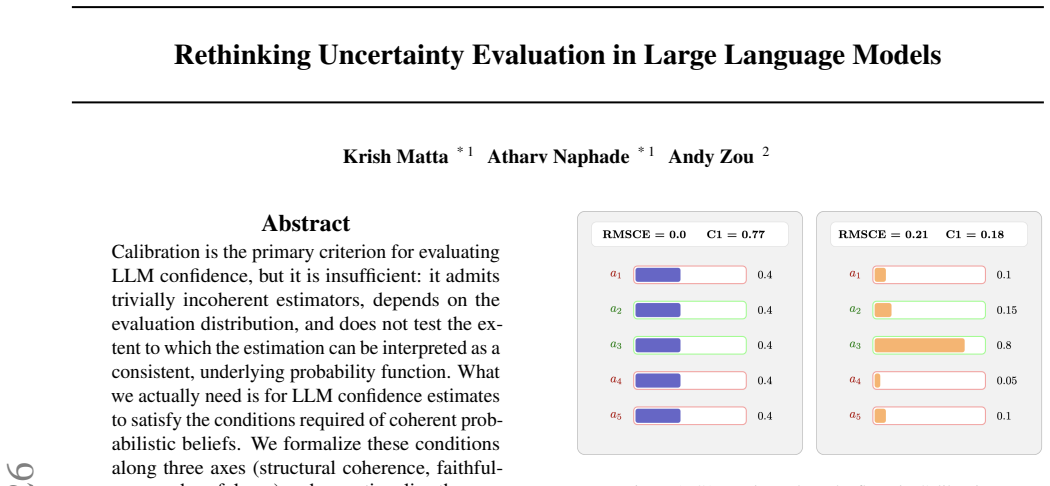
The paper's central claim is that confidence estimates from current LLMs should be held to the standards of coherent probabilistic beliefs, not just calibration, and that when they are, they fail. Treating a model's credence as a probability measure over world-states, the authors show that calibration admits trivially incoherent estimators (a constant predictor) and depends on the evaluation distribution. They instantiate three structural conditions of probability theory as measurable metrics: normalization (confidences over mutually exclusive answers should sum to one), conjunction consistency (confidence in a multi-hop answer should equal the product of confidences in its sub-answers), and
What carries the argument
The C1 evaluation framework, built on a subjectivist probability model in which a model's confidence in an answer is the credence that the answer is correct in the true world-state. The load-bearing pieces are the three structural metrics, each derived from a probability axiom: normalization (sum of confidences over disjoint answer classes is 1), conjunction consistency (product rule for multi-hop questions), and entailment monotonicity (set inclusion implies no decrease in probability). The comparison estimator that makes the violations visible is SliCK, which clusters sampled rollouts by semantic equivalence and reports the fraction of agreeing rollouts as confidence; unlike verbal or logi
Load-bearing premise
The structural metrics treat correctly answering the full multi-hop question as the same event as correctly answering both sub-questions with the gold answers, an event inclusion the paper asserts holds by construction but which need not hold when the model's chosen sub-answers differ from the gold answers.
What would settle it
Take a set of multi-hop questions, compute entailment-monotonicity violations as the paper does, then recompute them using the model's own most-confident sampled answer to the second-hop sub-question instead of the gold answer. If the violation rate drops well below 31% or the conjunction deviations shrink, the headline structural failures are artifacts of the inclusion assumption. A second check: measure the same structural metrics on a deliberately incoherent estimator (e.g., confidences drawn at random but scaled to calibrate on the benchmark) and see whether C1 correctly flags it while RMS
If this is right
- Calibration error (RMSCE) should no longer be treated as the primary or sufficient measure of LLM confidence; structural-coherence metrics can flag estimators that are calibrated but cannot be interpreted as probabilities.
- Output-based confidence estimators that saturate near certainty should be considered unreliable for any downstream decision that presupposes coherent probabilities, even when their calibration error looks low.
- Sampling-based confidence estimators (like SliCK) are diagnostic tools for model incoherence: their wide score range reveals conjunction and entailment violations that saturated estimators mask.
- RLHF can improve calibration while degrading discriminative power and structural coherence, so alignment recipes should be audited with C1-style metrics rather than RMSCE alone.
- Chain-of-thought reduces multi-hop overconfidence and improves conjunction consistency but leaves prompt-sensitivity (faithfulness) essentially unchanged, so reasoning helps only some axes of probabilistic validity.
Where Pith is reading between the lines
- A likely source of the 31% entailment-monotonicity violation is the paper's event-algebra assumption: it counts a confidence gap as a violation only if the model's chosen sub-question answer is fixed to the gold answer, but the model may be answering a different—yet still logically compatible—sub-question; re-running the metric with model-dependent answers would probably lower the violation rate.
- The framework suggests a direct training objective: penalize conjunction-consistency and entailment-monotonicity deviations during fine-tuning; the paper leaves this unexplored, but it is the natural next step implied by calling structural coherence a necessary condition.
- The distinction between aleatory and epistemic uncertainty in the paper implies that sampling-temperature interventions could alter structural metrics without changing the underlying beliefs, so improvements from decoding changes may be cosmetic rather than epistemic.
- A practical test of the framework's value: compare abstention or cascading systems built on C1-coherent scores versus calibrated-but-incoherent scores; if the coherent scores do not drive better downstream decisions, the structural metrics' operational importance would be weaker than claimed.
Editorial analysis
A structured set of objections, weighed in public.
Referee Report
Summary. The paper proposes C1, a three-axis framework for evaluating LLM confidence estimates beyond calibration: structural coherence (normalization, conjunction consistency, entailment monotonicity), faithfulness (prompt and generation semantic invariance), and usefulness (calibration, discrimination). The authors instantiate it with verbalized, logit-based, and SliCK estimators on SimpleQA, MuSiQue, and ParaRel, using Qwen-30B-A3B-Thinking and nine additional models. They report that SliCK is well-calibrated (RMSCE 0.251) but exhibits structural probability violations, including a 0.257 conjunction-consistency deviation and a 31.0% entailment-monotonicity violation rate on MuSiQue. The paper concludes that calibration is insufficient and that current LLM confidence estimates cannot be interpreted as coherent probabilities.
Significance. The conceptual critique of calibration is timely and valuable: the paper correctly notes that calibration admits constant predictors and is distribution-relative, and the proposed distinction among structural, faithfulness, and usefulness properties is a useful organizing framework. If the structural metrics were valid, the empirical results would constitute a significant contribution, showing that well-calibrated estimators can still violate probability axioms. The paper also has strengths: it explicitly names Assumption 3.1 (sampling faithfulness), provides detailed appendices with per-model tables, and correctly identifies that SliCK satisfies normalization and generation semantic invariance by construction, using them as diagnostics rather than wins. However, the central structural metrics are invalid as stated, and the headline empirical claims rest on those metrics.
major comments (4)
- [Sec. 4.1.1, Appendix A.3.3] The event inclusion defining Entailment Monotonicity is asserted, not derived. The paper defines E_x = {ω : A[x](ω) = ŷ([x])} and claims that for MuSiQue's two-hop structure, E_x ⊆ E_{x2|x1,y1*} 'holds by construction of the dataset.' This conflates gold-level entailment with the model's chosen outputs. ŷ([x]) and ŷ([x2|x1,y1*]) are produced by two separate prompt calls; nothing in the probability axioms requires that a correct full-answer output coincide with a correct second-hop output from a different prompt. A model can return the correct full answer while failing the standalone second-hop subquestion, so the set inclusion is an empirical assumption about the model, not a consequence of coherence. Consequently, the reported 31.0% violation rate and the claim that models 'assign lower confidence to logically easier questions' do not establish a probability-axiom violation; they may si
- [Sec. 4.1.1, Appendix A.3.2] Conjunction Consistency has the same load-bearing flaw. The paper asserts that 'correctly answering the full question x is precisely the event A∩B,' where A is correctness on the first-hop prompt and B is correctness on the conditioned second-hop prompt. This is not a definition; it is an empirical identity that fails for separately elicited outputs. A coherent model can assign high probability to the full question being correct while its independently chosen sub-answers are both wrong. The measured mean deviation of 0.257 on MuSiQue therefore cannot be interpreted as a violation of the product rule P(A∩B)=P(A)P(B|A). The metric would be valid only if the events were defined over a single joint generation (e.g., the full answer and its extracted sub-answers), which is not what the experiments do.
- [Sec. 4.3, Abstract] Because the two structural metrics above are invalid, the central empirical claims collapse. The abstract states 'models assign lower confidence to logically easier questions 31% of the time' and 'current LLM confidence estimates cannot be interpreted as coherent probabilities'; both rely on the asserted event inclusions. The data can be reinterpreted as quantifying cross-prompt answer disagreement rather than incoherence. The manuscript even acknowledges this possibility in passing for faithfulness (Sec. 4.1.2), but not for the structural metrics where it is equally applicable. The claim that SliCK 'exposes structural probability violations' is not supported by the experiments as designed.
- [Sec. 4.1.1, Appendix A.3.2/A.3.3] The manuscript labels the problematic equalities as definitions ('this is not an approximation but a definition of what multi-hop correctness means'). This is not a defensible operationalization. Even for a perfectly coherent credence function c, the events {ω: A[x](ω)=ŷ([x])} and {ω: A[x1](ω)=ŷ([x1])} ∩ {ω: A[x2|x1,y1*](ω)=ŷ([x2|x1,y1*])} are not equal because the argmax outputs in different prompts are not coordinated. The paper would need to define the events over the model's joint output distribution from a single sampling process, or otherwise justify why the separate-prompt events correspond to a single probability measure. No such justification appears.
minor comments (4)
- [Appendix B.2/B.3] The main experiments use 'Qwen-30B-A3B-Thinking' (Sec. 4.2), but this model is not listed in Table 1 or in the per-model results in Appendix C, which include Qwen3-14B and DeepSeek-R1-32B but no 30B model. The reader cannot verify the headline numbers (e.g., RMSCE 0.251, conjunction deviation 0.257, 31.0% entailment violations) against the tables.
- [Sec. 2/References] SliCK is cited to Gekhman et al. (2024), which is titled 'Does fine-tuning LLMs on new knowledge encourage hallucinations?' The reference may be correct (SliCK appears to be introduced in that work), but the authors should cite the exact paper or provide a dedicated reference for SliCK, as the title is not self-evidently about confidence estimation.
- [Sec. 4.3, Fig. 4/5] The figures are referenced in text but not shown in the manuscript body; the captions provide some context, but the actual data underlying the reported means (e.g., distributions of Δ(x)) would improve interpretability, especially given the large reported deviations.
- [Sec. 4.4] The sentence 'Model size does not correlate cleanly with most coherence metrics, but Semantic Invariance shows a clear scaling trend' is supported only by a figure in the appendix. Given the small number of models (n=9) and the 200-question subset, the authors should report confidence intervals or effect sizes; the claim is currently qualitative.
Circularity Check
Partial circularity: the conjunction and entailment metrics stipulate the event identities they claim to test, so the headline 'probability violations' partly reduce to those stipulations by construction.
specific steps
-
self definitional
[Appendix A.3.2 (Conjunction Consistency); see also §4.1.1]
"Correctly answering the full question x is precisely the event A∩B ; this is not an approximation but a definition of what multi-hop correctness means. Since A, B, and A∩B are all events in the same probability space Ω, the product rule applies directly."
In Section 3.1, E_x is defined as {ω : A[x](ω) = ŷ([x])}, where ŷ([x]) is the model's separately chosen argmax answer. The events A and B are defined analogously from the model's separately chosen first-hop and second-hop answers. No probability axiom makes these events equal: a model can answer the full question correctly while giving wrong answers on the standalone sub-prompts, or vice versa. By stipulating that 'multi-hop correctness' is A∩B, the metric assumes the exact identity needed to interpret any difference between ¯c(x) and c(x1,y*)·¯c(x2|x1,y*) as a probability-axiom violation. The measured deviation (0.257) is therefore partly baked into the definition rather than derived.
-
self definitional
[Appendix A.3.3 (Entailment Monotonicity); see also §4.1.1]
"Answering the full question x requires answering both hops; answering only the second (given the first) is strictly easier. The entailment E_x ⊆ E_{x2|x1,y∗1} holds by construction of the dataset."
Gold-level entailment does not imply the model-output event inclusion. E_x and E_{x2|x1,y∗1} use different argmax answers ŷ([x]) and ŷ([x2|x1,y∗1]) elicited from different prompts; even a coherent belief model can choose a correct full answer while failing the separately prompted second-hop question. The asserted inclusion—and with it the conclusion that ¯c(x)>¯c(x′) is a probability-monotonicity violation—is assumed 'by construction' rather than derived from the probability axioms. The 31% violation rate can therefore quantify cross-prompt answer inconsistency rather than incoherent probabilities, so the central claim that SliCK 'exposes structural probability violations' is partially constructed by this stipulation.
full rationale
The paper contains no fitted-parameter-as-prediction move and no load-bearing self-citation; its calibration-insufficiency examples (constant predictor, distribution-relative RMSCE), the saturation findings for verbal/logit estimators, and the usefulness metrics are self-contained and would stand independently. The circularity is concentrated in the operative empirical pillar: the claim that SliCK 'exposes structural probability violations' (conjunction deviation 0.257, entailment violations 31.0%) depends on event identities asserted rather than derived. Appendix A.3.2 defines multi-hop correctness as A∩B and Appendix A.3.3 asserts E_x⊆E_x′ 'by construction of the dataset,' but neither identity follows from the probability axioms or from dataset gold entailments once the events are defined, as the paper itself defines them, using the model's separately chosen argmax answers. Thus the structural tests are specified in a way that bakes in the target conclusion that the confidences cannot be rationalized as a single probability measure. This is partial circularity: the headline 'cannot be interpreted as coherent probabilities' reduces, for these two metrics, to the stipulated event identities. Other axes—normalization, faithfulness, usefulness, interventions—retain independent content, and Assumption 3.1 is explicitly flagged rather than hidden, so the paper is not wholly circular. Score 6 reflects that the structural-violation result is central and partially constructed by definition, while meaningful independent contributions remain.
Axiom & Free-Parameter Ledger
free parameters (4)
- rollout count k=16 =
16
- sampling temperature T=0.5 =
0.5
- calibration bin count B=20 =
20
- sample sizes (1,500 main; 200 per task in Section 4.4) =
1,500 / 200
axioms (6)
- standard math Probability axioms (normalization, product rule, monotonicity) are the normative standard for coherent beliefs.
- domain assumption Sampling faithfulness: at evaluation temperature, the generation distribution over semantic classes equals the credence function (Assumption 3.1).
- ad hoc to paper For conjunction consistency, correctly answering the full question is exactly the conjunction of correctly answering the first-hop and the conditioned second-hop (Full = A∩B).
- ad hoc to paper For entailment monotonicity, Ex ⊆ Ex′ holds 'by construction' of MuSiQue's two-hop structure.
- domain assumption All prompts induce events over one shared world-state space Ω.
- domain assumption LLM-judge semantic clustering is reliable enough (~94% accuracy) that clustering errors do not change conclusions.
invented entities (1)
-
Ideal coherent credence function c over world-states Ω
no independent evidence
read the original abstract
Calibration is the primary criterion for evaluating LLM confidence, but it is insufficient: it admits trivially incoherent estimators, depends on the evaluation distribution, and does not test the extent to which the estimation can be interpreted as a consistent, underlying probability function. What we actually need is for LLM confidence estimates to satisfy the conditions required of coherent probabilistic beliefs. We formalize these conditions along three axes (structural coherence, faithfulness, and usefulness) and operationalize them as the C1 metrics. Widely used estimators systematically violate these conditions despite appearing well-calibrated: models assign lower confidence to logically easier questions 31\% of the time, and common interventions reducing RMSCE leave structural violations unchanged, suggesting that calibration is orthogonal to probabilistic validity. RLHF and chain-of-thought improve usefulness metrics without restoring coherence. Our results show current LLM confidence estimates cannot be interpreted as coherent probabilities; our framework provides the tools to measure and close this gap.
Figures


Reference graph
Works this paper leans on
-
[1]
2025 , eprint=
Utility Engineering: Analyzing and Controlling Emergent Value Systems in AIs , author=. 2025 , eprint=
2025
-
[2]
2023 , eprint=
Just Ask for Calibration: Strategies for Eliciting Calibrated Confidence Scores from Language Models Fine-Tuned with Human Feedback , author=. 2023 , eprint=
2023
-
[3]
2022 , eprint=
Language Models (Mostly) Know What They Know , author=. 2022 , eprint=
2022
-
[4]
2024 , eprint=
Does Fine-Tuning LLMs on New Knowledge Encourage Hallucinations? , author=. 2024 , eprint=
2024
-
[5]
2025 , eprint=
Qwen3 Technical Report , author=. 2025 , eprint=
2025
-
[6]
2024 , eprint=
Measuring short-form factuality in large language models , author=. 2024 , eprint=
2024
-
[7]
and Levin, John-Clark and Kazakov, Mstyslav and Feng, Fiona and Feng, Steven Y
Phan, Long and Gatti, Alice and Li, Nathaniel and Khoja, Adam and Kim, Ryan and Ren, Richard and Hausenloy, Jason and Zhang, Oliver and Mazeika, Mantas and Hendrycks, Dan and Han, Ziwen and Hu, Josephina and Zhang, Hugh and Zhang, Chen Bo Calvin and Shaaban, Mohamed and Ling, John and Shi, Sean and Choi, Michael and Agrawal, Anish and Chopra, Arnav and Na...
-
[8]
Harsh Trivedi and Niranjan Balasubramanian and Tushar Khot and Ashish Sabharwal , title =. CoRR , volume =. 2021 , url =. 2108.00573 , timestamp =
Pith/arXiv arXiv 2021
-
[9]
2021 , eprint=
Measuring and Improving Consistency in Pretrained Language Models , author=. 2021 , eprint=
2021
-
[10]
2024 , eprint=
A Survey of Confidence Estimation and Calibration in Large Language Models , author=. 2024 , eprint=
2024
-
[11]
2024 , eprint=
GPT-4 Technical Report , author=. 2024 , eprint=
2024
-
[12]
The Foundations of Mathematics and other Logical Essays , editor =
Truth and Probability , author =. The Foundations of Mathematics and other Logical Essays , editor =. 1926 , chapter =
1926
-
[13]
Cox , doi =
Richard T. Cox , doi =. Probability, Frequency and Reasonable Expectation , volume =. Journal of Symbolic Logic , number =
-
[14]
2024 , eprint=
A Survey of Large Language Models in Medicine: Progress, Application, and Challenge , author=. 2024 , eprint=
2024
-
[15]
2023 , eprint=
Large Language Models in Law: A Survey , author=. 2023 , eprint=
2023
-
[16]
2025 , eprint=
LLM4SR: A Survey on Large Language Models for Scientific Research , author=. 2025 , eprint=
2025
-
[17]
A lawyer had to clean it up
Anthropic's Claude faked a legal citation. A lawyer had to clean it up. , author =. Business Insider , year =
-
[18]
2024 , eprint=
Semantic Entropy Probes: Robust and Cheap Hallucination Detection in LLMs , author=. 2024 , eprint=
2024
-
[19]
2024 , eprint=
SaySelf: Teaching LLMs to Express Confidence with Self-Reflective Rationales , author=. 2024 , eprint=
2024
-
[20]
2024 , eprint=
R-Tuning: Instructing Large Language Models to Say `I Don't Know' , author=. 2024 , eprint=
2024
-
[21]
Chuan Guo and Geoff Pleiss and Yu Sun and Kilian Q. Weinberger , title =. CoRR , volume =. 2017 , url =. 1706.04599 , timestamp =
Pith/arXiv arXiv 2017
-
[22]
2019 , eprint=
Can You Trust Your Model's Uncertainty? Evaluating Predictive Uncertainty Under Dataset Shift , author=. 2019 , eprint=
2019
-
[23]
2025 , eprint=
A Survey on Uncertainty Quantification Methods for Deep Learning , author=. 2025 , eprint=
2025
-
[24]
Weld and Luke Zettlemoyer , title =
Mandar Joshi and Eunsol Choi and Daniel S. Weld and Luke Zettlemoyer , title =. CoRR , volume =. 2017 , url =. 1705.03551 , timestamp =
Pith/arXiv arXiv 2017
-
[25]
2021 , eprint=
Measuring Mathematical Problem Solving With the MATH Dataset , author=. 2021 , eprint=
2021
-
[26]
2024 , eprint=
MMLU-Pro: A More Robust and Challenging Multi-Task Language Understanding Benchmark , author=. 2024 , eprint=
2024
-
[27]
2023 , eprint=
What Makes Good Data for Alignment? A Comprehensive Study of Automatic Data Selection in Instruction Tuning , author=. 2023 , eprint=
2023
-
[28]
2024 , eprint=
-bench: A Benchmark for Tool-Agent-User Interaction in Real-World Domains , author=. 2024 , eprint=
2024
-
[29]
2017 , eprint=
TriviaQA: A Large Scale Distantly Supervised Challenge Dataset for Reading Comprehension , author=. 2017 , eprint=
2017
-
[30]
2024 , eprint=
LiveCodeBench: Holistic and Contamination Free Evaluation of Large Language Models for Code , author=. 2024 , eprint=
2024
-
[31]
2023 , eprint=
The Internal State of an LLM Knows When It's Lying , author=. 2023 , eprint=
2023
-
[32]
2024 , eprint=
Discovering Latent Knowledge in Language Models Without Supervision , author=. 2024 , eprint=
2024
-
[33]
2024 , eprint=
Assessing the Creativity of LLMs in Proposing Novel Solutions to Mathematical Problems , author=. 2024 , eprint=
2024
-
[34]
2022 , eprint=
Teaching Models to Express Their Uncertainty in Words , author=. 2022 , eprint=
2022
-
[35]
2024 , eprint=
Can LLMs Express Their Uncertainty? An Empirical Evaluation of Confidence Elicitation in LLMs , author=. 2024 , eprint=
2024
-
[36]
2024 , eprint=
HelpSteer2-Preference: Complementing Ratings with Preferences , author=. 2024 , eprint=
2024
-
[37]
Huangfu, Qi and Hall, J. A. Julian , title =. Mathematical Programming Computation , volume =. 2018 , publisher =. doi:10.1007/s12532-017-0130-5 , url =
-
[38]
Shao, Zhihong and Wang, Peiyi and Zhu, Qihao and Xu, Runxin and Song, Jiayi and Zhang, Mingchuan and Li, Y. K. and Wu, Y. and Guo, Daya , title =. 2024 , eprint =
2024
-
[39]
Lamb, Tom A. and Ivanova, Desi R. and Torr, Philip H. S. and Rudner, Tim G. J. , title =. arXiv preprint arXiv:2604.07172 , year =
-
[40]
2021 , eprint =
Turner, Alexander and others , title =. 2021 , eprint =
2021
-
[41]
and Shen, Yelong and Wallis, Phillip and Allen-Zhu, Zeyuan and Li, Yuanzhi and Wang, Shean and Wang, Lu and Chen, Weizhu , title =
Hu, Edward J. and Shen, Yelong and Wallis, Phillip and Allen-Zhu, Zeyuan and Li, Yuanzhi and Wang, Shean and Wang, Lu and Chen, Weizhu , title =. 2021 , eprint =
2021
-
[42]
2023 , eprint=
Self-Consistency Improves Chain of Thought Reasoning in Language Models , author=. 2023 , eprint=
2023
-
[43]
2023 , eprint=
SelfCheckGPT: Zero-Resource Black-Box Hallucination Detection for Generative Large Language Models , author=. 2023 , eprint=
2023
-
[44]
2023 , eprint=
Semantic Uncertainty: Linguistic Invariances for Uncertainty Estimation in Natural Language Generation , author=. 2023 , eprint=
2023
discussion (0)
Sign in with ORCID, Apple, or X to comment. Anyone can read and Pith papers without signing in.