REVIEW 2 major objections 2 minor 72 references
The Unruh effect degrades the precision of estimating parameters in thermal attenuator and amplifier Gaussian channels.
Reviewed by Pith at T0; open to challenge. T0 means a machine referee read the full paper against a public rubric. the ladder, T0–T4 →
T0 review · grok-4.3
2026-06-27 16:46 UTC pith:SAZLD4IQ
load-bearing objection Extends standard QFI methods to Unruh-modified Gaussian channels and reports precision loss, but the effective thermal model may miss frame-dependent transformations on states and detectors. the 2 major comments →
Impact of the Unruh effect on the estimation precision of Gaussian channel parameters
The pith
A machine-rendered reading of the paper's core claim, the machinery that carries it, and where it could break.
Core claim
When the Unruh effect is included as an effective thermal contribution to the thermal attenuator and thermal amplifier channels, the quantum Fisher information for the channel parameters drops for both coherent and squeezed-vacuum probes. Consequently the estimation variance bounds rise in the single-parameter case. In the two-parameter case the quantum Cramér-Rao bound stays asymptotically achievable and the same degradation appears. Heterodyne measurement becomes nearly optimal once acceleration or mean thermal photon number is large.
What carries the argument
Quantum Fisher information extracted from the covariance matrix of the output state of an Unruh-modified thermal attenuator or amplifier channel.
Load-bearing premise
The Unruh effect can be captured entirely by increasing the thermal noise parameters of the Gaussian channels, without further relativistic transformations on the input states or on the measurement apparatus.
What would settle it
An explicit computation of the quantum Fisher information for a fixed channel transmissivity or gain at two different acceleration parameters that shows no increase in the bound when acceleration rises.
If this is right
- Precision loss appears for both coherent states and squeezed vacuum states.
- The quantum Cramér-Rao bound is asymptotically tight for joint estimation of two channel parameters.
- Heterodyne detection approaches the optimal precision at high acceleration or large thermal mean photon number.
Where Pith is reading between the lines
- The same noise model may limit other quantum metrology protocols performed by uniformly accelerated observers.
- Analog simulation of the Unruh effect in table-top optical systems could test the predicted precision loss directly.
Editorial analysis
A structured set of objections, weighed in public.
Referee Report
Summary. The paper analyzes the effect of the Unruh effect, modeled as an effective thermal noise contribution, on the precision of estimating parameters of thermal attenuator and thermal amplifier Gaussian channels. Using coherent states and squeezed vacuum states as inputs, it computes the quantum Fisher information for single-parameter estimation and the quantum Cramér-Rao bound for two-parameter estimation, concluding that the Unruh effect degrades estimation precision in both cases, that the QCRB is asymptotically achievable, and that heterodyne detection is near-optimal in the high-acceleration or large-thermal-mean-number limit.
Significance. If the effective thermal model fully captures the noninertial physics, the results extend Gaussian quantum metrology to accelerated frames and provide guidance on measurement optimality for relativistic quantum channels. The explicit demonstration of QCRB achievability and heterodyne near-optimality would be concrete contributions to the literature on relativistic quantum information.
major comments (2)
- [Unruh effect modeling / channel definitions] The central claim that the Unruh effect degrades estimation precision rests on modeling it solely as an additive thermal contribution that rescales the parameters of the attenuator/amplifier channels (see the channel definitions and Unruh modeling paragraph). It is unclear whether Bogoliubov transformations are applied to the covariance matrices of the coherent or squeezed input states when transforming to the accelerated frame; if omitted, the reported QFI degradation may be incomplete or misattributed to the channel alone rather than the full noninertial transformation.
- [Two-parameter estimation section] For the two-parameter estimation, the statement that the quantum Cramér-Rao bound is an asymptotically achievable precision limit requires explicit identification of the measurement achieving it and the precise asymptotic regime (e.g., number of copies or acceleration parameter). Without this, it is difficult to verify that the bound is not merely a formal lower bound but is attained under the same Unruh-modified channel model used for the single-parameter case.
minor comments (2)
- Notation for the thermal mean photon number and acceleration parameter should be defined once at first use and used consistently; several symbols appear without prior definition in the abstract and early sections.
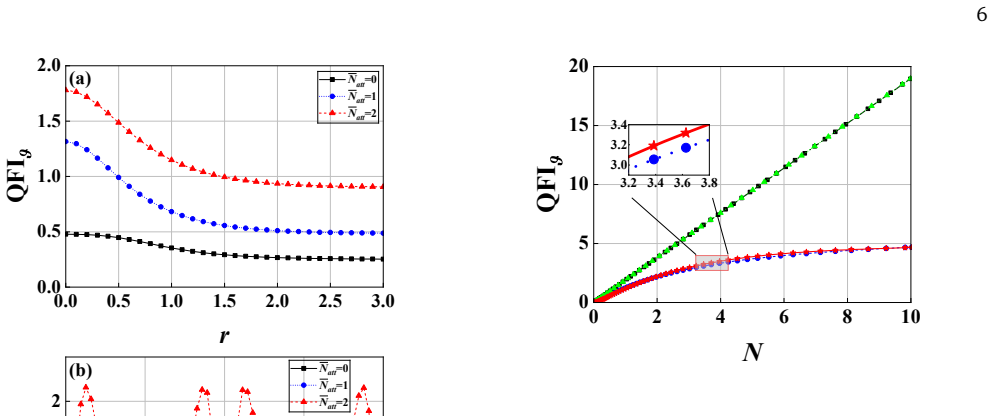
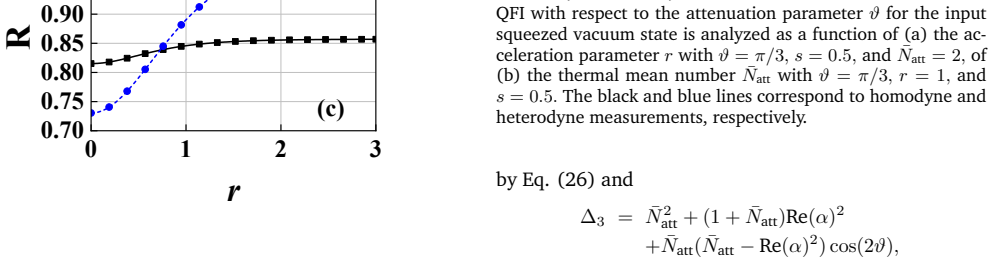
- Figure captions should explicitly state the input state (coherent vs. squeezed) and the value of the acceleration parameter used for each curve to improve readability.
Simulated Author's Rebuttal
We thank the referee for the careful reading and constructive comments. We address each major comment below with clarifications based on the manuscript content. We believe the points can be resolved through these explanations.
read point-by-point responses
-
Referee: [Unruh effect modeling / channel definitions] The central claim that the Unruh effect degrades estimation precision rests on modeling it solely as an additive thermal contribution that rescales the parameters of the attenuator/amplifier channels (see the channel definitions and Unruh modeling paragraph). It is unclear whether Bogoliubov transformations are applied to the covariance matrices of the coherent or squeezed input states when transforming to the accelerated frame; if omitted, the reported QFI degradation may be incomplete or misattributed to the channel alone rather than the full noninertial transformation.
Authors: The Unruh effect is modeled via the standard Bogoliubov transformations between Minkowski and Rindler modes, which produce the effective thermal noise contribution that rescales the attenuator and amplifier parameters. The covariance matrices of the coherent and squeezed-vacuum inputs are transformed to the accelerated frame using these Bogoliubov coefficients before the channel acts; this is the procedure underlying the channel definitions and Unruh modeling paragraph. Consequently the reported QFI degradation already incorporates the full noninertial transformation of both states and channel. revision: no
-
Referee: [Two-parameter estimation section] For the two-parameter estimation, the statement that the quantum Cramér-Rao bound is an asymptotically achievable precision limit requires explicit identification of the measurement achieving it and the precise asymptotic regime (e.g., number of copies or acceleration parameter). Without this, it is difficult to verify that the bound is not merely a formal lower bound but is attained under the same Unruh-modified channel model used for the single-parameter case.
Authors: In the two-parameter section we demonstrate that heterodyne detection saturates the QCRB in the high-acceleration (large thermal mean-number) limit, where the classical Fisher information matrix from heterodyne coincides with the quantum Fisher information matrix. This is the same Unruh-modified channel model employed for the single-parameter results, and the asymptotic regime is the large-acceleration limit already used throughout the paper. revision: partial
Circularity Check
No circularity; derivation relies on standard QFI/QCRB for Gaussian channels with external Unruh modeling
full rationale
The provided abstract and reader's summary contain no equations, no fitted parameters renamed as predictions, and no self-citations that bear the central claim. The analysis applies the quantum Cramér-Rao bound to thermal attenuator/amplifier channels after modeling Unruh as effective thermal noise—an external physical assumption, not a self-referential definition or fit. No step reduces by construction to its own inputs, and the QCRB is invoked as an independent asymptotic limit rather than derived from the paper's own data. This is the normal case of a self-contained calculation against standard quantum estimation benchmarks.
Axiom & Free-Parameter Ledger
read the original abstract
Gaussian quantum channels constitute a pivotal physical framework for characterizing the dynamics of Gaussian quantum states. Extensive scholarly attention has been devoted to the estimation of parameters associated with Gaussian channels. However, while previous research has predominantly focused on parameter estimation within inertial frames, the noninertial scenario, particularly in the context of the Unruh effect, remains largely unexplored. In this paper, we analyze the impact of the Unruh effect on the estimation precision of Gaussian channel parameters, with a specific focus on thermal attenuator and thermal amplifier channels. Our findings reveal that the Unruh effect significantly degrades the precision of single-parameter estimation for Gaussian channel parameters when employing both the input coherent state and squeezed vacuum state. For the two-parameter estimation, we further demonstrate that the quantum Cram\'er-Rao bound serves as an asymptotically achievable precision limit. Consistent with the single-parameter case, the Unruh effect exerts a detrimental impact on the precision of two-parameter estimation. Notably, heterodyne measurement is near-optimal for both single- and two-parameter estimation in the limit of high acceleration or large thermal mean numbers. These results provide crucial theoretical insights and practical guidance for advancing quantum parameter estimation in a relativistic context.
Figures






Reference graph
Works this paper leans on
-
[1]
Giovannetti, S
V. Giovannetti, S. Lloyd, and L. Maccone, Advances in quantum metrology , Nat. Photonics5, 222 (2011)
2011
-
[2]
Barbieri, Optical Quantum Metrology , PRX Quantum 3, 010202 (2022)
M. Barbieri, Optical Quantum Metrology , PRX Quantum 3, 010202 (2022)
2022
-
[3]
Pirandola, B
S. Pirandola, B. R. Bardhan, T. Gehring, C. Weedbrook, and S. Lloyd, Advances in photonic quantum sensing, Nat. Photon.12, 724 (2018)
2018
-
[4]
Montenegro, C
V. Montenegro, C. Mukhopadhyay , R. Yousefjani, S. Sarkar, U. Mishra, M. G. A. Paris, and A. Bayat, Re- view: quantum metrology and sensing with many-body systems, Phys. Rep.1134, 1-62 (2025)
2025
-
[5]
S. L. Braunstein and C. M. Caves, Statistical distance and the geometry of quantum states, Phys. Rev. Lett.72, 3439 (1994)
1994
-
[6]
Demkowicz-Dobrza ´nski, M
R. Demkowicz-Dobrza ´nski, M. Jarzyna, and J. Kołody´nski, Quantum limits in optical interferome- try , Prog. Opt.60, 345 (2015)
2015
-
[7]
M. G. A. Paris, Quantum estimation for quantum technol- ogy , Int. J. Quantum Inf.7, 125 (2009)
2009
-
[8]
Pezzè, A
L. Pezzè, A. Smerzi, M. K. Oberthaler, R. Schmied, and P. Treutlein, Quantum metrology with nonclassical states of atomic ensembles, Rev. Mod. Phys.90, 035005 (2018)
2018
-
[9]
Gessner, and A
M. Gessner, and A. Smerzi, Hierarchies of frequentist bounds for quantum metrology: From Cramér-Rao to Barankin, Phys. Rev. Lett.130, 260801 (2023)
2023
-
[10]
J. R. Hervas, A. Z. Goldberg, A. S. Sanz, Z. Hradil, J. ˇReháˇcek, and L. L. Sáchez-Soto, Beyond the quantum Cramér-Rao bound, Phys. Rev. Lett.134, 010804 (2025)
2025
-
[11]
Y. Xia, W. Li, Q. T. Zhuang, and Z. S. Zhang, Quantum- enhanced data classification with a variational entangled sensor network, Phys. Rev. X11, 021047 (2021)
2021
-
[12]
X. Guo, C. R. Breum, J. Borregaard, S. Izumi, M. V. Larsen, T. Gehring, M. Christandl, J. S. Neergaard- Nielsen, and U. L. Andersen, Distributed quantum sensing in a continuous-variable entangled network, Nat. Phys. 16, 281 (2020)
2020
-
[13]
M. M. Taddei, B. M. Escher, L. Davidovich, and R. L. de Matos Filho, Quantum speed limit for physical processes, Phys. Rev. Lett.110, 050402 (2013)
2013
-
[14]
L. P. Garcí-Pintos, S. B. Nicholson, J. R. Green, A. Campo, and A. V. Gorshkov, Unifying quantum and classical speed limits on observables, Phys. Rev. X12, 011038 (2022)
2022
-
[15]
D. P. Xuan, Z. X. Shen, W. Zhou, S. M. Fei, and Z. X. Wang, Quantum-imaginarity-based quantum speed limit, Phys. 21 Rev. A112, 052202 (2025)
2025
-
[16]
Tsang, R
M. Tsang, R. Nair, and X. M. Lu, Quantum theory of super- resolution for two incoherent optical point sources, Phys. Rev. X6, 031033 (2016)
2016
-
[17]
C. H. Oh, S. S. Zhou, Y. Wong, and L. Jiang, Quantum limits of superresolution in a noisy environment, Phys. Rev. Lett.126, 120502 (2021)
2021
-
[18]
Naimy , A
A. Naimy , A. Slaoui, A. Lakhfif, H. E. Hadfi, and R. A. Laamara, Achieving optimal multiparameter quantum es- timation in optomechanics, Phys. Rev. A,112, 052604 (2025)
2025
-
[19]
Nichols, P
R. Nichols, P. Liuzzo-Scorpo, P. A. Knott, and G. Adesso, Multiparameter Gaussian quantum metrology , Phys. Rev. A98, 012114 (2018)
2018
-
[20]
Gao and H
Y. Gao and H. Lee, Bounds on quantum multiple- parameter estimation with Gaussian state, Eur. Phys. J. D68, 1 (2014)
2014
-
[21]
Phase space formalism for quantum estimation of Gaussian states
A. Monras, Phase space formalism for quantum estima- tion of Gaussian states, arXiv:1303.3682
work page internal anchor Pith review Pith/arXiv arXiv
- [22]
-
[23]
Šafráek, Estimation of Gaussian quantum states, J
D. Šafráek, Estimation of Gaussian quantum states, J. Phys. A52, 035304 (2019)
2019
-
[24]
Monras, and M
A. Monras, and M. G. A. Paris, Optimal quantum esti- mation of loss in bosonic channels, Phys. Rev. Lett.98, 160401 (2007)
2007
-
[25]
Monras and F
A. Monras and F. Illuminati, Measurement of damping and temperature: Precision bounds in Gaussian dissipa- tive channels, Phys. Rev. A83, 012315 (2011)
2011
-
[26]
Šafráek, and I
D. Šafráek, and I. Fuentes, Optimal probe states for the estimation of Gaussian unitary channels, Phys. Rev. A94, 062313 (2016)
2016
-
[27]
Monras and F
A. Monras and F. Illuminati, Information geometry of Gaussian channels, Phys. Rev. A81, 062326 (2010)
2010
-
[28]
J. F. G. Santos, C. H. S. Vieira, and W. R. Cardoso, Im- proving parameter estimation in Gaussian channels using quantum coherence, Phys. Rev. A111, 052404 (2025)
2025
-
[29]
Nair, Quantum-limited loss sensing: multiparameter estimation and bures distance between loss channels, Phys
R. Nair, Quantum-limited loss sensing: multiparameter estimation and bures distance between loss channels, Phys. Rev. Lett.121, 230801 (2018)
2018
-
[30]
J. Wang, L. Davidovich, and G. S. Agarwal, Quantum sensing of open systems: estimation of damping constants and temperature, Phys. Rev. Res.2, 033389 (2020)
2020
-
[31]
Binder, and D
P. Binder, and D. Braun, Quantum parameter estimation of the frequency and damping of a harmonic oscillator, Phys. Rev. A102, 012223 (2020)
2020
-
[32]
L. A. Correa, M. Mehboudi, G. Adesso, and A. Sanpera, In- dividual quantum probes for optimal thermometry , Phys. Rev. Lett.114, 220405 (2015)
2015
-
[33]
Albarelli, M
F. Albarelli, M. G. A. Paris, B. Vacchini, and A. Smirne, Invasiveness of non-equilibrium quantum thermometry , Phys. Rev. A108, 062421 (2023)
2023
-
[34]
S. K. Chang, Y. Yan, L. Wang, W. Ye, X. Rao, H. Zhang, L. Huang, M. Luo, Y. Chen, Q. Ma, and S. Gao, Global quan tum thermometry based on the optimal biased bound, Phys. Rev. Res.6, 043171 (2024)
2024
-
[35]
J. X. Peng, P. Djorwe, H. T. Cui, N. Akhtar, I. U. Haq, C. Zhao, and D. Li, Quantum estimation for improv- ing optomechanical coupling strength, Phys. Rev. A111, 012607 (2025)
2025
-
[36]
Adesso, F
G. Adesso, F. Dell’Anno, S. De Siena, F. Illuminati, and L. A. M. Souza, Optimal estimation of losses at the ultimate quantum limit with non-Gaussian states, Phys. Rev. A79, 040305(R) (2009)
2009
-
[37]
Samantaray , J
N. Samantaray , J. C. F. Matthews, and J. G. Rarity , Pois- sonian twin-beam states and the effect of symmetrical photon subtraction in loss estimations, Phys. Rev. A104, 063718 (2021)
2021
-
[38]
Y. Tao, X. Li, L. Li, J. Huang, H. Li, T. Wang, L. Zhou, and G. Zeng, Surpassing the quantum limit in bosonic loss estimation without quantum probes, Phys. Rev. Lett.133, 060801 (2024)
2024
-
[39]
Belsley , E
A. Belsley , E. J. Allen, A. Datta, and J. C. F. Matthews, Advantage of coherent states in ring resonators over any quantum probe single-pass absorption estimation strat- egy , Phys. Rev. Lett.128, 230501 (2022)
2022
-
[40]
Peres, and D
A. Peres, and D. R. Terno, Quantum information and rel- ativity theory , Rev. Mod. Phys.76, 93 (2004)
2004
-
[41]
L. C. B. Crispino, A. Higuchi, and G. E. A. Matsas, The Unruh effect and its applications, Rev. Mod. Phys.80, 787 (2008)
2008
-
[42]
J. Wang, H. Cao, J. Jing, and H. Fan, Gaussian quantum steering and its asymmetry in curved spacetime, Phys. Rev. D93, 125011 (2016)
2016
-
[43]
W. G. Unruh, Notes on black-hole evaporation, Phys. Rev. D14, 870 (1976)
1976
-
[44]
S. W. Hawking, Breakdown of predictability in gravita- tional collapse, Phys. Rev. D 14, 2460 (1976)
1976
-
[45]
S. W. Hawking, Particle creation by black holes, Commun. Math. Phys. 43, 199 (1975)
1975
-
[46]
P. M. Alsing, I. Fuentes-Schuller, R. B. Mann, and T. E. Tessier, Entanglement of Dirac fields in noninertial frames, Phys. Rev. A74, 032326 (2006)
2006
-
[47]
Fuentes-Schuller, and R
I. Fuentes-Schuller, and R. B. Mann, Alice falls into a black hole: entanglement in noninertial frames, Phys. Rev. Lett. 95, 120404 (2005)
2005
-
[48]
Harikrishnan, S
S. Harikrishnan, S. Jambulingam, P. P. Rohde, and C. Rad- hakrishnan, Accessible and inaccessible quantum coher- ence in relativistic quantum systems, Phys. Rev. A105, 052403 (2022)
2022
-
[49]
J. Wang, Z. Tian, J. Jing, and H. Fan, Irreversible degra- dation of quantum coherence under relativistic motion, Phys. Rev. A93, 062105 (2016)
2016
-
[50]
Hosler, C
D. Hosler, C. Bruck, and P. Kok, Information gap for clas- sical and quantum communication in a Schwarzschild spacetime, Phys. Rev. A85, 042312 (2012)
2012
-
[51]
T. G. Downes, T. C. Ralph, and N. Walk, Quantum com- munication with an accelerated partner, Phys. Rev. A87, 012327 (2013)
2013
-
[52]
P. T. Grochowski, G. Rajchel, F. Kiałka, and A. Dragan, Effect of relativistic acceleration on continuous variable quantum teleportation and dense coding, Phys. Rev. D95, 105005 (2017)
2017
-
[53]
Aspachs, G
M. Aspachs, G. Adesso, and I. Fuentes, Optimal quantum estimation of the Unruh-Hawking effect, Phys. Rev. Lett. 105, 151301 (2010)
2010
-
[54]
Y. Yao, X. Xiao, L. Ge, X. Wang, and C. Sun, Quantum Fisher information in noninertial frames, Phys. Rev. A89, 042336 (2014)
2014
-
[55]
Hosler, and P
D. Hosler, and P. Kok, Parameter estimation using NOON states over a relativistic quantum channel, Phys. Rev. A 88, 052112 (2013)
2013
-
[56]
Friis, M
N. Friis, M. Skotiniotis, I. Fuentes, and W. Dür, Heisenberg scaling in Gaussian quantum metrology , Phys. Rev. A92, 022106 (2015)
2015
-
[57]
Ahmadi, D
M. Ahmadi, D. E. Bruschi, and I. Fuentes, Quantum 22 metrology for relativistic quantum fields, Phys. Rev. D89, 065028 (2014)
2014
-
[58]
Montero and E
M. Montero and E. Martín-Martínez, The entangling side of the Unruh-Hawking effect, J. High Energy Phys.07006 (2011)
2011
-
[59]
Albarelli, M
F. Albarelli, M. Barbieri, M. G. Genoni, and I. Gianani, A perspective on multiparameter quantum metrology: From theoretical tools to applications in quantum imag- ing, Phys. Lett. A384, 126311 (2020)
2020
-
[60]
Carollo, B
A. Carollo, B. Spagnolo, and D. Valenti, Uhlmann cur- vature in dissipative phase transitions, Sci. Rep.8, 9852 (2018)
2018
-
[61]
Demkowicz-Dobrza ´nski, W
R. Demkowicz-Dobrza ´nski, W. Góecki, and M. Gut ˇa, Multi-parameter estimation beyond quantum Fisher in formation, J. Phys. A53, 363001 (2020)
2020
-
[62]
S. L. Braunstein and P. van Loock, Quantum informa- tion with continuous variables, Rev. Mod. Phys.77, 513 (2005)
2005
-
[63]
Weedbrook, S
C. Weedbrook, S. Pirandola, R. Garcí-Patrón, N. J. Cerf, T. C. Ralph, J. H. Shapiro, and S. Lloyd, Gaussian quantum information, Rev. Mod. Phys.84, 621 (2012)
2012
-
[64]
Serafini, Quantum Continuous Variables: A Primer of Theoretical Methods (Taylor & Francis, Oxford, 2017)
A. Serafini, Quantum Continuous Variables: A Primer of Theoretical Methods (Taylor & Francis, Oxford, 2017)
2017
-
[65]
Bressanini, M
G. Bressanini, M. G Genoni, M. S. Kim, and M. G. A. Paris, Multi-parameter quantum estimation of single- and two- mode pure Gaussian states, J. Phys. A: Math. Theor.57, 315305 (2024)
2024
-
[66]
Pezzè, M
L. Pezzè, M. A. Ciampini, N. Spagnolo, P. C. Humphreys, A. Datta, I. A. Walmsley , M. Barbieri, F. Sciarrino, and A. Smerzi, Optimal measurements for simultaneous quan- tum estimation of multiple phases, Phys. Rev. Lett.119, 130504 (2017)
2017
-
[67]
J. Yang, S. Pang, Y. Zhou, and A. N. Jordan, Optimal mea- surements for quantum multiparameter estimation with general states, Phys. Rev. A100, 032104 (2019)
2019
-
[68]
Ragy , M
S. Ragy , M. Jarzyna, and R. Demkowicz-Dobrza´nski, Com- patibility in multiparameter quantum metrology , Phys. Rev. A94, 052108 (2016)
2016
-
[69]
J. O. de Almeida, M. Lewenstein, and M. Skotiniotis, Superresolving collective quantum measurements, Phys. Rev. A112, 052605 (2025)
2025
-
[70]
D. E. Bruschi, J. Louko, E. Martín-Martínez, A. Dragan, and I. Fuentes, Unruh effect in quantum information be- yond the single-mode approximation, Phys. Rev. A82, 042332 (2010)
2010
-
[71]
Dragan, J
A. Dragan, J. Doukas, E. Martín-Martínez, and D. E. Br- uschi, Localized projective measurement of a quantum field in non-inertial frames, Class. Quantum Grav.30 235006 (2013)
2013
-
[72]
Ahmadi, K
M. Ahmadi, K. Lorek, A. Ch˛ eci´nska, A. R. H. Smith, R. B. Mann, and A. Dragan, Effect of relativistic acceleration on localized two-mode Gaussian quantum states, Phys. Rev. D93, 124031 (2016)
2016
discussion (0)
Sign in with ORCID, Apple, or X to comment. Anyone can read and Pith papers without signing in.