REVIEW 3 major objections 6 minor 248 references
Protostellar disks in multiple systems preferentially align up to 6,000 AU, suggesting turbulent fragmentation alone cannot explain wide pairs.
Reviewed by Pith at T0; open to challenge. T0 means a machine referee read the full paper against a public rubric. the ladder, T0–T4 →
T0 review · deepseek-v4-flash
2026-08-02 02:30 UTC pith:SC5DNWVM
load-bearing objection The combined 9-cloud alignment signal is real and the sample is a big step up, but the abstract's 'across all evolutionary classes' is too strong and the ~50% aligned fraction is likely an upper limit given the outflow-selection bias the authors themselves flag. the 3 major comments →
Preferential alignment of Class 0, Class I protostellar disks in multiple systems across nine nearby molecular clouds
The pith
A machine-rendered reading of the paper's core claim, the machinery that carries it, and where it could break.
Core claim
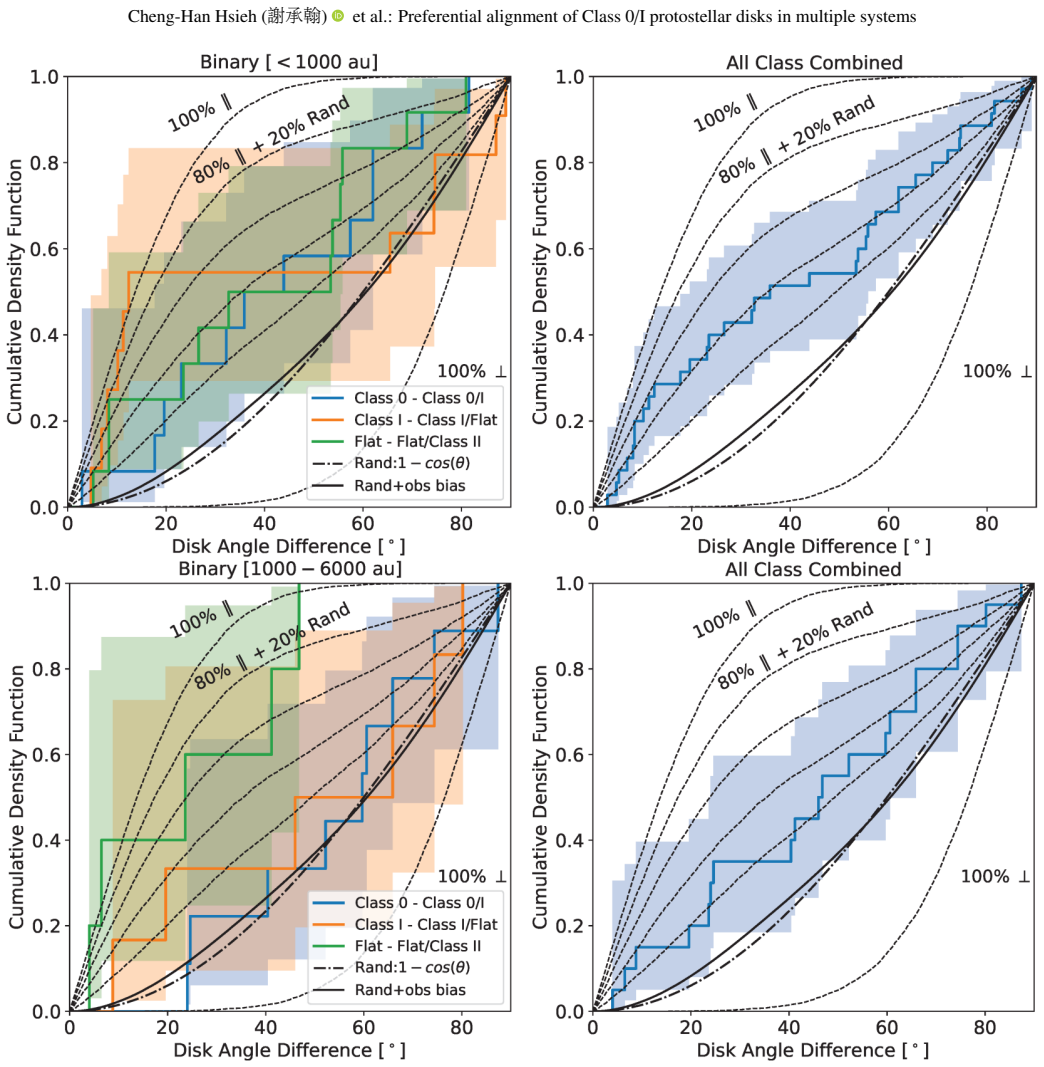
The central claim is that the angular momentum of protostellar disks is not set independently by turbulence: in multiple systems, disks are preferentially parallel to one another out to separations of several thousand AU, and this holds in both binaries and higher-order multiples. The paper reaches this by measuring disk position angles and inclinations from millimeter continuum images, using outflow emission to determine whether each disk tilts toward or away from the observer, and then comparing the three-dimensional angle differences to a random orientation model that includes observational bias. For pairs where the inclination sign is known, the distribution is described by a mixture of
What carries the argument
The central object is the three-dimensional disk orientation vector n=(sin i cos PA, sin i sin PA, cos i), built from the inclination angle i and position angle PA measured by fitting two-dimensional Gaussians to continuum emission. The acute angle θ=arccos(|n1·n2|) between two disks is the alignment statistic; outflow integrated-intensity maps break the sign degeneracy of i. A weighted Kaplan–Meier estimator handles pairs with two possible degeneracy solutions, and Monte Carlo random vectors with an inclination-bias correction supply the null distribution. The observed distribution is then compared with a simple binomial mixture of parallel and random components, and with spin orientations
Load-bearing premise
The central claim relies on the 48% of protostars with measurable outflow signs being representative of all pairs, yet the paper notes misaligned disks may hide their outflows and thus land in the sign-degenerate sample, which would inflate the quoted ~50% aligned fraction.
What would settle it
Re-observe the 262 sign-degenerate protostars with deeper molecular-line outflow observations; if the recovered angle distribution matches the random 1−cos θ curve while the non-degenerate sample remains aligned, the intrinsic aligned fraction would drop below ~50%.
If this is right
- If the paper is right, turbulent fragmentation cannot be the sole formation channel for wide (1,000–6,000 AU) multiples; star formation models must include core-scale angular momentum coherence.
- The persistence of alignment from ≤1,000 AU to 6,000 AU rules out a sharp transition to random orientations where turbulent fragmentation is expected to dominate.
- The comparable degree of nearest-neighbor alignment in binaries and higher-order multiples suggests both kinds of systems form from the same aligned reservoir rather than by different processes.
- The deficit of flat-spectrum disks in high-order multiples implies most higher-order systems dissolve or migrate to unresolved separations by the end of the Class I phase, increasing the apparent binary fraction.
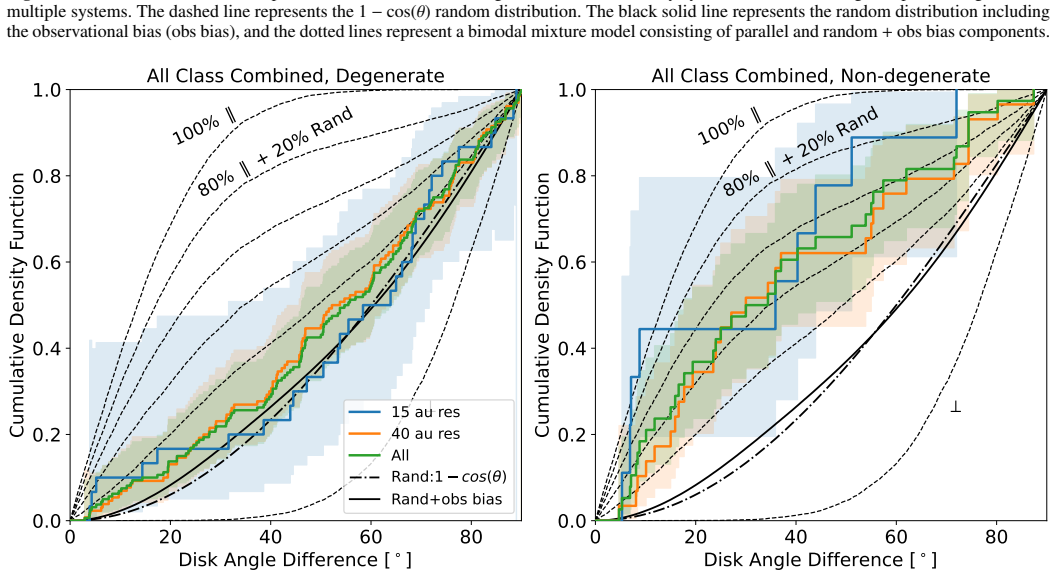
- Resolving inclination-sign degeneracy is essential: with signs known, the aligned fraction is about 50%; without signs, the distribution appears consistent with random.
Where Pith is reading between the lines
- Editorial inference: if the alignment signal is real, disk orientations in a multiple system are set before birth by the same core-scale flow, so the angular momentum direction of a protoplanetary disk is partly inherited from its parent core; this could be tested by comparing disk position angles with large-scale filament or magnetic-field orientations in the same clouds.
- Editorial inference: the scarcity of flat-spectrum disks in high-order multiples implies a dissolution timescale of order the Class I lifetime; one prediction is that many young binaries with separations of a few hundred AU are the surviving cores of dissolved triples and quadruples, which could be checked with dynamical simulations of orbital disruption.
- Editorial inference: because the sign-degenerate subsample is consistent with random, a targeted campaign to extract faint outflows from those sources would directly measure how much of the apparent alignment is selection bias versus intrinsic; that is a sharper test than simply adding more sources.
Editorial analysis
A structured set of objections, weighed in public.
Referee Report
Summary. The paper combines CAMPOS and VANDAM ALMA surveys of 512 Class 0/I/flat-spectrum protostars in nine nearby clouds to measure disk orientations in multiple systems. From deconvolved continuum axis ratios the authors derive |inclination| and position angle, and use CO outflows to break the inclination-sign degeneracy for ~48% of the sample. They compute acute 3D angle differences between disk orientation vectors, assigning half-weight to pairs with unconstrained sign. Using weighted KDEs, Kaplan–Meier cumulative distributions, KS tests against a Monte Carlo random distribution corrected for an observationally simulated inclination bias, they report significant alignment in the combined sample of 111 binary and high-order nearest-neighbor pairs (p<1e-4), a ~40% aligned mixture-model fraction, and, for the non-degenerate subsample, a ~50% aligned fraction (p=3e-5). They also find no significant close-versus-wide separation dependence out to 6000 au, a deficit of flat-spectrum disks in high-order multiples, and that Starforge spin-spin angles for pairs at 40–6000 au are consistent with random, unlike the observed disk angles. The paper concludes that turbulent fragmentation alone cannot explain wide protostellar multiples and that angular-momentum coherence is preserved during fragmentation and accretion.
Significance. This is the largest systematic study to date of disk orientations in embedded protostellar multiples, and it is methodologically careful: it simulates the inclination measurement bias, uses consistency-weighted tests for the sign degeneracy, and compares against previously published Starforge simulations with a defined proxy for disk orientation. If the alignment signal holds, it is an important constraint on multiple-star formation, favoring formation mechanisms that preserve angular-momentum coherence over purely stochastic turbulent fragmentation. The paper also has clear falsifiable content: the wide-separation alignment and the flat-spectrum deficit in higher-order multiples can be tested with future surveys. However, the strength of the headline claims depends on two points that need additional work: the possible selection bias in the sign-determined subsample and the support for the phrase 'across all evolutionary classes.'
major comments (3)
- [Section 5.6, Figure 11] The quantitative claim that 'the intrinsic degree of protostellar disk alignment ... approaching ~50%' rests entirely on the non-degenerate subsample. The paper itself acknowledges that 'misaligned sources may be more likely to fall into the degenerate sample, due to the difficulty of extracting outflows.' That is a selection bias that would inflate the aligned fraction in the non-degenerate sample. The degenerate sample being consistent with random does not remove this concern, because the two samples are not random subsets of the same population. Please provide a quantitative sensitivity analysis—for example, model the sign-determination completeness as a function of pair angle, or bound the intrinsic fraction under an assumed completeness function—so the 50% figure is not presented as an unbiased estimate. As written, this figure is an upper limit.
- [Abstract, Section 5.1, Table 2] The abstract states that multiple systems 'exhibit preferential disk alignment ... across all evolutionary classes.' This is not supported by the subsample tests in Table 2: the binary Class 0–0/I sample is not significantly different from random+obs bias (p=0.139), the high-order Class I–I/Flat sample is not significant (p=0.137), and the high-order Flat–Flat/Class II sample has n=1. The strong combined-sample result (n=111, p<1e-4) therefore does not imply that each evolutionary class individually shows alignment. Please either qualify the abstract and conclusions to 'the combined sample across evolutionary classes' or provide a formal test that the alignment signal is present within each class before claiming 'across all evolutionary classes.'
- [Sections 5.4 and 7] The conclusion that 'turbulent fragmentation alone is insufficient to explain wide protostellar multiples (separations of 10^3 au)' is load-bearing but is not directly supported by a significance test on the wide-only subsample. Table 2 reports close-versus-wide KS p-values (e.g., p=0.914 for the All-Class combined sample), but these test differences between subsamples, not departures of the 1000–6000 au subsample from the random+obs bias distribution. The only direct statement is that the combined wide-binary sample deviates at the '2σ level' (n=20), which is marginal. Please report the wide-only KS p-values against Random+obs bias for binaries, high-order nearest neighbors, and the combined sample. If those tests are not significant, the claim that alignment persists out to 6000 au should be softened accordingly.
minor comments (6)
- [Section 1] Typo: 'IntroductioFn' should be 'Introduction'.
- [Table 1] The row 'Chanmaeleon I and II' has a typo; also, the table would be clearer if the column headers indicated whether counts are protostars or systems, as the text reports 74 binaries, 12 triples, etc., while the table lists 148, 36, etc.
- [Sections 4.2 and 5.6] The notation for inclination angle should be harmonized. Section 4.2 says the derived inclination is the absolute value, while Section 2 defines a range from -90 to 90 degrees. Clarify that the sign is only assigned after the outflow analysis in Section 5.6.
- [Section 5.6, Figure 11] Figure 11 does not give the sample sizes n for the degenerate and non-degenerate subsamples. Please add the n values in the figure or caption; the main-text statement 'one-sample KS test yields a p-value of 3x10^-5' should also specify the reference distribution used in that test.
- [Figure 9] The caption of the bottom panel says 'wide binary' but the panel is for nearest-neighbor pairs in high-order multiple systems; correct the label to avoid confusion.
- [Section 5.1 and Section 5.6] The mixture-model aligned fraction is given as ~40% for the combined sample and ~50% for the non-degenerate sample. State explicitly that these are different samples and that the 50% value is subject to the selection-bias concern raised in the major comments.
Circularity Check
No circularity: measured ALMA orientations are compared against forward-simulated random baselines and an external Starforge benchmark; the ~50% aligned fraction is an honest mixture-model fit, not a derived prediction.
full rationale
I walked the derivation chain for every load-bearing claim. The disk orientations themselves are independent ALMA measurements (CAMPOS: Hsieh et al. 2024; VANDAM: Tobin et al. 2020), and the random null hypothesis is generated by Monte Carlo sampling of isotropically oriented unit vectors with an observationally calibrated D/b=2 inclination bias (Section 4.5, Figure 3), so the null is not constructed from the data being tested. The claim of preferential alignment rests on two-sample KS tests of the observed cumulative distribution against this independent random+bias baseline; the observed p-values (<1e-4 for the combined samples, Table 2) are falsifiable outcomes, not identities. The intrinsic aligned fraction (Section 5.6, Figure 11) is explicitly presented as a fit, 'well described by a simple binomial mixture model consisting of 50% aligned and 50% randomly oriented disks,' i.e., a measurement of the signal, not a first-principles prediction that could be circular. The Starforge comparison is an external benchmark: the simulations were previously published (Guszejnov et al. 2022b, 2023), and the outcome was a significant tension (KS p~4e-4) between the simulated near-random spin distribution and the observed aligned disk distribution, which is exactly the kind of test that could have failed and thereby supports rather than presupposes the conclusion. The paper even hedges the proxy validity ('These simulations do not have disks and therefore cannot say anything directly about disk alignment'), further reducing any risk that the benchmark is rigged. The remaining self-citations (CAMPOS data paper, Starforge papers with overlapping authors) are data/benchmark references, not load-bearing uniqueness arguments, and the caveat in Section 5.6 about misaligned sources being harder to sign-determine is an acknowledged selection-bias risk, not a circular reduction. No equation or fitted parameter is reused as a prediction of itself.
Axiom & Free-Parameter Ledger
free parameters (3)
- Mixture model aligned fraction =
~40% (combined), ~50% (non-degenerate)
- Inclination-bias correction curve D/b =
D/b = 2
- Separation cutoffs =
6000 au multiples; 1000 au close/wide split
axioms (4)
- domain assumption Disks are geometrically thin, intrinsically circular; inclination from deconvolved major/minor axis ratio (Eq. 1)
- domain assumption Outflows are perpendicular to disks, and blue/red lobe asymmetry determines the sign of the inclination
- domain assumption Starforge simulations (M2e4_mu1.3 and variants) represent turbulent fragmentation in Milky Way GMCs
- standard math Standard statistics (KS test, KDE, bootstrap) correctly handle weighted degenerate pairs
read the original abstract
Protostellar disk orientations in multiple systems provide critical insights into the primary mechanisms that govern the formation of multiple-star systems, their subsequent dynamical evolution, and their impact on planet-forming disks. We present a disk alignment study of 512 Class 0, Class I, and flat-spectrum protostars across nine nearby molecular clouds within 500 pc, utilizing data from the CAMPOS and VANDAM surveys. Our sample includes 74 binaries and 31 high-order multiple systems. We find that multiple systems with projected pair separations up to 6000 au exhibit preferential disk alignment with respect to each other across all evolutionary classes, deviating significantly from the random distribution predicted by turbulent fragmentation models. This suggests that the formation of multiple systems cannot be explained by turbulent fragmentation alone. Disk alignment on scales of a few thousand au is also difficult to explain by disk fragmentation as the dominant origin. We further find that the degree of nearest-neighbor disk alignment in higher-order multiples is comparable to that in binaries. Finally, we identify a significant deficit of flat-spectrum protostellar disks in high-order multiple systems as compared to younger Class 0 and Class I phases. The decline is consistent with rapid dynamical evolution, in which most higher-order systems dissolve by the end of the Class I phase.
Figures






Reference graph
Works this paper leans on
-
[1]
The Life and Times of Star-forming Cores: An Analysis of Dense Gas in the STARFORGE Simulations. , keywords =. doi:10.3847/1538-4357/adb71d , archivePrefix =. 2502.15057 , primaryClass =
-
[2]
The Evolution of Star-forming Gas in STARFORGE: From Clouds, to Cores, to Stars. , keywords =. doi:10.3847/1538-4357/ae5d33 , archivePrefix =. 2604.06471 , primaryClass =
-
[3]
On the diversity and statistical properties of protostellar discs. , keywords =. doi:10.1093/mnras/sty169 , archivePrefix =. 1801.07721 , primaryClass =
-
[4]
The Turbulent Origin of Outflow and Spin Misalignment in Multiple Star Systems. , keywords =. doi:10.3847/2041-8205/827/1/L11 , archivePrefix =. 1606.08445 , primaryClass =
Pith/arXiv arXiv 2041
-
[5]
Protostellar half-life: new methodology and estimates. , keywords =. doi:10.1051/0004-6361/201731584 , archivePrefix =. 1807.11262 , primaryClass =
-
[6]
Young Stellar Objects in the Gould Belt. , keywords =. doi:10.1088/0067-0049/220/1/11 , archivePrefix =. 1508.03199 , primaryClass =
-
[7]
Effects of the environment on the multiplicity properties of stars in the STARFORGE simulations. , keywords =. doi:10.1093/mnras/stac3268 , archivePrefix =. 2208.02844 , primaryClass =
-
[9]
Nature Astronomy , year = 2025, month = dec, volume =
The bound origin of low-mass stellar binaries. Nature Astronomy , year = 2025, month = dec, volume =. doi:10.1038/s41550-025-02686-5 , adsurl =
-
[10]
Gas temperature, density, and mass in Perseus with Nobeyama
The factors that influence protostellar multiplicity: I. Gas temperature, density, and mass in Perseus with Nobeyama. , keywords =. doi:10.1051/0004-6361/202348096 , archivePrefix =. 2407.14702 , primaryClass =
-
[11]
Multiplicity and the Physical Environment in L1448N
Mass Assembly of Stellar Systems and Their Evolution with the SMA (MASSES). Multiplicity and the Physical Environment in L1448N. , keywords =. doi:10.1088/0004-637X/814/2/114 , archivePrefix =. 1511.01141 , primaryClass =
-
[12]
Hierarchical Fragmentation in the Perseus Molecular Cloud: From the Cloud Scale to Protostellar Objects. , keywords =. doi:10.3847/1538-4357/aaa240 , archivePrefix =. 1712.04960 , primaryClass =
-
[13]
Alignment between Flattened Protostellar Infall Envelopes and Ambient Magnetic Fields. , keywords =. doi:10.1088/0004-637X/770/2/151 , archivePrefix =. 1305.2922 , primaryClass =
-
[14]
Direct Observation of a Sharp Transition to Coherence in Dense Cores. , keywords =. doi:10.1088/2041-8205/712/1/L116 , archivePrefix =. 1002.2946 , primaryClass =
Pith/arXiv arXiv 2041
-
[15]
Mind Your Ps and Qs: The Interrelation between Period (P) and Mass-ratio (Q) Distributions of Binary Stars. , keywords =. doi:10.3847/1538-4365/aa6fb6 , archivePrefix =. 1606.05347 , primaryClass =
-
[16]
A Survey of Stellar Families: Multiplicity of Solar-type Stars. , keywords =. doi:10.1088/0067-0049/190/1/1 , archivePrefix =. 1007.0414 , primaryClass =
-
[17]
Stellar Multiplicity. , keywords =. doi:10.1146/annurev-astro-081710-102602 , archivePrefix =. 1303.3028 , primaryClass =
-
[18]
Alignment between Protostellar Outflows and Filamentary Structure. , keywords =. doi:10.3847/1538-4357/aa8262 , archivePrefix =. 1707.08122 , primaryClass =
-
[19]
Theory of Star Formation. , keywords =. doi:10.1146/annurev.astro.45.051806.110602 , archivePrefix =. 0707.3514 , primaryClass =
-
[20]
The Formation of Low-mass Binary Star Systems Via Turbulent Fragmentation. , keywords =. doi:10.1088/0004-637X/725/2/1485 , archivePrefix =. 1010.3702 , primaryClass =
-
[21]
Protostars and Planets VII , year = 2023, editor =
The Origin and Evolution of Multiple Star Systems. Protostars and Planets VII , year = 2023, editor =. doi:10.48550/arXiv.2203.10066 , archivePrefix =. 2203.10066 , primaryClass =
-
[22]
The CARMA-NRO Orion Survey: Protostellar Outflows, Energetics, and Filamentary Alignment. , keywords =. doi:10.3847/1538-4357/ab86a9 , archivePrefix =. 2004.03504 , primaryClass =
Pith/arXiv arXiv 2004
-
[23]
Independent Core Rotation in Massive Filaments in Orion. , keywords =. doi:10.3847/2041-8213/ab8ad7 , archivePrefix =. 2004.14643 , primaryClass =
Pith/arXiv arXiv 2041
-
[24]
Rotating Filament in Orion B: Do Cores Inherit Their Angular Momentum from Their Parent Filament?. , keywords =. doi:10.3847/1538-4357/abd034 , archivePrefix =. 2012.02442 , primaryClass =
Pith/arXiv arXiv 2012
-
[25]
Filament Rotation in the California L1482 Cloud. , keywords =. doi:10.3847/1538-4357/abd47c , archivePrefix =. 2010.11211 , primaryClass =
Pith/arXiv arXiv 2010
-
[26]
Slingshot mechanism in Orion: Kinematic evidence for ejection of protostars by filaments. , keywords =. doi:10.1051/0004-6361/201527979 , archivePrefix =. 1512.04944 , primaryClass =
-
[27]
From filamentary clouds to prestellar cores to the stellar IMF: Initial highlights from the Herschel Gould Belt Survey. , keywords =. doi:10.1051/0004-6361/201014666 , archivePrefix =. 1005.2618 , primaryClass =
-
[28]
The contribution of binary star formation via core fragmentation on protostellar multiplicity. , keywords =. doi:10.1051/0004-6361/202244882 , archivePrefix =. 2209.01909 , primaryClass =
-
[29]
Characterizing interstellar filaments with Herschel in IC 5146. , keywords =. doi:10.1051/0004-6361/201116596 , archivePrefix =. 1103.0201 , primaryClass =
-
[30]
Chains of dense cores in the Taurus L1495/B213 complex. , keywords =. doi:10.1051/0004-6361/201424576 , archivePrefix =. 1412.1083 , primaryClass =
-
[31]
Characterizing the properties of nearby molecular filaments observed with Herschel. , keywords =. doi:10.1051/0004-6361/201832725 , archivePrefix =. 1810.00721 , primaryClass =
-
[32]
Spin alignment of stars in old open clusters. Nature Astronomy , keywords =. doi:10.1038/s41550-017-0064 , archivePrefix =. 1703.05588 , primaryClass =
-
[33]
Period spacings in red giants. IV. Toward a complete description of the mixed-mode pattern. , keywords =. doi:10.1051/0004-6361/201832777 , adsurl =
-
[34]
Are the spin axes of stars randomly aligned within a cluster?. , keywords =. doi:10.1111/j.1365-2966.2009.15983.x , archivePrefix =. 0911.1075 , primaryClass =
arXiv 2009
-
[35]
The inflated radii of M dwarfs in the Pleiades. , keywords =. doi:10.1093/mnras/sty374 , archivePrefix =. 1802.04288 , primaryClass =
-
[36]
Stellar Spin-Orbit Misalignment in a Multiplanet System. Science , keywords =. doi:10.1126/science.1242066 , archivePrefix =. 1310.4503 , primaryClass =
-
[37]
Search for Alignment of Disk Orientations in Nearby Star-forming Regions: Lupus, Taurus, Upper Scorpius, Ophiuchi, and Orion. , keywords =. doi:10.3847/1538-4357/aba43d , archivePrefix =. 2007.03393 , primaryClass =
Pith/arXiv arXiv 2007
-
[38]
Massive star formation by accretion. II. Rotation: how to circumvent the angular momentum barrier?. , keywords =. doi:10.1051/0004-6361/201630149 , archivePrefix =. 1703.08357 , primaryClass =
-
[39]
Fibers in the NGC 1333 proto-cluster. , keywords =. doi:10.1051/0004-6361/201630348 , archivePrefix =. 1703.07029 , primaryClass =
-
[40]
Widespread Molecular Outflows in the Infrared Dark Cloud G28.37+0.07: Indications of Orthogonal Outflow-filament Alignment. , keywords =. doi:10.3847/1538-4357/ab07b9 , archivePrefix =. 1903.05273 , primaryClass =
Pith/arXiv arXiv 1903
-
[41]
An observational correlation between magnetic field, angular momentum and fragmentation in the envelopes of Class 0 protostars?. , keywords =. doi:10.1051/0004-6361/202038854 , archivePrefix =. 2010.12466 , primaryClass =
Pith/arXiv arXiv 2010
-
[42]
The Formation and Evolution of Wide-orbit Stellar Multiples In Magnetized Clouds. , keywords =. doi:10.3847/1538-4357/ab584b , archivePrefix =. 1911.07863 , primaryClass =
Pith/arXiv arXiv 1911
-
[43]
Effects of stellar feedback on cores in STARFORGE. , keywords =. doi:10.1051/0004-6361/202451156 , archivePrefix =. 2409.05949 , primaryClass =
-
[44]
Protostars and Planets VII , year = 2023, editor =
The Life and Times of Giant Molecular Clouds. Protostars and Planets VII , year = 2023, editor =. doi:10.48550/arXiv.2203.09570 , archivePrefix =. 2203.09570 , primaryClass =
-
[45]
Magnetic Fields in Interstellar Clouds from Zeeman Observations: Inference of Total Field Strengths by Bayesian Analysis. , keywords =. doi:10.1088/0004-637X/725/1/466 , adsurl =
-
[46]
Rendeiro , title =
Cameron Davidson-Pilon and Jonas Kalderstam and Paul Zivich and Ben Kuhn and Andrew Fiore-Gartland and Luis Moneda and Gabriel and Daniel WIlson and Alex Parij and Kyle Stark and Steven Anton and Lilian Besson and Jona and Harsh Gadgil and Dave Golland and Sean Hussey and Ravin Kumar and Javad Noorbakhsh and Andreas Klintberg and Jakub Kaluzka and Isaac S...
-
[47]
Self-similar Solutions and the Stability of Collapsing Isothermal Filaments. , keywords =. doi:10.1086/171162 , adsurl =
-
[48]
Larson, Richard B. , title =. Monthly Notices of the Royal Astronomical Society , volume =. 1981 , month =. doi:10.1093/mnras/194.4.809 , url =
-
[49]
Modelling accretion in protobinary systems. , keywords =. doi:10.1093/mnras/277.2.362 , archivePrefix =. astro-ph/9510149 , primaryClass =
-
[50]
The Effects of Radiative Transfer on Low-Mass Star Formation. , keywords =. doi:10.1088/0004-637X/703/1/131 , archivePrefix =. 0904.2004 , primaryClass =
Pith/arXiv arXiv 2004
-
[51]
STARFORGE: Towards a comprehensive numerical model of star cluster formation and feedback. , keywords =. doi:10.1093/mnras/stab1347 , archivePrefix =. 2010.11254 , primaryClass =
Pith/arXiv arXiv 2010
-
[52]
The formation of a star cluster: predicting the properties of stars and brown dwarfs. , keywords =. doi:10.1046/j.1365-8711.2003.06210.x , archivePrefix =. astro-ph/0212380 , primaryClass =
arXiv 2003
-
[53]
and Burkert, Andreas , title =
Klessen, Ralf S. and Burkert, Andreas , title =. The Astrophysical Journal Supplement Series , abstract =. 2000 , month =. doi:10.1086/313371 , url =
doi:10.1086/313371 2000
-
[54]
From Molecular Cores to Planet-forming Disks: An SIRTF Legacy Program. , keywords =. doi:10.1086/376697 , archivePrefix =. astro-ph/0305127 , primaryClass =
-
[55]
Herschel-PACS imaging of protostars in the HH 1-2 outflow complex. , keywords =. doi:10.1051/0004-6361/201014636 , archivePrefix =. 1005.2183 , primaryClass =
-
[56]
A Herschel and APEX Census of the Reddest Sources in Orion: Searching for the Youngest Protostars. , keywords =. doi:10.1088/0004-637X/767/1/36 , archivePrefix =. 1302.1203 , primaryClass =
-
[57]
The Herschel Orion Protostar Survey: Spectral Energy Distributions and Fits Using a Grid of Protostellar Models. , keywords =. doi:10.3847/0067-0049/224/1/5 , archivePrefix =. 1602.07314 , primaryClass =
-
[58]
doi:10.1093/mnras/stv2180 , eprint =
, keywords =. doi:10.1093/mnras/stv2180 , eprint =
-
[59]
doi:10.1093/mnras/stab1347 , eprint =
, keywords =. doi:10.1093/mnras/stab1347 , eprint =
-
[60]
doi:10.1093/mnras/stac2060 , eprint =
, keywords =. doi:10.1093/mnras/stac2060 , eprint =
-
[61]
The VLA/ALMA Nascent Disk And Multiplicity (VANDAM) Survey of Orion Protostars. V. A Characterization of Protostellar Multiplicity. , keywords =. doi:10.3847/1538-4357/ac36d2 , archivePrefix =. 2111.05801 , primaryClass =
-
[62]
doi:10.1093/mnras/stac526 , eprint =
, keywords =. doi:10.1093/mnras/stac526 , eprint =
-
[63]
The Mass-Size Relation and the Constancy of GMC Surface Densities in the Milky Way. , keywords =. doi:10.3847/1538-4357/ab9bfb , archivePrefix =. 2006.08632 , primaryClass =
Pith/arXiv arXiv 2006
-
[64]
Effects of the environment and feedback physics on the initial mass function of stars in the STARFORGE simulations. , keywords =. doi:10.1093/mnras/stac2060 , archivePrefix =. 2205.10413 , primaryClass =
-
[65]
Extension of HOPS out to 500 pc (eHOPS). I. Identification and Modeling of Protostars in the Aquila Molecular Clouds. , keywords =. doi:10.3847/1538-4365/acbfac , archivePrefix =. 2209.12090 , primaryClass =
-
[66]
A Large Catalog of Accurate Distances to Local Molecular Clouds: The Gaia DR2 Edition. , keywords =. doi:10.3847/1538-4357/ab2388 , archivePrefix =. 1902.01425 , primaryClass =
Pith/arXiv arXiv 1902
-
[67]
Corona-Australis DANCe. I. Revisiting the census of stars with Gaia-DR2 data. , keywords =. doi:10.1051/0004-6361/201936708 , archivePrefix =. 2001.05190 , primaryClass =
Pith/arXiv arXiv 2001
-
[68]
Gaia-DR2 Confirms VLBA Parallaxes in Ophiuchus, Serpens, and Aquila. , keywords =. doi:10.3847/2041-8213/aaf6ad , archivePrefix =. 1812.02360 , primaryClass =
Pith/arXiv arXiv 2041
-
[69]
A revised estimate of the distance to the clouds in the Chamaeleon complex using the Tycho-Gaia Astrometric Solution. , keywords =. doi:10.1051/0004-6361/201731153 , archivePrefix =. 1710.04528 , primaryClass =
-
[70]
Investigating the complex velocity structures within dense molecular cloud cores with GBT-Argus. , keywords =. doi:10.1093/mnras/stz2633 , archivePrefix =. 1909.07997 , primaryClass =
Pith/arXiv arXiv 1909
-
[71]
Droplets. II. Internal Velocity Structures and Potential Rotational Motions in Pressure-dominated Coherent Structures. , keywords =. doi:10.3847/1538-4357/ab4ce9 , archivePrefix =. 1908.04367 , primaryClass =
Pith/arXiv arXiv 1908
-
[72]
Droplets. I. Pressure-dominated Coherent Structures in L1688 and B18. , keywords =. doi:10.3847/1538-4357/ab1a40 , archivePrefix =. 1809.10223 , primaryClass =
-
[73]
A Census of Outflow to Magnetic Field Orientations in Nearby Molecular Clouds. , keywords =. doi:10.3847/1538-4357/aca153 , archivePrefix =. 2211.03781 , primaryClass =
-
[74]
Why Are (Almost) All the Protostellar Outflows Aligned in Serpens Main?. , keywords =. doi:10.3847/1538-4357/ad5a02 , archivePrefix =. 2406.13084 , primaryClass =
-
[75]
Dense Cores in Dark Clouds. VIII. Velocity Gradients. , keywords =. doi:10.1086/172465 , adsurl =
-
[76]
The VLA Nascent Disk and Multiplicity Survey of Perseus Protostars (VANDAM). II. Multiplicity of Protostars in the Perseus Molecular Cloud. , keywords =. doi:10.3847/0004-637X/818/1/73 , archivePrefix =. 1601.00692 , primaryClass =
-
[77]
Gravitational Instabilities in Circumstellar Disks. , keywords =. doi:10.1146/annurev-astro-081915-023307 , archivePrefix =. 1603.01280 , primaryClass =
-
[78]
Misalignment of Outflow Axes in the Proto-multiple Systems in Perseus. , keywords =. doi:10.3847/2041-8205/820/1/L2 , archivePrefix =. 1602.07397 , primaryClass =
Pith/arXiv arXiv 2041
-
[79]
Protostellar Outflows Shed Light on the Dominant Close Companion Star Formation Pathways. , keywords =. doi:10.3847/1538-4357/ae4a29 , archivePrefix =. 2603.01347 , primaryClass =
-
[80]
Twin Jets and Close Binary Formation. , keywords =. doi:10.3847/2041-8213/ab9d86 , archivePrefix =. 2006.10243 , primaryClass =
Pith/arXiv arXiv 2041
-
[81]
A new formation scenario of a counter-rotating circumstellar disk: Spiral-arm accretion from a circumbinary disk in a triple protostar system. , keywords =. doi:10.1093/pasj/psab084 , archivePrefix =. 2108.01348 , primaryClass =
discussion (0)
Sign in with ORCID, Apple, or X to comment. Anyone can read and Pith papers without signing in.