REVIEW 2 major objections 6 minor 89 references
Nucleation and time-reversal symmetry breaking in nonconserved scalar field theories
T0 review · 2 major / 6 minor · reviewed 2026-07-07 · glm-5.2
Pith's one-line read Nucleation far from equilibrium breaks time-reversal symmetry
desk verdict Solid paper extending nucleation theory to non-equilibrium non-conserved fields; main soft spot is shared radial symmetry assumption between theory and numerics. read the letter →
The pith
A machine-rendered reading of the paper's core claim, the machinery that carries it, and where it could break.
The reading
What carries the argument
The key technical object is the reaction coordinate: the droplet radius is defined via a weighted integral of the field deviation, where the weighting function's derivative is chosen to lie in the kernel of the adjoint linear operator. This choice ensures that deviations of the instanton density profile from the relaxational profile contribute only at subleading order, making the projection self-consistent without requiring explicit computation of the instanton-relaxation difference.
What would settle it
If numerical action minimization in regimes beyond the perturbative limit (small critical radius) shows that the NNT quasipotential barrier disagrees with the true minimum action, or if capillary waves are found to be unstable in a nonconserved nonequilibrium model, the theory's domain of validity would be narrower than claimed.
Extended reading notes
Core claim
The authors show that for nonconserved nonequilibrium scalar field theories, the quasipotential barrier for nucleation requires projecting the field dynamics onto the droplet radius using a reaction coordinate defined by a function whose derivative lies in the kernel of the adjoint linear operator. This projection yields a modified interfacial mobility and quasipotential that differ from the results obtained by assuming the instanton equals the time-reversed relaxation path. The difference arises because, unlike in conserved-order-parameter systems, the density profile along the nucleation path deviates from the relaxational profile at leading order. The theory is validated numerically for a
Load-bearing premise
The derivation assumes a perturbative regime where the critical radius is large, equivalently the flat-interface velocity is small, and that the instanton remains radially symmetric. If the critical droplet is not large or if shape fluctuations become unstable, the single-reaction-coordinate reduction underlying the theory would not hold.
Editorial extensions
If this is right
- Nucleation rates in active matter systems with nonconserved dynamics could be systematically over- or under-estimated if one assumes the time-reversal symmetry of the instanton, with errors of order a factor of 2 in the barrier height.
- The framework can be applied to reaction-diffusion systems, ecological invasion models, and synthetic biological systems where detailed balance is broken, providing analytical predictions where previously only numerical action minimization was available.
- The method extends naturally to systems with multiple coupled order parameters or mixed conserved/nonconserved dynamics, broadening the class of nonequilibrium nucleation problems amenable to analytical treatment.
- The derivation of capillary wave stability within the same framework confirms that the spherical-droplet assumption underlying the theory is self-consistent, at least for the models studied.
Reading between the lines
- If the perturbative expansion in inverse critical radius breaks down, for instance in systems where the critical droplet is small or where capillary waves are unstable, the single-reaction-coordinate reduction may fail, and the theory would need modification.
- The distinction between conserved and nonconserved cases suggests a general principle: conservation laws can protect the time-reversal ansatz, while their absence exposes the full nonequilibrium structure of the instanton path.
- The framework could be tested experimentally in active colloidal systems or microbial populations by measuring nucleation rates near coexistence and comparing with predictions from the time-reversed relaxation ansatz.
Editorial analysis
A structured set of objections, weighed in public.
Referee Report
Summary. This paper presents Nonequilibrium Nucleation Theory (NNT), extending Classical Nucleation Theory to non-conserved scalar field theories that break detailed balance. The central result is that the quasipotential barrier for nucleation, given by Eqs. (14)-(16), differs from the prediction obtained via the time-reversed relaxation (TRR) ansatz, Eqs. (22)-(24). The authors provide two analytical derivations: a stochastic route (Sec. IID) projecting the field dynamics onto the droplet radius using a test function ψ' chosen in Ker(L†), and an action route (Sec. IIF) via self-consistent minimization of the Freidlin-Wentzell action. Both yield identical results. The theory is applied to Active Model A (Sec. III) and a population dynamics model (Sec. IV), with closed-form expressions for barriers and mobilities. Capillary wave stability is analyzed to justify the spherical droplet assumption. Numerical validation via geometric minimum action method (gMAM) and a Ritz method is presented in Sec. V. The framework is also shown to recover known results for the conserved case (AMB+, Sec. VI), where the TRR ansatz is valid to the required order.
Significance. The paper addresses a genuinely difficult problem: analytical computation of nucleation barriers in nonequilibrium systems where no free energy exists and the instanton is not the time-reversal of relaxation. The key technical insight — that choosing ψ' ∈ Ker(L†) eliminates the need to explicitly compute the deviation between instanton and relaxation profiles — is elegant and powerful. The two-route derivation (stochastic and action-based) provides a strong internal consistency check. The closed-form results for AMA and population dynamics, the perturbative near-equilibrium expansions, and the recovery of AMB+ results from the same framework all add value. The numerical validation via gMAM provides quantitative support. The distinction between NNT and TRR-ansatz barriers (factors of ~2 difference in examples) is physically significant and falsifiable.
major comments (2)
- Sec. V: The numerical validation via gMAM explicitly imposes radial symmetry ('We invoke rotational symmetry to impose that the instanton density field remains a function of the radial coordinate only'). This is the same radial symmetry assumed in the analytical theory. Consequently, the agreement between NNT predictions and numerical results in Fig. 5, while encouraging, is not a fully independent test of the central claim: both theory and numerics share the radial-symmetry constraint. The capillary wave analysis (Secs. IIIF, IVB) shows positive interfacial tension for the examples studied, which addresses stability to small transverse perturbations, but does not rule out qualitatively different non-radial instanton configurations with lower action. The authors should discuss this limitation explicitly and state whether an unconstrained (full 2D) action minimization is feasible as a未来的校
- Sec. IIF, Eqs. (26)-(30): The self-consistency argument showing ε_A ~ O(v_0) and that neglected terms are subleading is verified numerically only for specific AMA parameters (Fig. 6, with h=0.2, λ=-1.0333). The argument relies on the scaling ˙R ~ O(1/R, v_0) and ¨R ~ O(˙R/R²) for instanton paths. While this is standard for CNT-like regimes, the paper would benefit from a brief discussion of the parameter range over which this self-consistency is expected to hold, and any indications of where it might break down (e.g., very small R_c or strong activity).
minor comments (6)
- Eq. (15): The expression for U(R) contains the ratio ∫ψ'φ'_0 / ∫ψ'²D(φ_0), which is the inverse of the mobility prefactor in Eq. (14). This connection could be stated more explicitly for the reader's benefit.
- Sec. IIIA, Eq. (38): The choice ψ' = φ'_0 exp(-2λ*φ_0/K) is derived perturbatively near the coexistence line (λ*, h*). The paper should briefly state how far from this line the expression remains accurate, given that the numerical validation in Sec. V uses λ = -1.033 (which may not be in the perturbative regime).
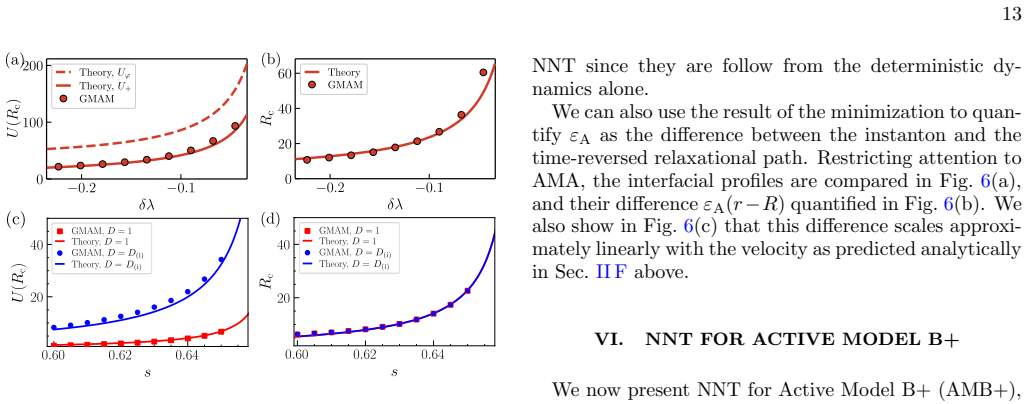
- Fig. 2(f): The barrier heights U(R_c) and U_φ(R_c) are plotted but the axes labels and parameter values (δλ range) could be stated more clearly in the caption.
- Sec. IV, Eq. (65): The modulus signs in D^(i)(ϕ) = |ϕ(1-ϕ)| + D_0 are noted as redundant given the dynamics, but the paper states they ensure positivity. A brief clarification that D_0 > 0 is required for well-posedness (not just for nucleation) would help.
- Sec. V, Fig. 4 caption: The parameter D_0 = 10^{-2} is stated in the caption but D_0 = 10^{-3} is used in Fig. 3. This inconsistency should be clarified or corrected.
- Reference [60] (the companion article) is cited frequently but listed as arXiv:2606.18911. Since both papers appear to be submitted simultaneously, the authors should ensure cross-references are consistent upon publication.
Simulated Author's Rebuttal
We thank the referee for a careful and constructive report. Both major comments identify legitimate limitations that we will address in the revised manuscript. The first concerns the circularity inherent in imposing radial symmetry in both the analytical theory and the numerical validation; we agree this is an important caveat and will discuss it explicitly, including the feasibility of unconstrained 2D action minimization. The second concerns the parameter range over which the self-consistency argument in Sec. IIF holds; we will add a discussion of the expected regime of validity and potential breakdown mechanisms. Neither comment requires changes to our central results, but both warrant transparent discussion that is currently missing from the manuscript.
read point-by-point responses
-
Referee: Sec. V: The numerical validation via gMAM explicitly imposes radial symmetry, so the agreement between NNT predictions and numerical results is not a fully independent test since both theory and numerics share the radial-symmetry constraint. The capillary wave analysis shows positive interfacial tension but does not rule out qualitatively different non-radial instanton configurations with lower action. The authors should discuss this limitation and state whether unconstrained full 2D action minimization is feasible.
Authors: The referee is correct that our numerical validation does not constitute a fully independent test of the radial symmetry assumption, since both the analytical theory and the gMAM computation impose it. We agree this limitation should be stated explicitly. In the revised manuscript, we will add a discussion in Sec. V making the following points. First, the capillary wave analysis (Secs. IIIF, IVB) demonstrates positive interfacial tension in the examples studied, which addresses stability to small transverse perturbations but, as the referee notes, does not rule out non-radial instanton configurations with lower action. Second, in equilibrium nucleation theory, the spherical droplet assumption is justified not only by capillary wave stability but also by the fact that the critical nucleus is a saddle point of the free energy functional, and non-spherical saddles are known to have higher action in the large-Rc limit. Our NNT framework inherits the large-Rc perturbative structure from CNT, so the same physical reasoning applies, but we have not proven this rigorously for the nonequilibrium case. Third, regarding feasibility of unconstrained 2D action minimization: this is in principle possible using gMAM on a 2D spatial grid without imposing radial symmetry, and we will state this. However, the computational cost is substantially higher (the number of degrees of freedom scales as Nr^2 * N_ell rather than Nr * N_ell), and the radial discretization used in our current implementation would need to be replaced by a full 2D mesh. We will note that such a computation would provide a stronger test and is a natural direction for future work, while clarifying that the agreement we do observe is consistent with — though not a proof of — the validity of the radial assumption. We will revision: yes
-
Referee: Sec. IIF, Eqs. (26)-(30): The self-consistency argument showing epsilon_A ~ O(v_0) and that neglected terms are subleading is verified numerically only for specific AMA parameters (Fig. 6, with h=0.2, lambda=-1.0333). The argument relies on the scaling R_dot ~ O(1/R, v_0) and R_ddot ~ O(R_dot/R^2) for instanton paths. The paper would benefit from a brief discussion of the parameter range over which this self-consistency is expected to hold, and where it might break down.
Authors: The referee correctly points out that our self-consistency argument is verified numerically only for specific AMA parameters and that the manuscript lacks a discussion of the parameter regime where the scaling assumptions hold. We will add such a discussion in Sec. IIF. The self-consistency argument relies on two key assumptions: (1) that the instanton path satisfies R_dot ~ O(1/R, v_0) and R_ddot ~ O(R_dot/R^2), which is standard for CNT-like regimes where the critical radius is large and the instanton traverses the quasipotential barrier slowly, and (2) that epsilon_A remains small, specifically O(v_0). Both assumptions are expected to hold when v_0 is small (equivalently, when Rc is large), which is the regime where the perturbative expansion in 1/R is controlled. The numerical verification in Fig. 6 confirms this for AMA with h=0.2 and lambda near lambda*(h), where v_0 is indeed small. We expect the same scaling to hold throughout the near-equilibrium perturbative regime (small h, small lambda) and more generally whenever |delta_lambda| is small enough that Rc >> interfacial width. Potential breakdown mechanisms include: (a) very small Rc, where the 1/R expansion is not controlled; (b) strong activity, where v_0 is not small and the instanton may deviate significantly from the relaxation path; and (c) cases where the capillary wave tension approaches zero or becomes negative, invalidating the spherical droplet assumption entirely. We will add a paragraph to Sec. IF stating these points and noting that a systematic numerical study of the breakdown regime is beyond the scope of the present work. revision: yes
Circularity Check
No significant circularity; derivations are self-contained with one non-load-bearing companion self-citation
full rationale
The paper presents two independent derivation routes for NNT: a stochastic projection (Sec. II D, attributed to companion [60]) and an action minimization route (Sec. II F, fully self-contained in this paper). The action route starts from the standard Freidlin-Wentzell action (Eq. 17) and independently arrives at Eqs. (14-16) by solving the variational equation (27), finding ϑ ∝ ψ' with ψ' ∈ Ker(L†) as a mathematical property of the linearized operator — not a fitted parameter or an assumption imported from [60]. The companion article [60] shares all four authors but is a short letter reporting results; the present paper re-derives everything via the action route without assuming [60]'s conclusions. The TRR ansatz results (Eqs. 22-24) are shown to differ from NNT results, constituting a genuine prediction rather than a renaming. The numerical gMAM validation (Sec. V) directly minimizes the discretized FW action (Eq. 76) without using the analytical formulas as input; the imposed radial symmetry is a shared structural assumption that limits the independence of the check (a correctness concern) but does not constitute circularity since the numerical computation does not assume the analytical result. Reference [29] for the conserved case is re-derived self-containedly in Sec. VI. The minor self-citation to [60] is non-load-bearing because the present paper's action route provides an independent derivation from first principles.
Assumptions & free parameters
free parameters (4)
- λ (activity parameter in AMA)
- h (external field in AMA)
- s (advantage parameter in population dynamics)
- D_0 (noise floor in population dynamics)
assumptions (4)
- domain assumption Large critical radius (small v_0) perturbative expansion in 1/R
- domain assumption Weak noise limit T → 0 (large deviation theory regime)
- domain assumption Radial symmetry of the instanton (spherical droplet)
- ad hoc to paper ψ' ∈ Ker(L†) makes ε subleading
Cite this review
Pith. "Pith review of Nucleation and time-reversal symmetry breaking in nonconserved scalar field theories." pith.science (2026). https://pith.science/paper/SCBB4IIF
@misc{pith2026260705194,
  author       = {Pith},
  title        = {Pith review of: Nucleation and time-reversal symmetry breaking in nonconserved scalar field theories},
  year         = {2026},
  howpublished = {\url{https://pith.science/paper/SCBB4IIF}},
  note         = {Machine review of arXiv:2607.05194}
}
read the original abstract
Classical nucleation theory (CNT) describes the formation of a stable phase from a metastable one in terms of a single reaction coordinate that corresponds to the radius of a nucleating droplet. In this work, we provide a full account of nonequilibrium nucleation theory (NNT), which generalizes CNT to non-equilibrium field theories with non-conserved order parameter. We present two equivalent derivations of the dynamics of the droplet radius: a stochastic route, based on a direct projection of the stochastic field equation onto the radial reaction coordinate, and a route based on the minimization of the Freidlin-Wentzell action. Crucially, the quasipotential barrier predicted by NNT differs from the one found when assuming the instanton to be the time-reversal of the relaxation dynamics. Whereas the interfacial density profile differs from that on the relaxation path, an analytical derivation of NNT remains possible using a careful definition of the reaction coordinate. This leverages the perturbative structure that (in common with CNT) emerges in the limit of large critical radius. We further derive with similar techniques the dynamics of capillary waves, whose stability is required for the CNT/NNT precept of a near-spherical droplet to prevail. After deriving our theory for generic non-conserved field-theories, we address two explicit examples: a non-equilibrium generalization of Model A (Active Model A), and a population dynamics model (with two choices of noise that each break time-reversal symmetry). In both cases, we validate our analytical NNT against numerical results obtained by action minimization, with excellent agreement. NNT provide a systematic framework for constructing nucleation theories in a broad class of non-equilibrium systems from active matter, reaction-diffusion systems and population dynamics.
Figures


Figures from the paper (3 more)

Reference graph
Works this paper leans on
-
[29]
S. F. Shimobayashi, P. Ronceray, D. W. Sanders, M. P. Haataja, and C. P. Brangwynne, Nucleation landscape of biomolecular condensates, Nature599, 503 (2021)
work page 2021
-
[1]
We now considerLwith (λ, h) = (λ ∗+δλ, h∗+δh) and |δλ|,|δh|small. As we haveL †ψ′ =L † λ∗,h∗ ψ′ +O(δλ, δh), we conclude that cφ′ 0e−2λ∗φ0/K +O(δλ, δh)∈Ker(L †).(39) Herecis a constant that cancels in the following and can thus be set to unity. The result (39) means that, to the order in small quantities required for our NNT calculation (and also for the d...
-
[2]
The corresponding equation for X(t) is given byφ ′′ 0 + ˙Xφ ′ 0 −λφ ′2 0 −∂ φ0 f(φ0) =h
We are first interested in obtaining a perturbative solution for the one-dimensional interfacial shapeφ 0(x−X(t)) in the absence of noise. The corresponding equation for X(t) is given byφ ′′ 0 + ˙Xφ ′ 0 −λφ ′2 0 −∂ φ0 f(φ0) =h. The boundary conditions areφ ′(∞) = 0 andφ(∞) =ϕ 1. We consider the perturbative solutionφ 0(x−X) = φ0,0 +λφ 0,1 +hφ 0,2 +O(λ 2, ...
-
[3]
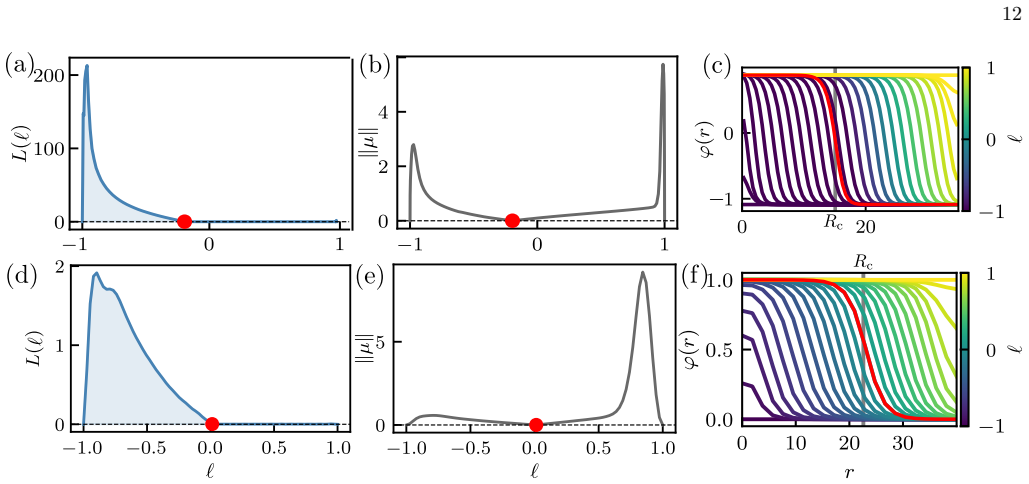
At leading order inλandhthe per- turbative solution ofφ 0(x) is found as φ0(x) =−tanh x√ 2 − h 2 tanh2 x√ 2 +λ 2 ln 1+exp(x √ 2) 2 −x √ 2 10 sech2 x√ 2 .(50) Having found the interface profile and the drift veloci- ties perturbatively forλ, h≪1, we can obtain the quasi- potential in this limit. In particular, using Eq. (16), the critical radius (gray line...
-
[4]
J. S. Langer, Theory of the condensation point, Ann. Phys.41, 108 (1967)
work page 1967
-
[5]
A. J. Bray, Theory of phase-ordering kinetics, Adv. Phys. 51, 481 (1994)
work page 1994
-
[6]
P. C. Hohenberg and B. I. Halperin, Theory of dynamic critical phenomena, Rev. Mod. Phys.49, 435 (1977)
work page 1977
-
[7]
I. S. Aranson and L. Kramer, The world of the com- plex ginzburg-landau equation, Rev. Mod. Phys.74, 99 (2002)
work page 2002
Show all 89 references
-
[8]
J. W. Cahn and J. E. Hilliard, Free Energy of a Nonuni- form System. I. Interfacial Free Energy, J. Chem. Phys. 28, 258 (1958)
1958
-
[9]
S. M. Allen and J. W. Cahn, A microscopic theory for an- tiphase boundary motion and its application to antiphase domain coarsening, Acta Metall.27, 1085 (1979)
1979
-
[10]
Onuki,Phase transition dynamics(Cambridge Uni- versity Press, 2002)
A. Onuki,Phase transition dynamics(Cambridge Uni- versity Press, 2002)
2002
-
[11]
Ishibashi and Y
Y. Ishibashi and Y. Takagi, Note on Ferroelectric Domain Switching, J. Phys. Soc. Jpn.31, 506 (1971)
1971
-
[12]
P. A. Rikvold, H. Tomita, S. Miyashita, and S. W. Sides, Metastable lifetimes in a kinetic Ising model: Depen- dence on field and system size, Phys. Rev. E49, 5080 (1994)
1994
-
[13]
P. G. Vekilov, Nucleation, Cryst. Growth Des.10, 5007 (2010)
2010
-
[14]
Hinrichsen, Non-equilibrium critical phenomena and phase transitions into absorbing states, Adv
H. Hinrichsen, Non-equilibrium critical phenomena and phase transitions into absorbing states, Adv. Phys. (2000)
2000
-
[15]
Elgart and A
V. Elgart and A. Kamenev, Rare event statistics in reaction-diffusion systems, Phys. Rev. E70, 041106 (2004)
2004
-
[16]
Halatek and E
J. Halatek and E. Frey, Rethinking pattern formation in reaction–diffusion systems, Nat. Phys.14, 507 (2018)
2018
-
[17]
E. R. Heller and D. T. Limmer, Pattern stability in reaction-diffusion systems depends on path entropy (2026), arXiv:2603.11192 [cond-mat]
2026
-
[18]
J. L. Cardy and U. C. T¨ auber, Field Theory of Branching and Annihilating Random Walks, J. Stat. Phys.90, 1 (1998)
1998
-
[19]
Bastiaansen, O
R. Bastiaansen, O. Ja¨ ıbi, V. Deblauwe, M. B. Eppinga, K. Siteur, E. Siero, S. Mermoz, A. Bouvet, A. Doelman, and M. Rietkerk, Multistability of model and real dryland ecosystems through spatial self-organization, Proc. Natl. Acad. Sci. U.S.A.115, 11256 (2018)
2018
-
[20]
Korniss and T
G. Korniss and T. Caraco, Spatial dynamics of invasion: the geometry of introduced species, J. Theor. Biol.233, 137 (2005)
2005
-
[21]
A. E. D. L. DeAngelis, Spatial Patterns and Persistence of Woody Plant Species in Ecological Communities, Am. Nat. (2001)
2001
-
[22]
Gandhi, S
A. Gandhi, S. Levin, and S. Orszag, Nucleation and Re- laxation from Meta-stability in Spatial Ecological Mod- els, J. Theor. Biol.200, 121 (1999)
1999
-
[23]
Tanaka, H
H. Tanaka, H. A. Stone, and D. R. Nelson, Spatial gene drives and pushed genetic waves, Proc. Natl. Acad. Sci. U.S.A.114, 8452 (2017)
2017
-
[24]
Giometto, D
A. Giometto, D. R. Nelson, and A. W. Murray, An- tagonism between killer yeast strains as an experi- mental model for biological nucleation dynamics, eLife 10.7554/eLife.62932 (2021)
2021 doi
-
[25]
Ouazan-Reboul, J
V. Ouazan-Reboul, J. Agudo-Canalejo, and R. Golesta- nian, Self-organization of primitive metabolic cycles due to non-reciprocal interactions, Nat. Commun.14, 4496 (2023)
2023
-
[26]
Schl¨ ogl, Chemical reaction models for non-equilibrium phase transitions, Z
F. Schl¨ ogl, Chemical reaction models for non-equilibrium phase transitions, Z. Physik253, 147 (1972)
1972
-
[27]
R. S. Cantrell and C. Cosner,Spatial Ecology via Reaction-Diffusion Equations, 1st ed. (Wiley, 2004)
2004
-
[28]
D. S. W. Lee, C.-H. Choi, D. W. Sanders, L. Beckers, J. A. Riback, C. P. Brangwynne, and N. S. Wingreen, Size distributions of intracellular condensates reflect com- petition between coalescence and nucleation, Nat. Phys. 19, 586 (2023)
2023
-
[30]
Shankar, S
S. Shankar, S. Ramaswamy, M. C. Marchetti, and M. J. Bowick, Defect unbinding in active nematics, Phys. Rev. Lett.121, 108002 (2018)
2018
-
[31]
Benvegnen, O
B. Benvegnen, O. Granek, S. Ro, R. Yaacoby, H. Chat´ e, Y. Kafri, D. Mukamel, A. Solon, and J. Tailleur, Metasta- bility of discrete-symmetry flocks, Phys. Rev. Lett.131, 218301 (2023)
2023
-
[32]
M. E. Cates and C. Nardini, Classical Nucleation Theory 17 for Active Fluid Phase Separation, Phys. Rev. Lett.130, 098203 (2023)
2023
-
[33]
M. I. Freidlin and A. D. Wentzell, Random Perturba- tions, inRandom Perturbations of Dynamical Systems (Springer, New York, NY, New York, NY, USA, 1998) pp. 15–43
1998
-
[34]
Touchette, The large deviation approach to statistical mechanics, Phys
H. Touchette, The large deviation approach to statistical mechanics, Phys. Rep.478, 1 (2009)
2009
-
[35]
Bouchet, K
F. Bouchet, K. Gawedzki, and C. Nardini, Perturbative Calculation of Quasi-Potential in Non-equilibrium Diffu- sions: A Mean-Field Example, J. Stat. Phys.163, 1157 (2016)
2016
-
[36]
Vanden-Eijnden and J
E. Vanden-Eijnden and J. Weare, Rare Event Simulation of Small Noise Diffusions, Commun. Pure Appl. Math. 65, 1770 (2012)
2012
-
[37]
Zakine and E
R. Zakine and E. Vanden-Eijnden, Minimum-action method for nonequilibrium phase transitions, Phys. Rev. X13, 041044 (2023)
2023
-
[38]
J. A. Bucklew and J. Bucklew,Introduction to rare event simulation, Vol. 5 (Springer, 2004)
2004
-
[39]
Giardin` a, J
C. Giardin` a, J. Kurchan, and L. Peliti, Direct evaluation of large-deviation functions, Phys. Rev. Lett.96, 120603 (2006)
2006
-
[40]
Lecomte and J
V. Lecomte and J. Tailleur, A numerical approach to large deviations in continuous time, J. Stat. Mech.: The- ory Exp.2007(03), P03004
2007
-
[41]
Vanden-Eijnden and M
E. Vanden-Eijnden and M. Heymann, The geometric minimum action method for computing minimum energy paths, J. Chem. Phys.128, 061103 (2008)
2008
-
[42]
Grafke, R
T. Grafke, R. Grauer, and T. Sch¨ afer, The instanton method and its numerical implementation in fluid me- chanics, J. Phys. A: Math. Theor.48, 333001 (2015)
2015
-
[44]
Nemoto and S.-i
T. Nemoto and S.-i. Sasa, Computation of large devi- ation statistics via iterative measurement-and-feedback procedure, Phys. Rev. Lett.112, 090602 (2014)
2014
-
[45]
Ferr´ e and H
G. Ferr´ e and H. Touchette, Adaptive Sampling of Large Deviations, J. Stat. Phys.172, 1525 (2018)
2018
-
[46]
J. Yan, H. Touchette, and G. M. Rotskoff, Learning nonequilibrium control forces to characterize dynamical phase transitions, Phys. Rev. E105, 024115 (2022)
2022
-
[47]
E. R. Heller and D. T. Limmer, Evaluation of transition rates from nonequilibrium instantons, Phys. Rev. Res.6, 043110 (2024)
2024
-
[48]
Simonnet, Computing non-equilibrium trajectories by a deep learning approach, J
E. Simonnet, Computing non-equilibrium trajectories by a deep learning approach, J. Comput. Phys.491, 112349 (2023)
2023
-
[49]
Zakine, E
R. Zakine, E. Simonnet, and E. Vanden-Eijnden, Unveil- ing the phase diagram and reaction paths of the active model b with the deep minimum action method, Phys. Rev. Lett.133, 038301 (2024)
2024
-
[50]
D. W. Oxtoby, Homogeneous nucleation: theory and ex- periment, J. Phys. Condens. Matter4, 7627 (1992)
1992
-
[51]
P. G. Debenedetti,Metastable Liquids : Concepts and Principles, Physical Chemistry: Science and Engineering (Princeton University Press, New Jersey :, 2020)
2020
-
[52]
Karthika, T
S. Karthika, T. K. Radhakrishnan, and P. Kalaichelvi, A Review of Classical and Nonclassical Nucleation The- ories, Cryst. Growth Des.16, 6663 (2016)
2016
-
[53]
Note that in the LDT limit ofT→0, the Itˆ o and Stratanovich interpretations of (1) coincide, despite the presence of multiplicative noise
-
[54]
H¨ anggi, P
P. H¨ anggi, P. Talkner, and M. Borkovec, Reaction-rate theory: fifty years after Kramers, Rev. Mod. Phys.62, 251 (1990)
1990
-
[55]
J. F. Lutsko, A dynamical theory of nucleation for col- loids and macromolecules, J. Chem. Phys.136, 034509 (2012)
2012
-
[56]
Richard, H
D. Richard, H. L¨ owen, and T. Speck, Nucleation pathway and kinetics of phase-separating active Brownian parti- cles, Soft Matter12, 5257 (2016)
2016
-
[57]
G. S. Redner, C. G. Wagner, A. Baskaran, and M. F. Hagan, Classical nucleation theory description of active colloid assembly, Phys. Rev. Lett.117, 148002 (2016)
2016
-
[58]
Levis, J
D. Levis, J. Codina, and I. Pagonabarraga, Active Brow- nian equation of state: metastability and phase coexis- tence, Soft Matter13, 8113 (2017)
2017
-
[59]
Cho and W
Y. Cho and W. M. Jacobs, Tuning nucleation kinetics via nonequilibrium chemical reactions, Phys. Rev. Lett. 130, 128203 (2023)
2023
-
[60]
T. K. Michaels, M. B. Eppinga, and J. D. Bever, A nucle- ation framework for transition between alternate states: Short-circuiting barriers to ecosystem recovery, Ecology 101, e03099 (2020)
2020
-
[61]
Ziethen and D
N. Ziethen and D. Zwicker, Heterogeneous nucleation and growth of sessile chemically active droplets, J. Chem. Phys.160, 10.1063/5.0207761 (2024)
2024 doi
-
[62]
Ziethen, J
N. Ziethen, J. Kirschbaum, and D. Zwicker, Nucleation of chemically active droplets, Phys. Rev. Lett.130, 248201 (2023)
2023
- [63]
-
[64]
Notice, however, that the term non-classical nucleation theory was widely employed in equilibrium systems to denote cases where the system visits states correspond- ing to non-spherical liquid droplets along the nucleation dynamics
-
[65]
Kuramoto, Instability and Turbulence of Wavefronts in Reaction-Diffusion Systems, Prog
Y. Kuramoto, Instability and Turbulence of Wavefronts in Reaction-Diffusion Systems, Prog. Theor. Phys.63, 1885 (1980)
1980
-
[66]
Kawasaki and T
K. Kawasaki and T. Ohta, Kinetic Drumhead Model of Interface. I, Prog. Theor. Phys.67, 147 (1982)
1982
-
[67]
Kawasaki and T
K. Kawasaki and T. Ohta, Kinetic Drumhead Models of Interface. II, Prog. Theor. Phys.68, 129 (1982)
1982
-
[68]
Bausch, V
R. Bausch, V. Dohm, H. K. Janssen, and R. K. P. Zia, Effects of bulk diffusion on interfacial dynamics, Z. Phys. B: Condens. Matter82, 121 (1991)
1991
-
[69]
Caballero and M
F. Caballero and M. E. Cates, Stealth entropy production in active field theories near ising critical points, Phys. Rev. Lett.124, 240604 (2020)
2020
-
[70]
Fausti, E
G. Fausti, E. Tjhung, M. E. Cates, and C. Nardini, Cap- illary interfacial tension in active phase separation, Phys. Rev. Lett.127, 068001 (2021)
2021
-
[71]
M. E. Cates and C. Nardini, Active phase separation: new phenomenology from non-equilibrium physics, Rep. Prog. Phys.88, 056601 (2025)
2025
- [72]
-
[73]
Besse, G
M. Besse, G. Fausti, M. E. Cates, B. Delamotte, and C. Nardini, Interface roughening in nonequilibrium phase-separated systems, Phys. Rev. Lett.130, 187102 (2023)
2023
-
[74]
Caballero, A
F. Caballero, A. Maitra, and C. Nardini, Interface dy- 18 namics of wet active systems, Phys. Rev. Lett.134, 087105 (2025)
2025
-
[75]
Burekovi´ c, F
S. Burekovi´ c, F. De Luca, M. E. Cates, and C. Nardini, Active Cahn–Hilliard theory for non-equilibrium phase separation: quantitative macroscopic predictions and a microscopic derivation, arXiv 10.48550/arXiv.2601.16539 (2026), 2601.16539
2026 doi
-
[76]
Garc´ ıa-Ojalvo and J
J. Garc´ ıa-Ojalvo and J. Sancho,Noise in spatially ex- tended systems(Springer Science & Business Media, 2012)
2012
-
[77]
K. S. Korolev, M. Avlund, O. Hallatschek, and D. R. Nelson, Genetic demixing and evolution in linear step- ping stone models, Rev. Mod. Phys.82, 1691 (2010)
2010
-
[78]
Alternatively this contribution toDcan be viewed as arising from additional, equiprobable random processes AB→AA and AB→BB
-
[79]
Sch¨ uttler, R
J. Sch¨ uttler, R. L. Jack, and M. E. Cates, Effects of phase separation on extinction times in population models, J. Stat. Mech.: Theory Exp.2024(8), 083209
2024
-
[80]
Kikuchi, R
L. Kikuchi, R. Singh, M. E. Cates, and R. Adhikari, Ritz method for transition paths and quasipotentials of rare diffusive events, Phys. Rev. Res.2, 033208 (2020)
2020
-
[81]
Grafke and E
T. Grafke and E. Vanden-Eijnden, Numerical computa- tion of rare events via large deviation theory, Chaos29, 10.1063/1.5084025 (2019)
2019 doi
-
[82]
C. Zhu, R. H. Byrd, P. Lu, and J. Nocedal, Algorithm 778: L-bfgs-b: Fortran subroutines for large-scale bound- constrained optimization, ACM Trans. Math. Softw.23, 550–560 (1997)
1997
-
[83]
P. K. Mogensen and A. N. Riseth, Optim: A mathemati- cal optimization package for Julia, J. Open Source Softw. 3, 615 (2018)
2018
-
[84]
Bezanson, A
J. Bezanson, A. Edelman, S. Karpinski, and V. B. Shah, Julia: A fresh approach to numerical computing, SIAM Rev.59, 65 (2017)
2017
-
[85]
Tjhung, C
E. Tjhung, C. Nardini, and M. E. Cates, Cluster phases and bubbly phase separation in active fluids: Reversal of the ostwald process, Phys. Rev. X8, 031080 (2018)
2018
-
[86]
Cavagna, J
A. Cavagna, J. Crist´ ın, I. Giardina, and M. Veca, From noise on the sites to noise on the links: Discretizing the conserved Kardar-Parisi-Zhang equation in real space, Phys. Rev. E109, 064136 (2024)
2024
-
[87]
Y. I. Li and M. E. Cates, Non-equilibrium phase separa- tion with reactions: A canonical model and its behaviour, J. Stat. Mech.: Theory Exp.2020(5), 053206
2020
-
[88]
C. A. Weber, D. Zwicker, F. J¨ ulicher, and C. F. Lee, Physics of active emulsions, Rep. Prog. Phys.82, 064601 (2019)
2019
- [89]
-
[90]
Andreghetti, A
D. Andreghetti, A. Braunstein, L. Dall’Asta, and A. Gamba, Enzyme-driven phase separation, arXiv 10.48550/arXiv.2512.08356 (2025)
2025 doi
Reviewed July 7, 2026 · model on record in the stance chip above.
Discussion (0). Sign in to comment.