REVIEW 4 major objections 4 minor 7 references
Comment on "On the bound states of the Schwarzschild black hole" by S. H. V\"olkel: A Reassessment of the Bound-State Analogy
T0 review · 4 major / 4 minor · reviewed 2026-08-07 · deepseek-v4-flash
Pith's one-line read Inverted-potential bound states cannot reproduce black hole quasinormal modes.
desk verdict A useful, partially persuasive comment on Völkel's bound-state/QNM analogy that never quite lands its central punch because it never quotes the target's equations or rules out a Mashhoon-style analytic continuation. read the letter →
The pith
A machine-rendered reading of the paper's core claim, the machinery that carries it, and where it could break.
The reading
What carries the argument
The load-bearing object is the inverted Regge–Wheeler potential: the effective barrier for Schwarzschild perturbations, flipped in sign so that a single peak becomes a well. What the argument hangs on is the boundary-condition change that comes with the inversion: radiative conditions (ingoing at the horizon, outgoing at infinity) are replaced by square-integrability at both ends. That change converts a non-Hermitian resonance problem with complex eigenfrequencies into a Hermitian eigenvalue problem with real eigenvalues, and because no operator similarity or spectral equivalence is established, any real “energy” from the well is unrelated to any quasinormal frequency. The figure-by-figure analysis of the target paper is organized around showing that each apparent quasinormal-mode feature—delocalization at high $n$, the ground-state “fundamental mode,” bump sensitivity, hydrogenic spacing—is a generic property of this artificial Hermitian problem rather than evidence about black hole resonances.
What would settle it
Compute the bound-state eigenvalues of the inverted Regge–Wheeler potential after applying the required analytic continuation $x \to -ix$ and compare them to the known complex quasinormal frequencies, e.g. $\omega_0 \approx 0.3737 - 0.08896i$ for $\ell = 2$ in units $2M = 1$. If the continued eigenvalues reproduce the complex spectrum, or even its real parts for all $n$, the paper's central claim of no isospectrality is false. The critique would equally be falsified if inspecting the target paper's equations revealed that it never claimed real eigenvalues correspond to quasinormal frequencies.
Extended reading notes
Core claim
The core claim is that there is no isospectrality between the operator governing Schwarzschild quasinormal modes and the operator obtained by flipping the Regge–Wheeler potential in sign. In the physical problem, quasinormal modes are complex poles of the Green's function selected by radiative boundary conditions; in the inverted problem, one solves a Hermitian wave equation with square-integrable wavefunctions and real eigenvalues. The boundary-condition substitution is not a harmless coordinate change: it removes the horizon's causal structure and replaces outgoing radiation with confinement, so the two spectra are not related by any known transformation. The paper then uses this distinction to reinterpret the proposal's numerical figures: the delocalized high-$n$ eigenfunctions, the identification of a ground state with the fundamental mode, the response to a localized bump, and a hydrogen-like level spacing are all artifacts of the artificial bound-state problem rather than features of true quasinormal modes. Quantitative comparison with established continued-fraction and asymptotic quasinormal-mode results shows severe disagreement for $n \geq 2$, and the paper concludes that the bound-state framework provides no reliable insight into black hole spectroscopy.
Load-bearing premise
The whole critique assumes that the target paper reads off real bound-state energies and compares them directly to quasinormal-mode frequencies without the complex-coordinate continuation that the inversion method requires; if that continuation was actually applied, the central charge would miss the target.
Editorial extensions
If this is right
- If the critique stands, the inverted-potential route to Schwarzschild quasinormal modes should be treated as a toy model for exactly solvable symmetric wells, not as a spectral reconstruction method.
- High-overtone quasinormal modes remain rapidly damped and horizon-dominated, with imaginary parts growing linearly in $n$; the delocalization seen in inverted eigenfunctions does not transfer to the physical spacetime.
- Spectral instability of black hole quasinormal modes has to be studied through the pseudospectrum of the non-normal wave operator, not through local bump deformations of a Hermitian well.
- Any future bound-state analogy must supply a quantitative match to complex benchmark frequencies (for example, the $\ell = 2$ fundamental value) before it can claim physical relevance.
Reading between the lines
- A decisive test of the critique is to check whether the target paper actually applied the complex-coordinate continuation ($x \to -ix$ plus a rotation of potential parameters) that the inversion method requires; if it did and still produced real energies, the critique is fully on target, whereas if it produced complex frequencies, the main objection would miss.
- The comment does not quote the target paper's equations to confirm that no such continuation was performed, so a fair reading should treat that interpretive step as an assumption rather than an established fact.
- The same boundary-condition distinction could be used to test other recent attempts to map black hole resonances onto bound states: the criterion is whether the complex spectrum, including damping, survives the mapping.
- One broader lesson is that visual or formal analogies between quantum wells and black hole potentials need quantitative spectral comparison before they can support physical conclusions.
Editorial analysis
A structured set of objections, weighed in public.
Referee Report
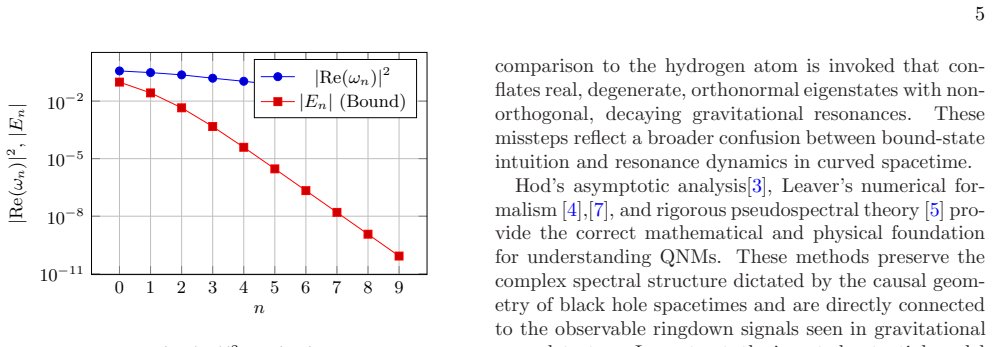
Summary. This comment critiques a recent paper by Völkel (arXiv:2505.17186) that proposes to reconstruct the quasinormal mode (QNM) spectrum of a Schwarzschild black hole from the bound states of an inverted Regge–Wheeler potential. The comment argues that Völkel's approach replaces the non-Hermitian resonance problem, defined by purely ingoing/outgoing boundary conditions and complex eigenfrequencies, with a Hermitian bound-state problem with real, square-integrable eigenfunctions. It further claims that the inverted potential is not isospectral to the QNM problem, that the delocalization of high-overtone eigenfunctions is an artifact, that the ground-state analogy with the fundamental QNM is a category error, that bump-perturbation stability tests miss the pseudospectral nature of QNM instability, and that a hydrogen-like spectrum analogy is misleading. The comment provides one figure comparing the squared real parts of known ℓ=2 Schwarzschild QNM frequencies with the bound-state energies E_n reported by Völkel, claiming severe disagreement for n ≥ 2.
Significance. If its central claim is correct, the comment would identify a fundamental flaw in a recent Physical Review Letter and would serve as a useful caution against using bound-state analogies for black hole spectroscopy. The comment correctly states several basic facts: QNMs are complex, non-normalizable resonances defined by radiative boundary conditions, whereas bound states of a naive inverted potential are real, square-integrable eigenstates. It also appropriately cites Leaver's continued fraction method, Hod's asymptotic analysis, and pseudospectral theory as benchmarks. However, the comment's significance is undermined because its main conclusion rests on an unverified reading of Völkel's method and includes categorical mathematical claims that are not established and are in fact false in general. The comment does not quote Völkel's equations or show that Völkel omits the required analytic continuation, so its central critique may miss the target. Its quantitative figure relies on an unjustified comparison, and its discussion of QNM localization is not backed by direct numerical or analytic evidence.
major comments (4)
- [Main text, paragraph beginning 'The key issue is that there exists no rigorous justification...'] The central premise—that Völkel's E_n are real eigenvalues of the inverted potential without any further analytic continuation—is never established. The comment does not quote Völkel's eigenvalue equation, his boundary conditions, or his stated mapping between E_n and the QNM frequency ω_n. If Völkel implements the full Mashhoon continuation x → -ix together with a rotation of the potential parameter, then the eigenvalues are not the real Hermitian bound-state energies the comment assumes, and the comparison in Figure 1 becomes irrelevant. The comment should reproduce Völkel's equations to demonstrate that no such continuation is present, or explicitly target that continuation step as the point of failure.
- [Main text, paragraph beginning 'In the physical case of Schwarzschild black holes...'] The categorical claim that 'there is no isospectrality between the two operators, nor is there a known transformation that preserves both the differential structure and the boundary conditions simultaneously' is incorrect in general. Complex scaling—a formal coordinate transformation x → x e^{iθ}—is a well-established method that maps resonance boundary conditions to square-integrability and yields complex eigenvalues of a non-Hermitian complex-scaled operator; it has been applied to black hole QNMs. The comment itself invokes 'complex scaling techniques' in the Figure 4 discussion, so the blanket denial of any such transformation is internally inconsistent. To support the comment's conclusion, the authors need a proof that the Regge–Wheeler potential specifically is not amenable to such a mapping.
- [Figure 1 and the paragraph beginning 'To support these points quantitatively...'] The quantitative evidence in Figure 1 is not a controlled test of Völkel's method. The plot compares |E_n| with |Re(ω_n)|², but under the natural inverted-potential correspondence -ψ'' + V_inv ψ = E ψ versus the QNM equation -ψ'' + V ψ = ω² ψ, the direct relation would be E = -ω², not |E_n| = |Re(ω_n)|². The comment never states Völkel's identification of E_n with a function of ω_n, so the observed disagreement cannot be interpreted as a failure of the bound-state method. The authors should adopt Völkel's own mapping and compare the appropriate quantities (e.g., complex ω_n = ±√(-E_n) after any required continuation).
- [Discussion of Figure 2, paragraph beginning 'The delocalization seen in Figure 2...'] The assertion that high-overtone QNMs are increasingly localized near the horizon and that Völkel's delocalized eigenfunctions are therefore 'artifacts' is stated without quantitative support. The comment does not compare Völkel's eigenfunctions with the QNM eigenfunctions (e.g., their probability densities or heights), nor does it provide a derivation of the near-horizon localization claim. This weakens the figure-by-figure case. If this point is to be part of the evidence against Völkel, it needs either an analytic argument or a direct numerical comparison.
minor comments (4)
- [Title] The title contains a typo: 'black ho le' should be 'black hole'.
- [Reference [2]] Reference [2] for Mashhoon's work lacks publication details (e.g., proceedings page numbers or DOI); a fuller citation would help readers locate the original proposal.
- [Figure 1 and its caption] The numerical values underlying Figure 1 are not tabulated; the authors should provide the specific E_n values from Völkel and the QNM frequencies used, together with their sources and units, so that the comparison is reproducible.
- [Main text, paragraph beginning 'Moreover, the intuition drawn from turning points...'] The statement 'The absence of a classically allowed region in the Regge–Wheeler potential' is confusing: the Regge–Wheeler potential is a barrier, so classically allowed regions exist for scattering states above the barrier; the authors likely mean the absence of bound-state classically allowed regions for real energies below the barrier.
Circularity Check
No circularity: the comment's critique rests on external Leaver/Hod benchmarks and adversarial use of Völkel's reported values, not on self-referential reasoning.
full rationale
This paper is a critical comment, not a derivation. Its central claim—that Völkel's bound-state method does not reproduce the complex QNM spectrum—is supported by citing independent external results: Leaver's continued-fraction method, Hod's asymptotic formula, Nollert's numerics, and pseudospectral theory. The only quantitative comparison uses Völkel's reported E_n values adversarially against known QNM frequencies, which is a falsification test rather than a circular fit. The comment does not fit parameters to its own conclusion, does not define QNMs in terms of bound-state energies, and contains no self-citations. The noted weakness—that the comment never quotes Völkel's equations or verifies whether a Mashhoon-style analytic continuation was already included—is a concern about interpretive accuracy and completeness, not about circularity. No step reduces to its own input by construction, and no prediction is merely a renamed fit. Therefore the appropriate circularity score is 0.
Assumptions & free parameters
assumptions (4)
- domain assumption QNMs are defined by purely ingoing waves at the horizon and purely outgoing waves at infinity, giving complex frequencies.
- standard math Bound states of the inverted Regge-Wheeler potential with square-integrable wavefunctions form a real, Hermitian spectrum.
- domain assumption Hod's asymptotic formula Re(omega_n) -> constant, Im(omega_n) ~ 2 pi n T_H captures the high-overtone QNM structure.
- domain assumption Leaver's continued fraction results are the gold-standard QNM values for Schwarzschild.
Cite this review
Pith. "Pith review of Comment on "On the bound states of the Schwarzschild black hole" by S. H. V\"olkel: A Reassessment of the Bound-State Analogy." pith.science (2026). https://pith.science/paper/SDWVEJXL
@misc{pith2026250521836,
  author       = {Pith},
  title        = {Pith review of: Comment on "On the bound states of the Schwarzschild black hole" by S. H. V\"olkel: A Reassessment of the Bound-State Analogy},
  year         = {2026},
  howpublished = {\url{https://pith.science/paper/SDWVEJXL}},
  note         = {Machine review of arXiv:2505.21836}
}
read the original abstract
This comment critically examines the recent proposal by S.~H.~V\"olkel [Phys. Rev. Lett., arXiv:2505.17186], which asserts that the quasinormal mode (QNM) spectrum of Schwarzschild black holes can be reconstructed from bound states of an inverted Regge--Wheeler potential. We demonstrate that this claim rests on a mathematically invalid spectral mapping and a misapplication of boundary conditions that define QNMs. Through a detailed figure-by-figure analysis, we expose deep inconsistencies in the numerical results and their physical interpretations. The inversion method, inspired by Mashhoon, is shown to fail in capturing the non-Hermitian, complex nature of black hole resonances. We contrast this with the rigorously established asymptotic structure of QNMs derived by Hod and others, concluding that the bound-state framework offers no reliable insight into black hole spectroscopy.
Figures
Reference graph
Works this paper leans on
-
[1]
S. H. V¨ olkel,Phys. Rev. Lett. , arXiv:2505.17186 [gr-qc]
-
[2]
Quasi-normal modes of a black hole,
B. Mashhoon, “Quasi-normal modes of a black hole,” in *Proceedings of the Third Marcel Grossmann Meeting*, pp. 599–608 (1983)
work page 1983
- [3]
-
[4]
An analytic representation for the quasi- normal modes of Kerr black holes,
E. W. Leaver, “An analytic representation for the quasi- normal modes of Kerr black holes,” Proc. Roy. Soc. Lond. A 402, 285–298 (1985)
work page 1985
-
[5]
J. L. Jaramillo et al., Phys. Rev. X 11, 031003 (2021)
work page 2021
-
[6]
H. P. Nollert, “Quasinormal modes of Schwarzschild black holes: The determination of quasinormal frequencies with very large imaginary parts,” Phys. Rev. D 47, 5253 (1993), doi:10.1103/PhysRevD.47.5253
-
[7]
Spectral decomposition of the perturbation response of the Schwarzschild geometry,
E. W. Leaver, “Spectral decomposition of the perturbation response of the Schwarzschild geometry,” Phys. Rev. D 34, 384–408 (1986)
work page 1986
Reviewed August 7, 2026 · model on record in the stance chip above.
Discussion (0). Sign in to comment.