A Reproducible Pipeline for Symmetry-Respecting Excited States on Near-Term Quantum Computers: The H2O/STO-3G Case
Pith reviewed 2026-06-29 03:58 UTC · model grok-4.3
The pith
The qEOM subspace method restores the H2O excited-state energy ladder to sub-milli-Hartree accuracy on 12 qubits while matrix-aware shot allocation reaches chemical accuracy at roughly 3 billion total shots.
A machine-rendered reading of the paper's core claim, the machinery that carries it, and where it could break.
Core claim
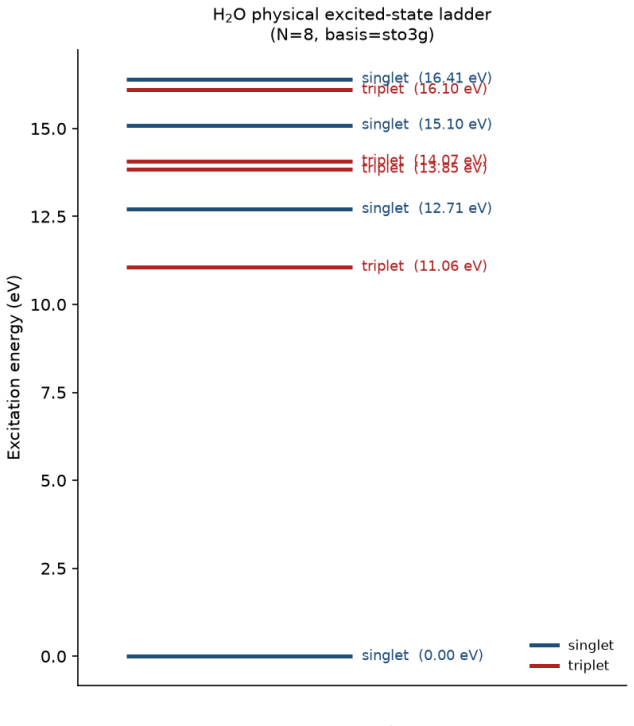
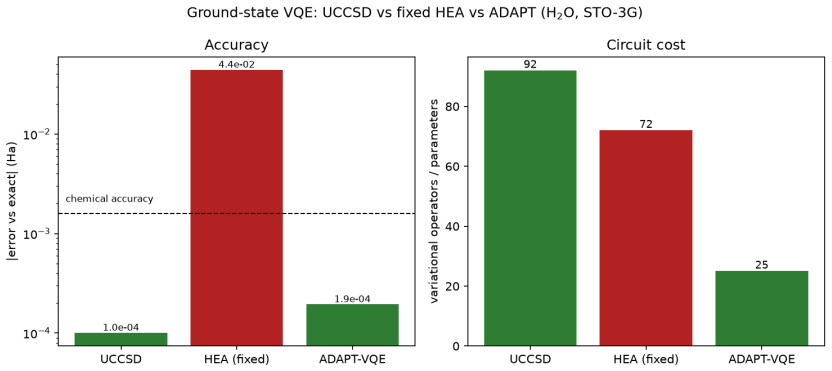
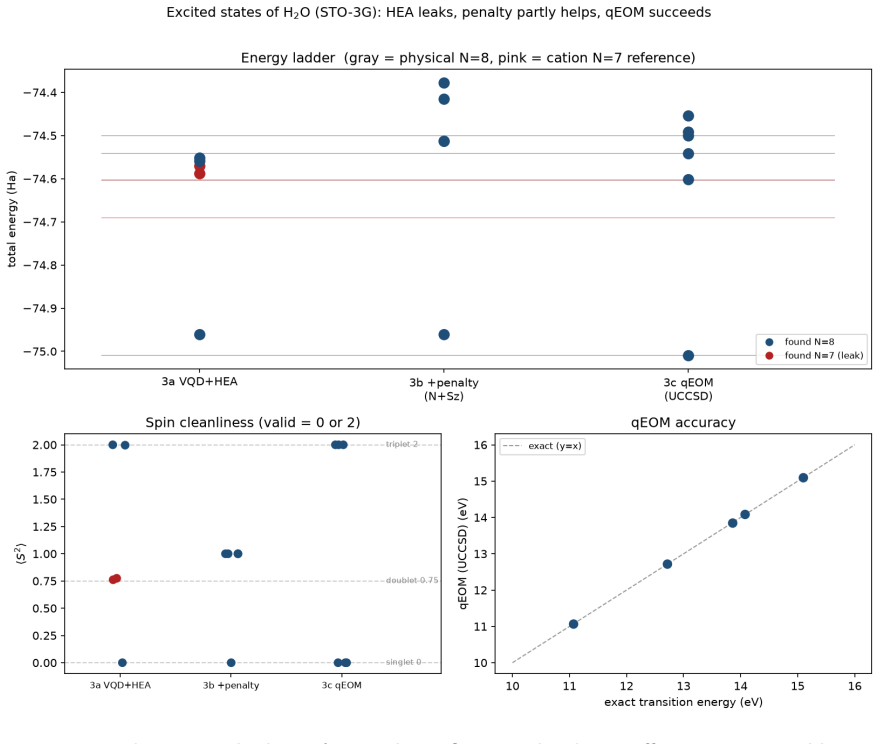
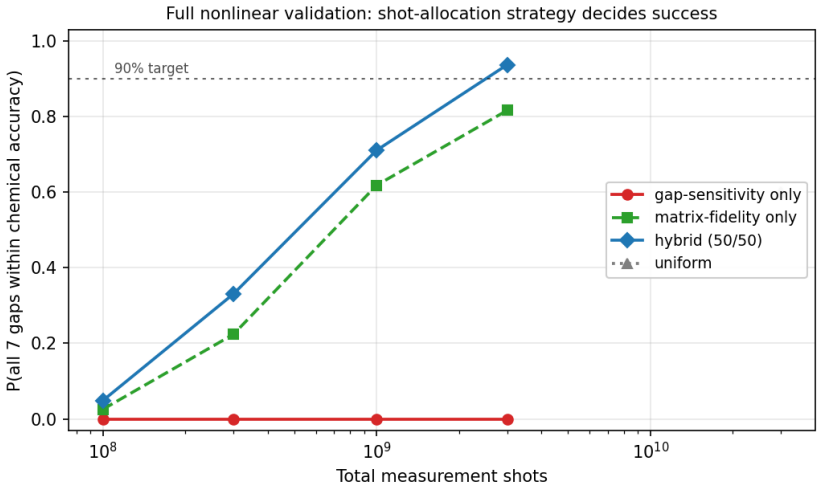
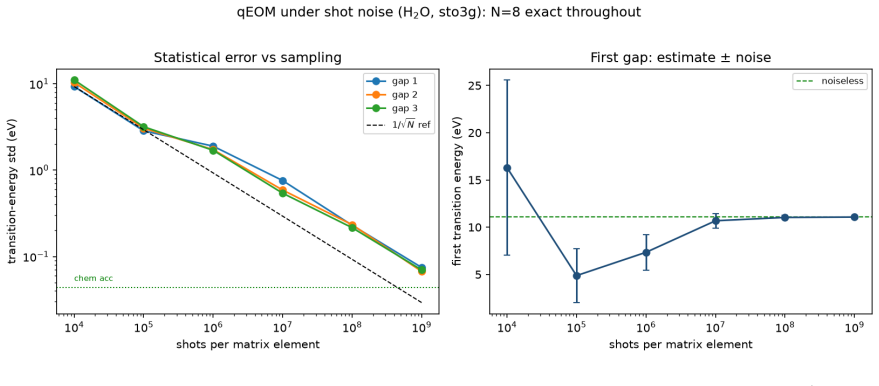
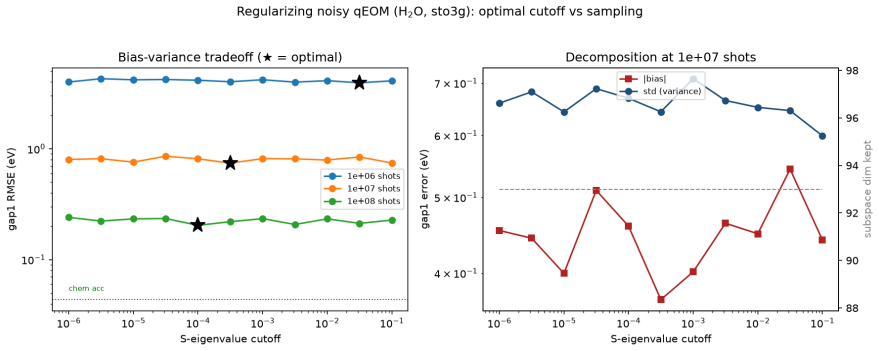
On the 12-qubit H2O/STO-3G system the bare qubit Hamiltonian interleaves cation states below the neutral manifold; hardware-efficient and number-conserving ansatze stall at the Hartree-Fock reference while ADAPT-VQE escapes; variational deflation inherits contamination and inverts the spectrum; the qEOM subspace method restores the energy ladder to sub-milli-Hartree accuracy; particle number is protected structurally under shot noise; a matrix-aware shot allocation collapses the subspace elements to approximately 10^5 commuting groups and reaches chemical accuracy at approximately 3 times 10^9 total shots.
What carries the argument
The quantum equation-of-motion (qEOM) subspace method, which builds a matrix of Hamiltonian and overlap elements between a reference state and a set of excitation operators to recover the excited-state spectrum without direct variational optimization of each state.
If this is right
- qEOM restores the correct ordering and spacing of neutral excited states to sub-milli-Hartree accuracy on this system.
- Particle number remains conserved under shot noise for the chosen number-conserving ansatze and Jordan-Wigner mapping.
- Matrix-aware allocation reduces the total shot budget from a naive per-element estimate to approximately 3 billion shots while still reaching chemical accuracy.
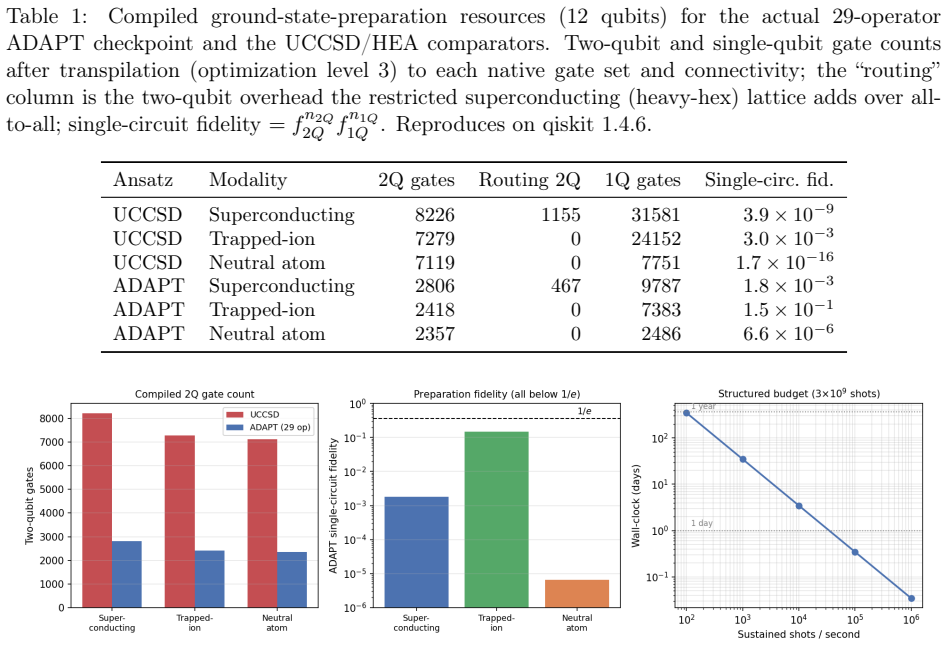
- Single-circuit gate fidelity, not measurement overhead, becomes the dominant remaining constraint once the shot budget is managed this way.
Where Pith is reading between the lines
- The same structural protection of particle number could be tested on other small molecules where the Jordan-Wigner mapping preserves the same symmetries.
- If the commuting-group count scales predictably with system size, the thousandfold reduction factor might extend to modestly larger active spaces.
- Releasing the full code, parameters, and figures turns the pipeline into a fixed benchmark that later hardware or algorithm papers can cite directly.
Load-bearing premise
The realistic model that collapses thousands of subspace matrix elements into roughly 100,000 commuting groups accurately reflects the noise and grouping constraints that would appear on actual hardware for this Jordan-Wigner mapped 12-qubit system.
What would settle it
Execute the released pipeline on current superconducting hardware for the same H2O/STO-3G instance and measure whether the qEOM energies deviate from exact diagonalization by more than one milli-Hartree once single-circuit gate fidelity is accounted for.
Figures
read the original abstract
Variational excited-state quantum algorithms fail for reasons usually studied in isolation: barren plateaus, symmetry contamination, finite-sampling instability, and hardware cost. Using one small but complete system -- H$_2$O in the STO-3G basis (12 qubits, Jordan--Wigner) -- we assemble these into a single reproducible pipeline, checking every claim against exact diagonalization. The bare qubit Hamiltonian interleaves cation ($N{=}7$) states below the neutral manifold; hardware-efficient and number-conserving ans\"atze stall at Hartree--Fock, an exact stationary point by Brillouin's theorem, while ADAPT-VQE escapes; variational deflation inherits the contamination and inverts the spectrum, whereas the quantum equation-of-motion (qEOM) subspace method restores the ladder to sub-milli-Hartree accuracy. Particle number is protected \emph{structurally} under shot noise, and a realistic measurement model collapses the thousands of subspace matrix elements to $\sim\!10^5$ commuting groups; a matrix-aware shot allocation then reaches chemical accuracy at $\sim\!3\times10^9$ total shots -- a thousandfold below the naive per-element estimate and reachable in days -- leaving single-circuit gate fidelity, not measurement, as the binding constraint. This work is a teaching and benchmarking reference, not a new method; all code, parameters, and figures are released.
Editorial analysis
A structured set of objections, weighed in public.
Referee Report
Summary. The manuscript assembles a complete, reproducible pipeline for symmetry-respecting excited states on near-term quantum hardware using the H2O/STO-3G system (12 qubits, Jordan-Wigner). It demonstrates that hardware-efficient and number-conserving ansatze stall at Hartree-Fock, variational deflation inverts the spectrum due to contamination, while the qEOM subspace method recovers the energy ladder to sub-milli-Hartree accuracy against exact diagonalization. A realistic measurement model reduces thousands of subspace matrix elements to ~10^5 commuting groups; matrix-aware shot allocation then achieves chemical accuracy at ~3e9 total shots (1000x below naive), with particle number protected structurally under shot noise. All code and parameters are released.
Significance. If the reported accuracies and shot counts hold under the stated measurement model, the work provides a valuable teaching and benchmarking reference by integrating barren-plateaus, symmetry, and sampling issues into one validated pipeline on an exactly solvable instance. Explicit strengths include direct comparison to full diagonalization (no fitted parameters), released code for reproducibility, and a concrete demonstration that measurement cost is no longer the binding constraint once grouping and allocation are applied.
minor comments (1)
- The abstract states that the bare qubit Hamiltonian interleaves cation states; a brief sentence in §2 or §3 clarifying how the neutral manifold is isolated in the qEOM subspace would aid readers replicating the pipeline.
Simulated Author's Rebuttal
We thank the referee for their positive summary, significance assessment, and recommendation to accept the manuscript. The report correctly identifies the work as a verified, reproducible pipeline integrating symmetry, sampling, and measurement issues on an exactly solvable instance, with all code released.
Circularity Check
No significant circularity detected
full rationale
The paper assembles a pipeline for excited states on H2O/STO-3G and explicitly validates every numerical claim (qEOM accuracy, shot counts, symmetry protection) against independent exact diagonalization on the same 12-qubit instance. No equation reduces a reported accuracy or shot count to a quantity defined by the authors' own fit or ansatz choice; the measurement grouping and particle-number protection are tested inside the same externally anchored scope. qEOM is invoked as a known method rather than self-defined, and the work positions itself as a benchmarking reference with released code, not a derivation whose central result is forced by internal construction.
Axiom & Free-Parameter Ledger
axioms (2)
- standard math Jordan-Wigner mapping converts the molecular Hamiltonian to a 12-qubit operator
- domain assumption Exact diagonalization supplies the ground-truth spectrum for verification
Reference graph
Works this paper leans on
-
[1]
Benjamin, and Xiao Yuan
Sam McArdle, Suguru Endo, Alán Aspuru-Guzik, Simon C. Benjamin, and Xiao Yuan. Quan- tum computational chemistry.Rev. Mod. Phys., 92:015003, 2020
2020
-
[2]
Love, Alán Aspuru-Guzik, and Jeremy L
Alberto Peruzzo, Jarrod McClean, Peter Shadbolt, Man-Hong Yung, Xiao-Qi Zhou, Peter J. Love, Alán Aspuru-Guzik, and Jeremy L. O’Brien. A variational eigenvalue solver on a photonic quantum processor.Nat. Commun., 5:4213, 2014
2014
-
[3]
McClean, Sergio Boixo, Vadim N
Jarrod R. McClean, Sergio Boixo, Vadim N. Smelyanskiy, Ryan Babbush, and Hartmut Neven. Barren plateaus in quantum neural network training landscapes.Nat. Commun., 9:4812, 2018
2018
-
[4]
Gard, Linghua Zhu, George S
Bryan T. Gard, Linghua Zhu, George S. Barron, Nicholas J. Mayhall, Sophia E. Economou, and Edwin Barnes. Efficient symmetry-preserving state preparation circuits for the variational quantum eigensolver algorithm.npj Quantum Inf., 6:10, 2020
2020
-
[5]
Generalized unitary coupled cluster excitations for multireference molecular states optimized by the variational quantum eigensolver.Int
Gabriel Greene-Diniz and David Muñoz Ramo. Generalized unitary coupled cluster excitations for multireference molecular states optimized by the variational quantum eigensolver.Int. J. Quantum Chem., 121:e26352, 2021
2021
-
[6]
Ollitrault, Abhinav Kandala, Chun-Fu Chen, Panagiotis Kl
Pauline J. Ollitrault, Abhinav Kandala, Chun-Fu Chen, Panagiotis Kl. Barkoutsos, Antonio Mezzacapo, Marco Pistoia, Sarah Sheldon, Stefan Woerner, Jay M. Gambetta, and Ivano Tavernelli. Quantum equation of motion for computing molecular excitation energies on a noisy quantum processor.Phys. Rev. Research, 2:043140, 2020
2020
-
[7]
Generalized Eigenvalue Problem in Subspace-Based Excited-State Methods for Quantum Com- puters.J
Prince Frederick Kwao, Srivathsan Poyyapakkam Sundar, Brajesh Gupt, and Ayush Asthana. Generalized Eigenvalue Problem in Subspace-Based Excited-State Methods for Quantum Com- puters.J. Chem. Theory Comput., 22:2892, 2026
2026
-
[8]
Gambetta, Antonio Mezzacapo, and Kristan Temme
Sergey Bravyi, Jay M. Gambetta, Antonio Mezzacapo, and Kristan Temme. Tapering off qubits to simulate fermionic Hamiltonians, 2017. arXiv:1701.08213. 14
Pith/arXiv arXiv 2017
-
[9]
Dub, Sophia E
Ayush Asthana, Ashutosh Kumar, Vibin Abraham, Harper Grimsley, Yu Zhang, Lukasz Cincio, Sergei Tretiak, Pavel A. Dub, Sophia E. Economou, Edwin Barnes, and Nicholas J. Mayhall. Quantum self-consistent equation-of-motion method for computing molecular excitation ener- gies, ionization potentials, and electron affinities on a quantum computer.Chem. Sci., 14...
2023
-
[10]
PySCF: the Python-based simulations of chemistry framework.WIREs Comput
Qiming Sun et al. PySCF: the Python-based simulations of chemistry framework.WIREs Comput. Mol. Sci., 8:e1340, 2018
2018
-
[11]
Anadaptive variational algorithm for exact molecular simulations on a quantum computer.Nat
HarperR.Grimsley, SophiaE.Economou, EdwinBarnes, andNicholasJ.Mayhall. Anadaptive variational algorithm for exact molecular simulations on a quantum computer.Nat. Commun., 10:3007, 2019
2019
-
[12]
Variational Quantum Computation of Excited States.Quantum, 3:156, 2019
Oscar Higgott, Daochen Wang, and Stephen Brierley. Variational Quantum Computation of Excited States.Quantum, 3:156, 2019
2019
-
[13]
Hybrid quantum-classical hierarchy for mitigation of decoherence and determination of excited states
JarrodR.McClean, MollieE.Kimchi-Schwartz, JonathanCarter, andWibeA.deJong. Hybrid quantum-classical hierarchy for mitigation of decoherence and determination of excited states. Phys. Rev. A, 95:042308, 2017
2017
-
[14]
Shot-Efficient ADAPT-VQE via Reused Pauli Mea- surements and Variance-Based Shot Allocation, 2025
Azhar Ikhtiarudin, Gagus Ketut Sunnardianto, Fadjar Fathurrahman, Mohammad Kemal Agusta, and Hermawan Kresno Dipojono. Shot-Efficient ADAPT-VQE via Reused Pauli Mea- surements and Variance-Based Shot Allocation, 2025. arXiv:2507.16879
arXiv 2025
-
[15]
Srivathsan Poyyapakkam Sundar, Prince Frederick Kwao, Alexey Galda, and Ayush Asthana. Molecular Excited States using Quantum Subspace Methods: Accuracy, Resource Reduction, and Error-Mitigated Hardware Implementation of q-sc-EOM, 2026. arXiv:2604.05380
Pith/arXiv arXiv 2026
-
[16]
Yu Chen and Michel Devoret. Our quantum hardware: the engine for verifiable quantum advan- tage (Willow processor).https://blog.google/innovation-and-ai/technology/research/ quantum-hardware-verifiable-advantage/, Oct 22, 2025. Google Research, accessed 2026- 04-23
2025
-
[17]
Anthony Ransford, M. S. Allman, Jake Arkinstall, et al. A 98-qubit trapped-ion quantum computer with all-to-all connectivity.Nature, 1476-4687, 2026. Published online: 17 Jun 2026, DOI:10.1038/s41586-026-10676-4
-
[18]
Simon J. Evered, Muqing Xu, Sophie H. Li, Alexandra A. Geim, J. Pablo Bonilla Ataides, Marcin Kalinowski, Dolev Bluvstein, Nishad Maskara, Christian Kokail, Markus Greiner, Vladan Vuletić, and Mikhail D. Lukin. High-fidelity entangling gates and nonlocal circuits with neutral atoms, 2026. URLhttps://arxiv.org/abs/2604.25987. arXiv:2604.25987. 15
Pith/arXiv arXiv 2026
discussion (0)
Sign in with ORCID, Apple, or X to comment. Anyone can read and Pith papers without signing in.