Target-Side Paraphrase Augmentation for Sign Language Translation with Large Language Models
Pith reviewed 2026-06-28 22:26 UTC · model grok-4.3
The pith
Using an LLM to generate paraphrases of target sentences improves BLEU-4 scores for sign language translation on the PHOENIX14T dataset.
A machine-rendered reading of the paper's core claim, the machinery that carries it, and where it could break.
Core claim
Pre-training a Signformer-style model on LLM-generated controlled paraphrase variants of the reference sentences, followed by fine-tuning on the original references, raises BLEU-4 from 9.56 to 10.33 on PHOENIX14T by helping the decoder move beyond memorizing single reference phrasings, with complementary LLM-as-a-Judge evaluation revealing semantic gains that lexical metrics understate.
What carries the argument
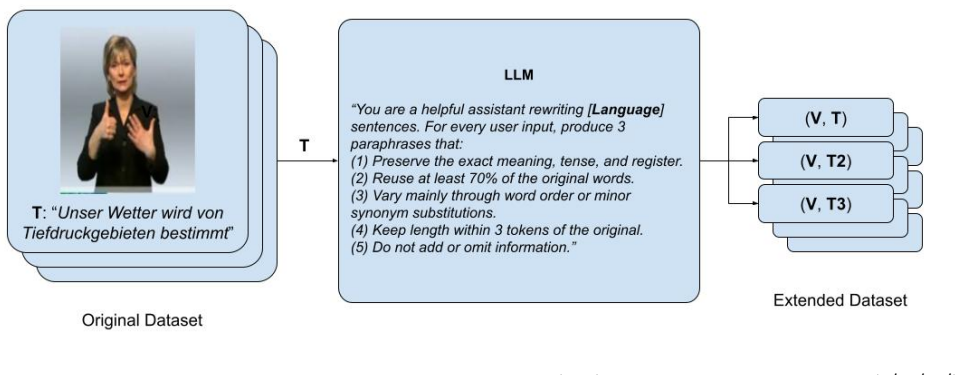
Target-side augmentation that keeps the sign input fixed while replacing each reference sentence with multiple LLM-generated semantically faithful paraphrase variants during a two-stage pre-training and fine-tuning schedule.
If this is right
- The decoder generalizes beyond memorized reference phrasing on datasets with moderate lexical diversity.
- Lexical overlap metrics alone are insufficient to capture the full performance picture in SLT.
- The approach shows limited benefit on near-saturated repetitive datasets and on extremely sparse large-vocabulary corpora.
- Semantic evaluation protocols become necessary to assess true fidelity gains.
Where Pith is reading between the lines
- The same target-side strategy could be tested on other low-resource spoken language translation tasks facing similar data scarcity.
- Dataset characteristics such as lexical diversity determine whether paraphrase augmentation yields measurable gains.
- The limits observed on repetitive and sparse datasets suggest the method works best as a complement to other data collection efforts.
Load-bearing premise
The paraphrases produced by GPT-4o are semantically faithful to the originals and supply a useful training signal that improves generalization instead of adding noise or bias.
What would settle it
Training the identical model architecture and schedule on PHOENIX14T without the paraphrase augmentation step and finding that the BLEU-4 score does not exceed 9.56.
Figures
read the original abstract
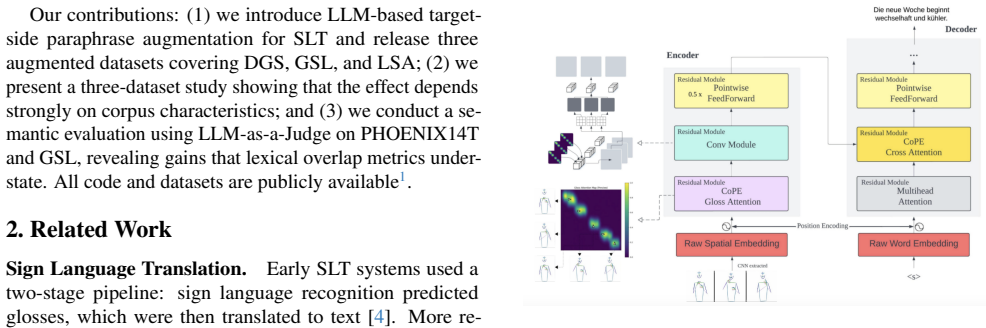
Sign language translation (SLT) remains constrained by the limited availability of paired sign-video/text corpora and by the heavy-tailed vocabularies typical of real-world datasets. We study a target-side augmentation strategy in which a large language model (LLM) generates controlled paraphrase variants of the reference spoken-language sentence while the sign input remains unchanged. Concretely, we use GPT-4o to produce semantically faithful variants of the training targets and train a Signformer-style pose-based Transformer under a two-stage schedule: pre-training on the augmented corpus followed by fine-tuning on the original references. We evaluate this strategy on three datasets that span complementary challenges: PHOENIX14T (German Sign Language), a real-world corpus with moderate lexical diversity; the Greek Sign Language Dataset with highly controlled, repetitive recordings; and LSA-T (Argentinian Sign Language), a naturalistic corpus with a large vocabulary and severe long-tail sparsity. This range allows us to characterize precisely when and why target-side augmentation is beneficial. On PHOENIX14T, augmentation improves BLEU-4 from 9.56 to 10.33, demonstrating that paraphrastic exposure helps the decoder generalize beyond memorized reference phrasing. The near-saturated GSL baseline and the extremely sparse LSA-T setting reveal the limits of the approach: in both cases, single-reference lexical overlap metrics are insufficient to capture the full picture, motivating a complementary semantic evaluation. To our knowledge, this is the first study to examine LLM-generated target-side paraphrases as an augmentation mechanism for SLT, and the first to apply an LLM-as-a-Judge evaluation protocol to SLT. This complementary evaluation reveals gains in semantic fidelity that lexical overlap metrics understate.
Editorial analysis
A structured set of objections, weighed in public.
Referee Report
Summary. The manuscript proposes target-side paraphrase augmentation for sign language translation: GPT-4o generates controlled, semantically faithful variants of reference spoken-language sentences while sign-video inputs remain fixed. A Signformer-style pose-based Transformer is trained under a two-stage schedule (pre-training on the augmented corpus, followed by fine-tuning on the original references). Experiments span PHOENIX14T (German SL), the Greek Sign Language Dataset, and LSA-T (Argentinian SL). The central empirical result is a BLEU-4 improvement from 9.56 to 10.33 on PHOENIX14T; the work also reports that single-reference lexical metrics are insufficient on the other two datasets and introduces an LLM-as-Judge semantic evaluation protocol. The authors position the study as the first to examine LLM-generated target-side paraphrases for SLT.
Significance. If the reported BLEU gain is reproducible and the generated paraphrases are shown to preserve meaning, the approach offers a practical route to mitigate data scarcity and heavy-tailed vocabularies in SLT by increasing target-side lexical diversity without modifying the visual input. The multi-dataset design and complementary semantic evaluation are strengths that help delineate when the method is beneficial versus when lexical-overlap metrics fail to capture gains.
major comments (2)
- [Abstract] Abstract: the central claim that the BLEU-4 gain (9.56 o 10.33) demonstrates improved decoder generalization via paraphrastic exposure rests on the unverified assertion that GPT-4o outputs are 'semantically faithful variants' and 'controlled paraphrase variants.' No supporting measurement—embedding cosine, NLI entailment rate, or human semantic-equivalence ratings—is reported for the actual training paraphrases, so it is impossible to rule out that the observed improvement arises from training on noisy or meaning-shifted targets rather than beneficial exposure.
- [Abstract] Abstract: the two-stage schedule (pre-training on augmented data, fine-tuning on originals) is presented without an ablation that isolates the contribution of each stage or of the augmentation itself; likewise, no statistical significance, error bars, or dataset-split details are supplied, making it impossible to assess whether the numeric gain is load-bearing evidence for the proposed mechanism.
minor comments (1)
- [Abstract] The abstract states that the three datasets 'span complementary challenges' but does not specify the exact train/dev/test splits or vocabulary statistics used for each, which would aid reproducibility.
Simulated Author's Rebuttal
We thank the referee for the constructive feedback. We address the two major comments below and will revise the manuscript accordingly to strengthen the empirical support for our claims.
read point-by-point responses
-
Referee: [Abstract] Abstract: the central claim that the BLEU-4 gain (9.56 o 10.33) demonstrates improved decoder generalization via paraphrastic exposure rests on the unverified assertion that GPT-4o outputs are 'semantically faithful variants' and 'controlled paraphrase variants.' No supporting measurement—embedding cosine, NLI entailment rate, or human semantic-equivalence ratings—is reported for the actual training paraphrases, so it is impossible to rule out that the observed improvement arises from training on noisy or meaning-shifted targets rather than beneficial exposure.
Authors: We agree that explicit verification of semantic faithfulness for the generated paraphrases is necessary to support the central claim. The revised manuscript will include quantitative measurements on the training paraphrases: sentence embedding cosine similarity (using a multilingual model) and NLI entailment rates between originals and GPT-4o outputs. These will be reported alongside the prompt templates used to enforce control and faithfulness. We will also note any cases where paraphrases were filtered for semantic drift. revision: yes
-
Referee: [Abstract] Abstract: the two-stage schedule (pre-training on augmented data, fine-tuning on originals) is presented without an ablation that isolates the contribution of each stage or of the augmentation itself; likewise, no statistical significance, error bars, or dataset-split details are supplied, making it impossible to assess whether the numeric gain is load-bearing evidence for the proposed mechanism.
Authors: We acknowledge that the current version lacks ablations isolating the two-stage schedule and the augmentation effect, as well as statistical details. In revision we will add: (i) an ablation comparing the full two-stage procedure against single-stage training on augmented data only and against the unaugmented baseline; (ii) results averaged over multiple random seeds with error bars and paired statistical significance tests (e.g., bootstrap or t-test); and (iii) explicit documentation of the train/validation/test splits for all three datasets. revision: yes
Circularity Check
No circularity: empirical augmentation results independent of inputs
full rationale
The paper reports an empirical experiment: GPT-4o generates target paraphrases, a Transformer is trained under a two-stage schedule, and BLEU-4 is measured on PHOENIX14T (9.56 → 10.33) plus other datasets. No equations, fitted parameters, or derivations appear. The central claim is a direct experimental outcome, not a prediction that reduces to its own inputs by construction. The assumption that generated variants are semantically faithful is an unverified modeling choice, but it is not circular per the enumerated patterns; it would fall under correctness risk instead. No self-citation chains, ansatzes, or renamings are load-bearing. The derivation chain is self-contained against external benchmarks.
Axiom & Free-Parameter Ledger
Reference graph
Works this paper leans on
-
[1]
A comprehensive study on sign language recognition methods.arXiv preprint arXiv:2007.12530, 2020
Nikolas Adaloglou, Theocharis Chatzis, Ilias Papastratis, Andreas Stergioulas, Georgios Th Papadopoulos, Vassia Zacharopoulou, George J Xydopoulos, Klimnis Atzakas, Dim- itris Papazachariou, and Petros Daras. A comprehensive study on sign language recognition methods.arXiv preprint arXiv:2007.12530, 2020. 1, 3
-
[2]
Lsa-t: The first continuous argentinian sign language dataset for sign language translation
Pedro Dal Bianco, Gast’on R’ıos, Franco Ronchetti, Facundo Quiroga, Oscar Stanchi, Waldo Hasperu’e, and Alejandro Rosete. Lsa-t: The first continuous argentinian sign language dataset for sign language translation. InAdvances in Artifi- cial Intelligence – IBERAMIA 2022, page 293–304. Springer, Cham, 2022. 1, 3
2022
-
[3]
Sign language recognition, genera- tion, and translation: An interdisciplinary perspective.ACM Transactions on Accessible Computing, 12(2):5:1–5:44, 2019
Danielle Bragg, Oscar Koller, Miriam Bellard, Larwan Berke, Naomi Caselli, and etc. Sign language recognition, genera- tion, and translation: An interdisciplinary perspective.ACM Transactions on Accessible Computing, 12(2):5:1–5:44, 2019. 1
2019
-
[4]
Neural sign language trans- lation
Necati Cihan Camgoz, Simon Hadfield, Oscar Koller, Her- mann Ney, and Richard Bowden. Neural sign language trans- lation. InProceedings of the IEEE Conference on Computer Vision and Pattern Recognition (CVPR), pages 7784–7793,
-
[5]
Sign language transformers: Joint end-to- end sign language recognition and translation
Necati Cihan Camgoz, Oscar Koller, Simon Hadfield, and Richard Bowden. Sign language transformers: Joint end-to- end sign language recognition and translation. InProceedings of the IEEE/CVF Conference on Computer Vision and Pattern Recognition, pages 10020–10030, 2020. 1, 2
2020
-
[6]
Two stream trans- former networks for sign language translation
Shizhe Chen, Yuecong Wang, and etc. Two stream trans- former networks for sign language translation. InProceedings of the 2022 IEEE/CVF Conference on Computer Vision and Pattern Recognition (CVPR), 2022. 2
2022
-
[7]
Improving low-resource classification via large language models for data augmentation
Ehsan Davoodi et al. Improving low-resource classification via large language models for data augmentation. InProceed- ings of the 60th Annual Meeting of the ACL (Short Papers),
-
[8]
Text data augmentation made simple by leveraging llms: A case study on low-resource nlu tasks
Xinyu Hu et al. Text data augmentation made simple by leveraging llms: A case study on low-resource nlu tasks. In Proceedings of the EMNLP 2021 (Findings), 2021. 1
2021
-
[9]
Large language models are state-of-the-art evaluators of translation quality
Tom Kocmi and Christian Federmann. Large language models are state-of-the-art evaluators of translation quality. InPro- ceedings of the 24th Annual Conference of the European As- sociation for Machine Translation, pages 193–203, Tampere, Finland, 2023. European Association for Machine Translation. 4
2023
-
[10]
Lopes, and Sérgio A
Wesley Maia, António M. Lopes, and Sérgio A. David. Au- tomatic sign language to text translation using mediapipe and transformer architectures.Neurocomputing, 642:130421,
-
[11]
Data augmentation for sign language gloss translation
Amit Moryossef, Kayo Yin, Graham Neubig, and Yoav Gold- berg. Data augmentation for sign language gloss translation. InProceedings of the 1st International Workshop on Auto- matic Translation for Signed and Spoken Languages (AT4SSL) at MTSummit, pages 1–11, Virtual, 2021. Association for Ma- chine Translation in the Americas. 1, 2
2021
-
[12]
Bleu: a method for automatic evaluation of machine translation
Kishore Papineni, Salim Roukos, Todd Ward, and Wei-Jing Zhu. Bleu: a method for automatic evaluation of machine translation. InProceedings of the 40th Annual Meeting of the Association for Computational Linguistics, pages 311–318,
-
[13]
Improv- ing neural machine translation models with monolingual data
Rico Sennrich, Barry Haddow, and Alexandra Birch. Improv- ing neural machine translation models with monolingual data. InProceedings of the 54th Annual Meeting of the ACL, 2016. 1
2016
-
[14]
Text2sign: Towards sign language produc- tion using neural machine translation and generative adversar- ial networks
Stefanie Stoll et al. Text2sign: Towards sign language produc- tion using neural machine translation and generative adversar- ial networks. InProceedings of the 2020 IEEE/CVF Confer- ence on Computer Vision and Pattern Recognition Workshops,
2020
-
[15]
Harry Walsh, Maksym Ivashechkin, and Richard Bowden. Us- ing sign language production as data augmentation to enhance sign language translation.arXiv preprint arXiv:2506.09643,
-
[16]
Sign2gpt: Leveraging large language models for gloss-free sign language translation
Ryan Wong, Necati Cihan Camgoz, and Richard Bowden. Sign2gpt: Leveraging large language models for gloss-free sign language translation. InInternational Conference on Learning Representations (ICLR), 2024. 1, 2
2024
-
[17]
Signformer is all you need: Towards edge ai for sign language.arXiv preprint arXiv:2411.12901, 2024
Eta Yang. Signformer is all you need: Towards edge ai for sign language.arXiv preprint arXiv:2411.12901, 2024. 1, 2
-
[19]
Exploring pose-based sign language translation: Ablation studies and attention insights
Tomáš Zelezný, Jakub Straka, Václav Javorek, Ondˇrej Valach, Marek Hrúz, and Ivan Gruber. Exploring pose-based sign language translation: Ablation studies and attention insights. arXiv preprint arXiv:2507.01532, 2025. 2
-
[20]
Judging LLM-as-a-Judge with MT-Bench and Chatbot Arena
Lianmin Zheng, Wei-Lin Chiang, Ying Sheng, Siyuan Zhuang, Zhanghao Wu, Yonghao Zhuang, Zi Lin, Zhuohan Li, Dacheng Li, Eric P. Xing, Hao Zhang, Joseph E. Gonzalez, and Ion Stoica. Judging LLM-as-a-judge with MT-bench and chatbot arena.arXiv preprint arXiv:2306.05685, 2023. 4
work page internal anchor Pith review Pith/arXiv arXiv 2023
discussion (0)
Sign in with ORCID, Apple, or X to comment. Anyone can read and Pith papers without signing in.