REVIEW 4 major objections 6 minor 28 references
Tackling fake images in cybersecurity -- Interpretation of a StyleGAN and lifting its black-box
T0 review · 4 major / 6 minor · reviewed 2026-08-06 · deepseek-v4-flash
Pith's one-line read A StyleGAN generator tolerates magnitude pruning of about two-thirds of its weights, and single latent-vector dimensions control facial attributes such as hair, lighting, and beards.
desk verdict A clear but thin empirical report whose pruning and latent-space claims are not supported by the evidence presented. read the letter →
The pith
A machine-rendered reading of the paper's core claim, the machinery that carries it, and where it could break.
The reading
What carries the argument
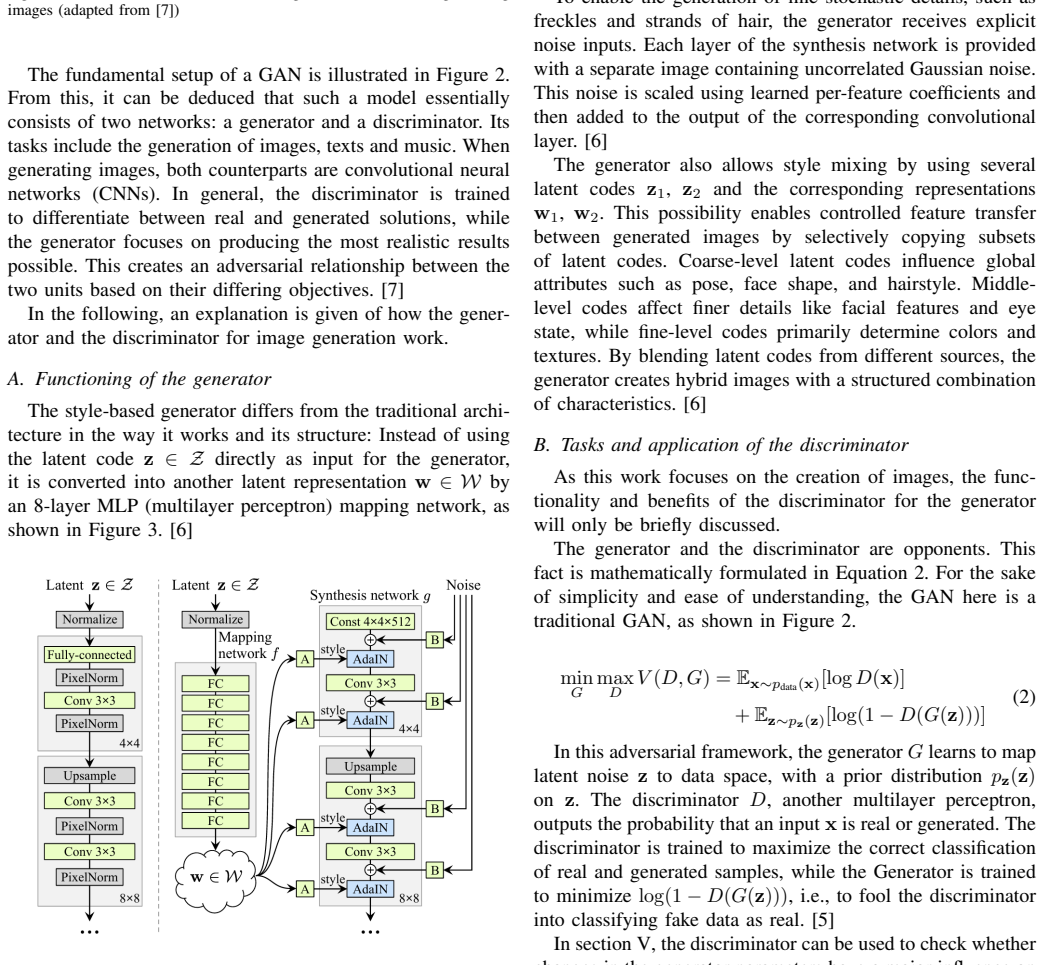
The machinery is the StyleGAN generator itself: an 8-layer mapping network that turns a 512-dimensional latent code z into per-layer style vectors w, and an 18-layer synthesis network that applies those styles through AdaIN (adaptive instance normalization) at each resolution, starting at 4x4 and growing to 128x128 in this training. The paper's two probes are magnitude pruning, building a binary mask by thresholding the absolute value of each weight and multiplying, and an interactive slider tool that adds a chosen delta to one coordinate of the 512-dimensional latent vector. The equalized learning-rate scaling matters here because it keeps weights from different layers on a comparable scale, which is what makes a single global pruning threshold meaningful; it is also why the pruning routine had to be implemented by hand rather than with a generic library pruner. The discriminator supplies the quality signal: its mean probability on the 32 fixed test images is tracked as pruning and latent edits are applied.
What would settle it
Show the same 32 fixed latent vectors at pruning threshold 0.4 to human raters, or compare the pruned images with the unpruned ones using a perceptual metric such as FID or LPIPS; if humans or the metric reliably detect a clear quality gap, the 'not drastically affected' claim fails. For the latent-direction claim, sweep all 512 dimensions across many random seeds and count how often each dimension produces a consistent, label-matched attribute change; if most dimensions fail that test, the interpretability claim is only true for a handful of hand-picked coordinates.
Extended reading notes
Core claim
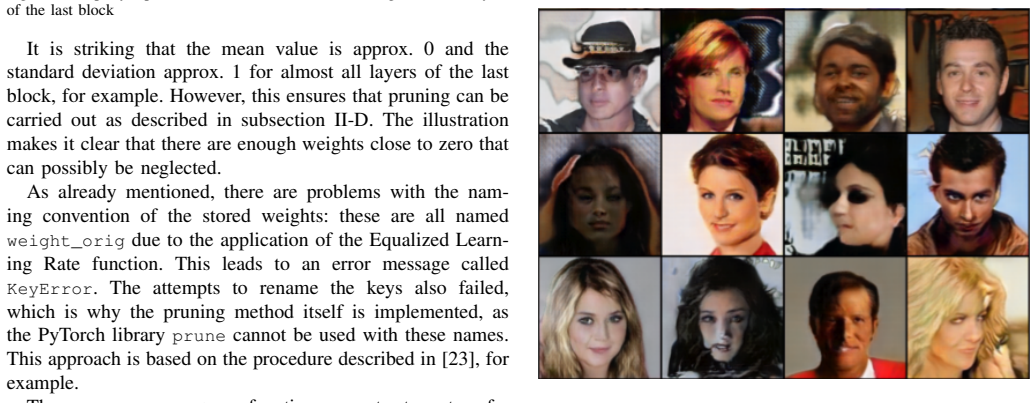
The central discovery, as the paper presents it, is that a StyleGAN generator trained on a 128x128 face dataset consists of a large pool of near-zero weights that can be set to zero without changing its outputs much, and a latent space whose individual dimensions carry separable semantic meaning. Concretely, the generator runs with 3,680,500 non-zero weights; after magnitude pruning each weight whose absolute value is below a threshold, the discriminator's mean realism probability stays at 35.98% at threshold 0.4 versus 38.18% before pruning, while the surviving weight count keeps falling toward 1,218,002 at threshold 1.0. Latent-vector experiments add the second half of the claim: global scaling factors produce broad, mostly color- and sharpness-level changes, while adjusting dimension 3 changes hairline, dimension 70 changes brightness and glasses, dimension 99 removes reddish background spots, dimension 125 controls facial hair, and dimension 360 adjusts contrast.
Load-bearing premise
The argument rests on treating the discriminator's average output as a trustworthy measure of image quality, so a two-percentage-point drop at threshold 0.4 is called acceptable even though the paper does not validate that score against human perception or an independent perceptual metric.
Editorial extensions
If this is right
- At a pruning threshold of 0.4, the discriminator's mean realism score falls only from 38.18% to 35.98%, while the weight curve is still near its linear descent; this is the paper's evidence that a substantial fraction of weights is redundant.
- Using the harshest threshold of 1.0, only 1,218,002 of the original 3,680,500 weights remain, but image quality collapses, so the useful pruning budget lies somewhere below that.
- Global latent-vector scaling produces broad appearance changes (blur, color tone, stylization), while single dimensions act as attribute sliders: dimension 3 affects hair, 70 affects brightness and glasses, 99 reduces reddish background spots, 125 controls facial hair, and 360 adjusts contrast.
- Because the changes are produced by adding constants to selected coordinates, no retraining is needed to steer the generator, which is what makes the manipulation cheap enough to be a realistic misuse scenario.
Reading between the lines
- A direct next experiment the paper does not run is a full scan of all 512 dimensions against attribute labels, such as the annotations in the training dataset; such a scan would tell whether the five highlighted dimensions are the rule or the exception for interpretability.
- The pruning result suggests that a sparse-inference implementation could inherit the quality of the unpruned model: the paper measures surviving weight counts and discriminator scores, but not actual latency, memory, or energy savings, so the practical compression gain remains untested.
- The paper's own discriminator plots show the real and generated score distributions drifting apart again at the end of training, which the authors attribute to possible overfitting; if that is right, both the pruning tolerance and the latent-direction mapping might change under better-regularized training, and a replication on a fresh run would be informative.
- For cybersecurity, the latent-dimension sliders imply a cheap editing capability: an attacker who knows the trained generator can tweak identities by adding constants to a few coordinates, and a defender could look for exactly those coordinate-level perturbations in suspicious images, though the paper does not develop such a detector.
Editorial analysis
A structured set of objections, weighed in public.
Referee Report
Summary. The paper trains a StyleGAN using a PyTorch implementation on the CelebA dataset, then analyzes the generator's internals for cybersecurity-motivated interpretability. Two central claims are made: (i) magnitude pruning can remove a significant number of generator weights 'without drastically affecting the output,' and (ii) targeted changes to individual latent dimensions allow 'precise manipulation of specific facial features' such as hair, lighting, facial hair, and contrast. The pruning evaluation uses the mean sigmoid output of the same discriminator on 32 fixed latents, together with visual inspection of selected images. The latent analysis is based on an interactive slider tool and a small number of hand-picked dimensions, each illustrated with one or two images. The paper also describes practical difficulties in training and loading the model, including a checkpoint selection based on observed image quality.
Significance. If the pruning and latent-interpretability claims were rigorously established, the paper would contribute to understanding StyleGAN's overparameterization and the semantic structure of its latent space, with plausible relevance to deepfake detection. The authors are transparent about training instabilities, checkpoint choices, and implementation obstacles, which is useful as a practitioner-oriented case study. However, the paper provides no code, no external image-quality metrics, no human evaluation, and no quantitative validation of the latent manipulations. The strengths are the detailed walkthrough of a PyTorch StyleGAN adaptation and the honest reporting of failed training runs; the weaknesses are that the central quantitative claims rest on a single, non-independent, uncalibrated metric and on anecdotal visual evidence.
major comments (4)
- [Section V-B and VI-B] The pruning mask is computed as module.weight_orig.abs() >= threshold, but the network uses the equalized weights defined in Eq. (3) as hat_w_i = w_i / c, where c is a per-layer scaling constant. A single global threshold on weight_orig therefore corresponds to different effective thresholds c*t in different layers. This makes the reported 'remaining weight fraction' not a well-defined measure of the network's active parameter importance, and it undermines the central claim that 'a significant number of these weights can be removed without drastically affecting the output.' The authors should apply the threshold to the effective weights or report per-layer thresholds and justify the global threshold choice.
- [Section VI-B] The only quantitative evaluation of pruning quality is the mean sigmoid output of the discriminator, which was trained adversarially against this very generator and is therefore not an independent quality oracle. The unpruned mean is already 38.18%, not 50%, and no confidence intervals, per-image variance, calibration, or external perceptual or distributional metric (e.g., FID, LPIPS, or human ratings) is provided. Without such a baseline, the statement that the output at pruning limit 0.4 (mean 35.98%) is 'still acceptable' is not interpretable. The claim 'without drastically affecting the output' is therefore not supported as stated.
- [Section VI-D] The latent dimension analysis is purely anecdotal: five dimensions (3, 70, 99, 125, 360) are selected by eye, each illustrated with one or two images, and no quantitative or statistical validation is offered. There is no evidence that these dimensions control the same attributes across the full set of latents, nor any measure of effect size or consistency. The claim that 'targeted changes to individual dimensions allow for precise manipulation of specific facial features' requires a systematic evaluation, for example using attribute classifiers, feature-space distances, or a larger sample of latents with error bars.
- [Section IV-B and VI-A] The paper discloses that training aborted at approximately 76,000 iterations and was resumed multiple times, and that the images used for interpretation are taken 'after the second training run' rather than after the final checkpoint. Figure 11 shows the discriminator distributions moving apart again after the final training stage, which the authors attribute to possible overfitting. This raises the concern that the analyzed model is not a representative or stable StyleGAN, and that the pruning and latent results may be artifacts of an undertrained or overfit checkpoint. The authors should justify the checkpoint choice and show that the main results are robust across checkpoints or training stages.
minor comments (6)
- [Section V-B] The custom pruning implementation due to the weight_orig naming conflict is described only verbally; including a short code snippet or pseudocode would improve reproducibility.
- [Figure 14] The y-axis label should state explicitly that the values are mean sigmoid probabilities in percent, to avoid confusion with raw discriminator logits.
- [Section VI-C] There is a typo: 'amplified witch a scaling factor' should read 'amplified with a scaling factor.'
- [References] Several references are informal sources (a Stack Overflow post and a Medium article); consider replacing them with peer-reviewed literature or official documentation where available.
- [Section VI-D and Conclusion] The conclusion refers to the 'inter-share control system,' which appears to be a typo for 'interactive control system'; please correct.
- [Abstract and Introduction] The cybersecurity framing is motivational and is not connected to any experimental result; consider adding a brief discussion of how the pruning and latent findings could inform deepfake detection, or explicitly state that such implications are outside the paper's scope.
Circularity Check
No significant circularity: the pruning and latent-dimension results are empirical observations rather than derivations that reduce to their inputs.
full rationale
The paper does not contain a load-bearing circular step. Its central claims about pruning and latent-dimension manipulation are empirical findings from a trained StyleGAN, not predictions fitted to the data they purport to explain. The pruning experiment applies a magnitude threshold to weights and measures the discriminator's mean sigmoid output on fixed latents; the discriminator is co-trained with the generator and is therefore not an independent quality oracle, but this is an evidentiary limitation, not a circularity. No parameter is fitted to a target and then renamed as a prediction, and no result is derived from an equation that defines it into existence. The GAN objective (Eq. 2) and equalized-learning-rate scaling (Eq. 3) are standard definitions cited from prior work and are not used tautologically. The latent-dimension findings (dimensions 3, 70, 99, 125, 360) are selected by visual inspection, which makes them anecdotal and cherry-picked, but selection by inspection is not equivalent to deriving the claim from its own assumption. The paper contains no self-citations that are load-bearing: all citations are to external works such as Karras et al., Goodfellow et al., and standard PyTorch documentation. There is no imported uniqueness theorem and no ansatz smuggled in via citation; the paper explicitly relies on the original StyleGAN architecture. Concerns about the lack of FID/LPIPS, the uncalibrated discriminator score, and the global threshold on raw weight_orig are validity or methodology issues, not circularity. The derivation chain is therefore self-contained in the sense that the conclusions are not forced by construction or by self-citation.
Assumptions & free parameters
assumptions (3)
- domain assumption StyleGAN architecture as described in [6] produces realistic images when trained properly
- ad hoc to paper The discriminator output is a reliable indicator of image quality
- domain assumption The trained model is representative of StyleGAN's behavior
Cite this review
Pith. "Pith review of Tackling fake images in cybersecurity -- Interpretation of a StyleGAN and lifting its black-box." pith.science (2026). https://pith.science/paper/SEOLPXWG
@misc{pith2026250713722,
  author       = {Pith},
  title        = {Pith review of: Tackling fake images in cybersecurity -- Interpretation of a StyleGAN and lifting its black-box},
  year         = {2026},
  howpublished = {\url{https://pith.science/paper/SEOLPXWG}},
  note         = {Machine review of arXiv:2507.13722}
}
read the original abstract
In today's digital age, concerns about the dangers of AI-generated images are increasingly common. One powerful tool in this domain is StyleGAN (style-based generative adversarial networks), a generative adversarial network capable of producing highly realistic synthetic faces. To gain a deeper understanding of how such a model operates, this work focuses on analyzing the inner workings of StyleGAN's generator component. Key architectural elements and techniques, such as the Equalized Learning Rate, are explored in detail to shed light on the model's behavior. A StyleGAN model is trained using the PyTorch framework, enabling direct inspection of its learned weights. Through pruning, it is revealed that a significant number of these weights can be removed without drastically affecting the output, leading to reduced computational requirements. Moreover, the role of the latent vector -- which heavily influences the appearance of the generated faces -- is closely examined. Global alterations to this vector primarily affect aspects like color tones, while targeted changes to individual dimensions allow for precise manipulation of specific facial features. This ability to finetune visual traits is not only of academic interest but also highlights a serious ethical concern: the potential misuse of such technology. Malicious actors could exploit this capability to fabricate convincing fake identities, posing significant risks in the context of digital deception and cybercrime.
Figures


Figures from the paper (14 more)




Reference graph
Works this paper leans on
-
[1]
NVlabs/ffhq-dataset: Flickr-Faces-HQ Dataset (FFHQ)
Tero Karras, Hellsten Janne, and NVIDIA Research. NVlabs/ffhq-dataset: Flickr-Faces-HQ Dataset (FFHQ). Publisher: NVIDIA. 2019. URL: https : / / github. com / NVlabs/ffhq-dataset (visited on 08/06/2024)
work page 2019
-
[2]
Deepfakes - Gefahren und Gegenmaßnahmen
Bundesamt f ¨ur Sicherheit in der Informationstechnik. Deepfakes - Gefahren und Gegenmaßnahmen . Place: Bonn. 2022. URL: https : / / www . bsi . bund . de / DE / Themen / Unternehmen - und - Organisationen / Informationen - und - Empfehlungen / Kuenstliche - Intelligenz/Deepfakes/deepfakes node.html (visited on 08/07/2024)
work page 2022
-
[3]
How Dangerous are Deep- fakes and Other AI-Powered Fraud? 2024
Florian Zandt and Statista. How Dangerous are Deep- fakes and Other AI-Powered Fraud? 2024. URL: https: //www.statista.com/chart/31901/countries-per-region- with - biggest - increases - in - deepfake - specific - fraud - cases/ (visited on 08/07/2024)
work page 2024
-
[4]
Where is the Information in a Deep Neural Network? 2019
Alessandro Achille, Giovanni Paolini, and Stefano Soatto. Where is the Information in a Deep Neural Network? 2019. DOI: 10.48550/arXiv.1905.12213. URL: https://arxiv.org/abs/1905.12213
-
[5]
Ian J. Goodfellow et al. Generative Adversarial Net- works. 2014. DOI: 10 . 48550 / arXiv. 1406 . 2661.URL: https://arxiv.org/abs/1406.2661
-
[6]
A Style- Based Generator Architecture for Generative Adversar- ial Networks
Tero Karras, Samuli Laine, and Timo Aila. A Style- Based Generator Architecture for Generative Adversar- ial Networks . 2018. DOI: 10.48550/arXiv.1812.04948. URL: https://arxiv.org/abs/1812.04948
-
[7]
Generative Adversarial Networks and Other Generative Models
Markus Wenzel. “Generative Adversarial Networks and Other Generative Models”. In: Machine Learning for Brain Disorders. Ed. by Olivier Colliot. Neuromethods
-
[8]
Delving Deep into Rectifiers: Surpassing Human- Level Performance on ImageNet Classification
Kaiming He, Xiangyu Zhang, Shaoqing Ren, and Jian Sun. Delving Deep into Rectifiers: Surpassing Human- Level Performance on ImageNet Classification . 2015. URL: https://arxiv.org/abs/1502.01852
arXiv 2015
Show all 28 references
-
[9]
Progressive Growing of GANs for Improved Quality, Stability, and Variation
Tero Karras, Timo Aila, Samuli Laine, and Jaakko Lehtinen. Progressive Growing of GANs for Improved Quality, Stability, and Variation . Version Number: 3
- [10]
- [11]
-
[12]
The MNIST Database of Handwritten Digit Images for Machine Learning Research [Best of the Web]
Li Deng. “The MNIST Database of Handwritten Digit Images for Machine Learning Research [Best of the Web]”. In: IEEE Signal Processing Magazine 29.6 (2012), pp. 141–142. ISSN : 1053-5888. DOI: 10.1109/ MSP.2012.2211477
2012
-
[13]
Datasets
Torch Contributors. Datasets. URL: https://pytorch.org/ vision/main/datasets.html (visited on 02/12/2025)
2025
-
[14]
Large-scale CelebFaces Attributes (CelebA) Dataset
Ziwei Liu, Ping Luo, Xiaogang Wang, and Xi- aoou Tang. Large-scale CelebFaces Attributes (CelebA) Dataset. Place: Multimedia Laboratory, The Chinese University of Hong Kong. 2015. URL: http://mmlab. ie . cuhk . edu . hk / projects / CelebA . html (visited on 02/12/2025)
2015
-
[15]
Hands-On-Image-Generation-with- TensorFlow-2.0: Faster StyleGAN
Soon Yau Cheong. Hands-On-Image-Generation-with- TensorFlow-2.0: Faster StyleGAN. Place: GitHub. 2023. URL: https://github.com/PacktPublishing/Hands- On- Image- Generation- with- TensorFlow- 2.0/tree/master/ Chapter07 (visited on 02/12/2025)
2023
-
[16]
Hands-On Image Generation with TensorFlow: A practical guide to generating images and videos using deep learning
Soon Yau Cheong. Hands-On Image Generation with TensorFlow: A practical guide to generating images and videos using deep learning . Birmingham: Packt Publishing Ltd., 2020. ISBN : 978-1-83882-678-9
2020
-
[17]
Build from source
TensorFlow. Build from source . 2024. URL: https : / / www . tensorflow . org / install / source # gpu (visited on 03/02/2025)
2024
-
[18]
NVIDIA. PyTorch. 2025. URL: https://www.nvidia.com/ en-us/glossary/pytorch/ (visited on 03/02/2025)
2025
-
[19]
Was ist Py- Torch? 2023
Dave Bergmann, Cole Stryker, and IBM. Was ist Py- Torch? 2023. URL: https://www.ibm.com/de-de/topics/ pytorch (visited on 03/02/2025)
2023
-
[20]
MyStyleGAN.ipynb
nivedwho. MyStyleGAN.ipynb. Place: Google Colabo- ratory. 2021. URL: https://colab.research.google.com/ github / nivedwho / Colab / blob / main / StyleGAN . ipynb (visited on 03/02/2025)
2021
-
[21]
Why Pytorch officially use mean=[0.485, 0.456, 0.406] and std=[0.229, 0.224, 0.225] to normalize images? 2019
Stack Exchange Inc. Why Pytorch officially use mean=[0.485, 0.456, 0.406] and std=[0.229, 0.224, 0.225] to normalize images? 2019. URL: https : / / stackoverflow.com/questions/58151507/why- pytorch- officially- use- mean- 0- 485- 0- 456- 0- 406- and- std- 0- 229-0-224-0-2 (vis...
2019
-
[22]
Jupyter Widgets 8.1.6 documentation
Project Jupyter. Jupyter Widgets 8.1.6 documentation . URL: https : / / ipywidgets . readthedocs . io / en / stable/ (visited on 04/23/2025)
2025
-
[23]
Pruning Tutorial
Michela Paganini. Pruning Tutorial. Nov. 2, 2023. URL: https : / / pytorch . org / tutorials / intermediate / pruning tutorial.html# (visited on 04/23/2025)
2023
-
[24]
Simon J.D. Prince. Understanding Deep Learning . The MIT Press, 2024. URL: http://udlbook.com
2024
-
[25]
Jakub M. Tomczak. Deep Generative Modeling. Cham: Springer International Publishing, 2024. ISBN : 978-3- 031-64086-5 978-3-031-64087-2. DOI: 10.1007/978-3- 031-64087-2. URL: https://link.springer.com/10.1007/ 978-3-031-64087-2
2024 doi
-
[26]
Generative Adversarial Networks (GANs) in Cybersecurity — Friend or Foe? Oct
Medium. Generative Adversarial Networks (GANs) in Cybersecurity — Friend or Foe? Oct. 18, 2024. URL: https : / / medium . com / @RocketMeUpCybersecurity / generative-adversarial-networks-gans-in-cybersecurity- friend-or-foe-997527b1b7c0 (visited on 04/24/2025)
2024
-
[197]
New York, NY, 2023, pp. 139–192. ISBN : 978-1- 0716-3195-9. DOI: 10.1007/978-1-0716-3195-9 5
2023 doi
- [2018]
Reviewed August 6, 2026 · model on record in the stance chip above.
Discussion (0). Sign in to comment.