REVIEW 5 major objections 4 minor 55 references
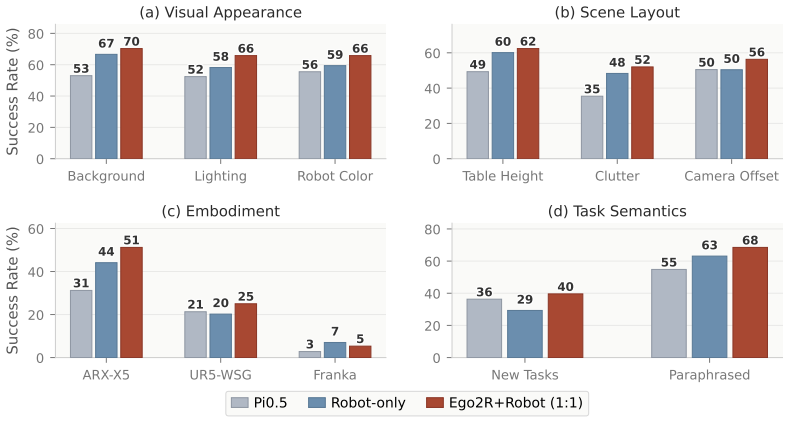
Converting 1,940 hours of egocentric human video into 18,561 hours of robot-format data, then mixing it with real robot data, improves out-of-distribution generalization across visual, scene, embodiment, and task-semantic shifts.
Reviewed by Pith at T0; open to challenge. T0 means a machine referee read the full paper against a public rubric. the ladder, T0–T4 →
T0 review · deepseek-v4-flash
2026-08-04 04:19 UTC pith:SEX24ZQT
load-bearing objection A serious, well-controlled study of ego-to-robot data at scale, with an unresolved question about camera motion in the action labels. the 5 major comments →
Ego2Robot: Scalable Robot Data Synthesis from Egocentric Human Data
The pith
A machine-rendered reading of the paper's core claim, the machinery that carries it, and where it could break.
Core claim
Ego2Robot's central discovery is that ego-to-robot synthesis scales beyond per-task demos. Starting from egocentric hand-manipulation video, the pipeline extracts hand keypoints, retargets them to a parallel-jaw gripper representation, optimizes a per-episode robot base pose so the trajectory is kinematically feasible, inpaints the human arms, and composites a rendered robot arm into the scene with depth ordering. All actions are stored as camera-frame relative end-effector deltas, so frames from different cameras and different robot bodies share a single action space. The paper reports that joint pretraining on this synthesized data plus real robot data improves out-of-distribution success
What carries the argument
The central object is the camera-frame relative end-effector (EEF) action: action deltas expressed in the observer's camera frame rather than the world frame, which unifies data from unknown camera placements and varied robot morphologies without per-video extrinsic calibration. The other load-bearing mechanism is the base-pose search—for each ego trajectory, a robot base placement in SE(3) is selected by grid search over kinematic reach and IK feasibility, so that human hand motions become feasible robot motions for each of 15 target morphologies. Visual alignment is completed by arm segmentation, video inpainting to remove hands, and depth-aware compositing of the rendered robot, followed
Load-bearing premise
The pipeline assumes that camera-frame relative end-effector actions are a stable action representation for egocentric sources with unknown, potentially moving camera placements; the paper neither estimates nor compensates for camera motion, so if head motion changes the mapping from robot behavior to action labels, the synthesized data is noisier than the reported gains suggest.
What would settle it
Take egocentric videos with known head motion (e.g., head-mounted IMU or reconstructed camera trajectories), generate Ego2R labels both in the moving camera frame and in a camera-motion-compensated frame, and run identical pretraining on both versions; if the compensated labels do not preserve or improve the out-of-distribution gains, the benefit is not due to transferable manipulation content but to representation noise.
If this is right
- Mixing Ego2R-synthesized data with robot data at a 1:1 ratio improves out-of-distribution success relative to robot-only pretraining across visual, scene, embodiment, and task-semantics shifts.
- The benefit is complementary rather than a simple volume effect: a low 1:3 mixing ratio yields little change, while 3:1 and 1:1 ratios give substantial gains.
- Scaling the number of rendered robot morphologies from 1 to 15 steadily improves downstream performance, and adding raw egocentric video as an extra 'morphology' provides a further jump.
- Even with no real robot data in pretraining, the pipeline-processed ego data outperforms raw ego data, showing the action and visual alignment stages matter.
- On a physical dual-arm robot, using pipeline-converted casual ego play alongside teleoperated demonstrations improves success on all five long-horizon tasks tested.
Where Pith is reading between the lines
- Inference: Because the egocentric camera is head-mounted and moving, camera-frame action labels contain motion-dependent noise that can act as an implicit augmentation; a controlled comparison against camera-motion-compensated labels would separate this from transferable manipulation content.
- Inference: The disentangled evaluation suggests ego-synthesized data mainly improves invariance and cross-distribution robustness rather than trajectory coverage—a testable prediction is that finetuning sample efficiency on novel tasks improves most in visually or semantically shifted settings.
- Inference: The per-trajectory base-pose search is a general feasibility filter that could be reused to screen any human demonstration against a target robot, beyond the rendering pipeline.
- Inference: Multi-morphology rendering also acts as cheap visual domain randomization; the reported robot-color and camera-offset robustness gains suggest the same synthesis could serve perception augmentation even when action labels are not retargeted.
Editorial analysis
A structured set of objections, weighed in public.
Referee Report
Summary. The paper presents Ego2Robot, a pipeline that converts egocentric human manipulation videos into robot-format training data by retargeting hand poses to parallel-jaw grippers, replacing human arms with rendered robot arms via segmentation/inpainting and depth-aware compositing, and applying three levels of quality curation. The pipeline is applied to four egocentric sources totaling roughly 1,940 hours, producing 18,561 hours of training data across 15 robot morphologies. The authors also extend RoboTwin2.0 with disentangled perturbation axes (visual, scene layout, embodiment, task semantics) and evaluate a Qwen3.5-4B VLA policy pretrained on mixtures of Ego2Robot-synthesized and real robot data. The central claim is that joint pretraining with Ego2Robot data consistently improves out-of-distribution generalization, with additional real-robot gains from finetuning on pipeline-converted ego play data.
Significance. If the central claim holds, this is a substantial contribution: it would show that retarget-and-render synthesis from egocentric human video can scale to VLA pretraining and provide complementary value to real robot data, which is currently expensive and heterogeneous. The paper has notable strengths: a controlled pretraining comparison with a fixed frame budget across all mixing ratios, evaluation on public benchmarks (RoboTwin2.0 and EBench), real-robot validation, and a detailed appendix documenting the pipeline. The disentangled perturbation protocol is a useful methodological contribution in itself. However, the empirical support is weakened by the absence of seeds or error bars and by an unaddressed action-representation issue for moving egocentric cameras, which could confound the interpretation of the reported gains.
major comments (5)
- [Section 3 and Appendix C.2, Eq. (10)] The camera-frame relative EEF action representation requires a per-frame camera-to-world transform T_wc to convert end-effector deltas into the observer's frame. For all four egocentric sources (ANT, EgoDex, ViTRA, EgoVerse), the camera is head-mounted and moves during manipulation. The paper does not state whether T_wc is per-frame or fixed, and no camera-pose estimation or stabilization step is described in Sec. A.1 (WiLoR/DynHaMR output hand poses, not camera poses; Eq. (6) optimizes MANO parameters only). If T_wc is fixed, Eq. (10) is invalid for moving cameras: the same robot EEF displacement maps to different labels depending on head motion. If T_wc is per-frame, the paper must specify how it is obtained. This is load-bearing because the central claim attributes OOD gains to action retargeting; without camera-motion compensation, the synthesized action labels can be systematically
- [Tables 1-2 and Figures 3-4] All success rates are point estimates with no seeds, error bars, or confidence intervals. For RoboTwin aggregates with 50 episodes per task and 50 tasks (n=2500), a +2.6 change in the Randomized column is only about 2.6 binomial standard errors under independence, and many per-dimension differences are smaller (e.g., Table 2: Height +2.3, UR5 +4.8, Franka -1.7). The real-robot results use 20 trials per task (Table 4), where a +14 difference carries a standard error of roughly 10 percentage points. Without multiple seeds or confidence intervals, the claim that the method 'consistently improves' is not statistically supported. I recommend reporting at least 3 seeds with mean±std, or per-condition confidence intervals, and performing a significance test for the main comparisons.
- [Abstract and Section 5.2] The abstract states that joint pretraining 'consistently improves out-of-distribution generalization across multiple perturbation types.' This is contradicted by Table 2: at the 1:3 ratio, 7 of 11 perturbation cells are negative (e.g., BG -1.6, Height -1.5, Franka -2.5); at 3:1, BG -1.1, Franka -1.4, Lang +0.0; at 1:1, Franka -1.7, with UR5 only +4.8. The gains are consistent for some axes (especially Object instances and Paraphrased instructions), but not universal. The wording should be tempered, or the paper should report which differences are statistically significant.
- [Sections 5.1, A.2, A.5] Qwen3.5 is used as the policy backbone, as the VLM for subtask segmentation and instruction generation (A.2), and as the L3 semantic consistency filter (A.5). The Task Semantics axis includes paraphrased instructions generated by human+LLM and unseen-object tasks; the gains in Object (+10.3) and Paraphrased (+5.4) conditions could be inflated by the same model family generating the training instructions and filtering the data. This is a confound rather than a circular derivation, but it should be addressed: e.g., evaluate with a set of human-written paraphrases, use a different VLM for filtering, or ablate the L3 filter.
- [Figure 3 and Section 5.3] The ablation 'pipeline alignment is essential' rests on a single point estimate on the RoboTwin Randomized setting, with no error bars. The difference between raw ego (28.1%) and Ego2R single-morphology (31.7%) is plausible but needs variance reporting. Also, the statement that raw ego data 'acts as a 16th morphology' is speculative; the jump from 33.5% to 37.3% could come from extra data diversity, not from treating raw ego as a morphology. The paper should either provide supporting analysis (e.g., action-space/visual-embedding distance) or soften the claim.
minor comments (4)
- [Abstract and Section 3] The '18,561 hours' figure is the total volume after rendering across 15 morphologies and curation, not unique source hours. Please clarify this in the abstract and main text to avoid misinterpretation.
- [Section 5.2] The statement that EBench 'confirms gains under higher viewpoint' is based on the 3:1 ratio achieving 51.7 vs. 1:1 achieving 49.8; the ordering across ratios is not consistent, so this conclusion should be phrased more cautiously.
- [Appendix A.5] The L3 prompt instructs the VLM to be tolerant of 'fake/toy objects' and 'minor spatial deviations.' This may make the filter too permissive and weaken the curation step; consider reporting how many episodes were discarded at each level.
- [Appendix A.6 and Table 3] The color randomization range H∼U(0,1), S∼U(0.3,1), V∼U(0.4,1) is applied to all links; this is a sensible augmentation, but please clarify whether the background and scene objects are also randomized, since Figure 2 lists Robot Color as a separate axis.
Circularity Check
No circular derivation; empirical claims are benchmarked externally and pipeline stages do not reduce to their inputs.
full rationale
The paper's central claim is empirical, not derivational: it asserts that joint pretraining on Ego2Robot-synthesized and robot data improves out-of-distribution generalization. That claim is tested on external benchmarks (RoboTwin2.0, EBench) and real-robot deployment, with held-out perturbation axes; the results are not obtained by plugging the conclusion into the construction. The action-alignment stage (Eqs. 1-3, temporal smoothing) converts hand keypoints to gripper trajectories; the base-pose search (Eq. 4) optimizes IK feasibility and is not a fit to the evaluation metric; visual alignment (Eq. 5) is compositing, not a prediction. The camera-frame relative EEF transform (Eq. 10) is a coordinate transformation chosen to unify data from unknown camera placements; while the moving-camera issue in egocentric video is a genuine validity concern, no equation defines the evaluation outcome in terms of this transform. Self-citations (refs 27, 28, 30) appear only in related work and are not load-bearing; ref [50] (Qwen3.5) is used both for data filtering/instruction generation and as the policy backbone, which is a possible experimental confound for language/semantic gains, but the paper does not derive its generalization claim from that identity—the gains are measured against externally defined tasks. The Limitations section acknowledges rendering and retargeting limitations but does not assert any circular dependency. Thus no step in the claimed derivation chain reduces to its own inputs.
Axiom & Free-Parameter Ledger
free parameters (5)
- Per-source frame subsampling ratios =
ANT/EgoDex 0.6, EgoVerse 0.45, ViTRA 0.25
- Base-pose reach penalty target (rho_bar) =
0.65
- Hand-to-gripper fingertip blend weights =
0.7 index, 0.3 middle
- L1 validity thresholds =
IK error <0.05m; mask >70% invalid; cross-arm contacts >1 invalid
- Robot color randomization ranges =
H~U(0,1), S~U(0.3,1), V~U(0.4,1)
axioms (6)
- domain assumption Hand trajectories after retargeting to a parallel gripper preserve task-relevant manipulation intent.
- domain assumption Camera-frame relative EEF actions are consistent across egocentric sources with unknown, potentially moving cameras.
- domain assumption IK feasibility at keyframes implies whole-trajectory feasibility for the chosen base placement.
- domain assumption Depth-aware compositing yields images whose task-relevant information is preserved after inpainting and overlay.
- domain assumption Qwen3.5 VLM judgments of semantic consistency are accurate enough to curate training data.
- domain assumption RoboTwin2.0 extensions and EBench are valid proxies for real-world out-of-distribution generalization.
read the original abstract
Learning generalizable robot manipulation policies requires large-scale and diverse demonstration data. Egocentric human manipulation videos offer rich scene and task diversity, and prior work has shown that retargeting and rendering such videos into robot-format data can yield effective per-task policies at small scale. However, whether this approach can provide pretraining benefits for vision-language-action models at scale remains unexplored. We present \textbf{Ego2Robot}, a scalable pipeline that converts egocentric human manipulation videos into robot training data through action retargeting, robot-arm visual synthesis, and multi-level quality curation. Ego2Robot supports both curated datasets and in-the-wild videos, producing 18,561 hours of robot training data spanning 15 robot morphologies, making it the largest ego-to-robot dataset to date. To evaluate generalization, we extend RoboTwin2.0 with disentangled perturbation axes covering visual appearance, scene layout, embodiment morphology, and task semantics. Experiments show that joint pretraining on Ego2Robot-synthesized and robot data consistently improves out-of-distribution generalization across multiple perturbation types, with benefits validated on real-robot deployment. Project page: https://www-ye.github.io/ego2robot_blog/
Figures


Reference graph
Works this paper leans on
-
[1]
Zitkovich, T
B. Zitkovich, T. Yu, S. Xu, P. Xu, T. Xiao, F. Xia, J. Wu, P. Wohlhart, S. Welker, A. Wahid, et al. Rt-2: Vision-language-action models transfer web knowledge to robotic control. In Conference on Robot Learning, pages 2165–2183. PMLR, 2023
2023
-
[2]
M. J. Kim, K. Pertsch, S. Karamcheti, T. Xiao, A. Balakrishna, S. Nair, R. Rafailov, E. Foster, G. Lam, P. Sanketi, et al. Openvla: An open-source vision-language-action model.arXiv preprint arXiv:2406.09246, 2024
Pith/arXiv arXiv 2024
-
[3]
K. Black, N. Brown, D. Driess, A. Esmail, M. Equi, C. Finn, N. Fusai, L. Groom, K. Hausman, B. Ichter, et al.pi 0: A vision-language-action flow model for general robot control.arXiv preprint arXiv:2410.24164, 2024
Pith/arXiv arXiv 2024
-
[4]
P. Intelligence, K. Black, N. Brown, J. Darpinian, K. Dhabalia, D. Driess, A. Esmail, M. Equi, C. Finn, N. Fusai, et al.pi {0.5}: a vision-language-action model with open-world general- ization.arXiv preprint arXiv:2504.16054, 2025
Pith/arXiv arXiv 2025
-
[5]
J. Bjorck, F. Casta ˜neda, N. Cherniadev, X. Da, R. Ding, L. Fan, Y . Fang, D. Fox, F. Hu, S. Huang, et al. Gr00t n1: An open foundation model for generalist humanoid robots.arXiv preprint arXiv:2503.14734, 2025
Pith/arXiv arXiv 2025
-
[6]
O’Neill, A
A. O’Neill, A. Rehman, A. Maddukuri, A. Gupta, A. Padalkar, A. Lee, A. Pooley, A. Gupta, A. Mandlekar, A. Jain, et al. Open x-embodiment: Robotic learning datasets and rt-x models: Open x-embodiment collaboration 0. In2024 IEEE International Conference on Robotics and Automation (ICRA), pages 6892–6903. IEEE, 2024
2024
-
[7]
A. Khazatsky, K. Pertsch, S. Nair, A. Balakrishna, S. Dasari, S. Karamcheti, S. Nasiriany, M. K. Srirama, L. Y . Chen, K. Ellis, et al. Droid: A large-scale in-the-wild robot manipulation dataset.arXiv preprint arXiv:2403.12945, 2024
Pith/arXiv arXiv 2024
-
[8]
Q. Bu, J. Cai, L. Chen, X. Cui, Y . Ding, S. Feng, S. Gao, X. He, X. Hu, X. Huang, et al. Agibot world colosseo: A large-scale manipulation platform for scalable and intelligent embodied systems.arXiv preprint arXiv:2503.06669, 2025
Pith/arXiv arXiv 2025
-
[9]
C. Chi, Z. Xu, C. Pan, E. Cousineau, B. Burchfiel, S. Feng, R. Tedrake, and S. Song. Universal manipulation interface: In-the-wild robot teaching without in-the-wild robots.arXiv preprint arXiv:2402.10329, 2024
Pith/arXiv arXiv 2024
-
[10]
T. Z. Zhao, V . Kumar, S. Levine, and C. Finn. Learning fine-grained bimanual manipulation with low-cost hardware.arXiv preprint arXiv:2304.13705, 2023
Pith/arXiv arXiv 2023
-
[11]
P. Wu, Y . Shentu, Z. Yi, X. Lin, and P. Abbeel. Gello: A general, low-cost, and intuitive teleoperation framework for robot manipulators. In2024 IEEE/RSJ International Conference on Intelligent Robots and Systems (IROS), pages 12156–12163. IEEE, 2024
2024
-
[12]
R. Hoque, P. Huang, D. J. Yoon, M. Sivapurapu, and J. Zhang. Egodex: Learning dexterous manipulation from large-scale egocentric video.arXiv preprint arXiv:2505.11709, 2025
Pith/arXiv arXiv 2025
-
[13]
R. Punamiya, S. Kareer, Z. Liu, J. Citron, R.-Z. Qiu, X. Cai, A. Gavryushin, J. Chen, D. Li- conti, L. Y . Zhu, et al. Egoverse: An egocentric human dataset for robot learning from around the world.arXiv preprint arXiv:2604.07607, 2026
Pith/arXiv arXiv 2026
-
[14]
Lepert, J
M. Lepert, J. Fang, and J. Bohg. Phantom: Training robots without robots using only human videos. InConference on Robot Learning, pages 4545–4565. PMLR, 2025
2025
-
[15]
Kareer, D
S. Kareer, D. Patel, R. Punamiya, P. Mathur, S. Cheng, C. Wang, J. Hoffman, and D. Xu. Egomimic: Scaling imitation learning via egocentric video. In2025 IEEE International Con- ference on Robotics and Automation (ICRA), pages 13226–13233. IEEE, 2025. 10
2025
-
[16]
T. Chen, Z. Chen, B. Chen, Z. Cai, Y . Liu, Z. Li, Q. Liang, X. Lin, Y . Ge, Z. Gu, et al. Robotwin 2.0: A scalable data generator and benchmark with strong domain randomization for robust bimanual robotic manipulation.arXiv preprint arXiv:2506.18088, 2025
Pith/arXiv arXiv 2025
-
[17]
N. M. M. Shafiullah, A. Rai, H. Etukuru, Y . Liu, I. Misra, S. Chintala, and L. Pinto. On bringing robots home.arXiv preprint arXiv:2311.16098, 2023
Pith/arXiv arXiv 2023
-
[18]
L. Pei, H. Yuzhe, L. Wanlin, X. Chenxi, and J. Ziyuan. Dexmove: Learning tactile-guided non-prehensile manipulation with dexterous hands. InThe Fourteenth International Con- ference on Learning Representations, 2026. URLhttps://openreview.net/forum?id= dT3ZciXvNX
2026
-
[19]
S. Nair, A. Rajeswaran, V . Kumar, C. Finn, and A. Gupta. R3m: A universal visual represen- tation for robot manipulation.arXiv preprint arXiv:2203.12601, 2022
Pith/arXiv arXiv 2022
-
[20]
Radosavovic, T
I. Radosavovic, T. Xiao, S. James, P. Abbeel, J. Malik, and T. Darrell. Real-world robot learning with masked visual pre-training. InConference on Robot Learning, pages 416–426. PMLR, 2023
2023
-
[21]
Y . J. Ma, S. Sodhani, D. Jayaraman, O. Bastani, V . Kumar, and A. Zhang. Vip: Towards universal visual reward and representation via value-implicit pre-training.arXiv preprint arXiv:2210.00030, 2022
Pith/arXiv arXiv 2022
-
[22]
A. S. Chen, S. Nair, and C. Finn. Learning generalizable robotic reward functions from” in- the-wild” human videos.arXiv preprint arXiv:2103.16817, 2021
Pith/arXiv arXiv 2021
-
[23]
C. Wang, L. Fan, J. Sun, R. Zhang, L. Fei-Fei, D. Xu, Y . Zhu, and A. Anandkumar. Mimicplay: Long-horizon imitation learning by watching human play.arXiv preprint arXiv:2302.12422, 2023
Pith/arXiv arXiv 2023
-
[24]
M. Xu, Z. Xu, Y . Xu, C. Chi, G. Wetzstein, M. Veloso, and S. Song. Flow as the cross-domain manipulation interface.arXiv preprint arXiv:2407.15208, 2024
Pith/arXiv arXiv 2024
-
[25]
J. Ren, P. Sundaresan, D. Sadigh, S. Choudhury, and J. Bohg. Motion tracks: A unified repre- sentation for human-robot transfer in few-shot imitation learning. In2025 IEEE International Conference on Robotics and Automation (ICRA), pages 8802–8810. IEEE, 2025
2025
- [26]
-
[27]
H. Luo, Y . Feng, W. Zhang, S. Zheng, Y . Wang, H. Yuan, J. Liu, C. Xu, Q. Jin, and Z. Lu. Being-h0: vision-language-action pretraining from large-scale human videos.arXiv preprint arXiv:2507.15597, 2025
Pith/arXiv arXiv 2025
-
[28]
H. Luo, Y . Wang, W. Zhang, S. Zheng, Z. Xi, C. Xu, H. Xu, H. Yuan, C. Zhang, Y . Wang, et al. Being-h0. 5: Scaling human-centric robot learning for cross-embodiment generalization. arXiv preprint arXiv:2601.12993, 2026
arXiv 2026
-
[29]
Q. Li, Y . Deng, Y . Liang, L. Luo, L. Zhou, C. Yao, L. Zeng, Z. Feng, H. Liang, S. Xu, et al. Scalable vision-language-action model pretraining for robotic manipulation with real-life hu- man activity videos.arXiv preprint arXiv:2510.21571, 2025
arXiv 2025
- [30]
-
[31]
A. Mandlekar, S. Nasiriany, B. Wen, I. Akinola, Y . Narang, L. Fan, Y . Zhu, and D. Fox. Mimicgen: A data generation system for scalable robot learning using human demonstrations. arXiv preprint arXiv:2310.17596, 2023. 11
Pith/arXiv arXiv 2023
-
[32]
S. Nasiriany, A. Maddukuri, L. Zhang, A. Parikh, A. Lo, A. Joshi, A. Mandlekar, and Y . Zhu. Robocasa: Large-scale simulation of everyday tasks for generalist robots.arXiv preprint arXiv:2406.02523, 2024
Pith/arXiv arXiv 2024
-
[33]
L. Y . Chen, C. Xu, K. Dharmarajan, M. Z. Irshad, R. Cheng, K. Keutzer, M. Tomizuka, Q. Vuong, and K. Goldberg. Rovi-aug: Robot and viewpoint augmentation for cross- embodiment robot learning.arXiv preprint arXiv:2409.03403, 2024
Pith/arXiv arXiv 2024
-
[34]
L. Y . Chen, K. Hari, K. Dharmarajan, C. Xu, Q. Vuong, and K. Goldberg. Mirage: Cross- embodiment zero-shot policy transfer with cross-painting.arXiv preprint arXiv:2402.19249, 2024
Pith/arXiv arXiv 2024
-
[35]
G. Ji, H. Polavaram, L. Y . Chen, S. Bajamahal, Z. Ma, S. Adebola, C. Xu, and K. Goldberg. Oxe-auge: A large-scale robot augmentation of oxe for scaling cross-embodiment policy learn- ing.arXiv preprint arXiv:2512.13100, 2025
arXiv 2025
-
[36]
Y . Mu, T. Chen, Z. Chen, S. Peng, Z. Lan, Z. Gao, Z. Liang, Q. Yu, Y . Zou, M. Xu, et al. Robotwin: Dual-arm robot benchmark with generative digital twins. InProceedings of the computer vision and pattern recognition conference, pages 27649–27660, 2025
2025
-
[37]
B. Liu, Y . Zhu, C. Gao, Y . Feng, Q. Liu, Y . Zhu, and P. Stone. Libero: Benchmarking knowl- edge transfer for lifelong robot learning.Advances in Neural Information Processing Systems, 36:44776–44791, 2023
2023
-
[38]
O. Mees, L. Hermann, E. Rosete-Beas, and W. Burgard. Calvin: A benchmark for language- conditioned policy learning for long-horizon robot manipulation tasks.IEEE Robotics and Automation Letters, 7(3):7327–7334, 2022
2022
-
[39]
James, Z
S. James, Z. Ma, D. R. Arrojo, and A. J. Davison. Rlbench: The robot learning benchmark & learning environment.IEEE Robotics and Automation Letters, 5(2):3019–3026, 2020
2020
-
[40]
X. Li, K. Hsu, J. Gu, K. Pertsch, O. Mees, H. R. Walke, C. Fu, I. Lunawat, I. Sieh, S. Kir- mani, et al. Evaluating real-world robot manipulation policies in simulation.arXiv preprint arXiv:2405.05941, 2024
Pith/arXiv arXiv 2024
-
[41]
J. Gu, F. Xiang, X. Li, Z. Ling, X. Liu, T. Mu, Y . Tang, S. Tao, X. Wei, Y . Yao, et al. Maniskill2: A unified benchmark for generalizable manipulation skills.arXiv preprint arXiv:2302.04659, 2023
Pith/arXiv arXiv 2023
-
[42]
S. Tao, F. Xiang, A. Shukla, Y . Qin, X. Hinrichsen, X. Yuan, C. Bao, X. Lin, Y . Liu, T.-k. Chan, et al. Maniskill3: Gpu parallelized robotics simulation and rendering for generalizable embodied ai.arXiv preprint arXiv:2410.00425, 2024
Pith/arXiv arXiv 2024
-
[43]
W. Pumacay, I. Singh, J. Duan, R. Krishna, J. Thomason, and D. Fox. The colosseum: A bench- mark for evaluating generalization for robotic manipulation.arXiv preprint arXiv:2402.08191, 2024
Pith/arXiv arXiv 2024
-
[44]
S. Fei, S. Wang, J. Shi, Z. Dai, J. Cai, P. Qian, L. Ji, X. He, S. Zhang, Z. Fei, et al. Libero-plus: In-depth robustness analysis of vision-language-action models.arXiv preprint arXiv:2510.13626, 2025
Pith/arXiv arXiv 2025
-
[45]
X. Zhou, Y . Xu, G. Tie, Y . Chen, G. Zhang, D. Chu, P. Zhou, and L. Sun. Libero-pro: To- wards robust and fair evaluation of vision-language-action models beyond memorization.arXiv preprint arXiv:2510.03827, 2025
Pith/arXiv arXiv 2025
-
[46]
S. A. Laboratory. Ebench: Elemental mobile manipulation benchmark, 2026. URLhttps: //internrobotics.github.io/EBench-doc/. Preprint coming soon. 12
2026
-
[47]
R. A. Potamias, J. Zhang, J. Deng, and S. Zafeiriou. Wilor: End-to-end 3d hand localization and reconstruction in-the-wild. InProceedings of the Computer Vision and Pattern Recognition Conference, pages 12242–12254, 2025
2025
-
[48]
C. Si, Y . Liu, B. Ai, J. Xie, R. A. Potamias, C. Zheng, and H. Su. Anyhand: A large-scale synthetic dataset for rgb (-d) hand pose estimation.arXiv preprint arXiv:2603.25726, 2026
Pith/arXiv arXiv 2026
-
[49]
Z. Yu, S. Zafeiriou, and T. Birdal. Dyn-hamr: Recovering 4d interacting hand motion from a dynamic camera. InProceedings of the Computer Vision and Pattern Recognition Conference, pages 27716–27726, 2025
2025
-
[50]
Q. Team. Qwen3. 5: Accelerating productivity with native multimodal agents, february 2026. URL https://qwen. ai/blog
2026
-
[51]
N. Carion, L. Gustafson, Y .-T. Hu, S. Debnath, R. Hu, D. Suris, C. Ryali, K. V . Alwala, H. Khedr, A. Huang, et al. Sam 3: Segment anything with concepts.arXiv preprint arXiv:2511.16719, 2025
Pith/arXiv arXiv 2025
-
[52]
S. Zhou, C. Li, K. C. Chan, and C. C. Loy. Propainter: Improving propagation and transformer for video inpainting. InProceedings of the IEEE/CVF international conference on computer vision, pages 10477–10486, 2023
2023
-
[53]
Todorov, T
E. Todorov, T. Erez, and Y . Tassa. Mujoco: A physics engine for model-based control. In2012 IEEE/RSJ international conference on intelligent robots and systems, pages 5026–5033. IEEE, 2012
2012
-
[54]
K. Zakka. Mink: Python inverse kinematics based on MuJoCo, Feb. 2026. URLhttps: //github.com/kevinzakka/mink
2026
-
[55]
Y . Tian, Y . Yang, Y . Xie, Z. Cai, X. Shi, N. Gao, H. Liu, X. Jiang, Z. Qiu, F. Yuan, et al. Interndata-a1: Pioneering high-fidelity synthetic data for pre-training generalist policy.arXiv preprint arXiv:2511.16651, 2025. 13 Ego2Robot Appendix A Ego2Robot Pipeline Details 14 B Evaluation Framework Details 17 C Model Architecture Details 19 D Training De...
arXiv 2025
discussion (0)
Sign in with ORCID, Apple, or X to comment. Anyone can read and Pith papers without signing in.