REVIEW 4 major objections 5 minor 62 references
Diffusion Model Guided Sampling with Pixel-Wise Aleatoric Uncertainty Estimation
T0 review · 4 major / 5 minor · reviewed 2026-08-12 · deepseek-v4-flash
Pith's one-line read Pixel-wise score variance doubles as a diffusion model's quality map and steering signal.
desk verdict Genuinely new training-free uncertainty estimator for diffusion sampling, but the theoretical curvature claim does not survive contact with Algorithm 1. read the letter →
The pith
A machine-rendered reading of the paper's core claim, the machinery that carries it, and where it could break.
The reading
What carries the argument
The load-bearing object is Algorithm 1's uncertainty map: starting from the current noisy image $X_t$, compute the DDIM predicted clean image $\hat{X}_0$, draw $M$ noisy samples $\hat{X}_t^i \sim q(X_t|\hat{X}_0)$, evaluate the denoising network on each, and set $U_t$ to the diagonal variance of the stacked scores. Algorithm 2 turns that map into a guidance update $\hat{\varepsilon}_t = \varepsilon_t + \lambda\,\mathbb{I}[U_t > p]\cdot \partial U_t/\partial \varepsilon_t$, where $\mathbb{I}$ is the indicator of pixels above the $p$-th percentile threshold and $\lambda$ is the update strength. The identity connecting the two is Eq. 9, the Fisher-information relation between score variance and curvature; it licenses reading $U_t$ as second-order information about the noising distribution and gives the guidance update its stated rationale.
What would settle it
On a Gaussian mixture with a known closed-form score, compute the exact marginal Fisher information $-\mathbb{E}[\partial^2\log q_t(X_t)/\partial X_t^2]$ and compare it with Algorithm 1's $U_t$ at the same time steps. If $U_t$ deviates systematically from the marginal curvature, especially when the DDIM reconstruction $\hat{X}_0$ lands far from any clean sample, the Eq. 9 interpretation is refuted.
Extended reading notes
Core claim
The central claim is that the diagonal variance of the scores $\varepsilon_\theta(\hat{X}_t^i,t)$ over $M$ Monte-Carlo renoised versions of the DDIM-predicted clean image, $U_t = \mathrm{diag}(\mathrm{Var}_i[\varepsilon_\theta(\hat{X}_t^i,t)])$, approximates the expected outer product of the score, $\mathbb{E}[\nabla_{X_t}\log q_t(X_t)\,\nabla_{X_t}\log q_t(X_t)^\top]$, and by the Fisher-information identity this equals the negative expected Hessian $-\mathbb{E}[\partial^2 \log q_t(X_t)/\partial X_t\partial X_t^\top]$. In the paper's own terms, $U_t$ is therefore a Monte-Carlo estimate of the curvature of the marginal noising distribution $q_t(X_t)=\int p_{\mathrm{data}}(X_0)q(X_t|X_0)\,dX_0$, with high values marking pixels the model finds hard to reconstruct consistently. The authors further claim that gradient ascent on $U_t$ at pixels above a percentile threshold steers the reverse process toward higher-quality images, and their experiments report consistent FID gains across resolutions and model families.
Load-bearing premise
The identity in Eq. 9 is argued for the marginal noising distribution $q_t(X_t)$, but Algorithm 1 computes its variance from samples of the conditional distribution $q(X_t|\hat{X}_0)$ built from one DDIM-predicted clean image, and the paper gives no argument that the plug-in conditional variance equals the marginal Fisher information.
Editorial extensions
If this is right
- A diffusion model can report where it is uncertain at the final denoising steps for 20 extra score evaluations in the paper's setup ($M=5$ over four steps), compared with about 130 for the existing pixel-wise Bayesian baseline.
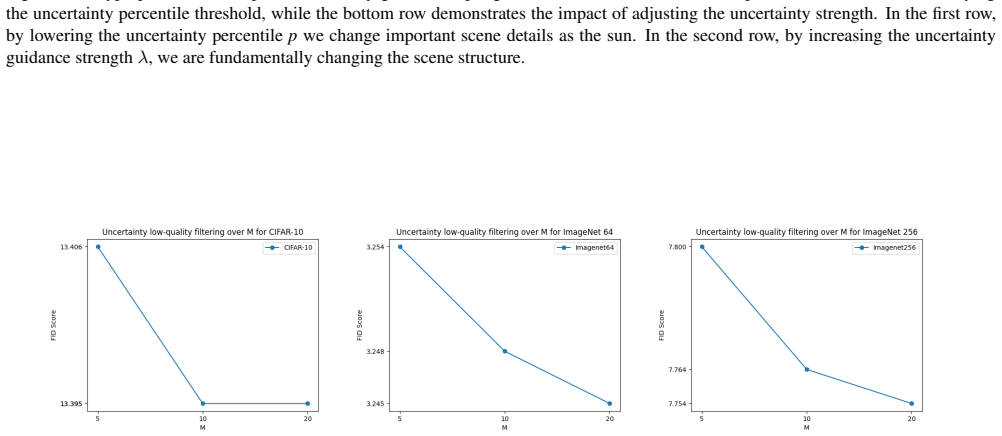
- Filtering the generated pool using the uncertainty score improves FID over random selection on ImageNet and CIFAR-10, providing a practical low-quality filter.
- Guiding the sampler on high-uncertainty pixels improves FID by about one point across ADM, U-ViT, and DDPM at resolutions from 64 to 512.
- The method transfers across samplers such as DDIM and second-order DPM solvers, and to text-to-image models, with qualitative results showing fewer artifacts.
- Uncertainty concentrates in foreground elements and in the late denoising steps, so the maps localize the pixels the model struggles to synthesize.
Reading between the lines
- We infer that the curvature reading depends on the plug-in conditional $q(X_t|\hat{X}_0)$ standing in for the true marginal $q_t(X_t)$; a direct comparison of $U_t$ with the exact Fisher information on a synthetic density would be the natural test.
- The update rule differentiates $U_t$ with respect to the score $\varepsilon_t$, a heuristic move not derived from Eq. 9; ablating it against a simpler high-uncertainty score scaling would isolate what the gradient term contributes.
- If the curvature interpretation survives that test, the same map could support other uses not explored here, such as artifact localization, adaptive compute allocation, or quality control in safety-critical generation.
- The reported FID gains are about one point, and the appendix shows that large guidance strengths or low percentiles change scene content, so the working range of $p$ and $\lambda$ needs calibration per model.
Editorial analysis
A structured set of objections, weighed in public.
Referee Report
Summary. The paper proposes a training-free method to estimate pixel-wise aleatoric uncertainty during diffusion-model sampling. At each denoising step the algorithm builds a DDIM estimate X̂0 from the current state Xt, draws M Gaussian-perturbed samples around X̂0, runs the score network on these samples, and defines the uncertainty map as the diagonal of the sample variance of the resulting scores. The authors claim that this uncertainty approximates the curvature of the noising distribution, specifically the expected second derivative of log q(Xt), and they use the uncertainty map to guide sampling by applying gradient ascent to high-uncertainty pixels. Experiments on ImageNet and CIFAR-10 with ADM, U-ViT, DDPM, and Stable Diffusion compare the method with BayesDiff and MC-Dropout for low-quality-sample filtering, reconstruction uncertainty metrics (AUSE/AURG), and FID under guidance.
Significance. The idea of a training-free, scheduler-agnostic uncertainty signal that can both filter samples and steer generation is attractive, and the paper's strengths include a public code release, a broad set of models and datasets, and a favorable NFE comparison (20 vs. roughly 130 for BayesDiff). If the curvature interpretation were valid, the method would offer a principled and cheap way to improve sampling quality. However, the central theoretical equivalence is not established: the Fisher-information identity in Eq. (9) is proven for the marginal q_t, while Algorithm 1 estimates a conditional plug-in variance. In addition, the empirical gains are modest and inconsistent: BayesDiff attains a better FID on ImageNet256 in Table 1, and the guided-sampling improvements in Table 3 are about one FID point without error bars or multiple seeds. As it stands, the contribution is an ungrounded heuristic with limited evidence of practical benefit.
major comments (4)
- [Sec. 3.5, Eq. (9), Appendix A, Algorithm 1] The main theoretical claim is not established. Appendix A proves the standard Fisher-information identity E_q[s s^T] = -E_q[∂² log q(s)] for draws from the marginal distribution q_t(X_t), but Algorithm 1 computes the sample variance of scores at points X̂_i^t drawn from the conditional Gaussian q(·|X̂0), where X̂0 is the DDIM point estimate from Eq. (7). No importance weighting, correction term, or additional argument shows that the plug-in conditional variance equals the marginal Fisher information. This is not a technicality: for a mixture such as q_t = 0.5 N(-1,1) + 0.5 N(1,1), the variance of the score under one conditional component can differ substantially from the marginal Fisher information. The centered sample variance in Eq. (8) also coincides with the uncentered second moment in Eq. (9) only if the mean score under the sampling distribution is zero, which is not guaranteed for the conditional plug-in. Consequently, the equivalence between U_t and the curvature of the noising distribution is unsupported, and the rationale for the guidance update in Eq. (10) collapses.
- [Sec. 3.6, Eq. (10), Algorithm 2] The guidance mechanism is not justified. The update ε̂_t = ε_t + λ(I[U_t > p] · ∂U_t/∂ε_t) treats ∂U_t/∂ε_t as a gradient-ascent direction, but U_t depends on ε_t through the DDIM estimate X̂0 in Eq. (7) and then through the M perturbed samples in Algorithm 1. The paper does not specify how this gradient is computed, nor does it show that stepping ε_t along this direction increases the curvature of q_t as claimed. The sentence in Sec. 3.6 that maximizing the second derivative improves the convergence rate and cites [33] is not supported by that reference, which is a statistics textbook rather than an optimization or diffusion result. As written, the guidance step is a heuristic whose stated theoretical motivation is not valid.
- [Table 3 and Table 1] The empirical evidence for the central practical claims is weak. In Table 3, the FID improvements from uncertainty guidance are about 0.9–1.1 points on 10,000 generated samples, with no standard errors, confidence intervals, or multiple seeds; FID differences of this size are within the sampling noise of the metric. In Table 1, the proposed filtering method is not uniformly better than the baseline: BayesDiff achieves a clearly lower FID on ImageNet256 (6.81 vs. 7.80), and several of the reported improvements are very small (e.g., 3.289 vs. 3.254 on ImageNet64). The abstract's claim of 'state-of-the-art performance' is therefore not supported by the reported numbers, and the guided-sampling result lacks a comparison to a similarly priced baseline with the same compute budget.
- [Sec. 4.1 and Fig. 10] The guidance results depend on several hand-chosen hyperparameters—M = 5, p = 95, λ = 1.0, and the uncertainty timestep window (steps 45–48)—but no sensitivity analysis is provided for the ImageNet or CIFAR-10 benchmarks. The only ablation (Fig. 10) is qualitative and on Stable Diffusion, where changes in p and λ can substantially alter image content. Since the method is proposed as a general guidance technique, the lack of ablations on the benchmark datasets makes it unclear whether the small FID gains are robust or are the result of tuned settings.
minor comments (5)
- [Sec. 3.2, Eq. (2)] The reparametrization is written as X_t = √ᾱ_t X0 + (1-ᾱ_t) ε; it should be X_t = √ᾱ_t X0 + √(1-ᾱ_t) ε. Equation (1) also appears to define the conditional distribution of X_t given X_{t-1}, not X_{t-1} given X_t, as the notation suggests.
- [Sec. 4.2] The text says the uncertainty estimation results are presented in Table 4, but the results described (filtering FID and comparisons with BayesDiff/MC-Dropout) appear in Table 1; Table 4 in the appendix reports Precision/Recall. Please correct the cross-reference.
- [Algorithm 2 and Sec. 4.1] The use of the percentile threshold is ambiguous. Algorithm 2 uses a per-image threshold 'percentile(U_t, p)', while Sec. 4.1 describes a global 95-th percentile 'of the uncertainty computed over the 10,000 samples'. Please clarify which implementation was used and whether p is the same in both places.
- [Appendix A] The proof is stated for a scalar x and assumes conditions (15)–(16), but the paper uses vector-valued image tensors and a diagonal of the full covariance matrix. The vector case and the boundary decay of ∂q/∂x at infinity are not discussed, so the proof as written does not directly cover the setting of the main text.
- [Throughout] There are numerous presentation issues: 'threhsolds' in Algorithm 2, 'V AEs' in the Related Work, inconsistent capitalization such as 'Imagenet64' vs. 'ImageNet64' and 'U-VIT' vs. 'U-ViT', and Table 1's caption says 'with and without uncertainty guidance' when the experiment is actually low-quality filtering.
Circularity Check
No circular derivation found: Eq. 9 is an external Fisher-information identity, and the uncertainty-guided sampling is evaluated on external benchmarks with fixed hyperparameters rather than fitted to the target FID.
full rationale
The paper's claimed derivation chain is not circular. The uncertainty map U_t is defined in Eq. 8 and Algorithm 1 as the sample variance of score-network outputs over perturbations drawn from the conditional noising distribution q(X_t|X_hat_0), where X_hat_0 is the DDIM point estimate from Eq. 7. Equation 9 then invokes the standard Fisher-information identity E[s s^T] = -E[∂^2 log q], citing external references [12,33]; the identity is not manufactured by the paper and its proof in Appendix A is a textbook calculation. The load-bearing assumption that the plug-in conditional variance equals the marginal Fisher information is not proved, and the guidance update in Eq. 10 is therefore heuristically motivated rather than forced by a self-referential construction. However, an unsupported equivalence is a correctness gap, not a circularity: no output quantity is defined in terms of the claim it is supposed to establish, and no parameter is fitted to the FID scores it later 'predicts.' The reported FID improvements in Table 3 are external benchmark comparisons with fixed M=5, p=95th percentile, and lambda=1.0, so the empirical claim is not an artifact of fitting. The paper's self-citations (e.g., Hornauer and Belagiannis works in the related-work section) are not load-bearing for the curvature derivation. Hence there is no circular step to exhibit.
Assumptions & free parameters
free parameters (4)
- M (number of Monte Carlo perturbed samples) =
5 (20 in Appendix Fig. 11)
- p (uncertainty percentile threshold) =
95th percentile
- lambda (guidance strength) =
1.0
- uncertainty timestep window =
steps 45-48 of 50
assumptions (6)
- standard math The noising distribution q_t(X_t) = ∫ p_data(X0) q(X_t|X0) dX0 is twice continuously differentiable with finite expected squared second derivative of its log-density (regularity conditions in Appendix A, Eq. 15-16).
- domain assumption The trained score network epsilon_theta(X_t,t) equals the true score ∇ log q_t(X_t) at the re-noised inputs X_i^t.
- ad hoc to paper Monte Carlo draws X_i^t from q(X_t | X0_hat), where X0_hat is the DDIM estimate in Eq. 7, are representative samples from the marginal q_t(X_t).
- domain assumption Sensitivity of model outputs to input perturbations is a valid proxy for aleatoric uncertainty, as established by Mi et al. [35].
- ad hoc to paper Performing gradient ascent on the uncertainty map, equivalently on the second derivative of log q_t(X_t), improves the perceptual quality of generated samples.
- domain assumption The variance of M=5 score estimates is an unbiased and sufficient estimate of the expectation in Eq. 9.
Cite this review
Pith. "Pith review of Diffusion Model Guided Sampling with Pixel-Wise Aleatoric Uncertainty Estimation." pith.science (2026). https://pith.science/paper/SFHQCV7U
@misc{pith2026241200205,
  author       = {Pith},
  title        = {Pith review of: Diffusion Model Guided Sampling with Pixel-Wise Aleatoric Uncertainty Estimation},
  year         = {2026},
  howpublished = {\url{https://pith.science/paper/SFHQCV7U}},
  note         = {Machine review of arXiv:2412.00205}
}
read the original abstract
Despite the remarkable progress in generative modelling, current diffusion models lack a quantitative approach to assess image quality. To address this limitation, we propose to estimate the pixel-wise aleatoric uncertainty during the sampling phase of diffusion models and utilise the uncertainty to improve the sample generation quality. The uncertainty is computed as the variance of the denoising scores with a perturbation scheme that is specifically designed for diffusion models. We then show that the aleatoric uncertainty estimates are related to the second-order derivative of the diffusion noise distribution. We evaluate our uncertainty estimation algorithm and the uncertainty-guided sampling on the ImageNet and CIFAR-10 datasets. In our comparisons with the related work, we demonstrate promising results in filtering out low quality samples. Furthermore, we show that our guided approach leads to better sample generation in terms of FID scores.
Figures


Figures from the paper (10 more)




Reference graph
Works this paper leans on
-
[33]
Springer texts in statistics, Springer, New York, NY , 2
Lehmann, E.L., Casella, G.: Theory of point estima- tion. Springer texts in statistics, Springer, New York, NY , 2. ed edn. (1998) 5, 6
work page 1998
-
[1]
An, J., Cho, S.: Variational autoencoder based anomaly detection using reconstruction probability (2015), https : / / api . semanticscholar . org/CorpusID:36663713 3
work page 2015
-
[2]
Stochastic Processes and their Applications 12(3), 313–326 (1982)
Anderson, B.D.O.: Reverse-time diffusion equation models. Stochastic Processes and their Applications 12(3), 313–326 (1982). https://doi.org/https://doi.org/10.1016/0304- 4149(82)90051-5, https : / / www . sciencedirect . com / science / article / pii/0304414982900515 4
arXiv 1982
-
[3]
Transactions on Machine Learning Research (2024), https:// openreview.net/forum?id=5VotySkajV 3
Asthana, R., Conrad, J., Dawoud, Y ., Ortmanns, M., Belagiannis, V .: Multi-conditioned graph dif- fusion for neural architecture search. Transactions on Machine Learning Research (2024), https:// openreview.net/forum?id=5VotySkajV 3
work page 2024
-
[4]
Bao, F., Li, C., Cao, Y ., Zhu, J.: All are worth words: a vit backbone for score-based diffusion models. In: NeurIPS 2022 Workshop on Score-Based Methods (2022), https://openreview.net/forum? id=WfkBiPO5dsG 6
work page 2022
-
[5]
Blundell, C., Cornebise, J., Kavukcuoglu, K., Wier- stra, D.: Weight uncertainty in neural network. In: Bach, F., Blei, D. (eds.) Proceedings of the 32nd International Conference on Machine Learning. Pro- ceedings of Machine Learning Research, vol. 37, pp. 1613–1622. PMLR, Lille, France (07–09 Jul 2015), https : / / proceedings . mlr . press / v37 / blund...
work page 2015
-
[6]
arXiv preprint arXiv:1806.05452 (2018) 1
Chen, X., Pawlowski, N., Rajchl, M., Glocker, B., Konukoglu, E.: Deep generative models in the real- world: An open challenge from medical imaging. arXiv preprint arXiv:1806.05452 (2018) 1
arXiv 2018
-
[7]
In: Proceed- ings of the IEEE/CVF conference on computer vision and pattern recognition
Chong, M.J., Forsyth, D.: Effectively unbiased fid and inception score and where to find them. In: Proceed- ings of the IEEE/CVF conference on computer vision and pattern recognition. pp. 6070–6079 (2020) 6
work page 2020
Show all 62 references
-
[8]
In: NeurIPS (2021) 1
Daxberger, E., Kristiadi, A., Immer, A., Eschenhagen, R., Bauer, M., Hennig, P.: Laplace redux–effortless Bayesian deep learning. In: NeurIPS (2021) 1
2021
-
[9]
In: 2009 IEEE conference on computer vi- sion and pattern recognition
Deng, J., Dong, W., Socher, R., Li, L.J., Li, K., Fei- Fei, L.: Imagenet: A large-scale hierarchical image database. In: 2009 IEEE conference on computer vi- sion and pattern recognition. pp. 248–255. Ieee (2009) 2, 6, 7
2009
-
[10]
Advances in neural information processing systems 34, 8780–8794 (2021) 1, 3, 6
Dhariwal, P., Nichol, A.: Diffusion models beat gans on image synthesis. Advances in neural information processing systems 34, 8780–8794 (2021) 1, 3, 6
2021
-
[11]
In: Forty-first In- ternational Conference on Machine Learning 2
Esser, P., Kulal, S., Blattmann, A., Entezari, R., M¨uller, J., Saini, H., Levi, Y ., Lorenz, D., Sauer, A., Boesel, F., et al.: Scaling rectified flow transformers for high-resolution image synthesis. In: Forty-first In- ternational Conference on Machine Learning 2
-
[12]
University of Toronto, 2 edn
Evans, M.J., Rosenthal, J.S.: Probability and Statis- tics: The Science of Uncertainty. University of Toronto, 2 edn. (2010) 5
2010
-
[13]
Filos, A., Tigkas, P., McAllister, R., Rhinehart, N., Levine, S., Gal, Y .: Can autonomous vehicles iden- tify, recover from, and adapt to distribution shifts? In: International Conference on Machine Learning. pp. 3145–3153. PMLR (2020) 1, 6
2020
-
[14]
In: international conference on machine learning
Gal, Y ., Ghahramani, Z.: Dropout as a bayesian ap- proximation: Representing model uncertainty in deep learning. In: international conference on machine learning. pp. 1050–1059. PMLR (2016) 1, 2, 7
2016
-
[15]
Communications of the ACM 63(11), 139–144 (2020) 1, 3
Goodfellow, I., Pouget-Abadie, J., Mirza, M., Xu, B., Warde-Farley, D., Ozair, S., Courville, A., Bengio, Y .: Generative adversarial networks. Communications of the ACM 63(11), 139–144 (2020) 1, 3
2020
-
[16]
https://huggingface.co/google/ddpm- cifar10-32 (2022) 6
Google: Denoising diffusion probabilistic model (ddpm) trained on cifar-10 at 32x32 resolution. https://huggingface.co/google/ddpm- cifar10-32 (2022) 6
2022
-
[17]
In: Chaudhuri, K., Sugiyama, M
Grover, A., Ermon, S.: Uncertainty autoencoders: Learning compressed representations via variational information maximization. In: Chaudhuri, K., Sugiyama, M. (eds.) Proceedings of the Twenty- Second International Conference on Artificial Intelli- gence and Statistics. Proceed...
2019
-
[18]
In: Medical Image Computing and Computer Assisted Intervention–MICCAI 2020: 23rd International Con- ference, Lima, Peru, October 4–8, 2020, Proceedings, Part I 23
Hemsley, M., Chugh, B., Ruschin, M., Lee, Y ., Tseng, C.L., Stanisz, G., Lau, A.: Deep generative model for synthetic-ct generation with uncertainty predictions. In: Medical Image Computing and Computer Assisted Intervention–MICCAI 2020: 23rd International Con- ference, Lima, ...
2020
-
[19]
Ad- vances in neural information processing systems 30 (2017) 6, 7
Heusel, M., Ramsauer, H., Unterthiner, T., Nessler, B., Hochreiter, S.: Gans trained by a two time-scale 9 update rule converge to a local nash equilibrium. Ad- vances in neural information processing systems 30 (2017) 6, 7
2017
-
[20]
In: Guyon, I., Luxburg, U.V ., Bengio, S., Wal- lach, H., Fergus, R., Vishwanathan, S., Garnett, R
Heusel, M., Ramsauer, H., Unterthiner, T., Nessler, B., Hochreiter, S.: Gans trained by a two time-scale update rule converge to a local nash equilibrium. In: Guyon, I., Luxburg, U.V ., Bengio, S., Wal- lach, H., Fergus, R., Vishwanathan, S., Garnett, R. (eds.) Advances in Neu...
2017
-
[21]
Advances in neural information pro- cessing systems 33, 6840–6851 (2020) 1, 3, 6
Ho, J., Jain, A., Abbeel, P.: Denoising diffusion prob- abilistic models. Advances in neural information pro- cessing systems 33, 6840–6851 (2020) 1, 3, 6
2020
-
[22]
In: Euro- pean Conference on Computer Vision
Hornauer, J., Belagiannis, V .: Gradient-based un- certainty for monocular depth estimation. In: Euro- pean Conference on Computer Vision. pp. 613–630. Springer (2022) 2
2022
-
[23]
In: Proceedings of the IEEE/CVF Winter Conference on Applications of Computer Vision
Hornauer, J., Belagiannis, V .: Heatmap-based out- of-distribution detection. In: Proceedings of the IEEE/CVF Winter Conference on Applications of Computer Vision. pp. 2603–2612 (2023) 3
2023
-
[24]
In: Proceedings of the IEEE/CVF International Con- ference on Computer Vision
Hornauer, J., Holzbock, A., Belagiannis, V .: Out-of- distribution detection for monocular depth estimation. In: Proceedings of the IEEE/CVF International Con- ference on Computer Vision. pp. 1911–1921 (2023) 2, 3
2023
-
[25]
arXiv preprint arXiv:1704.00109 (2017) 3
Huang, G., Li, Y ., Pleiss, G., Liu, Z., Hopcroft, J.E., Weinberger, K.Q.: Snapshot ensembles: Train 1, get m for free. arXiv preprint arXiv:1704.00109 (2017) 3
2017 arXiv
-
[26]
In: Pro- ceedings of the European Conference on Computer Vision (ECCV)
Ilg, E., Cicek, O., Galesso, S., Klein, A., Makansi, O., Hutter, F., Brox, T.: Uncertainty estimates and multi-hypotheses networks for optical flow. In: Pro- ceedings of the European Conference on Computer Vision (ECCV). pp. 652–667 (2018) 7
2018
-
[27]
In: International conference on machine learning
Ioffe, S., Szegedy, C.: Batch normalization: Acceler- ating deep network training by reducing internal co- variate shift. In: International conference on machine learning. pp. 448–456. pmlr (2015) 2
2015
-
[28]
Advances in neural informa- tion processing systems 34, 21696–21707 (2021) 3
Kingma, D., Salimans, T., Poole, B., Ho, J.: Varia- tional diffusion models. Advances in neural informa- tion processing systems 34, 21696–21707 (2021) 3
2021
-
[29]
Kingma, D.P., Welling, M.: Auto-encoding variational bayes (2013) 1, 3, 4
2013
-
[30]
arXiv preprint arXiv:2310.11142 (2023) 1, 3, 6, 7
Kou, S., Gan, L., Wang, D., Li, C., Deng, Z.: Bayesd- iff: Estimating pixel-wise uncertainty in diffusion via bayesian inference. arXiv preprint arXiv:2310.11142 (2023) 1, 3, 6, 7
2023 arXiv
-
[31]
Krizhevsky, A.: Learning multiple layers of features from tiny images. Tech. rep. (2009) 2, 7
2009
-
[32]
Advances in neural information processing systems 30 (2017) 1, 2
Lakshminarayanan, B., Pritzel, A., Blundell, C.: Sim- ple and scalable predictive uncertainty estimation us- ing deep ensembles. Advances in neural information processing systems 30 (2017) 1, 2
2017
-
[34]
Lu, C., Zhou, Y ., Bao, F., Chen, J., Li, C., Zhu, J.: Dpm-solver++: Fast solver for guided sampling of dif- fusion probabilistic models (2022) 7
2022
-
[35]
In: Proceedings of the AAAI Conference on Artificial Intelligence
Mi, L., Wang, H., Tian, Y ., He, H., Shavit, N.N.: Training-free uncertainty estimation for dense regres- sion: Sensitivity as a surrogate. In: Proceedings of the AAAI Conference on Artificial Intelligence. vol. 36, pp. 10042–10050 (2022) 1, 3, 4
2022
-
[36]
In: International Con- ference on Learning Representations (2020) 2
Morales-Alvarez, P., Hern ´andez-Lobato, D., Molina, R., Hern ´andez-Lobato, J.M.: Activation-level uncer- tainty in deep neural networks. In: International Con- ference on Learning Representations (2020) 2
2020
-
[37]
In: Pro- ceedings of the IEEE/CVF Conference on Com- puter Vision and Pattern Recognition
Neumeier, M., Dorn, S., Botsch, M., Utschick, W.: Reliable trajectory prediction and uncertainty quan- tification with conditioned diffusion models. In: Pro- ceedings of the IEEE/CVF Conference on Com- puter Vision and Pattern Recognition. pp. 3461–3470 (2024) 1
2024
-
[38]
In: The Twelfth International Confer- ence on Learning Representations (2024),https:// openreview.net/forum?id=8nxy1bQWTG 3
Nielsen, B.M.G., Christensen, A., Dittadi, A., Winther, O.: Diffenc: Variational diffusion with a learned encoder. In: The Twelfth International Confer- ence on Learning Representations (2024),https:// openreview.net/forum?id=8nxy1bQWTG 3
2024
-
[39]
Advances in Neural Information Processing Systems 34, 802–814 (2021) 1, 3
Notin, P., Hern ´andez-Lobato, J.M., Gal, Y .: Improv- ing black-box optimization in vae latent space using decoder uncertainty. Advances in Neural Information Processing Systems 34, 802–814 (2021) 1, 3
2021
-
[40]
In: Proceedings of the IEEE/CVF Confer- ence on Computer Vision and Pattern Recognition
Poggi, M., Aleotti, F., Tosi, F., Mattoccia, S.: On the uncertainty of self-supervised monocular depth esti- mation. In: Proceedings of the IEEE/CVF Confer- ence on Computer Vision and Pattern Recognition. pp. 3227–3237 (2020) 7 10
2020
-
[41]
In: Proceedings of the IEEE/CVF conference on computer vision and pattern recognition
Rombach, R., Blattmann, A., Lorenz, D., Esser, P., Ommer, B.: High-resolution image synthesis with latent diffusion models. In: Proceedings of the IEEE/CVF conference on computer vision and pattern recognition. pp. 10684–10695 (2022) 2, 6, 7
2022
-
[42]
Advances in neural information processing systems 30 (2017) 1, 3
Saatci, Y ., Wilson, A.G.: Bayesian gan. Advances in neural information processing systems 30 (2017) 1, 3
2017
-
[43]
In: Pro- ceedings of the IEEE/CVF Winter Conference on Ap- plications of Computer Vision
Sagar, A.: Uncertainty quantification using variational inference for biomedical image segmentation. In: Pro- ceedings of the IEEE/CVF Winter Conference on Ap- plications of Computer Vision. pp. 44–51 (2022) 3
2022
-
[44]
In: International Conference on Learning Representations (2020) 1, 4, 5, 7
Song, J., Meng, C., Ermon, S.: Denoising diffu- sion implicit models. In: International Conference on Learning Representations (2020) 1, 4, 5, 7
2020
-
[45]
Advances in neu- ral information processing systems 32 (2019) 4, 5
Song, Y ., Ermon, S.: Generative modeling by estimat- ing gradients of the data distribution. Advances in neu- ral information processing systems 32 (2019) 4, 5
2019
-
[46]
In: Uncertainty in Artificial Intelligence
Song, Y ., Garg, S., Shi, J., Ermon, S.: Sliced score matching: A scalable approach to density and score estimation. In: Uncertainty in Artificial Intelligence. pp. 574–584. PMLR (2020) 5
2020
-
[47]
In: In- ternational Conference on Learning Representations (2021), https://openreview.net/forum? id=PxTIG12RRHS 4, 5, 6
Song, Y ., Sohl-Dickstein, J., Kingma, D.P., Kumar, A., Ermon, S., Poole, B.: Score-based generative model- ing through stochastic differential equations. In: In- ternational Conference on Learning Representations (2021), https://openreview.net/forum? id=PxTIG12RRHS 4, 5, 6
2021
-
[48]
In: Proceedings of the IEEE conference on computer vision and pattern recognition
Szegedy, C., Vanhoucke, V ., Ioffe, S., Shlens, J., Wo- jna, Z.: Rethinking the inception architecture for com- puter vision. In: Proceedings of the IEEE conference on computer vision and pattern recognition. pp. 2818– 2826 (2016) 7
2016
-
[49]
In: Dy, J., Krause, A
Teye, M., Azizpour, H., Smith, K.: Bayesian uncer- tainty estimation for batch normalized deep networks. In: Dy, J., Krause, A. (eds.) Proceedings of the 35th International Conference on Machine Learning. Pro- ceedings of Machine Learning Research, vol. 80, pp. 4907–4916. PMLR...
2018
-
[50]
In: 2023 IEEE/RSJ International Conference on In- telligent Robots and Systems (IROS)
Wiederer, J., Schmidt, J., Kressel, U., Dietmayer, K., Belagiannis, V .: Joint out-of-distribution detection and uncertainty estimation for trajectory prediction. In: 2023 IEEE/RSJ International Conference on In- telligent Robots and Systems (IROS). pp. 5487–5494. IEEE (2023) 2
2023
-
[51]
Ad- vances in neural information processing systems 33, 4697–4708 (2020) 2
Wilson, A.G., Izmailov, P.: Bayesian deep learning and a probabilistic perspective of generalization. Ad- vances in neural information processing systems 33, 4697–4708 (2020) 2
2020
-
[52]
In: Pro- ceedings of the IEEE/CVF Conference on Computer Vision and Pattern Recognition (CVPR) Workshops
Wyatt, J., Leach, A., Schmon, S.M., Willcocks, C.G.: Anoddpm: Anomaly detection with denoising diffu- sion probabilistic models using simplex noise. In: Pro- ceedings of the IEEE/CVF Conference on Computer Vision and Pattern Recognition (CVPR) Workshops. pp. 650–656 (June 2022) 7
2022
-
[53]
∂ ∂Xt log q(Xt) ∂ ∂Xt log q(Xt) ⊤# (14) where
Zhai, G., Min, X.: Perceptual image quality assess- ment: a survey. Science China Information Sciences 63, 1–52 (2020) 6 11 A. Proof of the main statement In this section we provide the proof that the expected value of the variance of the scores is equivalent to the ex- pected...
2020
-
[54]
First, we expand the RHS: −E ∂2 ∂x2 log q(x) = − Z q(x) ∂2 ∂x2 log q(x)dx (18)
-
[55]
Using the chain rule: ∂2 ∂x2 log q(x) = ∂ ∂x 1 q(x) ∂q(x) ∂x (19) Then by applying the product rule for differentiation, which states that (u · v)′ = u · v′ + v · u′ we have that = − 1 q(x)2 ∂q(x) ∂x 2 + 1 q(x) ∂2q(x) ∂x2 (20)
-
[56]
Substituting this back into the integral: − Z q(x) − 1 q(x)2 ∂q(x) ∂x 2 + 1 q(x) ∂2q(x) ∂x2 ! dx = Z 1 q(x) ∂q(x) ∂x 2 dx − Z ∂2q(x) ∂x2 dx
-
[57]
The second term becomes zero due to the property in Eq. 15 as: Z ∂2q(x) ∂x2 dx = ∂q(x) ∂x |∞ −∞ (21) Finally, considering that q(x) is a probability distribu- tion, its derivative ∂q(x) ∂x is 0 when diverging to ±∞, hence ∂q(x) ∂x |∞ −∞ = 0 (22) Now, going back to the first te...
-
[58]
We can multiply and divide the integrand byq(x) with- out changing the value of the integral: Z q(x) q(x) ∂q(x) ∂x 2 1 q(x) dx (24)
-
[59]
This can be rewritten as: Z q(x) 1 q(x) ∂q(x) ∂x 2 dx (25)
-
[60]
Now, we can use the following identity: 1 q(x) ∂q(x) ∂x = ∂ log q(x) ∂x (26) 12
-
[61]
Substituting this identity into the previous expression, we get: Z q(x) ∂ log q(x) ∂x 2 dx (27)
-
[62]
This is exactly the definition of the left-hand side of the original equation: E " ∂ ∂x log q(x) 2# (28) Therefore, we have shown that the right-hand side equals the left-hand side, proving the identity. B. Additional figures Figure 4. Left: generated image from DDPM trained o...
Reviewed August 12, 2026 · model on record in the stance chip above.
Discussion (0). Continue with ORCID to comment.