REVIEW 5 major objections 5 minor 15 references
Tiny QA Benchmark++: Ultra-Lightweight, Synthetic Multilingual Dataset Generation & Smoke-Tests for Continuous LLM Evaluation
T0 review · 5 major / 5 minor · reviewed 2026-08-15 · deepseek-v4-flash
Pith's one-line read Small QA set catches LLM regressions before big benchmarks do
desk verdict A genuinely useful, openly-shipped tool for LLM smoke testing, but the paper's headline claim that it 'reliably flags' regressions is not tested — the experiments are cross-sectional rankings, not fault-injection. read the letter →
The pith
A machine-rendered reading of the paper's core claim, the machinery that carries it, and where it could break.
The reading
What carries the argument
The carrying object is a two-part benchmark-plus-generator pair. The first part is an immutable JSON core of 52 question-answer triples, each with a one-sentence context and category/difficulty tags; the second is a short generator script that sends two few-shot JSON exemplars to an LLM through a provider-agnostic client, validates that the returned list has the required keys, retries up to three times on malformed output, and hashes every item with SHA-256 for provenance. Evaluation uses normalized exact match for the deterministic core and a Levenshtein ratio for generated packs, with the acceptance threshold chosen by bootstrapping to maximize F1 against exact-match ground truth. That machinery makes failures salient and custom packs cheap, private, and reproducible.
What would settle it
Run a deliberately broken pipeline through TQB++—for example, a prompt template that truncates every answer to one character, or a tokenizer that drops non-Latin script—and compare accuracy on the 52-item core and a 40-item multilingual pack with accuracy on a human-checked version of the same questions. If the tiny suite stays above its pass threshold while the human-checked set drops by several points, the early-warning claim is refuted; separately, fact-check a generated pack and count how many labels are wrong or ambiguous.
Extended reading notes
Core claim
The central claim is that a small, deliberately easy QA set works as an early-warning canary for LLM systems. The paper argues that because competent models are expected to ace the 52-item core, any failure is conspicuous, and because the synthetic packs are cheap to regenerate, teams can guard against overfitting to a fixed test set. Its evidence is sensitivity: larger models in the same family generally outperform smaller siblings, scores drop as stated difficulty rises, and multilingual packs separate languages sharply, with the biggest drops on Japanese and Turkish. The author positions TQB++ not as a ranking instrument but as a pass/fail gate that runs in seconds and decides whether a model or pipeline is worth sending to expensive, comprehensive evaluation.
Load-bearing premise
The load-bearing premise is that every generated question has one correct, unambiguous answer: the generator only validates JSON schema and never checks facts, and the paper's appendix explicitly says label quality relies on the LLM following instructions.
Editorial extensions
If this is right
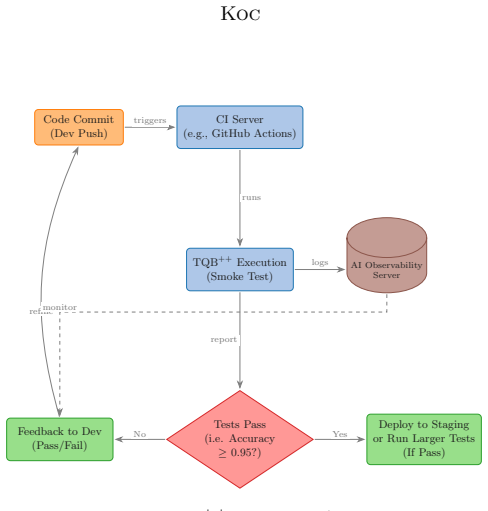
- CI/CD pipelines can gate every commit on TQB++: the 52-item core runs in about 0.5 seconds on a CPU and the paper suggests failing a build when exact-match accuracy drops below 0.95, roughly two errors.
- Even a 10-item synthetic pack preserves the directional model-ordering signal visible in a 40-item pack, supporting randomized smoke tests that resist overfitting to a fixed set.
- Multilingual packs turn localization regressions into visible signals; the paper's example is a Turkish tokenizer change that would be caught as an 18-percentage-point accuracy drop before user impact.
- Fine-tuning runs can be checked at each checkpoint against relevant TQB++ packs to catch catastrophic forgetting early, before expensive full-scale evaluation is worth running.
- A pass on TQB++ is not a green light for release; it is the cheap first stage of a two-stage pipeline that still ends in MMLU, BIG-Bench, or HELM.
Reading between the lines
- One untested extension, which the paper lists as future work, is to feed production telemetry into the generator so new smoke-test packs are minted from emerging failure themes; if it worked, the suite would update itself as the application drifts.
- Because labels are only schema-validated, any team adopting the generator for a new language or domain should independently fact-check a sample of items before treating the pack as a hard CI gate; the paper concedes this is not implemented.
- The same canonical-input, pass/fail logic should transfer to non-QA smoke checks such as instruction-following or tool-call formatting, though the paper does not demonstrate this.
Signed reviews
Editorial analysis
A structured set of objections, weighed in public.
Referee Report
Summary. The paper presents Tiny QA Benchmark++ (TQB++), an ultra-lightweight LLM smoke-test suite built around a 52-item English gold QA set (core_en), a LiteLLM-based synthetic QA generator, ten ready-made multilingual packs, Croissant metadata, and integrations for CI/CD, OpenAI Evals, LangChain, and observability dashboards. The experiments evaluate eight open-weight models on the English core, synthetic English packs of sizes 10–40, and French, Japanese, and Turkish 40-item packs, reporting Exact Match and Levenshtein Ratio scores. The results show plausible performance gradients by model family/size and by language, with English scores highest and Japanese/Turkish scores substantially lower. The abstract and Section 4 claim that a TQB++ run 'reliably flags prompt-template errors, tokenizer drift, and fine-tuning side-effects,' but the paper's experiments are cross-sectional comparisons of static checkpoints; no controlled fault-injection test of these failure modes is presented. The synthetic generation pipeline is only schema-validated, with no factuality or self-consistency post-filtering, which weakens the reliability of low scores on multilingual packs as regression signals.
Significance. If the headline claim were demonstrated, TQB++ would be a genuinely useful low-cost canary for continuous LLM evaluation, and the open release of the dataset, generator script, Croissant metadata, and SHA-256 provenance has real community value. The paper also correctly scopes itself as a smoke test rather than a ranking benchmark, citing tinyBenchmarks and acknowledging that small sets are unsuitable for fine-grained model differentiation. However, the current evidence only supports cross-sectional capability ranking, not the claimed reliability in detecting prompt-template errors, tokenizer drift, or fine-tuning side-effects. The lack of factuality verification for generated labels and the small per-pack sample sizes further limit the strength of the central claims. The resource itself is a reasonable engineering contribution, but the paper's central selling point is not yet validated by the experiments.
major comments (5)
- [Abstract; Section 7.1] The abstract states that a complete TQB++ run 'reliably flags prompt-template errors, tokenizer drift, and fine-tuning side-effects,' but Section 7 contains no experiment that introduces a known prompt-template error, a tokenizer modification, or a fine-tuning checkpoint and checks whether TQB++ detects it. All reported evaluations compare static model checkpoints on fixed datasets, which supports capability ranking but not regression-detection reliability. For example, the Turkish tokenizer scenario in Section 4.4 is presented as a use case with a specific 18-percentage-point drop, but it is never operationalized as a measurement.
- [Appendix A.1] The generator's post-filtering is limited to schema validation: 'No further automated post-filtering, such as self-consistency checks or external factuality verification against a knowledge base, is implemented directly within this basic generation script. The quality relies on the LLM's ability to follow instructions and the schema validation.' Because generated packs are not factuality-checked, a low EM score on pack_ja_40 or pack_tr_40 could be caused by incorrect, ambiguous, or culturally inappropriate generated labels rather than by a real model regression. This directly undermines the smoke-test interpretation of low scores, which is a load-bearing part of the paper's utility claim.
- [Appendix A.1; Section 4.8] The generation model is identified inconsistently: Section 4.8 says 'The current study focused on 'o3-mini' for generation,' while Appendix A.1 states that the model was OpenAI's gpt-3.5-turbo-0125 'referred to as o3-mini in Section 6.' The temperature setting also differs between Section 6 (temperature 0.0) and Appendix A.1 (temperature 1.0 for OpenAI reasoning models). This ambiguity makes the generation setup difficult to audit and impairs reproducibility of the synthetic packs.
- [Section 7.4] The Levenshtein Ratio acceptance threshold of 0.95 is selected as the F1-maximizing threshold against EM ground truth on the same model predictions that are then used with the threshold in reporting, and no held-out validation or confidence interval is reported. The reported F1 of 1.000 at the chosen threshold suggests overfitting to the calibration sample. The threshold analysis should be repeated with a held-out split or nested bootstrap, and the uncertainty in the optimal threshold should be reported.
- [Section 7.5; Table 5] Several 'signals' rest on one-item differences on packs with n=10 or n=20. For example, Table 5 shows gemma-3-12b at EM 100.0 and gemma-3-4b at 90.0 on pack_en_10, a difference of a single answer. Section 7.5 describes intra-family deltas as detectable signals without any confidence intervals, error bars, or statistical test. The small-sample variance makes these directional claims unsupported; at minimum, bootstrap intervals for EM/LR scores should be reported before asserting sensitivity to intra-family differences.
minor comments (5)
- [Section 2.1; Table 2] Section 2.1 states that no core items are labeled 'hard,' but Table 2 reports a 'Hard' column with scores (e.g., 49.0 for gemma-3-12b). The table should clarify whether these scores come from synthetic packs or a different subset, or the description of the core set should be corrected.
- [Section 3.1; Appendix A.1] The generator size is given as 'approximately 40 lines of Python' in Section 3.1 but 'approx. 300 lines' (or '<200 when not packaged for PyPI') in Appendix A.1. These numbers should be reconciled.
- [Section 6; Appendix A.1] There are several typos and formatting errors: 'rsaw Levenshtein Ratio' in Section 6, 'reprodceability' in Appendix A.1, 'suplimentary' in the Appendix A heading, the equation label 'extcos' for cosine similarity, and the system prompt showing 'tagscategory' instead of 'tags.category'.
- [Section 7.4; Figure 5] The LR calibration figure is referenced as 'Figure ??', leaving a placeholder in the text. The figure should be properly labeled and cited.
- [References] Some references are malformed, notably 'Osma endangering Trazona' in the Croissant citation and the undefined 'urldate' field used in several entries. The bibliography should be cleaned before publication.
Circularity Check
No circularity found: the paper reports a dataset and cross-sectional evaluations; its regression-detection claims are unsupported by the experiments but are not derived from their own inputs.
full rationale
This paper contains no derivation chain that could be circular. Its contributions are a hand-curated 52-item English QA set, a LiteLLM-based synthetic data generator, and cross-sectional evaluations of several models on those items. The only fitted parameter is the Levenshtein Ratio acceptance threshold, and the paper explicitly frames this as metric calibration: EM scores are treated as ground truth and precision/recall/F1 are computed over LR thresholds (Section 7.4). That is an internal calibration of a scoring rule, not a prediction derived from the benchmark's own outputs, so it is not circular. Self-citations appear throughout (Koc 2025d, 2025b, 2025c, 2025e), but they are used for dataset provenance, background motivation, and pointers to the project artifacts; no load-bearing argument, uniqueness theorem, or ansatz is imported from them. The abstract's claim that a TQB++ run 'reliably flags prompt-template errors, tokenizer drift, and fine-tuning side-effects' is not demonstrated by the experiments, which only rank static checkpoints across models and languages; however, an unsupported claim is a correctness/evidence gap, not a circularity. Similarly, Appendix A.1 states that no factuality or self-consistency post-filtering is applied and that quality relies on the LLM following instructions plus schema validation, which weakens the utility argument but does not make any result equivalent to an input by construction. The inconsistent labeling of the generation model ('gpt-3.5-turbo-0125 (referred to as o3-mini)') is an auditability problem, again not a circular step. Since no quoted equation or fitted parameter is renamed as a prediction, the appropriate finding is no significant circularity.
Assumptions & free parameters
free parameters (3)
- LR acceptance threshold 0.95 =
0.95
- LR acceptance threshold 0.75 =
0.75
- Pass/fail accuracy threshold 0.95 =
0.95
assumptions (4)
- domain assumption LLM-generated synthetic QA items are factually correct and unambiguous.
- domain assumption The 52-item human-curated English core is a valid smoke test for basic LLM competency.
- domain assumption Exact Match, after normalization, is a valid ground truth for answer correctness.
- domain assumption API evaluation at temperature 0.0 yields deterministic outputs from the models under test.
Cite this review
Pith. "Pith review of Tiny QA Benchmark++: Ultra-Lightweight, Synthetic Multilingual Dataset Generation & Smoke-Tests for Continuous LLM Evaluation." pith.science (2026). https://pith.science/paper/SFKGJCCN
@misc{pith2026250512058,
  author       = {Pith},
  title        = {Pith review of: Tiny QA Benchmark++: Ultra-Lightweight, Synthetic Multilingual Dataset Generation & Smoke-Tests for Continuous LLM Evaluation},
  year         = {2026},
  howpublished = {\url{https://pith.science/paper/SFKGJCCN}},
  note         = {Machine review of arXiv:2505.12058}
}
read the original abstract
Tiny QA Benchmark++ (TQB++) presents an ultra-lightweight, multilingual smoke-test suite designed to give large-language-model (LLM) pipelines a unit-test style safety net dataset that runs in seconds with minimal cost. Born out of the tight feedback-loop demands building the Comet Opik prompt-optimization SDK, where waiting on heavyweight benchmarks breaks developer flow. TQB++ couples a 52-item English gold set (less than 20 kB) with a tiny synthetic-data generator pypi package built on provider-agnostic LiteLLM. The generator lets practitioners mint their own tiny packs in any language, domain, or difficulty, while ten ready-made packs already cover Arabic, Chinese, French, German, Japanese, Korean, Portuguese, Russian, Spanish, and Turkish. Every dataset ships with Croissant metadata and plug-and-play files for OpenAI-Evals, LangChain, and standard CI tools, so teams can drop deterministic micro-benchmarks directly into pull-request gates, prompt-engineering loops, and production dashboards without touching GPU budgets. A complete TQB++ run adds only a few seconds to pipeline latency yet reliably flags prompt-template errors, tokenizer drift, and fine-tuning side-effects long before full-scale suites like MMLU or BIG-Bench would finish configuring. The entire framework is released to accelerate continuous, resource-efficient quality assurance across the generative-AI ecosystem.
Figures


Figures from the paper (3 more)


Reference graph
Works this paper leans on
-
[1]
Omar Akhtar, Ruanne de Castro, Romain Egele, Osma endangering Trazona, Stephane Massonnet, Sarah Moir, David Kanter, Joaquin Vanschoren, Max Pagels, Vojtech Hudecek, Andrew Zaldivar, Been Kim, and Nicolas Passat. Croissant: A metadata format for machine learning datasets. arXiv preprint arXiv:2401.12982 ,
-
[5]
URL https://arxiv.org/abs/2504.07086. Jaikanth J. Understanding llm observability - key insights, best practices, & tools. https: //signoz.io/blog/llm-observability/, September
-
[6]
Accessed: 2025-05-15. V. Koc. Framework for fairness in machine learning using detecting and mitigating bias in ai algorithms. In 2025 3rd IEEE International Conference on Business Analytics for Technology and Security (ICBATS-2025), Dubai, United Arab Emirates, May 2025a. V. Koc, K. Alang, J. I. Janjua, and S. B. Peta. Leveraging multiple llm evaluators ...
work page 2025
-
[7]
Generative AI and Large Language Models in Language Preservation: Opportunities and Challenges
Vincent Koc. Complexities for non-latin languages & llm evaluations, 03 2025b. URL https://www.comet.com/site/blog/complexities-for-non-latin-languages-llm -evaluations/. Accessed on the urldate. Vincent Koc. Generative ai and large language models in language preservation: Opportuni- ties and challenges, 01 2025c. URL https://arxiv.org/abs/2501.11496. Vi...
- [8]
-
[9]
Accessed: 2025-05-15. Vladimir I. Levenshtein. Binary codes capable of correcting deletions, insertions, and reversals. Soviet Physics Doklady , 10(8):707–710,
work page 2025
-
[12]
Pratyush Maini, Mohammad Yaghini, and Nicolas Papernot
URL https://arxiv.org/abs/2406.15126. Pratyush Maini, Mohammad Yaghini, and Nicolas Papernot. Dataset inference: Ownership resolution in machine learning,
-
[13]
URL https://arxiv.org/abs/2104.10706. OpenAI. Openai evals framework. https://github.com/openai/evals,
Show all 15 references
-
[14]
Felipe Maia Polo, Lucas Weber, Leshem Choshen, Yuekai Sun, Gongjun Xu, and Mikhail Yurochkin
Accessed: 2025-05-15. Felipe Maia Polo, Lucas Weber, Leshem Choshen, Yuekai Sun, Gongjun Xu, and Mikhail Yurochkin. tinybenchmarks: evaluating llms with fewer examples,
2025
-
[15]
Aarohi Srivastava et al
URL https: //arxiv.org/abs/2402.14992. Aarohi Srivastava et al. Beyond the imitation game: Quantifying and extrapolating the capabilities of language models,
-
[16]
Yuchen Zhuang, Yue Yu, Kuan Wang, Haotian Sun, and Chao Zhang
URL https://arxiv.org/abs/2206.04615. Yuchen Zhuang, Yue Yu, Kuan Wang, Haotian Sun, and Chao Zhang. Toolqa: A dataset for llm question answering with external tools,
-
[1966]
Holistic evaluation of language models
24 Tiny QA Benchmark ++: Micro Gold for LLMOps Percy Liang, Rishi Bommasani, Tony Lee, Dimitris Tsipras, Dilara Soylu, Michihiro Yasunaga, Yian Zhang, Deepak Narayanan, Yuhuai Wu, Ananya Kumar, et al. Holistic evaluation of language models. arXiv preprint arXiv:2211.09110 ,
-
[2021]
Andreas Hochlehnert, Hardik Bhatnagar, Vishaal Udandarao, Samuel Albanie, Ameya Prabhu, and Matthias Bethge
URL https://arxiv.org/abs/2009.03300. Andreas Hochlehnert, Hardik Bhatnagar, Vishaal Udandarao, Samuel Albanie, Ameya Prabhu, and Matthias Bethge. A sober look at progress in language model reasoning: Pitfalls and paths to reproducibility,
2009 arXiv
-
[2023]
Lin Long, Rui Wang, Ruixuan Xiao, Junbo Zhao, Xiao Ding, Gang Chen, and Haobo Wang
URL https: //arxiv.org/abs/2308.03688. Lin Long, Rui Wang, Ruixuan Xiao, Junbo Zhao, Xiao Ding, Gang Chen, and Haobo Wang. On llms-driven synthetic data generation, curation, and evaluation: A survey,
-
[2024]
Accessed: 2025-05-15. Inc. Comet ML. Cometopik optimizer documentation. https://www.comet.com/docs/opi k/agent_optimization/opik_optimizer,
2025
Reviewed August 15, 2026 · model on record in the stance chip above.
Discussion (0). Continue with ORCID to comment.