REVIEW 3 major objections 5 minor 42 references
IR spectra are ambiguous, and test-time search that scores candidate molecules by spectral consistency can lift top-1 reconstruction accuracy by up to 26 percentage points across existing base models.
Reviewed by Pith at T0; open to challenge. T0 means a machine referee read the full paper against a public rubric. the ladder, T0–T4 →
T0 review · deepseek-v4-flash
2026-08-01 01:21 UTC pith:SFQMITE3
load-bearing objection Useful test-time calibration method for IR-to-molecule, with real gains, but the evaluation has important caveats: SynSet results rest on 211 samples and the spectral-reward mechanism lacks a random-reward control. the 3 major comments →
SpecCal: Ambiguity-Aware Candidate Calibration for Infrared Spectrum-Based Molecular Structure Reconstruction
The pith
A machine-rendered reading of the paper's core claim, the machinery that carries it, and where it could break.
Core claim
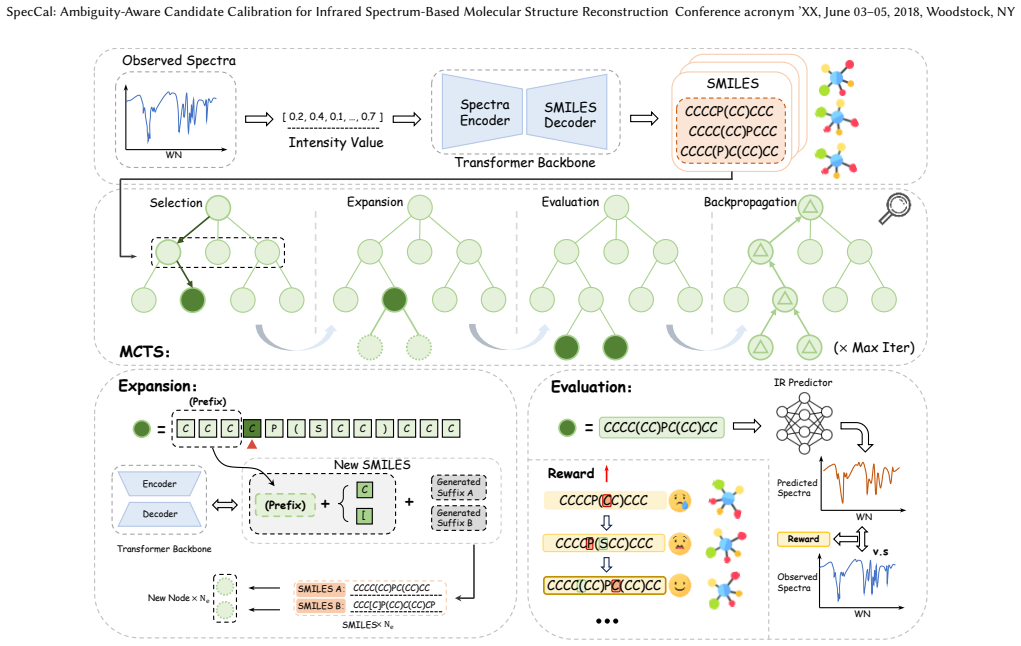
The paper establishes that applying Monte Carlo Tree Search over SMILES sequences, guided by a reward based on agreement between the observed IR spectrum and a spectrum predicted from the candidate molecule, consistently improves top-k hit rates at both exact SMILES and molecular scaffold levels. The strongest gains appear at top-1 and top-5, with reported increases such as from 37.1% to 54.4% on a real experimental benchmark and from 21.3% to 47.9% on a large synthetic benchmark. The method also increases structural diversity of the predicted set, measured by lower Tanimoto similarity and higher scaffold diversity. The framework requires no parameter updates and can be layered onto any base
What carries the argument
The central mechanism is a spectral-consistency reward S(y,s)=1/(1+SID(f_IR(y),s)), where f_IR is a pretrained forward IR spectrum predictor and SID is spectral information divergence. This reward is embedded in a Monte Carlo Tree Search that expands candidate SMILES sequences by resampling the most uncertain token position and completing the sequence autoregressively. A Maximal Marginal Relevance selection step balances reward and structural diversity when assembling the final candidate set.
Load-bearing premise
The search reward assumes that the pretrained forward IR predictor assigns a higher spectral-consistency score to the true molecule than to plausible decoys; the paper never directly verifies this ordering on the evaluated distributions.
What would settle it
Take a set of IR spectra with known ground-truth molecules, compute the spectral-consistency reward for the true molecule and for the top-ranked candidates produced by a base model, and test whether the true molecule is systematically among the highest-reward candidates. If it is not, the MCTS guidance is driven by a ranking signal that does not correlate with structural correctness, and the reported gains would not transfer to new distributions.
If this is right
- If the central claim holds, existing IR-to-molecule models can be improved without retraining, merely by allocating more computation at inference time.
- Calibration can rescue cases where the ground-truth molecule is absent from the original beam candidates, as the case study demonstrates.
- The gains concentrate at top-1 and top-5, meaning the method sharpens the ranking of plausible structures rather than merely expanding a broad pool.
- Increased diversity of the candidate set suggests that calibrated predictions better reflect the true ambiguity of IR spectra, where multiple structures may be consistent with one observation.
- The ablation indicates that the quality of the forward spectrum predictor is the main driver of calibration performance.
Where Pith is reading between the lines
- Editorial extension: the same pattern—test-time search with a forward-model reward—could transfer to other spectroscopy tasks such as NMR or MS, provided a reliable forward predictor exists; the paper does not test this.
- Editorial extension: if the reward signal were explicitly validated to rank the true molecule above plausible decoys, the approach could compound with stronger base models; otherwise its ceiling depends on the forward predictor's fidelity.
- Editorial extension: the entropy-guided expansion mutates only the single most uncertain token; targeting multiple uncertain positions or mutating scaffold-level fragments might yield further gains on scaffold hit rates, a hypothesis the paper does not explore.
- Editorial extension: evaluating against a single ground truth may understate the method's value in genuinely ambiguous cases, where several structures are chemically valid.
Editorial analysis
A structured set of objections, weighed in public.
Referee Report
Summary. The paper proposes SpecCal, a test-time, training-free candidate calibration framework for IR-to-molecule prediction. Given a base model's ranked candidate SMILES, SpecCal reranks and expands the candidate set using Monte Carlo Tree Search guided by a spectral-consistency reward computed with a pretrained Chemprop-IR forward predictor, then applies Maximal Marginal Relevance to maintain diversity. The authors evaluate on the NIST dataset and a 211-sample subset of the SynSet dataset with IR2Mol, Patch Transformer, and CoCa as base models, reporting top-k SMILES/scaffold hit rates and diversity metrics. The central claim is that SpecCal consistently improves top-k reconstruction at both SMILES and scaffold levels across base models and datasets.
Significance. If the central claim is substantiated, this is a useful contribution: the framework is model-agnostic, requires no retraining, and provides a practical way to improve candidate sets in a fundamentally ambiguous inverse problem. The released code supports reproducibility, and the idea of using a forward spectral predictor as an inference-time reward is natural and potentially extendable to other spectroscopy tasks. However, the current empirical validation leaves the proposed mechanism unproven, and the 'consistent improvement' claim is statistically fragile due to small sample sizes, missing error bars, and several reported performance decreases.
major comments (3)
- [§4.4, Eq. (13)–(15)] The spectral-consistency reward is the sole guidance signal for MCTS, but the paper never validates that this reward ranks the ground-truth molecule above plausible decoys on the evaluated distributions. The case study (Fig. 7) reports a reward of 0.29 for the ground truth, but no reward distribution is given. The ablation in Fig. 4 replaces Chemprop-IR with a formula-matching score, which is a different reward rather than a no-reward control; moreover, Appendix B's formula score uses the target ground-truth formula, which is not part of the spectrum-only input in §3. Without a random-reward or unguided-MCTS control, the observed gains could be attributable to additional sampling/broadening rather than to spectral-consistency calibration. This should be addressed with a reward-validity analysis (e.g., ground-truth vs. decoy reward comparisons) and a control reward.
- [§5.1–5.2, Table 1] The claim of 'consistently improves' is not supported by the reported numbers. Several cells decline: Patch Transformer NIST SMILES Top-10 is -0.343 pp and SynSet Top-5 is -0.474 pp; IR2Mol SynSet Top-5/Top-10 are +0.474 pp. The SynSet evaluation is described as a 211-sample subset, so 0.474 pp corresponds to exactly one molecule. No error bars, confidence intervals, or paired significance tests are provided, and it is unclear whether the SynSet rows use the full synthetic test set or only the 211 overlapping samples. Please report the exact sample sizes in the table caption, include uncertainty estimates, use paired tests, and either soften 'consistent' or establish it statistically.
- [Appendix B / §5.3] The formula-reward ablation is a misleading baseline: it is given the target molecular formula, which is not part of the input spectrum under the problem definition in §3. Thus the statement that SpecCal 'still yields noticeable improvements even without a dedicated IR predictor' conflates a privileged oracle signal with a reward-free search. A fairer ablation would use only information available at inference (e.g., predicted formula from the base model) or a constant/random reward.
minor comments (5)
- [§4.3 vs Algorithm 1] Algorithm 1 writes expansion as y_k ∼ p_theta(·|y(z), s), but Section 4.3 defines expansion by sampling N_c tokens at an uncertain position and then completing the sequence. The algorithm should reflect the actual expansion procedure, including the sampling temperature that is later used in §5.3.
- [§5.3 Computational Overhead] The section is qualitative; it would be useful to report actual wall-clock time or comparisons of inference cost for the different search budgets, especially since the paper motivates SpecCal as a practical test-time strategy.
- [Conclusion] The conclusion states that SpecCal 'achieves state-of-the-art accuracy', but the paper contains no comparison to state-of-the-art test-time scaling or other candidate-calibration methods; only base-model comparisons are reported. Please revise or add such a comparison.
- [Table 1] Some table cells appear merged or missing separators (e.g., Patch Transformer NIST base row). The table also does not indicate that SynSet results use the 211-sample subset; this should be stated in the caption.
- [General] The manuscript contains template placeholders (conference name, ACM reference format, 'Do Not Use This Code') and should be formatted for the target venue before resubmission.
Circularity Check
No circularity: SpecCal's performance gains are an empirical, externally benchmarked result, not a derivation equivalent to its inputs.
full rationale
The central claim of SpecCal is that a training-free, MCTS-based calibration using a spectral-consistency reward improves top-k reconstruction. The reward S(y,s)=1/(1+SID(f_IR(y),s)) is defined in Eqs. 13-15 using a pretrained Chemprop-IR forward predictor from prior external work [25] and the observed spectrum s. No parameter of SpecCal is fitted to the evaluation labels, and the evaluation metric (top-k SMILES/scaffold hit rate) is measured against ground-truth structures, not against the reward itself. The objective in Eq. 4 is a design choice, not a mathematical consequence of the evaluation metric; the reported gains are empirical results on external benchmarks (NIST and SynSet). There is no self-citation chain: Chemprop-IR, the base models (IR2Mol, Patch Transformer, CoCa), and the datasets are all external prior work. The ablation replacing Chemprop-IR with a formula-matching reward shows the reward contributes independently, further supporting that the mechanism is not tautological. The skeptical concern that the reward may not rank true molecules above plausible decoys is a validity/correctness risk, not a circularity: it questions whether the guiding signal is useful, not whether the output is equivalent to the input by construction. The only stated limitation is computational overhead (§7), which is orthogonal to circularity. No equation in the paper reduces to another by construction, and no fitted parameter is renamed as a prediction. Therefore no significant circularity is present.
Axiom & Free-Parameter Ledger
free parameters (6)
- exploration constant C =
1.5
- search iterations T =
30-50 depending on base model
- expansion size Ne =
1-2
- MMR trade-off lambda =
not stated for main results
- sampling temperature =
not stated for main results
- token candidates Nc =
not specified
axioms (4)
- domain assumption Chemprop-IR predicted spectra are a sufficiently accurate proxy for observed IR spectra to rank molecular candidates.
- domain assumption SID-based reward correlates with structural identity.
- domain assumption Entropy-based token selection identifies positions where the base model is uncertain and worth editing.
- domain assumption Base-model conditional distributions remain meaningful when sampling replacements and completing partial sequences.
read the original abstract
Inferring molecular structures from infrared (IR) spectra is a fundamental yet challenging problem. A key difficulty is that an IR spectrum provides limited structural information: different molecules may share similar functional groups and local vibrational patterns, leading to highly similar spectral responses. Thus, even when an observed spectrum has a unique underlying structure, reconstructing it from the spectrum remains ambiguous. Existing IR-to-molecule models usually generate a ranked set of candidate molecules, but this set is largely determined by the model's learned generation preference and may not fully capture the structures that best satisfy the observed spectral constraints. To address this limitation, we propose SpecCal, a training-free candidate calibration framework for IR-to-molecule prediction. SpecCal operates on the candidate outputs of existing base models and improves the prediction set by re-ranking current candidates while introducing additional structurally plausible alternatives guided by spectral consistency. The framework is plug-and-play and model-agnostic, requiring no parameter updates for integration with diverse base models. Experiments on multiple benchmarks show that SpecCal consistently improves top-k reconstruction at both SMILES and scaffold levels across different base models. Further analyses demonstrate that calibrating candidate sets under spectral ambiguity provides a practical way to improve molecular reconstruction from IR spectra. The code is available at: https://anonymous.4open.science/r/SpecCal-B18A.
Figures


Reference graph
Works this paper leans on
-
[1]
Marvin Alberts, Teodoro Laino, and Alain C Vaucher. 2024. Leveraging infrared spectroscopy for automated structure elucidation.Communications Chemistry7, 1 (2024), 268
2024
-
[2]
Matthew J Baker, Júlio Trevisan, Paul Bassan, Rohit Bhargava, Holly J Butler, Konrad M Dorling, Peter R Fielden, Simon W Fogarty, Nigel J Fullwood, Kelly A Heys, et al. 2014. Using Fourier transform IR spectroscopy to analyze biological materials.Nature protocols9, 8 (2014), 1771–1791
2014
-
[3]
Axel D Becke. 1993. Density-functional thermochemistry. III. The role of exact exchange.The Journal of chemical physics98, 7 (1993), 5648–5652
1993
-
[4]
Guy W Bemis and Mark A Murcko. 1996. The properties of known drugs. 1. Molecular frameworks.Journal of medicinal chemistry39, 15 (1996), 2887–2893
1996
-
[5]
Cameron B Browne, Edward Powley, Daniel Whitehouse, Simon M Lucas, Peter I Cowling, Philipp Rohlfshagen, Stephen Tavener, Diego Perez, Spyridon Samoth- rakis, and Simon Colton. 2012. A survey of monte carlo tree search methods. IEEE Transactions on Computational Intelligence and AI in games4, 1 (2012), 1–43
2012
-
[6]
Jaime Carbonell and Jade Goldstein. 1998. The use of MMR, diversity-based reranking for reordering documents and producing summaries. InProceedings of the 21st annual international ACM SIGIR conference on Research and development in information retrieval. 335–336
1998
-
[7]
Chein-I Chang. 1999. Spectral information divergence for hyperspectral image analysis. InIEEE 1999 International Geoscience and Remote Sensing Symposium. IGARSS’99 (Cat. No. 99CH36293), Vol. 1. IEEE, 509–511
1999
-
[8]
Zhe Chen, Weiyun Wang, Yue Cao, Yangzhou Liu, Zhangwei Gao, Erfei Cui, Jinguo Zhu, Shenglong Ye, Hao Tian, Zhaoyang Liu, et al . 2024. Expanding performance boundaries of open-source multimodal models with model, data, and test-time scaling.arXiv preprint arXiv:2412.05271(2024)
Pith/arXiv arXiv 2024
-
[9]
Rémi Coulom. 2006. Efficient selectivity and backup operators in Monte-Carlo tree search. InInternational conference on computers and games. Springer, 72–83
2006
-
[10]
Sriram Devata, Bhuvanesh Sridharan, Sarvesh Mehta, Yashaswi Pathak, Sid- dhartha Laghuvarapu, Girish Varma, and U Deva Priyakumar. 2024. DeepSPInN– deep reinforcement learning for molecular structure prediction from infrared and 13 C NMR spectra.Digital Discovery3, 4 (2024), 818–829
2024
-
[11]
Shuo Feng, Meng Huang, Yanbo Li, Aoran Cai, Xiaoyu Yue, Song Wang, Linjiang Chen, Jun Jiang, and Yi Luo. 2025. Intelligent understanding of spectra: from structural elucidation to property design.Chemical Society Reviews54, 18 (2025), 8243–8286
2025
-
[12]
Markus Freitag and Yaser Al-Onaizan. 2017. Beam search strategies for neural machine translation. InProceedings of the First Workshop on Neural Machine Translation. 56–60
2017
-
[13]
Michael Gastegger, Jörg Behler, and Philipp Marquetand. 2017. Machine learning molecular dynamics for the simulation of infrared spectra.Chemical science8, 10 (2017), 6924–6935
2017
-
[14]
Shibo Hao, Yi Gu, Haodi Ma, Joshua Hong, Zhen Wang, Daisy Wang, and Zhiting Hu. 2023. Reasoning with language model is planning with world model. In Proceedings of the 2023 Conference on Empirical Methods in Natural Language Processing. 8154–8173
2023
-
[15]
Di He, Hanqing Lu, Yingce Xia, Tao Qin, Liwei Wang, and Tie-Yan Liu. 2017. Decoding with value networks for neural machine translation.Advances in Neural information processing systems30 (2017)
2017
-
[16]
Henning Henschel, Alfred T Andersson, Willem Jespers, Mohammad Mehdi Ghahremanpour, and David Van der Spoel. 2020. Theoretical infrared spectra: quantitative similarity measures and force fields.Journal of chemical theory and computation16, 5 (2020), 3307–3315
2020
-
[17]
Coleman Hooper, Sehoon Kim, Suhong Moon, Kerem Dilmen, Monishwaran Maheswaran, Nicholas Lee, Michael W Mahoney, Sophia Shao, Kurt Keutzer, and Amir Gholami. 2025. Ets: Efficient tree search for inference-time scaling.arXiv preprint arXiv:2502.13575(2025)
Pith/arXiv arXiv 2025
-
[18]
Kas J Houthuijs, Giel Berden, Udo FH Engelke, Vasuk Gautam, David S Wishart, Ron A Wevers, Jonathan Martens, and Jos Oomens. 2023. An in silico infrared spectral library of molecular ions for metabolite identification.Analytical chem- istry95, 23 (2023), 8998–9005
2023
-
[19]
Neena Jaggi and DR Vij. 2006. Fourier transform infrared spectroscopy. In Handbook of Applied Solid State Spectroscopy. Springer, 411–450
2006
-
[20]
Ganesh Chandan Kanakala, Bhuvanesh Sridharan, and U Deva Priyakumar. 2024. Spectra to structure: contrastive learning framework for library ranking and generating molecular structures for infrared spectra.Digital Discovery3, 12 (2024), 2417–2423
2024
-
[21]
Madanakrishna Katari, Edith Nicol, Vincent Steinmetz, Guillaume van der Rest, Duncan Carmichael, and Gilles Frison. 2017. Improved infrared spectra prediction by DFT from a new experimental database.Chemistry–A European Journal23, 35 (2017), 8414–8423
2017
-
[22]
Tobias Kind and Oliver Fiehn. 2010. Advances in structure elucidation of small molecules using mass spectrometry.Bioanalytical reviews2, 1 (2010), 23–60
2010
-
[23]
Levente Kocsis and Csaba Szepesvári. 2006. Bandit based monte-carlo planning. InEuropean conference on machine learning. Springer, 282–293
2006
-
[24]
Peter J Linstrom and William G Mallard. 2001. The NIST Chemistry WebBook: A chemical data resource on the internet.Journal of Chemical & Engineering Data 46, 5 (2001), 1059–1063
2001
-
[25]
Charles McGill, Michael Forsuelo, Yanfei Guan, and William H Green. 2021. Predicting infrared spectra with message passing neural networks.Journal of chemical information and modeling61, 6 (2021), 2594–2609
2021
-
[26]
David Rogers and Mathew Hahn. 2010. Extended-connectivity fingerprints. Journal of chemical information and modeling50, 5 (2010), 742–754
2010
-
[27]
Naseem Saquer, Razib Iqbal, Joshua D Ellis, and Keiichi Yoshimatsu. 2024. Infrared spectra prediction using attention-based graph neural networks.Digital Discovery 3, 3 (2024), 602–609
2024
-
[28]
Claude Elwood Shannon. 1948. A mathematical theory of communication.The Bell system technical journal27, 3 (1948), 379–423
1948
-
[29]
Shuaike Shen, Jiaqing Xie, Zhuo Yang, Antong Zhang, Shuzhou Sun, Ben Gao, Tianfan Fu, Biqing Qi, and Yuqiang Li. 2025. MolSpectLLM: A Molecular Foun- dation Model Bridging Spectroscopy, Molecule Elucidation, and 3D Structure Generation.arXiv preprint arXiv:2509.21861(2025)
arXiv 2025
-
[30]
David Silver, Aja Huang, Chris J Maddison, Arthur Guez, Laurent Sifre, George Van Den Driessche, Julian Schrittwieser, Ioannis Antonoglou, Veda Panneershel- vam, Marc Lanctot, et al . 2016. Mastering the game of Go with deep neural networks and tree search.nature529, 7587 (2016), 484–489
2016
-
[31]
2011.Fundamentals of Fourier transform infrared spectroscopy
Brian C Smith. 2011.Fundamentals of Fourier transform infrared spectroscopy. CRC press
2011
-
[32]
Charlie Snell, Jaehoon Lee, Kelvin Xu, and Aviral Kumar. 2024. Scaling llm test- time compute optimally can be more effective than scaling model parameters. arXiv preprint arXiv:2408.03314(2024)
Pith/arXiv arXiv 2024
-
[33]
Stephen E Stein and Donald R Scott. 1994. Optimization and testing of mass spectral library search algorithms for compound identification.Journal of the American Society for Mass Spectrometry5, 9 (1994), 859–866
1994
-
[34]
Ashish Vaswani, Noam Shazeer, Niki Parmar, Jakob Uszkoreit, Llion Jones, Aidan N Gomez, Łukasz Kaiser, and Illia Polosukhin. 2017. Attention is all you need.Advances in neural information processing systems30 (2017)
2017
-
[35]
Ashwin K Vijayakumar, Michael Cogswell, Ramprasath R Selvaraju, Qing Sun, Ste- fan Lee, David Crandall, and Dhruv Batra. 2016. Diverse beam search: Decoding diverse solutions from neural sequence models.arXiv preprint arXiv:1610.02424 (2016)
Pith/arXiv arXiv 2016
-
[36]
Xuezhi Wang, Jason Wei, Dale Schuurmans, Quoc Le, Ed Chi, Sharan Narang, Aakanksha Chowdhery, and Denny Zhou. 2022. Self-consistency improves chain of thought reasoning in language models.arXiv preprint arXiv:2203.11171(2022)
Pith/arXiv arXiv 2022
-
[37]
David Weininger. 1988. SMILES, a chemical language and information system. 1. Introduction to methodology and encoding rules.Journal of chemical information and computer sciences28, 1 (1988), 31–36
1988
-
[38]
Wenjin Wu, Ales Leonardis, Jianbo Jiao, Jun Jiang, and Linjiang Chen. 2025. Transformer-based models for predicting molecular structures from infrared spectra using patch-based self-attention.The Journal of Physical Chemistry A 129, 8 (2025), 2077–2085
2025
-
[39]
Yilin Yang, Liang Huang, and Mingbo Ma. 2018. Breaking the beam search curse: A study of (re-) scoring methods and stopping criteria for neural machine translation. InProceedings of the 2018 Conference on Empirical Methods in Natural Language Processing. 3054–3059
2018
-
[40]
Shunyu Yao, Dian Yu, Jeffrey Zhao, Izhak Shafran, Tom Griffiths, Yuan Cao, and Karthik Narasimhan. 2023. Tree of thoughts: Deliberate problem solving with large language models.Advances in neural information processing systems36 (2023), 11809–11822
2023
-
[41]
Colin Zhang and Yang Ha. 2025. Toward Complete Molecular Structure Prediction from Infrared Spectroscopy Using Deep Learning.Journal of Chemical Information and Modeling66, 1 (2025), 100–109
2025
-
[42]
Qiyuan Zhang, Fuyuan Lyu, Zexu Sun, Lei Wang, Weixu Zhang, Wenyue Hua, Haolun Wu, Zhihan Guo, Yufei Wang, Niklas Muennighoff, et al. 2025. A survey on test-time scaling in large language models: What, how, where, and how well? arXiv preprint arXiv:2503.24235(2025). A Evaluation Metrics To evaluate the structural diversity of the predicted molecular sets, ...
Pith/arXiv arXiv 2025
discussion (0)
Sign in with ORCID, Apple, or X to comment. Anyone can read and Pith papers without signing in.