REVIEW 4 major objections 5 minor 45 references
Raw-to-End Name Entity Recognition in Social Media
T0 review · 4 major / 5 minor · reviewed 2026-08-14 · deepseek-v4-flash
Pith's one-line read A raw-to-end character-level NER model, Neural-Char-CRF, claims to avoid tokenization errors and to beat word-level state of the art on two Twitter benchmarks by 3.70 and 6.65 absolute F1 points.
desk verdict Plausible raw-to-end character NER with real novelty, but the unvalidated label conversion in Appendix A is a load-bearing risk that needs a validation study before the F1 gains are taken at face value. read the letter →
The pith
A machine-rendered reading of the paper's core claim, the machinery that carries it, and where it could break.
The reading
What carries the argument
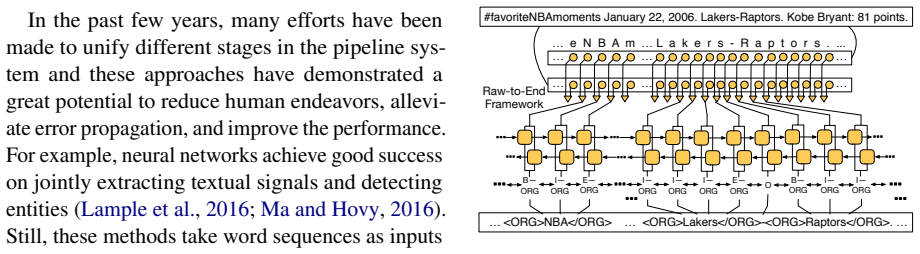
The load-bearing machinery is the character-level representation built from two aligned signal sources. First, each character is attached to a word embedding by aligning the raw character stream to a dictionary: either through a tokenizer's boundaries or, tokenization-free, by matching dictionary substrings and choosing the highest-IDF match for each character. Second, bidirectional character-level language models pre-trained on a large raw tweet corpus provide contextualized vectors for each character, projected down and concatenated with the embedding. The full per-character vector sequence is decoded by a linear-chain CRF over a Bi-LSTM, so all predictions are made at character granularity and no word segmentation is required at inference.
What would settle it
Manually inspect a random sample of, say, 200 converted character-level annotations from TNT or BTC, checking that every entity span in the raw tweet maps to the exact B/I/E/S characters; alternatively, build a small character-level gold set by independent annotation and compare the model's F1 on it with the converted-label F1. If the conversion is accurate, the two should agree; systematic disagreements would falsify the central comparison.
Extended reading notes
Core claim
The central discovery is that a raw-to-end character-level NER framework can sidestep tokenization errors and still exploit word embeddings and contextualized language models. The paper constructs, for each character, a representation that concatenates a word embedding aligned to that character (either through a tokenizer or through dictionary string matching with IDF selection) and a contextualized character representation from pre-trained forward and backward character-level language models. These representations feed an LSTM-CRF that labels characters directly. On TNT and BTC, the best variant (string matching) reaches 86.96 and 74.98 F1, gains of 3.70 and 6.65 over strong word-level baselines, and the authors report the model's F1 is unchanged when tokenization is swapped for string matching, indicating it is effectively tokenization-free.
Load-bearing premise
The results assume that the Appendix A procedure that converts word-level gold annotations into character-level BIOES labels is correct; if the raw-to-processed string alignment misplaces even a small fraction of entity boundaries, both the proposed model and the baselines are scored against corrupted labels and the reported F1 gaps may not reflect true performance.
Editorial extensions
If this is right
- If the claim holds, NER on noisy text can be run with no tokenizer at all, eliminating a whole class of preprocessing-induced errors such as entity boundaries hidden inside one token.
- Since the string-matching variant matches or exceeds the tokenizer-based variant, any pre-existing word embedding can be aligned to raw text without knowing which tokenizer it was trained with.
- The large F1 drops observed when baseline models switch between different system tokenizers would become irrelevant for a tokenization-free system.
- Character-level BIOES predictions imply the model can recognize entities that span partial tokens, which word-level CRFs cannot represent.
Reading between the lines
- The same raw-to-end recipe—character inputs, dictionary-based embedding alignment, and character-level language models—could transfer to other tokenization-sensitive sequence tasks such as part-of-speech tagging or chunking on social media, though the paper does not test this.
- Because the reported gains depend on an automatic conversion of word-level gold labels to character-level labels, one testable extension is to evaluate on an independently annotated character-level corpus; if conversion errors exist, the gain relative to word-level models could shrink.
- The IDF-based string matching alignment is essentially a parameter-free way to select the most informative dictionary match; it could be compared against learned span selection to see whether the simple heuristic is near-optimal.
Signed reviews
Editorial analysis
A structured set of objections, weighed in public.
Referee Report
Summary. The paper proposes Neural-Char-CRF, a character-level sequence labeling model for named entity recognition (NER) on noisy social media text. Instead of tokenizing first, the model consumes raw character sequences, constructs per-character representations by aligning pre-trained word embeddings either through a tokenizer or through a string-matching procedure, and augments them with contextualized character representations from a pre-trained bidirectional character-level language model. Decoding uses a Bi-LSTM-CRF. Experiments on the TNT and BTC datasets report absolute F1 gains of 3.70 and 6.65 over the best tested word-level baselines, and an ablation study attributes large gains to the two representation modules. The paper further observes that replacing tokenizer-based alignment with string matching leaves performance essentially unchanged, which is used to argue that the model is tokenization-free.
Significance. The contribution is potentially significant for noisy-text NER: it shows that a character-level system can avoid tokenization-error propagation and outperform strong word-level baselines on Twitter data, and it provides a conceptually clean design that integrates word embeddings and language models at the character level. The strengths include the public release of implementations and datasets, evaluation on two standard benchmarks with recommended splits, two complementary embedding-alignment strategies, and both ablation and case-study analyses. The main qualifications are that the converted character-level gold labels are unvalidated, the empirical comparisons are single runs without significance testing, and the 'state-of-the-art' claim is not benchmarked against all relevant published systems. With these issues addressed, the result would be a solid empirical contribution.
major comments (4)
- [§4.1, Appendix A] The conversion of word-level annotations to character-level BIOES labels in Appendix A is the load-bearing step for every reported F1 score, since it produces both the training labels for Neural-Char-CRF and the evaluation labels for all baselines. The procedure is under-specified (the alignment of the reverted dictionary with the concatenated tokenized string is not described as an algorithm, and no handling of ambiguous or failed matches is given) and no validation is reported: there is no manual audit, no agreement statistic, and no alignment error rate. §4.1 itself notes that this process is hard to revert, which makes the absence of validation particularly serious. The authors should validate the conversion on a random sample, report the alignment success rate, and ideally re-score systems on the original word-level annotations to show that the converted labels are faithful.
- [§4.4, Table 2] All reported F1 numbers are point estimates from single runs; no standard deviations, confidence intervals, or significance tests are provided, although the text uses 'significant' for the main gains and the ablations. This is a concern for the central claim because seed and optimization variance can be non-negligible in LSTM-CRF models of this size. Please report mean±std over multiple seeds and include paired significance tests (or bootstrap CIs) for the main comparisons in Tables 2, 4, and 5.
- [§4.2, Table 2] The claim of advancing state of the art by 3.70 and 6.65 absolute F1 is made relative to the authors' own reimplementations of four baselines, but the original system that introduced TNT (Lu et al., 2018) is not included among the baselines, and no published state-of-the-art numbers for BTC are quoted. Since 'state-of-the-art' is an external claim, please either include the original TNT system and any published BTC SOTA results, or restate the claim explicitly as 'best among the baselines considered here.' This is needed to make the headline result falsifiable.
- [§3.1] The string-matching alignment algorithm is described only at a high level: the text states that all possible matches are sorted by IDF and that the highest-IDF match is retrieved for each character, but it does not specify how overlapping matches of different lengths or nested matches are resolved, how ties are broken, or why the union-find implementation realizes that objective. A precise step-by-step algorithm or pseudocode is needed to make the method reproducible and to support the O(T α(T)) complexity claim.
minor comments (5)
- [Title] The title reads 'Name Entity Recognition'; the standard term is 'Named Entity Recognition.' Please correct it.
- [§4.4] There is a typographical error 'toknenization' in the sentence after Table 3; it should be 'tokenization.'
- [Table 6] The statement that incorrect outputs are marked red and bold cannot be verified in black-and-white print; please add a legend or marks such as an asterisk.
- [§4.3] The hyperparameter details are given in prose; a table listing language model, embedding, and NER hyperparameters would improve reproducibility.
- [Equation (1)] The notation in Eq. (1) is slightly confusing: the product over t=1..T with φ(y_{t-1},y_t,z_t) requires y_0; please define a boundary label y_0.
Circularity Check
No significant circularity: the central claim is an empirical comparison on public benchmarks, and the model's components are independently trained or standard baselines.
full rationale
The paper's central claim is that a character-level raw-to-end NER model outperforms word-level state-of-the-art systems on two public Twitter benchmarks (TNT and BTC). This is evaluated against external datasets with standard splits, and the reported F1 gains are the result of training and testing concrete neural models, not of any parameter fitted to the test labels being renamed as a prediction. The proposed components — tokenization-based and string-matching-based word embedding alignment, character-level language models, and LSTM-CRF decoding — are all specified independently of the evaluation labels. The label conversion from word-level to character-level annotations in Appendix A is a deterministic index-mapping procedure; while it is a data-processing assumption that could affect all compared methods equally, it is not a circular step because it does not encode the model's outputs or predictions. Self-citations appear for baselines (e.g., LM-LSTM-CRF), embedding-dictionary construction, and optimizer details, but none of these citations is load-bearing as an unverified substitute for the paper's empirical demonstration. The ablation study, case study, and tokenizer-swap experiments provide additional independent evidence. Therefore no step in the derivation chain reduces by construction to its own inputs, and the appropriate circularity score is 0.
Assumptions & free parameters
free parameters (3)
- Contextual character LM hidden size =
2048
- Contextual representation projection dimension =
100
- Decoder Bi-LSTM hidden size =
256
assumptions (3)
- domain assumption The Appendix A character-level annotation conversion correctly maps word-level gold annotations to raw character sequences.
- domain assumption The pretrained word embeddings and character LMs are trained on corpora that do not include the test sets' gold labels, and the test sets are not used for hyperparameter tuning.
- domain assumption The IDF-based string matching disambiguates overlapping dictionary matches to the correct word.
Cite this review
Pith. "Pith review of Raw-to-End Name Entity Recognition in Social Media." pith.science (2026). https://pith.science/paper/SGPA7DUH
@misc{pith2026190805344,
  author       = {Pith},
  title        = {Pith review of: Raw-to-End Name Entity Recognition in Social Media},
  year         = {2026},
  howpublished = {\url{https://pith.science/paper/SGPA7DUH}},
  note         = {Machine review of arXiv:1908.05344}
}
read the original abstract
Taking word sequences as the input, typical named entity recognition (NER) models neglect errors from pre-processing (e.g., tokenization). However, these errors can influence the model performance greatly, especially for noisy texts like tweets. Here, we introduce Neural-Char-CRF, a raw-to-end framework that is more robust to pre-processing errors. It takes raw character sequences as inputs and makes end-to-end predictions. Word embedding and contextualized representation models are further tailored to capture textual signals for each character instead of each word. Our model neither requires the conversion from character sequences to word sequences, nor assumes tokenizer can correctly detect all word boundaries. Moreover, we observe our model performance remains unchanged after replacing tokenization with string matching, which demonstrates its potential to be tokenization-free. Extensive experimental results on two public datasets demonstrate the superiority of our proposed method over the state of the art. The implementations and datasets are made available at: https://github.com/LiyuanLucasLiu/Raw-to-End.
Figures


Figures from the paper (2 more)


Reference graph
Works this paper leans on
-
[1]
Alan Akbik, Duncan Blythe, and Roland Vollgraf. 2018. Contextual string embeddings for sequence labeling. In Proceedings of the 27th International Conference on Computational Linguistics, pages 1638--1649
2018
-
[2]
Mikel Artetxe, Gorka Labaka, Inigo Lopez-Gazpio, and Eneko Agirre. 2018. Uncovering divergent linguistic information in word embeddings with lessons for intrinsic and extrinsic evaluation. In Proceedings of the 22nd Conference on Computational Natural Language Learning, pages 282--291
work page 2018
-
[3]
Yoshua Bengio, R \'e jean Ducharme, Pascal Vincent, and Christian Jauvin. 2003. A neural probabilistic language model. Journal of machine learning research, 3(Feb):1137--1155
work page 2003
-
[4]
Steven Bird, Ewan Klein, Edward Loper, and Jason Baldridge. 2008. Multidisciplinary instruction with the natural language toolkit. In Proceedings of the Third Workshop on Issues in Teaching Computational Linguistics, pages 62--70. Association for Computational Linguistics
work page 2008
-
[5]
Colin Cherry and Hongyu Guo. 2015. The unreasonable effectiveness of word representations for twitter named entity recognition. In Proceedings of the 2015 Conference of the North American Chapter of the Association for Computational Linguistics: Human Language Technologies, pages 735--745
work page 2015
-
[6]
Jason PC Chiu and Eric Nichols. 2016. Named entity recognition with bidirectional lstm-cnns. Transactions of the Association for Computational Linguistics, 4:357--370
work page 2016
-
[7]
Leon Derczynski, Kalina Bontcheva, and Ian Roberts. 2016. Broad twitter corpus: A diverse named entity recognition resource. In Proceedings of COLING 2016, pages 1169--1179
work page 2016
-
[8]
Leon Derczynski, Eric Nichols, Marieke van Erp, and Nut Limsopatham. 2017. Results of the wnut2017 shared task on novel and emerging entity recognition. In Proceedings of the 3rd Workshop on Noisy User-generated Text, pages 140--147
2017
Show all 45 references
-
[9]
Jacob Devlin, Ming-Wei Chang, Kenton Lee, and Kristina Toutanova. 2018. Bert: Pre-training of deep bidirectional transformers for language understanding. arXiv preprint arXiv:1810.04805
2018 arXiv
-
[10]
Timothy Dozat. 2016. Incorporating nesterov momentum into adam
2016
-
[11]
J. R. Finkel, T. Grenager, and C. Manning. 2005. Incorporating non-local information into information extraction systems by G ibbs sampling. In Association for Computational Linguistics (ACL), pages 363--370
2005
-
[12]
Zellig S Harris. 1954. Distributional structure. Word, 10(2-3):146--162
1954
-
[13]
Geoffrey E Hinton. 1986. Learning distributed representations of concepts. In Proceedings of the eighth annual conference of the cognitive science society, volume 1, page 12. Amherst, MA
1986
-
[14]
Matthew Honnibal and Ines Montani. 2017. spacy 2: Natural language understanding with bloom embeddings, convolutional neural networks and incremental parsing. Version: 2.0.18
2017
-
[15]
Jeremy Howard and Sebastian Ruder. 2018. Universal language model fine-tuning for text classification. In Proceedings of the 56th Annual Meeting of the Association for Computational Linguistics (Volume 1: Long Papers), volume 1, pages 328--339
2018
-
[16]
Zhiheng Huang, Wei Xu, and Kai Yu. 2015. Bidirectional lstm-crf models for sequence tagging. arXiv preprint arXiv:1508.01991
2015 arXiv
-
[17]
Diederik P Kingma and Jimmy Ba. 2014. Adam: A method for stochastic optimization. arXiv preprint arXiv:1412.6980
2014 arXiv
-
[18]
Onur Kuru, Ozan Arkan Can, and Deniz Yuret. 2016. Charner: Character-level named entity recognition. In Proceedings of COLING 2016, the 26th International Conference on Computational Linguistics: Technical Papers, pages 911--921
2016
-
[19]
Guillaume Lample, Miguel Ballesteros, Sandeep Subramanian, Kazuya Kawakami, and Chris Dyer. 2016. Neural architectures for named entity recognition. In Proceedings of NAACL-HLT, pages 260--270
2016
-
[20]
Robert Leaman, Graciela Gonzalez, et al. 2008. Banner: an executable survey of advances in biomedical named entity recognition. In Pacific Symposium on Biocomputing, volume 13, pages 652--663. Citeseer
2008
-
[21]
Ying Lin, Liyuan Liu, Heng Ji, Dong Yu, and Jiawei Han. 2019. Reliability-aware dynamic feature composition for name tagging. In Proceedings of the 57th Conference of the Association for Computational Linguistics, pages 165--174
2019
-
[22]
Jialu Liu, Jingbo Shang, Chi Wang, Xiang Ren, and Jiawei Han. 2015. Mining quality phrases from massive text corpora. In Proceedings of the 2015 ACM SIGMOD International Conference on Management of Data, pages 1729--1744. ACM
2015
-
[23]
Liyuan Liu, Haoming Jiang, Pengcheng He, Weizhu Chen, Xiaodong Liu, Jianfeng Gao, and Jiawei Han. 2019 a . On the variance of the adaptive learning rate and beyond. arXiv preprint arXiv:1908.03265
2019 arXiv
-
[24]
Liyuan Liu, Xiang Ren, Jingbo Shang, Xiaotao Gu, Jian Peng, and Jiawei Han. 2018 a . Efficient contextualized representation: Language model pruning for sequence labeling. In Proceedings of the 2018 Conference on Empirical Methods in Natural Language Processing, pages 1215--1225
2018
-
[25]
Liyuan Liu, Jingbo Shang, and Jiawei Han. 2019 b . Arabic named entity recognition: What works and what’s next. In Proceedings of the Fourth Arabic Natural Language Processing Workshop, pages 60--67
2019
-
[26]
Liyuan Liu, Jingbo Shang, Xiang Ren, Frank Fangzheng Xu, Huan Gui, Jian Peng, and Jiawei Han. 2018 b . Empower sequence labeling with task-aware neural language model. In Thirty-Second AAAI Conference on Artificial Intelligence
2018
-
[27]
Di Lu, Leonardo Neves, Vitor Carvalho, Ning Zhang, and Heng Ji. 2018. Visual attention model for name tagging in multimodal social media. In Proceedings of the ACL, volume 1, pages 1990--1999
2018
-
[28]
Xuezhe Ma and Eduard Hovy. 2016. End-to-end sequence labeling via bi-directional lstm-cnns-crf. arXiv preprint arXiv:1603.01354
2016 arXiv
-
[29]
Manning, Mihai Surdeanu, John Bauer, Jenny Finkel, Steven J
Christopher D. Manning, Mihai Surdeanu, John Bauer, Jenny Finkel, Steven J. Bethard, and David McClosky. 2014. http://www.aclweb.org/anthology/P/P14/P14-5010 The Stanford CoreNLP natural language processing toolkit . In Association for Computational Linguistics (ACL) System De...
2014
-
[30]
Bryan McCann, James Bradbury, Caiming Xiong, and Richard Socher. 2017. Learned in translation: Contextualized word vectors. In Advances in Neural Information Processing Systems, pages 6294--6305
2017
-
[31]
Tomas Mikolov, Kai Chen, Greg Corrado, and Jeffrey Dean. 2013. Efficient estimation of word representations in vector space. arXiv preprint arXiv:1301.3781
2013 arXiv
-
[32]
Shubhanshu Mishra and Jana Diesner. 2016. http://aclweb.org/anthology/W16-3927 Semi-supervised named entity recognition in noisy-text . In Proceedings of the 2nd Workshop on Noisy User-generated Text (WNUT), pages 203--212. The COLING 2016 Organizing Committee
2016
-
[33]
Jeffrey Pennington, Richard Socher, and Christopher Manning. 2014. Glove: Global vectors for word representation. In Proceedings of the 2014 conference on empirical methods in natural language processing (EMNLP), pages 1532--1543
2014
-
[34]
Matthew Peters, Waleed Ammar, Chandra Bhagavatula, and Russell Power. 2017. Semi-supervised sequence tagging with bidirectional language models. In Proceedings of the ACL, volume 1, pages 1756--1765
2017
-
[35]
Matthew Peters, Mark Neumann, Mohit Iyyer, Matt Gardner, Christopher Clark, Kenton Lee, and Luke Zettlemoyer. 2018. Deep contextualized word representations. In Proceedings of NAACL-HLT, volume 1, pages 2227--2237
2018
-
[36]
Alec Radford, Karthik Narasimhan, Tim Salimans, and Ilya Sutskever. 2018. Improving language understanding by generative pre-training
2018
-
[37]
Lev Ratinov and Dan Roth. 2009. Design challenges and misconceptions in named entity recognition. In Proceedings of the ACL
2009
-
[38]
Nils Reimers and Iryna Gurevych. 2017. Optimal hyperparameters for deep lstm-networks for sequence labeling tasks. arXiv preprint arXiv:1707.06799
2017 arXiv
-
[39]
Burr Settles. 2004. Biomedical named entity recognition using conditional random fields and rich feature sets. In Proceedings of the international joint workshop on natural language processing in biomedicine and its applications, pages 104--107. Association for Computational L...
2004
-
[40]
Jingbo Shang, Jialu Liu, Meng Jiang, Xiang Ren, Clare R Voss, and Jiawei Han. 2018. Automated phrase mining from massive text corpora. IEEE TKDE
2018
-
[41]
Karen Sparck Jones. 1972. A statistical interpretation of term specificity and its application in retrieval. Journal of documentation, 28(1):11--21
1972
-
[42]
Benjamin Strauss, Bethany Toma, Alan Ritter, Marie-Catherine De Marneffe, and Wei Xu. 2016. Results of the wnut16 named entity recognition shared task. In Proceedings of the 2nd Workshop on Noisy User-generated Text (WNUT), pages 138--144
2016
-
[43]
Kelly W Zhang and Samuel R Bowman. 2018. Language modeling teaches you more syntax than translation does: Lessons learned through auxiliary task analysis. EMNLP 2018, page 359
2018
-
[44]
URL: " 'urlintro :=
ENTRY address author booktitle chapter edition editor howpublished institution journal key month note number organization pages publisher school series title type volume year eprint doi pubmed url lastchecked label extra.label sort.label short.list INTEGERS output.state before...
-
[45]
write newline
" write newline "" before.all 'output.state := FUNCTION n.dashify 't := "" t empty not t #1 #1 substring "-" = t #1 #2 substring "--" = not "--" * t #2 global.max substring 't := t #1 #1 substring "-" = "-" * t #2 global.max substring 't := while if t #1 #1 substring * t #2 gl...
Reviewed August 14, 2026 · model on record in the stance chip above.
Discussion (0). Continue with ORCID to comment.