REVIEW 4 major objections 4 minor 57 references
Efficient Speech Command Recognition Leveraging Spiking Neural Network and Curriculum Learning-based Knowledge Distillation
T0 review · 4 major / 4 minor · reviewed 2026-08-11 · deepseek-v4-flash
Pith's one-line read This paper claims a fully spike-driven speech recognizer can match state-of-the-art accuracy while running on 60% fewer time steps through curriculum-based knowledge distillation.
desk verdict Solid SNN accuracy engineering with a genuinely useful curriculum distillation idea, but the headline energy number is an operation-count claim that doesn't yet hold up. read the letter →
The pith
A machine-rendered reading of the paper's core claim, the machinery that carries it, and where it could break.
The reading
What carries the argument
The load-bearing mechanism is the pairing of a spike-domain rotary position encoding with a curriculum of distillation teachers. Instead of injecting float-valued sinusoidal position vectors, SpikeSCR applies rotary position embeddings through a Hadamard product followed immediately by a LIF spike neuron, so positional information enters the spiking self-attention without converting the whole feature map back to real-valued multiply-accumulate computation. The local branch uses a spiking gated unit that gates one split of the features with the spiking output of the other split, keeping operations as spike-based accumulates. KDCL is the second half of the machinery: a teacher trained on long time steps is frozen and its logits distilled into a student at shorter time steps, then the student becomes the next teacher, so knowledge moves down the curriculum ladder one rung at a time.
What would settle it
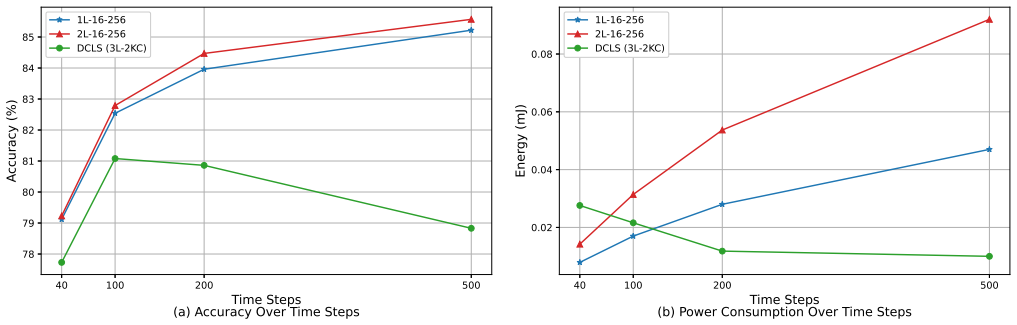
Take the two-block SpikeSCR at 40 and 100 time steps on the SSC test set, run it on a neuromorphic chip or a cycle-accurate power simulator, and compare measured per-command energy to the reported 0.0142 mJ and 0.0314 mJ; a reduction far from 54.8%, or a cost breakdown showing the rotary-position MACs dominate, would refute the energy claim.
Extended reading notes
Core claim
On its own terms, the paper's central discovery is that the accuracy-latency trade-off of a spiking network in speech command recognition can be moved by architecture and by curriculum distillation rather than by adding parameters. SpikeSCR is a global-local hybrid: the global path is spiking self-attention with rotary position embeddings applied inside the spike domain, and the local path is a separable convolution with a spiking gated unit that keeps computation in sparse spike-accumulate operations. Trained directly, it outperforms prior spiking networks on SHD, SSC, and GSC at equal time steps, and its accuracy keeps improving as time steps grow to 400-500 instead of saturating. KDCL then turns the long-time-step model into a teacher, distilling it stepwise to 200, 100, and finally 40 time steps; the paper reports 60% fewer time steps and a 54.8% drop in estimated energy while accuracy stays within a point or two of 100-step state-of-the-art results.
Load-bearing premise
The energy-reduction claim rests on a cost model that counts only spike-based accumulate operations at a fixed 0.9 pJ each, while ignoring memory access, control overhead, and the real-valued rotary position embedding that is applied before the next spiking layer.
Editorial extensions
If this is right
- At 40 time steps, the distilled SpikeSCR is competitive with 100-step state-of-the-art models on all three benchmarks, so always-on keyword spotting can run with lower latency and a smaller energy budget.
- Because SpikeSCR accuracy still rises at 400-500 time steps, it can serve as a stable teacher for distillation, a role that the dilated-convolution baseline cannot fill since its accuracy declines at long time steps.
- The combination of rotary position embedding followed by a LIF neuron shows that positional information can be added in the spike domain without switching to float multiply-accumulate operations.
- The KDCL schedule is not tied to speech: any temporal SNN trained with long time steps can be chained through successive shorter-time-step students to compress latency with modest accuracy loss.
Reading between the lines
- A natural next experiment, not run in the paper, would apply KDCL to event-based audio or video with more than two curricula to see whether the 60% time-step reduction generalizes or saturates.
- Recomputing the energy ledger with the multiply-accumulate operations hidden in the rotary position embedding and with memory-access costs would likely raise the absolute energy numbers; the qualitative ranking of 40-step versus 100-step models may survive, but the 54.8% figure probably would not.
- The ablation pattern suggests that on Mel-spectrogram inputs the local separable gated convolution carries more of the accuracy than the global attention branch, a ranking worth testing on other audio features such as raw waveforms.
Signed reviews
Editorial analysis
A structured set of objections, weighed in public.
Referee Report
Summary. The paper proposes SpikeSCR, a fully spike-driven SNN architecture for speech command recognition that combines spiking self-attention with rotary position embedding (global branch) and a separable gated convolution module (local branch), together with a curriculum-learning-based knowledge distillation method (KDCL) that transfers knowledge from models trained with long time steps to students trained with shorter time steps. The authors evaluate on SHD, SSC, and GSC and report that SpikeSCR outperforms prior SNN methods at matched time steps, and that KDCL allows a 60% reduction in time steps and a 54.8% reduction in energy while keeping performance comparable to recent SOTA.
Significance. If the main empirical claims hold, the paper makes a useful contribution: the architecture is a reasonable synthesis of spiking attention, rotary position encoding, and gated convolutions, and the KDCL schedule is a practical way to recover accuracy at short time steps. The systematic ablations (Tables 3, 9, 10), the matched-time-step comparisons with DCLS (Tables 1, 7, 8), and the use of the SpikingJelly framework are strengths. However, the headline energy-reduction number rests on an idealized operation-count model that omits real-valued operations and memory costs, and several key accuracy comparisons are reported without variance estimates. These issues are load-bearing for the abstract's central claims and need to be addressed before the paper can be accepted.
major comments (4)
- [Appendix D, Tables 7 and 8] The energy model in Eqs. (19)-(20) counts only MAC operations for the first Conv layer and AC operations for all subsequent layers, but the RoPE operation in Eq. (6), Q'_S = SN_RQ(R_Q ⊙ Q_S), involves an elementwise Hadamard product between a binary spike tensor Q_S and a real-valued rotary matrix R_Q. This operation is not a spike-based AC operation, and it produces real-valued intermediate activations before the LIF neuron re-spikifies them. The cost of this operation, including memory traffic, is absent from the energy accounting, yet it is precisely the operation introduced to improve accuracy. Because the abstract's 54.8% energy reduction is computed from these tables, the headline number is at best an operation-count reduction, not a hardware energy reduction. The authors should either extend the model to include RoPE's real-valued multiplies and memory costs, or explicitly present the numbers as theoretical AC/MAC counts with a clear caveat that real hardware energy will be higher.
- [Algorithm 1] The distillation step is not well-defined as written. In Algorithm 1, the teacher receives mini-batch x1(i) from D1 and the student receives mini-batch x2(i) from D2, and then LKD is computed between OT1(i) and OS1(i). For KL-divergence distillation to be meaningful, x1(i) and x2(i) must be paired versions of the same utterance under the easy and hard curricula. The text only says "D1 and D2 synchronization" without explaining how the two data streams are aligned. If they are not paired, the distillation objective compares teacher predictions on one input with student predictions on a different input, which does not transfer per-sample knowledge and may actually harm training. The authors must state explicitly how synchronization is performed and confirm that both models see the same underlying samples at each iteration.
- [Tables 1, 3, 7, 8] All accuracy results are reported as single numbers without error bars or multiple seeds. Several of the most important comparisons are very close, for example SSC 80.25% vs. DCLS 80.16% and GSC 95.01% vs. DCLS 95.00% in Table 1. With a single run it is not possible to know whether these differences are statistically meaningful, yet the abstract and main text describe these as clear SOTA improvements. At minimum, the authors should report mean and standard deviation over at least three independent training runs for the main configurations, and temper the SOTA language if the margins are within noise.
- [Tables 7 and 8] The reported energy consumption of the DCLS baseline decreases as the number of time steps increases (Table 7: 0.0276 mJ at 40 steps, 0.0216 at 100, 0.0118 at 200, 0.0110 at 500; Table 8 shows a similar but milder trend). Since longer time steps normally imply more temporal processing, this trend is surprising and suggests that the SOP counting, firing-rate estimation, or input preprocessing is doing something non-obvious for DCLS. The paper's explanation in Appendix C that DCLS "mitigates rising energy consumption by learning delays with only a few kernel counts" is not quantitatively justified. The authors should either explain the mechanism with measured firing rates or acknowledge that the comparison is not apples-to-apples in terms of how time steps affect each architecture.
minor comments (4)
- [Table 1] The caption says "† indicates the performance after KDCL" but the entries use a slash notation such as "93.60 †/92.01"; the meaning of the number before and after the slash is not explained and should be clarified.
- [Appendix E] The code availability statement says the organized code "will be made publicly available upon reaching the camera-ready version." For a paper whose main claims are empirical and whose comparisons depend on exact preprocessing and energy accounting, releasing code and random seeds at submission time, or at least providing a detailed configuration file, would substantially improve reproducibility.
- [Section KDCL] The loss weight λ2 = 0.5 is described as "refined through experiments" but no sensitivity analysis is shown. A short ablation over λ2 and the distillation temperature τ would help the reader judge how robust the KDCL gains are to hyperparameter choice.
- [Appendix D] Equation (18) defines SOP^l = fr^{l-1} × FLOP^l but does not state whether the firing rate is averaged over time steps or per simulation, nor whether FLOP^l is per time step or over the full sequence. This ambiguity makes it difficult to reproduce the energy numbers in Tables 7 and 8.
Circularity Check
No significant circularity; the results are empirical and the energy estimates follow a stated external cost model.
full rationale
The paper's central claims are empirical: SpikeSCR accuracy numbers are measured on three benchmarks, and the KDCL results compare trained student models against trained teachers. No prediction is derived by construction from a fitted parameter: the KDCL loss weights (lambda1 = 1.0, lambda2 = 0.5) are validation-tuned hyperparameters, not inputs that force the reported accuracies. The 54.8% energy reduction is computed from a transparent operation-count model (Appendix D, Eqs. 18-20) using fixed hardware cost constants (E_MAC = 4.6 pJ, E_AC = 0.9 pJ at 45nm). That the reduction follows from fewer time steps and fewer spike operations is the intended meaning of the claim, not a hidden equivalence between input and output. The paper cites prior work by overlapping authors (e.g., Spikformer for SSA, SGLFormer as one of several references for the energy-calculation convention), but these citations are not load-bearing axioms; the architecture component SSA is used as a building block and the energy formula is standard in the SNN literature and independently grounded in Horowitz's 45nm data. The skeptic's concern that the energy model omits memory access, control overhead, and real-valued RoPE operations is a correctness or realism concern about the energy metric, not circularity: under the paper's own stated model, the energy numbers are legitimate, and the paper does not disguise a fitted quantity as a prediction. Therefore, no circular step meeting the required evidentiary standard is present.
Assumptions & free parameters
free parameters (6)
- KDCL loss weight lambda2 =
0.5
- Curriculum time-step schedule =
SHD: 100, 40; SSC/GSC: 500, 200, 100, 40
- EventDrop augmentation parameters =
drop proportion 0.5, time drop 0.2 for SHD and 0.1 for SSC, neuron drop 20 for SHD and 10 for SSC
- SpecAugment mask parameters =
1 frequency mask of size 10 and 1 time mask of size 0.25
- LIF neuron parameters =
tau = 2.0, V_threshold = 1.0
- Architecture dimensions =
1 or 2 SGLE blocks, 8 or 16 heads, hidden sizes 128 or 256, depthwise kernel 31
assumptions (4)
- domain assumption LIF neuron dynamics and surrogate-gradient BPTT can train the network end-to-end.
- domain assumption Energy cost is fully captured by SOP counts with E_AC = 0.9 pJ and E_MAC = 4.6 pJ on 45nm hardware, ignoring memory and control overhead.
- ad hoc to paper The rotary position embedding applied to spike tensors can be implemented without additional MAC operations beyond the counted AC operations.
- domain assumption Using the DCLS preprocessing pipeline, including spatio-temporal binning of 700 input neurons into 140, preserves comparability with prior SOTA results.
Cite this review
Pith. "Pith review of Efficient Speech Command Recognition Leveraging Spiking Neural Network and Curriculum Learning-based Knowledge Distillation." pith.science (2026). https://pith.science/paper/SH6DCGNI
@misc{pith2026241212858,
  author       = {Pith},
  title        = {Pith review of: Efficient Speech Command Recognition Leveraging Spiking Neural Network and Curriculum Learning-based Knowledge Distillation},
  year         = {2026},
  howpublished = {\url{https://pith.science/paper/SH6DCGNI}},
  note         = {Machine review of arXiv:2412.12858}
}
read the original abstract
The intrinsic dynamics and event-driven nature of spiking neural networks (SNNs) make them excel in processing temporal information by naturally utilizing embedded time sequences as time steps. Recent studies adopting this approach have demonstrated SNNs' effectiveness in speech command recognition, achieving high performance by employing large time steps for long time sequences. However, the large time steps lead to increased deployment burdens for edge computing applications. Thus, it is important to balance high performance and low energy consumption when detecting temporal patterns in edge devices. Our solution comprises two key components. 1). We propose a high-performance fully spike-driven framework termed SpikeSCR, characterized by a global-local hybrid structure for efficient representation learning, which exhibits long-term learning capabilities with extended time steps. 2). To further fully embrace low energy consumption, we propose an effective knowledge distillation method based on curriculum learning (KDCL), where valuable representations learned from the easy curriculum are progressively transferred to the hard curriculum with minor loss, striking a trade-off between power efficiency and high performance. We evaluate our method on three benchmark datasets: the Spiking Heidelberg Dataset (SHD), the Spiking Speech Commands (SSC), and the Google Speech Commands (GSC) V2. Our experimental results demonstrate that SpikeSCR outperforms current state-of-the-art (SOTA) methods across these three datasets with the same time steps. Furthermore, by executing KDCL, we reduce the number of time steps by 60% and decrease energy consumption by 54.8% while maintaining comparable performance to recent SOTA results. Therefore, this work offers valuable insights for tackling temporal processing challenges with long time sequences in edge neuromorphic computing systems.
Figures


Figures from the paper (7 more)


Reference graph
Works this paper leans on
-
[1]
Bittar, A.; and Garner, P. N. 2022. A surrogate gradient spiking baseline for speech command recognition. Frontiers in Neuroscience, 16: 865897
work page 2022
-
[2]
Bu, T.; Fang, W.; Ding, J.; DAI, P.; Yu, Z.; and Huang, T. 2022. Optimal ANN - SNN Conversion for High-accuracy and Ultra-low-latency Spiking Neural Networks. In International Conference on Learning Representations
2022
-
[3]
Chen, G.; Peng, P.; Li, G.; and Tian, Y. 2023. Training full spike neural networks via auxiliary accumulation pathway. arXiv preprint arXiv:2301.11929
arXiv 2023
-
[4]
Cramer, B.; Stradmann, Y.; Schemmel, J.; and Zenke, F. 2020. The heidelberg spiking data sets for the systematic evaluation of spiking neural networks. IEEE Transactions on Neural Networks and Learning Systems, 33(7): 2744--2757
work page 2020
-
[5]
Dampfhoffer, M.; Mesquida, T.; Valentian, A.; and Anghel, L. 2022. Investigating current-based and gating approaches for accurate and energy-efficient spiking recurrent neural networks. In International Conference on Artificial Neural Networks, 359--370. Springer
work page 2022
-
[6]
Datta, G.; Kundu, S.; Jaiswal, A. R.; and Beerel, P. A. 2022. ACE-SNN: Algorithm-hardware co-design of energy-efficient & low-latency deep spiking neural networks for 3d image recognition. Frontiers in Neuroscience, 16: 815258
work page 2022
-
[7]
N.; Fan, A.; Auli, M.; and Grangier, D
Dauphin, Y. N.; Fan, A.; Auli, M.; and Grangier, D. 2017. Language modeling with gated convolutional networks. In International Conference on Machine Learning, 933--941. PMLR
work page 2017
-
[8]
Deckers, L.; Van Damme, L.; Van Leekwijck, W.; Tsang, I. J.; and Latr \'e , S. 2024. Co-learning synaptic delays, weights and adaptation in spiking neural networks. Frontiers in Neuroscience, 18: 1360300
work page 2024
Show all 57 references
-
[9]
Deng, S.; and Gu, S. 2021. Optimal Conversion of Conventional Artificial Neural Networks to Spiking Neural Networks. In International Conference on Learning Representations
2021
-
[10]
Fang, W.; Chen, Y.; Ding, J.; Yu, Z.; Masquelier, T.; Chen, D.; Huang, L.; Zhou, H.; Li, G.; and Tian, Y. 2023. Spikingjelly: An open-source machine learning infrastructure platform for spike-based intelligence. Science Advances, 9(40): eadi1480
2023
-
[11]
Fang, W.; Yu, Z.; Chen, Y.; Huang, T.; Masquelier, T.; and Tian, Y. 2021. Deep Residual Learning in Spiking Neural Networks. In Advances in Neural Information Processing Systems, volume 34, 21056--21069
2021
-
[12]
Gu, F.; Sng, W.; Hu, X.; and Yu, F. 2021. EventDrop: Data Augmentation for Event-based Learning. In 30th International Joint Conference on Artificial Intelligence, IJCAI 202
2021
-
[13]
Gulati, A.; Qin, J.; Chiu, C.-C.; Parmar, N.; Zhang, Y.; Yu, J.; Han, W.; Wang, S.; Zhang, Z.; Wu, Y.; et al. 2020. Conformer: Convolution-augmented transformer for speech recognition. arXiv preprint arXiv:2005.08100
2020 arXiv
-
[14]
Guo, Y.; Chen, Y.; Liu, X.; Peng, W.; Zhang, Y.; Huang, X.; and Ma, Z. 2024. Ternary spike: Learning ternary spikes for spiking neural networks. In Proceedings of the AAAI Conference on Artificial Intelligence, volume 38, 12244--12252
2024
-
[15]
Hammouamri, I.; Khalfaoui-Hassani, I.; and Masquelier, T. 2024. Learning Delays in Spiking Neural Networks using Dilated Convolutions with Learnable Spacings. In International Conference on Learning Representations
2024
-
[16]
Horowitz, M. 2014. 1.1 computing's energy problem (and what we can do about it). In 2014 IEEE international solid-state circuits conference digest of technical papers (ISSCC), 10--14. IEEE
2014
-
[17]
Kim, K.; Ji, B.; Yoon, D.; and Hwang, S. 2021. Self-knowledge distillation with progressive refinement of targets. In Proceedings of the IEEE/CVF International Conference on Computer Vision, 6567--6576
2021
-
[18]
Kim, Y.; Li, Y.; Park, H.; Venkatesha, Y.; Hambitzer, A.; and Panda, P. 2023. Exploring temporal information dynamics in spiking neural networks. In Proceedings of the AAAI Conference on Artificial Intelligence, volume 37, 8308--8316
2023
-
[19]
Kugele, A.; Pfeil, T.; Pfeiffer, M.; and Chicca, E. 2020. Efficient processing of spatio-temporal data streams with spiking neural networks. Frontiers in Neuroscience, 14: 512192
2020
-
[20]
S.; Panda, P.; Srinivasan, G.; and Roy, K
Lee, C.; Sarwar, S. S.; Panda, P.; Srinivasan, G.; and Roy, K. 2020. Enabling spike-based backpropagation for training deep neural network architectures. Frontiers in Neuroscience, 14: 497482
2020
-
[21]
H.; Delbruck, T.; and Pfeiffer, M
Lee, J. H.; Delbruck, T.; and Pfeiffer, M. 2016. Training deep spiking neural networks using backpropagation. Frontiers in Neuroscience, 10: 508
2016
-
[22]
Liu, F.; Wang, Z.; Zhao, W.; Yang, N.; Chen, Y.; Huang, S.; Li, H.; Yang, T.; Pei, S.; Liang, X.; et al. 2024 a . Exploiting Temporal-Unrolled Parallelism for Energy-Efficient SNN Acceleration. IEEE Transactions on Parallel & Distributed Systems, (01): 1--16
2024
-
[23]
Liu, Z.; Datta, G.; Li, A.; and Beerel, P. A. 2024 b . LMUFormer: Low Complexity Yet Powerful Spiking Model With Legendre Memory Units. In International Conference on Learning Representations
2024
-
[24]
Logan, B.; et al. 2000. Mel frequency cepstral coefficients for music modeling. In Ismir, volume 270, 11
2000
-
[25]
Maass, W. 1997. Networks of spiking neurons: the third generation of neural network models. Neural Networks, 10(9): 1659--1671
1997
-
[26]
O.; Mostafa, H.; and Zenke, F
Neftci, E. O.; Mostafa, H.; and Zenke, F. 2019. Surrogate gradient learning in spiking neural networks: Bringing the power of gradient-based optimization to spiking neural networks. IEEE Signal Processing Magazine, 36(6): 51--63
2019
-
[27]
A.; and Roy, K
Panda, P.; Aketi, S. A.; and Roy, K. 2020. Toward scalable, efficient, and accurate deep spiking neural networks with backward residual connections, stochastic softmax, and hybridization. Frontiers in Neuroscience, 14: 653
2020
-
[28]
S.; Chan, W.; Zhang, Y.; Chiu, C.-C.; Zoph, B.; Cubuk, E
Park, D. S.; Chan, W.; Zhang, Y.; Chiu, C.-C.; Zoph, B.; Cubuk, E. D.; and Le, Q. V. 2019. Specaugment: A simple data augmentation method for automatic speech recognition. arXiv preprint arXiv:1904.08779
2019 arXiv
-
[29]
Rathi, N.; Chakraborty, I.; Kosta, A.; Sengupta, A.; Ankit, A.; Panda, P.; and Roy, K. 2023. Exploring neuromorphic computing based on spiking neural networks: Algorithms to hardware. ACM Computing Surveys, 55(12): 1--49
2023
-
[30]
Rathi, N.; and Roy, K. 2021. Diet-snn: A low-latency spiking neural network with direct input encoding and leakage and threshold optimization. IEEE Transactions on Neural Networks and Learning Systems, 34(6): 3174--3182
2021
-
[31]
R.; and Panda, P
Roy, K.; Jaiswal, A. R.; and Panda, P. 2019. Towards spike-based machine intelligence with neuromorphic computing. Nature, 575: 607 -- 617
2019
-
[32]
Sengupta, A.; Ye, Y.; Wang, R.; Liu, C.; and Roy, K. 2019. Going deeper in spiking neural networks: VGG and residual architectures. Frontiers in Neuroscience, 13: 95
2019
-
[33]
J.; Schuster, M.; Jaitly, N.; Yang, Z.; Chen, Z.; Zhang, Y.; Wang, Y.; Skerrv-Ryan, R.; et al
Shen, J.; Pang, R.; Weiss, R. J.; Schuster, M.; Jaitly, N.; Yang, Z.; Chen, Z.; Zhang, Y.; Wang, Y.; Skerrv-Ryan, R.; et al. 2018. Natural tts synthesis by conditioning wavenet on mel spectrogram predictions. In 2018 IEEE International Conference on Acoustics, Speech and Signa...
2018
-
[34]
Shen, S.; Zhao, D.; Shen, G.; and Zeng, Y. 2024. TIM: An Efficient Temporal Interaction Module for Spiking Transformer. arXiv preprint arXiv:2401.11687
2024 arXiv
-
[35]
M.; Shea, T.; Pacik-Nelson, N.; Gallo, E.; and Danielescu, A
Stewart, K. M.; Shea, T.; Pacik-Nelson, N.; Gallo, E.; and Danielescu, A. 2023. Speech2spikes: Efficient audio encoding pipeline for real-time neuromorphic systems. In Proceedings of the 2023 Annual Neuro-Inspired Computational Elements Conference, 71--78
2023
-
[36]
Su, J.; Ahmed, M.; Lu, Y.; Pan, S.; Bo, W.; and Liu, Y. 2024. Roformer: Enhanced transformer with rotary position embedding. Neurocomputing, 568: 127063
2024
-
[37]
Su, Q.; Chou, Y.; Hu, Y.; Li, J.; Mei, S.; Zhang, Z.; and Li, G. 2023. Deep directly-trained spiking neural networks for object detection. In Proceedings of the IEEE/CVF International Conference on Computer Vision, 6555--6565
2023
-
[38]
Sun, P.; Chua, Y.; Devos, P.; and Botteldooren, D. 2023 a . Learnable axonal delay in spiking neural networks improves spoken word recognition. Frontiers in Neuroscience, 17: 1275944
2023
-
[39]
Sun, P.; Eqlimi, E.; Chua, Y.; Devos, P.; and Botteldooren, D. 2023 b . Adaptive Axonal Delays in Feedforward Spiking Neural Networks for Accurate Spoken Word Recognition. In 2023 IEEE International Conference on Acoustics, Speech and Signal Processing (ICASSP), 1--5
2023
-
[40]
N.; Kaiser, .; and Polosukhin, I
Vaswani, A.; Shazeer, N.; Parmar, N.; Uszkoreit, J.; Jones, L.; Gomez, A. N.; Kaiser, .; and Polosukhin, I. 2017. Attention is all you need. Advances in Neural Information Processing Systems, 30
2017
-
[41]
H.; and Lim, M.-H
Wang, S.; Cheng, T. H.; and Lim, M.-H. 2022. LTMD: learning improvement of spiking neural networks with learnable thresholding neurons and moderate dropout. Advances in Neural Information Processing Systems, 35: 28350--28362
2022
-
[42]
Warden, P. 2018. Speech commands: A dataset for limited-vocabulary speech recognition. arXiv preprint arXiv:1804.03209
2018 arXiv
-
[43]
Wu, X.; Zhao, Y.; Song, Y.; Jiang, Y.; Bai, Y.; Li, X.; Zhou, Y.; Yang, X.; and Hao, Q. 2023. Dynamic threshold integrate and fire neuron model for low latency spiking neural networks. Neurocomputing, 544: 126247
2023
-
[44]
Xu, M.; Chen, X.; Guo, Y.; Wang, Y.; Qiu, D.; Du, X.; Cui, Y.; Wang, X.; and Xiong, J. 2023 a . Reconfigurable neuromorphic computing: Materials, devices, and integration. Advanced Materials, 35(51): 2301063
2023
-
[45]
K.; Tang, H.; and Pan, G
Xu, Q.; Li, Y.; Shen, J.; Liu, J. K.; Tang, H.; and Pan, G. 2023 b . Constructing deep spiking neural networks from artificial neural networks with knowledge distillation. In Proceedings of the IEEE/CVF Conference on Computer Vision and Pattern Recognition, 7886--7895
2023
-
[46]
Yang, H.; Lam, K.-Y.; Xiao, L.; Xiong, Z.; Hu, H.; Niyato, D.; and Vincent Poor, H. 2022. Lead federated neuromorphic learning for wireless edge artificial intelligence. Nature Communications, 13(1): 4269
2022
-
[47]
Yang, Q.; Liu, Q.; and Li, H. 2022. Deep residual spiking neural network for keyword spotting in low-resource settings. In Interspeech, 3023--3027
2022
-
[48]
Yang, S.; and Chen, B. 2023. SNIB: improving spike-based machine learning using nonlinear information bottleneck. IEEE Transactions on Systems, Man, and Cybernetics: Systems, 53(12): 7852--7863
2023
-
[49]
Yao, M.; Gao, H.; Zhao, G.; Wang, D.; Lin, Y.; Yang, Z.; and Li, G. 2021. Temporal-wise attention spiking neural networks for event streams classification. In Proceedings of the IEEE/CVF International Conference on Computer Vision, 10221--10230
2021
-
[50]
Yao, M.; Hu, J.; Hu, T.; Xu, Y.; Zhou, Z.; Tian, Y.; XU, B.; and Li, G. 2024. Spike-driven Transformer V2: Meta Spiking Neural Network Architecture Inspiring the Design of Next-generation Neuromorphic Chips. In International Conference on Learning Representations
2024
-
[51]
Zhang, H.; Zhou, C.; Yu, L.; Huang, L.; Ma, Z.; Fan, X.; Zhou, H.; and Tian, Y. 2024 a . SGLFormer: Spiking Global-Local-Fusion Transformer with High Performance. Frontiers in Neuroscience, 18: 1371290
2024
-
[52]
Zhang, S.; Yang, Q.; Ma, C.; Wu, J.; Li, H.; and Tan, K. C. 2024 b . Tc-lif: A two-compartment spiking neuron model for long-term sequential modelling. In Proceedings of the AAAI Conference on Artificial Intelligence, volume 38, 16838--16847
2024
-
[53]
Zhou, C.; Zhang, H.; Yu, L.; Ye, Y.; Zhou, Z.; Huang, L.; Ma, Z.; Fan, X.; Zhou, H.; and Tian, Y. 2024. Direct training high-performance deep spiking neural networks: a review of theories and methods. Frontiers in Neuroscience, 18
2024
-
[54]
Zhou, Z.; Zhu, Y.; He, C.; Wang, Y.; YAN, S.; Tian, Y.; and Yuan, L. 2023. Spikformer: When Spiking Neural Network Meets Transformer. In International Conference on Learning Representations
2023
-
[55]
Zhu, R.-J.; Zhang, M.; Zhao, Q.; Deng, H.; Duan, Y.; and Deng, L.-J. 2024. Tcja-snn: Temporal-channel joint attention for spiking neural networks. IEEE Transactions on Neural Networks and Learning Systems, 1--14
2024
-
[56]
, " * write output.state after.block = add.period write newline
ENTRY address archivePrefix author booktitle chapter edition editor eid eprint howpublished institution isbn journal key month note number organization pages publisher school series title type volume year label extra.label sort.label short.list INTEGERS output.state before.all...
-
[57]
write newline
" write newline "" before.all 'output.state := FUNCTION n.dashify 't := "" t empty not t #1 #1 substring "-" = t #1 #2 substring "--" = not "--" * t #2 global.max substring 't := t #1 #1 substring "-" = "-" * t #2 global.max substring 't := while if t #1 #1 substring * t #2 gl...
Reviewed August 11, 2026 · model on record in the stance chip above.
Discussion (0). Continue with ORCID to comment.