Transfer learning-based method for automated ewaste recycling in smart cities
Pith reviewed 2026-06-26 08:40 UTC · model grok-4.3
The pith
Fine-tuning AlexNet output layers on a small smartphone dataset yields nearly 98 percent accuracy for e-waste classification using SGD with momentum.
A machine-rendered reading of the paper's core claim, the machinery that carries it, and where it could break.
Core claim
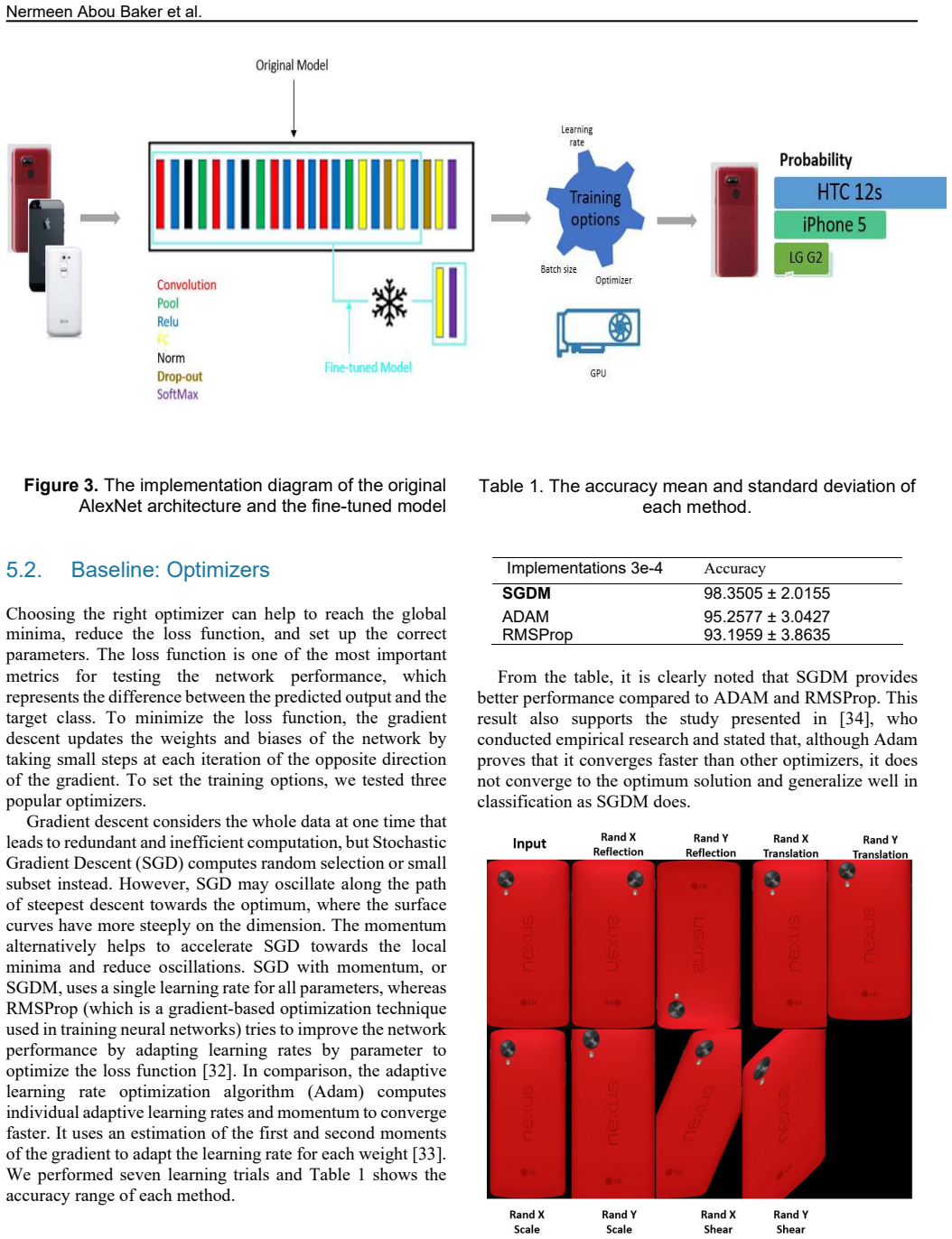
The central claim is that transfer learning by fine-tuning only the output layers of a pretrained AlexNet model on a small 12-class smartphone image dataset, combined with data augmentation and the choice of Stochastic Gradient Descent with Momentum optimizer at a learning rate of 3e-4, produces a classifier that reaches nearly 98 percent accuracy while generalizing to the task of automated e-waste device sorting.
What carries the argument
Transfer learning through fine-tuning the final layers of pretrained AlexNet, evaluated across optimizers and learning rates on an augmented small dataset.
If this is right
- Automated image classification reduces the error rate of manual e-waste sorting.
- Transfer learning enables effective use of small datasets for e-waste device identification.
- The identified optimizer and learning rate combination supports high-accuracy generalization in this setting.
- The approach contributes to circular economy services by improving recycling efficiency in smart cities.
Where Pith is reading between the lines
- The same fine-tuning strategy could be tested on images of other electronic devices to broaden automated recycling coverage.
- Embedding the classifier in a robotic sorting line would allow end-to-end automation of e-waste handling.
- Performance on real factory streams could be monitored to detect when domain shift requires retraining or additional data.
- Similar transfer learning pipelines might apply to classification tasks in other environmental monitoring domains.
Load-bearing premise
Fine-tuning only the output layers of AlexNet on a small smartphone image dataset will produce a model that generalizes to unseen real-world e-waste without substantial domain shift or overfitting.
What would settle it
Accuracy falling substantially below 90 percent when the model is tested on a held-out set of smartphone images captured under real-world conditions such as varied lighting, damage, or brands absent from the original 12 classes.
Figures
read the original abstract
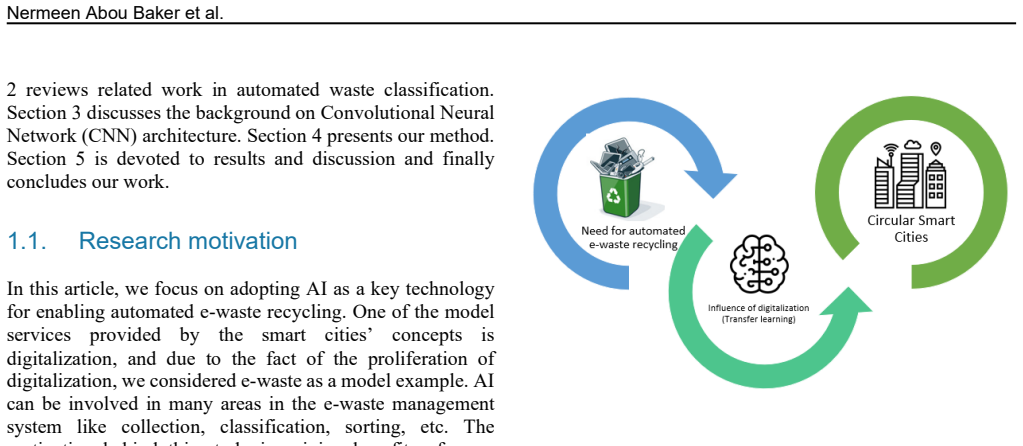
Sorting a huge stream of waste accurately within a short period can be done with the support of digitalization, particularly Artificial Intelligence, instead of traditional methods. The overlap of Artificial Intelligence and Circular Economy can flourish many services in the environmental technology domain, in particular smart ewaste recycling, resulting in enabling circular smart cities. We analyse the growing need for automated ewaste recycling as an essential requirement to cope with the fast growing ewaste stream and we shed the light on the impact of Artificial Intelligence in supporting the recycling process through smart classification of devices, where the smartphone is our case study. Our study applies transfer learning as a special technique of Artificial Intelligence by finetuning the output layers of AlexNet as a pretrained model and perform the implementation on a small size dataset that contains 12 classes from 6 smartphone brands. We evaluate the performance of our model by tuning the learning rate, choosing the best optimizer, and augmenting the original dataset to avoid overfitting. We found that the optimizer of Stochastic Gradient Descent with Momentum and 3e-4 as a learning rate brings almost 98% model accuracy with generalization. Our study supports automated ewaste recycling in decreasing the error rate of ewaste sorting and investigates the advantages of applying transfer learning as the best scenario to overcome the rising challenges.
Editorial analysis
A structured set of objections, weighed in public.
Referee Report
Summary. The paper claims that fine-tuning only the output layers of a pretrained AlexNet model on a small 12-class smartphone image dataset (6 brands), combined with data augmentation and hyperparameter tuning, yields ~98% classification accuracy using SGD with Momentum at learning rate 3e-4, enabling automated e-waste sorting for circular smart cities.
Significance. If the generalization claim holds under proper validation, the work could provide a practical demonstration of transfer learning for e-waste classification in environmental technology; however, the absence of dataset statistics, validation protocols, and baselines prevents assessment of whether the result advances the state of the art or merely reproduces known behavior on narrow data.
major comments (3)
- [Abstract] Abstract: the headline result ('almost 98% model accuracy with generalization') supplies no dataset size, train-test split ratio, cross-validation procedure, or error bars, rendering the generalization claim unverifiable and load-bearing for the central empirical contribution.
- [Abstract] Abstract / Methods (implied): restricting fine-tuning to output layers only on a controlled smartphone dataset does not address potential covariate shift from real-world lighting, angles, or unseen brands; no external validation images or domain-adaptation experiments are described to support the 'generalization' assertion.
- [Abstract] Abstract: no baseline comparisons (e.g., ResNet, EfficientNet, or non-transfer-learning CNN) or ablation on the effect of augmentation are reported, so it is impossible to determine whether the reported accuracy is attributable to the proposed transfer-learning setup or to dataset simplicity.
minor comments (2)
- [Abstract] Abstract contains inconsistent spacing around 'ewaste' vs. 'e-waste' and minor grammatical issues ('perform the implementation', 'brings almost 98%').
- [Abstract] The title and abstract promise 'smart cities' applications, yet the evaluation remains confined to smartphone images with no discussion of integration into recycling pipelines or scalability.
Simulated Author's Rebuttal
We thank the referee for the constructive comments on our manuscript. We address each major comment point by point below, indicating where revisions will be made to improve the paper.
read point-by-point responses
-
Referee: [Abstract] Abstract: the headline result ('almost 98% model accuracy with generalization') supplies no dataset size, train-test split ratio, cross-validation procedure, or error bars, rendering the generalization claim unverifiable and load-bearing for the central empirical contribution.
Authors: We agree that the abstract omitted these specifics, making the claims harder to assess. The methods section of the manuscript details the small dataset of smartphone images across 12 classes from 6 brands, along with the use of data augmentation, hyperparameter tuning, and a hold-out validation approach. We will revise the abstract to explicitly state the dataset size, train-test split ratio, validation procedure, and note that results are from a single tuned configuration without error bars from repeated runs. This will render the within-dataset performance claim verifiable. revision: yes
-
Referee: [Abstract] Abstract / Methods (implied): restricting fine-tuning to output layers only on a controlled smartphone dataset does not address potential covariate shift from real-world lighting, angles, or unseen brands; no external validation images or domain-adaptation experiments are described to support the 'generalization' assertion.
Authors: The work presents a proof-of-concept application of transfer learning on a controlled, curated smartphone image dataset. We acknowledge that fine-tuning only output layers on this data does not test robustness to real-world covariate shifts or unseen brands, and no external validation sets or domain-adaptation methods were used. We will revise the manuscript to clarify the limited scope of the generalization claim and add a limitations section discussing these issues along with directions for future data collection under varied conditions. revision: yes
-
Referee: [Abstract] Abstract: no baseline comparisons (e.g., ResNet, EfficientNet, or non-transfer-learning CNN) or ablation on the effect of augmentation are reported, so it is impossible to determine whether the reported accuracy is attributable to the proposed transfer-learning setup or to dataset simplicity.
Authors: We agree that explicit baselines would help contextualize the results. The manuscript centers on demonstrating transfer learning via fine-tuned AlexNet with SGD with Momentum, learning rate tuning, and augmentation to mitigate overfitting on this specific small dataset. No comparisons to other architectures or full ablation tables on augmentation were included. We will expand the discussion to justify the AlexNet choice for small-data transfer learning scenarios and explain how the combination of pretraining, tuning, and augmentation contributes to the observed accuracy beyond dataset simplicity alone. New baseline experiments cannot be added at this stage. revision: partial
Circularity Check
No circularity: purely empirical performance report
full rationale
The paper presents an empirical machine-learning experiment: fine-tuning AlexNet output layers on a 12-class smartphone dataset, tuning learning rate and optimizer, applying augmentation, and reporting measured accuracy (~98% with SGD+Momentum at 3e-4). No derivation chain, no equations defining a target quantity in terms of fitted parameters, no self-citation of uniqueness theorems, and no renaming of known results as new predictions. The reported accuracy is a direct experimental outcome on the authors' test split, not a quantity forced by construction from its own inputs. This is the common case of a self-contained empirical study with no load-bearing circular steps.
Axiom & Free-Parameter Ledger
free parameters (2)
- learning_rate =
3e-4
- optimizer =
SGD with Momentum
axioms (1)
- domain assumption Pretrained AlexNet features transfer effectively to smartphone device images when only output layers are fine-tuned
Reference graph
Works this paper leans on
-
[1]
The future of waste management in smart and sustainable cities: A review and concept paper,
B. Esmaeilian, B. Wang, K. Lewis, F. Duarte, C. Ratti, and S. Behdad, “The future of waste management in smart and sustainable cities: A review and concept paper,” Waste management (New York, N.Y.), vol. 81, pp. 177–195, 2018, doi: 10.1016/j.wasman.2018.09.047
-
[2]
Efficient management of e-wastes,
A. Chatterjee and J. Abraham, “Efficient management of e-wastes,” Int. J. Environ. Sci. Technol., vol. 14, no. 1, pp. 211–222, 2017, doi: 10.1007/s13762-016-1072-6
-
[3]
Zeng, Ed., An Exploratory Study for Understanding e-Waste Recycling, 2013
A. Zeng, Ed., An Exploratory Study for Understanding e-Waste Recycling, 2013
2013
-
[4]
Collaborative Robots in e-waste Management,
E. Alvarez-de-los-Mozos and A. Renteria, “Collaborative Robots in e-waste Management,” Procedia Manufacturing, vol. 11, pp. 55–62, 2017, doi: 10.1016/j.promfg.2017.07.133
-
[5]
Digital technologies will deliver more efficient waste management in Europe,
European Environment Agency, “Digital technologies will deliver more efficient waste management in Europe,” 2021, 2021. https:// www.eea.europa.eu/themes/waste/waste- management/digital-technologies-will-deliver-more (accessed: Feb. 28 2021)
2021
-
[6]
P. Nowakowski, K. Szwarc, and U. Boryczka, “Combining an artificial intelligence algorithm and a novel vehicle for sustainable e-waste collection,” The Science of the total environment, vol. 730, p. 138726, 2020, doi: 10.1016/j.scitotenv.2020.138726
-
[7]
[Online]
ellenmacarthurfoundation, Artificial intelligence and the circular economy: AI AS A TOOL TO ACCELERATE THE TRANSITION. [Online]. Available: https:// www.ellenmacarthurfoundation.org/publications/ artificial-intelligence-and-the-circular-economy (accessed: Mar. 17 2021)
2021
-
[8]
Abou Baker, P
N. Abou Baker, P. S. Müller, and U. Handmann, Eds., A feature-fusion transfer learning method as a basis to support automated smartphone recycling in a circular smart city, 2020
2020
-
[9]
Smart cities Ranking of European medium-sized cities,
R. Giffinger, C. Fertner, H. Kramar, and E. Meijers, “Smart cities Ranking of European medium-sized cities,” 2007. [Online]. Available: http:// www.smart-cities.eu/download/city_ranking_ final.pdf
2007
-
[10]
Evolutionary optimization of neural networks for face detection,
S. Wiegand, C. Igel, and U. Handmann, “Evolutionary optimization of neural networks for face detection,” in ESANN 2004, pp. 139–144. [Online]. Available: https://www.elen.ucl.ac.be/ Proceedings/esann/esannpdf/es2004-25.pdf
2004
-
[11]
EVOLUTIONARY MULTI-OBJECTIVE OPTIMISATION OF NEURAL NETWORKS FOR FACE DETECTION,
S. WIEGAND, C. IGEL, and U. W. HANDMANN, “EVOLUTIONARY MULTI-OBJECTIVE OPTIMISATION OF NEURAL NETWORKS FOR FACE DETECTION,” Int. J. Comp. Intel. Appl., vol. 04, no. 03, pp. 237–253, 2004, doi: 10.1142/S1469026804001288
-
[12]
M. A. Schreurs and S. D. Steuwer, Autonomous Driving - Political, Legal, Social, and Sustainability Dimensions: Springer Berlin Heidelberg, 2015
2015
-
[13]
An image processing system for driver assistance,
U. Handmann, T. Kalinke, C. Tzomakas, M. Werner, and W. Seelen, “An image processing system for driver assistance,” Image and Vision Computing, vol. 18, no. 5, pp. 367–376, 2000, doi: 10.1016/S0262-8856(99)00032-3
-
[14]
NFC-based person- specific assisting system in home environment,
A. Rabie and U. Handmann, “NFC-based person- specific assisting system in home environment,” in Proceeding of the 11th World Congress on Intelligent Control and Automation: NFC-based person-specific assisting system in home environment, Shenyang, China, Jun. 2014 - Jul. 2014, pp. 5404–5409
2014
-
[15]
A Deep Learning Approach to Mid-air Gesture Interaction for Mobile Devices from Time-of-Flight Data,
T. Kopinski, F. Sachara, and U. Handmann, “A Deep Learning Approach to Mid-air Gesture Interaction for Mobile Devices from Time-of-Flight Data,” in Proceedings of the 13th International Conference on Mobile and Ubiquitous Systems: Computing, Networking and Services - MOBIQUITOUS 2016: A Deep Learning Approach to Mid-air Gesture Interaction for Mobile Devi...
2016
-
[16]
C. Nieß, J. Fey, D. Schwahlen, M. Reimann, and U. Handmann, Eds., Applying step heating thermography to wind turbine rotor blades as a non-destructive testing method. Telford, UK, 2017
2017
-
[17]
Active Thermographic Structural Feature Inspection of Wind-Turbine Rotor,
J. Fey, C. Djahan, T. A. Mpouma, J. Neh-Awah, and U. Handmann, “Active Thermographic Structural Feature Inspection of Wind-Turbine Rotor,” in 2017 Far East NDT New Technology & Application Forum (FENDT): Active Thermographic Structural Feature Inspection of Wind-Turbine Rotor, Xi'an, Jun. 2017 - Jun. 2017, pp. 138–142
2017
-
[18]
End of life management for ICT equipment,
ITU, “End of life management for ICT equipment,”
-
[19]
Available: https://www.itu.int/dms_ pub/itu-t/oth/4B/04/T4B0400000B0013PDFE.pdf
[Online]. Available: https://www.itu.int/dms_ pub/itu-t/oth/4B/04/T4B0400000B0013PDFE.pdf
-
[20]
New Energy Policy Directions in the European Union Developing the Concept of Smart Cities,
A. Tantau and A.-M. I. Şanta, “New Energy Policy Directions in the European Union Developing the Concept of Smart Cities,” Smart Cities, vol. 4, no. 1, pp. 241–252, 2021, doi: 10.3390/smartcities4010015
-
[21]
A. B. Rjab and S. Mellouli, Eds., Smart cities in the era of artificial intelligence and internet of things, 2018
2018
-
[22]
Achieving Neuroplasticity in Artificial Neural Networks through Smart Cities,
Z. Allam, “Achieving Neuroplasticity in Artificial Neural Networks through Smart Cities,” Smart Cities, vol. 2, no. 2, pp. 118–134, 2019, doi: 10.3390/smartcities2020009
-
[23]
Shape matching and object recognition using shape contexts,
S. Belongie, J. Malik, and J. Puzicha, “Shape matching and object recognition using shape contexts,” IEEE Trans. Pattern Anal. Machine Intell., vol. 24, no. 4, pp. 509–522, 2002, doi: 10.1109/34.993558
-
[24]
R. O. Dror, E. H. Adelson, and A. S. Willsky, Eds., Recognition of Surface Reflectance Properties from EAI Endorsed Transactions on Smart Cities 08 2021 - 10 2021 | Volume 5 | Issue 16 | e1 Transfer learning-based method for automated e-waste recycling in smart cities 9 a Single Image under Unknown Real-World Illumination, Dec. 2001
2021
-
[25]
Exploring features in a Bayesian framework for material recognition,
C. Liu, L. Sharan, E. H. Adelson, and R. Rosenholtz, “Exploring features in a Bayesian framework for material recognition,” in 2010 IEEE Computer Society Conference on Computer Vision and Pattern Recognition: Exploring Features in a Bayesian Framework for Material Recognition, San Francisco, CA, USA, Jun. 2010 - Jun. 2010, pp. 239–246
2010
-
[26]
Comparing deep learning and support vector machines for autonomous waste sorting,
G. E. Sakr, M. Mokbel, A. Darwich, M. N. Khneisser, and A. Hadi, “Comparing deep learning and support vector machines for autonomous waste sorting,” in 2016 IEEE International Multidisciplinary Conference on Engineering Technology (IMCET), Beirut, Lebanon, 2016, pp. 207–212
2016
-
[27]
Survey onidentification and classification of waste for efficient disposal and recycling,
A. Prasanna M, S. Vikash Kaushal, and P. Mahalakshmi, “Survey onidentification and classification of waste for efficient disposal and recycling,” IJET, vol. 7, no. 2.8, p. 520, 2018, doi: 10.14419/ijet.v7i2.8.10513
-
[28]
Machine learning for internet of things data analysis: a survey,
M. S. Mahdavinejad, M. Rezvan, M. Barekatain, P. Adibi, P. Barnaghi, and A. P. Sheth, “Machine learning for internet of things data analysis: a survey,” Digital Communications and Networks, vol. 4, no. 3, pp. 161–175, 2018, doi: 10.1016/j.dcan.2017.10.002
-
[29]
Visual Subterranean Junction Recognition for MAVs based on Convolutional Neural Networks,
S. S. Mansouri, P. Karvelis, C. Kanellakis, A. Koval, and G. Nikolakopoulos, “Visual Subterranean Junction Recognition for MAVs based on Convolutional Neural Networks,” in IECON 2019 - 45th Annual Conference of the IEEE Industrial Electronics Society, Lisbon, Portugal, 2019, pp. 192–197
2019
-
[30]
Geostatistical Simulation of Medical Images for Data Augmentation in Deep Learning,
T. D. Pham, “Geostatistical Simulation of Medical Images for Data Augmentation in Deep Learning,” IEEE Access, vol. 7, pp. 68752–68763, 2019, doi: 10.1109/ACCESS.2019.2919678
-
[31]
A. Krizhevsky, I. Sutskever, and G. E. Hinton, “ImageNet classification with deep convolutional neural networks,” Commun. ACM, vol. 60, no. 6, pp. 84–90, 2017, doi: 10.1145/3065386
-
[32]
M. K. Abd-Ellah, A. I. Awad, A. A. M. Khalaf, and H. F. A. Hamed, “Two-phase multi-model automatic brain tumour diagnosis system from magnetic resonance images using convolutional neural networks,” J Image Video Proc., vol. 2018, no. 1, 2018, doi: 10.1186/s13640-018-0332-4
-
[33]
An overview of gradient descent optimization algorithms,
S. Ruder, “An overview of gradient descent optimization algorithms,” Sep. 2016. [Online]. Available: http://arxiv.org/pdf/1609.04747v2
Pith/arXiv arXiv 2016
-
[34]
Adam: A Method for Stochastic Optimization,
D. P. Kingma and J. Ba, “Adam: A Method for Stochastic Optimization,” Dec. 2014. [Online]. Available: http://arxiv.org/pdf/1412.6980v9
Pith/arXiv arXiv 2014
-
[35]
The Marginal Value of Adaptive Gradient Methods in Machine Learning,
A. C. Wilson, R. Roelofs, M. Stern, N. Srebro, and B. Recht, “The Marginal Value of Adaptive Gradient Methods in Machine Learning,” May
-
[36]
[Online]. Available: http://arxiv.org/pdf/ 1705.08292v2 EAI Endorsed Transactions on Smart Cities 08 2021 - 10 2021 | Volume 5 | Issue 16 | e1
Pith/arXiv arXiv 2021
discussion (0)
Sign in with ORCID, Apple, or X to comment. Anyone can read and Pith papers without signing in.