Extended Thermodynamics and Renyi Entropy Beyond Fixed Central Charge
Pith reviewed 2026-06-26 08:01 UTC · model grok-4.3
The pith
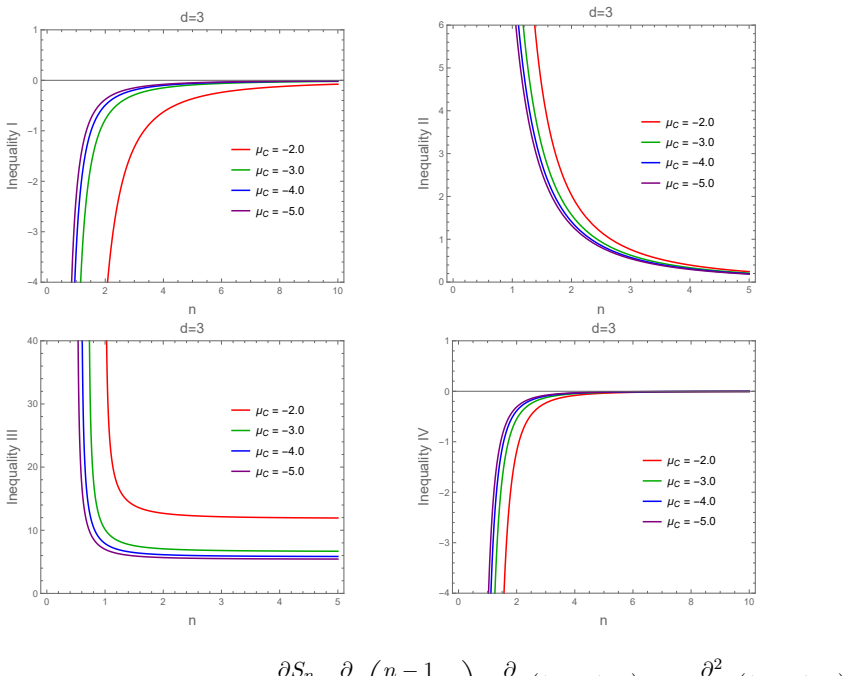
A central-charge Rényi entropy defined via the Casini-Huerta-Myers map in a grand canonical ensemble satisfies all four standard inequalities and identifies two statistical regimes separated by index n*.
A machine-rendered reading of the paper's core claim, the machinery that carries it, and where it could break.
Core claim
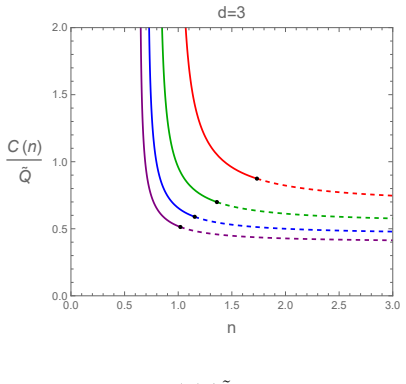
By placing the Casini-Huerta-Myers map inside the fixed (Q̃, V, μ_C) grand canonical ensemble, the construction produces a Rényi entropy that satisfies all four inequalities and measures the degree of entanglement in a statistical ensemble of holographic CFTs with fluctuating degrees of freedom. Near extremality the residual entropy is carried by the central charge sector; the mass gap between the extremal state and the first thermal excitation defines a temperature T̃* that translates into a distinguished Rényi index n* dividing theory space into a dominant-theory regime for n > n* and a multi-theory regime for n < n*.
What carries the argument
The Casini-Huerta-Myers map applied to the grand canonical ensemble at fixed charge, volume and central charge potential μ_C, which permits the central charge to fluctuate while the thermodynamic relations remain intact.
Load-bearing premise
The Casini-Huerta-Myers map continues to define a valid entropy when the central charge is allowed to fluctuate at fixed charge, volume and potential.
What would settle it
A direct computation that shows the constructed entropy violates one of the four Rényi inequalities (for example monotonicity or subadditivity) at some admissible value of μ_C would falsify the claim that it is a genuine Rényi measure.
Figures
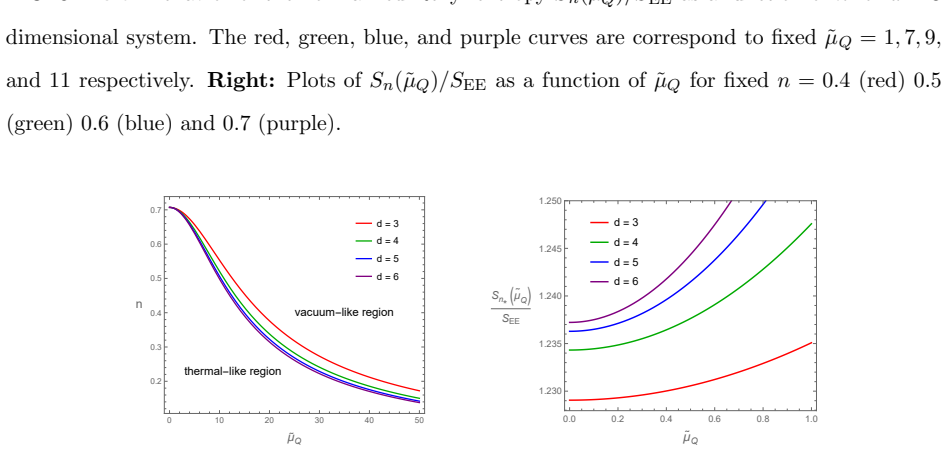
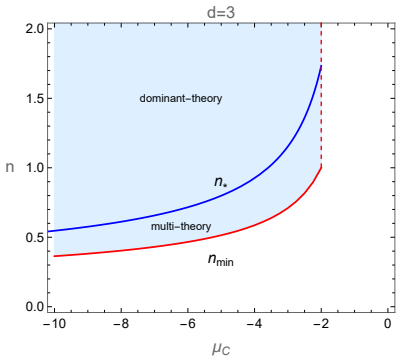
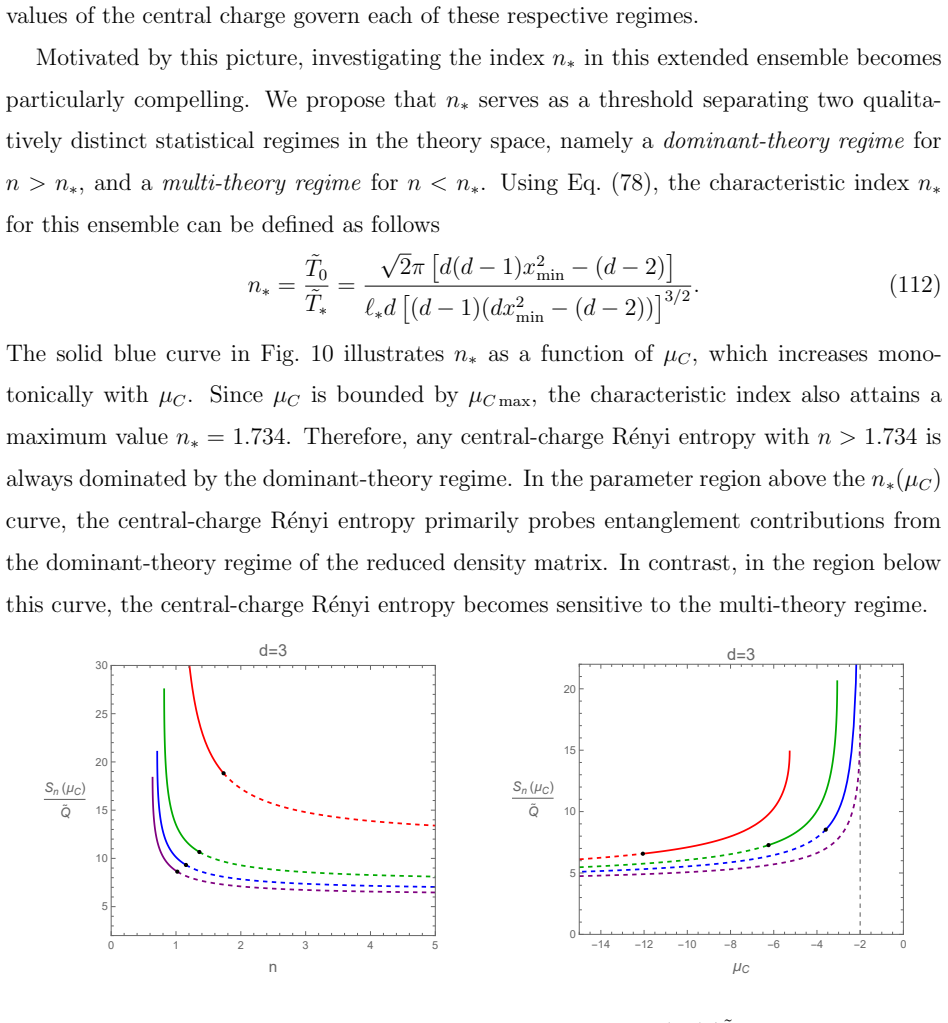
read the original abstract
An outstanding problem in the framework of conformal thermodynamics concerns the interpretation of variations in the central charge $C$. In this paper, we construct a novel central-charge R\'enyi entropy via the Casini-Huerta-Myers (CHM) map by considering thermal CFTs on a hyperbolic cylinder within a fixed charge, field theory volume and central charge potential $(\tilde{Q},\mathcal{V},\mu_C)$ grand canonical ensemble. We demonstrate that the resulting entropy satisfies all four fundamental R\'enyi entropy inequalities throughout the admissible range of $\mu_C$, establishing its consistency as a genuine R\'enyi measure. Physically, this novel measure extends conventional R\'enyi entropy by capturing the degree of entanglement across a statistical ensemble of holographic CFTs with fluctuating degrees of freedom. Furthermore, our conformal thermodynamic analysis of near-extremal configurations reveals that residual entropy arises from the central charge sector rather than thermal excitations. The mass gap that separates the extremal state and the first thermal excitation introduces a characteristic temperature scale $\tilde{T}_*$, which translates via the CHM map into a distinguished characteristic R\'enyi index $n_*$. Crucially, we propose that $n_*$ separates the theory space into two qualitatively distinct statistical regimes: a dominant-theory regime ($n > n_*$) governed by the most probable CFT realizations, and a multi-theory regime ($n < n_*$) where a broader spectrum of fluctuating theories and higher-energy modular excitations becomes increasingly relevant.
Editorial analysis
A structured set of objections, weighed in public.
Referee Report
Summary. The manuscript constructs a novel central-charge Rényi entropy by applying the Casini-Huerta-Myers (CHM) map to thermal CFTs on a hyperbolic cylinder in the grand canonical ensemble with fixed ( ilde{Q}, \mathcal{V}, ilde{ u}_C). It asserts that this entropy satisfies all four fundamental Rényi inequalities for admissible ilde{ u}_C, identifies a characteristic index n_* separating dominant-theory (n > n_*) and multi-theory (n < n_*) regimes, and attributes residual entropy in near-extremal black hole configurations to the central charge sector rather than thermal excitations.
Significance. If the CHM map extension to fluctuating central charge is justified and the inequalities are derived explicitly, the result would provide a concrete link between extended black hole thermodynamics and Rényi entanglement measures in ensembles of CFTs with varying degrees of freedom. The identification of n_* as a separator between statistical regimes is potentially falsifiable and could motivate new holographic calculations, but the significance hinges on whether the construction is internally consistent rather than definitional.
major comments (2)
- [Abstract / entropy construction] The central claim that the constructed entropy satisfies the four Rényi inequalities rests on the unverified extension of the CHM map to the grand canonical ensemble with fluctuating central charge (via ilde{ u}_C). No derivation is supplied showing that ilde{ u}_C-induced variations ilde{ u}_C preserve the modular Hamiltonian, the reduced density matrix, or the first-law compatibility required for the map; this is load-bearing for the consistency assertion in the abstract.
- [Near-extremal analysis / n_* definition] The value of n_* is introduced as the image under the CHM map of the mass-gap temperature ilde{T}_*, yet the manuscript supplies no explicit computation relating the near-extremal mass gap to the Rényi index or demonstrating that n_* is independent of the fitting procedure used to define the entropy; this risks circularity in the regime-separation claim.
minor comments (1)
- [Abstract] Notation for the central-charge potential ( ilde{ u}_C vs. ilde{ u}_C) and the fixed quantities ( ilde{Q}, ilde{ u}) should be standardized and defined at first use.
Simulated Author's Rebuttal
We thank the referee for their careful reading of the manuscript and for highlighting points that require additional explicit derivations to strengthen the presentation. We address each major comment below and will incorporate the requested clarifications and computations in a revised version.
read point-by-point responses
-
Referee: [Abstract / entropy construction] The central claim that the constructed entropy satisfies the four Rényi inequalities rests on the unverified extension of the CHM map to the grand canonical ensemble with fluctuating central charge (via ilde{쳌}). No derivation is supplied showing that ilde{쳌}-induced variations ilde{쳌 preserve the modular Hamiltonian, the reduced density matrix, or the first-law compatibility required for the map; this is load-bearing for the consistency assertion in the abstract.
Authors: We agree that the extension of the CHM map to the grand canonical ensemble with fluctuating central charge requires explicit verification. In the revised manuscript we will add a dedicated derivation subsection demonstrating that variations induced by ilde{쳌 preserve the modular Hamiltonian and reduced density matrix while maintaining first-law compatibility. This will directly support the application of the map and the satisfaction of the Rényi inequalities. revision: yes
-
Referee: [Near-extremal analysis / n_* definition] The value of n_* is introduced as the image under the CHM map of the mass-gap temperature ilde{T}_*, yet the manuscript supplies no explicit computation relating the near-extremal mass gap to the Rényi index or demonstrating that n_* is independent of the fitting procedure used to define the entropy; this risks circularity in the regime-separation claim.
Authors: We acknowledge that an explicit mapping from the near-extremal mass gap to n_* and a demonstration of independence from the fitting procedure are needed. In the revision we will include a detailed computation of the CHM image of ilde{T}_* together with an alternative entropy definition (based directly on the thermodynamic potential) to show that the value of n_* and the resulting regime separation are robust and free of circularity. revision: yes
Circularity Check
No circularity; derivation self-contained
full rationale
The paper defines a central-charge Rényi entropy by applying the CHM map to the grand-canonical ensemble with fluctuating C via μ_C, then states that the resulting quantity satisfies the four standard Rényi inequalities over the admissible μ_C range. No quoted equations or steps reduce the claimed inequalities, the value of n*, or the regime separation to a fitted parameter, a self-citation chain, or a definitional tautology. The construction is presented as an extension whose consistency is checked against independent external properties (the four inequalities), with no evidence that those checks are forced by the same inputs used to build the entropy. The derivation therefore remains self-contained.
Axiom & Free-Parameter Ledger
axioms (2)
- domain assumption The Casini-Huerta-Myers map extends to a grand canonical ensemble with fluctuating central charge while preserving thermodynamic relations.
- domain assumption The four fundamental Rényi entropy inequalities remain the correct consistency conditions even after the central charge is promoted to a fluctuating variable.
invented entities (1)
-
central-charge Rényi entropy
no independent evidence
Reference graph
Works this paper leans on
-
[1]
J. M. Maldacena, Adv. Theor. Math. Phys.2, 231 (1998), arXiv:hep-th/9711200
Pith/arXiv arXiv 1998
-
[2]
E. Witten, Adv. Theor. Math. Phys.2, 253 (1998), arXiv:hep-th/9802150
Pith/arXiv arXiv 1998
-
[3]
S. S. Gubser, I. R. Klebanov, and A. M. Polyakov, Phys. Lett. B428, 105 (1998), arXiv:hep- th/9802109
arXiv 1998
-
[4]
S. A. Hartnoll, Class. Quant. Grav.26, 224002 (2009), arXiv:0903.3246 [hep-th]. 43
Pith/arXiv arXiv 2009
-
[5]
S. Ryu and T. Takayanagi, Phys. Rev. Lett.96, 181602 (2006), arXiv:hep-th/0603001
Pith/arXiv arXiv 2006
-
[6]
H. Casini, M. Huerta, and R. C. Myers, JHEP05, 036 (2011), arXiv:1102.0440 [hep-th]
Pith/arXiv arXiv 2011
-
[7]
L.-Y. Hung, R. C. Myers, M. Smolkin, and A. Yale, JHEP12, 047 (2011), arXiv:1110.1084 [hep-th]
Pith/arXiv arXiv 2011
-
[8]
M. R. Visser, Phys. Rev. D105, 106014 (2022), arXiv:2101.04145 [hep-th]
arXiv 2022
-
[9]
M. B. Ahmed, W. Cong, D. Kubizˇ n´ ak, R. B. Mann, and M. R. Visser, Phys. Rev. Lett.130, 181401 (2023)
2023
-
[10]
W. Cong, D. Kubiznak, R. B. Mann, and M. R. Visser, JHEP08, 174 (2022), arXiv:2112.14848 [hep-th]
arXiv 2022
-
[11]
Y. Qu, J. Tao, and H. Yang, Nucl. Phys. B992, 116234 (2023), arXiv:2211.08127 [gr-qc]
arXiv 2023
-
[12]
N.-C. Bai, L. Song, and J. Tao, Eur. Phys. J. C84, 43 (2024), arXiv:2212.04341 [hep-th]
arXiv 2024
-
[13]
C. Promsiri, W. Horinouchi, and E. Hirunsirisawat, Eur. Phys. J. C85, 484 (2025), arXiv:2409.01582 [gr-qc]
arXiv 2025
-
[14]
Emparan, JHEP06, 036 (1999), arXiv:hep-th/9906040
R. Emparan, JHEP06, 036 (1999), arXiv:hep-th/9906040
Pith/arXiv arXiv 1999
-
[15]
R.-G. Cai and A. Wang, Phys. Rev. D70, 064013 (2004), arXiv:hep-th/0406057
Pith/arXiv arXiv 2004
-
[16]
Preskill, P
J. Preskill, P. Schwarz, A. D. Shapere, S. Trivedi, and F. Wilczek, Mod. Phys. Lett. A6, 2353 (1991)
1991
-
[17]
L. V. Iliesiu and G. J. Turiaci, JHEP05, 145 (2021), arXiv:2003.02860 [hep-th]
arXiv 2021
-
[18]
A. Karch and B. Robinson, JHEP12, 073 (2015), arXiv:1510.02472 [hep-th]
Pith/arXiv arXiv 2015
-
[19]
J. D. Brown and M. Henneaux, Commun. Math. Phys.104, 207 (1986)
1986
-
[20]
D. Kubiznak, R. B. Mann, and M. Teo, Class. Quant. Grav.34, 063001 (2017), arXiv:1608.06147 [hep-th]
Pith/arXiv arXiv 2017
-
[21]
Y. Ladghami and T. Ouali, Phys. Dark Univ.44, 101471 (2024), arXiv:2402.15913 [hep-th]
arXiv 2024
- [22]
- [23]
-
[24]
E. H. Lieb, Phys. Rev.162, 162 (1967)
1967
-
[25]
G. C. Lau, R. S. Freitas, B. G. Ueland, B. D. Muegge, E. L. Duncan, P. Schiffer, and R. J. Cava, Nature Physics2, 249–253 (2006)
2006
-
[26]
Morita and N
K. Morita and N. Shibata, Journal of the Physical Society of Japan85, 033705 (2016). 44
2016
-
[27]
F. J. Ohkawa, Progress of Theoretical Physics128, 125–151 (2012)
2012
-
[28]
R´ enyi, inProceedings of the fourth Berkeley symposium on mathematical statistics and probability, volume 1: contributions to the theory of statistics, Vol
A. R´ enyi, inProceedings of the fourth Berkeley symposium on mathematical statistics and probability, volume 1: contributions to the theory of statistics, Vol. 4 (University of California Press, 1961) pp. 547–562
1961
-
[29]
P. Calabrese and J. Cardy, J. Phys. A42, 504005 (2009), arXiv:0905.4013 [cond-mat.stat- mech]
Pith/arXiv arXiv 2009
-
[30]
P. Calabrese and J. L. Cardy, J. Stat. Mech.0406, P06002 (2004), arXiv:hep-th/0405152
Pith/arXiv arXiv 2004
-
[31]
J. C. Baez, Entropy24, 706 (2022), arXiv:1102.2098 [quant-ph]
arXiv 2022
-
[32]
A. Belin, L.-Y. Hung, A. Maloney, S. Matsuura, R. C. Myers, and T. Sierens, JHEP12, 059 (2013), arXiv:1310.4180 [hep-th]. 45
Pith/arXiv arXiv 2013
discussion (0)
Sign in with ORCID, Apple, or X to comment. Anyone can read and Pith papers without signing in.